
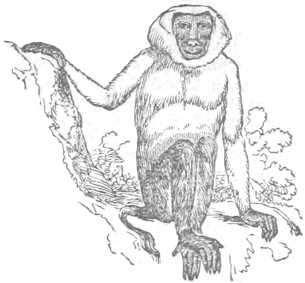
Fig. 312—Macacus Arabicus
There is much to suggest the probability that the ’satyr’ of Isa 13:21; Isa 34:14, if not also the ’hairy ones’ (rendered ’devils’) of Lev 17:7, were no other than a species of ape or baboon. The only species of ape of the baboon form known in Arabia is the Macacus Arabicus, remarkable for stature and aspect, having the doglike nose and approximating eyes of baboons; the skin of the face of a reddish color; the snout, lips, and chin black; the forehead low, and the sides of the head furnished with bushy, long, white hair; the breast, arms and shoulders similarly covered, but the loins and lower extremities of a fine chestnut; the tail of the same color, of no great length, tufted at the end, and all the hands black. It is found from the straits of Bab-el-Mandeb, through Southern Arabia to the Euphrates, and even beyond the junction of that river with the Tigris. Like other large and formidable Simiadæ, it is less solicitous about the vicinity of trees, because it is armed with powerful canines; holds its enemy firmly grasped, and fights, not singly, but assisted by the whole troop: it frequents scrubby underwood near water, but becomes more rare eastward of Yemen. Comparing the characters of this species, we find it by configuration, colors, and manners peculiarly adapted to the purposes of idolatry in its grossest and most debasing aspect. The Hebrew people, already familiar with a similar worship in Egypt, may have copied the native tribes in the wilderness, and thus drawn upon themselves the remonstrance in Lev 17:7, where the allusion to these animals is very descriptive, as is that in Isa 13:21; and again, Isa 34:14, where the image is perfect, when we picture to ourselves the ’hairy ones’ lurking about the river in the juniper and liquorice jungle, as described by Mr. Rich in his Memoir on the Ruins of Babylon.
Sa’tyr or Sat’yr. A sylvan deity or demigod of Greek mythology, represented as a monster, part man and part goat. Isa 13:21; Isa 34:14. The Hebrew word signifies "hairy" or "rough", and is frequently applied to "he-goats." In the passages cited, it probably refers to demons of woods and desert places. Compare Lev 17:7; 2Ch 11:15.
Satyr (sat’ir). A fabled creature of Greek mythology, part man and part goat, and supposed to be the deity of forests and rural places. The expression "satyrs shall dance there," Isa 13:21 (the R. V. margin reads "he goats," comp. also Isa 34:14), denotes that the place shall become a rude, wild, uncultivated waste.
The word is sair , which signifies ’hairy one,’ and hence a ’he goat.’ It is translated ’goat’ and ’kid’ many times. In Lev 17:7 and 2Ch 11:15 it is translated ’devils,’ but would have been better ’demons,’ referring to the gods which the heathen unconsciously worshipped: cf. 1Co 10:20. The word is translated ’satyr’ in Isa 13:21; Isa 34:14, both passages referring to places brought to utter desolation, so that they are inhabited by wild beasts, owls, and perhaps ’wild goats’ are intended; or that the desolation would be such that men would shun them as if haunted by unearthly beings. Such a dread is often expressed by dwellers in the East.
By: Joseph Jacobs, I. M. Casanowicz
Rendering by the English versions of the Hebrew "se'irim" in Isa. xiii. 21, xxxiv. 14 (R. V., margin, "he-goats"; American R. V., "wild goats"), while in Lev. xvii. 7 and II Chron. xi. 15 the Authorized Version renders the word by "devil," the Revised Version by "he-goat," and the Revised Version, margin, by "satyr." The old versions use for it a word denoting a demon, false god, or a hairy being. It is certain that a natural animal is not intended in these passages. Thus in Isaiah the se'irim are mentioned together with Lilith and animals of the desert and desolate places, and are described as "dancing" and "calling to one another"; in the other passages they are referred to as objects of worship. Possibly the versions reflect the ancient conception of the se'irim as hairy and perhaps goat-shaped beings. The association of monstrous beings with ruins and desert places is still a prevalent element in the folk-lore of Arabia and Syria; and the Arabian jinn also are represented as having monstrous hairy forms.
In Ḳid. 72a the Ishmaelites are compared to the se'irim of unclean places, i.e., the spirits ("shedim") which inhabit retreats. Of other monstrous, half-human and half-animal beings referred to in the Talmud may be mentioned here the "adne [or "abne"] sadeh" (Kil. viii. 5, and Maimonides ad loc.), and the "yiddoa'" (Sanh. 65b), explained as a being with human shape and attached to the earth by its umbilical cord (comp. Bertinoro on Sanh. vii. 7).
Bibliography:
Tristram, Nat. Hist. p. 131;
Lewysohn, Z. T. pp. 64, 356.
SATYR.—The Heb. word sâ‘îr means primarily ‘he-goat,’ but the plur. sĕ‘îrîm is tr.
E. W. G. Masterman.
The text of the American Standard Revised Version in these passages is as follows: Lev 17:7, “And they shall no more sacrifice their sacrifices unto the he-goats, after which they play the harlot”; 2Ch 11:15, “And he (Jeroboam) appointed him priests for the high places, and for the he-goats, and for the calves which he had made”; Isa 13:21 f (of Babylon), “But wild beasts of the desert (
The question is whether
See Goat; Owl