
Sandal, a covering for the feet, usually denoted by the word translated ’shoe’ in the Authorized Version. It was usually a sole of hide, leather, or wood, bound on to the foot by thongs; but it may sometimes denote such shoes and buskins as eventually came into use.
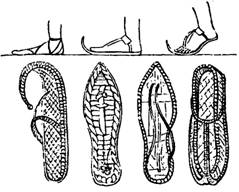
Fig. 310—Ancient Egyptian Sandals
Ladies of rank appear to have paid great attention to the beauty of their sandals (Son 7:1); though, if the bride in that book was an Egyptian princess, as some suppose, the exclamation, ’How beautiful are thy feet with sandals, O prince’s daughter!’ may imply admiration of a luxury properly Egyptian, as the ladies of that country were noted for their sumptuous sandals. But this taste was probably general; for, at the present day, the dress slippers of ladies of rank are among the richest articles of their attire, being elaborately embroidered with flowers and other figures wrought in silk, silver, and gold.
It does not seem probable that the sandals of the Hebrews differed much from those used in Egypt, excepting, perhaps, that from the greater roughness of their country, they were usually of more substantial make and materials. The Egyptian sandals varied slightly in form: those worn by the upper classes, and by women, were usually pointed and turned up at the end, like our skates and many of the Eastern slippers at the present day. They were made of a sort of woven or interlaced work of palm-leaves and papyrus-stalks or other similar materials, and sometimes of leather; and were frequently lined with cloth on which the figure of a captive was painted; that humiliating position being considered suited to the enemies of their country, whom they hated and despised. It is not likely that the Jews adopted this practice: but the idea which it expressed, of treading their enemies under their feet, was familiar to them (Jos 10:24). Those of the middle classes who were in the habit of wearing sandals, often preferred walking barefooted.
In transferring a possession or domain it was customary to deliver a sandal (Rth 4:7), as in our Middle Ages, a glove. Hence the action of throwing down a shoe upon a region or territory was a symbol of occupancy, so Psa 60:8. In Ruth, as above, the delivering of a sandal signified that the next of kin transferred to another a sacred obligation; and he was hence called ’sandal-loosed.’
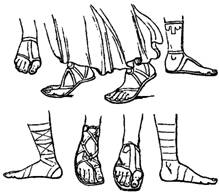
Fig. 311—Greek and Roman Sandals
It was undoubtedly the custom to take off the sandals on holy ground, in the act of worship, and in the presence of a superior. Hence the command to take the sandals from the feet under such circumstances (Exo 3:5; Jos 5:15). This is still the well-known custom of the East—an Oriental taking off his shoe in cases in which a European would remove his hat. The shoes of the modern Orientals are, however, made to slip off easily, which was not the case with sandals, that required to be unbound with some trouble. This operation was usually performed by servants; and hence the act of unloosing the sandals of another became a familiar symbol of servitude (Mar 1:7; Luk 3:16; Joh 1:27; Act 13:25).
Sandal. Sandal was the article ordinarily used by the Hebrews for protecting the feet. It consisted simply of a sole attached to the foot by thongs. We have express notice of the thong, (Authorized Version, "shoe latchet"), in several passages, notably Gen 14:23; Isa 5:27; Mar 1:7. Sandals were worn by all classes of society in Palestine, even by the very poor; and both the sandal and the thong, or shoe-latchet, were so cheap and common, that they passed into a proverb for the most insignificant thing. Gen 14:23. Sir 46:13. They were dispensed with in-doors, and were only put on by persons about to undertake some business away from their homes.
During mealtimes, the feet were uncovered. Luk 7:38; Joh 13:5-6. It was a mark of reverence, to cast off the shoes in approaching a place or person of eminent sanctity. Exo 3:5; Jos 5:15. It was also an indication of violent emotion, or of mourning, if a person appeared barefoot in public. 2Sa 15:30. To carry or to unloose a person’s sandal was a menial office, betokening great inferiority on the part of the person performing it. Mat 3:11.
The latchet was the strap across the instep, securing it on the foot, of small value (Gen 14:23; Amo 2:6; Amo 8:6). "Buy the needy for a pair of shoes," i.e. by oppression compel them to sell themselves to us as bondmen, in order that our great women may have elaborately ornamented sandals. Sandals were laid aside indoors, and only put on in a journey or military expedition (Jos 9:5; Jos 9:13; Isa 5:27; Eph 6:15). "Your feet shod with the preparation (Psa 10:17) of the gospel of peace," i.e. preparedness for the good warfare, produced by the gospel, which brings peace within though there is conflict outside with Satan and the world (Luk 1:79; Rom 10:15; Isa 26:3; Php 4:7). The shoes and sandals were taken off during meals (Luk 7:38; Joh 13:5-6); but the Jews wore sandals on their feet at the Passover, as ready for the journey (Exo 12:11).
They put off sandals in reverence at a sacred place (Exo 3:5; Jos 5:15). So the priests in the temple officiated barefoot; so the Mahometans of Palestine before entering a mosque or the Kaaba at Mecca, and the Mesopotamian Yezidis before entering the tomb of a patron saint, and the Samaritans before treading Mount Gerizim. A sign of mourning (2Sa 15:30; Eze 24:17); humiliation (Isa 20:2; Isa 20:4; Eze 16:10), "I shod thee with badgers’ skins" or seal skins, and skins of other marine animals of the Red Sea; the material of the Hebrew shoes and of the tabernacle covering.
SANDAL.—See Dress, 6.
See Shce.