
The chief city in the kingdom, of the ten tribes. It was built by Omri, as we read 1 Kings 16. 24. It seems to have taken its name from Shamar, and hence called Shomeron by the Israelites: so that his Shamar might mean his prison or his guard. Samaria formes an interesting history to the church, both in the Old Testament and the New. From 1 Kings chap. 16. to the end of the Second Book of the Kings, and in the Gospel the woman of Samaria, John 4:, and numberless other occasions render it memorable.
one of the three divisions of the Holy Land, having Galilee on the north, Judea on the south, the river Jordan on the east, and the Mediterranean Sea on the west. It took its name from its capital city, Samaria; and formed, together with Galilee and some cantons on the east of Jordan, during the reigns of the kings of Israel and Judah, the kingdom of the former. The general aspect and produce of the country are nearly the same as those of Judea. But Mr. Buckingham observes, that “while in Judea the hills are mostly as bare as the imagination can paint them, and a few of the narrow valleys only are fertile, in Samaria, the very summits of the eminences are as well clothed as the sides of them. These, with the luxuriant valleys which they enclose, present scenes of unbroken verdure in almost every point of view. which are delightfully variegated by the picturesque forms of the hills and vales themselves, enriched by the occasional sight of wood and water, in clusters of olive and other trees, and rills and torrents running among them.”
2. SAMARIA, the capital city of the kingdom of the ten tribes that revolted from the house of David. It was built by Omri, king of Israel, who began to reign A.M. 3079, and who died 3086. He bought the hill Samaria of Shemer for two talents of silver, or for the sum of 684l. 7s. 6d. It took the name of Samaria from Shemer, the owner of the hill, 1Ki 16:24. Some think, however, that there were before this some beginnings of a city in that place, because, antecedent to the reign of Omri, there is mention made of Samaria, 1Ki 13:32, A.M. 3030. But others take this for a prolepsis, or an anticipation, in the discourse of the man of God. However this may be, it is certain that Samaria was no considerable place, and did not become the capital of the kingdom, till after the reign of Omri. Before him, the kings of Israel dwelt at Shechem or at Tirzah. Samaria was advantageously situated upon an agreeable and fruitful hill, twelve miles from Dothaim, twelve from Merrom, and four from Atharath. Josephus says it was a day’s journey from Jerusalem. the kings of Samaria omitted nothing to make this city the strongest, the finest, and the richest that was possible. Ahab built there a palace of ivory, 1Ki 22:39; that is, in which there were many ivory ornaments; and, according to Amo 3:15; Amo 4:1-2, it became the seat of luxury and effeminacy. Benhadad, king of Syria, built public places, called “streets,” in Samaria, 1Ki 20:34; probably bazaars for trade, and quarters where his people dwelt to pursue commerce. His son Benhadad besieged this place under the reign of Ahab, 1 Kings 20, A.M. 3103. It was besieged by Shalmaneser, king of Assyria, in the ninth year of the reign of Hoshea, king of Israel, 2Ki 17:6, &c, which was the fourth of Hezekiah, king of Judah. It was taken three years after, A.M. 3283. The Prophet Hosea, Hos 10:4; Hos 10:8-9, speaks of the cruelties exercised by Shalmaneser against the besieged; and Mic 1:6, says that the city was reduced to a heap of stones. The Cuthites that were sent by Esar-haddon to inhabit the country of Samaria did not think it worth their while to repair the ruined city: they dwelt at Shechem, which they made the capital city of their state. They were in this condition when Alexander the Great came into Phenicia and Judea. However, the Cuthites had rebuilt some of the houses of Samaria, even from the time of the return of the Jews from the captivity, since the inhabitants of Samaria are spoken of, Ezr 4:17; Neh 4:2. And the Samaritans, being jealous of the Jews, on account of the favours that Alexander the Great had conferred on them, revolted from him, while he was in Egypt, and burned Andromachus alive, whom he had left governor of Syria. Alexander soon marched against them, took Samaria, and appointed Macedonians to inhabit it, giving the country round it to the Jews; and to encourage them in the cultivation, he exempted them from tribute. The kings of Egypt and Syria, who succeeded Alexander, deprived them of the property of this country. But Alexander Balas, king of Syria, restored to Jonathan Maccabaeus the cities of Lydda, Ephrem, and Ramatha, which he cut off from the country of Samaria, 1Ma 10:30; 1Ma 10:38; 1Ma 11:28; 1Ma 11:34. Lastly, the Jews reentered into the full possession of this whole country under John Hircanus, the Asmonean, who took Samaria, and, according to Josephus, made the river run through its ruins. It continued in this state till A.M. 3947, when Aulus Gabinius, the proconsul of Syria, rebuilt it, and gave it the name of Gabiniana. Yet it remained very inconsiderable till Herod the Great restored it to its ancient splendour.
The sacred authors of the New Testament speak but little of Samaria; and when they do mention it, the country is rather to be understood than the city, Luk 17:11; Joh 4:4-5. After the death of Stephen, Act 8:1-3, when the disciples were dispersed through the cities of Judea and Samaria, Philip made several converts in this city. There it was that Simon Magus resided, and thither Peter and John went to communicate the gifts of the Holy Spirit.
Travellers give the following account of its present state:—Sebaste is the name which Herod gave to the name of the ancient Samaria, the imperial city of the ten tribes, in honour of Augustus (Sebastos) Caesar, when he rebuilt and fortified it, converting the greater part of it into a citadel, and erecting here a noble temple. “The situation,” says Dr. Richardson, “is extremely beautiful, and strong by nature; more so, I think, than Jerusalem. It stands on a fine, large, insulated hill, compassed all around by a broad deep valley; and when fortified, as it is stated to have been by Herod, one would have imagined that, in the ancient system of warfare, nothing but famine could have reduced such a place. The valley is surrounded by four hills, one on each side, which are cultivated in terraces up to the top, sown with grain, and planted with fig and olive trees, as is also the valley. The hill of Samaria likewise rises in terraces to a height equal to any of the adjoining mountains. The present village is small and poor, and, after passing the valley, the ascent to it is very steep. Viewed from the station of our tents, it is extremely interesting, both from its natural situation, and from the picturesque remains of a ruined convent, of good Gothic architecture. Having passed the village, toward the middle of the first terrace, there is a number of columns still standing. I counted twelve in one row, beside several that stood apart, the brotherless remains of other rows. The situation is extremely delightful, and my guide informed me, that they belonged to the serai, or palace. On the next terrace there are no remains of solid building, but heaps of stone and lime and rubbish mixed with the soil in great profusion. Ascending to the third or highest terrace, the traces of former building were not so numerous, but we enjoyed a delightful view of the surrounding country. The eye passed over the deep valley that encompasses the hill of Sebaste, and rested on the mountains beyond, that retreated as they rose with a gentle slope, and met the view in every direction, like a book laid out for perusal on a reading desk. This was the seat of the capital of the short-lived and wicked kingdom of Israel: and on the face of these mountains the eye surveys the scene of many bloody conflicts and many memorable events. Here those holy men of God, Elijah and Elisha, spoke their tremendous warnings in the ears of their incorrigible rulers, and wrought their miracles in the sight of all the people. From this lofty eminence we descended to the south side of the hill, where we saw the remains of a stately colonnade that stretches along this beautiful exposure from east to west. Sixty columns are still standing in one row. The shafts are plain; and fragments of Ionic volutes, that lie scattered about, testify the order to which they belonged. These are probably the relics of some of the magnificent structures with which Herod the Great adorned Samaria. None of the walls remain.” Mr. Buckingham mentions a current tradition, that the avenue of columns formed a part of Herod’s palace. According to his account, there were eighty-three of these columns erect in 1816, beside others prostrate; all without capitals. Josephus states, that, about the middle of the city, Herod built “a sacred place, of a furlong and a half in circuit, and adorned it with all sorts of decorations; and therein erected a temple, illustrious for both its largeness and beauty.” It is probable that these columns belonged to it. On the eastern side of the same summit are the remains, Mr. Buckingham states, of another building, “of which eight large and eight small columns are still standing, with many others fallen near them. These also are without capitals, and are of a smaller size and of an inferior stone to the others.” “In the walls of the humble dwellings forming the modern village, portions of sculptured blocks of stone are perceived, and even fragments of granite pillars have been worked into the masonry.
Sama´ria (watch-height), a city, situated near the middle of Palestine, built by Omri, king of Israel, on a mountain or hill of the same name, about B.C. 925. It was the metropolis of the kingdom of Israel, or of the ten tribes. The hill was purchased from the owner, Shemer, from whom the city took its name (1Ki 16:23-24). Samaria continued to be the capital of Israel for two centuries, till the carrying away of the ten tribes by Shalmaneser, about B.C. 720 (2Ki 17:3; 2Ki 17:5). During all this time it was the seat of idolatry, and is often as such denounced by the prophets, sometimes in connection with Jerusalem. It was the seat of a temple of Baal, built by Ahab, and destroyed by Jehu (1Ki 16:32-33; 2Ki 10:18-28). It was the scene of many of the acts of the prophets Elijah and Elisha, connected with the various famines of the land, the unexpected plenty of Samaria, and the several deliverances of the city from the Syrians. After the exile of the ten tribes, Samaria appears to have continued, for a time at least, the chief city of the foreigners brought to occupy their place; although Shechem soon became the capital of the Samaritans as a religious sect. John Hyrcanus took the city after a year’s siege, and razed it to the ground. Yet it must soon have revived, as it is not long after mentioned as an inhabited place, in the possession of the Jews. Pompey restored it to its former possessors; and it was afterwards rebuilt by Gabinius. Augustus bestowed Samaria on Herod; who eventually rebuilt the city with great magnificence, and gave it the name of Sebaste. Here Herod planted a colony of 6000 persons, composed partly of veteran soldiers, and partly of people from the environs; enlarged the circumference of the city; and surrounded it with a strong wall twenty stades in circuit. In the midst of the city—that is to say, upon the summit of the hill—he left a sacred place of a stade and a half, splendidly decorated, and here he erected a temple to Augustus, celebrated for its magnitude and beauty. The whole city was greatly ornamented, and became a strong fortress. Such was the Samaria of the time of the New Testament, where the Gospel was preached by Philip, and a church was gathered by the apostles (Act 8:5; Act 8:9, sq.). At what time the city of Herod became desolate, no existing accounts state; but all the notices of the fourth century and later lead to the inference that its destruction had already taken place. A few scanty notices of Samaria are found scattered through the works of ancient travelers, but it was not till the present century that it was fully explored and described.
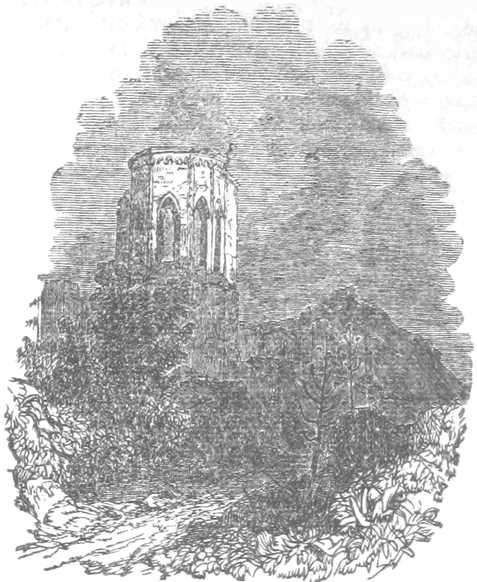
Fig. 309—Samaria: Church of St. John
The hill of Samaria is an oblong mountain of considerable elevation, and very regular in form, situated in the midst of a broad deep valley. Beyond this valley, which completely isolates the hill, the mountains rise again on every side, forming a complete wall around the city. They are terraced to the tops, sown in grain, and planted with olives and figs, in the midst of which a number of handsome villages appear to great advantage, their white stone cottages contrasting strikingly with the verdure of the trees. ’The hill of Samaria’ itself is cultivated from its base, the terraced sides and summits being covered with corn and with olive-trees. The most conspicuous ruin of the place, is the church dedicated to John the Baptist, erected on the spot which an old tradition fixed as the place of his burial, if not of his martyrdom. It is said to have been built by the Empress Helena; but the architecture limits its antiquity to the period of the crusades, although a portion of the eastern end seems to have been of earlier date. On the summit of the hill is an area, once surrounded by limestone columns, of which fifteen are still standing, and two prostrate. There is no trace of the order of their architecture, nor any indications of the nature of the edifice to which they belong. On the W.S.W. descent of the hill there is a very remarkable colonnade, of which eighty-two columns are still standing, and the number of those fallen and broken must be much greater. They may without much hesitation be referred to the time of Herod the Great, and must be regarded as belonging to someone of the splendid edifices with which he adorned the city.
1. One of the three divisions of the Holy Land in the time of our Savior, having Galilee on the north and Judea on the south, the Jordan on the east and the Mediterranean on the west, and occupying parts of the territory assigned at first to Ephraim, Mahasseh, and Issachar, Luk 17:11 Joh 4:4 . It is described as having its hills less bare than those of Judea, and its valleys and plains more cultivated and fruitful. See CANAAN. Many gospel churches were early planted here, Mal 8:1,25 9:31 15:3.\par 2. A city situated near the middle of Palestine, some six miles northwest of Shechem. It was built by Omri king of Israel, about 920 B. C., and named after Shemer the previous owner of the mountain or hill on which the city stood, 1Ki 16.23,24. It became the favorite residence of the kings of Israel, instead of Shechem and Thirzah the former capitals. It was highly adorned with public buildings. Ahab built there a palace of ivory, 1Ki 22:39, and also a temple of Baal, 1Ki 16:32,33, which Jehu destroyed, 2Ki 10:18-28 . The prophets often denounced it for its idolatry, Isa 9:9 Eze 16:46-63 . It was twice besieged by the Syrians, 1Ki 20:1-43 2Ki 6:24 7:1-20. At length Shalmanezer king of Assyria captured and destroyed the city, and removed the people of the land, B. C. 720, 2Ki 17:3-6 Hos 10:5-7 Mic 1:1-6 . See OMRI. The city was in part rebuilt by Cuthits imported from beyond the Tigris, but was again nearly destroyed by John Hyrcanus. The Roman proconsul Gabinius once more restored it and calling it Gabinia; and it was afterwards given by Augustus to Herod the Great, who enlarged and adorned it, and gave it the name of Sebaste, the Greek translation of the Latin word Augusta, in honor of the emperor. He placed in it a colony of six thousand persons, surrounded it with a strong wall, and built a magnificent temple in honor of Augustus. Early in the apostolic age it was favored by the successful labors of Philip and others, Ac 8.5-25; and the church then formed continued in existence several centuries, till the city of Herod was destroyed. Sebaste was afterwards revived, and is mentioned in the histories of the Crusades. It is now an inconsiderable village, called Sebustieh, with a few cottages built of stones from the ancient ruins.\par The following is the account of the modern city, as given by Richardson: "Its situation is extremely beautiful and strong by nature; more so, I think, than Jerusalem. It stands on a fine large insulated hill, compassed all round by a broad, deep valley; and when fortified, as it is stated to have been by Herod, one would imagine that in the ancient system of warfare nothing but famine would have reduced such a place. The valley is surrounded by four hills, one on each side, which are cultivated in terraces to the top, sown with grain and planted with fig and olive trees, as is also the valley. The hill of Samaria rises in terraces to a height equal to any of the adjoining mountains."\par "The present village is small and poor, and after passing the valley, the ascent to it is very steep; but viewed from the station of our tents, it is extremely interesting, both from its natural situation and from the picturesque remains of a ruined convent of good Gothic architecture."\par "Having passed the village, towards the middle of the first terrace there is a number of columns still standing. I counted twelve in one row, besides several that stood apart, the brotherless remains of other rows. The situation is extremely delightful, and my guide informed me that they belonged to the serai or palace. On the next terrace there are no remains of solid building, but heaps of stones and lime, and rubbish mixed with the soil in great profusion. Ascending to the third or highest terrace, the traces of former buildings were not so numerous, but we enjoyed a delightful view of the surrounding country. The eye passed over the deep valley that compassed the hill of Sebaste, and rested on the mountains beyond, that retreated as they rose with a gentle slope, and met the view in every direction, like a book laid out for perusal on a writingdesk."\par
Sama’ria. (watch mountain). This city is situated 30 miles north of Jerusalem and about six miles to the northwest of Shechem, in a wide basin-shaped valley, six miles in diameter, encircled with high hills, almost on the edge of the great plain which borders upon the Mediterranean. In the centre of this basin, which is on a lower level than the valley of Shechem, rises a less elevated hill, with steep yet accessible sides and a long fiat top. This hill was chosen by Omri as the site of the capital of the kingdom of Israel. He "bought the hill of Samaria of Shemer for two talents of silver, and built on the hill, and called the name of the city which he built, after the name of the owner of the hill, Samaria." 1Ki 16:23-24.
From the time of Omri’s purchase, B.C. 925, Samaria retained its dignity as the capital of the ten tribes, and the name is given to the northern kingdom, as well as to the city. Ahab built a temple to Baal there. 1Ki 16:32-33. It was twice besieged by the Syrians, in B.C. 901, 1Ki 20:1, and in B.C. 892, 2Ki 6:24-7; 2Ki 6:20, but on both occasions, the siege was ineffectual. The possessor of Samaria was considered de facto, king of Israel. 2Ki 15:13-14.
In B.C. 721, Samaria was taken, after a siege of three years, by Shalmaneser king of Assyria, 2Ki 18:9-10, and the kingdom of the ten tribes was put to an end. Some years afterward, the district of which Samaria was the centre was repeopled by Esarhaddon. Alexander the Great took the city, killed a large portion of the inhabitants, and suffered the remainder to set it at Shechem. He replaced them by a colony of Syro-Macedonians, who occupied the city, until the time of John Hyrcanus, who took it after a year’s siege, and did his best to demolish it entirely. (B.C. 109). It was rebuilt and greatly embellished by Herod the Great. He called it Sebaste-Augusta, after the name of his patron, Augustus Caesar.
The wall around it was 2 1/2 miles long, and, in the centre of the city was a park, 900 feet square, containing a magnificent temple dedicated to Caesar. In the New Testament, the city itself does not appear to be mentioned; but rather a portion of the district to which, even in older times, it had extended its name. Mat 10:5; Joh 4:4-5. At this day, the city is represented by a small village retaining few vestiges of the past except its name, Sebustiyeh, an Arabic corruption of Sebaste.
Some architectural remains it has, partly of Christian construction or adaptation, as the ruined church of St. John the Baptist, partly, perhaps, traces of Idumaean magnificence, St. Jerome, whose acquaintance with Palestine imparts a sort of probability to the tradition, which prevailed so strongly in later days, asserts that Sebaste, which he invariably identifies with Samaria, was the place in which St. John the Baptist was imprisoned and suffered death. He also makes it the burial-place of the prophets, Elisha and Obadiah.
("a watch mountain".) The oblong terraced hill in the center of a basinshaped, valley, a continuation of the Shethem valley, six miles N.W. of Shechem. The owner, Shemer, sold it for two silver talents to Omri king of Israel (925 B.C.), who built on it a city and called it after Shomer (1Ki 16:23-24). Shechem previously had been the capital, Tirzah the court residence in summer (1Ki 15:21; 1Ki 15:33; 1Ki 16:1-18). The situation combines strength, fertility and beauty (Josephus, Ant. 15:8, section 5; B.J. 1:21, section 2). It is 600 ft. high, surrounded with terraced hills, clad with figs and olives. There is abundant water in the valley; but the city, like Jerusalem, is dependent on rain cisterns. The view is charming: to the N. and E. lie its own rich valleys; to the W. fertile Sharon and the blue Mediterranean. (On the "glorious beauty" of Ephraim (Samaria), Isa 28:1, see MEALS.) Its strength enabled it to withstand severe sieges by the Syrians (1 Kings 20; 2 Kings 6; 7). Finally it fell before Shalmaneser and Sargon, after a three years’ siege (2Ki 18:9-12), 721 B.C.
Called from its Baal worship, introduced by Ahab, "the city of the house of Ahab" (1Ki 16:32-33; 2Ki 10:25). Alexander the Great replaced its inhabitants with Syro Macedonians. John Hyrcanus (109 B.C.) destroyed the city after a 12 months’ siege (Josephus, Ant. 13:10, section 2-3). Herod the Great rebuilt and adorned it, naming it Sebaste from Sebastos, Greek for Augustus, his patron (Ant. 14:5, section 3; 15:8, section 5; B.J. 1:20, section 3, 21, section 2). The woman of Samaria and several of her townsmen (John 4) were the firstfruits gathered into Christ; the fuller harvest followed under Philip the evangelist deacon (Acts 8, compare Joh 4:35). Septimius Severus planted a Roman colony there in the third century A.D.; but politically it became secondary to Caesarea. Ecclesiastically it was of more importance; and Marius its bishop signed himself "Maximus Sebastenus" at the council of Nice, A.D. 325. The Mahometans took it, A.D. 614. The Crusaders established a Latin bishop there.
Now Sebustieh; its houses of stone are taken from ancient materials, but irregularly placed; the inhabitants are rude but industrious. The ruin of the church of John the Baptist marks the traditional place of his burial; the original structure is attributed to Helena, Constantine’s mother; but the present building, except the eastern Greek end, is of later style: 153 ft. long inside, 75 broad, and a porch 10 ft. wide. Within is a Turkish tomb under which by steps you descend to a vault with tessellated floor, and five niches for the dead, the central one being alleged to have been that of John (?). Fifteen limestone columns stand near the hill top, two others lie on the ground, in two rows, 32 paces apart. Another colonnade, on the N. side of the hill, in a ravine, is arranged in a quadrangle, 196 paces long and 64 broad. On the W.S.W. are many columns, erect or prostrate, extending a third of a mile, and ending in a heap of ruins; each column 16 ft. high, 6 ft. in circumference at the base, 5 ft. at the top: probably relics of Herod’s work.
Its present state accords with prophecy: (Hos 13:16) "Samaria shall become desolate"; (Mic 1:6) "I will make Samaria as an heap of the field, and as plantings of a vineyard, and I will pour down the stones thereof into the valley (a graphic picture of its present state which is ’as though the buildings of the ancient city had been thrown down from the brow of a hill’: Scottish Mission Enquiry, 295), and I will discover the foundations thereof." The hill planted with vines originally should return to its pristine state. SAMARIA is the designation of northern Israel under Jeroboam (1Ki 13:32; Hos 8:5-6; Amo 3:9). Through the depopulations by Pul and Tiglath Pileser (1Ch 5:26; 2Ki 15:29) the extent of Samaria was much limited. The pagan pushed into the vacated region, and "Galilee of the Gentiles" ("nations") became an accepted phrase (Isa 9:1). After Shalmaneser’s capture of Samaria and carrying away of Israel to Halah and Habor, and in the cities of the Medes (2Ki 17:5-6; 2Ki 17:23-24), Esarhaddon or Asnapper planted "instead" men of Babylon (where Esarhaddon resided in part: 2Ch 33:11), Cuthah, Ava, and Sepharvaim (Ezr 4:2-3; Ezr 4:10).
So completely did God "wipe" away Israel (2Ki 21:13) that no Israelite remained able to teach the colonists "the manner of the God of the land" (2Ki 17:26). Isaiah (Isa 7:8) in 742 B.C. foretold that within 65 years Ephraim should be "broken" so as "not to be a people"; accomplished in 677 B.C. by Esarhaddon’s occupying their land with foreigners. Josephus (Ant. 10:9, section 7) notices the difference between the ten and the two tribes. Israel’s land became the land of complete strangers; Judah not so. The lions sent by Jehovah (who still claims the land as His own and His people’s: Jer 31:20; Lev 26:42), in consequence of the colonists worshipping their five deities respectively, constrained them through fear to learn from an imported Israelite priest how to "fear Jehovah." But it was fear, not love; it was a vain combination of incompatible worships, that of Jehovah and of idols (Zep 1:5; Eze 20:39; 1Ki 18:21; Mat 6:24). Luke (Luk 17:18) calls them "strangers," foreigners (
The Samaritans gradually cast off idols. In 409 B.C. Manasseh, of priestly descent, having been expelled for an unlawful marriage by Nehemiah, built a temple on Mount Gerizim for the Samaritans by Darius Nothus’ permission. Henceforward the Samaritans refused all kindness to the pilgrims on their way to the feasts at Jerusalem, and often even waylaid them (Josephus, Ant. 20:6, section 1, 18:2, section 2). John Hyrcanus destroyed the Gerizim temple, but they still directed their worship toward it; then they built one at Shechem. The Pentateuch was their sole code; for their copy they claimed an antiquity and authority above any Jewish manuscript Jewish renegades joined them; hence they began to claim Jewish descent, as the Samaritan woman (Joh 4:12) says "Jacob our father."
Possibly (though there is no positive evidence) Israelites may have not been completely swept from the fastness of the Samaritan hills, and these may have intermarried with the colonists. The Jews recognized no Israelite connection in the Samaritans. The Jews’ charge against Jesus was, "Thou art a Samaritan" (Joh 8:48), probably because He had conversed with the Samaritans for their salvation (John 4). Then He was coming from Judaea, at a season "four months before the harvest," when the Samaritans could have no suspicion of His having been at Jerusalem for devotion (Joh 4:8; Joh 4:35); so the Samaritans treated Him with civility and hospitality, and the disciples bought food in the Samaritan town without being insulted. But in Luk 9:51-53, when He was "going to Jerusalem," the Samaritans did not receive Him: a minute coincidence with propriety, confirming the gospel narratives.
In sending forth the twelve Christ identifies the Samaritans with Gentiles (Mat 10:5-6); He distinguishes them from Jews (Act 1:8; Joh 4:22). Samaria lay between Judaea and Galilee. (See Josephus, B. J. 3:3, section 4). Bounded N. by the hills beginning at Carmel and running E. toward Jordan, forming the southern boundary of the plain Esdraelon (Jezreel); including Ephraim and the Manasseh W. of Jordan. Pilate chastised them, to his own downfall (Josephus, Ant. 18:4, section 1). Under Vespasian 10,600 fell (B. J. 3:7, section 32). Dositheus an apostate Jew became their leader. Epiphanius (Haer. 1) mentions their hostility to Christianity, and numerous sects. Jos. Scaliger corresponded with them in the 16th century; DeSacy edited two of their letters to Scaliger; Job Ludolf received a letter from them in the 17th century.
Samaria (sa-mâ’ri-ah; Lat. săm’a-rî’ah), watch-post. A city and district of Palestine. The city was founded by Omri. 1Ki 16:23-24 The palace at Tirzah, where the preceding monarch had resided, was burnt by Zimri. A hill admirably adapted for the site of a great city and capital belonged to Shemer. Omri purchased it for two talents of silver; and the city that he built thereon he called "Samaria," after the name of the former owner. 1Ki 16:18; 1Ki 16:23-24. Thenceforth it was the metropolis of the northern kingdom, the rival of Jerusalem, and generally the residence of the Israelitish monarchs, 1Ki 16:29; 1Ki 20:43; 2Ki 1:2, though they had also a palace at Jezreel. 1Ki 21:1; 2Ki 8:29. The worship of Baal was set up in Samaria by Ahab, who built there an altar and a temple to the idol-god, 1Ki 16:32, which were destroyed by Jehu. 2Ki 10:18-28. Samaria was unsuccessfully besieged by the Syrians in the reigns of Ahab and Joram. 1Ki 20:1-21; 2Ki 6:24-33; 2Ki 7:1-20. It was ultimately taken by the Assyrians after a siege of three years in the reign of Hoshea. 2Ki 17:6; 2Ki 18:9-10. The inhabitants were carried into captivity and colonists put in their place. 2Ki 17:24; Ezr 4:9-10. The city was taken by Alexander the Great, who placed a body of Syro-Macedonians in it. Subsequently Samaria was utterly destroyed by John Hyrcanus. It must, however, have been rebuilt; for in the time of Alexander Jannæus it was reckoned one of the cities possessed by the Jews. Pompey assigned it to the province of Syria. Augustus gave it to Herod the Great, who adorned it, settled a colony of veterans there, and strengthened its defences. He also gave it the name of Sebaste in honor of the emperor—Sebastos being the Greek equivalent of Augustus. But it began to decay, overshadowed by its neighbor Nablous, and it is now but a mass of ruins, adjacent to the modern village of Sebustieh. Samaria was gloriously beautiful, "a crown of pride," Isa 28:1, upon its fruitful hill. "The site of this celebrated capital," says Dr. Thomson, "is delightful, by universal consent." The name Samaria is often applied to the northern kingdom. Thus the sovereigns are called kings of Samaria as well as of Israel, 1Ki 21:1; 2Ki 1:1-18; 2Ki 3:1-27; and we also read of "the cities of Samaria." 2Ki 17:24. In New Testament times Samaria was one of the Roman divisions of Palestine lying between Galilee and Judæa; so that any one who would pass straight from one of these provinces to the other "must needs go through Samaria." Joh 4:4. It occupied the ancient territories of the tribes of Ephraim and western Manasseh.
[Sama’ria]
This city was built by Omri, king of Israel, and came into prominence by becoming the capital of the kingdom of the ten tribes. It was situated on the side of a hill, and was adorned and fortified by the kings of Israel. Ben-hadad, king of Syria, besieged Samaria in the reign of Ahab, but by the intervention of God it was not taken. 1Ki 20:1-34. In the days of Jehoram it was again besieged by Ben-hadad, and the famine became so great that they were on the point of capitulating when some lepers brought word that the enemy had fled, and abundance of provision was to be found in the camp. 2Ki 6:24-33; 2Ki 7:1-20.
It was besieged again by Shalmaneser, about B.C. 723, but held out for three years, being eventually taken by Sargon. The people were now carried into captivity. 2Ki 18:9-12. Among the Assyrian inscriptions there is one in which Sargon says, "The city of Samaria I besieged, I captured; 27,280 of its inhabitants I carried away." It was partly re-peopled by the colonists imported by Esar-haddon. Samaria was again taken by John Hyrcanus, who did his best to destroy it.
The city was rebuilt by Herod the Great, and named Sebaste (the Greek form of Augusta) in honour of his patron the emperor Augustus; but on the death of Herod it gradually declined. It is now only a miserable village, called Sebustieh, 32° 17’ N, 35° 12’ E, but with some grand columns standing and relics of its former greatness lying about.
THE DISTRICT OF SAMARIA is often alluded to in the N.T. It occupied about the same territory as that of Ephraim and Manasseh’s portion in the west. It had the district of Galilee on the north, and Judaea on the south. Luk 17:11; Joh 4:4; Act 1:8; Act 8:1-14; Act 9:31; Act 15:3.
(Hebrew, "Shomeron"; Aramaic, "Shamerayin," Ezra iv. 10, 17):
By: Joseph Jacobs, M. Seligsohn
The Name.
City of Palestine; capital of the kingdom of Israel. It was built by Omri, in the seventh year of his reign, on the mountain Shomeron (Samaria); he had bought this mountain for two talents of silver from Shemer, after whom he named the city Shomeron (I Kings xvi. 23-24). The fact that the mountain was called Shomeron when Omri bought it leads one to think that the correctness of the foregoing passage is questionable. The real etymology of the name may be "watch mountain" (see Stade in his "Zeitschrift," v. 165 et seq.). In the earlier cuneiform inscriptions Samaria is designated under the name of "Bet Ḥumri" (= "the house of Omri"); but in those of Tiglathpileser III. and later it is called Samirin, after its Aramaic name (comp. Rawlinson, "Historical Evidences," p. 321).
High Street in Old Samarcand, with Ghetto to Left.(From a photograph by E. N. Adler.)
The topography of Samaria is not indicated in the Bible; the mountains of Samaria are mentioned several times (Amos iii. 9; Jer. xxxi. 5; and elsewhere) and "the field of Samaria" once (Ob. 19). Through recent investigations it has become known that the mountain of Samaria is one situated in a basin surrounded by hills, six miles from Shechem, and almost on the edge of the maritime plain. Owing to its fertility, which is alluded to in Isa. xxviii. 1, Omri selected it as the site of his residence; and it continued to be the capital of the kingdom of the Ten Tribes for a space of two centuries, till it was destroyed by the Assyrian king (I Kings xvi. 29 et passim; II Kings i. 3, iii. 1, et passim). Isaiah called Samaria "the head of Ephraim" (Isa. vii. 9), and Ezekiel speaks of "Samaria and her daughters" (Ezek. xvi. 53). That the city was strongly fortified is evident from the fruitless sieges which it sustained (see below; comp. Josephus, "Ant." viii. 14, § 1). Ahab built there a temple for Baal with an altar for the cult of that divinity (I Kings xvi. 32); and perhaps the ivory palace (ib. xxii. 39) was also at or near Samaria. The king's palace was independently fortified (II Kings xv. 25), and it had aroof-chamber (ib. i. 2). The city gate of Samaria is often mentioned (I Kings xxii. 10; II Kings vii. 1, 18, 20; II Chron. xviii. 9); and there is a single reference to "the pool of Samaria" (I Kings xxii. 38). Still during the lifetime of Omri, Samaria was required by the father of Ben-hadad to lay out streets for the Syrians (I Kings xx. 34); but it is not stated whether Samaria was directly besieged by the Syrian king or whether Omri, being defeated in one of his battles, was obliged to make concessions in Samaria (see Omri). Samaria successfully sustained two sieges by the Syrians under Ben-hadad, the first of which was in the time of Ahab (901 B.C.; I Kings xx. 1 et seq.), and the second, nine years later, in the time of Joram, Ahab's son (II Kings vi. 24-vii. 7). In the first siege Samaria was afflicted by a famine caused by drought (I Kings xviii. 2), but more terrible was the famine caused by the second siege, when women ate their children and an ass's head was sold for eighty pieces of silver (II Kings vi. 25 et seq.). The miraculous rout of the Syrian army caused an extraordinary cheapness of provisions in Samaria (ib. vii. 16).
Jewess of Samarcand.(From a photograph.)
Under Ahab.
Other notable events took place in Samaria: it was there that Ahab met Jehoshaphat, both of whom sat in the entrance of the gate to hear the prophecy of Micaiah (I Kings xxii. 10; II Chron. xviii. 2, 9). The seventy sons of Ahab were brought up in Samaria, and were slain there by command of Jehu, who destroyed "all that remained of the house of Ahab," as well as the temple of Baal (II Kings x. 1-27). According to II Chron. xxii. 9, Ahaziah, King of Judah, was killed at Samaria (comp. II Kings ix. 27). Joash, after having captured Jerusalem, brought to Samaria all the gold, silver, and vessels of the Temple and of the king's palace (ib. xiv. 14; II Chron. xxiv. 25). Pekah returned to Samaria with the spoils and a great number of captives of Judah, who were well treated in Samaria and afterward released (II Chron. xxviii. 8-9, 15).
In the seventh year of Hoshea, Samaria was besieged by Shalmaneser. Three years later it was captured by an Assyrian king (II Kings xvii. 5-6, xviii. 9-10) whose name is not mentioned; and although Josephus ("Ant." ix. 14, § 1) states that it was Shalmaneser, the Assyrian cuneiform inscriptions show that it was Sargon who ascended the throne in 722 B.C., and captured Samaria in the following year. The city, however, was not destroyed (comp. Jer. xli. 5). Two years later it made an alliance with Hamath, Arpad, and Damascus against the Assyrians, which failed through the overthrow of the King of Hamath (inscriptions of Sargon). The deported Israelites of Samaria as well as those of its dependencies were replaced by heathen from different countries, sent thither by the Assyrian king. The new settlers established there a mixed cult of Jahvism and heathenism (II Kings xvii.24-41). According to the Jewish theory they were the founders of the Samaritan religion and the ancestors of the Samaritans. From the time of its foundation to its fall the city was a place of idolatry, not one of its kings being a worshiper of Yhwh. It was violently denounced by Amos (viii. 14), Isaiah (vii. 1, passim), Micah (i. 6), and other prophets, who also foretold the punishment of the city.
Dismantled and Destroyed.
Samaria emerges again into history four centuries after its capture by the Assyrians. The Samaritans, having assassinated Andromachus, governor of Cœle-Syria (332 or 331 B.C.), were severely punished by Alexander the Great, who colonized the city with Macedonians (331; Eusebius, "Chronicon," ed. Schoene, ii. 114). It appears also from Eusebius (ib. ii. 118) that a few years later, by command of Alexander, Samaria was rebuilt by Perdiccas. In 312 the city, which was still well fortified, was dismantled by Ptolemy, son of Lagus, and fifteen years later (c. 296) it was again destroyed, by Demetrius Poliorcetes (Eusebius, l.c.). Almost two centuries elapsed during which nothing is heard of Samaria; but it is quite evident that the city was rebuilt and strongly fortified, for at the end of the second century B.C. John Hyrcanus besieged it a whole year before he captured and destroyed it, by diverting certain streams, which flooded the lower part of the city (Josephus, l.c. xiii. 10, §§ 2-3; idem, "B. J." i. 2, § 7). The year of the conquest of Samaria is not clearly indicated. In Megillat Ta'anit it is stated that the city was captured on the 25th of Marḥeshwan (=November), and other circumstances connected with the siege indicate that it was taken shortly before 107 B.C.
Rebuilt by Herod.
Samaria, or its ruins, was in the possession of Alexander Jannæus ("Ant." xiii. 15, § 4), and was afterward taken by Pompey, who rebuilt it and attached it to the government of Syria (ib. xiv. 4, § 4; "B. J." i. 7, § 7). The city was further strengthenedby Gabinius, on account of which the inhabitants are also called
In the fourth century Sebaste was a small town (Eusebius, "Onomasticon," s.v.). Jerome (Commentary on Obadiah) records the tradition that Samaria was the burial-place of Elisha, Obadiah, and John the Baptist. Benjamin of Tudela, however, does not relate that these tombs were shown to him; he states only ("Itinerary," ed. Asher, i. 32) that traces of Ahab's palace were still visible, and that he found no Jews in the place (comp. ib., Asher's notes, ii. 83). On the site of the ancient Sebaste now stands the small village of Sabasṭiyah, where traces of ancient edifices are still to be seen.
Bibliography:
Baedeker-Socin, Palestine, p.259;
Grätz, Gesch. 4th ed., iii. 74 et seq.;
Guérin, La Terre Sainte, i. 270;
Munk, Palestine, p. 79;
Robinson, Researches, iii. 138 et seq.;
Schürer, Gesch. 3d ed., ii. 149 et seq.;
Stanley, Sinai and Palestine, pp. 245 et seq.;
Wilson, in Hastings, Dict. Bible.
SAMARIA.—A city built on a hill purchased by Omri, king of Israel, from a certain Shemer, and by him made the capital of the Israelite kingdom (1Ki 16:24). We gather from 1Ki 20:34 that Ben-hadad i., king of Syria, successfully attacked it soon afterwards, and had compelled Omri to grant him favourable trade facilities. Ahab here built a Baal temple (1Ki 16:32) and a palace of ivory (1Ki 22:39). Ben-hadad ii. here besieged Ahab, but unsuccessfully, and was obliged to reverse the terms his father had exacted from Omri. Jehoram attempted a feeble and half-hearted reform, destroying Ahab’s Baal-pillar, though retaining the calf-worship (2Ki 3:2) and the ashçrah (2Ki 13:5). The city was again besieged in his time by Ben-hadad ii. (2Ki 6:1-33; 2Ki 7:1-20). After this event the history of Samaria is bound up with the troublesome internal affairs of the Northern Kingdom, and we need not follow it closely till we reach b.c. 724, when Shalmaneser iv. besieged Samaria in punishment for king Hoshea’s disaffection. It fell three years later; and Sargon, who had meanwhile succeeded Shalmaneser on the Assyrian throne, deported its inhabitants, substituting a number of people drawn from other places (2Ki 17:1-41). In b.c. 331 it was besieged and conquered by Alexander, and in b.c. 120 by John Hyrcanus. Herod carried out important building works here, large portions of which still remain. He changed the name to Sebaste in honour of Augustus. Philip preached here (Act 8:5). The city, however, gradually decayed, fading before the growing importance of Neapolis (Shechem). The Crusaders established a bishopric here.
Extensive remains of ancient Samaria still exist at the mound known as Sebustîyeh (Sebaste), a short distance from Nâblus. It is one of the largest and most important mounds in ancient Palestine. Excavations under the auspices of Harvard University were begun in 1908.
R. A. S. Macalister.
(Hebrew: Somron, from Semer, name of the owner of the hill on which the city was built)
City in Ephraim, Palestine, capital of the kingdom of Israel since c.900 B.C. (3 Kings 16), and its religious and political center. The use of the name gradually extended to the entire kingdom or, after the Captivity, to the central region of Palestine between Judea and Galilee. In the time of Christ there was great hostility between the Jews and the Samaritans, which explains the episode of the Samaritan Woman, and Our Lord’s command to His disciples not to enter any of their cities (Matthew 10), and makes all the more noble the deed of the Good Samaritan. The Gospel seems to have been preached there first by Philip (Acts 8). The city was rebuilt by Herod and renamed Sebaste, and is now the Mohammedan village of Sebastieh.
A titular see, suffragan of Cæsarea in Palestine Prima. In the sixth year of his reign (about 900 B. C.) Amri, King of Israel, laid the foundations of the city to which he gave the name of Samaria, "after the name of Semer the owner of the hill" (2 Samuel 16:24). This detached hill was 1454 feet above sea-level, and more than 328 feet above the surrounding hills. His son, Achab, married to Jezabel, a Sidonian princess, introduced the worship of Baal (1 Kings 16:32). Shortly after, the Prophet Elias announced the famine which for three years and more devastated the city and surrounding country (1 Kings 17:18). Samaria suffered her first siege from Benadad, King of Damascus (1 Kings 20:1-21); after the disaster which this same king suffered at Aphec, he concluded a treaty with Achab (1 Kings 20:34-43). The body of Achab was carried there from Ramoth Galaad, and the dogs licked his blood in the gutters, according to the prediction of the Prophet (1 Kings 22:1-39). Elias prophesied that King Ochonias, who fell from the window of his palace, would die of this fall, which prophecy was very shortly fulfilled (2 Kings 1). His brother and successor, Joram, threw down the statue of Baal, erected by Achab (2 Kings 3:2). The history of Samaria is connected with various episodes in the life of the Prophet Elias, notably on account of the siege of the city by Benadad (2 Kings 2:25; 6:8 sq.). Jehu, founder of a new dynasty, exterminated the last descendants of Achab, and destroyed the temple of Baal in Samaria; then he was interred in the city as his predecessors had been (2 Kings 10). Nevertheless the worship of Astarte still continued in the city (2 Kings 13:6). Joas, who had transported the treasures of the temple of Jerusalem, pillaged by him, to Samaria, was buried in the tomb of the kings of Israel (2 Kings 14:14-16; 2 Chronicles 25:24) as also was his son Jeroboam II (2 Kings 14:16, 24, 29). Then followed a series of regicides and changing of ruling families. Zachary, after reigning six months, was assassinated (2 Kings 15:10) by Sellum, who reigned one month, and was in turn killed by Manahem, who ruled ten years (2 Kings 15:14-17). His son, Phaceia, after a reign of two years, was put to death by the chief of his army, Phacee (2 Kings 15:25), who met a like fate at the end of twenty years (2 Kings 15:30). Osee, son of Ella, seems to have been crowned or placed upon the throne by Teglathphalasar III, King of Assyria. Finally Salmanasar IV and his general, Sargon, took possession of Samaria (721 B. C.) after a siege lasting not less than three years (2 Kings 17:4-6; 18:9 sq.). The inhabitants who survived the siege were transported into Assyria to the number of 27,290, according to an inscription. Thus were realized the threats of the Prophets against haughty Samaria (Isaiah 9:9-11; 28:1-8; Ezekiel 23:4-9; Hosea 7, 8, 10, 14; Amos 3:9-15; 4:1 sq.; 6:1; 7:2-17; 8:14; Micah 1:5-7; 2; 3; 6; Psalm 8:4 etc.).The first historical period, and not the least glorious, since it was for nearly two hundred years the capital of the kingdom of Israel, was thus ended. There remained only the temple of Baal, which had preceded the temple of Augustus, erected by King Herod, repaired by the American mission of Harvard University, also the palace of Amri, discovered by this same mission. Instead of the Israelites transported into Assyria, colonies were sent over, formed of various nations, Chaldeans, Cutheans, Syrians, Arabs, and others (2 Kings 17:24); these mingled with the native population, forming an amalgamation of religion and superstition; thus the Israelites with their own national worship gave birth to the people and the religion of the Samaritans. The latter became furious enemies of the Jews, but Sichem or Neapolia, and not Samaria, became their principal religious and political centre. From 721-355 B. C., Samaria was a Babylonian and Persian city; finally it fell into the power of Alexander who to avenge the murder of his governor, partly exterminated the inhabitants, replacing them by a Græco-Syrian colony (Quintus Curtius, IV, 321). Having thus become Græco- Samaritan, the city continued its hostilities against the Jews, and following an attack upon Marissa, it was taken after a memorable siege and utterly destroyed by John Hyrcanus about 110 B. C.. It was rebuilt by the proconsul of Syria, Gabinus, between 57 and 55 B. C. (Josephus, "Bell. Jud.", I, vii, 7; I, viii, 4; "Ant.", XIII, x, 2, 3; XIV, v, 3). The city was then returned to the Samaritans. Herod the Great eventually received it from Octavius (31 B. C.) after the death of Cleopatra, the previous ruler. He enlarged and embellished it, in the centre built a magnificent temple to Augustus (of which the monumental staircase may still be seen), and called it Sebaste (about 25 B. C.) in honour of the sovereign (Josephus, "Bell. Jud.", I, xx, 3; I, xxi, 2; "Ant.", XV, vii, 3; XV, viii, 5). Herod made it one of his favourite residences, although it was maritime Cæsarea which obtained his political preponderance. After Herod came his son Archelaus, who ruled the city ("Ant.", XVII, xi, 4; "Bell. Jud.", II, vi, 3); at the death of the latter the province was annexed to Syria as a gift to Herod Agrippa I, A. D. 41 ("Ant.", XIX, v, 1; XIX, ix, 1-2). Always hostile to the Jews, the inhabitants of Samaria saw their city burned by the latter, A. D. 65 ("Bell. Jud.", II, xviii, 1); according to Ulpianus, "Digest", L, tit. 15, and the coinage of the city, Septimus Severus established there a colony about A. D. 200 (Eckhel, "Doctrina numm.", III, 44). Very likely a Roman garrison was then placed there.It is possible that there may have been some question of Samaria in Acts, viii, 5, on the subject of the sermon of the deacon Philip; in this case Christianity is traced to its very origins. According to Le Quien (Oriens christ., III, 649-54), Marinus, Bishop of Sebaste, represented the diocese at the Council of Nicæa (325); Eusebius at Seleucia (359); Priscianus at Constantinople (381); Eleutherius at Lydda (Lydia), (415); Constantine at the Robber Synod of Ephesus (449); Marcianus, at the end of the fifth century; Pelagius (535). During the French occupation Samaria was a Latin bishopric, and several titulary bishops are mentioned (Eubel, "Hierarchia Catholica medii ævi", I, 445; II, 309). The Greeks also made it a titular see. It must be remembered that Sebaste and not Samaria was always the correct name of this diocese. From the fourth century we meet with the cultus of St. Paul and St. Jerome at Samaria; it possessed also the tombs of Eliseus and Abdias, and that of St. John the Baptist, whose magnificent church, rebuilt by the Crusaders, is to-day a mosque (see text in Thomson, "Sacred Places", I, 102). From 985, El- Muqadassi does not mention Samaria, now nothing more than a humble district of Nablusi; in 1283, we find nothing but one inhabited house with the exception of a little Greek monastery (Burchard, "Descriptio Terræ Sanctæ", Leipzig, 1873, 53). To-day the village of Sebastyeh, amid orchards and kitchen gardens, comprises three hundred inhabitants, all Mussulmans.-----------------------------------SMITH, Dict. of Greek and Roman Geog., s. v.; ROBINSON, Biblical Researches in Palestine, III (Boston, 1841), 138-49; The Survey of Western Palestine, Memoirs, II (London, 1882), 160-1, 211-4; LYNN AND REISNER, The Harvard Expedition to Samaria in The Harvard Theological Review, II (January, 1909), III (April, 1910); GUÉRIN, Description de la Palestine, Samarie (II (Paqris, 1874-5), 188-209; HEIDET in VIG. Dict. de la Bible, s. v. Samarie; Revue biblique (1909), 435-45 (1911), 125-31.S. VAILHÉ Transcribed by WGKofron With thanks to Fr. John Hilkert and St. Mary’s Church, Akron, Ohio The Catholic Encyclopedia, Volume XIIICopyright © 1912 by Robert Appleton CompanyOnline Edition Copyright © 2003 by K. KnightNihil Obstat, February 1, 1912. Remy Lafort, D.D., CensorImprimatur. +John Cardinal Farley, Archbishop of New York
(ÓáìÜñåéá [T WH [Note: H Westcott-Hort’s Greek Testament.] -ßá], from ùׂîְøåֹï)
1. The kingdom or district.-Samaria originally denoted the capital of the kingdom of Israel, but the term was early applied to the kingdom itself, and in this sense ‘the king of Samaria,’ ‘the cities of Samaria,’ ‘the mountains of Samaria’ are familiar expressions in the OT writings. After the over-throw of the monarchy, the name was still attached to the old territory, whether under the government of Assyrians, Persians, Greeks, Hasmonaeans, or Romans. The boundary of Samaria on the N. was the southern edge of the Plain of Esdraelon, on the W. the eastern fringe of Sharon, and on the E. the Jordan. On the S. the frontier was very mutable: Josephus names ‘the Acrabbene toparchy’ and ‘the village Anuath, which is also named Borceos,’ as the boundaries in his time, and these terms have been identified with Akrabbeh and Burkit, about 6 miles S. of Shechem. The Wady Farah on the E. of the watershed, and the Wady Ishar, called lower down Wady Deir Ballut and Wady Auja, on the western side, may be regarded as the dividing lines, which in our Lord’s time were religious rather than political. Ginea (the modern Jenîn) is given as the most northerly town (Bellum Judaicum (Josephus) III. iii. 4), and Antipatris was just beyond the S.W. border (Talm. Bab. [Note: Babylonian.] Giṭṭin, 76a).
Josephus’ statement (loc. cit.) that Samaria ‘is entirely of the same nature with Judaea ’ is inaccurate; for, while Judaea was a single massive table-land, with natural barriers which rendered it austerely solitary and inaccessible, Samaria consisted of groups of mountains separated by fertile valleys, meadows, and plains, while it was so exposed on its frontiers that neither could artificial fortresses protect it from hostile invasions nor spiritual barriers defend it from the subtler influences of environment. The physical difference between the two countries, however, does not explain that most bitter quarrel in history which came to a head some time before the Christian era began. It was after all a quarrel between brethren, the old tribal and national feud of Judah and Ephraim being accentuated and perpetuated as a religious controversy. The Jewish contention that the Samaritans were at once foreigners and heretics was on both counts an exaggeration. The Assyrian conqueror Shalmancser (2Ki_17:24), or, according to the inscriptions, his successor Sargon, deported from Samaria only the most influential families, which would have been those most likely to give trouble-27,000 persons in all-leaving the humbler classes in the cities, as well as whole minor towns and villages, undisturbed. The number of Assyrian colonists then and afterwards (Ezr_4:2) introduced into the country was no doubt small in proportion to the entire population. Only the most rigid Jewish exclusiveness could refuse to the Samaritans as a whole the right to the sacred name and traditions of Israel, and so to an equal share in the worship of Jahweh. Josephus, whose Jewish bias is obvious, presents the case against the Samaritans, or, as he frequently calls them, from the Assyrian origin of a fraction of them, the Cuthaeans (2Ki_17:24). He alleges that the rival worship on Mt. Gerizim was begun by a renegade Jewish priest-Manasseh the high priest’s brother-who had married a Cuthaean satrap’s daughter (Ant. XI. vii. 2, viii. 2); and that when Antiochus Epiphanes desecrated the Temple in Jerusalem, the Samaritans denied ‘that the temple on Mt. Gerizim belonged to Almighty God,’ and petitioned ‘Antiochus, the god Epiphanes,’ to permit them to name it ‘the temple of Jupiter Hellenius’ (ib. XII. v. 5). Josephus therefore glories in the Maccabaean zeal which ‘subdued the nation of the Cuthaeans, who dwelt round about that temple which was built in imitation of the Temple at Jerusalem,’ ‘demolished the city [of Samaria] and made slaves of its inhabitants’ (Bellum Judaicum (Josephus) I. ii. 6, 7). He asserts that in his own time the Samaritans still continued to distress the Jews, ‘cutting off parts of their land and carrying off slaves’ (Ant. XII. iv. 1); that on one occasion they ‘came privately into Jerusalem and threw about dead bodies in the cloisters’ (ib. XVIII. ii. 2); that they harassed the Galilaeans on their way to Jerusalem and ‘killed a great many of them’ (ib. XX. vi. 1); that in the days of Jewish prosperity they called themselves ‘kindred,’ but at other times declared that they were ‘no way related to them, and that the Jews had no right to expect any kindness or marks of kindred from them,’ who were ‘sojourners that came from other countries’ (ib. IX. xiv. 3). That there is some measure of truth in these allegations is quite probable, but there has unfortunately been no advocate for the defence, no historian who has eloquently presented the facts from the Samaritan point of view. The despised heretics have, however, found one Defender who has adjusted the balance. Jesus not only rebuked the fiery zeal of His disciples-in this respect thorough Jews-against the hated race (Luk_9:51-56), but made one Samaritan a pattern to all the world of neighbourly love (Luk_10:30-37) and another-‘this alien’ (ἀëëïãåíÞò)-of gratitude to God (Luk_17:11-19).
The Pentecostal Church, thrilled by the Spirit of the Risen Christ, is said to have awakened early to her duty to Samaria. The dispersion which followed the death of Stephen brought many preachers ‘to the regions of … Samaria’ (Act_8:1; Act_8:4). While Philip, and afterwards Peter and John, probably laboured in the city of Samaria-now called Sebaste-itself (Act_8:5), others evangelized in ‘many villages of the Samaritans’ (Act_8:25), and their efforts were not without success. The church in Samaria, enjoying, like those in Judaea and Galilee, a time of peace, was built up and multiplied (Act_9:31). St. Paul and Barnabas, going up to Jerusalem at the end of their first missionary tour, gave a complete account (ἐêäéçãïýìåíïé) of the conversion of the Gentiles as they went through Samaria (Act_15:3). But from this moment Samaria passes out of view. After Christ’s own work there-if Joh_4:39-42 is a reflexion of facts-and the primitive mission of His apostles, history has nothing more to say of the evangelization of Samaria. In the Roman wars the Samaritans made common cause with the Jews and endured great sufferings. Gathered on the top of Gerizim, a company of them preferred death to surrender, and 11,600 are said to have been cut to pieces by Vespasian’s fifth legion (Bellum Judaicum (Josephus) III. vii. 32). In later times they seem to have become as fanatical as the Jews, and under the Byzantine Emperors Zeno and Justinian they were punished for their cruelty to the Christian Church. In the Middle Ages there were colonies of them in Nâblus, Caesarea, Damascus, and Cairo. They are now reduced to a little community-‘forty families,’ it is always said-who still sacrifice on Mt. Gerizim, ‘the oldest and the smallest sect in the world’ (A. P. Stanley, Sinai and Palestine, p. 240).
2. The city.-The city of Samaria, rather than the territory, appears to be meant in Act_8:5; Act_8:9; Act_8:14, the best Manuscripts having the article before ðüëéí ôῆò Óáìáñßáò in Act_8:5, and the genitive being probably that of apposition. This is the view of Weiss, Wendt, Blass, Knowling, and others, and, if they are right, the character of the city chosen by Philip for a Christian mission is a matter of interest. The royal city of Omri occupied a strong position on a round and isolated hill in a broad and fertile vale, about 6 miles N.W. of Shechem, commanding a splendid view (as its name Shômrôn, i.e. ‘Wartburg’ or ‘Watch Tower,’ would indicate) across the Plain of Sharon to the Western Sea, 23 miles distant. Already partly paganized (2Ki_17:24) after its capture by the Assyrians (722 b.c.), it began to be Hellenized by Alexander the Great (331). He avenged the cruel death of Andromachus, his governor in CCEle-Syria, by killing many of the inhabitants of Samaria, deporting others to Shechem, and substituting Macedonian colonists, who continued to occupy the city till the time of John Hyrcanus. It was ‘a very strong city’ (Jos. Ant. XIII. x. 2) in the time of this victorious Maccabaean prince and high priest, whose sons destroyed it after a year’s siege, and took possession of the whole district for the Jews (Bellum Judaicum (Josephus) I. ii. 7). Being afterwards separated from Judaea by Pompey, and made a free city (Ant. XIV. iv. 4, Bellum Judaicum (Josephus) I. vii. 7), it was rebuilt by Gabinius (Ant. XIV. v. 3, Bellum Judaicum (Josephus) I. viii. 4). Its second period of royal splendour began when Augustus presented it to Herod the Great, who made it an impregnable fortress with a wall 2½ miles in circumference, built in it a magnificent temple to Divus Caesar, adorned it with public buildings, colonnades and gateways, settled in it thousands of his veterans along with people from the neighbourhood, and renamed it ‘Sebaste’ (=Augusta) in honour of his Imperial patron (Ant. XV. vii. 3, viii. 5, Bellum Judaicum (Josephus) I. xx. 3, xxi. 2; Strabo, XVI. ii. 34). That the populace was now non-Jewish-‘chiefly heathen’ (Schürer, HJP [Note: JP History of the Jewish People (Eng. tr. of GJV).] II. i. 126), ‘half Greek, half Samaritan’ (G. A. Smith, Historical Geography of the Holy Land (G. A. Smith) 7, p. 348)-is proved by their taking the side of the Romans, first in the conflicts that followed the death of Herod, and again in the great war which sealed the fate of the Jewish nation.
If this was the city which Philip went to evangelize, and in which he was joined by Peter and John (Act_8:14), it is probable that their gospel was heard chiefly, if not solely, by members of the Samaritan race, whose faith did not essentially differ from that of the Jews by whom they were counted heretical. The time was not yet come for ‘turning unto the Gentiles’; that was first done in the purely Gentile city of Antioch. But the apostles obeyed their marching orders: beginning at Jerusalem, they went to Judaea , Samaria, and the ends of the earth (Act_1:8).
Herod’s Hellenistic city, which he stained with the blood of his own family (Jos. Bellum Judaicum (Josephus) I. xxvii. 6), was re-created as a Roman colony under Septimius Severus; but when the need for a fortified ‘Watchtower’ was past, the tide of prosperity returned to the ancient town of Shechem (re-named Neapolis, now Nâblus), and Samaria fell into decay.
Eusebius, in the 4th cent., describes it as ÓåâáóôÞí, ôὴí íῦí ðïëß÷íçí ôῆò Ðáëáéóôßíçò (Onom. 292). A bishop of Samaria attended the Council of Nicaea (a.d. 325), and another that of Jerusalem (a.d. 536). A baseless tradition made it the scene of the death of John the Baptist, and a church of the 12th cent. stands over his supposed tomb. A small village retains the Imperial name-Sebustiyeh-and some of Herod’s pillars are still standing. Excavations carried on by Harvard University since 1908 have resulted in many remarkable discoveries.
Literature.-W. M. Thomson, The Land and the Book, 1910, p. 462f.; A. P. Stanley, Sinai and Palestine, new ed., 1887, pp. 240-246; E. Schürer, HJP [Note: JP History of the Jewish People (Eng. tr. of GJV).] , 1886-91, II. i. 123-127; G. A. Smith, Historical Geography of the Holy Land (G. A. Smith) 7, 1900, pp. 345-350; D. G. Lyon, ‘Hebrew Ostraca from Samaria,’ in Harvard Theological Review, iv. [1911] 136 ff.; S. R. Driver, ‘The Discoveries at Samaria,’ in PEFSt [Note: EFSt Palestine Exploration Fund Quarterly Statement.] xliii. [1911] 79 ff.
James Strahan.
During Old Testament times, the
capital city of Israel, the northern Israelite
kingdom. In New Testament times,
the name refers to the central hill country,
the general area that had been occupied
by the northern kingdom.