
Frequent mention is made of the potter in Scripture, Jer 18:3; Sir 38:29-30. Homer says, that the potter turns his wheel with his hands. But at the present day, the wheel on which the work is formed is turned by another.
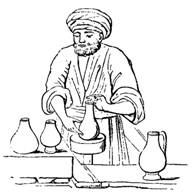
Fig. 295—Modern Egyptian Potter
The potter, and the produce of his labors, are often alluded to in the Scriptures. The fragility of his wares, and the ease with which they are destroyed, supply apt emblems of the facility with which human life and power may be broken and destroyed. It is in this figurative use that the potter’s vessels are most frequently noticed in Scripture (Psa 2:9; Isa 30:14; Jer 19:11; Rev 2:27). In one place, the power of the potter to form with his clay, by the impulse of his will and hand, vessels either for honorable or for mean uses, is employed with great force by the apostle to illustrate the absolute power of God in molding the destinies of men according to His pleasure (Rom 9:21). The first distinct mention of earthenware vessels is in the case of the pitchers in which Gideon’s men concealed their lamps, and which they broke in pieces when they withdrew their lamps from them (Jdg 7:16; Jdg 7:19). Pitchers and bottles are indeed mentioned earlier; but the ’bottle’ which contained Hagar’s water (Gen 21:14-15) was undoubtedly of skin; and although Rebekah’s pitcher was possibly of earthenware (Gen 24:14-15), we cannot be certain that it was so.
A maker of earthenware, Gen 24:14-15 ; Jdg 7:16,19 ; Psa 2:9 . Ancient Egyptian paintings represent the potter turning and shaping, on his small and simple wheel made to revolve rapidly by the foot, the lump of clay, which he had previously kneaded with his feet. A pan of water stands by his side, with which he kept the clay moist. After the body of the vessel was worked into shape and beauty, the handle was affixed to it, devices traced upon it, and after drying a little, it was carefully taken to the oven and baked. The potter’s control over the clay illustrates the sovereignty of God, who made us of clay, and forms and disposes of us as he deems good: "O house of Israel, cannot I do with you as this potter? saith the Lord. Behold, as the clay is in the potter’s hand, so are ye in my hand, saith the Lord," Jer 18:1-6 . "Shall the thing formed say to him that formed it, Why hast thou made me thus? Hath not the potter power over the clay, of the same lump to make one vessel unto honor and another unto dishonor?" 1Ch 9:20-21 .\par
Of the potter scripture says he treadeth the clay to make it pliable, Isa 41:25; and he forms his vessel on a wheel. Jer 18:3. Much of the ordinary pottery in the East is made in a very simple way: the workman turns the wheel with his feet, and with his hands he forms the vessel as it pleases him. This common pottery of the East is very fragile, and as such is often alluded to in scripture. The Lord Jesus will subdue all His enemies: will dash them in pieces like a potter’s vessel. Psa 2:9, Isa 30:14; Rev 2:27.
The potter making his vessels as it pleases him, is a beautiful illustration of the power of God as Creator, and is applied to Israel: "as the clay is in the potter’s hand, so are ye in my hand, O house of Israel." Jer 18:2-6. It also illustrates God’s sovereignty: "Shall the thing formed say to him that formed it, Why hast thou made me thus?" The potter has full power over the clay. Rom 9:20-21.
POTTER.—‘The Potter’s Field’ was the name of the property in the purchase of which the chief priests spent the thirty pieces of silver returned by Judas, and which they proposed to use as a burial-place for strangers (Mat 27:7). Mat 27:8 states that this spot came in consequence to be known as ‘the field of blood—that is, the field bought with the price of blood; but a different reason for that name is given in Act 1:18-19, where Judas himself purchases the field, and commits suicide in it. The ‘field of blood,’ or Akeldama (
T. H. Weir.
(êåñáìåýò)
The ceramic art is of great antiquity. Wherever the primitive races of mankind found clay, they became potters. Rude baked vessels are found with the remains of our remotest ancestors. In the story of the creation, God is represented as a Potter moulding the human body out of the dust of the ground (Gen_2:7; cf. Job_10:9; Job_33:6), and thoughtful men in all ages have figured themselves, in their whole relation to God, as clay in the Potter’s hands (Isa_45:9; Isa_64:8, Jer_18:6, Rom_9:21). In one aspect the metaphor is still readily accepted, for all devout men believe in the Divinity that shapes their ends. The classical modern expression of the doctrine is found in Browning’s Rabbi Ben Ezra:
‘Ay, note that Potter’s wheel,
That metaphor! and feel
Why time spins fast, why passive lies our clay,-
But I need, now as then,
Thee, God, who mouldest men;
My times be in Thy hand!
Perfect the cup as planned!’
But God’s ‘vessels of wrath’ (Rom_9:22) create a difficulty for the reason as well as the heart, a difficulty which becomes a óêἁíäáëïí when the phrase is interpreted as meaning that ‘the Lord has created those who, as He certainly foreknew, were to go to destruction, and He did so because He so willed’ (J. Calvin, Institutes, Eng. tr._, 1879, ii. 229). Such a doctrine has been a rock of offence to very many. The legitimate protest of the clay is heard in the quatrains of Omar Khayyam; and the last word of the Christian spirit is not uttered in the militant Messianic Psalm quoted in the Apocalypse: ‘Thou, shalt dash them in pieces like a potter’s vessel’ (Psa_2:9 || Rev_2:27). See Predestination.
James Strahan.
Psa 2:9 (b) This type represents GOD in His terrible fury breaking the nations of the earth because they have no value to Him, and are an offense to Him. (See also Isa 30:14; Jer 19:11; Rev 2:27).
Lam 4:2 (a) Those in Israel who should have been as wonderful golden vessels are classed as men of common clay because they had forsaken GOD, and lived in wickedness.
Someone who makes pottery (jars,
bowls, etc.) from clay. The Hebrew word
also means “creator” or “a person who
makes new things.”