
[PESTILENCE]
See PESTILENCE.\par
A close connection exists between the ordinary physical visitations of Egypt and those whereby Pharaoh was constrained to let Israel go. It attests the sacred author’s accurate acquaintance with the phenomena of the land which was the scene of his history. "The supernatural presents in Scripture generally no violent opposition to the natural, but rather unites in a friendly alliance with it" (Hengstenberg). A special reason why in this case the natural background of the miracles should appear was in order to show that Jehovah was God of Egypt as much as of Israel, and rules "in the midst of the earth" (Exo 8:22)
By exhibiting Jehovah through Moses at will bringing on with unusual intensity, and withdrawing in answer to intercession at once and completely, the well known Egyptian periodical scourges which their superstition attributed to false gods, Jehovah was proved more effectively to be supreme than He could have been by inflicting some new and strange visitation. The plagues were upon Egypt’s idols, the Nile water, the air, the frog, the cow, the beetle, etc., as Jehovah saith (Exo 12:12), "against all the gods of Egypt will I execute judgment" (Exo 18:11; Exo 15:11; Num 33:4). Ten is significant of completeness, the full flood of God’s wrath upon the God-opposed world power. The magicians initiate no plague; in producing the same plague by their enchantments (which seem real, as demoniacal powers have exerted themselves in each crisis of the kingdom of God) as Moses by God’s word, they only increase the visitation upon themselves. The plagues as they progress prove:
(1) Jehovah’s infinite power over Egypt’s deified powers of nature. The first stroke affects the very source of the nation’s life, the Nile; then the soil (the dust producing the plague); then the irrigating canals breeding flies.
(2) The difference marked between Israel and Egypt; the cattle, the crops, the furnaces (wherein Israel was worn with bondage) represent all the industrial resources of the nation. The stroke on the firstborn was the crowning one, altogether supernatural, whereas the others were intensifications of existing scourges. The firstborn, usually selected for worship, is now the object of the stroke. The difference marked all along from the third plague was most marked in that on the firstborn (Exo 11:7). The plague was national, the firstborn representing Egypt: Isa 43:3, "I gave Egypt for thy ransom."
Who Will Be Plagued
Lev_26:13-22; Num_14:36-37; Deu_28:58-62; Psa_106:19-29; Rev_18:1-8; Rev_22:18.
PLAGUE.—The word ‘plague’ is used in the Gospels to render the Greek word
W. W. Holdsworth.
By: Executive Committee of the Editorial Board., J. F. McLaughlin, Judah David Eisenstein
—Biblical Data:
Word which is used in the English versions of the Bible as a rendering of several Hebrew words, all closely related in meaning. These are:
(1) "Maggefah" (a striking, or smiting): Used in a general way of the plagues inflicted upon the Egyptians (Ex. ix. 3-4); of the fatal disease which overtook the spies (Num. xiv. 37), and of that which slew many of the people after the rebellion of Korah (Num. xvi. 48-49), and at Shittim because of idolatrous practises at the shrine of Baal-peor (Num. xxv. 8, 9, 18; Ps. cvi. 29-30); of the tumors which attacked the Philistines on account of the presence of the Ark (I Sam. vi. 4), and of the three days' pestilence which ravaged Israel after David's numbering of the people (II Sam. xxiv. 21, 25); of a disease of the bowels (II Chron. xxi. 14-15), and, prophetically, of a plague which shall consume the flesh of the enemies of Jerusalem, both man and beast (Zech. xiv. 12, 15, 18).
(2) "Negef" from the same root and with the same general meaning as "maggefah" (a blow, a striking): Used of the plague of Baal-peor (Josh. xxii. 17), of that which followed the rebellion of Korah (Num. xvi. 46-47.), and with a general application (Ex. xii. 13, xxx. 12; Num. viii. 19). The corresponding verb is used with the sense of "to plague" in Ex. xxxii, 35, Josh. xxiv. 5, and Ps. lxxxix. 23.
(3) "Nega" (a touch, a stroke): Used of the last of the Egyptian plagues (Ex. xi. 1) and many times of leprosy (Lev. xiii., xiv., and xxiv., and generally in I Kings viii. 37-38 and Ps. xci. 10). The corresponding verb, in addition to a general use in Ps. lxxiii. 5, 14, is used of the plague which afflicted Pharaoh and his house because of the wrong done to Abram (Gen. xii. 17).
(4) "Makkah" (a blow, a wound): Used of the plague which was due to the eating of quails (Num. xi. 33), of the plagues of Egypt (I Sam. iv. 8), and more generally (Lev. xxvi. 21; Deut. xxviii. 59, 61; xxix. 22; Jer. xix. 8, xlix. 17, l. 13)
(5) "Deber": Rendered "plagues" in Hos. xiii. 14; "murrain" (i.e., cattle-plague) in Ex. ix. 3; and "pestilence" in Ex. v. 3, ix. 15; Num. xiv. 12, and Hab. iii. 5.
E. C. J. F. McL."Lex Talionis." —In Rabbinical Literature:
Commenting on the words of Jethro, "For in the thing wherein they dealt proudly he was above them" (Ex. xviii. 11), the Talmud says: "The Egyptians were cooked in the pot in which they cooked others" (Soṭah 11a), that is, the punishment was made to correspond to their crime, on the "jus talionis," principle. This refers to Pharaoh's. edict to the effect that all Jewish infants were to be cast into the Nile, the Egyptians being punished by the plague that turned the water of the Nile to blood. At the same time this plague proved that the Nile was not a deity as the Egyptians believed. Furthermore, the Egyptians suffered to the full extent the evils of the plagues, and did not derive any benefit, however indirect, therefrom. Hence, the frogs died in heaps "and the land stank"; while the '"arob," which the Rabbis say was a mixture or drove of wild animals (not "a swarm of flies"), disappeared after the plague ceased, and "there remained not one": so that the Egyptians might not profit from the hides of the animals, which they might have done had the latter died like the frogs. Two theories have been advanced for the plague of darkness, one of which is that the plague was intended to hide the annihilation of the wicked Israelites who, refusing to leave Egypt died there.
The period of each plague was seven days (Ex. vii. 25); and twenty-four days intervened between one plague and the next. The ten plagues lasted nearly twelve months ('Eduy. ii. 10; comp. Ex. R. ix. 12). The order and nature of the plagues are described by R. Levi b. Zachariah in the name of R. Berechiah, who says: "God used military tactics against the Egyptians. First, He stopped their water-supply (the water turned to blood). Second, He brought a shouting army (frogs). Third, He shot arrows at them (lice). Fourth, He directed His legions against them (wild animals). Fifth, He caused an epidemic (murrain). Sixth, He poured naphtha on them (blains). Seventh, He hurled at them stones from a catapult (hail). Eighth, He ordered His storming troops (locusts) against them. Ninth, He put them under the torturing stock (darkness). Tenth, He killed till their leaders (first-born)" (Yalḳ., Ex. 182; Pesiḳ. R, xvii. [ed. Friedmann, 89b]).
Plagues in the Red Sea.
Ten other plagues were inflicted on the Egyptians in the Red Sea (Ab. v. 6; Ab. R. N. xxxiii.; comp. ed. Schechter, 2d version, xxxvi.), in the various ways in which Pharaoh and his hosts were drowned. R. Jose the Galilean says: "The Egyptians in the Red Sea suffered fifty plagues. In Egypt the 'finger' of God was recognized by the ten plagues; but at the Red Sea God's powerful 'hand' was visible [Ex. xiv. 31, Hebr.], which being multiplied by five fingers makes fifty plagues." R. Eliezer multiplied these by 4, making 200 plagues; and R. Akiba multiplied them by 5 making 250 plagues. Each adduced his multiplier from the verse: "He cast upon them (1) the fierceness of his anger, (2) wrath, (3) and indignation, (4) and trouble, (5) by sending evil angels among them" (Ps. lxxviii. 49). R. Eliezer does not count "fierceness of his anger" (Mek., Ex. vi.; comp. Ex. R. xxiii. 10; see also the Passover Haggadah).
The order of the plagues in the Psalms differs from that in Exodus. R. Judah indicated the latter order by the mnemonic combination  , consisting of the initial letters of the ten plagues as follows:
 = (1) water turning to blood, (2) frogs, (3) lice, (4) swarms of beasts, (5) murrain, (6) blains, (7) hail, (8) locusts, (9) darkness, (10) slaying of the first-born. The ten plagues are furthermore divided thus: three performed through Moses, three through Aaron, three directly by God, and one, the sixth, through Moses and Aaron together (Ex. vii. 17-x. 21; "Shibbole ha-Leḳeṭ," ed. Buber, p. 97b).
—Critical View:
In the majority of cases the plague is regarded and spoken of as a divine visitation, a penalty inflicted upon the individual, family, or nation because of sin. Even the common disease of leprosy is said to be "put in a house" by God (Lev. xiv. 34). The exact nature of the fatal sickness which attacked the people on more than one occasion in the wilderness is a matter of conjecture, but there can be little doubt that it was the bubonic plague which destroyed the Philistines (I Sam. v. 6-12).
Plagues of Egypt.
The calamities inflicted upon the Egyptians because of Pharaoh's refusal to let the people of Israel go into the wilderness to observe a feast to Yhwh are designated "plagues" (Ex. ix. 14, xi. 1). The narrative in Exodus tells of ten such visitations. According to the critical analysis of the sources of this narrative it appears that one, probably the earliest, story (J) tells of seven of the ten plagues (viz., 1, 2, 4, 5, 7, 8, 10); another (E), of four, or possibly six (viz., 1, 3, [?], 7, 8, 9, 10 [?]); and the third (P), of six (viz., 1, 2, 3, 5, 6, 10). Psalm lxxviii. recalls seven, and Psalm cv. eight, of these. It is possible that one or more of the plagues may be duplicated in the narrative as it now stands.
Details of Plagues.
The Ten Plagues, According to a Passover Haggadah of 1695.(From the Sulzberger collection in the Jewish Theological Seminary of America, New York.)
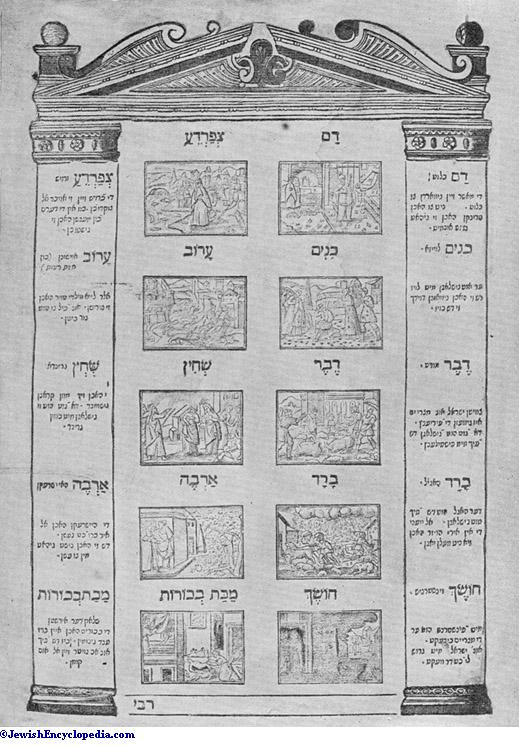
The first plague was the defilement of the river. "All the waters that were in the river were turned to blood. And the fish that was in the river died" (Ex. vii. 21). The Egyptians regarded the Nile as a god (see Maspero, "Dawn of Civilization," pp. 36-42), and no doubt, to the Hebrew writer, this visitation seemed peculiarly appropriate. The water of the Nile regularly becomes discolored from minute organisms or from decaying vegetable matter and mud carried down by the floods which reach Egypt in June. The color is said to vary from gray-blue to dark red. A cause of this plague might therefore be found in the presence of an unusually large quantity of such impurities, making the water putrid. The second plague was a multitude of frogs. The third and fourth consisted of swarms of insect pests, probably stinging flies or gnats. The fifth was a murrain, or cattle-plague, probably anthrax or rinderpest. Pruner ("Krankheiten des Orients," Erlangen, 1847) describes an outbreak of the last-named in Egypt in 1842.
The sixth plague was one of boils which Philo ("De Vita Moysis") describes as a red eruption in which the spots became swollen and pustular, and in which "the pustules, confluent into a mass, were spread over the body and limbs." This description, if correct, would point to smallpox. The seventh plague was a great storm of hail; the eighth, a swarm of locusts destroying the crops and even the leaves and fruit of the trees. The ninth was a "thick darkness" continuing for three days. It has been suggested that such a darkness might have been caused by the south or southwest wind, which blows about the time of the vernal equinox, bearing clouds of sand and fine dust that darken the air (see Denon, "Voyage dans l'Egypte," p. 286, Paris, 1802); this wind blows for two or three days at a time. The tenth and last plague was the destruction of the first-born, when Yhwh "gave their life over to the pestilence and smote all the first-born of Egypt" (Ps. lxxviii. 50-51).
Bibliography:
Dilimann-Ryssel, Exodus und Leviticus, Leipsic, 1897;
Pruner, Krankheiten des Orients, Erlangen, 1847;
A. Macalister, Medicine and Plague, in Hastings, Dict. Bible.
PLAGUE.—See Medicine, p. 598b.
The specific disease now named “plague” has been from the earliest historic times a frequent visitant to Palestine and Egypt. Indeed in the Southeast between Gaza and Bubastis it has occurred so frequently that it may almost be regarded as endemic. The suddenness of its attack, the shortness of its incubation period and the rapidity of its course give it the characters which of old have been associated with manifestations of divine anger. In the early days of an epidemic it is no infrequent occurrence that 60 per cent of those attacked die within three days. I have seen a case in which death took place ten hours after the first symptoms. In the filthy and insanitary houses of eastern towns, the disease spreads rapidly. In a recent epidemic in one village of 534 inhabitants 311 died within 21 days, and I once crossed the track of a party of pilgrims to Mecca of whom two-thirds died of plague on the road. Even with modern sanitary activity, it is very difficult to root it out, as our recent experiences in Hong Kong and India have shown.
Of the Biblical outbreaks that were not improbably bubonic plague, the first recorded is the slaughter of the firstborn in Egypt - the 10th plague. We have too little information to identify it (Exo 11:1). The Philistines, however, used the same name,
A later epidemic, which was probably of bubonic plague, was that which avenged the capture of the ark (1Sa 5:6). We read of the tumors which were probably the glandular enlargements characteristic of this disease; also that at the time there was a plague of rats (1Sa 6:5) - “mice,” in our version, but the word is also used as the name of the rat. The cattle seem to have carried the plague to Beth-shemesh, as has been observed in more than one place in China (1Sa 6:19). Concerning the three days’ pestilence that followed David’s census (2Sa 24:15; 1Ch 21:12), see Josephus, Ant., VII, xiii, 3. The destruction of the army of Sennacherib may have been a sudden outbreak of plague (2Ki 19:35; Isa 37:36). It is perhaps worthy of note that in Herodotus’ account of the destruction of this army (ii. 141) he refers to the incursion of swarms of mice.
One of the latest prophetic mentions of plague is Hos 13:14, where the plague (
The word ðëçãÞ, ‘stroke,’ occurs in the NT only in the Apocalypse (Rev_8:8; Rev_9:18; Rev_9:20; Rev_11:6; Rev_13:3; Rev_13:12; Rev_13:14; Rev_15:1; Rev_15:6; Rev_15:8; Rev_16:9; Rev_16:21; Rev_18:4; Rev_18:8; Rev_21:9; Rev_22:18). It was used by the LXX_ for the ‘plagues’ of Egypt and the later visitations of God upon His people and their enemies, which made a profound impression upon the Hebrews (cf. Lev_26:2; Lev_26:24, Num_25:8 f., 2Sa_24:21). In the Apocalypse the plagues are unforeseen, sudden occurrences, greater and more terrible than those in Egypt, which will disclose God’s purpose and providence concerning His own. However violent the opposition, or bitter the persecution, or extreme the danger to which God’s people are exposed, they have nothing to fear. The Seer beholds successive Divine judgments fall upon the earth, the sea, the rivers, the sun, moon, and stars. Instruments of Divine punishment are insects, beasts, angels, hail-stones, death, mourning, want, and fire. In a word, all the forces and agencies of the world which are naturally friendly to man are turned into hostile and destructive action against those who dishonour God and would destroy His Kingdom. Even the people of God are secure against the same fate only by faith and obedience.
C. A. Beckwith.
Different versions of the Bible use a variety of words to describe the many disasters, plagues, diseases and sicknesses that afflict people (e.g. Exo 8:2; Exo 9:3; 1Ki 8:37; Psa 91:6; Psa 91:10; Jer 14:12; Luk 7:21; Luk 21:11; see also DISEASE).
The ten plagues of Egypt were judgments of God on the stubborn nation and its king. Both people and king were bitterly opposed to Yahweh, the God of Israel, and were devoted followers of Yahweh’s real enemies, the Egyptian gods (Exo 9:27; Exo 12:12). These were gods of nature and were therefore connected with the Nile River, upon which Egypt depended entirely for its agricultural life. God may have used the physical characteristics of the Nile Valley to produce the plagues, but the timing, intensity and extent of the plagues showed clearly that they were judgments sent directly by God (Exo 8:21-23; Exo 8:31; Exo 9:1-6; Exo 9:22; Exo 9:33).
God in his mercy gave advance notice of the plagues and consistently gave Pharaoh the chance to repent; but the longer Pharaoh delayed, the more he increased the judgment that was to fall on him (Exo 9:15-19). The tenth plague was God’s final great judgment on Egypt and at the same time his act of redemption for his people. Previously the Israelites escaped the plagues without having to do anything, but this time their safety depended upon carrying out God’s commands. Their redemption involved faith and obedience (Exo 12:1-13; see PASSOVER).