
Pithom was one of the store cities that the Israelites built for Pharaoh in Egypt during their servitude, as described in Exodus 1:11. The town lay at the entrance of the Wady Fumilat, and another identifies its modern name as Abhaseh. Some interpreters have proposed derivations for the name, though these are not supported by any authority.
One of the cities which the children of Israel built for Pharaoh during their captivity in Egypt. Perhaps the name is derived from Pe, the mouth - - and Sham, which signifies to finish; - - but there is no authority for it. A much more important consideration is it to remark the diligence of Israel in their captivity, thus building houses for their masters. Though the Egyptians oppressed them, and made their lives bitter by reason of the task - masters set over them, ye we do not find that the poor captives gave over their duty because of their enemies’ cruelty. The Holy Ghost compels the foes of the church thus to give testimony, however unwillingly, to the dutiful and honourable deportment of the people. "And they built for Pharaoh treasure cities, Pithom and Ramases. But the more they afflicted them, the more they multiplied and grew. And they were grieved because of the children of Israel." (Exod. i. 11, 12.) I beg the reader to observe how every thing turned out the reverse of their tyrants’ intention. Egypt wished to lesson Israel by cruelty: Israelthrived and multiplied the more. Egypt intended to make their lives bitter to them; whereas the bitterness recoiled on themselves. Thus the Lord carries on the gracious purposes of his government in the minds of men in all ages! We have another striking testimony of a like kind to the good conduct of the Lord’s people upon a similar occasion, when the people were again brought into bondage. I mean when Jobin, king of Canaan, ruled with an iron rod over Israel. (See Judg, chap. 4: and v.) The mother of Sisera gave this unintentional testimony to the good housewifery of our mothers in Israel, when, looking out at a window to watch for the coming of her son in triumph, she cried out, " Have they not divided the preys to every man a damsel or two; to Sisera a prey of divers colours, a prey of divers colours of needlework, of divers colours of needlework on both sides, meet for the necks of them that take the spoil?" (Judg. v. 30.) Here we see that the daughters of Israel, as their fathers before them, ate not the bread of idleness, for their divers colours of needlework manifested their industry. But what an awful character must this mother of Sisera have been, to take pleasure in the lusts of her son! Forgetting the chastity of her sex, she seemed to rest in the very thought that the daughters of Israel would serve for the savage sports of her son and his army, and a damsel or two fall to the lot of every man. We see here, in striking features, a mind indeed ripe for hell. We behold sin become so exceedingly sinful, that the sinner enjoys in idea what in reality he doth not partake of. This is the state which the apostle Paul describes of sinners, "who knowing the judgment of God, that they who commit such things are worthy of death, not only do the same, but take pleasure in them that do them." (Rom. i. 32.) The imagination can form no picture out of hell of equal malignity of mind. Such are full ripe for hell; the next step brings them into it. They are like a vessel brim full, one drop more, and they sink to the bottom.
one of the cities that the Israelites built for Pharaoh in Egypt, during the time of their servitude, Exo 1:11.
Pi´thom, one of the ’treasure-cities’ which the Israelites built in the land of Goshen ’for Pharaoh’ (Exo 1:11) [EGYPT; GOSHEN]. The site is by general consent identified with that of the Patumos of Herodotus (ii. 158). Speaking of the canal which connected the Nile with the Red Sea, this author says, ’The water was admitted into it from the Nile. It began a little above the city Bubastus [PIBESETH], near the Arabian city Patumos, but it discharged itself into the Red Sea.’ According to this, Patumos was situated on the east side of the Pelusiac arm of the Nile, not far from the canal which unites the Nile with the Red Sea, in the Arabian part of Egypt. We gather from the Itinerarium of Antoninus that this city was twelve Roman miles distant from Heroopolis, the ruins of which are found in the region of the present Abu-Keisheid. All these designations are appropriate if, with the scholars who accompanied the French expedition, we place Pithom on the site of the present Abhaseh, at the entrance of the Wady Fumilat, where there was at all times a strong military post.
One of the cities built by the children of Israel for Pharaoh in Egypt, during their servitude, Exo 1:11 . This is probably the Pathumos mentioned by Herodotus, which he places near Pi-beseth and the Pelusiac arm of the Nile, not far from the canal made by the kings Necho and Darius to join the Red Sea with the Nile. See EGYPT.\par
Pi’thom. (the city of justice). One of the store-cites built by the Israelites in Egypt, for the first oppressor, the Pharaoh "which knew not Joseph." Exo 1:11 It is probably the Patumus of Herodotus, (ii. 1 159). Now called Abhaseh, at the entrance of Wady Fumilat, on the line of the ancient canal to the Red Sea. A town on the borders of Egypt, nest which Necho constructed a canal from the Nile to the Arabian Gulf.
An Egyptian store city built by Israelites for their oppressor (Exo 1:11). Identified by Brugsch with the fort of Djar, Pachtum. It existed early in the 18th dynasty, before Thothmes III (the Pharaoh who perished in the Red Sea), and was probably erected by his grandfather Aahmes I. The fort subsequently was called Heroopolis. The Egyptian name is
Rameses II subsequently fortified and enlarged it and Raamses. Lepsius says the son of Aahmes I was
Pithom (pî’thom), house or temple, of Tum, who was the sun-god of Heliopolis, a "treasure city," or depot of provisions, built by the Israelites in Goshen. Exo 1:11. M. Naville has identified Pithom with Pa-Tum, "setting sun," and with Tel el-Maskhûta, where he found remarkable ruins, brick grain-chambers, and similar evidences of a "store city."
[Pi’thom]
One of the store-cities built by the Israelites for the Pharaoh ’who knew not Joseph.’ Exo 1:11. It has been identified with Tell Maskhuta, on the west of the Suez Canal, 30° 35’ N, 32° 11’E. In these ruins bricks have been found in some of which no straw can be discovered.
( ; LXX.
By: Executive Committee of the Editorial Board., J. F. McLaughlin
One of the cities which, according to Ex. i. 11, was built for the Pharaoh of the oppression by the forced labor of the Israelites. The other city was Raamses; and the Septuagint adds a third, "On, which is Heliopolis." The meaning of the term  , rendered in the Authorized Version "treasure cities" and in the Revised Version "store cities," is not definitely known. The Septuagint renders
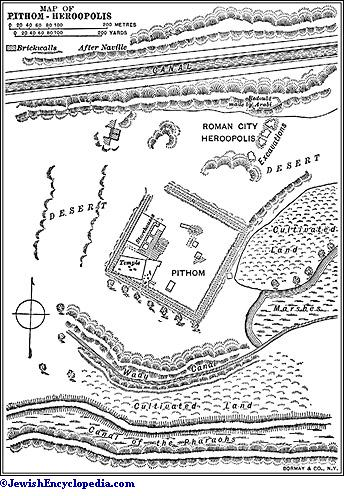
The site of Pithom, as identified by Naville, is to the east of the Wady Tumilat, south-west of Ismailia. Here was formerly a group of granite statues representing Rameses II., standing between two gods; and from this it had been inferred that this was the city of Raamses mentioned in Ex. i. 11. The excavations carried on by Naville for the Egypt Exploration Fund disclosed a city wall, a ruined temple, and the remains of a series of brick buildings with very thick walls and consisting of rectangular chambers of various sizes, opening only at the top and without any communication with one another. These are supposed to have been the granaries or store-chambers, from which, possibly, the army may have been supplied when about to set out upon expeditions northward or eastward. The city stood in the eighth nome, adjoining that of Arabia; so that the statement of Herodotus is not exactly correct. It was known in the Greek period as Heroopolis or Heroonpolis. The Egyptian name, "Pithom" (Pi-Tum or Pa-Tum), means "house of Tum" [or "Atum,"], i.e., the sun-god of Heliopolis; and the Greek word "Hero" is probably a translation of "Atum."
The discovery of the ruins of Pithom confirms the Biblical statement and points to Rameses II. as the Pharaoh that oppressed Israel. The name of the city Pi-Tum is first found on Egyptian monuments of the nineteenth dynasty. Important evidence is thus afforded of the date of the Exodus, which must have taken place toward the end of the nineteenth dynasty or in the beginning of the twentieth dynasty.
In the Middle Ages Fayum was called "Pithom" by the Jews, so that the Gaon Saadia is termed "Al-Fayyumi" in Arabic (Hebr. "Ha-Pitomi"), and he himself translates "Pithom" in Ex. i. 11 by "Al Fayyum."
Bibliography:
Naville, The Store City of Pithom, etc., in Memoir of Egypt Exploration Fund, 1885;
Sayce, Higher Criticism and the Monuments, 1894, pp. 239 et seq., 250 et seq.;
Driver, in Hogarth's Authority and Archœology, 1899, pp. 54 et seq., 61, 68.
PITHOM.—One of the ‘treasure cities’ built by the Israelites in Egypt (Exo 1:11 etc.). It is the Egyptian Petôm (‘House of Etôm’), the site of which is now marked by Tell el-Maskhuta in the Wady Tumilat. The researches of Naville and Petrie indicate that the city dates as far back as the 12th Dyn., and was occupied down to very late times. It was capital of the 8th nome of Lower Egypt, and in it was worshipped a form of the sun-god under the name of Etôm.
F. Ll. Griffith.
1. Meaning of Name:
Champollion (Gesenius, Lexicon, under the word) considered this name to mean “a narrow place” in Coptic, but it is generally explained to be the Egyptian
Brugsch (History of Egypt, 1879, II, 343) says that it was identical with “Heracleopolis Parva, the capital of the Sethroitic nome in the age of the Greeks and Romans ... half-way on the great road from Pelusium to Tanis (Zoan), and this indication given on the authority of the itineraries furnishes the sole means of fixing its position.” This is, however, disputed. Tum was worshipped at Thebes, at Zoan, and probably at Bubastis, while Heliopolis (Brugsch, Geogr., I, 254) was also called Pa-tum.
There were apparently several places of the name; and Herodotus (ii. 158) says that the Canal of Darius began a little above Bubastis, “near the Arabian city Patournos,” and reached the Red Sea.
2. Situation:
(1) Dr. Naville’s Theory.
In 1885 Dr. E. Naville discovered a Roman milestone of Maximian and Severus, proving that the site of Heroopolis was at
(2) Patoumos of Herodotus.
These places seem to have been on the eastern border of Egypt, but may have been close to the Bitter Lakes or farther North (see SUCCOTH), whereas
Pithom was one of the store cities built by the Israelites during their time as slaves in Egypt. The Bible mentions that the Israelites built both Pithom and Rameses as store cities for Pharaoh (Exodus 1:11).
For more than 100 years, experts who study ancient Egypt have debated about where these cities were actually located. The location of Rameses is fairly well known. Most experts connect it with Pirameses. It was the capital of Pharaoh Ramses II, who ruled from 1290 to 1224 BC. Several ancient sites have been suggested as the location of Rameses. For many years, scholars thought it was at Tanis in the northeastern Nile Delta region. However, Qantir, which is in the same general area, is now considered the more likely location.
The name "Pithom" comes from an Egyptian phrase that means "House of [the god] Atum." This would have been a temple built to worship Atum, who was an Egyptian sun god. The Israelites would have been involved in building the storage facilities that were part of this temple. We can get a good idea of what these storage buildings looked like by studying similar structures from Ramses II's tomb temple in Thebes. These storage buildings are still well-preserved today. They were long rectangular structures with curved roofs, built side by side. These storage facilities covered a large area of the temple complex. This helps us understand the kind of buildings the Israelites were forced to make bricks for during their slavery in Egypt.
Although we know what the name Pithom means, its exact location is still being discussed by scholars. The two places most often suggested as the site of Pithom are Tell er-Retabah and Tell el-Maskhutah. Both of these ancient sites are located in the Wadi Tumilat, a valley that runs eastward from the Nile Delta to Lake Timsah.
In recent years, archaeologists have dug at both sites. They have found evidence that people from Palestine and Syria (called Asiatics) lived in both places. There might be a connection between the Arabic name "Maskhutah" and the Hebrew word "Succoth." Succoth is mentioned in Exodus 12:37 as a place where the Israelites stopped during their journey out of Egypt. Because of this possible connection, many scholars now think Tell er-Retabah is the most likely location for Pithom, while Tell el-Maskhutah might be Succoth.
See also Egypt, Egyptian; Rameses (Place).
Aquifer Open Bible Dictionary © 2026 Mission Mutual, an adaptation of the Tyndale Open Bible Dictionary © 2023 Tyndale House Publishers. Licensed under CC BY-SA 4.0.