
In the general, was a name given by the ancients to all kinds of charms, spells, or characters, which they wore about them, as amulets, to preserve them from dangers or diseases. Phylactery particularly denoted a slip of parchment, wherein was written some text of holy Scripture, particularly of the decalogue, which the more devout people among the Jews wore at the forehead, the breast, or the neck, as a mark of their religion. The primitive christians also gave the name Phylacteries to the cases wherein they enclosed the relics of their dead. Phylacteries are often mentioned in the New Testament, and appear to have been very common among the Pharisees in our Lord’s time.
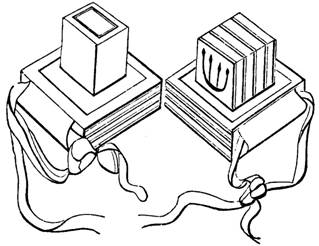
Fig. 293—Phylactery
Phylac´tery, strips of parchment inscribed with particular passages of Scripture (Deu 6:4-9; Deu 11:13-21; Exo 13:1-16). They were folded up and enclosed in a small leather box, and worn upon the forehead nearly between the eyes, or upon the left arm near to the heart, being attached by straps of leather. They were considered as thus reminding the wearers to fulfill the law with the head and heart; and they were also regarded as amulets, protecting the wearer from the powers of evil, especially demons. These appendages were used during the stated prayers, and only by men. The whole observance is founded on the authority of the texts which are written on the strips of parchment, as Exo 13:16: ’It shall be for a token upon thine hand, and for frontlets (bands, fillets) between thine eyes;’ which, although in all probability only figurative expressions, have been literally understood, and acted upon by the Jews since the Exile. In existing usage the skin employed in making the phylacteries is prepared with much care, and the writing traced with minute accuracy and neatness. The Hebrew ritualists give very exact and numerous directions on this subject, which are required to be closely observed. The case itself is composed of several layers of parchment or of black calfskin. The phylacteries for the head have four cavities, in each of which is put one of the four texts to which we have referred; but the phylacteries for the arm have only one cavity, containing the same texts all written on one slip of parchment. Lightfoot thinks it not unlikely that our Savior himself wore the Jewish phylacteries, as well as the fringes, according to the custom of his nation; and that in Mat 23:5, our Lord condemns not the wearing of them, but the pride and hypocrisy of the Pharisees in making them broad and visible, to obtain respect and reputation for wisdom and piety.
Phylactery. See Frontlets.
Phylactery. Mat 23:5. A strip of parchment on which some verses of Scripture were written, e.g., Exo 13:2-16; Deu 6:4-9; Deu 11:13-21. Such strips were enclosed in small leathern boxes, and during the time of prayer worn by men on the forehead between the eyebrows, or on the left arm near the region of the heart, being attached by leathern straps. They were supposed to be preservatives against the power of demons; hence the name phylacteries, i.e., safeguards. The practice was founded upon a literal interpretation of Exo 13:9; Exo 13:16; Deu 6:8; Deu 11:18, and is continued to the present day.
Short portions of the law written on strips of parchment, which were placed in a case made of calf skin, and worn upon the forehead and the left arm, supposed to be in obedience to Deu 6:8; Deu 11:18. The Pharisees and scribes made them large to attract attention; it was their being made ’broad’ that was condemned by the Lord. Mat 23:5. In later times they were worn as a sort of charm. See FRONTLET.
1. Bible References:
This word is found only in Mat 23:5 in our Lord’s denunciation of the Pharisees, who, in order that their works might “be seen of men,” and in their zeal for the forms of religion, “make broad their phylacteries and enlarge the borders of their garments.” The corresponding word in the Old Testament,
2. Description:
The phylactery was a leather box, cube-shaped, closed with an attached flap and bound to the person by a leather band. There were two kinds: (1) one to be bound to the inner side of the left arm, and near the elbow, so that with the bending of the arm it would rest over the heart, the knot fastening it to the arm being in the form of the Hebrew letter
3. Interpretation of Old Testament Passages:
The passages on which the wearing of the phylacteries is based are as follows: “It (i.e. the feast of unleavened bread) shall be for a sign unto thee upon thy hand, and for a memorial between thine eyes, that the law of Yahweh may be in thy mouth” (Exo 13:9); “And it (i.e. sacrifice of the firstborn) shall be for a sign upon thy hand, and for frontlets between thine eyes” (Exo 13:16); “thou shalt bind them (i.e. the words of Yahweh) for a sign upon thy hand, and they shall be for frontlets between thine eyes” (Deu 6:8); “therefore shall ye lay up these my words in your heart and in your soul; and ye shall bind them for a sign upon your hand, and they shall be for frontlets between your eyes” (Deu 11:18). It is evident that the words in Exodus are beyond all question used figuratively; a careful reading of the verses in Deuteronomy in close relation to their contexts, in which are other figures of speech not to be taken literally, is sufficient proof of their purely figurative intention also. Only the formalism of later ages could distort these figures into the gross and materialistic practice of the phylactery. Just when this practice began cannot accurately be determined. While the Talmud attempts to trace it back to the primitive, even Mosaic, times, it probably did not long antedate the birth of Christ. In conservative Jewish circles it has been maintained through the centuries, and at present is faithfully followed by orthodox Judaism. Every male, who at the age of 13 becomes a “son of the Law” (
In the New Testament passage (Mat 23:5) our Lord rebukes the Pharisees, who make more pronounced the un-Scriptural formalism and the crude literalism of the phylacteries by making them obtrusively large, as they also seek notoriety for their religiosity by the enlarged fringes, or “borders.” See FRINGES; FRONTLETS; PHARISEES.
Litrature.
The various commentaries. on Ex and Dt: tractate