
We meet with this word but once in the whole Bible, namely, Matt. 23. 5. Our blessed Lord condemned the Jews for making broad their phylacteries. It should seem that the Jews had a superstition, that by wearing certain amulets or borders with words of Scripture upon them, they would act like so many charms, and preserve them from danger. The word phylacteries, which is derived from the Greek, means to preserve. The Jews, it is said by some, justified this from what was commanded in Scripture. "And it shall be for asign unto thee, upon thine head, and for a memorial between thine eyes, that the Lord’s law may be in their mouth. (Exod. 33. 3.) But had the Jews observed the pure sense of this precept, it was their wonderful deliverance from Egypt that was to be the memorial, and not the preservation from future dangers to which this command had respect. It should rather seem, therefore, that that natural proneness the children of Israel had to imitate their idolatrous neighbours, tempted them to do as the heathen did, whose superstition is well known to have been of this kind; though Israel in the midst of their using charms like them, still had respect to words of Scripture. That this was the case, seems highly probable, in that the Lord Jesus reproved them for it. See Frontlets.
called by the Jews
Were little rolls of parchment, in which were written certain words of the law, and which were worn by the Jews upon their foreheads, and upon the left arm. The custom was founded on a mistaken interpretation of Exo 13:9,16, "And it shall be for a taken upon thy hand, and for frontlets between thine eyes."\par Leo of Modena informs us particularly about these rolls. Those worn upon the forehead have been described under the article FRONTLETS, which see. Those that were to be fastened to the arms were two rolls of parchment written in square letters, with ink made on purpose, and with much care. They were rolled up to a point, and enclosed in a sort of case of black calfskin. They then were put upon a square bit of the same leather, whence hung a throng of the same, of about a finger’s breadth and a cubit and a half long. These rolls were placed at the bending of the left arm, and after the throng had made a little knot in the form of the letter Yodh, it was wound about the arm in a spiral line, which ended at the top of the middle finger. They were called the Tephila of the hand.\par The phylactery, from a Greek word signifying preservative, was regarded not only as a remembrancer of God’s law, but as a protection against demons. It was probably introduced at a late period in the Old Testament history. Our Savior reproaches the pride and hypocrisy of the Pharisees, shown in making their phylacteries broad as a sign of their superior wisdom and piety, Mat 23:5 . David, on the other hand, says, "Thy word have I hid in my heart, that I might not sin against thee," Psa 119:11 .\par
Phylacteries. See Frontlets.
PHYLACTERIES (OT ‘frontlets’).—The observance of phylacteries is based on Exo 13:9-10 and Deu 6:8; Deu 11:18. For the Heb. and Greek terms see Hasting’s Dictionary of the Bible , s.v. It is disputed whether the passages in the Pentateuch are to be understood literally (so most of the Rabbinic writers, and Ginsburg in Kitto’s Cyclop.) or metaphorically (so Ibn Ezra, Rashbam, the Karaites, Jerome, Lyra, Calvin, Hengstenberg, Knobel, Keil, and Kennedy in Hasting’s Dictionary of the Bible ); some assign a metaphorical meaning to the passages in Ex. and a literal to those in Deuteronomy. Under the more legal and formal interpretation and observance of the OT which flourished after the Return, the literal interpretation became dominant. The exact date of the introduction of the literal observance of the precept cannot be given. No indisputable reference is found in the OT; passages like Pro 1:9 being indecisive. From the relatively large number of regulations referring to phylacteries—some of them connected with the Tannaim—it follows that they were used as early as the time of the Sopherim, the 4th or at least the 3rd cent. b.c. (see JE
In the later Jewish writers, phylacteries play a great part; their manufacture and use are elaborately described, and their significance and importance dwelt upon at length. ‘There are more laws—ascribed to delivery by God to Moses—clustering about phylacteries than about any other institution of Judaism. Maimonides (Yad Tef.) mentions 10; Rodkinssohn (Tef. le Mosheh) mentions 18’ (J
Phylacteries are of two kinds, those for the hand and those for the head. In the case of the former, a box or house (
The following benedictions are said. At the laying of the hand phylactery—‘Blessed art Thou, O Lord our God, King of the Universe, who hast sanctified us by Thy commandments, and has commanded us to lay the Tephillin.’ An almost identical one is uttered during the placing of that for the head, and when it is finished—‘Blessed be His name, whose glorious kingdom is for ever and ever.’ At the adjusting of the strap round the middle finger, which is left till the last, ‘And I will betroth thee unto me for ever; yea, I will betroth thee unto me in righteousness, and in judgment, and in loving-kindness, and in mercy. I will even betroth thee unto me in faithfulness: and thou shalt know the Lord’ (Hos 2:19). In removing, the fastening of the hand is first undone, the head phylactery removed, then that on the arm; they are kissed and placed in a bag, as. to the place and use of which careful directions are given.
It cannot be doubted that the Pharisees and scribes in the time of our Lord used phylacteries; but how far the custom was followed by the people generally is uncertain. In order to emphasize their profession of religion, these people ‘made broad’ (
Literature.—Comm. on Ex. and Deut., including long note in Kalisch’s Exodus; Maimonides, Yad Hachazakah, Hilcoth Tephillin; Wagenseil, Sota; artt. in Hasting’s Dictionary of the Bible , the EBi
J. T. L. Maggs.
(Greek: phylakterion, safeguard, charm)
Two small square leather cases worn by Jews during prayer, one on the forehead, the other on the left upper arm. They contained the following passages written on parcament: Exodus 13:1-10; 11-16, and Deuteronomy 6:4-9; 11:13-21. The cases were fastened to, and held in place by, long leather straps. The one for the forehead is called "frontlet" in the English Protestant Bible. Both are called phylacteries, meaning conservatories (of God’s commandments) or safeguards (against evil influences). The Hebrew name for both is tephillim. Their use seems to date from the 2nd century B.C. Even Jewish scholars maintained with the Christians that the passages in question were to be taken in a figurative sense only.
(Phulachterion — safeguard, amulet, or charm).The word occurs only once in the New Testament (Matthew 23:5), in the great discourse of Our Lord against the Pharisees whom He reproaches with ostentation in the discharge of their religious and social duties: "For they make their phylacteries broad and enlarge their fringes." By the Jews the phylacteries are termed tephillin, plural of the word tephillah, "a prayer", and consist of two small square cases of leather, one of which is worn on the forehead, the other on the upper left arm. The case for the forehead holds four distinct compartments, that for the arm only one. They contain narrow strips of parchment on which are copied passages from the Pentateuch, viz., Exodus 13:1-10; and Deuteronomy 6:4-9; 11:13-21. The practice of wearing the phylacteries at stated moments is still regarded as a sacred religious duty by the orthodox Jews.-----------------------------------KLEIN, Die Totaphoth nach Bibel und Tradition in Jahrbuecher f. Prot. Theol. (Berlin, 1881), 666-689; VIGOUROUX, Dict. de la Bible, s.v. Phylacteres.JAMES F. DRISCOLL Transcribed by John Fobian In memory of Helen L. Johnson The Catholic Encyclopedia, Volume XIICopyright © 1911 by Robert Appleton CompanyOnline Edition Copyright © 2003 by K. KnightNihil Obstat, June 1, 1911. Remy Lafort, S.T.D., CensorImprimatur. +John Cardinal Farley, Archbishop of New York
Leather pouches containing scrolls with passages of scripture, used to fulfill the commandment to bind the commandments to our hands and between our eyes. Jews refer to them as tefillin. The Greek term "phylacteries" literally means "amulets" and is offensive to some.
When God told the people of Israel through Moses that they were to bind his laws upon their hands and between their eyes, he was no doubt emphasizing that his people were to live in the constant remembrance of his law. Not only their actions but also their thoughts were to be governed by the law of God (Exo 13:9; Exo 13:16; Deu 6:8; Deu 11:18).
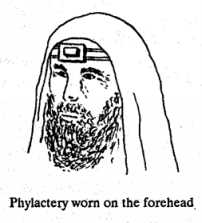
Taking God’s instructions literally, Israelites of later times wrote selected commands of the law on small strips of cloth or parchment, placed these strips in small leather boxes called phylacteries, and bound the phylacteries on to their arms or foreheads. Jesus condemned those Pharisees and scribes who wore extra large phylacteries to try to impress people with their apparent devotion to God (Mat 23:5).