
The pelican is classed by Moses among the unclean fowls. (Lev. xi. 18.) Notwithstanding the Psalmist seems to have had much respect to the solitary pursuit of this bird, when describing his loneliness of soul under this figure - - "I am like a pelican of the wilderness." And if this psalm be considered (as I confess I feel much inclined to believe) to have more of David’s Lord in it than David, there is something very stalking in the similitude of the pelican. I refer the reader to my Poor Man’s Commentary, on the - one hundred and second Psalm, for my thoughts concerning Jesus as the glorious person to whom the principal characters in that psalm have respect. The Hebrews distinguished the pelican by the name Kaath. It hath been a generally - received opinion, and some of the early fathers have given countenance to it, such as St. Austin, and Isidore, that the pelican feeds her young with her blood, and by sprinkling it on her young also contributes to their life. Be the fact so or not, yet certain it is that our heavenly Pelican both feed and sprinkles his young with his blood, and is their life and their portion for ever. He saith himself, "Except ye eat the flesh of the Son of Man, and drink his blood, ye have no life in you. And whoso eateth my flesh, and drinketh my: blood, hath eternal life; and I will raise him up at the last day. (John vi. 53, 54.) These are sweet views of Jesus! Blessed are the souls who are daily living thus upon him. Surely the pelican in this point of view becomes no unapt resemblance of Christ.
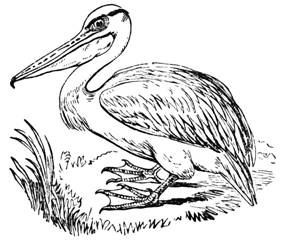
Fig. 290—Pelican
Pelican (Lev 11:18; Deu 14:17; Psa 102:6; Isa 34:11; Zep 2:14).
The name kaath thus rendered, is supposed to be derived from the action of throwing up food, which the bird really effects when discharging the contents of the bag beneath its bill. But it may be suggested, as not unlikely, that the name is imitative of the voice of the pelican, which, although seldom heard in captivity, is uttered frequently at the periods of migration, and is compared to the braying of an ass.
Pelicans are chiefly tropical birds, equal or superior in bulk to the common swan: they have powerful wings; fly at a great elevation; are partially gregarious; and though some always remain in their favorite subsolar regions, most of them migrate in our hemisphere with the northern spring, occupy Syria, the lakes and rivers of temperate Asia, and extend westward into Europe up the Danube into Hungary, and northward to some rivers of southern Russia. They likewise frequent salt-water marshes, and the shallows of harbors, but seldom alight on the open sea, though they are said to dart down upon fish from a considerable height.
Lev 11:18, sometimes translated cormorant, Isa 34:11 Zep 2:14 ; a voracious waterfowl, somewhat gregarious and migratory, frequenting tropical climates, and still found on the waters of Egypt and Palestine. It fully equals the swan in size, and resembles it in shape and color. Its plumage is of a grayish white, except the long feathers, which are black. Its great peculiarity is its broad, flat bill, fifteen inches long; and the pouch of the female under the bill, used for the temporary storage of food, and said to be able to hold fifteen quarts. When empty, this pouch is not seen; but when full, it presents a very singular appearance. The pelican is a dull, indolent, and melancholy bird; and its voice is harsh and dissonant, Psa 102:6 . Its Hebrew name is probably derived from its habit of emptying its pouch of the food stored in it, by compressing it against its breast. The young then receive their food from their mother’s bill; and the current tradition that she tears her own breast to feed them with her blood, may have this origin. The pelican’s bill also, terminating in a strong, curved, crimson tip and resting on the white breast might seem to be tinged with blood.\par
Pelican. (Hebrew, kaath). Pelican, sometimes translated, "cormorant," as Isa 34:11; Zep 2:14, though in the margin correctly rendered, "pelican". A voracious waterbird, found most abundantly in tropical regions. It is equal to the swan in size. (It has a flat bill fifteen inches long, and the female has under the bill, a pouch capable of great distension. It is capacious enough to hold fish sufficient for the dinner of half a dozen men. The young are fed from this pouch, which is emptied of the food by pressing the pouch against the breast.
The pelican’s bill has a crimson tip, and the contrast of this red tip against the white breast, probably, gave rise to the tradition that the bird tore her own breast, to feed her young with her blood. The flesh of the pelican was forbidden to the Jews. Lev 11:18 -- Editor). The psalmist, in comparing his pitiable condition to the pelican, Psa 102:6, probably, has reference to its general aspect, as it sits in apparent melancholy mood, with its bill resting on its breast.
"Pelican of the wilderness" alludes to its seeking uninhabited places as breeding places. Being a water bird, it could not live in a place destitute of water. But
Pelican. Heb. the vomiter. A voracious water-bird, unclean by the Levitical law. Lev 11:18, of singular construction and habits, resembling the goose, though nearly twice as large. Its bill is 15 inches long. The female has a large pouch or bag capable of containing two or three gallons of water, and food enough for six common men. Out of this pouch she feeds herself and her young, and from this habit and the red nail at the end of her bill came the notion that she fed her offspring on her own blood. The pelican was formerly more abundant than now in the East. Having gorged itself with fish, this bird flies miles into the wilderness, where it sits in some lonely place "for hours, or even days, with. Its bill resting on its breast, a picture of melancholy." Psa 102:6. The R. V. and the margin of the A. V. read "pelican" for "cormorant" in Isa 34:11; Zep 2:14.
The Hebrew word is qaath, and this is said to be derived from a verb signifying ’to vomit.’ The pelican has a peculiar habit in feeding its young that seems to have suggested this name. It goes into the sea and catches a number of fishes which it stows away in its lower beak, the under side of which is capable of being distended like a large pouch. Then it flies away inland with its burden, for which purpose it is provided with enormous wings. On the land it presses its beak against its breast, and the fish are thrown out for the young birds.
The Psalmist said, "I am like a pelican of the wilderness," which refers to the bird sitting solitary for hours as it digests its stock of fish. It was an unclean bird. Lev 11:18; Deu 14:17; Psa 102:6. In two other passages the same Hebrew word is in the A.V. translated ’CORMORANT,’ where it should be ’pelican.’ Isa 34:11; Zep 2:14. The Pelicanus graculus and the P. crispus are known in Palestine.
("ḳa'at"):
By: Emil G. Hirsch, I. M. Casanowicz
Unclean bird mentioned in Lev. xi. 18 and Deut. xiv. 17. Reference to its habit of living in ruins and desolate places is made in Isa. xxxiv. 11 and Zeph. ii. 14 (A. V. "cormorant") and in Ps. cii. 7 (A. V. 6). From its habit of storing quantities of food in the large pouch attached to its lower mandible, for the purpose of feeding its young, which it does by pressing its pouch against its breast, arose the belief that the pelican opened its breast with its bill to feed its young with its own blood—a belief which seemed to derive support from the red at the end of the bill.
Two species of pelican are found on the coast of Syria: the white pelican (Pelecanus onocrotalus) and, less frequently, the Dalmatian (P. crispus). In the Talmud the pelican is assumed to be referred to in Ḥul 63a ( ) and Yer. Kil. viii. 6 (
 ), and in other passages. See Goose.
Bibliography:
Tristram, Natural History of the Bible, p. 251;
Lewysohn, Zoologie des Talmuds, pp. 184, 368.
PELICAN (qâ’ath, prob. from root ‘to vomit’).—One of the ‘unclean’ birds (Lev 11:18, Deu 14:17) inhabiting the ruins of Nineveh (Zep 2:14, where AV
E. W. G. Masterman.
A sea-bird, symbolical of Our Redeemer and particularly of the Holy Eucharist. In this sense it is invoked in the sixth stanza of the hymn Adoro te. According to legend, it feeds its young with its own blood, and hence is an emblem of Him Who shed His Blood for us, and Who nourishes our souls with His Body and Blood.
“I am like a pelican of the wilderness;
I am become as an owl of the waste places.”
Here David from the depths of affliction likened himself to a pelican as it appears when it perches in the wilderness. See Isa 34:11: “But the pelican and the porcupine shall possess it; and the owl and the raven shall dwell therein: and he will stretch over it the line of confusion, and the plummet of emptiness.” Here the bird is used to complete the picture of desolation that was to prevail after the destruction of Edom. The other reference concerns the destruction of Nineveh and is found in Zep 2:14: “And herds shall lie down in the midst of her, all the beasts of the nations: both the pelican and the porcupine shall lodge in the capitals thereof; their voice shall sing in the windows; desolation shall be in the thresholds: for he hath laid bare the cedar-work.”
Psa 102:6 (a) This is a type of CHRIST in His loneliness. He was a stranger in a strange land, and among enemies. The pelican obtained its food from the sea, not in the wilderness. In the wilderness it could find no food and no companionship. It was away from its customary haunts. So CHRIST was away from Heaven, His element, and was among strangers where there was nothing upon which His soul could feed.
Pelican. The pelican is one of the largest webfooted birds, often reaching 2 meters (6 feet) in length with a 3 meter (lo-foot) wingspread. But in spite of its great size, the pelican swims and flies well.
Pelicans live in colonies, and they are known as experts at catching fish for food. Their long bills have an elastic pouch on the bottom half. With this pouch a pelican scoops up several quarts of water along with his prey. The pouch serves also as a dinner bowl for baby pelicans, who dip into it for a partially digested treat.
Beautiful in flight, the pelican is a haunting, solitary figure when at rest. Perhaps this was the image in David’s mind when he declared, "I am like a pelican of the wilderness" (Psa 102:6). Other translations render the word as vulture, desert-owl, or jackdaw.