
A solemn festival of the Jews, instituted in commemoration of their coming out of Egypt; because, the night before their departure, the destroying angel, who put to death the first-born of the Egyptians, passed over the houses of the Hebrews, without entering therein; because they were marked with the blood of the lamb, which was killed the evening before, and which for this reason was called the paschal lamb.
See Exo 12:1-51: Brown’s Dict. article FEAST; and Mc’Ewen on the Types. p. 172.
While we have the comment which God the Holy Ghost hath given us by his servant Paul, (1 Cor. v. 7.) concerning the Passover, in expressly calling Christ by that name, we must be convinced that it is our highest interest and most bounden duty to study the subject with the closest apprehension, in order to obtain the clearest sense of that the important subject of the Passover means. The reader, therefore, I trust, will bear with me if I call his attention somewhat more particularly to this point.
The Jews called the Passover Paschah or Pesach, and the original meaning is flight or passage - - perhaps in allusion to the flight or hasty departure of Israel from Egypt. We have a very circumstantial account of the Passover, Exod. x2: to which I refer. The Israelites, no doubt, had higher views in the institution itself than to suppose it merely referred as a memorial of their deliverance from Egypt. They considered it typical; and the ordination of it being of perpetual standing in the church, must have led them to this conclusion.And may we not add, that, since all the leading features of the redemption by the Lord Jesus, in his person, work, offices, and character, are more or less exhibited in shadow and figure in the Passover, surely the Lord the Spirit gave to many a true Israelite grace and faith to eye, in the paschal lamb, the type of the "Lamb slain from the foundation of the world." (Rev. 13. 8.)
If the lamb appointed in the Jewish Passover was to be a male of the first year without blemish and without spot; such was Christ. If the lamb was set apart four days before the Passover - - so was Christ, not only in the original purpose, and council, and foreknowledge of God before all worlds, but also in four days’ entrance into Jerusalem, as it is remarkable Christ did before his sufferings and death. And if the Jewish lamb was roasted whole with fire, and not a bone of him broken, who but must see in this a type of himwho,in the accomplishment of salvation sustained all the fire of divine wrath against sin in his sacrifice, and whose bones, it is expressly said, were not broken, that this Scripture might be fulfilled? (John xix. 36.)
Various are the accounts given by various writers of the manner in which the Jews of modern times observe the Passover. They all make it a very high festival. Eight days, for the most part they continue this festivity, during which time they would not for the world knowingly have any leaven within their houses. Nothing would hurt the mind of a Jew more than the discovery of any thing disposed to fermentation, or to make leaven. And on the fourteenth day of Nisan the Passover begins. And the ceremony generally commencethin every family by the first - born observing fasting, by way of reference to the destruction of the first - born in Egypt. When this is over, and the time of the evening service being come, all the household enter on prayer, which when finished they proceed to the feast of unleavened bread, with some portion of a lamb, and bitter herbs. During the service they hold wine in their hands, and recount the history of their fathers in Egypt, and the Lord’s deliverance of them. The close of their devotions is generally withsome of the Psalms, such as from the one hundred and twelfth Psalm, to the one hundred and eighteenth, always beginning with Hallelujah. When the devotional part is all over, they sit down to eat and drink, generally break up their meeting with praying for the health and prosperity of the prince in whose dominions they dwelt, agreeably to the advice of Jeremiah, chap. 29. 7. So much concerning the method of the observance of the Passover by the children of Israel. I cannot dismiss this part of the subject without firstremarking, that as far as decency and seriousness are observed by them in their seasons of worship, it were to be wished that many Christians would follow their example. It appears from the relation given by the several evangelists, that the Lord Jesus observed this feast of the Passover four times during his ministry, which was but about three years and a half; but by our Lord’s entering upon his ministry sometime before the first of the four Passovers he kept, the annual period came round the fourth time before his crucifixion, and therefore we count four in the life of Jesus.
The first public Passover Christ observed is related to us by John, chap. 2: 13, to the end. The second Passover which Christ graced with his presence is recorded John v. 1, &c. when he healed the cripple at the pool of Bethesda The third public Passover where we find the Lord Jesus also present is recorded John vi. 4. The feast we read of John 7: 37. was the feast of tabernacles. (See John 7: 2, &c.)
The fourth and last Passover the Lord Jesus honoured in the observance was, as is recorded by all the evangelists, when in the midst of it he summed up and finished the whole shadow of types and ordinances in that one offering of himself upon the cross, whereby "he hath perfected for ever them that are sanctified." (See the relation of this Passover at large, Matt. 26. Mark 14. Luke xx2: John x2: and 13.)
I would only make one observation upon the whole in this place, namely, if the Lord Jesus never once during his ministry omitted his attendance on the Passover, how hath he thereby endeared to his redeemed his holy Supper, instituted and appointed as it was by himself to take place in his church in the room of the Jewish Passover! Surely by this Jesus might be supposed to intimate his holy pleasure, that his people should be always present at the celebration of it. Methinks by this constant attendance of the Lord, he meant tosay that not one of his little ones should be absent at his Supper. And his servant, the apostle, seems to have had the same views of his Master’s gracious design in this particular when he saith, "For as often as ye eat this bread and drink this cup, ye do shew the Lord’s death till he comes." (1 Cor. xi. 26.)
Pass´over. The Passover, like the sabbath and other institutions, had a twofold reference—historical and typical. As a commemorative institution it was designed to preserve among the Hebrews a grateful sense of their redemption from Egyptian bondage, and of the protection granted to their first-born on the night when all the first-born of the Egyptians were destroyed (Exo 12:27); as a typical institute its object was to shadow forth the great facts and consequences of the Christian Sacrifice (1Co 5:7).
The word Passover has three general acceptations in Scripture. First, it denotes the yearly solemnity celebrated on the 14th day of Nisan or Abib, which was strictly the Passover of the Lamb, for on that day the Israelites were commanded to roast the lamb and eat it in their own houses; Second, It signifies that yearly festivity, celebrated on the 15th of Nisan, which may be called the Feast of the Passover (Deu 16:2; Num 28:16-17); Third, it denotes the whole solemnity, commencing on the 14th, and ending on the 21st day of Nisan (Luk 22:1). The paschal lamb, in the age following the first institution of the Passover in Egypt, and after the settlement of the Hebrews in Palestine, could only be killed by the priests in the court of the temple (Deu 16:5-7; 2Ch 35:1-11; Lev 17:3-6), whence the owner of the lamb received it from the priests, and ’brought it to his house in Jerusalem, and roasted it, and ate it in the evening;’ and it was thus that Christ kept the Passover, eating it in a chamber within Jerusalem (Luk 22:7-11); but the feast of unfermented things (Exo 12:15) the Jews thought themselves bound to keep in every place in which they might dwell, if they could not visit Jerusalem. As, however, from the evening of the 14th to the 21st day of Abib or Nisan (April), all ferment was banished from the habitations of the Hebrews, both institutions thus received a common name (1Co 5:5; 1Co 5:7-8; 1Co 5:13).
On the 10th of the month Abib, the master of a family separated a ram or a goat of a year old, without blemish (Exo 12:1-6; 1Pe 1:19), which was slain on the 14th day, between the two evenings, before the altar (Deu 16:2; Deu 16:5-6). Originally the blood was sprinkled on the posts of the door (Exo 12:7), but afterwards the priests sprinkled the blood upon the bottom of the altar (comp. Deu 6:9; 1Pe 1:2; Heb 8:10; Heb 9:13-14). The ram or kid was roasted in an oven whole, with two spits made of pomegranate wood thrust through it, the one lengthwise, the other transversely (crossing the longitudinal one near the fore-legs), thus forming a cross. Thus roasted with fire, as an emblem of purification, it was served up with a bitter salad unpickled, indicative of the bitterness of their bondage in Egypt, and with the flesh of the other sacrifices (Deu 16:2-6). What of the flesh remained uneaten was to b e consumed with fire, lest it should see corruption (comp. Exo 12:10; Psa 16:10; Act 2:27). Not fewer than ten, nor more than twenty persons, were admitted to this sacred solemnity. At its first observance the Hebrews ate the Passover with loins girt about, sandals on their feet, staves in their hands, and in haste, like travelers equipped and prepared for immediate departure (Exo 12:11); but subsequently the usual mode of reclining was adopted in token of rest and security (Joh 13:23).
Hebrew PESACH, Greek PASCHA, a passing over, a name given to the festival established and to the victim offered in commemoration of he coming forth out of Egypt, Exo 12:1-51 ; because the night before their departure, the destroying angel, who slew the firstborn of the Egyptians, passed over the houses of the Hebrews without entering them, they being marked with the blood of the lamb, which for this reason was called he Passover, Mar 14:12,14 1Co 5:7, or the paschal lamb.\par The month of the exodus from Egypt, called Abib by Moses, and afterwards named Nisan, was ordained to be thereafter the first month of the sacred or ecclesiastical year. On the fourteenth day of this month, between the two evenings, (See EVENING,) they were to kill the paschal lamb, and to abstain from leavened bread. The day following, being the fifteenth, reckoned from six o’clock of the preceding evening, was the grand feast of the Passover, which continues seven days, usually called "the days of unleavened bread," or "the Passover," Luk 22:1 ; but only the first and the seventh day were peculiarly solemn, Lev 23:5-8 Num 28:16,17 Mat 26:17 . They were days of rest, and were called Sabbaths by the Jews. The slain lamb was to be without defect, a male, and of that year. If no lamb could be found, they might take a kid. They killed a lamb or a kid in each family; but if any family was not large enough to eat the lamb, they might associate another small family with them. The Passover was to be slain and eaten only at Jerusalem, though the remainder of the festival might be observed in any place. The lamb was to be roasted entire, and eaten the same night, with unleavened bread and bitter herbs; not a bone of it was to be broken; and all that was not eaten was to be consumed by fire, Exo 12:1-51 Joh 19:36 . If any one was unable to keep the Passover at the time appointed, he was to observe it on the second month; he that willfully neglected it, forfeited the covenant favor of God; while on the other hand resident foreigners were admitted to partake of it, Num 9:6-14 2Ch 30:1-27 . The direction to eat the Passover in the posture and with the equipments of travelers seems to have been observed only on the first Passover. Besides the private family festival, there were public and national sacrifices offered on each of the seven days of unleavened bread, Num 28:19 . On the second day also the first fruits of the barley harvest were offered in the temple, Lev 23:10 .\par Jewish writers give us full descriptions of the Passover feast, from which we gather a few particulars. Those who were to partake having performed the required purification and being assembled at the table, the master of the feast took a cup of unfermented wine, and blessed God for the fruit of the vine, of which all ten drank. This was followed by a washing of hands. The paschal lamb was then brought in, with unleavened cakes, bitter herbs, and a sauce or fruit-paste. The master of the feast then blessed God for the fruits of the earth, and gave the explanations prescribed in Exo 12:26,27, specifying each particular. After a second cup, with a second washing of hands, an unleavened cake was broken and distributed, and a blessing pronounced upon the Giver of Bread. When all had eaten sufficiently of the food before them, a third cup of thanksgiving, for deliverance from Egypt and for the gift of the law, was blessed and drunk, Mat 26:27 1Co 10:16 ; this was called "the cup of blessing." The repast was usually closed by a fourth cup and psalms of praise, Psa 136:1-26 145:10 Mat 26:30 .\par Our Savior partook of the Passover for the last time, with his disciples, on the evening with which the day of his crucifixion commenced, Mat 26:17 Mar 14:12 Luk 22:7 . The following day, commencing with the sunset three hours after his death, was the Jewish Sabbath, and was also observed as "a Passover," Joh 13:29 18:28 19:14,31. Compare Mat 27:62 .\par This sacred festival was both commemorative and typical in its nature and design; the deliverance which it commemorated was a type of the great salvation it foretold. The Savior identified himself with the paschal lamb as its great Antitype, in substituting the Lord’s supper for the Passover. "Christ our Passover is sacrificed for us," 1Co 5:7 ; and as we compare the innocent lamb slain in Egypt with the infinite lamb of God, the contrast teaches us how infinite is the perdition which He alone can cause to "pass over" us, and how essential it is to be under the shelter of his sprinkled blood, before the night of judgment and ruin overtakes us.\par The modern Jews also continue to observe the Passover. With those who live in Palestine the feast continues a week; but the Jews out of Palestine extend it to eight days, according to an ancient custom, by which the Sanhedrin sent two men to observe the first appearance of the new moon, who immediately gave notice of it to the chief of the council. For fear of error, they dept two days of the festival.\par As to the Christian Passover, the Lord’s supper, it was instituted by Christ when, at the last Passover supper he ate with his apostles, he gave them a symbol of his body to eat, and a symbol of his blood to drink, under the form of bread and wine; prefiguring that he should give up his body to the Jews and to death. The paschal lamb, which the Jews killed, tore to pieces, and ate, and whose blood preserved them from the destroying angel, was a type, and figure of our Savior’s death and passion, and of his blood shed for the salvation of the world.\par
Pass’over. The first of the three great annual festivals of the Israelites, celebrated in the month Nisan, (March-April) from the 14th to the 21st. (Strictly speaking the Passover only applied to the Paschal Supper, and the Feast of Unleavened Bread followed, which was celebrated to the 21st). (For the corresponding dates in our month, see the Jewish Calendar, at the end of this volume). The following are the principal passages, in the Pentateuch, relating to the Passover : Exo 12:1-51; Exo 13:3-10; Exo 23:14-19; Exo 34:18-26; Lev 23:4-14; Num 9:1-14; Num 28:16-25; Deu 16:1-6.
Why instituted. -- This feast was instituted by God, to commemorate the deliverance of the Israelites, from Egyptian bondage, and the sparing of their firstborn, when the destroying angel smote the first-born of the Egyptians. The deliverance from Egypt was regarded, as the starting-point of the Hebrew nation. The Israelites were, then, raised from the condition of bondmen under a foreign tyrant, to that of a free people owing allegiance to no one, but Jehovah. The prophet, in a later age, spoke of the event as a creation and a redemption of the nation.
God declares himself to be "the Creator of Israel." The Exodus was, thus, looked upon as the birth of the nation; the Passover was its annual birthday feast. It was the yearly memorial, of the dedication of the people to him, who had saved their first-born from the destroyer, in order that they might be made holy to himself.
First celebration of the Passover. -- On the tenth day of the month, the head of each family was to select from the flock, either a lamb or a kid, a male of the first year, without blemish. If his family was too small to eat the whole of the lamb, he was permitted to invite his nearest neighbor to join the party.
On the fourteenth day of the month, he was to kill his lamb, while the sun was setting. He was then to take blood in a basin, and with a sprig of hyssop, to sprinkle it on the two side-posts, and the lintel of the door of the house. The lamb was then thoroughly roasted, whole. It was expressly forbidden that it should be boiled, or that a bone of it should be broken. Unleavened bread and bitter herbs were to be eaten with the flesh.
No male who was uncircumcised was to join the company. Each one was to have his loins girt, to hold a staff in his hand, and to have shoes on his feet. He was to eat in haste, and it would seem that, he was to stand during the meal. The number of the party was to be calculated as nearly as possible, so that all the flesh of the lamb might be eaten; but if any portion of it happened to remain, it was to be burned in the morning. No morsel of it was to be carried out of the house.
The lambs were selected, on the fourteenth, they were slain, and the blood sprinkled, and in the following evening, after the fifteenth day of the Passover had commenced, the first Paschal Meal was eaten. At midnight, the firstborn of the Egyptians were smitten. The king and his people were now urgent that the Israelites should start immediately, and readily bestowed on them supplies for the journey. In such haste did the Israelites depart, on that very day, Num 33:3, that they packed up their kneading troughs, containing the dough prepared, for the morrow’s provisions, which was not yet leavened.
Observance of the Passover in later times. -- As the original institution of the Passover in Egypt, preceded the establishment of the priesthood, and the regulation of the service of the Tabernacle, it necessarily fell short, in several particulars, of the observance of the festival , according to the fully-developed ceremonial law. The head of the family slew the lamb in his own house, not in the Holy Place; the blood was sprinkled on the doorway, not on the altar.
But when the law was perfected, certain particulars were altered, in order to assimilate the Passover, to the accustomed order of religious service. In the twelfth and thirteenth chapters of Exodus, there are not only distinct references, to the observance of the festival in future ages, for example, Exo 12:2; Exo 12:14; Exo 12:17; Exo 12:24-27; Exo 12:42; Exo 13:2; Exo 13:5; Exo 13:8-10, but there are several injunctions, which were evidently not intended for the first Passover, and which, indeed, could not possibly have been observed.
Besides the private family festival, there were public and national sacrifices offered, each of the seven days of unleavened bread. Num 28:19. On the second day, also, the first-fruits of the barley harvest were offered in the Temple. Lev 23:10. In the latter notices of the festival in the books of the law, there are particulars added, which appear as modifications of the original institution. Lev 23:10-14; Num 28:16-25; Deu 16:1-6. Hence, it is not without reason that the Jewish writers have laid great stress on the distinction between "the Egyptian Passover, " and "the perpetual Passover."
Mode and order of the Paschal Meal. -- All work, except that belonging to a few trades, connected with daily life was suspended, for some hours before the evening of the 14th Nisan. It was not lawful to eat any ordinary food after midday. No male was admitted to the table unless he was circumcised, even if he were of the seed of Israel. Exo 12:48. It was customary for the number of a party to be not less than ten.
When the meal was prepared, the family was placed round the table, the paterfamilias taking a place of honor, probably, somewhat raised above the rest. When the party was arranged, the first cup of wine was filled, and a blessing was asked by the head of the family on the feast, as well as a special one, on the cup. The bitter herbs were then placed on the table, and a portion of them eaten, either with or without the sauce. The unleavened bread was handed round next, and afterward, the lamb was placed on the table, in front of the head of the family.
The Paschal Lamb could be legally slain, and the blood and fat offered only in the national sanctuary. Deu 16:2. Before the lamb was eaten, the second cup of wine was filled, and the son, in accordance with Exo 12:26, asked his father, the meaning of the feast. In reply, an account was given of the sufferings of the Israelites in Egypt , and of their deliverance, with a particular explanation of Deu 26:5, and the first part of the Hallel, (a contraction from Hallelujah), Psalms 113; Psalms 114, was sung.
This being gone through, the lamb was carved and eaten. The third cup of wine was poured out and drunk, and soon afterward the fourth. The second part of the Hallel, Psalms 115 to Psalms 118, was then sung. A fifth wine-cup appears to have been occasionally produced, but perhaps, only in later times. What was termed the greater Hallel, Psalms 120 to Psalms 138, was sung on such occasions.
The Israelites, who lived in the country, appear to have been accommodated at the feast, by the inhabitants of Jerusalem, in their houses, so far if there was room for them. Mat 26:18; Luk 22:10-12 Those who could not be received into the city, encamped without the walls in tents, as the pilgrims now do at Mecca.
The Passover as a type. -- The Passover was not only commemorative, but also typical. "The deliverance which it commemorated was a type of the great salvation it foretold." -- No other shadow of things to come contained in the law can vie with the festival of the Passover, in expressiveness and completeness.
(1) The Paschal Lamb must of course be regarded, as the leading feature, in the ceremonial of the festival. The lamb slain typified Christ, the "Lamb of God," slain for the sins of the world. Christ, "our Passover, is sacrificed for us." 1Co 5:7.
According to the divine purpose, the true Lamb of God was slain, at nearly the same time as, "the Lord’s Passover," at the same season of the year; and at the same time of the day, as the daily sacrifice at the Temple, the crucifixion beginning at the hour of the morning sacrifice, and ending at the hour of the evening sacrifice. That the lamb was to be roasted and not boiled, has been supposed to commemorate the haste of the departure of the Israelites. It is not difficult to determine the reason of the command, "not a bone of him shall be broken." The lamb was to be a symbol of unity -- the unity of the family, the unity of the nation, the unity of God with his people, whom he had taken into covenant with himself.
(2) The unleavened bread ranks, next in importance to the Paschal Lamb. We are warranted in concluding that, unleavened bread had a peculiar sacrificial character, according to the law. It seems more reasonable to accept St, Paul’s reference to the subject, 1Co 5:6-8, as furnishing the true meaning of the symbol. Fermentation is decomposition, a dissolution of unity. The pure dry biscuit would be an apt emblem of unchanged duration, and, in its freedom from foreign mixture, of purity also.
(3) The offering of the omer, or first sheaf of the harvest, Lev 23:10-14, signified deliverance from winter: the bondage of Egypt being well considered, as a winter in the history of the nation.
(4) The consecration of the first-fruits, the firstborn of the soil, is an easy type of the consecration of the first born of the Israelites, and of our own best selves, to God. Further than this...
(1) the Passover is a type of deliverance from the slavery of sin.
(2) It is the passing over of the doom we deserve for your sins, because the blood of Christ has been applied to us by faith.
(3) The sprinkling of the blood upon the door-posts was a symbol of open confession of our allegiance and love.
(4) The Passover was useless unless eaten; so we live upon the Lord Jesus Christ.
(5) It was eaten with bitter herbs, as we must eat our Passover with the bitter herbs of repentance and confession, which yet, like the bitter herbs of the Passover, are a fitting and natural accompaniment.
(6) As the Israelites ate the Passover all prepared for the journey, so do we with a readiness and desire to enter the active service of Christ, and to go on the journey toward heaven. -- Editor).
So Heb 11:28; Exo 12:23. Israel’s deliverance front Egyptian bondage and adoption by Jehovah was sealed by the Passover, which was their consecration to Him. Exo 12:1-14 directs as to the Passover before the Exodus, Exo 12:15-20 as to the seven days’ "feast of unleavened bread" (leaven symbolising corruption, as setting the dough in fermentation; excluded therefore from sacrifices, Lev 2:11). The Passover was a kind. of sacrament, uniting the nation to God on the ground of God’s grace to them. The slain lamb typified the "Lamb of God that taketh away the sin of the world" (Joh 1:29). The unleavened loaves, called "broad of affliction" (Deu 16:3) as reminding them of past affliction, symbolized the new life cleansed from the leaven of the old Egyptian-like nature (1Co 5:8), of which the deliverance from the external Egypt was a pledge to the believing.
The sacrifice (for Jehovah calls it "My sacrifice": Exo 23:15-18; Exo 34:25) came first; then, on the ground of that, the seven days’ feast of unleavened bread to show they walked in the strength of the pure bread of a new life, in fellowship with Jehovah. Leaven was forbidden in all offerings (Lev 2:4-5; Lev 7:12; Lev 10:12); symbol of hypocrisy and misleading doctrine (Mat 16:12; Luk 12:1). The seven stamped the feast with the seal of covenant relationship. The first and seventh days (the beginning and the end comprehending the whole) were sanctified by a holy convocation and suspension of work, worship of and rest in Jehovah, who had created Israel as His own people (Isa 43:1; Isa 43:15-17). From the 14th to the 21st of Nisan. See also Exo 13:3-10; Lev 23:4-14. In Num 9:1-14 God repeats the command for the Passover, in the second year after the Exodus; those disqualified in the first month were to keep it in the second month.
Talmudists call this "the little Passover," and say it lasted but one day instead of seven, and the Hallel was not sung during the meal but only when the lamb was slain, and leaven was not put away. In Num 28:16-25 the offering for each day is prescribed. In Deu 16:1-6 directions are given as to its observance in the promised land, with allusion to the voluntary peace offerings (
Not less than ten, generally under 20, but it might be 100, provided each had a portion (Mishna, Pes. 8:7) as large as an olive, formed the company (Josephus, B. J., 6:9, section 3); Jesus’ party of 13 was the usual number. On the 14th day he killed it at sunset (Deu 16:6) "between the two evenings" (margin Exo 12:6; Lev 23:5; Num 9:3-5). The rabbis defined two evenings, the first the afternoon (
The lamb was roasted whole (Gen 22:8, representing Jesus’ complete dedication as a holocaust), not a bone broken (Joh 19:36); the skeleton left entire, while the flesh was divided among the partakers, expresses the unity of the nation and church amidst the variety of its members; so 1Co 10:17, Christ the antitype is the true center of unity. The lintel and doorposts were the place of sprinkling as being prominent to passers by, and therefore chosen for inscriptions (Deu 6:9). The sanctity attached to fire was a reason for the roasting with fire; a tradition preserved in the hymns to Agni the fire god in the Rig Veda. Instead of a part only being eaten and the rest burnt, as in other sacrifices, the whole except the blood sprinkled was eaten when roast; typifying Christ’s blood shed as a propitiation, but His whole man hood transfused spiritually into His church who feed on Him by faith, of which the Lord’s supper is a sensible pledge. Eaten with unleavened bread (1Co 5:7-8) and bitter herbs (repentance Zec 12:10).
No uncircumcised male was to partake (Col 2:11-13). Each had his loins girt, staff in hand, shoes on his feet; and ate in haste (as we are to be pilgrims, ready to leave this world: 1Pe 1:13; 1Pe 2:11; Heb 11:13; Luk 12:35-36; Eph 6:14-15), probably standing. Any flesh remaining was burnt, and none left until morning. No morsel was carried out of the house. Jehovah smote the firstborn of man and beast, and so "executed judgment against all the gods of Egypt" (Exo 12:12; Num 33:3-4), for every nome and town had its sacred animal, bull, cow, goat, ram, cat, frog, beetle, etc. But the sprinkled blood was a sacramental pledge of God’s passing over, i.e. sparing the Israelites. The feast was thenceforth to be kept in "memorial," and its significance to be explained to their children as "the sacrifice of the Passover (i.e. the lamb, as in Exo 12:21, ’kill the Passover’), to Jehovah" (Hebrew Exo 12:27).
In such haste did Israel go that they packed up in their outer mantle (as the Arab
The consecration of the firstborn in Exodus 13, naturally connects itself with the consecration of the firstfruits, which is its type. Again these typify further "Christ the firstfruits of them that slept"; also the Spirit, the firstfruits in the believer and earnest of the coming full redemption, namely, of the body (Rom 8:23); also Israel, the firstfruit of the church (Rom 11:16; Rev 14:4), and elect believers (Jas 1:18). "The barley was smitten, for the barley was in the ear ... but the wheat was not smitten, for it was not grown up" (Exo 9:31-32). The seasons in Judaea and Egypt. were much the same. Therefore in Deu 16:9 the direction is "seven weeks shalt thou number unto thee from such time as thou beginnest to put the sickle to the grain," namely, at the Passover when the wave sheaf was offered, the ceremony from which the feast of weeks was measured. By "grain" the barley harvest is meant: had Moses written "wheat" it would have been impossible to reconcile him with himself; but as "corn" means here barley, all is clear, seven weeks still remaining until wheat harvest, when at Pentecost or the feast of weeks the firstfruit loaves were offered (Blunt, Undesigned Coincidences, 1).
Moreover, the Passover lambs were to be slain at the sanctuary, and their blood sprinkled on the altar, instead of on the lintel and doorposts (Deu 16:1-6). The Mishna (Pesachim, 9:5) marks the distinctions between "the Egyptian Passover" and "the perpetual passover." The lamb was at the first Passover selected on the tenth day of the month (not so subsequently: Luk 22:7-9; Mar 14:12-16); the blood was sprinkled on the lintels and side-posts; the hyssop was used; the meal was eaten in haste; and only for a day was unleavened bread abstained from. The subsequent command to burn the fat on the altar, and that the pure alone should eat (Num 9:5-10; Num 18:11), and that the males alone should appear (Exo 23:17; Deu 16:16), was unknown at the first celebration; nor was the Hallel sung as afterward (Isa 30:29); nor were there days of holy convocation; nor were the lambs slain at a consecrated place (Deu 16:2-7). Devout women, as Hannah and Mary, even in late times attended (1Sa 1:7; Luk 2:41-42).
The fat was burned by the priests (Exo 23:18; Exo 34:25-26), and the blood sprinkled on the altar (2Ch 35:11; 2Ch 30:16). Joy before the Lord was to be the predominant feeling (Deu 27:7). The head of the family or anyone ceremonially clean brought the lamb to the sanctuary court, and slew it, or on special occasions gave it to Levites to slay (2Ch 30:17). Numbers at Hezekiah’s Passover partook "otherwise than it was written," "not cleansed according to the purification of the sanctuary" (Num 9:5-10). Instead therefore of the father of the family slaying the lamb and handing the blood to the priest, to sprinkle on the altar, the Levites did so; also at Josiah’s Passover (2Ch 35:6; 2Ch 35:11). Hezekiah prayed for the unpurified partakers: "the good Jehovah pardon every one that prepareth his heart to seek God ... though he be not cleansed according to the purification of the sanctuary."
Hezekiah presumes that those out of Ephraim coming to the Passover were sincere in seeking Jehovah the God of their fathers, though they had been unable to purify themselves in time for the Passover. Sincerity of spirit in seeking the Lord is acceptable to Him, even where the strict letter of the law has been unavoidably unfulfilled (Hos 6:6; Mic 6:8; Mat 9:13). Hezekiah kept the Passover as "the little passover" in the second month, for "they could not keep it" at the regular time, "because the priests had not sanctified themselves sufficiently, neither had the priests gathered themselves to Jerusalem." They kept other seven days beside the first seven,
(1) because Hezekiah had given so many beasts that there was more than they could use during the ordinary seven days;
(2) so many priests bad sanctified themselves as to be able to carry on the altar services with such numerous sacrifices.
Josiah’s Passover is the next recorded (2 Chronicles 35). Then Ezra’s (6). The Pesachim (7:1) say a wooden (pomegranate) spit was thrust lengthwise through the lamb; Justin Martyr says (Trypho, 40) another spit was put crosswise, to which the front feet were attached; so do the modern Samaritans in roasting the Passover lamb; type of the cross, it was roasted thoroughly in an earthen beehive-shaped oven, but not touching the sides, that the roasting might be wholly by fire (Exo 12:9; 2Ch 35:6-13). The modern Jews use dry thin biscuits as unleavened bread; a shoulder of lamb thoroughly roasted, instead of a whole one; a boiled egg, symbolizing wholeness; sweet sauce to represent the sort of work in Egypt; a vessel of salt and water (representing the Red Sea) into which they dip their bitter herbs; a cup of wine stands all the night on the table for Elijah (Mal 4:5); before filling the guests’ cups a fourth time an interval of dead silence follows, and the door is opened to admit him. The purging away of leaven from the house, and the not eating leavened bread, is emphatically enforced under penalty of cutting off (Exo 12:15-20; Exo 13:7).
The rabbis say that every corner was searched for leaven in the evening before the 14th Nisan. The bitter herbs (wild lettuces, endive, chicory, or nettles, all articles of Egyptian food: Pesachim 2:6) symbolized Israel’s past bitter affliction, and the sorrow for sin which becomes us in spiritually feeding on the Lamb slain for us (Luk 22:62). The sauce is not mentioned in the Pentateuch, but in Joh 13:26; Mat 26:23. Called
The second cup was filled before the lamb was eaten, and the son (Exo 12:26) asked the father the meaning of the Passover; he in reply recounted the deliverance, and explained Deu 26:5, which was also connected with offering the firstfruits. The third was "the cup of blessing." The fourth the cup of the Hallel; others make the fourth, or "cup of the Hallel," the "cup of blessing" answering to "the cup after supper" (Luk 22:20). Schoettgen says "cup of blessing" was applied to any cup drunk with thanksgiving (compare Psa 116:13). The Hallel consisted of Psalm 113; 114, sung in the early part of the Passover, before the lamb was carved and eaten; Psalm 115-118, after the fourth cup (the greater Hallel sung at times was Psalm 120-138). So the "hymn" sung by Jesus and His apostles (Mat 26:30; Mar 14:26). The ancient Israelites sat. But reclining was the custom in our Lord’s time (Luk 22:14; Mat 26:20; Joh 21:20 Greek).
A marble tablet found at Cyricus shows the mode of reclining at meals, and illustrate, the language of the Syrophoenician woman, "the dogs eat of the crumbs." The inhabitants of Jerusalem accommodated at their houses as many as they could, so that our Lord’s direction to His disciples as to asking for a guestchamber to keep the Passover in was nothing unusual, only His divine prescience is shown in His command (Mat 26:18; Mar 14:13-15). Those for whom there was no room in the city camped outside in tents, as the pilgrims at Mecca. In Nero’s reign they numbered, on one occasion, 2,700,000, according to Josephus (B. J. 6:9, section 3); seditions hence arose (Mat 26:5; Luk 13:1). After the Passover meal many of the country pilgrims returned to keep the remainder of the feast at their own homes (Deu 16:7). The release of a prisoner at the Passover was a Jewish and Roman custom which Pilate complied with (Mat 27:15; Joh 18:39).
As to the reconciling of the synoptical Gospels, which identify the last supper with the Passover, and John, who seems to make the Passover a day later, probably Joh 13:1-2 means "before the Passover (i.e. in the early part of the Passover meal) Jesus gave a proof of His love for His own to the end. And during supper" (
Joseph however did not scruple to enter the praetorium and beg Jesus’ body from Pilate (Mar 15:43). Had the Passover supper not been until that evening (Joh 18:28) they might have been purified in good time for it by ablution; but as the feast had begun, and they were about to eat the
Peter was seized during the Passover (Act 12:3-4). They themselves stated as their reason for not seizing Him during the Passover, not its sanctity, but the fear of an uproar among the assembled multitudes (Mat 26:5). On the Sabbath itself not only Joseph but the chief priests come to Pilate, probably in the praetorium (Mat 27:62). However, Caspari (Chronicles and Geogr. Introduction Life of Christ) brings arguments to prove Christ did not eat the paschal lamb, but Himself suffered as the true Lamb at the paschal feast.
It was offered in the holy place (Deu 16:5-6); the blood was sprinkled on the altar, the fat burned (2Ch 30:16; 2Ch 35:11; Exo 12:27; Exo 23:18; Num 9:7; Deu 16:2; Deu 16:5; 1Co 5:7). The Passover was the yearly thank offering of the family for the nation’s constitution by God through the deliverance from Egypt, the type of the church’s constitution by a coming greater deliverance. It preserved the patriarchal truth that each head of a family is priest. No part of the victim was given to the Levitical priest, because the father of the family was himself priest. Thus when the nation’s inherent priesthood (Exo 19:6) was delegated to one family, Israel’s rights were vindicated by the Passover priesthood of each father (Isa 61:6; 1Pe 2:5; 1Pe 2:9).
The fact that the blood sprinkled on the altar was at the first celebration sprinkled on the lintel and doorposts of each house attested the sacredness of each family, the spiritual priesthood of its head, and the duty of family worship. Faith moving to obedience was the instrumental mean of the original deliverance (Heb 11:28) and the condition of the continued life of the nation. So the Passover kept in faith was a kind of sacrament, analogous to the Lord’s supper as circumcision was to baptism. The laying up the lamb four days before Passover may allude to the four centuries before the promise to Abram was fulfilled (Genesis 15), typically to Christ’s being marked as the Victim before the actual immolation (Mar 14:8; Mar 14:10-11). Christ’s blood must be sprinkled on us by the hyssop of faith, else guilt and wrath remain (Isa 53:7; Act 8:32; 1Pe 1:18-19). Being first in the religious year, and with its single victim, the Passover stands forth preeminent.
Passover, the principal annual feast of the Jews. Comp. 1Co 5:7-8. It was appointed to commemorate the "passing over" of the families of the Israelites when the destroying angel smote the first-born of Egypt, and also their departure from the land of bondage. Exo 12:1-51. At even of the 14th day of the first month (Nisan) the Passover was to be celebrated, and on the 15th day commenced the seven days’ feast of unleavened bread. The term "Passover" is strictly applicable only to the meal of the paschal lamb, and the feast of unleavened bread was celebrated on the 15th onward for seven days to the. 21st inclusive. This order is recognized in Jos 5:10-11. But in the sacred history the term "Passover" is used also to denote the whole period—the 14th day, and the festival of the seven days following. Luk 2:41; Joh 2:13; Joh 2:23; Joh 6:4; Joh 11:55. As to the time of the celebration of the Passover, it is expressly appointed "between the two evenings," Exo 12:6; Lev 23:5; Num 9:3; Num 9:5, or, as it is elsewhere expressed, "at even, at the going down of the sun." Deu 16:6. This is supposed to denote the commencement of the 15th day of Nisan, or at the moment when the 14th day closed and the 15th began. The twenty-four hours, reckoned from this point of time to the same period of the next day, or 15th, was the day of the Passover. At sunset of the 14th day the 15th began, and with it the feast of unleavened bread. The lamb was to be selected on the 10th day, and kept till the 14th day, in the evening of which day it was to be killed. Exo 12:3-6. The feast began by the handing around of a cup of wine mixed with water; over which the head of the family or the chief of the association pronounced the benediction. The lamb, roasted whole, and the other dishes were then placed on the table, and after a second cup of wine the meal was eaten. Everybody present partook of the lamb, the bitter herbs, and the unleavened bread, and care was taken that no bone was broken. What was left of the flesh was immediately burnt. After the meal followed the third cup of wine, then the singing of psalms and hymns, and finally a fourth, and perhaps a fifth, cup of wine. Then followed the feast of unleavened bread, occupying seven days, the first and last or which were peculiarly holy, like the Sabbath. Exo 12:15-16. That the Passover was a type of the sacrifice of Christ is clearly shown by Christ himself, where he says, "With desire I have desired to eat this passover with you before I suffer: For I say unto you, I will not any more eat thereof, until it be fulfilled in the kingdom of God." Luk 22:15-16. He at that time instituted what is called the Lord’s Supper to commemorate his death and which since then has taken the place of the Passover in his church.
Pasach (
While the whole Gospel narrative points to the relationship between Christ and the Paschal Lamb, there is only one passage in the N.T. which definitely asserts it, but that single sentence is clear enough, ’Christ our passover is sacrificed (i.e. slain) for us’ (1Co 5:7).
( ; Aramaic,
  ; hence the Greek
By: Emil G. Hirsch, Executive Committee of the Editorial Board.
—Biblical Data:
The Biblical account connects the term with the root  (= "to pass by," "to spare"; Ex. xii. 13, 23, 27; comp. Isa. xxxi. 5). As a derivative
  designates (1) a festival and (2) the sacrificial lamb and meal introductory to the festival.
The festival commemorates the deliverance of Israel's first-born from the judgment wrought on those of the Egyptians (Ex. xii. 12-13; comp. Ex. xiii. 2, 12 et seq.), and the wondrous liberation of the Hebrews from Egyptian bondage (Ex. xii. 14-17). As such, it is identical with the Maẓẓot ( , Ex. xii. 17;
  , Lev. xxiii. 5-6) festival, and was instituted for an everlasting statute (Ex. xii. 14). Lev. xxiii., however, seems to distinguish between Passover, which is set for the fourteenth day of the month, and
  (the Festival of Unleavened Bread;
Paschal Lamb.
The setting aside, slaughtering, and eating of the paschal lamb was introductory to the celebration of the festival. According to Ex. xii. this rite was instituted by Moses in Egypt, in anticipation of the judgment about to be visited on Pharaoh and his people. On the tenth of the month—ever thereafter to be the first month of the year—the Hebrews were to take a lamb for each household, "without blemish, a male of the first year," "from the sheep or from the goats." Kept until the fourteenth day, this lamb was killed "at eve" ("at the going down of the sun"; Deut. xvi. 6), the blood being sprinkled by means of a "bunch of hyssop" (Ex. xii. 22) on the two door-posts and on the lintels of the houses wherein the Hebrews assembled to eat the lamb during this night, denominated the  ("night of the vigils unto Yhwh"; Ex. xii. 42, Hebr.; see, however, R. V. and margin). Prepared for the impending journey, with loins girded, shoes on their feet, and staves in their hands, they were to eat "in haste." The lamb was to be roasted at the fire, not boiled in water, or left raw; its head, legs, and inwards were not to be removed, and it was to be eaten with bitter herbs and unleavened bread. Nothing was to be left until the morning; anything that remained was to be burned (Ex. xii.).
The details of this rite as observed in Egypt are summarized in "the ordinance of the Passover" (Ex. xii. 43 et seq.). No bone was to be broken; the meal was to be eaten in one house; no alien could participate; circumcision was a prerequisite in the case of servants bought for money and of the stranger desiring to participate (Ex. xii. 44-48). According to Num. ix. 6, Levitical purity was another prerequisite. To enable such as happened to be in an unclean state through contact with the dead, or were away from home at the appointed season, to "offer the oblation of Yhwh," a second Passover was instituted on the fourteenth day of the second month (Num. ix. 9 et seq.). In Deut. xvi. 2, 5 the slaughtering and eating of the lamb appear to be restricted to the central sanctuary.
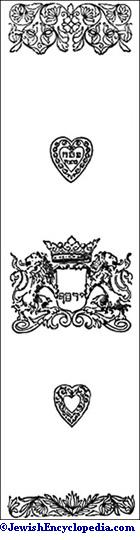
Cover for Maẓẓot.(From a drawing by Viefers.)
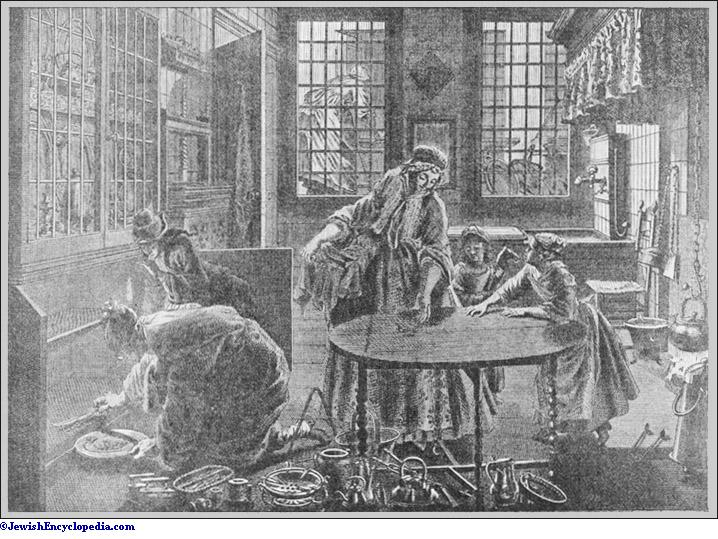
Search for Leaven.(From a drawing by Picart, 1725.)
Glosses concerning the observance of Passover are not infrequent in the historical narratives. The keeping of the rite is first mentioned as having occurred at Sinai (Num. ix. 1 et seq.); under Joshua, at Gilgal (Josh. v. 10), another celebration of it is noticed. Hezekiah figures prominently in an account of the revival of the festival after a long period in which it was not observed (II Chron. xxx.). The reforms of Josiah brought about a new zeal in behalf of this institution, the Passover celebrated at his bidding in the eighteenth year of his reign being described as singular and memorable (II Kings xxiii. 21 et seq.). After the return from the Captivity (Ezra vi. 19 et seq.) another Passover observance is reported to have taken place in due conformity with the required laws of purity and in a most joyful spirit.
The sacrifices ordained for Passover are as follows: "an offering made by fire, a burnt offering; two young bullocks, and one ram, and seven he-lambs of the first year, without blemish, and their meal-offering, fine flour mingled with oil; . . . and one he-goat for a sin-offering, beside the burnt offering of the morning." These were to be offered daily for seven days (Num. xxviii. 16-25, Hebr.).
E. G. H.Penalties for Infringement. —In Rabbinical Literature:
For reasons well known (see Calendar; Festivals; Holy Days) Passover was extended to eight days, including the 22d of Nisan, and the 23d of Nisan came to be regarded as a semiholy day, an "issur la-ḥag," according to the interpretation of Ps. cxviii. 27 (Suk. 45b; Rashi, ad loc.). The Biblical injunctions concerning the eating of leaven and the like (see Biblical Data) were applied in conformity with the methods of rabbinical exegesis. The quantity of leaven which, if eaten deliberately ("be-zadon"), entailed the penalty of excision was fixed at "ke-zayit," an amount equal to that of an olive (Maimonides, "Yad," Ḥameẓ, i. 1; Ker. i.). For inadvertent violation of the prohibition the penalty was the regular sin-offering. The phrase "to eat" in the prohibition was construed to include any use of leaven as nourishment (by drinking, for instance). In fact, neither advantage nor enjoyment ("hana'ah") might be drawn from leaven during the festival ("Yad," l.c. i. 2). Hence, neglect to remove the leaven from one's "reshut" (domain or house) entailed punishment for the violation of two prohibitions (comp. Ex. xiii. 7). The penalty of stripes "min ha-Torah" was not enforced except where, during the festival week, one had purchased leaven or caused the process of fermentation for some definite purpose. Still, neglect to remove leaven rendered one liable to "makkat mardut" (see Corporal Punishment; also "Yad," l.c. i. 3). Leaven not removed could never after be utilized—this prohibition being deduced from the construction of the Biblical text by the Soferim ("mi-dibre soferim"), and it mattered not that the neglect was unintentional or even unavoidable (l.c. i. 4). Leaven mixed with anything else during Passover rendered the article unfit for use. In this case, however, an exception was made where the leaven belonged to an Israelite; though itself barred from use, it was not forbidden, after the festival, when combined with other things.
"Karet" was imposed for eating pure "ḥameẓ," but the eating of mixed "ḥameẓ" ("'erub ḥameẓ"), of which the Mishnah (Pes. iii. 1) gives instances (see "Yad," l.c. i. 6), entails flagellation, though this depended upon the quantity consumed and the proportion of the ḥameẓ (l.c.). The interdiction against eating or using ḥameẓ becomes operative at noon of the 14th of Nisan, but as a precaution the Rabbis set the limit an hour earlier (l.c. i. 9) and even advise refraining from eating leavened food after ten in the morning (l.c. i. 10).
Removal of Leaven.
The proper removal of ḥameẓ ("bi'ur ḥameẓ") constitutes one of the chief concerns of rabbinical law and practise. Great care is enjoined in the inspection and cleaning of all possible nooks and corners, lest ḥameẓ be overlooked. The night preceding the 14th of Nisan was especially set apart for this inspection by candle-light or lamplight, not by moonlight, though it was not necessary to examine by candle-light places that were open to the sunlight. Study was suspended in favor of this duty of inspecting holes and corners. Minute regulations were devised for the inspection of holes midway between houses, but precautions were taken not to arouse suspicions of witchcraft in the minds of non-Jewish neighbors. Certain places, where the likelihood of finding ḥameẓ was infinitesimal, were exempt (see "Yad," l.c. ii.).
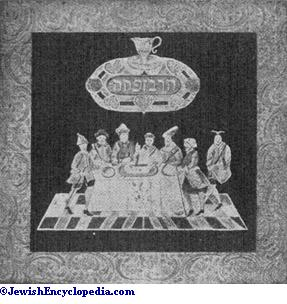
Cloth Used for Covering Passover Dish.(In the possession of Von Wilmersdörffer, Munich.)
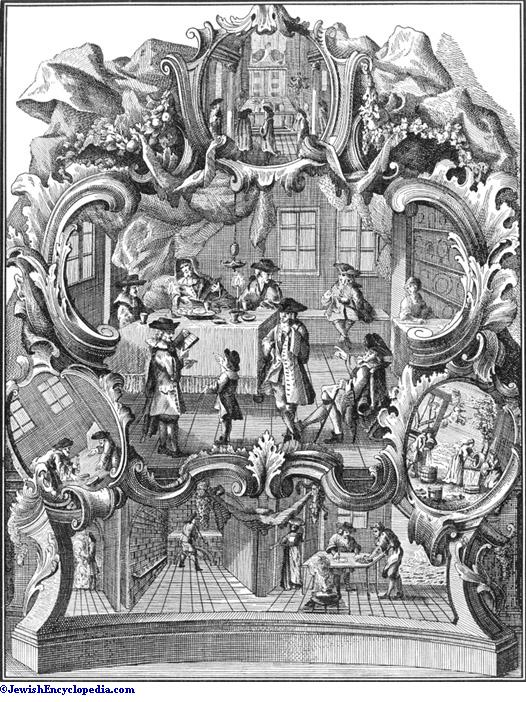
Seder Feast and Accompanying Passover Preparations.'(From Bodenschatz, "Kirchliche Verfassung," 1748.)
In practise this "bediḳat ḥameẓ" was effected as follows: As soon as night (on the 13th) had completely set in, the father of the household ("ba'al ha-bayit") lighted a plain wax taper, took a spoon and a brush, or three or four entire feathers, and, after having deposited a piece of bread in some noticeable place, as on a window-sill, to mark the beginning of the search, made the complete round of the house and gathered up all the leavened bread that was in it. Coming to the window-sill where the piece of bread was deposited, he carefully put it into the spoon, leaving no crums on the sill, and pronounced this benediction: "Blessed be Thou . . . who hast commanded us to remove the leaven." Then he added an Aramaic formula: "All leaven which perchance remains in my domain and which has escaped my observation shall be destroyed and be like unto the dust of the earth." Then the spoon and brush were tied into a bundle and suspended over the lamp in the room, or elsewhere, but so that mice could not get at it. Next morning, if the bundle was found untouched, it was not necessary to go through the same process; otherwise the inspection was repeated. The bundle and its contents were either sold or burned before six o'clock in the evening; only so much leaven was retained as would be needed up to ten in the morning (Shulḥan 'Aruk, Oraḥ Ḥayyim, 431; Pes. i.). This "investigation" was transferred to the eve of Sabbath when the 14th of Nisan coincided with the Sabbath.
Certain precautions were taken in the disposal by burning of the "terumah" (priestly portion). Neglect to inspect one's house at the proper time could be remedied by inspection later, even during the festival itself, or after its close, provided no benefit were derived from the ḥameẓ (for further details see "Yad," l.c. iii., iv.).
While regarding only five kinds of produce (two of wheat and three of barley) as ḥameẓ, rabbinical law is very careful to establish precautionary provisions lest the interdiction of ḥameẓ be violated, and with this in view culinary freedom is much restricted. Even the dishes and cooking-utensils are objects of special attention for this reason, and among the preparations made for the proper observance of the festival the "cleansing of the dishes" (= "hag'alat kelim") two or three days in advance is not the least important; a complete set of tableware and kitchen utensils is, as a rule, kept in readiness to take the place of those in use during the rest of the year.
The eating of maẓẓot is considered as a positive command for the first night of the festival ("Yad," l.c. vi. 1). A quantity equal to that of an olive is deemed sufficient to discharge this mandatory obligation. Intention ("kawwanah") is not essential; the fact that maẓẓah was eaten is sufficient. Still, certain limitations developed concerning the manner of preparing food containing maẓẓah when it was intended to be eaten in fulfilment of the obligation.
Recital of the Haggadah.
The Rabbis also regarded it as a positive duty on the first night to relate the miracles incidental to Israel's deliverance from Egypt; hence the Haggadah and the Seder. Each Israelite was obliged to drink on this night four cups of wine ("arba'ah kosot"); red wine was excluded later owing to the Blood Accusation. While eating the maẓẓah and drinking the wine, the position of free men (i.e., reclining on the left side against cushions) was obligatory on all male participants ("hasibah"). The benedictions over the several cups were specified. "Ḥarosat" also was compulsory, "mi-dibre soferim," for this meal. Maimonides ("Yad," l.c. vii. 11) gives the recipe for its preparation; but the bitter herbs were not regarded as obligatory by themselves; they formed a part of the Passover meal. The practise of eating bitter herbs now, though the paschal lamb is no longer prepared, is characterized as an institution of the scribes. "Afiḳomen," usually a dessert of sweet ingredients, was excluded from this meal (Pes. x. 8), its place being taken by a piece of the maẓẓah, which, as such, is familiar in Jewish folk-lore and proverbs.
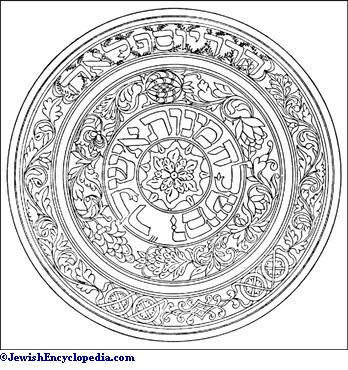
Passover Plate of the Seventeenth Century.(In the Kunstgewerbe-Museum, Düsseldorf.)
The Fast of the First-Born, in commemoration of the escape of the Hebrew first-born in Egypt, occurs on the 14th of Nisan. The chief of the house-hold may take the place of the minor son, or fastvoluntarily in case there be none in the family subject to the obligation.
Paschal Lamb.
The Passover lamb was killed, in the time of the Second Temple, in the court where all other "ḳodashim" were slaughtered, in keeping with the Deuteronomic prescription, and it was incumbent upon every man and woman to fulfil this obligation. The time "between the two evenings" ("ben ha-'arbayim") was construed to mean "after noon and until nightfall," the killing of the lamb following immediately upon that of the "tamid," the burning of the incense, and the setting in order of the lamps, according to daily routine. The killing was done with great caution, to avoid contact with ḥameẓ. After the carcass had been properly prepared, and the blood properly disposed of, it was taken home by its owner and roasted and eaten at eventide. The owners of the lambs were divided into three sets ("kittot") of at least thirty each, and during the slaughtering never less than thirty could be present in the courtyard. When the first group had entered the courtyard the doors were closed, and while the Levites sang the "Hallel" the lambs were killed, the psalms being sung, if necessary, three times.
The Ḥaburah.
In prescribed order the trumpets were blown, while the priests stood ready with gold and silver utensils to sprinkle the blood. The vessel was passed from one to the other that many might have a part in the meritorious act, until it reached the priest nearest the altar. The empty pan was returned. Then the carcasses were suspended on iron hooks along the walls and columns, or even on poles, shouldered between two men; the excrement was removed and the proper parts salted and incensed on the altar. The doors were then reopened, and, the first group departing, the second was admitted, and next the third, after which the court was cleansed. This order was observed even when the 14th fell on a Sabbath; but in that case the several groups would wait at certain stations in the Temple until the Sabbath was over before proceeding homeward. The lamb represented a "ḥaburah" (company); for single individuals it was not to be killed except in extraordinary cases. All members of the ḥaburah were to be in a state to eat at least "ke-zayit" (the equivalent of an olive). In the composition of the ḥaburah care was taken to avoid provoking levity; for instance, the sexes were kept apart. The members of the ḥaburah complied with the conditions, regarding purity, circumcision, etc., prescribed for partaking of the paschal lamb. Not only must the personal status of the owner be conformable to the law, but his ownership also must be beyond doubt; the lamb must be slaughtered on his account, and in accordance with the Biblical prescriptions and the Temple ordinances (see "Yad," Ḳorban Pesaḥ, iii. and iv.).
Passover and Sabbath.
Precautions were taken against defilement by contact with the dead. For this purpose, before Passover, the graves were whited. In fact, the whole of the preceding month was devoted to setting things in order with a view to facilitating the coming of the pilgrims to Jerusalem and to deciding judicial questions (Yer. Sheḳ. iii.). The usual sacrifices and the additional offerings were performed during this holy day. As stated above, later rabbinical practise was based on the principle that the Passover suspended the Sabbath law. But this question has an important bearing on the problem of reconciling the data in the Synoptics with those in John, and both with rabbinical law, with reference to the day of Jesus' death. Chwolson ("Das Letzte Passamahl Christi und der Tag Seines Todes," p. 31, St. Petersburg, 1892) contends that in the time of Jesus this was not yet a universally recognized canon, and that this would account for the discrepancy due to Jesus' slaughter of the paschal lamb on the eve of the 13th of Nisan. Chwolson's theory has not been generally accepted. The Samaritans and the Karaites slaughter the Passover lamb not earlier than about one hour and a half before dark.
According to the Samaritans, the offering can take place only on Mount Gerizim (see Aaron ben Elijah, "Gan 'Eden," Eupatoria, 1866, s.v. "Inyan Pesaḥ"; Geiger, in "Z. D. M. G." xx. 532-545; Ibrahim ibn Jacob, "Das Festgesetz der Samaritaner," ed. Dr. Hanover, Berlin, 1904). The Samaritans consider the Feast of Passover and the Feast of Unleavened Bread as two distinct festivals. The Sabbath is not suspended by the Pesaḥ offering (ib. p. 24). The custom among the Karaites corresponds to that of the Samaritans (see Judah Hadassi, "Eshkol ha-Kofer," § 202). On the 15th of Nisan, which is the "ḥag ha-maẓẓot" ("ḥaj al-faṭir"), no manner of work is permitted by the Samaritans, even cooking being prohibited; in this they are stricter than the Karaites, who permit the preparation of food (Aaron ben Elijah, ib. s.v. "Inyan Ḥag ha-Maẓẓot"). Processions are arranged on Mount Gerizim on this holy day (Petermann, "Reisen im Orient," i. 287; see also "Jour. Bib. Lit.," 1903). The 'Omer day does not fall on the second day (16th of Nisan), but on the Sunday after the Sabbath in the festival week.
E. C. E. G. H.—Critical View:
Comparison of the successive strata of the Pentateuchal laws bearing on the festival makes it plain that the institution, as developed, is really of a composite character. Two festivals, originally distinct, have become merged, their underlying ideas reappearing both in the legend associated with the holy day as its assumed historical setting and occasion, and in the ritual. The name  must be taken to be derived from that meaning of the root which designates the "skipping," "dancing" motions of a young lamb (Toy, in "Jour. Bib. Lit." 1897), only secondarily connoting "passing over" in the sense of "sparing." Pesaḥ, thus explained, is connected with pastoral life; it is the festival celebrated in early spring by the shepherds before setting out for the new pastures. In the ordinance of Ex. xii. the primitive manner of preparing the lamb for the family feast is still apparent. Such a family feast, naturally, was in the nature of a sacrifice, the gods of the clan being supposed to partake of it as well as the human members. There is a strong presumption that the skipping motions of the lamb were imitated by the participants, who in this wise "danced" around the sacrificial offering,and that this explains the designation of both the feast and the lamb.
Feast of First-Born.
There is good ground for the theory of Dozy ("Die Israeliten zu Mekka," Leyden, 1869) that the rites of the Arabian haj recall those of this old Israelitish "ḥag," though the inference drawn from this resemblance, that the Meccan celebration had been imported from Israel by the tribe of Simeon, must be rejected. The lamb served, however, the purpose of propitiating the gods and securing the prosperity of the flock about to depart for the pasture. Wellhausen's surmise that the lamb was a firstling, though not borne out by the Biblical data, seems to throw light on the connection, apparently very primitive, between the festival and the escape of the first-born and their subsequent devotion to Yhwh (Ex. xii., xiii.). The first-born of the flock (and even of men) was offered that the lives of those born later might be safe.
Hence the ceremony came naturally to be associated with the intention of "saving," and then with the fact of having "spared," from which secondary meaning of the root  came the tradition that the Hebrews' first-born had been "spared" in Egypt, God "passing over" their houses. The sprinkling of the blood points in the same direction. This was a feature accompanying every propitiatory slaughtering (see Samuel Ives Curtis, "Ursemitische Religion," p. 259, Leipsic, 1903). It is suggested that when later the tendency became dominant to give old festivals historical associations—a tendency clearly traceable in the evolution of the Biblical holy days—this very primitive practise was explained by a reference to the occurrence in Egypt during the "night of watching"—another expression which plainly refers to the night preceding the day of the flock's departure, and which, as such, was marked by a proper ritual. It has been urged that the term "night of watching" points to a custom similar to that which prevails in Germany, where the night before Easter is set apart for seeing the sun "jump" or "dance," as it is called; it is more likely, however, that the phrase has reference to the moon's phases.
Connected with Maẓẓot.
This pastoral Pesaḥ was originally distinct from the Maẓẓot festival, but it merged all the more readily with it because both occurred in the spring, about the time of the vernal equinox. The Maẓẓot feast is distinctly agricultural, the maẓẓot cakes being both the natural offering from the newly gathered barley to the gods that had allowed the crop to ripen, and then the staple food of the harvesters. Offering and food are nearly always identical in the concepts and practises of primitive races. The difficulty of finding an adequate historical explanation for the maẓẓot is apparent even in the account of Ex. xii., which would make them emblematic of the hurry of the deliverance from Egypt, though it was the supposition that the maẓẓot had been used at the Passover meal before the Exodus.
The agricultural character of the Passover (or Maẓẓot) festival is evidenced by the fact that it is one of the three pilgrim, or season, festivals. Of course, when the pastoral Pesaḥ and the agricultural Maẓẓot came to be merged can not be determined definitely, but one is safe in saying that it must have been shortly after the occupation of Palestine, the tradition about the Pesaḥ observed by Joshua at Gilgal (see Biblical Data) suggesting and confirming this assumption.
The relation of circumcision to Pesaḥ is explained when the original pastoral and propitiatory character of the latter is remembered. The pastoral clan would naturally exclude all that were not of the clan from the meal at which it trysted with its protecting god (that being the original significance of every solemn meal) and disarmed his jealousy. Circumcision itself was a rite of propitiation, like the lamb at Pesaḥ, possibly a substitute for human sacrifice. (See the legend of Cain and Abel for the bearing of the lamb, and that of Zipporah's sons for the bearing of circumcision, on human sacrifice.) A good case may be made out in favor of the theory that, for this reason, Pesaḥ was at one time the festival of the circumcision, all that had attained the proper age during the year being circumcised on one and the same day, namely, at Pesaḥ; the puzzling question why the lamb had to be set aside on the tenth finds in this its explanation. Three to four days were required to heal the wound of circumcision (see Josh. v. 8; Gen. xxxiv. 25), and the designation of maẓẓot as the "bread of affliction" (Deut. xvi. 3) may possibly carry some allusion to this custom.
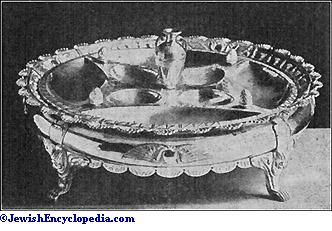
Passover Dish.(In the possession of E. A. Franklin, London.)
The law of the second Pesaḥ (Num. ix. 6) reflects the unsettled relations which the pastoral Pesaḥ originally bore to the agricultural harvest festival, the two, apparently, not being at first simultaneous.
(In the Johns Hopkins University, Baltimore, Md.)
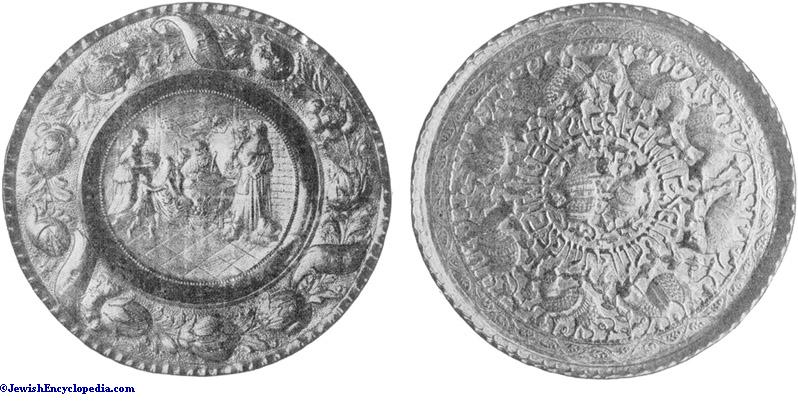
Passover Plates. (In the United States National Museum, Washington, D. C.)
The legal as well as the historical sources agree in assigning to this Pesaḥ = Maẓẓot festival a Mosaic (or a very remote) origin. In the Book of the Covenant "Pesaḥ" does not occur, "Maẓẓot" being used as it is in Ex. xxxiv. (verse 18), where "Pesaḥ" is named only in verse 25. Both the J-E (Jahvist-Elohist) and the P (Priestly) narratives emphasize the historical prominence of the day. It is J-E that explains maẓẓot as due to the haste of the departure (Ex. xii. 34, 39), while P presupposes their use at the meal in Egypt (Ex. xii. 8, 15-20). The Deuteronomist (D) seems to follow J-E in calling maẓẓot "the bread of affliction." According to the Book of the Covenant (Ex. xxiii. 15, xxxiv. 20), Pesaḥ is one of the three pilgrim festivals. The sacrifices to be offered by the community are mentioned only in II (the Holiness code; Lev. xxiii. 8) and P (Num. xxviii. 19). D insists that the Pesaḥ must be slaughtered at the central sanctuary (Deut. xvi.). D (Deut. xvi. 8) and the Book of the Covenant (Ex. xiii. 6) mention only the seventh day of Maẓẓot as a holy day. H (Lev. xxiii. 7) and P (Ex. xii. 16; Num. xxviii. 18, 25) make the first and the seventh day holy days. Ezekiel's scheme (Ezek. xlv. 21 et seq.) provides sacrifices different from those prescribed in P.
Bibliography:
For the analysis of the Pentateuchal texts see Wellhausen, Die Composition des Hexateuchs:
Kuenen, Einleitung;
and the commentaries. Comp. F. C. Baur, in Theologische Zeitschrift, 1832;
Ewald, in Zeitschrift für die Kunde des Morgenlandes, iii. 424 et seq.;
Vatke, Religion des Alten Testaments, pp. 492 et seq.;
Lengerke, Kanaan, i. 381;
Nowack, Archäologie, ii. 148 et seq.;
Kurtz, Der Alttestamentliche Opferkultus, 1862;
Wellhausen, Prolegomena, 1899;
Riedel, in Stade's Zeitschrift, 1900;
R. Schaefer, Das Mazzotfest, Güterslohe, 1900;
S. A. Fries, Die Gesetzesschrift des Königs Josia, Leipsic, 1903.
Jews of all classes and ways of thinking look forward to the Passover holidays with the same eagerness as Christians do to Christmastide. It is for them the great event of the year. With the exception of the Temple sacrifices, their manner of observing it differs but little from that which obtained in the time of Christ. Directions for keeping the feast were carefully laid down in the Law (see Exodus 12, 13, etc.), and carried out with great exactness after the Exile. THE PREPARATIONThe feast of the Passover begins on the fourteenth day of Nisan (a lunar month which roughly corresponds with the latter part of March and the first part of April) and ends with the twenty-first. The Jews now, as in ancient times, make elaborate preparations for the festival. Every house is subjected to a thorough spring cleaning.The Saturday preceding the day of the Pasch (fifteenth) is called a "Great Sabbath", because it is supposed that the tenth day of the month Abib (or Nisan) -- when the Israelites were to select the Paschal lambs, before their deliverance from Egypt -- fell on a Sabbath. On this Sabbath, the day of the following week on which the Passover is to fall is solemnly announced.Some days before the feast, culinary and other utensils to be used during the festival are carefully and legally purified from all contact with leaven, or leavened bread. They are then said to be kosher. Special sets of cooking and table utensils are not unfrequently kept in every household.On the evening of the thirteenth, after dark, the head of the house makes the "search for leaven" according to the manner indicated in the Mishna (Tractate Pesachim, I), which is probably the custom followed by the Jews for at least two thousand years. The search is made by means of a lighted wax candle. A piece of ordinary, or leavened, bread is left in some conspicuous place, generally on a window-sill. The search begins by a prayer containing a reference to the command to put away all leaven during the feast. The place of the piece of bread just mentioned is first marked to indicate the beginning of the search. The whole house is then carefully examined, and all fragments of leaven are carefully collected on a large spoon or scoop by means of a brush or bundle of quills. The search is ended by coming back to the piece of bread with which it began. This, also is collected on the scoop. The latter, with its contents, and the brush are then carefully tied up in a bundle and suspended over a lamp to prevent mice from scattering leaven during the night and necessitating a fresh search. The master of the house then proclaims in Aramaic that all the leaven that is in his house, of which he is unaware, is to him no more than dust.During the forenoon of the next day (fourteenth) all the leaven that remains is burnt, and a similar declaration is made. From this time till the evening of the 22nd, when the feast ends, only unleavened bread is allowed. The legal time when the use of leavened bread was prohibited was understood to be the noon on the fourteenth Nisan; but the rabbis, in order to run no risks, and to place a hedge around the Law, anticipated this by one or two hours. THE PASCHAL FEASTOn this day, the fourteenth, the first-born son of each family, if he be above thirteen, fasts in memory of the deliverance of the first-born of the Israelites, when the destroying angel passed over Egypt. On the evening of the fourteenth the male members of the family, attired in their best, attend special services in the synagogue.On their return home they find the house lit up and the Seder, or Paschal Table, prepared. The head of the family takes his place at the head of the table, where there is an arm-chair prepared for him with cushions or pillows. A similar chair is also ready for the mistress of the house. The meal is called Seder by the Ashkenaziac Jews, and Haggadah (because of the story of the deliverance recited during it) by the Sephardic Jews. All the members of the Jewish family, including servants, sit round the table.In front of the head of the family is the Seder-dish, which is of such a kind as to allow three unleavened cakes or matzoth, each wrapped in a napkin, to be placed on it one above the other. A shank bone of lamb (with a small portion of meat attached) which has been roasted on the coals is placed, together with an egg that has been roasted in hot ashes, on another dish above the three unleavened cakes. The roasted shank represents the Paschal lamb, and the roasted egg the chagigah, or free will offerings, made daily in the Temple. Bitter herbs, such as parsley and horseradish, a kind of sop called charoseth, consisting of various fruits pounded into a mucilage and mixed with vinegar, and salt water, are arranged in different vessels, sometimes disposed like candelabra above the leavened bread. The table is also furnished with wine, and cups or glasses for each person, an extra cup being always left for the prophet Elias, whom they expect as the precursor of the Messiah.The First CupWhen all are seated around the table the first cup of wine is poured out for each. The head of the house rises and thanks God for the fruits of the vine and for the great day which they are about to celebrate. He then sits down and drinks his cup of wine in a reclining posture, leaning on his left arm. The others drink at the same time. In the time of the Temple the poorest Jew was to drink four cups of wine during this joyful meal; and if he happened to be too poor, it was to be supplied out of public funds. Though four cups are prescribed, the quantity is not restricted to that amount. Some water is generally added to the wine. In early days red wine was used; but on account of the fear of fostering the groundless blood accusations against Jews, this usage was discontinued. Unfermented raisin wine or Palestinian wine is now generally used.The Bitter Herbs and AfikomanAfter drinking the first cup the master rises and washes his hands, the others remaining seated, and Eldersheim is of the opinion that it was at this point of the supper that Christ washed the disciples feet. After washing his hands, the head of the family sits down, takes a small quantity of bitter herbs, dips them in salt water, and eats them, reclining on his left elbow. Jewish interpreters say that only the first Passover was to be eaten standing, and with circumstances of haste. During the Passovers commemorative of the first they reclined "like a king [or free man] at his ease, and not as slaves" -- in this probably following the example of the independent Romans with whom they came into contact. After the head of the family has eaten his portion of bitter herbs, he takes similar portions, dips them in salt water, and hands them round to be eaten by the others.He then takes out the middle unleavened cake, breaks it in two, and hides away one-half under a pillow or cushion, to be distributed and eaten after supper. If this practice existed in the time of Christ, it is not improbable that it was from this portion, called afikoman, that the Eucharist was instituted. As soon as this portion is laid aside, the other half is replaced, the dish containing the unleavened cakes is uncovered, and all, standing up, take hold of the dish and solemnly lift it up, chanting slowly in Aramaic: "This is the bread of affliction which our fathers ate in Egypt. This year here, next year in Jerusalem. This year slaves, next year free."The Second Cup The dish is then replaced and the shank bone, roasted egg, etc. restored to their places above it. All sit down, and the youngest son asks why this night above all other nights they eat bitter herbs, unleavened bread, and in a reclining posture. The head of the house then tells how their fathers were idolaters when God chose Abraham, how they were slaves in Egypt, how God delivered them, etc. God is praised and blessed for His wondrous mercies to their nation, and this first part of the ceremony is brought to a close by their breaking forth with the recitation of the first part of the Hallel (Psalms 112 and 114) and drinking the second cup of wine, which is triumphantly held aloft and called the cup of the Haggadah or story of deliverance.The Meal ProperThe ceremony so far has been only introductory. The meal proper now begins. First all wash their hands; the president then recites a blessing over the unleavened cakes, and, after having dipped small fragments of them in salt water, he eats them reclining. He next distributes pieces to the others. He also takes some bitter herbs, dips them in the charoseth, and gives them to the others to be eaten. He next makes a kind of sandwich by putting a portion of horse-radish between two pieces of unleavened bread and hands it around, saying that it is in memory of the Temple and of Hillel, who used to wrap together pieces of the paschal lamb, unleavened bread, bitter herbs, and eat them, in fulfilment of the command of Exodus 12:8.The supper proper is now served, and consists of many courses of dishes loved by Jews, such as soup, fish, etc., prepared in curious ways unknown to Gentiles. At the end of the meal some of the children snatch the afikoman that has been hidden away, and it has to be redeemed by presents -- a custom probably arising from a mistranslation of the Talmud. It is then divided between all present and eaten. Oesterly and Box think that this is a survival from an earlier time when a part of the paschal lamb was kept to the end and distributed, so as to be the last thing eaten.The Third CupWhen the afikoman is eaten, the third cup is filled; and grace after meals is said, and the third cup drunk in a reclining posture. A cup of wine is now poured out for the prophet Elias, in a dead silence which is maintained for some time, and the door is opened. Imprecations against unbelievers, taken from the Psalms and Lamentations, are then recited. These were introduced only during the Middle Ages.The Fourth CupAfter this the fourth cup is filled and the great Hallel (Psalms 115-118) and a prayer of praise are recited. Before drinking the fourth cup, the Jews of some countries recite five poetical pieces and then the fourth cup is drunk. At the end a prayer asking God to accept what they have done is added. Among the German and Polish Jews this prayer is followed by popular songs. THE REMAINDER OF PASSOVER WEEKThe same ceremonies are observed the next evening. According to the Law the fifteenth and twenty-first were to be kept as solemn festivals and days of rest. At present the fifteenth and sixteenth, the twenty-first and twenty-second are whole holidays, a custom introduced among the Jews of the Dispersion to make sure that they fulfilled the precepts of the Law on the proper day. The other days are half-holidays. Special services are held in the synagogues throughout the Passover week. Formerly the date of the Pasch was fixed by actual observations [Schurer, History of the Jewish People (Edinburgh, 1902), I, II, Append. 3]. It is now deduced from astronomical calculations.----------------------------------- OESTERLY AND BOX, Religion and Worship of the synagogue (London, 1907); DEMBITZ, Jewish Services in the Synagogue and Home (Philadelphia, 1898); GINSBURG in KITTO, Cyclop. Of Bibl. Lit..; ABRAHAMS in HASTINGS, Dict. Of the Bible, s.v. Passover; SMITH, Bibl. Dict.; ZANGWILL, Dreamers of the Ghetto (London): JACOBS, Jewish Year Book (LONDON, annual); EDERSHEIM, Life and Times of Jesus the Messiah, II (London, 1900), 479. C. AHERNETranscribed by John Looby The Catholic Encyclopedia, Volume XICopyright © 1911 by Robert Appleton CompanyOnline Edition Copyright © 2003 by K. KnightNihil Obstat, February 1, 1911. Remy Lafort, S.T.D., CensorImprimatur. +John Cardinal Farley, Archbishop of New York
1. Pesach and Maccoth
2. Pesach Micrayim
3. Pesach Doroth
4. Maccoth
5. The ’Omer
6. Non-Traditional Theories
7. The Higher Criticism
8. Historical Celebrations: Old Testament Times
9. Historical Celebrations: New Testament Times
10. The Jewish Passover
1. Pesach and Maccoth:
The Passover was the annual Hebrew festival on the evening of the 14th day of the month of
2. Pesach Micrayim:
The ordinance of
3. Pesah Doroth:
This service was to be observed as an ordinance forever (Exo 12:14, Exo 12:24), and the night was to be lel
4. Maccoth:
Unleavened bread was eaten with the Passover meal, just as with all sacrificial meals of later times (Exo 23:18; Exo 34:25; Lev 7:12), independently perhaps of the fact that the Passover came in such close proximity with the Feast of Unleavened Bread (Exo 12:8). Jewish tradition distinguishes, at any rate, between the first night and the rest of the festival in that the eating of
During the entire week additional sacrifices were offered in the temple: an offering made by fire and a burnt offering, 2 young bullocks, 1 ram, 7 lambs of the first year without blemish, together with meal offerings and drink offerings and a goat for a sin offering.
5. The ’Omer:
During the week of the
6. Non-Traditional Theories:
Many writers, however, eager to explain the entire festival as originally an agricultural feast (presumably a Canaanitic one, though there is not a shred of evidence that the Canaanites had such a festival), have seized upon the
7. The Higher Criticism:
The Pentateuch speaks of the Passover in many contexts and naturally with constantly varying emphasis. Thus the story of the Exodus it is natural to expect fewer ritual details than in a manual of temple services; again, according to the view here taken, we must distinguish between the
8. Historical Celebrations: Old Testament Times:
The children of Israel began the keeping of the Passover in its due season according to all its ordinances in the wilderness of Sinai (Num 9:5). In the very beginning of their national life in Palestine we find them celebrating the Passover under the leadership of Joshua in the plains of Jericho (Jos 5:10). History records but few later celebrations in Palestine, but there are enough intimations to indicate that it was frequently if not regularly observed. Thus Solomon offered sacrifices three times a year upon the altar which he had built to Yahweh, at the appointed seasons, including the Feast of Unleavened Bread (1Ki 9:25 = 2Ch 8:13). The later prophets speak of appointed seasons for pilgrimages and sacrifices (compare Isa 1:12-14), and occasionally perhaps refer to a Passover celebration (compare Isa 30:29, bearing in mind that the Passover is the only night-feast of which we have any record). In Hezekiah’s time the Passover had fallen into such a state of desuetude that neither the priests nor the people were prepared for the king’s urgent appeal to observe it. Nevertheless, he was able to bring together a large concourse in Jerusalem during the 2nd month and institute a more joyful observance than any other recorded since the days of Solomon. In the 18th year of King Josiah, however, there was celebrated the most memorable Passover, presumably in the matter of conformity to rule, since the days of the Judges (2Ki 23:21; 2Ch 35:1 ff). The continued observance of the feast to the days of the exile is attested by Ezekiel’s interest in it (Eze 45:18). In post-exilic times it was probably observed more scrupulously than ever before (Ezr 6:19 ff).
9. Historical Celebrations: New Testament Times:
Further evidence, if any were needed, of the importance of the Passover in the life of the Jews of the second temple is found in the Talmud, which devotes to this subject an entire tractate,
10. The Jewish Passover:
After the destruction of the temple the Passover became a home service. The paschal lamb was no longer included. Only the Samaritans have continued this rite to this day. In the Jewish home a roasted bone is placed on the table in memory of the rite, and other articles symbolic of the Passover are placed beside it: such as a roasted egg, said to be in memory of the free-will offering; a sauce called
The prohibition against leaven is strictly observed. The searching for hidden leaven on the evening before the Passover and its destruction in the morning have become formal ceremonies for which appropriate blessings and declarations have been included in the liturgy since the days when Aramaic was the vernacular of the Jews. As in the case of other festivals, the Jews have doubled the days of holy convocation, and have added a semi-holiday after the last day, the so-called
In the NT we meet with two alternative names for the great Jewish festal season of the Passover-ôὸ ðÜó÷á and ôὰ ἄæõìá. These are the LXX_ equivalents for the corresponding Heb. terms in the OT, ðÜó÷á being a rough transliteration of Heb. pesaḥ (probably through the Aramaic form pasḥa), and ôὰ ἄæõìá a translation of Heb. hammaẓẓôth (‘the unleavened bread,’ Exo_12:17), a brief form of reference to ḥag hammaẓẓôth (‘the feast of the unleavened bread,’ Exo_23:15). We have also one instance of the full phrase ἡ ἑïñôὴ ôῶí ἀæýìùí in Luk_22:1. Similarly ôὸ ðÜó÷á is an abbreviation for ἡ ἑïñôὴ ôïῦ ðÜó÷á (Luk_2:41); and this is parallel with the OT use of happesaḥ (e.g. Jos_5:10) for the full ḥag happesaḥ (e.g. Exo_34:25). In both cases the name of an essential feature of the feast (the lamb, the cakes) is used to denote the feast itself. The analogy of the use of the maẓẓôth (‘cakes’) as a short name for the festival suggests that pesaḥ was originally the special name for the lamb and that it is not the name of the feast transferred to the lamb. ‘Killing’ and ‘eating’ ôὸ ðÜó÷á are just as often spoken of as ‘keeping’ ôὸ ðÜó÷á.
It would be impossible for readers of the LXX_, who were familiar only with Greek, to realize such word-play between ‘passover’ and ‘pass over’ as is found in Exodus 12 -word-play which is obvious alike in EVV_ and in Heb.; e.g. Exo_12:27 : zebhaḥpesaḥ … ǎsher pâsaḥ, ‘passover-sacrifice (to the Lord) who passed over.’ The LXX_, which uses ðÜó÷á invariably for pesaḥ, reads in the same passage, ‘A sacrifice to the Lord is this pasch (ôὸ ðÜó÷á), for He screened (ἐóêÝðáóå) the houses of the people of Israel.’
The Vulg._ handling of the term is very curious. At its first appearance in Exo_12:11 it is a sort of transliteration yielding the odd form Phase followed by an explanatory parenthesis, ‘(id est, transitus) Domini.’ So throughout the OT, except in Ezra and Ezekiel, Phase as an indeclinable substantive continues to be used, but some caprice is shown in using sometimes Phase and sometimes phase. In Ezr_6:19-20 and Eze_45:21 the form Pascha appears: and in the NT this term is invariably used. It appears to be generally intended to mark the distinction between the name as applied to the feast and as applied to the lamb by using Pascha in the former case (‘facere, celebrare Pascha’) and pascha in the latter (‘immolare, comedere, manducare pascha’). Uncertainty, too, is shown as to the declension of the word, it being treated both as feminine and as neuter (e.g. Luk_2:41 ‘in die solemni Paschae’; Luk_22:8, ‘parate nobis pascha’). Similarly we have in Mar_14:1 ‘Erat autem Pascha et Azyma,’ and in Luk_22:1 ‘appropinquabat autem dies festus Azymorum, qui dicitur Pascha.’ In Act_12:3; Act_20:6 is found ‘dies Azymorum.’
Whether we have not here traces of two ancient Spring festivals, one pastoral (peṣaḥ) and one agricultural (maẓẓôth), now merged into one and invested with a new significance as a historical commemoration which almost wholly obliterates the primitive origins, is a question that lies beyond the scope of this article. This much, however, may be said. The real origin of the term pesaḥ (and so ðÜó÷á) is, to say the least, obscure. The explanation given in Exodus 12 quite possibly indicates the well-known tendency to supply a derivation for a term from itself, especially when it is to be adapted to new uses. For ðÜó÷á, we know, a connection with ðÜó÷ù (‘suffer’), was found as early as Irenaeus (2nd cent. a.d.), who says: ‘A Moyse ostenditur Filius Dei, cuius et diem passionis non ignoravit, sed figuratim pronunciavit, eum pascha nominans’ (Haer. iv. 10). Tertullian and Chrysostom repeated the error of connecting ðÜó÷á with our Lord’s Passion. There must have been very many, familiar only with Greek, to whom the term itself was meaningless.
1. The feast.-The Passover was a ḥag, i.e. a pilgrim feast characterized by joyousness; it was necessarily observed at the central sanctuary at Jerusalem. Josephus mentions more than once the large numbers that came up to the feast, and speaks of it as a particularly turbulent time when sedition was liable to break out on the slightest provocation (see Ant. XVII. ix. 3, XX. v. 3). He calculates that there were 2,700,200 capable of celebrating the Passover at the time of the destruction of Jerusalem (BJ_ VI. ix. 3; see also [for a.d. 65] BJ_ II. xiv. 3). Whatever exaggeration there may be in these numbers, it is clear that the concourse of people at the feast must have been great. According to the same authority, more than once in the unquiet years which preceded the fall of Jerusalem the Passover was made the occasion of massacre and bloodshed in which many perished.
With the fall of Jerusalem and the destruction of the Temple, the Passover necessarily ceased to be a ḥag. It became simply a domestic festival, though of peculiar preciousness. Their downfall as a nation, their being scattered abroad throughout the world, could not blot out for the Jews the memory of their redemption from Egyptian bondage, which the festival commemorated, whilst it also kept alive hopes for the days to come. The scene of the celebration was the home, and those who kept the feast were the family circle or household. But we are largely in the dark as to how the Jews observed the feast, say in a.d. 71, when it was no longer possible to go up to Jerusalem, and how exactly the celebration of the Passover (as well as other matters) was adjusted to the new order of things. All we know is that out of a period of uncertainty and dimness the Passover feast emerges as one of the most distinctive features of Judaism, one that has been made the subject of a special tractate of the Mishna (Pesaḥim), and one that has continued to this day as a specially valued festival.
2. The Passover as a note of time.-Twice in the Acts (Act_12:3; Act_20:6) we have ‘the days of unleavened bread’ referred to as a note of time. No absolute certainty is attainable with reference to NT chronology; everything, therefore, that can shed light on it is to be welcomed. In Act_12:3 we have the fact explicitly mentioned that it was the Passover time when the occurrences there recorded took place; but unfortunately that does not give us information as to the year. The uncertainties, however, are narrowed down to the limits of a very few years, and careful calculation has shown that Herod Agrippa I. most probably died in a.d. 44. St. Peter mysteriously disappears from view, leaving us henceforth dependent on uncertain tradition for all further knowledge of his career. The unfortunate translation of ìåôὰ ôὸ ðÜó÷á in AV_ as ‘after Easter’ is an obvious anachronism, unless, indeed, ‘Easter’ was in the 16th cent. used indiscriminately for the Jewish and the Christian Pasch. Act_20:6 f. also probably indicates the Passover of a.d. 56 or 57 as marking the close of the missionary activity of St. Paul, who was arrested soon after (see art._ ‘Chronology of the NT’ in HDB_ i. 416, 420).
Nothing could show better than these scanty notes of time how deep-rooted the custom was, how the feast was observed as regularly as the year came round. Men spoke naturally of ‘the days of the unleavened bread’ as a significant point in the calendar, just as we speak of ‘after Christmas’ or ‘at Christmas.’ Ordinary dates dwindle into insignificance beside these fixed, outstanding seasons. Similarly we find the other primary Jewish festivals (Tabernacles and Pentecost) used in the same way-Joh_7:2 (Tabernacles), Act_2:1; Act_20:16, 1Co_16:8 (Pentecost).
3. How Passover was kept in apostolic times.-Even among the Jews the Paschal observance had undergone considerable changes in the course of time. Whilst a due reference was preserved to the all-important fact of the deliverance from Egypt, the emergence of the Jews as more or less a people, yet time and historical catastrophes had left their mark. What mention, e.g., is there in the Pentateuchal legislation of the four cups of wine? When were they introduced? We cannot tell; yet they were a settled feature of the feast in our Lord’s day. The cup which He took in the institution of the Lord’s Supper was no new thing. It is generally admitted that this was the third cup or cup of blessing which is still drunk at the conclusion of the meal (‘after supper,’ Luk_22:20, 1Co_11:25). The greatest difference, however, was made by the destruction of Jerusalem in a.d. 70. Up to that time the paschal lambs had been slain in their thousands year by year. Then it all ceased. A roasted shank-bone of a lamb is all that remains of the most notable element of the feast as originally ordained. On the other hand, the unleavened cakes and the bitter herbs (now taking the form of horse-radish) go back to primitive times.
But ‘the present Passover liturgy contains comparatively very few relics from New Testament times’ (A. Edersheim, The Temple: its Ministry and Services as they were at the Time of Jesus Christ, London, n.d., p. 231). Perhaps it is more correct to say that the present Passover liturgy contains large expansions of and additions to the ritual observed in the 1st cent. a.d. What that form was exactly it is impossible to tell. It was pre-eminently a time of revolution: the breakup and passing away of the old order to give place to a new. The transformation of Passover from a ḥag to a purely domestic festival was not so sudden as might at first appear. Even before the destruction of Jerusalem the domestic festivities were of growing importance, although that stupendous event made an end of the whole sacrificial system and yearly festal gatherings. We may be sure, however, that the kernel of the commemoration was jealously maintained, that the essential framework of the ritual to-day was there from the first. That ritual briefly is as follows. The search for leaven on the eve of Passover with quaint formulae ushers in the feast. The festival commences with a sanctification; then comes the first cup of wine; the aphiḳomen (half a maẓẓah, which is reserved to be eaten at the close) is set aside; the question is asked, ‘Why is this night distinguished from all other nights?’ to which a long response is given; this is followed by the first part of Hallel (Psalms 113, 114), the second cup of wine, washing of the hands; the unleavened bread (maẓẓôth) is eaten with bitter herbs (horse-radish); next comes Hillel’s ceremony (eating a piece of horse-radish placed between two pieces of unleavened bread); the aphiḳomen is eaten, grape after meals is said with considerable additions; then there is the third cup of wine and the opening of the door; Hallel is resumed (Psalms 115-118); Psalms 136 is recited with large expansions, followed by the fourth cup of wine and prayer for the Divine acceptance of the service; ‘Adir hu’, an impassioned song praying for the rebuilding of the Temple, brings all to a close.
Such a curious feature as the opening of the door is of uncertain date, but, though most likely later than the 1st cent. a.d., is yet of considerable age. The expansions are mostly seen in the Haggâdic matter-the long narrative sections which are so conspicuous a feature of the observance. The compositions, ‘How many are the benefits which God has conferred upon us?’ ‘And it came to pass at midnight,’ ‘Ye shall say, “It is the sacrifice of Passover,” ’ ‘To Him praise has ever been and ever will be due,’ and others, must be dated long after apostolic times. On the other hand, the Hallel and other portions of the Psalms are most probably amongst the oldest features.
One feature of the celebration on the second night of the Passover carries us back uninterruptedly to the primitive times when the Jews were settled in Canaan and were an agricultural people. It is the counting of the omer, and it most particularly reminds us that here we have originally a celebration of the recurring seasons of the year and the yearly ingathering of the earth’s fruits. The first-fruits of barley harvest were offered on the second day of Passover, and from then seven weeks were counted by primitive methods of calculation; this brought them to Pentecost and the beginning of wheat harvest. ‘Though one ephah, or ten omers, of barley was cut down, only one omer of flour, or about 5·1 pints of our measure, was offered in the Temple on the second Paschal’ (Edersheim, op. cit. p. 259). Ages have passed, the Jews are scattered throughout the world, there is no longer flour to be offered, there is no omer; still at the evening service in the synagogue and on the second night of the festival in the home, as regularly as the Passover comes round, the words are said: ‘Blessed art Thou, O Lord our God, King of the universe, who hast sanctified us with Thy precepts and commanded us concerning the counting of the Omer. This is the first day of the Omer. May it be Thy will, O Lord our God and the God of our fathers, to rebuild thy Temple speedily, in our days, and to make Thy law our portion.’ And at evening service in the synagogue daily the counting goes on until the night before Pentecost (see art._ Pentecost).
Whenever the custom may have originated, it is curious to think that still in every Jewish home, just after the third cup, or cup of blessing, has been drunk, the door is opened to admit the prophet Elijah, for whom a spare cup of wine is always set, as the forerunner of the Messiah. ‘May the All-merciful send us Elijah the prophet … who shall give us good tidings, salvation, and consolation.’ We think of the question: ‘Why then say the scribes that Elijah must first come?’ (Mat_17:10), and of the answer: ‘Elijah is come already.’ That which differentiates between Jew and Christian is mainly the recognition of Jesus as the Christ. How can we fail to feel the pathos in the impassioned prayers with which the Paschal service closes? ‘O mighty God, rebuild Thy house speedily, speedily even in our days, rebuild it. O God, rebuild Thy Temple speedily!’ and in the aspiration repeated more than once, but especially before the fourth cup: ‘Next year in Jerusalem!’ We wonder how far these words really express the yearning of the Jewish heart. Words and formulae often live on and survive the original desire, very intense and sincere, which prompted them.
The question arises, as in the matter of keeping Sabbath on the seventh day, whether the early Christians continued to observe these festivals just the same as the Jews. They did not at once break away from the practices in which they had been brought up (see, e.g., Act_3:1). ‘The Christian Churches in Judaea existed as Jewish sects’ (C. von Weizsäcker, The Apostolic Age, i.2 [London, 1897] 175), and it is with Jewish Christians that we are first of all concerned. In all probability they went on for years observing the festivals with their old Jewish significance as they also complied with other traditional usages. J. Bingham, indeed, on very slender grounds holds that the ‘first Christians of Jerusalem … did not keep Easter with the Jews on what day of the week scever it fell, but on the Sunday following in honour of our Saviour’s resurrection’ (Ant. XX. v. 4 [in Works, Oxford, 1855, vol. vii.]). Apart even from the loose wording here, when we come to look into matters we see that he has little, if any, authority for the belief. The ‘first day of the week,’ the Lord’s Day, was the regular, weekly commemoration of our Lord’s resurrection. It is more than doubtful if there was an annual commemoration (‘Easter’) in apostolic times.
But the old runs into the new. Even though still marking events by ‘the days of unleavened bread’ (Act_12:3), they might well invest the season with a new significance as time went on, and associate it with a new commemoration. ‘When the apostles came to write of the bondage of sin and the new liberty and life in Christ, their teaching would be all the more easily understood and more lovingly accepted, because to many of their readers it recalled the Passover table of the family and the sound of silent voices’ (G. M. Mackie, ‘The Jewish Passover in the Christian Church,’ ExpT_ xiii. [1901-02] 392).
St. Paul, however, who divined most accurately the true genius of Christianity as a religion with universal aims, evidently disapproved of the continuance of Judaism as a system crippling the spiritual energies of the Church, the new liberty in Christ. He explicitly deprecated the observance of Jewish feasts (Gal_4:8-11) on the part of purely Gentile converts. Col_2:16 is equally decided. Though he was, as he himself proudly claimed, ‘a Hebrew of Hebrews,’ it is more than questionable if he kept the Passover after his conversion and after he had grasped the meaning of Christianity for the Gentile world. And when he makes an allusion to the feast in writing to the Corinthians (1Co_5:6-8), it shows only that the feast per se has no longer any interest for him. It may, indeed, show incidentally that it was somewhere about the time of its celebration that he was writing his Epistle; but his allusions are purely symbolic. He gives to the Paschal lamb and to the unleavened bread a meaning of which his forefathers never dreamed. To St. Paul more than to any other is it due that Christianity broke away from the swaddling-clothes of Judaism and became a faith with a far more glorious redemption than the Exodus to commemorate.
As L. Duchesne remarks, ‘There was no reason why Christians should observe the feasts and fasts of the Jewish calendar. They were allowed to drop out of use. Nevertheless, each year one of these holy days, the Paschal Feast or the Feast of the Azymes, recalled the memory of the Passion of the Saviour. The memories which Israel had connected, and still connected, with this anniversary might no longer be of interest; but it was impossible to forget that Our Lord had died … on one of those days. The Pasch was therefore retained, though the ritual details of the Jewish observance were omitted’ (Early History of the Christian Church, Eng. tr._ of 4th ed., i. [London, 1909] 207 f.).
4. ‘Christ our Passover.’-We have already referred in passing to 1Co_5:6-8, but both here and in 1Co_15:20; 1Co_15:23 there are allusions to Passover (‘the firstfruits,’ ἀðáñ÷Þ) which call for a rather more extended notice. For they show us better than anything else how the transition from the Jewish to the Christian Pasch was made, how the new interest and commemoration swallowed up and superseded the old. Once again Passover was in all probability being celebrated in the Jewish community. But St. Paul, perhaps for the very first time, was quick to see an illustration of Christ and His redeeming work in the sacrifice of the lamb, and in the complete removal of leaven which preceded the feast (Exo_12:15) an illustration of the moral purification which Christianity calls for. He sees, again, in the first-fruits offered at the Passover an illustration of what Christ is in His resurrection to the harvest field of the dead.
(a) ôὸ ðÜó÷á ἡìῶí: ‘our Paschal lamb,’ i.e. of Christians as distinct from Jews. It is altogether unnecessary to see in the lamb of the original institution an actual prototype of our Lord. To see in the Paschal lamb ‘the prefiguration of Jesus Christ whose death is the sacrifice which averts the wrath of God from His community’ (C. von Orelli, art._ ‘Passover’ in Schaff-Herzog_, viii. 370) is to go beyond what is warranted. The reference is too casual for so much to be built upon it. The Apostle never again speaks of Christ as a lamb. The lamb of the Passover, moreover, was partaken of in a festal meal, and St. Paul was probably thinking specially of this. For he immediately follows with ‘Therefore let us keep festival’ (ἑïñôÜæùìåí); not with a reference to any feast in particular, but to the new life of joyousness Christians are to live, in which ‘sincerity and truth’ are essential (so Chrysostom, Hom. in 1 Cor. xv. 3. 8). Again we have Christ compared to a ‘lamb without blemish and without spot’ (1Pe_1:19), absolute purity, however, being a general requirement in any sacrifice offered to God (Deu_17:1). Allegory soon became busy with these representations of the Lord. He was ‘the Lamb of God’ (Joh_1:29) rather in antithesis to the whole sacrificial system of the Jews. The majestic apocalyptic figure of the Lamb which is all-prominent in Rev. is the outgrowth of this conception, and is mainly responsible for the Agnus Dei of Christian art._
(b) ἀðáñ÷Þ, LXX_ for Heb. re’shîth (Lev_23:10), ‘firstfruits.’ It is almost impossible that St. Paul should use this particular term without having in mind a reference to the offering of first-fruits at Passover, especially when we take it in connection with Lev_5:6. R. F. Weymouth (The NT in Modern Speech3, London, 1909, p. 469) translates (no doubt advisedly) 1Co_15:20, ‘being the first to do so of those who are asleep’; and again 1Co_15:23, ‘Christ having been the first to rise’: but this entirely obscures the beautiful figure of the harvest field. As used by St. Paul, the gathering of first-fruits and the presenting of them to God is a pledge that the whole harvest shall be reaped.
5. Passover and the Eucharist.-Is there any connection between the Passover of the Jews and the Lord’s Supper of the Christian Church? Our limitations forbid any treatment in detail of what is still a very vexed question. It must be admitted that the materials are scanty and not free from obscurity. The difference, e.g., between the Synoptists and the Fourth Gospel as to the actual time when the Lord held His Last Supper, whether the meal was an ‘anticipated Passover’ or Passover itself, is well known. Referring to the repeated attempts to harmonize them, Duchesne sensibly remarks: ‘It is wiser to acknowledge that, on this point, we are not in a position to reconcile the evangelists’ (op. cit. p. 209, n._ 4). And why trouble, when even the fact that the Lord instituted some memorial observance for His disciples is itself open to question? Wilder extremists see in the Supper, not a simple memorial instituted naturally by Jesus and suggested by the circumstances of the time, but the influence of mystery-religions and strange cults with their eating and drinking of a god.
One thing is pretty certain. There was a meal in some form or another associated with Christianity from the very beginning. In Act_2:42 the êëÜóéò ôïῦ ἄñôïõ, ‘the breaking of the bread,’ suggests a distinctive custom of the first disciples. Still more in Act_20:7 is it apparent that this custom was observed ‘on the first day of the week,’ and it becomes a more definitely religious ordinance. More than all we have fortunately St. Paul’s treatment of a crying scandal in the Church at Corinth which incidentally gives us some light on the practice of the times (1Co_10:16 f., 1Co_11:17 ff.). From the first, apparently, the commemoration (Eucharist) was observed in connection with a common meal to symbolize and to foster fraternity (Agape). The Apostle’s action here was to set a hedge round the commemoration and rescue it from the disgraceful abuses which attended the common meal. It distinctly contributed to the ultimate separation of the Eucharist as a purely religious and symbolic feast, although at the time of the Didache (c._ a.d. 100) the Agape appears still to have been associated with it ( 10), at any rate in certain localities.
But St. Paul’s mention of the ‘cup of blessing’ (1Co_10:16), coupled with the fact that he had already seen in the Paschal lamb an illustration of Christ, makes it clear that he at any rate viewed this ordinance as the Christian counterpart of the Jewish Passover. Edersheim (LT_4, London, 1887, ii. 511) is very decided as to this relation, and even goes so far as to venture the opinion that the broken bread was none other than the aphiḳomen or unleavened cake eaten at the close of the meal. A. C. McGiffert (A History of Christianity in the Apostolic Age, Edinburgh, 1897, p. 70) seems hardly consistent in saying there is no indication in our sources that the Lord’s Supper was viewed as thus related to the Jewish Passover, as he remarks, ‘It can hardly be doubted, in other words, that it was believed, at any rate at an early day, if not from the beginning, in the church of Jerusalem, that Jesus had commanded them to do as they actually were doing.’ If Jesus gave the command He gave it at the Paschal meal, or at least in close association with it. ‘Whether in the words and acts of Jesus there is an implied reference to the Passover or not, the association of the Eucharist with the Passover was a natural one, though we may have to admit that the Paschal features in the language of St. Paul represent the later reflexion of a period when the idea of Christ as the true Passover (1Co_5:7, Joh_19:36) had influenced the conception of the institution’ (art._ ‘Eucharist’ in ERE_ v. 543a). We may notice that really St. Paul’s language is separated from the Crucifixion only by a score of years or so, no great interval after all. It is the more natural to think, considering the relation of Christianity to Judaism, that we have here a close point of connection between the old and the new.
6. Passover and Easter.-The true celebration of Easter, the festival of our Lord’s resurrection, was, as we have seen above, a thing of weekly occurrence. ‘The first day of the week’ became established even in the Apostolic Church as the special day of joyful commemoration on the part of Christians. In that they were most sharply in contrast with the Jews. But whatever obscurity may hang round the original connection between the Paschal feast and the Eucharist, there can be no question that when Easter came to be observed, as it was observed at the same season of the year,-in spring-it was regarded as the counterpart of the Jewish Passover. Speaking of the movable feasts, Duchesne says: ‘Dans ces fêtes, comme en tant d’autres choses, l’Eglise est, à un certain degré, héritière de la Synagogue. L’année ecclésiastique n’est autre chose que la combinaison de deux calendriers, l’un juif et l’autre chrétien. Au calendrier juif correspondent les fêtes mobiles, au calendrier chrétien les fêtes fixes’ (Origines du culte chrétien4, Paris, 1909, p. 225). After observing that this symmetry must not be pressed too far, he remarks: ‘Les chrétiens ne conservèrent point toutes les fêtes juives; et quant à celles qu’ils retinrent, ils y attachèrent de bonne heure une signification appropriée à leurs croyances.… On ne conserva que celles de Pâques et de la Pentecôte’ (ib.).
This correspondence is made abundantly clear by the fact that the name for the festival of the resurrection of our Lord is in most countries simply the name ‘Pascha’ reproduced in various forms. Thus Lat. festa paschalia, which has passed into Fr. as Pâques (a plur. form), Ital. Pasqua, etc. (see CED_, s.v. ‘Pasch’). The name ‘Easter’ is, quite differently, from A.S._ plur. eâstron, a relic of heathenism with dim suggestions of the worship of nature powers awakening in spring. But even where ‘Easter’ became the settled name, some form of Pascha such as ‘Pasch’ existed side by side with it.
It was only to be expected that with the weekly celebration there should gradually grow up a special yearly commemoration of the resurrection of Jesus Christ. That is so tremendous and vital a fact that as each Paschal season came round the tendency would be more and more to give importance to the annual celebration at the very season when our Lord died and rose again. But this was after the Apostolic Age.
So there is no need to enter with any minuteness upon a controversy which, springing up in the 2nd cent., continued for long to agitate the Christian Church and was the occasion of great and widespread bitterness of feeling. Pity that such things should be! But it was a controversy that grew up out of this very relation of the Christian to the Jewish feast; and it had reference to the time when the festival should be kept. A large section of the Church, believing that on the 14th Nisan, the day of the Paschal sacrifice, Jesus also died, were firm in their resolve to keep their Pasch on the same day as did the Jews. (The term Pascha, it may be said, originally included a reference to the death as well as the resurrection of Christ. A distinction was made between ôὸ ðÜó÷á óôáõñþóéìïí, the Pascha crucifixionis, and ôὸ ðÜó÷á ἀíáóôÜóéìïí, the Pascha resurrectionis.) On the other hand, seeing that the 14th Nisan could fall on any day of the week, and therefore the celebration of Easter also, the Roman Church, and those who were influenced by it, kept the festival on Sunday as a fixed day, arriving at the date by more or less intricate calculation. It was not, however, by any means the same Sunday that Christians observed even where this principle obtained. The former, mainly Asians, were called Quartodecimans or ‘Fourteenthers.’ At first they agreed to differ. ‘Polycarp [c._ a.d. 150], during his stay in Rome, tried to convince Pope Anicetus that the quartodeciman use was the only one permissible. He did not succeed. Neither could Anicetus succeed in persuading the old master to adopt the Roman method. They parted, nevertheless, on the best of terms’ (Duchesne, Early Hist. of the Christian Church, i. 210). A very different state of things followed when a later pope, Victor, interfered to secure one uniform way. It is a sorry story of schism and strife. But where now are the Tessarescaedecatitae, Audiani, Sabbatiani, Protopaschitae and other curious sects, who ‘would not hold any communion with … any that did not keep the Pasch at the same time that the Jews did’? (Bingham, op. cit. XX. v. 3).
The two festivals still exist side by side. It is true that, quite apart from the Jewish feast, Christians would still have celebrated the resurrection of the Lord. But, be that as it may, the historical connection of Christianity and Judaism is indubitably signified as year by year at the same time the Christian keeps Easter and the Jew Passover-though with what radical difference of meaning!
Literature.-In addition to works and articles quoted throughout, see artt._ ‘Passover’ in HDB_ (W. J. Moulton), in EBi_ (I. Benzinger), in JE_ (E. G. Hirsch); art._ ‘Pasch or Passover’ in CE_ (C. Aherne); in ERE_, artt._ ‘Festivals and Fasts (Christian)’ (J. G. Carleton), ‘Festivals and Fasts (Hebrew)’ (F. H. Woods); A. Hilgenfeld, Der Paschastreit der alten Kirche nach seiner Bedeutung für die Kirchengeschichte, Halle, 1860; Eighteen Treatises from the Mischna (including Pesahim), tr._ D. A. de Sola and M. J. Raphall, London, 1843; F. Delitzsch, ‘Der Passahritus zur Zeit des zweiten Tempels,’ Zeitschr. für die ges. luther. Theologie und Kirche, xvi. [1855] 257 ff.; P. Gardner, The Origin of the Lord’s Supper, London, 1893; A. A. Green, The Revised Hagada, do., 1897; H. C. Trumbull, The Blood Covenant, do., 1887.
J. S. Clemens.
(Luke 2)
- To pass over without touching. The Jewish Spring festival commemorating the Exodus, or escape of the Israelites under Moses from Egyptian slavery
Holiday commemorating the Exodus from Egypt. The holiday also marks the beginning of the harvest season.
The Feast of Passover was God’s appointed way for the people of Israel to celebrate their miraculous escape from Egypt (Exo 12:14; Exo 12:24). The name of the feast recalled God’s act of ‘passing over’ the houses of the Israelites while killing the firstborn of the Egyptians (Exo 12:27). However, God withheld judgment from the Israelite households only when he saw the blood of the sacrificial animal around the front door. The blood was a sign that an innocent life had been taken in place of the one under judgment (Exo 12:5; Exo 12:7; Exo 12:12-13; Exo 12:21-23; cf. Lev 17:11; see BLOOD).
Regulations and practices
The month of the Passover became the first month of the Jewish religious year (Exo 12:2). (This was the season of spring in Israel and corresponds with March-April on our calendar.) Late in the afternoon of the fourteenth day, each household killed a lamb, which the people ate in a sacrificial meal that night. This was now the beginning of the fifteenth day according to Israelite reckoning, for they considered sunset to mark the end of one day and the beginning of the next (Exo 12:6; Exo 12:8).
Each Passover meal was a re-enactment of the first Passover meal, when people prepared and ate it in haste, dressed ready for their departure in the morning (Exo 12:11; Exo 12:25-27). They did not cut up the animal and boil it, but roasted it whole over an open fire. They made their bread without yeast (leaven), to save time waiting for the dough to rise. The entire meal was deliberately kept simple, to keep the people from any feeling of self-glory. They were to burn the leftovers, and so prevent any defilement of the solemn occasion through the meat’s spoiling or the people’s keeping portions as sacred charms (Exo 12:8-10).
Following the Passover, and joined to it, was the seven-day Feast of Unleavened Bread. The two were considered one festival (Deu 16:1-8; Mar 14:1). Having removed leaven from their houses before preparing the Passover, the people kept their houses free of leaven for the week after the Passover (Exo 12:14-20). This reminded them that, having been saved through the Passover, they had fled from Egypt hastily, cooking unleavened bread as they travelled (Exo 12:33-34; Exo 12:39). (Concerning the offerings made at the Feast of Unleavened Bread see FEASTS.)
Once the Israelites arrived in Canaan, they were to celebrate the Passover only at the central place of worship. At first this was the tabernacle, and later the temple (Deu 16:5-6; Jos 5:10-11; 2Ch 8:12-13; 2Ch 30:1; 2Ch 35:1; Luk 2:41; Joh 2:13; Joh 11:55).
All adult male Israelites had to attend the Passover celebration (Exo 23:14; Exo 23:17), and so could foreigners, provided they had accepted circumcision and so become part of the covenant people (Exo 12:43-49). There were special provisions for those Israelites who were unable to attend because of unavoidable circumstances (Num 9:6-13; cf. 2Ch 30:17-20). The reforms that became necessary at various times in Israel’s later history show that people had frequently neglected or misused the Passover (2Ch 30:5; 2Ch 35:16-18).
Jesus’ last Passover
By the time of Jesus, the Passover had developed into a set form with a number of added rituals. Although people killed the lamb at the temple, they ate the meal privately with friends and relatives (Luk 22:8-13). Among the additions to the meal was a cup of wine, for which the head of the household offered a prayer of thanks (or blessing; 1Co 10:16), and which he passed around among the participants, both before and after the eating of unleavened bread (Mar 14:22-24; Luk 22:15-20).
Singing also became part of the celebration, the participants singing a collection of psalms known as the Hallel (Psalms 113; Psalms 114; Psalms 115; Psalms 116; Psalms 117; Psalms 118). They usually sang the first two psalms before eating the lamb, the other psalms after (Mar 14:26).
It appears that on the occasion of Jesus’ last Passover, he and his disciples ate the meal a day earlier than the official time, and probably without a lamb (Luk 22:15; Joh 13:1). If this was so, the reason was probably that Jesus knew that he himself was now the Passover lamb. On the next day he would lay down his life at the same time as the animals were being killed in preparation for the meal that was to follow that night (Joh 18:28; Joh 19:14; Joh 19:31; Joh 19:42).
Jesus’ death on the cross was the great act of redemption of which the Israelite Passover was but a picture (cf. Exo 12:5 with 1Pe 1:18-19; cf. Exo 12:46 with Joh 19:36; cf. Exo 12:21; Exo 12:27 with 1Co 5:7). Once Jesus had died, the Passover was of no further use. It was replaced by a new remembrance ceremony, the Lord’s Supper (Mat 26:17-30; 1Co 10:16; 1Co 11:23-26; see LORD’S SUPPER).
Nevertheless, the New Testament refers to the requirements of the Passover to provide a lesson for Christians. Just as the Passover festival meant that Israelites removed leaven from their houses, so the sacrifice of Jesus Christ means that Christians should remove sin from their lives (1Co 5:7-8; see LEAVEN).
A very important holy day for
the people of Israel and their descendants.
They ate a special meal on this day
every year to remember that God made
them free from slavery in Egypt in the
time of Moses. The name may come
from the word in Ex. 12:13, 23, 27 that
means “to pass over” or “to protect.”