
This beautiful tree is spoken of in Scripture with so much commendation, that it merits our attention; and the more so because the Lord Jesus, when describing the loveliness of his church, compares her stature to it, and speaks with a degree of fervour and delight while professing his determination to take hold of her. "I said I will go up to the palm tree, I will take hold of the boughs thereof: now also thy breasts shall be as the clusters of the vine, and the smell of thy nose like apples." (Song 7: 7, 8.) So very highly esteemedinthe eastern world was the palm tree, that Jericho, where they chiefly grew, was called by the name, "The city of palm trees." (Deut. 34. 3.) Engedi was also called Hazazon Tamar, or the village of palm trees, from the number of palm trees which grew there. The Jews called the palm tree Tamar. And not only in Judea, but in all places of the east where palms are found, the branches of it have always been celebrated as the tokens of triumph and victory; hence when the Lord Jesus entered Jerusalem, the multitude, asif overruled by a divine power, "took branches of palm trees, and went forth to meet him, and cried, Hosanna, blessed is the King of Israel, that cometh in the name of the Lord." (John x2: 12, 13.) And hence also, as if to shew the same glorious testimony to the Lord Jesus, the redeemed in heaven are represented as standing before the throne, and before the Lamb, clothed with white robes, and palms their hands." (Rev. 7: 9.) I defy any man upon earth to shew the shadow of a reason wherefore the correspondence between Christ’s appearance upon earth, in the day of his unequalled humility, and the day of his supreme power and glory, should have been thus set forth, but from the one certain and unquestionable truth of his almighty power and GODHEAD, and the divinity of his mission. What could have induced the whole multitude to have honoured Christ with those palm trees in the days of his flesh, when in the garb of a poor Jew, but the power of God overruling the whole mind of the people as the mind of one man? And whereforethe same display made in heaven, but to testify the approbation of God?
I cannot prevail upon myself to dismiss our attention to the palm tree before that I have first remarked some of the properties of it, by way of illustrating the beauty of our Lord’s comparing his church to it. The Psalmist hath said, (Ps. xc2: 12.) that "the righteous shall flourish like the palm tree; he shall grow like a cedar in Lebanon." And there will appear a striking allusion between the believer in Jesus and the palm tree of Engedi, if we consider a few of the leading particulars. The growth of the palm is very upright and tall;and, as we are told by naturalists, is to old age always in this state of progression. And surely the church of Jesus, and every individual of the church, is in constant tendency upward. Trees of the Lord’s "right hand planting are trees of righteousness, " always supposed to be looking upward to Jesus, and their branches extending in every direction according to the exercise of his grace in them, by living wholly upon him in his person, blood, and righteousness.
Moreover, the palm tree is very fruitful, and the fruit is both lovely to the eye and delicious to the taste. And such are the followers of the Lord Jesus. What more lovely than to behold a truly regenerated believer in Christ Jesus? and who more blessed in his day and generation? Like the lofty and luxuriant palm tree of Engedi, which forms both a shade to the traveller to protect him from the heat, and fruit to refresh him as he passeth by, so the church of Jesus becomes a blessedness in her Lord to every spiritual traveller, andaffords shelter, and nourishment, and every delight.
There is one property yet, if possible, more striking in the palm tree, which serves to open to a spiritual. Improvement, in allusion to Christ and his church, of a very singular nature, and peculiar, as far as I have learned, to the palm; namely, that the chief source of life in this tree is in its top; or, as it is physically called, the brain of the tree. We are told by those who are acquainted with the nature of palm trees, that if by any means this top be cut off, the tree is for ever after barren. Now here the reader will instantly perceivethe striking resemblance between the palm tree and the child of God. To be wholly in Jesus is found the source of life and fruitfulness; and were it possible for a believer to be separated from Christ, yea, but for a moment, everlasting barrenness would follow. How blessedly hath Jesus spoken to this point when he said, "From me is thy fruit found." (Hos. 14. 8.) And so again, (John xv. 4.) "Abide in me, and I in you; as the branch cannot bear fruit of itself, except it abide in the vine, no more can ye, except ye abide in me?
We are told that the palm tree is all evergreen. On the top of the tree is a kind of tuft or coronet, which never falls off, but is continually the same in verdure. A beautiful representation this of the church in Jesus. Many parts of Scripture correspond in speaking of the real disciple of Christ as one whose leaf shall never fade nor fall; and certainly, in the unceasing spring and summer of his glorious head, into whom he is ingrafted, there are no wintery dispensations or change.
One property more merits regard in the resemblance of the palm tree to the Christian, namely, the great duration and continuance of the palm. Dr. Shaw, in his travels, relates that the commonly - received opinion of the inhabitants of those countries where palm trees mostly abound is, that for seventy or eighty years the palm will live, bearing fruit to a great extent, even of 300 lb. weight of dates every year. It need not be noticed, by way of shewing the striking similarity to our nature, that the Psalmist represents the age ofman as three - score years and ten, and (saith the Psalmist) "by reason of strength sometimes to four - score years." (Ps. xc. 10.) What a lovely palm tree then is the real follower of the Lord Jesus, if thus living to extreme old age he still brings forth fruit to the praise of the Lord’s grace, "some thirty fold, some sixty fold, some au hundred fold!" So speaks the Holy Ghost concerning the faithful: "Those that be planted in the house of the Lord shall flourish in the courts of our God; they shall still bring forth fruit in old age, theyshall be fat and flourishing; to shew that the Lord is upright: he is my rock, and there is no unrighteousness in him." (Ps. xc2: 13 - 15.)
It is even said that from one variety of the palm tree, the phoenix farinifera, meal has been extracted, which is found among the fibres of the trunk, and has been used for food.”
In the temple of Solomon were pilasters made in the form of palm trees, 1Ki 6:29. It was under a tree of this kind that Deborah dwelt between Ramah and Bethel, Jdg 4:5. To the fair, flourishing, and fruitful condition of this tree, the psalmist very aptly compares the votary of virtue, Psa 92:12-14:—
The righteous shall flourish like a palm tree. Those that are planted in the house of Jehovah, In the courts of our God, shall flourish;
In old age they shall still put forth buds, They shall be full of sap and vigorous.
The palm tree is crowned at its top with a large tuft of spiring leaves about four feet long, which never fall off, but always continue in the same flourishing verdure. The tree, as Dr. Shaw was informed, is in its greatest vigour about thirty years after it is planted, and continues in full vigour seventy years longer; bearing all this while, every year, about three or four hundred pounds’ weight of dates. The trunk of the tree is remarkably straight and lofty. Jeremiah, speaking of the idols that were carried in procession, says they were upright as the palm tree, Jer 10:5. And for erect stature and slenderness of form, the spouse, in Son 7:7, is compared to this tree:—
How framed, O my love, for delights! Lo, thy stature is like a palm tree, And thy bosom like clusters of dates.
On this passage Mr. Good observes, that “the very word tamar, here used for the palm tree, and whose radical meaning is ‘straight,’ or ‘upright,’ (whence it was afterward applied to pillars or columns, as well as to the palm,) was also a general name among the ladies of Palestine, and unquestionably adopted in honour of the stature they had already acquired, or gave a fair promise of attaining.”
A branch of palm was a signal of victory, and was carried before conquerors in the triumphs. To this, allusion is made, Rev 7:9: and for this purpose were they borne before Christ in his way to Jerusalem, Joh 12:13. From the inspissated sap of the tree, a kind of honey, or dispse, as it is called, is produced, little inferior to that of bees. The same juice, after fermentation, makes a sort of wine much used in the east. It is once mentioned as wine, Num 28:7; Exo 29:40; and by it is intended the strong drink, Isa 5:11; Isa 24:9. Theodoret and Chrysostom, on these places, both Syrians, and unexceptionable witnesses in what belongs to their own country, confirm this declaration. “This liquor,” says Dr. Shaw, “which has a more luscious sweetness than honey, is of the consistence of a thin syrup, but quickly grows tart and ropy, acquiring an intoxicating quality, and giving by distillation an agreeable spirit, or araky, according to the general name of these people for all hot liquors, extracted by the alembic.” Its Hebrew name is
This tree was formerly of great value and esteem among the Israelites, and so very much cultivated in Judea, that, in after times, it became the emblem of that country, as may be seen in a medal of the Emperor Vespasian upon the conquest of Judea. It represents a captive woman sitting under a palm tree, with this inscription, “Judea capta;” [Judea captivated;] and upon a Greek coin, likewise, of his son Titus, struck upon the like occasion, we see a shield suspended upon a palm tree, with a Victory writing upon it.
Pliny also calls Judea palmis inclyta, “renowned for palms.” Jericho, in particular, was called “the city of palms,” Deu 34:3; 2Ch 28:15; because, as Josephus, Strabo, and Pliny have remarked, it anciently abounded in palm trees. And so Dr. Shaw remarks, that, though these trees are not now either plentiful or fruitful in other parts of the holy land, yet there are several of them at Jericho, where there is the conveniency they require of being often watered; where, likewise, the climate is warm, and the soil sandy, such as they thrive and delight in. Tamar, a city built in the desert by Solomon, 1Ki 9:18; Eze 47:19; Eze 48:28, was probably so named from the palm trees growing about it; as it was afterward by the Romans called Palmyra, or rather Palmira, on the same account, from palma, “a palm tree.”
The family of palms is characteristic of tropical countries, and but few of them extend into northern latitudes. In the old world, the species P. dactylifera, genus Phoenix, is that found farthest north. It spreads along the course of the Euphrates and Tigris across to Palmyra and the Syrian coast of the Mediterranean. It has been introduced into the south of Spain, and thrives well at Malaga; and is also cultivated at Bordaghiere in the south of France, chiefly on account of its leaves, which are sold at two periods of the year, in Spring for Palm Sunday, and again at the Jewish Passover.
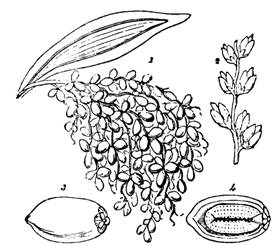
Fig. 287—1. Cluster of dates; 2. Flower; 3. A date; 4. Section of a date
The peculiarities of the palm-tree are such that they could not fail to attract the attention of the writers of any country where it is indigenous, and especially from its being an indication of the vicinity of water even in the midst of the most desert country. Its roots, though not penetrating very deep, or spreading very wide, yet support a stem of considerable height, which is remarkable for its uniformity of thickness throughout. The center of this lofty stem, instead of being the hardest part, as in other trees, is soft and spongy, and the bundles of woody fibers successively produced in the interior are regularly pushed outwards, until the outer part becomes the most dense and hard, and is hence most fitted to answer the purposes of wood. The outside, though devoid of branches, is marked with a number of protuberances, which are the points of insertion of former leaves. These are from four to six and eight feet in length, ranged in a bunch round the top of the stem, the younger and softer being in the center, and the older and outer series hanging down. They are employed for covering the roofs or sides of houses, for fences, frame-work, mats, and baskets. The male and female flowers being on different trees, the latter require to be fecundated by the pollen of the former before the fruit can ripen. The tender part of the spatha of the flowers being pierced, a bland and sweet juice exudes, which being evaporated, yield sugar, and is no doubt what is alluded to in some passages of Scripture: if it be fermented and distilled a strong spirit or arak is yielded. The fruit, however, which is yearly produced in numerous clusters and in the utmost abundance, is its chief value; for whole tribes of Arabs and Africans find their chief sustenance in the date, of which even the stony-seeds, being ground down, yield nourishment to the camel of the desert.
The palm-tree is first mentioned in Exo 15:27, when the Israelites encamped at Elim, where there were twelve wells and threescore and ten palm-trees. In the present day Wady Ghorendel is found the largest of the torrent beds on the west side of the Sinai peninsula, and is a valley full of date-trees, tamarisks, etc. Jericho was called the City of Palm-Trees, no doubt from the locality being favorable to their growth. Mariti and Shaw describe them as still existing there, though in diminished numbers. The palm-tree was considered characteristic of Judea, not so much probably because it was more abundant there than in other countries, but because that was the first country where the Greeks and Romans would meet with it in proceeding southward. Hence the coins of the Roman conquerors of Judea have inscribed on them a weeping female sitting under a palm-tree, with the inscription ’Judea capta.’
Exo 15:27 . This tree is called in Hebrew tamar, from its straight upright, branchless growth, for which it seems more remarkable than any other tree; it sometimes rises to the height of a hundred feet.\par The palm is one of the most beautiful trees of the vegetable kingdom. The stalks are generally full of rugged knots, which render it comparatively easy to climb to the top for the fruit, Son 7:7, 8. These projections are the vestiges of the decayed leaves; for the trunk is not solid like other trees, but its center is filled with pith, round which is a tough bark, full of strong fibers when young, which, as the tree grows old, hardens and becomes ligneous. To this bark the leaves are closely joined, which in the center rise erect, but after they are advanced above the sheath that surrounds them, they expand very wide on every side the stem, and as the older leaves decay, the stalk advances in height. With its ever verdant and graceful crown continually aspiring towards heaven, it is an apt image of the soul growing in grace, Psa 92:12 . The leaves, when the tree has grown to a size for bearing fruit, are six to eight feet long, are very broad when spread out, and are used for covering the tops of houses, and similar purposes.\par The fruit, from which the palm is often called the date-tree, grows below the leaves in clusters sometimes weighing over fifteen pounds, and is of a sweet and agreeable taste. The diligent natives, says Mr. Gibbon, celebrate, either in verse or prose, the three hundred and sixty uses to which the trunk, the branches or long leaf-stalks, the leaves, fibers, and fruit of the palm are skillfully applied. A considerable part of the inhabitants of Egypt, of Arabia, and Persia, subsist almost entirely on its fruit. They boast also of its medicinal virtues. Their camels feed upon the date stone. From the leaves they make couches, baskets, bags, mats, and brushes: from the branches or stalks, cages for their poultry, and fences for their gardens; from the fiber of the trunk, thread, ropes, and rigging; from the sap is prepared a spirituous liquor; and the body of the tree furnishes fuel: it is even said that from one variety of the palm-tree, the phoenix farinifera, meal has been extracted, which is found among the fibers of the trunk, and has been used for food.\par Several parts of the Holy Land, no less than of Idumea, that lay contiguous to it, are described by the ancients to have abounded with date-trees. Judea particularly is typified in several coins of Vespasian by a desconsolate woman sitting under a palm-tree, with the inscription, JUDEA CAPTA. In Deu 34:3, Jericho is called the "city of palm-trees;" and several of these trees are still found in that vicinity; but in general they are now rare in Palestine. Palm wreaths, and branches waved in the air or strown on the road, are associated not only with the honors paid to ancient conquerors in the Grecian games and in war, but with the triumphant entry of the King of Zion into Jerusalem, Joh 12:12-13, and with his more glorious triumph with his people in heaven, Jer 7:9 .\par
Palm Tree. (Hebrew, tamar). Under this generic term, many species are botanically included; but we have here only to do with the date palm, the Phoenix dactylifera of Linnaeus. While this tree was abundant generally in the Levant, it was regarded, by the ancients, as peculiarly characteristic of Palestine and the neighboring regions, though now it is rare.
("The palm tree frequently attains a height of eighty feet, but more commonly forty to fifty feet. It begins to bear fruit, after it has been planted six or eight years, and continues to be productive for a century. Its trunk is straight, tall and unbroken, terminating in a crown of emerald-green plumes, like a diadem of gigantic ostrich-feathers; these leaves are frequently twenty feet in length, droop slightly at the ends, and whisper musically in the breeze.
The palm is, in truth, a beautiful and most useful tree. Its fruit is the daily food of millions; its sap furnishes an agreeable wine; the fibres of the base of its leaves are woven into ropes and rigging; its tall stem supplies a valuable timber; its leaves are manufactured into brushes, mats, bags, couches and baskets. This one tree supplies almost all the wants of the Arab or Egyptian." -- Bible Plants).
Many places are mentioned in the Bible as having connection with palm trees; Elim, where grew three score and ten palm trees, Exo 15:27, and Elath. Deu 2:8. Jericho was the city of "palm trees", Deu 31:3, Hazezon-tamar, "the felling of the palm tree", is clear in its derivation. There is also Tamar, "the palm". Eze 47:19. Bethany means the "house of dates". The word Phoenicia, which occurs twice in the New Testament -- Act 11:19; Act 15:3 -- is in all probability derived from the Greek word for a palm.
The striking appearance of the tree, its uprightness and beauty, would naturally suggest the giving of its name, occasionally, to women. Gen 38:6; 2Sa 13:1; 2Sa 14:27. There is, in the Psalms, Psa 92:12, the familiar comparison, "The righteous shall flourish like the palm tree," which suggests a world of illustration, whether respect be had to the orderly and regular aspect of the tree, its fruitfulness, the perpetual greenness of its foliage, or the height at which the foliage grows, as far as possible, from earth, and as near as possible, to heaven.
Perhaps no point is more worthy of mention, we wish to pursue the comparison, than the elasticity of the fibre of the palm, and its determined growth upward, even when loaded with weights. The passage in Rev 7:9, where the glorified of all nations are described as "clothed with white robes and palms in their hands," might seem to us a purely classical image; but palm branches were used, by the Jews, in token of victory and peace.
(To these points of comparison may be added, its principle of growth: it is an endogen, and grows from within; its usefulness; the Syrians enumerating 360 different uses to which it may be put; and the statement that it bears its best fruit in old age. -- Editor). It is curious that this tree, once so abundant in Judea, is now comparatively rare, except in the Philistine plain, and in the old Phoenicia about Beyrout.
PALM.—Palm trees, though frequently referred to in the OT, are mentioned in connexion with the life of Christ only once: viz. in the account of the triumphal entry into Jerusalem (Joh 12:13). The English name (Lat. palma) is due to the similarity of the leaves of some kinds to the open hand. The term in Greek (applied only to a genus) is
Palms have been divided into five tribes, over a hundred genera, over a thousand species: but there is a limited number of main kinds. The palm of Palestine is the date-palm. This tree (phœnix dactylifera, date being a contraction of dactylus, ‘finger’) rises gracefully to a height of from fifty to ninety feet. It grows in various climates and latitudes, but its fruit fails both in Europe and in India. The female tree (for the phœnix, unlike most others, is not hermaphrodite) bears a cluster which may contain 200 dates, and it may continue to bear for two hundred years. These fruits, which are half sugar, are a chief article of food in Arabia and North Africa. From an incision near the top the fermenting sap flows so as to yield in one month twenty gallons of wine or toddy. The pinnated leaves, which are of a deep) green colour and from 9 to 12 feet in length, are used to make mats and baskets, and the fibres of their stalks make cordage. The leaves also make thatch, and the trunk is useful timber. This tree abounded in the valley of the Jordan, but Jericho was specially the city of palm trees (Deu 34:3). A group of palms, with their magnificent crowns, might afford ample shade. Accordingly, we find that early in the history of Israel Deborah dwelt under her palm tree (Jdg 4:5), while in the time of our Lord many of the Essenes were said to live in palm groves. Fructification is artificial or accidental; and forests may be cultivated that in years of famine will support the population of a country.
The palm, being upright, green, fruitful, and imposing, was an emblem of the righteous in their prosperity (Psa 92:12). In appreciation of the beauty of its form it was carved on the walls and doors of the Temple (1Ki 6:29; 1Ki 6:32, cf. Eze 40:16; Eze 41:18). Its leaves were borne as symbols of rejoicing at the Feast of Tabernacles (Lev 23:40) and also at the Maccabaean Feast of Dedication, of which the special feature was the illumination. This tall, firm, unbending tree, with its magnificent crown of fronds, with fruit and leaves that served for sustenance and ornament, was readily reckoned emblematic of moral qualities—rectitude, constancy, gracefulness, usefulness—such as are the constituents of success. The palm came to be regarded specially as the symbol of victory and triumph. It is in that sense that the name has acquired its metaphorical meaning. The winner (we say) carries off the palm. A period of exceptional prosperity is remembered as ‘palmy days’. ‘Another race hath been, and other palms are won’ (Wordsworth).
The carrying of palm leaves (
The supreme expression of the palm as the symbol of triumphant homage is in the Apocalyptic vision, where the innumerable multitude who nave come through the great tribulation, and who serve God day and night, stand before the throne and before the Lamb, clothed in white robes and with palms in their hands (Rev 7:9; Rev 7:14).
Literature.—Artt. in Encyc. Brit.9 [Note: designates the particular edition of the work referred] , Chambers’s Encyc., the EBi
R. Scott.
PALM TREE (tâmâr).—The date palm (Phœnix dactylifera) is a tree essential to existence in the deserts of Arabia, and was therefore held sacred among the Semites from the earliest historic times. It flourishes in Egypt, Mesopotamia, and the oases of Arabia (Exo 15:27, Num 33:9), but its cultivation has for long been much neglected in Palestine. It is still found in considerable numbers in the Maritime Plain, e.g. at the Bay of ‘Akka and at Gaza; and small scattered groups occur all over the land in the neighbourhood of springs. In the valleys east of the Dead Sea, many sterile, dwarfed palms occur. Both in the OT (Deu 34:3, Jdg 1:16; Jdg 3:13, 2Ch 28:15) and in Josephus (BJ IV. viii. 2–3), Jericho is famous for its vast groves of palms; to-day there are but few, and these quite modern trees. Not only are dates a staple diet in Arabia and an important article of export, but the plaited leaves furnish mats and baskets, the bark is made into ropes, and the seeds are ground up for cattle. From the dates is made a kind of syrup, date-honey or dibs, a valuable substitute for sugar. The method of fertilization of the female (pistillate) flowers by the pollen from the male (staminate) flowers was known in very ancient times, and nature was then, as now, assisted by shaking out the pollen over the female flowers. The palm tree is referred to (Psa 92:12) as a sign of prosperity and (Son 7:7-8) of beauty. Figures of palm trees were used to ornament the Temple (1Ki 6:1-38); at a later period they occur on Jewish coins and in the sculpture of the ancient Jewish synagogues, notably in the recently excavated synagogue at Tell Hûm (Capernaum). The sacredness of this tree thus persisted from the early Semite to late Jewish times. Palm branches were used at the rejoicings of the Feast of Tabernacles (Lev 23:40, Neh 8:15), as they are among the modern Jews, who daily, during this feast, wave branches of palms in their synagogues. In 1Ma 13:51 we read of the bearing of palm branches as the sign of triumphant rejoicing—an idea also implied in their use in Joh 12:13 and Rev 7:9. To-day these branches are used by the Moslems especially at funeral processions, and to decorate graves.
E. W. G. Masterman.
1. Palm Trees:
The palm, Phoenix dactylifera (Natural Order Palmeae), Arabic
“The righteous shall flourish like the palm-tree:
He shall grow like a cedar in Lebanon.
They are planted in the house of Yahweh;
They shall flourish in the courts of our God.
They shall still bring forth fruit in old age;
They shall be full of sap and green” (Psa 92:12-14).
The palm tree or branch is used extensively on Jewish coinage and most noticeably appears as a symbol of the land upon the celebrated Judea Capta coins of Vespasian. A couple of centuries or so later it forms a prominent architectural feature in the ornamentation of the Galilean synagogues, e.g. at
2. Their Ancient Abundance in Palestine:
In Palestine today the palm is much neglected; there are few groves except along the coast, e.g. at the bay of Akka, Jaffa and Gaza; solitary palms occur all over the land in the courtyards of mosques (compare Psa 92:13) and houses even in the mountains. Once palms flourished upon the Mount of Olives (Neh 8:15), and Jericho was long known as the “city of palm-trees” (Deu 34:3; Jdg 1:16; Jdg 3:13; 2Ch 28:15; Josephus BJ, IV, viii, 2-3), but today the only palms are scarce and small; under its name Hazazon-tamar (2Ch 20:2), En-gedi would appear to have been as much a place of palms in ancient days as we know it was in later history. A city, too, called Tamar (“date palm”) appears to have been somewhere near the southwestern corner of the Dead Sea (Eze 47:19; Eze 48:28). Today the numerous salt-encrusted stumps of wild palm trees washed up all along the shores of the Dead Sea witness to the existence of these trees within recent times in some of the deep valleys around.
3. Palm Branches:
Branches of palms have been symbolically associated with several different ideas. A palm branch is used in Isa 9:14; Isa 19:15 to signify he “head,” the highest of the people, as contrasted with the rush, the “tail,” or humblest of the people. Palm branches appear from early times to have been associated with rejoicing. On the first day of the Feast of Tabernacles the Hebrews were commanded to take branches of palms, with other trees, and rejoice before God (Lev 23:40; compare Neh 8:15; 2 Macc 10:7). The palm branch still forms the chief feature of the
See also TAMAR as a proper name.