
The church is compared to an olive tree upon many occasions, (Jer. xi. 16. Ps. 3: 8.) - - and the young converts in Zion to olive branches. (Ps. c28. 3.) And Paul in a beautiful figure, represents the state of conversion from nature to grace by the change from the olive tree which is wild, by nature, to that of a true olive tree, which is planted by grace. (Rom. xi. 17, to the end.)
I must not dismiss this subject without first remarking the allusions made by men in general to the olive branch, as an emblem of peace. It is more than probable that this took its rise from the circumstance of Noah’s dove in the ark, when from being sent forth to discover whether the waters of the flood had subsided at length returned with the olive - branch in her mouth. The raven he dismissed found means of subsistence in going to and fro, probably from the carcases of those drowned; but the dove found no rest for the sole of her foot until returning to the ark. It is so with God’s people; hence they are said to come as "doves to their windows." And it is remarkable, that when the Psalmist saith, (Ps. c16. 7.) "Return unto thy rest, O my soul!" the original is, Return unto thy Noah, thy Christ; for he is the rest wherewith the Lord causeth the weary to rest. The olive branch in the mouth of the dove is a token of peace. God will no more destroy the earth by a flood. The ark is a type of Jesus, through whom and in whom God is at peace, in the blood of his cross. (See Isa. 28. 12. Matt. 28. 29, 30.)
It is more than probable that the olive was introduced from Asia into Europe; and though it continues to be much cultivated in Syria, it is yet much more extensively so in the south of Europe, whence the rest of the world is chiefly supplied with olive-oil.
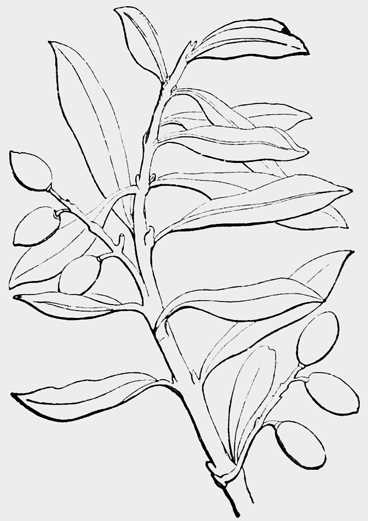
Fig. 281—Olea Europea
The olive-tree is of slow growth, but remarkable for the great age it attains. It never, however, becomes a very large tree, though sometimes two or three stems rise from the same root, and reach from twenty to thirty feet high. The leaves are in pairs, lanceolate in shape, of a dull green on the upper, and hoary on the under surface. Hence in countries where the olive is extensively cultivated, the scenery is of a dull character from this color of the foliage. The fruit is an elliptical drupe, with a hard stony kernel, and remarkable from the outer fleshy part being that in which much oil is lodged, and not, as is usual, in the almond of the seed. It ripens from August to September.
Of the olive-tree two varieties are particularly distinguished; the long leafed, which is cultivated in the south of France and in Italy, and the broad-leafed in Spain, which has also its fruit much larger than that of the former kind. That the olive grows to a great age, has long been known. Pliny mentions one which the Athenians of his time considered to be coeval with their city, and therefore 1600 years old. Near Terni, in the vale of the cascade of Marmora, there is a plantation of very old trees, supposed to consist of the same plants that were growing there in the time of Pliny. Chateaubriand says: ’Those in the garden of Olivet (or Gethsemane) are at least of the times of the Eastern Empire, as is demonstrated by the following circumstance. In Turkey every olive-tree found standing by the Mussulmans, when they conquered Asia, pays one medina to the Treasury, while each of those planted since the conquest is taxed half its produce. The eight olives of which we are speaking are charged only eight medinas. By some, especially by Dr. Martin, it is supposed that these olive trees may have been in existence even in the time of our Savior.
The wood of the olive-tree, which is imported into this country from Leghorn, is described by M. Holtzapffel to be ’like that of the box, but softer, with darker gray-colored veins. The roots have a very pretty knotted and curly character; they are much esteemed on the continent for making embossed boxes, pressed into engraved metallic molds.’ A resin-like exudation is obtained from it, which was known to the ancients, and is now sometimes called olive-gum; but the fruit, with its oil, is that which renders the tree especially valuable. The green unripe fruit is preserved in a solution of salt, and is well known at our desserts. The fruit when ripe is bruised in mills, and the oil pressed out of the paste.
The olive is one of the earliest of the plants specifically mentioned in the Bible, the fig being the first. Thus, in Gen 8:11, the dove is described as bringing the olive-branch to Noah. It is always enumerated among the valued trees of Palestine; which Moses describes (Deu 6:11; Deu 8:8) as ’a land of oil-olive and honey’ (so in Deu 28:40, etc.); and (2Ch 2:10) Solomon gave to the laborers sent him by Hiram, king of Tyre, 20,000 baths of oil. Besides this, immense quantities must have been required for home consumption, as it was extensively used as an article of diet, for burning in lamps, and for the ritual service. The olive still continues one of the most extensively cultivated of plants. The olive, being an evergreen, was adduced as an emblem of prosperity (Psa 52:8), and it has continued, from the earliest ages, to be an emblem of peace among all civilized nations.
1. The Olive Tree:
The olive tree has all through history been one of the most characteristic, most valued and most useful of trees in Palestine. It is only right that it is the first named “king” of the trees (Jdg 9:8, Jdg 9:9). When the children of Israel came to the land they acquired olive trees which they planted not (Deu 6:11; compare Jos 24:13). The cultivation of the olive goes back to the earliest times in Canaan. The frequent references in the Bible, the evidences (see 4 below) from archaeology and the important place the product of this tree has held in the economy of the inhabitants of Syria make it highly probable that this land is the actual home of the cultivated olive. The wild olive is indigenous there. The most fruitful trees are the product of bare and rocky ground (compare Deu 32:13) situated preferably at no great distance from the sea. The terraced hills of Palestine, where the earth lies never many inches above the limestone rocks, the long rainless summer of unbroken sunshine, and the heavy “clews” of the autumn afford conditions which are extraordinarily favorable to at least the indigenous olive.
The olive, Olea Europaea (Natural Order Oleaceae), is a slow-growing tree, requiring years of patient labor before reaching full fruitfulness. Its growth implies a certain degree of settlement and peace, for a hostile army can in a few days destroy the patient work of two generations. Possibly this may have something to do with its being the emblem of peace. Enemies of a village or of an individual often today carry out revenge by cutting away a ring of bark from the trunks of the olives, thus killing the trees in a few months. The beauty of this tree is referred to in Jer 11:16; Hos 14:6, and its fruitfulness in Psa 128:3. The characteristic olive-green of its foliage, frosted silver below and the twisted and gnarled trunks - often hollow in the center - are some of the most picturesque and constant signs of settled habitations. In some parts of the land large plantations occur: the famous olive grove near Beirut is 5 miles square; there are also fine, ancient trees in great numbers near Bethlehem.
In starting an oliveyard the fellah not infrequently plants young wild olive trees which grow plentifully over many parts of the land, or he may grow from cuttings. When the young trees are 3 years old they are grafted from a choice stock and after another three or four years they may commence to bear fruit, but they take quite a decade more before reaching full fruition. Much attention is, however, required. The soil around the trees must be frequently plowed and broken up; water must be conducted to the roots from the earliest rain, and the soil must be freely enriched with a kind of marl known in Arabic as
2. The Fruit:
The olive is in flower about May; it produces clusters of small white flowers, springing from the axils of the leaves, which fall as showers to the ground (Job 15:33). The first olives mature as early as September in some places, but, in the mountain districts, the olive harvest is not till November or even December. Much of the earliest fruit falls to the ground and is left by the owner ungathered until the harvest. The trees are beaten with long sticks (Deu 24:20), the young folks often climbing into the branches to reach the highest fruit, while the women and older girls gather up the fruit from the ground. The immature fruit left after such an ingathering is described graphically in Isa 17:6: “There shall be left therein gleanings, as the shaking (margin “beating”) of an olive-tree, two or three berries in the top of the uppermost bough, four or five in the outmost branches of a fruitful tree.” Such gleanings belonged to the poor (Deu 24:20), as is the case today. Modern villages in Palestine allow the poor of even neighboring villages to glean the olives. The yield of an olive tree is very uncertain; a year of great fruitfulness may be followed by a very scanty crop or by a succession of such.
The olive is an important article of diet in Palestine. Some are gathered green and pickled in brine, after slight bruising, and others, the “black” olives, are gathered quite ripe and are either packed in salt or in brine. In both cases the salt modifies the bitter taste. They are eaten with bread.
More important commercially is the oil. This is sometimes extracted in a primitive way by crushing a few berries by hand in the hollow of a stone (compare Exo 27:20), from which a shallow channel runs for the oil. It is an old custom to tread them by foot (Mic 6:15).
3. Olive Oil:
Oil is obtained on a larger scale in one of the many varieties of oil mills. The berries are carried in baskets, by donkeys, to the mill, and they are crushed by heavy weights. A better class of oil can be obtained by collecting the first oil to come off separately, but not much attention is given to this in Palestine, and usually the berries are crushed, stones and all, by a circular millstone revolving upright round a central pivot. A plenteous harvest of oil was looked upon as one of God’s blessings (Joe 2:24; Joe 3:13). That the “labor of the olive” should fail was one of the trials to faith in Yahweh (Hab 3:17). Olive oil is extensively used as food, morsels of bread being dipped into it in eating; also medicinally (Luk 10:34; Jas 5:14). In ancient times it was greatly used for anointing the person (Psa 23:5; Mat 6:17). In Rome’s days of luxury it was a common maxim that a long and pleasant life depended upon two fiuids - “wine within and oil without.” In modern times this use of oil for the person is replaced by the employment of soap, which in Palestine is made from olive oil. In all ages this oil has been used for illumination (Mat 25:3).
4. Greater Plenty of Olive Trees in Ancient Times:
Comparatively plentiful as olive trees are today in Palestine, there is abundant evidence that the cultivation was once much more extensive. “The countless rock-cut oil-presses and wine-presses, both within and without the walls of the city (of Gezer), show that the cultivation of the olive and vine was of much greater importance than it is anywhere in Palestine today.... Excessive taxation has made olive culture unprofitable” (“Gezer Mem,” PEF, II, 23). A further evidence of this is seen today in many now deserted sites which are covered with wild olive trees, descendants of large plantations of the cultivated tree which have quite disappeared.
5. Wild Olives:
Many of these spring from the old roots; others are from the fallen drupes. Isolated trees scattered over many parts of the land, especially in Galilee, are sown by the birds. As a rule the wild olive is but a shrub, with small leaves, a stem more or less prickly, and a small, hard drupe with but little or no oil. That a wild olive branch should be grafted into a fruitful tree would be a proceeding useless and contrary to Nature (Rom 11:17, Rom 11:24). On the mention of “branches of wild olive” in Neh 8:15, see OIL TREE.
Jdg 9:8 (b) In this parable probably this tree represents some delightful, refreshing person who might be called to be the leader of the people. You will note that other trees represent other kinds of people in this same parable.
Isa 17:6 (c) Perhaps this represents the fact that Damascus would not be completely destroyed, but that some families would remain and the city would continue to be a city. This certainly has been the case.
Hos 14:6 (b) Here we see a picture of Israel restored to her place of prominence and power with the land healed, the rains falling on rich pastures, and the glory of all lands again seen in Palestine.
Zec 4:3 (a) Plainly the passage indicates that these two olive trees are types of the Holy Spirit of GOD and the Word of GOD. The Spirit has, in Himself, might on the one hand, and power on the other. He is able to move mountains out of the life of the believer. Might refers to inward ability. Power refers to outside influence. The Spirit needs neither one. He is able in Himself to give the victory to the believer, and He does it. Some think that these two trees represent Moses and Elijah, Moses the lawgiver, and Elijah the grace giver. Others think that these two trees represent two angelic beings, who stand guard over the believer to protect and preserve him, and make him a radiant conqueror.
Rom 11:17 (a) This represents GOD’s plan, purpose and program which began with Israel and which continues all through the church. Israel was in that plan as a green tree, and after Pentecost the Gentiles were brought into that same plan.
All are saved by grace.
All are redeemed by the Blood.
All are dependent entirely upon the Lord JESUS for salvation and redemption.
The olive tree represents Israel from a religious aspect, while the fig tree represents Israel from the political aspect. The Lord did not curse an olive tree, for the religion of Israel had GOD’s approval. He did curse the political Israel as a nation and scatter them over the world. It is the fig tree that buds, and is a type of the restoration of Israel from the political standpoint.
Rev 11:4 (a) The two olive trees in this passage certainly represent the two witnesses. Just who they are we do not know. Most Bible students think they are Moses and Elijah who return to this earth in person with a message from GOD, and are persecuted. (See Zec 4:3-6).