
Son of Jacob by Bilhah. (Gen. xxx. 8.) The name signifies struggling. The margin of our Bible saith, that Rachel called him thus, "my wrestlings." The patriarch when dying gave a particular blessing to Naphtali, and said "Naphtali is a hind let loose: he giveth goodly words." (Gen. xlix. 21.) This prophetical blessing of Jacob hath not been regarded in terms equal to its importance, according to my apprehension; and yet the Holy Ghost seems to have called up the attention of the church to it, upon various occasions, in his holy word. I would ask, are not many of the dying patriarch’s benedictions to his children considered more with reference to Christ, than to the twelve patriarchs? Do we not consider the blessing of Judah, as one whom his brethren shall praise, and as one from whom the sceptre shall not depart, as having respect principally, if not altogether, to the person of Christ? And are not the several blessings prophesied of Joseph, on the dying bed of his father, spoken directly with an eye to Joseph’s Lord? And if so, why may we not with equal safety, in the blessing of Naphtali discover Christ also? Is Naphtali an hind let loose? And can we overlook that hind of the morning, even Jesus, whom the hunters pursued, and the dogs of Bashan compassed around? (See Psalm xx2: in the title of it, and throughout the Psalm.) And when we read what the church saith of her Lord, as a roe or a hind upon the mountains of spices, and thus frequently through the book of the Songs, surely it can be no difficult matter to behold Jesus in the type, and regard him whogiveth goodly words.
I am the more inclined to those discoveries of Jesus, in the view of Naphtali, because in my apprehension of the subject, Moses, the man of God, in his dying benediction concerning Naphtali, confirmed what Jacob in his dying moments had before said concerning him. (See Deut. 33. 23.) "O Naphtali! (said Moses) satisfied with favour, and full with the blessing of the Lord, possess thou the west and the south." And to whom are we to look for any, or for all the tribes of Israel in the possession of the divine favour, and so satisfied with it? Of whom, among the sons of Jacob, can it be said with truth, "that they are full of the blessing of the Lord, " unless we first behold him in whom it hath "pleased the Father that all fulness should dwell, " and from him, and in him, and by him, all the seed of Israel are justified and shall glory?" Surely it is blessed first to eye Christ as possessing and being the cause of the true Naphtali’s portion, and then, by virtue of an union with him, and interest in him, to behold those blessings flowing in upon his inheritance. It is Jesus alone who hath satisfied for sin, and with whom alone JEHOVAH is satisfied; and therefore Jesus, as the Head of his body the church, is satisfied with favour, and full of the blessings of the Lord. Both the west and the south are his for a possession; yea, his dominion shall be from sea to sea, and from the river unto the ends of earth, men shall be blessed in him, and all nations shall call him blessed." (Ps. lxxii, throughout.)
See Hind.
the sixth son of Jacob by Bilhah, Rachel’s handmaid. The word Naphtali signifies wrestling, or struggling. When Rachel gave him this name, she said, “With great wrestlings have I wrestled with my sister, and I have prevailed,” Gen 30:8. Naphtali had but four sons, and yet at the coming out of Egypt his tribe made up fifty-three thousand four hundred men, able to bear arms. Moses, in the blessing he gave to the same tribe, says, “O Naphtali, satisfied with favour, and full with the blessing of the Lord, possess thou the west and the south,” Deu 33:23. The Vulgate reads it, “the sea and the south,” and the Hebrew will admit of either interpretation, that is, the sea of Gennesareth, which was to the south by the inheritance of this tribe. His soil was very fruitful in corn and oil. His limits were extended into upper and lower Galilee, having Jordan to the east, the tribes of Asher and Zebulun to the west, Libanus to the north, and the tribe of Issachar to the south. Under Barak, their general, they and the Zebulunites fought with distinguished bravery against the army of Jabin the younger; and at the desire of Gideon they pursued the Midianites, Jdg 4:10; Jdg 5:18; Jdg 7:23. A thousand of their captains, with thirty-seven thousand of their troops, assisted at David’s coronation, and brought great quantities of provision with them, 1Ch 12:34; 1Ch 12:40. We find no person of distinguished note among them, save Barak, and Hiram the artificer. Instigated by Asa, Benhadad the elder, king of Syria, terribly ravaged the land of Naphtali; and what it suffered in after invasions by the Syrians we are partly told, 1Ki 15:20. The Naphtalites were, many, if not most of them, carried captive by Tiglath-pileser, king of Assyria, 2Ki 15:29. Josiah purged their country from idols. Our Saviour and his disciples, during his public ministry, resided much and preached frequently in the land of Naphtali, Isa 9:1; Mat 4:13; Mat 4:15.
Naphtali (my wrestling), the sixth son of Jacob, and his second by Bilhah, Rachel’s handmaid, born B.C. 1747, in Padan-Aram. Nothing of his personal history is recorded. The description given of Naphtali in the testamentary blessing of Jacob (Gen 49:21) has been variously rendered. In the Authorized Version it is translated ’a hind let loose, he giveth goodly words.’ But, according to the reading in the Septuagint, the verse maybe rendered, ’Naphtali is a goodly tree [TEREBINTH or OAK] that puts forth lovely branches.’ We certainly incline to this view of the text; the metaphor which it involves being well adapted to the residence of the tribe of Naphtali, which was a beautiful woodland country, extending to Mount Lebanon, and producing fruits of every sort. With this interpretation, better than with the other, agrees the blessing of Moses upon the same tribe: ’O Naphtali, satisfied with favor, and full with the blessing of the Lord, possess thou the west and the south’ (Deu 33:23).
When the Israelites departed from Egypt, the tribe of Naphtali numbered 53,400 adult males (Num 1:43), which made it the sixth in population among the tribes; but at the census taken in the plains of Moab it counted only 45,400 (Num 26:50), being a decrease of 8000 in one generation, whereby it became the seventh in point of numbers. The limits of the territory assigned to this tribe are stated in Jos 19:32-39, which show that it possessed one of the finest and most fertile districts of Upper Galilee, extending from the Lake Gennesareth and the border of Zebulun, on the south, to the sources of the Jordan and the spurs of Lebanon on the north, and from the Jordan, on the east, to the borders of Asher on the west. But it was somewhat slow in acquiring possession of the assigned territory (Jdg 1:33). The chief towns of the tribe were Kedesh, Hazor, Harosheth, and Chinnereth, which last was also the name of the great lake afterwards called Gennesareth. In the Hebrew history Naphtali is distinguished for the alacrity with which it obeyed the call to arms against the oppressors of Israel when many other tribes held back (Jdg 4:10; Jdg 5:18; Jdg 6:35; Jdg 7:23). In the time of David the tribe had on its rolls 37,000 men fit for military service, armed with shields and spears, under a thousand officers (1Ch 12:34).
The sixth son of Jacob, by Bilhah, Rachel’s handmaid, Gen 30:8 . We know but few particulars of the lie of Naphtali. His sons were four, Gen 46:24 . The patriarch Jacob, when he gave his blessing, said, as it is in the English Bible, "Naphtali is a hind let loose; he giveth goodly words," Gen 49:21 . For an illustration of this passage, see HIND.\par The tribe of Naphtali, called Nephtalim in Mat 4:15, were located in a rich and fertile portion of northern Palestine; having Asher on the west, the upper Jordan and part of the sea of Tiberias on the east; and running north into the Lebanon range, some lower offshoots of which prolonged to the south formed the "mountains of Naphtali," Jos 19:32-39 20:7. They attended in force at the coronation of David, 1Ch 12:34 ; and are mentioned with honor in the wars of the Judges, Jdg 1:33 5:18 6:35 7:23; as much reduced by the Syrians, 1Ki 15:20 ; and as among the first captives to Assyria, 2Ki 15:29 Isa 9:1 . Our Savior spent much time in the southern part of this region, Mat 4:13-15 .\par
Naph’tali. (wrestling). The fifth son of Jacob, the second child name to him by Bilhah, Rachel’s slave. His birth and the bestowal of his name are recorded in Gen 30:8. When the census was taken at Mount Sinai, the tribe of Naphtali numbered no less than 53,400 fighting men, Num 1:43; Num 2:50, but when the borders of the Promised Land were reached, its numbers were reduced to 45,400. Num 26:48-50.
During the march through the wilderness, Naphtali occupied a position on the north of the sacred tent with Dan and Asher. Num 2:25-31. In the apportionment of the land, the lot of Naphtali was enclosed on three sides by those of other tribes. On the west lay Asher, on the south lay Zebulun, and on the east lay the TransJordanic Manasseh.
(In the division of the kingdom, Naphtali belonged to the kingdom of Israel, and later, was a part of Galilee, bordering on the northwestern part of the Sea of Galilee, and including Capernaum and Bethsaida. -- Editor).
("my wrestling".) Jacob’s fifth son, second by Bilhah, Rachel’s maid. Gen 30:8, Rachel said, "with wrestlings of God (i.e. earnest prayer, as her husband does in Gen 32:24-28; he had reproved her impatience, telling her God, not he, is the giver of children: Gen 30:1-2; so she wrestled with God) have I wrestled with my sister, and I have prevailed," i.e. succeeded in getting from God a child as my sister. Thus allied to Dan (Gen 35:25). He had four sons at the descent to Egypt (Gen 46:24). At the census of Sinai Naphtali’s tribe numbered 53,400 able for war (Num 1:43). At the borders of Canaan the tribe of Naphtali had fallen to 45,400 (Num 26:48-50). On march Naphtali was north of the tabernacle, next Dan his kinsman, and Asher (Num 2:25-31), together forming "the camp of Dan," hindmost or rearward of all the camps (Num 10:25). Naphtali had its portion between the coastland strip of Asher and the upper Jordan. Dan shortly after sent a number from his less desirable position next the Philistines to seek a settlement near his kinsman Napthtali in the far north.
Zebulun was on S. of Naphtali; trans-jordanic Manasseh on the E. The ravine of the Leontes (Litany) and the valley between Lebanon and Antilebanon was on the N. Thus, Naphtali had the well watered district about Banias and the springs of the Jordan. Jacob in his dying prophecy says, "Naphtali is a hind let loose, he giveth goodly words." The targums of Pseudo-Jonathan and Jerusalem say Naphtali first told Jacob Joseph was alive. "Naphtali (say the targums) is a swift messenger, like a hind that runneth on the mountains, bringing good tidings." Joshua (Jos 20:7) calls it "Mount Naphtali" from the mountainous parts of its possessions. Shelucha, "let loose," is cognate to sheluchim, "the apostles," who on Galilee mountains "brought good tidings" of Jesus (Isa 52:7). Hab 3:19, "the Lord will make my feet like hinds’ feet," has in view Jacob’s prophecy as to Naphtali. Temporally Naphtali disports gracefully and joyously in its fertile allotment, as a hind at large exulting amidst grass; it shall be famous too for eloquence. The "bind" symbolizes a swift warrior (2Sa 2:18; 1Ch 12:8).
Barak with 10,000 men of Naphtali, at Deborah’s call, fought and delivered Israel from Jabin of Canaan. His war-like energy and his and Deborah’s joint song are specimens of the prowess and the eloquence of Naphtali (Judges 4-5); Naphtali and Zebulun "jeoparded their lives unto the death in the high places of the field" (Jdg 5:18). So they helped Gideon against Midian (Jdg 6:35; Jdg 7:23). Moses’ blessing on Naphtali is (Deu 33:23), "Naphtali, satisfied with favor, and full with the blessing of Jehovah, possess thou the "sect" (
"The soil is rich, full of trees of all sorts, so fertile as to invite the most slothful to cultivate it" (Josephus); but now the population of this once thickly peopled, flourishing region, is as scanty as its natural vegetation is luxuriant. Its forests and ever varying scenery are among the finest in Palestine (Van de Velde, 1:170, 293; 2:407). Naphtali failed to drive out the Canaanites (Jdg 1:33). Pagan neighbours soon made it and northern Israel "Galilee of the Gentiles." Tiglath Pileser swept away its people to Assyria; Benhadad of Syria had previously smitten all Naphtali (1Ki 15:20; 2Ki 15:29). But where the darkness was greatest and the captivity first came, there gospel light first shone, as foretold of Zebulun and Naphtali (Isa 9:1-2; Mat 4:16). Naphtali shall have its 12,000 elect ones sealed (Rev 7:6), and its allotment in restored Israel (Eze 48:3-4; Eze 48:34).
Naphtali (năph’ta-lî), my wrestling. The sixth son of Jacob, by Bilhah, Rachel’s handmaid. Gen 30:7-8. He had four sons. Gen 46:24; Exo 1:4; 1Ch 7:13. Jacob said, "Naphtali is a hind let loose, he giveth goodly words," graceful and eloquent. Gen 49:21.
Territory of Naphtali, peopled by his descendants, called Nephthalim, Mat 4:15, A.V., was called "the west and the south," A.V., literally "the sea and the circuit." Deu 33:23; Jos 19:32-39. It lay in a rich and fertile portion of Northern Palestine, partly along the Lebanon range, called "the mount of Naphtali" Jos 19:32-39; Jos 20:7, R. V., "Hill country of Naphtali." They attended in force at the coronation of David, 1Ch 12:34, and are mentioned with honor in the wars of the Judges, Jdg 1:33; Jdg 5:18; Jdg 6:35; Jdg 7:23, as much reduced by the Syrians, 1Ki 15:20, and as among the first captives to Assyria, 2Ki 15:29; Isa 9:1. Barak was their most notable leader. Jdg 4:6-16. Our Saviour spent much time in the southern part of this region; Mat 4:13-15; Mar 2:1-12, partially fulfilling Isa 9:1-2.
[Naph’tali]
Fifth son of Jacob, and second of Bilhah. The name also often includes his descendants, and the territory which they possessed. Naphtali and his four sons entered Egypt with Jacob, and nothing further is recorded of him personally. At the two numberings of the tribes Naphtali amounted to 53,400 and 45,400. When Jacob prophetically announced to the tribes that which should befall them in the last days, he said, "Naphtali is a hind let loose: he giveth goodly words," Gen 49:21; it is the remnant of Israel as the vessel of testimony. Moses said, "O Naphtali, satisfied with favour, and full with the blessing of the Lord: possess thou the west and the south." Deu 33:23. It is the full blessing of the remnant as Jehovah’s people.
Their possession, which was mountainous and fertile, was in the north with the upper Jordan on the east and Asher in the west. Ijon, which was farther north than Dan, was in their land. Jos 19:32-39. When Baasha, king of Israel, attacked Judah, Asa sent gold and silver to Ben-hadad, king of Syria, for help. He responded at once, and his army smote Ijon, and Dan, and Abel-maim, and all the store cities of Naphtali. 2Ch 16:4. This tribe was the first of those on the west of the Jordan to be carried away captive by Tiglath-pileser, king of Assyria. 2Ki 15:29.
In Isa 9:1-2 it is prophesied that Naphtali with Zebulun should see a great light: this was fulfilled when the Lord traversed that district, taught in the synagogues, and healed diseases there. Mat 4:13; Mat 4:15, (where the name is NEPHTHALIM and in Rev 7:6 NEPTHALIM). The prophecy seems to say that Zebulun and Nephthalim were beyond the Jordan; but some judge that three districts are alluded to; Zebulun and Nephthalim; the way of the sea beyond the Jordan; and Galilee of the Gentiles. But others judge that only the district on the west of the Jordan is alluded to. The Hebrew word in Isa 9:1, translated ’beyond’ is eber, and is sometimes translated ’on this side,’ as in Jos 1:14-15. When the Lord Jesus was on earth, the great light was shed on both sides of the Jordan, though the west was more especially the scene of His ministry. Matthew’s Gospel does not speak of His ministry at Jerusalem until He went there to suffer.
NAPHTALI (
From the north end of the Plain of Gennesaret and the Sea of Galilee (–682.5 ft.) the land rises through a series of steep ascents and small plateaux to Safed (+2750 ft.) and Jebel Jermuk (4000 ft.), the highest peak in Western Palestine. To the north of these points, and until the valley of the Litani is reached, we have an undulating tableland, with vast stretches that are arable and everywhere tilled, with swelling hills in view all round, covered with prickly shrubs and trees and forests of small oak. This district is broken into by two deep valleys, somewhat like but narrower than Wady Hamam. From the N.W. of the Plain of Gennesaret the Wady Leimon, otherwise called Wady Amûd, and in ancient times
In the neighbourhood of el-Jish and Taitabeh (said to be the Tishbe of 1Ki 17:1) we meet with three extinct craters and quantities of black volcanic rock, and by it the slopes to the Huleh valley and the Jordan as far as the Sea of Galilee are also fringed. Between Kerazeh and Tell Hum great quantities of basaltic boulders cumber the ground, and the stones of Tiberias again are black. Volcanic forces have been active in the past. They have created for us these wild gorges and gigantic cliffs, and their continued existence is proved by the hot springs, as also by the frequent earthquakes in ancient (Ant. xv. v. 2; Joma v. 2; Sota viii. 7) and in modern times. Of these latter the most terrible known is that which occurred on 1st Jan. 1837. Elsewhere the rocks of Naphtali are generally a species of limestone, known in Palestine by the name of nâri. On the hills above the Lake there are great stretches of these white rocks, hard as flint, bare, desolate, and painful to the eye, especially under the summer sun. But though the surface is hard and glossy, we have only to get below it to find that the rock is really soft. It may be cut with a saw with even greater facility than wood. All sorts of trees—olives, figs, and vines—can send their roots through it and draw nourishment thence, while the hard exposed surface is there to conserve the moisture below. With little trouble these rocky desolations may be turned into vineyards, olive groves, and orchards, and we have every reason to believe that they were such in the early Christian centuries (Bab.
Naphtali will thus be seen to have, in virtue of its lands of varying altitude and deep depression, a greater variety of climate, scenery, and possible variety of production than any other tribe of Israel. To it more than to any other could be applied the words of promise uttered ere the Land was yet entered—‘a land of brooks of water, of fountains and depths that spring out of valleys and hills; a land of wheat and barley and vines and fig-trees and pomegranates, a land of oil olives and honey’ (Deu 8:7-8). Apart from the barren stretches mentioned, these words describe most naturally the state of Naphtali to-day. Different parts are renowned for their varied products—Rameh for the excellence of its olives and its oranges, el-Jish for its vineyards, the north and the Huleh valley for their fine crops of wheat and barley. Elsewhere we meet with the lemon, fig, mulberry, apricot, and even tobacco and tomatoes, in great abundance. As the Targum (on Gen 49:21) has it, ‘Naphtali’s lot was cast in a pleasant land.’ From shortly after the commencement of the rainy season it is brilliant with flowers—anemones of many varied tints, cyclamens, and lilies, while all its water-courses may be traced by the red bloom of the oleander. The hills are greener than those of any other tribe, and the grass and the spring flowers continue among its uplands long after the rest of Palestine is burned black and bare. This arises from the fact that Naphtali enjoys first and most of all the much praised ‘dews of Hermon that descend upon the mountains of Zion’ (Psa 133:3). When the N.E. wind has come gently blowing over the great mountain, we have seen the dew-clouds rolling down in great volumes over its fields, supplying all nature with fresh vigour and sensations of pleasantness. Modern products, such as oranges, tobacco, and tomatoes, were absent in our Lord’s time, as was also another feature that attracts the eye in these days, viz., the great hedges of prickly pear or cactus, by which many of the villages are practically fortified. This plant is of modern importation, though, unfortunately, it has often found its way into pictures of Bible scenes. Compared with the present day, the hills of Naphtali were much more wooded in NT times. Just after such another period of unrest and unsettlement as Galilee had passed through before the Advent, Arculphus, a pilgrim (a.d. 670), found that the hills in his time were wooded down to the shores of the Lake. The woods of Naphtali are mentioned in the Palestinian Talmud (Baba Bathra v. 1).
Of the productiveness of the soil there is ample testimony. We are told that Gush Halab (Gischala; el-Jish) was famous for the quantity of its oil (Erakhin ix. 6; Menakhoth, 85b), and as this was considered to be a border town adjoining the tribe of Asher, the Rabbis saw here a fulfilment of Gen 49:20, Deu 33:24. Josephus, speaking of the same place, tells us that its people were generally husbandmen, and applied themselves to the cultivation of the fruits of the earth (BJ iv ii. 1). The quality of the wheat of Chorazin and Capernaum is well spoken of (Men. 85a). It is elsewhere stated that Naphtali possessed vines and fruitful fields (Bab.
2. The people.—Zebulun and Naphtali were in the year b.c. 135 practically Gentile (1Ma 5:23), but from that time onward they became gradually reoccupied by a population of Jewish blood, and from the time of this resettlement its people were pre-eminently patriotic (Ant. xiv. ix. 2, xv. 10). It was a district of great memories and inspiring scenes, and the new settlers acted up to them. The kind of immigrants—those who sought a freedom unknown at the court of Herod—would guarantee their quality, and, besides, there is something in the free air of the mountains—especially mountains that have a past heroic history—that goes a long way to make heroes and warriors. In b.c. 4, Judas the son of Hezekiah had made an unsuccessful attempt to revolt, and again in a.d. 6, Judas of Galilee and his Zealots (cf. Luk 6:15), declaring ‘There is no king but God’ (Ant. xviii. i. 6). [With this saying we may compare that in the Jewish Morning Prayer,
3. Christ’s sojourn.—Our Lord’s settlement in the lands of Naphtali began probably about January of the year a.d. 27 (Mat 4:13), a short visit of ‘not many days’ having been made before the previous Passover (Joh 2:12). The time of sojourn would then extend till Sept.
Literature.—See the authorities cited under artt. Palestine, Galilee, Capernaum, etc. For homil. use, C. H. Waller, The Names on the Gates of Pearl3 [Note: designates the particular edition of the work referred] (1903), p. 129.
W. M. Christie.
( ; Greek, N
By: Executive Committee of the Editorial Board., J. F. McLaughlin
Second son of Jacob and Bilhah, and younger full brother of Dan. According to Gen. xxx. 8, the name means "my wrestling," and has reference to the jealous rivalry of the sisters Rachel and Leah. According to Gen. xlvi. 24, he had four sons when Israel went down into Egypt. In the Blessing of Jacob (ib. xlix. 21) the passage which concerns Naphtali has reference to the qualities of the tribe, rather than to those of the individual. "Naphtali is a hind let loose: he giveth goodly words"; i.e., "He is alert, nimble, free-spirited, and has poetical or oratorical gifts" (Driver, Commentary on Genesis, ad loc.). According to the Targums (pseudo-Jonathan and Jerusalem), Naphtali was a swift runner and came first to Jacob with the good news that Joseph was alive. This may be only an inference from the passage in the Blessing of Jacob quoted above. The Targums say also that he was one of the five brethren presented by Joseph to Pharaoh (ib. xlvii. 2).
NAPHTALI.—The second son of Bilhah, Rachel’s handmaid, and the sixth son of Jacob (Gen 30:7 f. [J
The information which we have of Naphtali is very meagre. P
While the genealogical lists cannot he relied on, there is no apparent reason for linking together Dan and Naphtali. But that they are both traced to Bilhah indicates that they were tribes of minor importance, inferior in strength, and of less consequence in the national development at the time when these relationships were created, than the tribes which sprang from Rachel.
Naphtali was the sixth in order to receive its lot (Jos 19:32-39). It is somewhat more definitely defined than the others, though few of the places mentioned can be identified. No fewer than nineteen cities are said to lie within its territory, the most of which are not found again in the OT, doubtless because the history of Israel was wrought out mainly in the regions to the south. The territory reached on the north almost to the Lebanon. Southward it extended along the Jordan until it reached the point below the Sea of Galilee where the Wady el-Bireh joins the Jordan. The greater part lay to the north-west of the Sea, and in this direction (N. and W.) its boundaries appear to have been shifting. ‘Ancient and modern writers’ (writes Driver, Deut. 413) ‘vie with one another in praising the soil and climate of the territory owned by Naphtali: it was abundantly irrigated; and its productions rich and varied. Lower Galilee was, however, yet more fertile and beautiful than Upper Galilee. The vegetation in the neighbourhood of the lake is semi-tropical.’ Modern writers join with Josephus in praising it, and Neubauer (Géog. du Talm. p. 180) quotes a saying from the Talmud: ‘It is easier to raise a legion of olives in Galilee than to bring up a child in Palestine.’ No wonder that Naphtali was ‘like a hind let loose’ (Gen 49:21, if this be the correct translation; see the Comm.). Besides these advantages, it was fortunate in location in times of peace. Roads ran in every direction, connecting it with the outer world.
The heroism and warlike daring of the tribe is sung in Jdg 5:1-31. In that decisive struggle with the Canaanitcs the tribe wrote its name high on the roll of Israelitish fame. But this was in the days of its pristine vigour. At a later period it performed nothing worthy of record. The Blessings of Jacob (Gen 49:21) and of Moses (Deu 33:23, ‘Satisfied with favour, and full with the blessing of Jahweh’) dwell only upon its productivity. The captain to whom the honour of leading the Israelites to victory over the hosts of Sisera is ascribed in the prose narrative, Jdg 4:1-24, was Barak of Kedesn-naphtali. This is probable in view of the readiness with which Naphtali and Zehulun its neighbour responded to his call, though Jdg 5:15 points rather to a connexion with Issachar. According to 1Ki 7:14, Hiram, the worker in metals, etc., whom Solomon brought from Tyre to work on the house of Jahweh, was the son of a widow of the tribe of Naphtali [2Ch 2:14, it is true, says she was of Dan. The shifting of boundaries may be the cause of the divergence]. Few names of prominence, however, from members of this tribe appear in connexion with the national life.
According to the Chronicler (1Ch 12:34) 37,000 warriors with 1000 captains went to the support of David at Hebron. Under the Syrian king Bir-idri (Benhadad), ‘all the land of Naphtali,’ together with certain cities of Israel, were smitten with the sword (1Ki 15:20). When the Syrian kingdom fell before the Assyrian armies, northern Israel was exposed, as never before, to the relentless legions of the East; and ‘in the days of Pekah, king of Israel, came Tiglath-pileser [iii. b.c. 734], king of Assyria, and took l jon, and Abel-beth-maacah, and Janoah, and Kedesh, and Hazor, and Gilead, and Galilee, and all the land of Naphtali, and he carried them captive to Assyria’ (2Ki 15:29). See also Tribes.
James A. Craig.
I. THE PATRIARCH
1. Name
2. Circumstances of His Birth
3. Historical and Traditional Details
II. TRIBE OF NAPHTALI
1. Its Relative Position
2. Its Location in Palestine
3. Physical Features
4. Distinction of the Tribe
5. Sites and Inhabitants
6. Labors of Jesus in This District
I. The Patriarch.
1. Name:
The 5th son of Jacob, and the 2nd born to him by Rachel’s handmaid, Bilhah. He was full brother of Dan (Gen 30:7 ff).
At his birth Rachel is said to have exclaimed,
2. Circumstances of His Birth:
Her sister’s fruitfulness was a sore trial to the barren Rachel. By her artifice she had obtained children, the offspring of her maid ranking as her own; and thus her reproach of childlessness was removed. The name Naphtali given to this son was a monument of her victory. She had won the favor and blessing of God as made manifest in the way yearned for by the oriental heart, the birth of sons.
3. Historical and Traditional Details:
Personal details regarding the patriarch North are entirely wanting in Scripture; and the traditions have not much to say about him. According to Targum Pseudo-Jonathan, he was a swift runner. It also tells us that he was one of the 5 brethren whom Joseph chose to represent the family of Jacob in the presence of Pharaoh. He is said to have been 132 years old at his death (Testament of the Twelve Patriarchs, viii, 1, 1). When Jacob and his family moved to Egypt, Naphtali had 4 sons (Gen 46:24). In Egypt, he died and was buried.
II. Tribe of Naphtali.
1. Its Relative Position:
When the first census was taken in the wilderness, the tribe numbered 53,400 fighting men (Num 1:43; Num 2:30). At the second census, the numbers had shrunk to 45,400 (Num 26:48 ff); but see NUMBERS. The position of Naphtali in the desert was on the North of the tabernacle with the standard of the camp of Dan, along with the tribe of Asher (Num 2:25 ff). The standard, according to Jewish tradition, was a serpent, or basilisk, with the legend, “Return of
2. Its Location in Palestine:
In the allocation of the land, the lot of Naphtali was the last but one to be drawn (Jos 19:32-39). The boundaries are stated with great fullness. While it is yet impossible to trace them with certainty, the identification of sites in recent years, for which we are mainly indebted to the late Col. Conder, makes possible an approximation. The territory was bounded on the East by the Sea of Galilee and the upper reaches of the Jordan. Josephus makes it extend to Damascus (Ant., V, i, 22); but there is nothing to support this. The southern boundary probably ran from the point where
The land lying around the springs of the Jordan was included in the lot of Naphtali. It is clear that from this part, as well as from the cities named in Jdg 1:33, Naphtali did not drive out the Canaanites. These the Danites found in possession at the time of their raid. There is no indication that Naphtali resented in any way this incursion of their kindred tribe into their territory (Jdg 18).
3. Physical Features:
The district thus indicated includes much excellent land, both pastoral and arable. There are the broad, rich terraces that rise away to the North and Northwest of the Sea of Galilee, with the fertile plain of Gennesaret on the seashore. The mountains immediately North of the sea are rocky and barren; but when this tract is passed, we enter the lofty and spacious lands of upper Galilee, which from time immemorial have been the joy of the peasant farmer. Great breadths there are which in season yield golden harvests. The richly diversified scenery, mountain, hill and valley, is marked by a finer growth of trees than is common in Palestine. The terebinth and pine, the olive, mulberry, apricot, fig, pomegranate, orange, lemon and vine are cultivated to good purpose. Water is comparatively plentiful, supplied by many copious springs. It was one of the districts from which Solomon drew provisions, the officer in charge being the king’s son-in-law, Ahimaaz (1Ki 4:15).
4. Distinction of the Tribe:
The free life of these spacious uplands, which yielded so liberally to the touch of the hand of industry, developed a robust manhood and a wholesome spirit of independence among its inhabitants. According to Josephus, who knew them well (BJ, III, iii, 2), the country never lacked multitudes of men of courage ready to give a good account of themselves on all occasions of war. Its history, as far as we know it, afforded ample opportunity for the development of warlike qualities. In the struggle with Sisera, Naphtali was found on the high places of the field (Jdg 5:18). To David’s forces at Hebron, Naphtali contributed a thousand captains “and with them with shield and spear thirty and seven thousand” (1Ch 12:34). Their position exposed them to the first brunt of attack by enemies from the North; and in the wars of the kings they bore an important part (1Ki 15:20; 2Ki 12:18; 2Ki 13:22); and they were the first on the West of the Jordan to be carried away captive (2Ki 15:29). See GALILEE.
5. Sites and Inhabitants:
The largest town in Mt. Naphtali today (in 1915) is
6. Labors of Jesus in This District:
In the land of Naphtali Jesus spent a great part of his public life, the land of Gennesaret, Bethsaida, Capernaum and Chorazin all lying within its boundaries (compare Mat 4:15).
See Tribes.
1) Son of Jacob (Israel). Ancestor of one of the tribes of Israel; 2) The tribe that bears his name.
Naphtali was the younger of two sons whom Rachel’s maid Bilhah bore to Jacob (Gen 30:7-8). The tribe descended from him settled in the north of Canaan, and together with the neighbouring tribe of Zebulun occupied much of the region later known as Galilee. This was the region to the north and west of the Sea of Chinnereth (Lake Galilee) where Jesus grew up and where he spent most of the time recorded of him in the New Testament. The country was mainly hilly, with good pastures and fertile soil (Gen 49:21; Deu 33:23; Jos 19:32-39; Jos 20:7; Isa 9:1; Mat 4:12-16). (For other features of the region see BETHSAIDA; CAPERNAUM; CHINNERETH; GALILEE; HAZOR.)
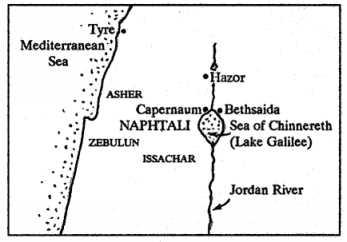
In Old Testament times the men of Naphtali proved to be good fighters when called upon to help the other tribes in battle (Jdg 4:6; Jdg 4:10; Jdg 5:18; Jdg 6:35; Jdg 7:23; 1Ch 12:34). The tribe itself, however, was open to attack from the north (1Ki 15:20). It was among the first tribes to go into captivity when Assyria invaded and finally destroyed Israel (2Ki 15:29). Yet out of this land of darkness and defeat came light and salvation in the person of Jesus Christ (Isa 9:1; Mat 4:12-16).