
Between the altar and the tabernacle, a little to the south, stood a circular laver, which, together with its base, was made of the brazen ornaments which the women had presented for the use of the tabernacle, and was thence called
Laver, a basin to contain the water used by the priests in their ablutions during their sacred ministrations. There was one of brass (fabricated out of the metal mirrors which the women brought from Egypt, Exo 38:8). It had a ’foot’ or base, which, from the manner in which ’the laver and its foot’ are mentioned, must have been a conspicuous feature, and was perhaps separable from the basin itself for the purpose of removal. We are not informed of the size or shape of this laver; but it appears to have been large. It stood between the altar of burnt-offerings and the door of the tabernacle (Exo 30:18-21; Exo 40:30-32). The water of this laver seems to have served the double purpose of washing the parts of the sacrifices, and the hands and feet of the priests. But in the temple of Solomon, when the number of both priests and victims had greatly increased, ten lavers were used for the sacrifices, and the molten sea for the personal ablutions of the priests (2Ch 4:6). These lavers are more minutely described than that of the tabernacle. So far as can be made out from the description, they consisted of a square base or stand mounted upon rollers or wheels, and adorned with figures of palm trees, cherubim, lions, and oxen. The stand doubtless formed a hollow basin for receiving the water which fell from the laver itself, and which appears to have been drawn from it by means of cocks (1Ki 7:27-39). Each of the lavers contained forty baths, or, according to the usual computation, about 300 English gallons.
In the second temple there appears to have been only one laver. Of its size or shape we have no information, but it was probably like those of Solomon’s temple.
A large circular vessel, cast from the polished brass mirrors contributed by the Hebrew women, and placed between the door of the tabernacle and the altar of burnt-offering, with water for the necessary sacred ablutions, Exo 30:18-21 28:8 40:7 30:1 32:35.\par For the temple of Solomon, besides the vast brazen sea for the use of the priests, (see SEA,) ten lavers were made for cleansing the sacrifices, 2Ch 4:6 . Each laver contained about three hundred gallons, and was supported above a highly elaborate and beautiful base, 1Ki 7:27-39 . They were stationed within the court of the priests, in front of the temple, five on each side. See TEMPLE.\par
Laver.
1. In the Tabernacle, a vessel of brass containing water for the priests to wash their hands and feet before offering sacrifice. It stood in the fore offering sacrifice. It stood in the court between the altar and the door of the Tabernacle. Exo 30:19; Exo 30:21. It rested on a basis, that is, a foot, which, was well as the laver itself, was made from the mirrors of the women who assembled at the door of the Tabernacle court. Exo 38:8. The form of the laver is not specified, but may be assumed to have been circular. Like the other vessels belonging to the Tabernacle, it was, together with its "foot," consecrated with oil. Lev 8:10-11.
2. In Solomon’s Temple, besides the great Molten Sea, there were ten lavers of brass, raised on bases, 1Ki 7:27; 1Ki 7:39, five on the north and five on the south side of the court of the priests. They were used for washing the animals to be offered in Burnt Offerings. 2Ch 4:6.
It and the altar stood in the court of the tabernacle. Consisting of the laver itself and a base, both of brass. In it the priests were bound to wash their hands and feet in approaching the altar and entering the tabernacle, on pain of death. Constructed of the polished metallic looking glasses which the devout women (assembling at the door of the tabernacle of God’s meeting His people) offered, renouncing the instrument of personal vanity for the sake of the higher beauties of holiness. The word of God is at once a mirror wherein to see ourselves and God’s image reflected, and the means of sanctifying or cleansing (2Co 3:18; Jas 1:23-25; Eph 5:26; Exo 30:18-19; Exo 38:8). The women made a like sacrifice of ornaments ("tablets," rather armlets) for the Lord’s honour (Exo 35:22). On solemn occasions the priest had to bathe his whole person (Exo 29:4; Lev 16:4). The
Thus, the water was kept pure until drawn off for use. In Solomon’s temple there was one great brazen "sea" for the priests to wash in, and ten lavers on bases which could be wheeled about, for washing the animal victims for burnt offering, five on the N., five on the S. sides of the priests’ courts; each contained 40 "baths" (1Ki 7:27; 1Ki 7:39; 2Ch 4:5-6). Ahaz mutilated the bases; and Nebuzaradan carried away the remainder (2Ki 16:17; 2Ki 25:13). No lavers are mentioned in the second or Herod’s temple. Solomon’s "molten sea" was made of the copper captured from Tibhath and Chun, cities of Hadarezer king of Zobah (1Ch 18:8), five cubits high, ten diameter, 30 circumference; one hand-breadth thick; containing 3,000 baths according to Chronicles, but 2,000 in Kings; 2,000 is probably correct, Chronicles reading is a transcriber’s error.
It is thought that it bulged out below, but contracted at the mouth to the dimensions in 1Ki 7:23-26. A double row of gourds ("knops"), 5 + 5 or 10 in each cubit, ran below the brim. The brim or lip was wrought curving outward like a lily or lotus flower. Layard describes similar vessels at Nineveh, of smaller size. The 12 oxen represent the 12 tribes of Israel the priestly nation, which cleansed itself here in the person of its priests to appear holy before the Lord. The sacrificial animals, the oxen, represent the priestly service.
The "oxen" in 2Ch 4:3 instead of "gourds" or "knops" in Kings is a transcriber’s error. The "holy water" in the trial of jealousy (Num 5:17), and in consecrating the Levites by purifying and sprinkling, was probably from the laver (Num 8:7); type of the true and efficacious sprinkling of Christ’s blood on the conscience (Heb 9:9-10; Heb 10:22; Tit 3:5; Eph 5:26); not to be so washed entails eternal death. The hands and feet need daily cleansing, expressing those members in general most exposed to soils; but the whole body needs but once for all "bathing" (Greek
Laver. 1. A circular vessel of brass, in the tabernacle containing water for the priests to wash their hands and feet, before offering sacrifice. It stood in the court between the altar and the door of the tabernacle. Exo 30:18-21. It rested on a basis, i.e., a foot, which, as well as the laver itself, was made from the mirrors of the women who assembled at the door of the tabernacle court. Exo 38:8. Like the other vessels belonging to the tabernacle, it was, together with its "foot," consecrated with oil. Lev 8:10; Lev 11:2. In Solomon’s temple, besides the great molten sea, there were ten lavers of brass, raised on bases, 1Ki 7:27; 1Ki 7:39, five on the north and five on the south side of the court of the priests. They were used for washing the animals to be offered in burnt offerings. 2Ch 4:6.
This appertained to the tabernacle and the temple. It was placed between the tabernacle and the brazen altar, and the priests were required to wash their hands and their feet when they approached for any service. Exo 30:18-21. The priests were at first thoroughly washed, but that was a distinct thing from the continual cleansing of their hands and feet. Joh 13:4-14 is somewhat analogous to this, where the apostles, though declared to be clean (except Judas), needed that their feet should be washed, because of the defilements of the way, in order to have part with Christ when He went to the Father. In the tabernacle it was hands as well as feet that were to be washed, because there it was service, as well as the sphere of their walk. Exo 40:7; Exo 40:11; Exo 40:30.
The laver for the tabernacle was made of the brazen mirrors given by the women. Exo 38:8; its shape and size are not specified. The laver for the temple was circular, being ten cubits in diameter, and (in round numbers) thirty in circumference, and five cubits in height. 1Ki 7:26 states that it "contained 2000 baths," which probably refers to the quantity of water that was usually put into it; for 2Ch 4:5 says "it received and held 3000 baths," which may signify its full capacity. The above dimensions do not seem to agree with this capacity; but the definite shape of the laver is not given, it may have bulged out considerably in the middle.
The laver for the temple is called ’a molten sea,’ and ’a brazen sea,’ and was supported on twelve oxen. It was used for the same purpose as the laver of the tabernacle; but in the temple there were also ten smaller lavers at which the sacrifices were washed. 1Ki 7:23-43; 2Ki 16:17; 2Ch 4:6; 2Ch 4:14.
( ):
):
By: Cyrus Adler, I. M. Casanowicz
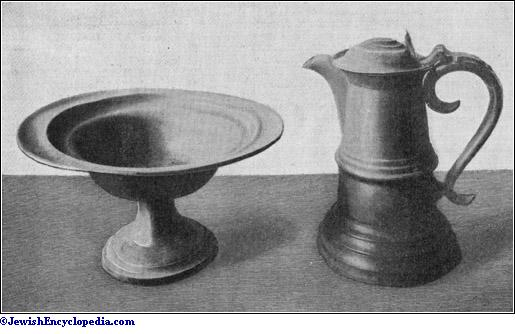
Laver and Basin.(In the possession of Maurice Herrmann, New York.)
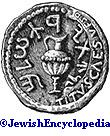
Obverse of a Bar Kokba Coin Bearing a Laver.(After Madden.)
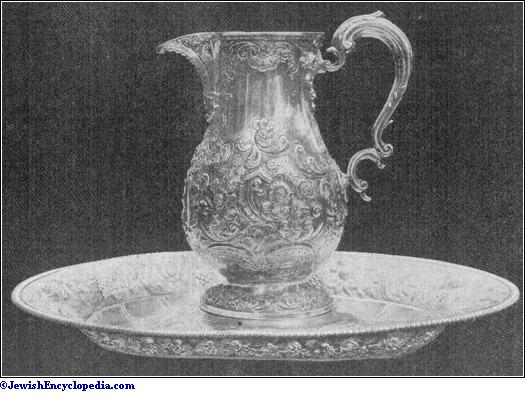
Laver Consisting of Ewer and Basin.(In the possession of B. L. Cohen, London.)
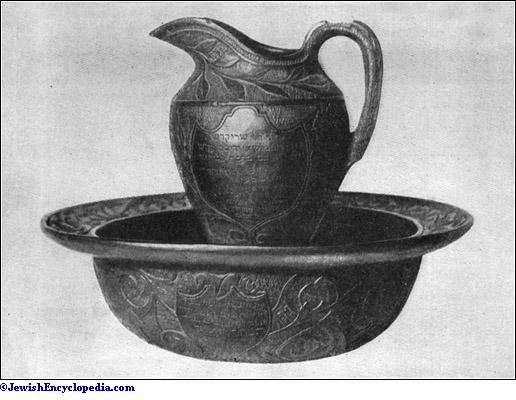
Laver Consisting of Ewer and Basin.(In the Synagogue at Ramegate, England.)
Vessel used for ritual ablutions. The laver in the Tabernacle consisted of two parts, a basin and a stand ("ken"; Ex. xxx. 18 et al.). It was made of the brass from the mirrors given by the women who served in the Sanctuary (Ex. xxxviii. 8), and stood between the door of the Tabernacle and the altar of burnt offering. It was placed there that Aaron and his sons might wash their hands and feet before entering the Tabernacle (Ex. xxx. 19-21). Nothing is said as to its size or shape. In the court of Solomon's Temple ten lavers of bronze were established, five on the right and five on the left, facing eastward (I Kings vii. 27-39). They were used for the cleansing of the entrails and feet of the animals sacrificed (Josephus, "Ant." viii. 3, § 6; comp. II Chron. iv. 6), while the "brazen sea" served the purpose of the laver of the Tabernacle. As far as can be made out from the detailed but not entirely clear and intelligible descriptions of I Kings and Josephus, and from comparing similar vessels represented on Assyrian monuments, the lavers had bases ("mekonot"), in two parts or divisions. The lower part consisted of a square framework, the sides being a kind of open lattice-work ("misgerot" and "shelabbim"). At the corners of this frame were "shoulders" ("ketefot"), in which were fixed the axles on which the wheels turned. These bases were each four cubits long, four broad, and three high (Josephus and the LXX. give somewhat different measurements), while the wheels were each one and one-half cubits in diameter. Upon these bases were set round pedestals (I Kings vii. 31, 35), each half a cubit in height, one and one-half cubits across, and one cubit on the inside; the pedestals rested on supports ("yadot" = "hands") springing, as it seems, from the lower square base (comp. Stade's "Zeitschrift," xxi. 150 et seq.; Nowack, "Lehrbuch der Hebr. Archäologie," ii. 44-46). The panels and stays were ornamented with figures of lions, oxen, cherubim, and wreaths. The lavers proper, or basins, were four cubits in diameter, and had a capacity of "forty baths" (= 52 cubic feet), being therefore about two feet high.
Laver and Basin.(In the British Museum, London.)
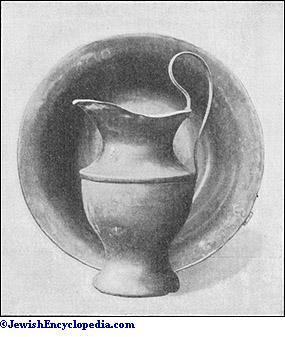
In the Second Temple there was only one laver of brass, which served the same purpose as that of the Tabernacle, namely, for the priests to wash the hands and feet (Tam. i. 2, ii. 1; Mid. iii. 6). According to Yoma 37a, Ḳaṭin supplied it with twelve spigots ("daddim," lit. "breasts"), it having had only two before, and with some contrivance for letting the water in and out. Of its size and shape no information is given. No mention is made of the laver in the Temple of Herod.
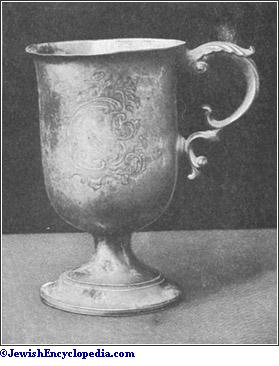
The holiness of the priests and Levites was transferred to the whole people after the destruction of the Temple, and prayer took the place of sacrifices. Hence the institution of the washing of hands before prayer. The antiquity of the custom among the Jews is evidenced by its mention in the epistle of pseudo-Aristeas (comp. ed. Moritz Schmidt, p. 67; comp. also Judith xii. 7; Clement of Alexandria, "Stromata," iv. 22, 144; Sibyllines, iii. 591-593). Orthodox synagogues, therefore, have a laver either in the anteroom or in the court. The form and material of the synagogue laver vary. Usually it is of copper, barrel-like in shape, with a spout near the bottom from which the water is allowed to run over the hands into a receptacle underneath. The strict regulations for washing the hands before meals do not obtain in regard to prayer; it is only required to moisten the hands to the wrists and recite the benediction ("'al neṭilat yadayim . . .") while drying them ("Yad," Tefillin, iv. 2). For the washing of the priests hands by the Levites before the blessing of the congregation ("dukan"; comp. Soṭah 39a: Num. R. xi. 4) a ewer and basin are used. See Ablution; Levites; Priest.
Bibliography:
H. G. Clemens, De Labro Æneo, Utrecht, 1725;
B. F. Quintorp, De Speculis Labri Ænei, Greifswald, 1773;
Lightfoot, Descr. Temp. c. 37, 1;
Vitringa, De Synagoga Vetere, pp. 1091, 1105;
Bähr, Symbolik des Mosaischen Cultus, 2d ed., i. 583;
idem, Salomons Tempel, pp. 214, 222;
Keil, Tempel Salomos, p. 118.
Laver from Tunis.(In the United States National Museum, Washington, D. C.)
LAVER.—See Tabernacle, § 4, Temple, § 6 (d).
1. In the Tabernacle:
Every priest in attendance on the altar of Yahweh was required to wash his hands and his feet before entering upon his official duties (Exo 30:19 ff). To this end a laver was ordered to be made as part of the tabernacle equipment (Exo 30:17-21; Exo 38:8). Its composition was of brass (bronze), and it consisted of two parts, the bowl and its pedestal or foot (Exo 30:18, etc.). This first laver was a small one, and was made of the hand mirrors of the women in attendance upon the altar (Exo 38:8). Its place was between the altar and the tabernacle (Exo 40:30). See TABERNACLE.
2. In the Temple:
The difficulty as to the washing of parts of the sacrificial carcasses was overcome, in the temple of Solomon, by the construction of “10 lavers” and a “molten sea” (1Ki 7:23-37; 2Ch 4:2-6; see TEMPLE; SEA, MOLTEN). We learn from 2Ch 4:6 that the “sea” was for the priests to wash in - therefore took the place of the laver in the tabernacle - and the lavers were used as baths for portions of the burnt offerings. The lavers themselves were artistic works of unusual merit for that age. Like that in the tabernacle, each had its own stand or base, which was cast in a separate piece from the laver. These bases rested on wheels which allowed of the laver being moved from one part of the court to another without being turned about. Five stood on the north and five on the south side of the temple. They were ornamented with “lions, oxen, and cherubim,” and on a lower level, with a series of wreaths or festoons of flowers (1Ki 7:27-37). In modern speech, the lavers may be described as so many circular open tanks for the storage of water. Each laver contained 40 baths (about 320 gals.) of water. Its height was 5 cubits, the locomotive machinery being 3 cubits in height, and the depth of the bowl or tank, judging from its capacity, about 2 cubits. The last we hear of the lavers, apart from their bases, is that the idolatrous king Ahaz cut off the border of the bases, and removed the bases from them (2Ki 16:17). During the reign of Jehoiakim, Jeremiah foretold that the molten sea and the bases (there being then no lavers) should be carried to Babylon (Jer 27:19). A few years later it is recorded that the bases were broken up, and the brass of which they were made was carried away (Jer 52:17).
3. The Laver in the New Testament:
The Greek word (
‘Laver’ is the translation of ëïõôñüí in Eph_5:26 Revised Version margin, where the text has ‘washing.’ The same Greek word occurs in Tit_3:5, where the Revised Version margin again gives ‘laver.’ This rendering is at least doubtful. In the Septuagint ëִּéåֹø, ‘a layer,’ is always rendered by ëïõôÞñ, while ëïõôñüí is used for øַäְöָä, ‘washing,’ in Son_4:2; Son_6:6, Sir_31:30. The phrase äéὰ ëïõôñïῦ ðáëéíãåíåóßáò, therefore, probably means ‘through a washing, or bathing, of regeneration,’ rather than ‘through a laver, or font.’ For patristic references confirming the translation ‘washing,’ see J. A. Robinson’s Ephesians, 1903, p. 206.
James Strahan.
Exo 30:18 (c) This may be used as a type of the Word of GOD. (See Psa 119:9, Eph 5:26). No size is given for the laver, nor do we know how it was carried. We do not know the depth, the scope, nor the value of the Word of GOD. There is no rule about how GOD’s Word is to be carried here and there from heart to heart. The laver is a beautiful picture of all of this.