
See under LIGHT.
Much is said in the holy Scripture concerning the lamps of the temple. And when the Lord Jesus appeared to John, he was seen in the midst of the golden candlesticks (Rev. i. 12, 13.) And John saw before the throne, at another vision, seven lamps of fire burning before the throne, (Rev 4: 5.) See also Exod. xxv. 37; 37. 23. Num. 8. 2. Zech. 4: 2.) No doubt, that besides the general use of lighting the temple, they had a reference to spiritual things, and were meant as emblems of the illuminating and brightening offices ofGod the Holy Ghost to the churches and people. We know that this almighty Minister in the church of Jesus, acts as "a spirit of judgment, and a spirit of burning." (Isa. 4: 4.) And how blessedly he manifests the sovereignty of is power in both convincing of sin, and of righteousness, and of judgment, " the church of God in all ages hath borne witness. Precious are his sevenfold gifts, when by his gracious influence he penetrates the heart of the redeemed, melting by his burning the frozen affections, softening and subduing thestubborn mind, and making it willing in the day of his power. Oh, what unknown influence doth the Holy Ghost manifest in the hearts of those he makes his temple! (I Cor. vi. 19.) what light, what grace, what information, what comfort, the Lord the Spirit imparts! Oh, ye ransomed of the Lord, who know the infinite preciousness his grace, see that ye "grieve not the Holy Spirit of God, whereby ye are sealed unto the day of redemption!" (Ephes. 4: 30.) I cannot dismiss the subject of the sacred lamps of the temple, emblemsas they were of the light of the Spirit, without one observation more, namely, that it should seem, the perpetual, use of them was designed to keep alive the remembrance of his unceasing, presence, who is the light of his people. It is said in the history of Samuel, that ere the lamp of God went out in the temple of the Lord where the ark of God was, and Samuel was laid down to sleep, that the Lord called Samuel." (1 Sam. 3: 3, 4.) Was not this emblematical of the Spirit of prophecy, that before one lamp of the Lordwent out another should be lighted, before Eli was quite extinguished Samuel should be kindred? Do we not find it so through the church’s history in all ages? Did not the spirit of Elijah rest on Elisha? Did not all the prophets succeed one another in their ministry, as might best promote and carry on the Lords cause in the earth? I do not presume to speak decidely upon the subject, but if the thought be right, is there not great sweetness in that Scripture explained in reference to this view, and with an eye to the Lord Jesus?"I have ordained a lamp for mine anointed." (Ps. cxxx2: 17.) That lamps are constantly used figuratively in Scripture, I need not insist upon. The Lord is said to be the light of his people, (Ps. 27. 1. Job 29, 3.) and even his servants, shining by his brightness, are spoken of by the same figure. Thus David was called "the lamp of Israel, " 2 Sam. xxi. 17. and John the Baptist said to be a burning and a shining light." (John v. 35.)
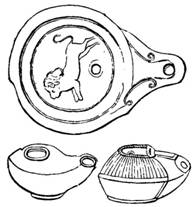
Fig. 237—Egyptian Lamps
Lamps are very often mentioned in Scripture; but there is nothing to give any notion of their form. Almost the only fact we can gather is, that vegetable oils were burnt in them, and especially, if not exclusively, olive-oil. This, of the finest quality, was the oil used in the seven lamps of the Tabernacle (Exo 27:20). It is somewhat remarkable, that while the golden candlestick, or rather candelabrum, is so minutely described, not a word is said of the shape, or even the material, of the lamps (Exo 25:37). This was, perhaps, because they were to be of the common forms, already familiarly known to the Hebrews, and the same probably which were used in Egypt, which they had just departed. They were in this instance doubtless of gold, although metal is scarcely the best substance for a lamp. The golden candlestick may also suggest that lamps in ordinary use were placed on stands, and where more than one was required, on stands with two or more branches. The modern Orientals, who are satisfied with very little light in their rooms, use stands of brass or wood, on which to raise the lamps to a sufficient height above the floor on which they sit. Such stands are shaped not unlike a tall candlestick, spreading out at the top. Sometimes the lamps are placed on brackets against the wall, made for the purpose, and often upon stools. Doubtless the same contrivances were employed by the Hebrews.
From the fact that lamps were carried in the pitchers of Gideon’s soldiers, from which, at the end of the march, they were taken out, and borne in the hand (Jdg 7:16; Jdg 7:20), we may with certainty infer that they were not, like many of the classical lamps, entirely open at top, but so shaped that the oil could not easily be spilled. This was remarkably the case in the Egyptian specimens, and is not rare in the classical. Gideon’s lamps must also have had handles; but that the Hebrew lamps were always furnished with handles we are not bound to infer: in Egypt we find lamps both with and without handles.
Although the lamp-oils of the Hebrews were exclusively vegetable, it is probable that animal fat was used, as it is at present by the Western Asiatics, by being placed in a kind of lamp, and burnt by means of a wick inserted in it. This we have often witnessed in districts where oil-yielding plants are not common.
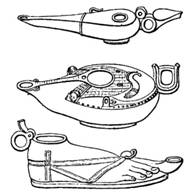
Fig. 238—Classical Lamps
Cotton wicks are now used throughout Asia; but the Hebrews, like the Egyptians, probably employed the outer and coarser fiber of flax; and perhaps linen yarn, if the Rabbins are correct in alleging that the linen dresses of the priests were unraveled when old, to furnish wicks for the sacred lamps [CANDLESTICK].
It seems that the Hebrews, like the modern Orientals, were accustomed to burn lamps overnight in their chambers; and this practice may appear to give point to the expression of ’outer darkness,’ which repeatedly occurs in the New Testament (Mat 8:12; Mat 22:13): the force is greater, however, when the contrast implied in the term outer is viewed with reference to the effect produced by sudden expulsion into the darkness of night from a chamber highly illuminated for an entertainment. This custom of burning lamps at night, with the effect produced by their going out or being extinguished, supplies various figures to the sacred writers (2Sa 21:17; Pro 13:9; Pro 20:20). And, on the other hand, the keeping up of a lamp’s light is used as a symbol of enduring and unbroken succession (1Ki 11:36; 1Ki 15:4; Psa 132:17).
It appears from Mat 25:1, that the Jews used lamps and torches in their marriage ceremonies, or rather when the bridegroom same to conduct home the bride by night. This is still the custom in those parts of the East where, on account of the heat of the day, the bridal procession takes place in the night-time. The connection of lamps and torches with marriage ceremonies, it may be observed, is still preserved in Western Asia, even where it is no longer usual to bring home the bride by night. During two, or three, or more nights preceding the wedding, the street or quarter in which the bridegroom lives is illuminated with chandeliers and lanterns, or with lanterns and small lamps suspended from cords drawn across from the bridegroom’s and several other houses on each side to the houses opposite; and several small silk flags, each of two colors, generally red and green, are attached to other cords. Lamps of this kind are sometimes hung over doors. There are some indications that the ancient Egyptians had lamps of glass; and, if so, there is no reason why the Jews also might not have had them, especially as this material is more proper for lamps intended to be hung up, and therefore to cast their light down from above. The Jews certainly used lamps in other festivals besides those of marriage. If this custom had not been so general in the ancient and modern East, it might have been supposed that the Jews adopted it from the Egyptians, who, according to Herodotus, had a ’Feast of Lamps,’ which was celebrated at Sais, and, indeed, throughout the country at a certain season of the year. The description which the historian gives of the lamps employed on this occasion, strictly applies to those in modern use already described, and the concurrence of both these sources of illustration strengthens the probable analogy of Jewish usage. He speaks of them as ’small vases filled with salt and olive-oil, in which the wick floated, and burnt during the whole night.’ It does not indeed appear of what materials these vases were made; but we may reasonably suppose them to have been of glass.
The later Jews had even something like this feast among themselves. A ’Feast of Lamps’ was held every year on the twenty-fifth of the month Chisleu. It was founded by Judas Maccabeus in celebration of the restoration of the temple worship, and has ever since been observed by the lighting up of lamps or candles on that day in all the countries of their dispersion. Other Orientals have at this day a similar feast, of which the ’Feast of Lanterns’ among the Chinese is, perhaps, the best known.
The lamps of the ancients, sometimes called "candles" in our Bible, were cups and vessels of many convenient and graceful shapes; and might be carried in the hand, or set upon a stand. See CANDLESTICK. The lamp was fed with vegetable oils, tallow, wax, etc., and was kept burning all night. The poorest families, in some parts of the East, still regard this as essential to health and comfort. A darkened house therefore forcibly told of the extinction of its former occupants, Job 18:5,6 Pro 13:9 20:20 Jer 25:10,11; while a constant light was significant of prosperity and perpetuity, 2Sa 21:17 1Ki 11:36 Psa 132:17 . Lamps to be carried in the streets presented a large surface of wicking to the air, and needed to be frequently replenished from a vessel of oil borne in the other hand, Mat 25:3,4 . Torches and lanterns, Joh 18:3, were very necessary in ancient cities, the streets of which were never lighted.\par
Lamp.
1. That part of the Golden Candlestick belonging to the Tabernacle which bore the light; also of each of the ten candlesticks placed by Solomon in the Temple before the Holy of Holies. Exo 25:37; 1Ki 7:49; 2Ch 4:20; 2Ch 13:11; Zec 4:2. The lamps were lighted every evening and cleansed every morning. Exo 30:7-8.
2. A torch or flambeau, such as was carried by the soldiers of Gideon. Jdg 7:16; Jdg 7:20. Compare Jdg 15:4. The use, in marriage processions, of lamps fed with oil is alluded to in the parable of the ten virgins. Mat 25:1. Modern Egyptian lamps consist of small glass vessels with a tube at the bottom containing a cotton wick twisted around a piece of straw.
For night travelling, a lantern composed of waxed cloth strained over a sort of cylinder of wire rings, and a top and bottom of perforated copper. This would, in form, at least, answer to the lamps within pitchers of Gideon.
"The Hebrews, like the ancient Greeks and Romans, as well as the modern Orientals, were accustomed to burn lamps all night. This custom, with the effect produced by their going out or being extinguished, supplies various figures to the sacred writers. 2Sa 21:17; Pro 13:9; Pro 20:20. On the other hand, the keeping up of a lamp’s light is used as a symbol of enduring and unbroken succession. 1Ki 11:36; 1Ki 15:4; Psa 132:17." -- McClintock and Strong.
Lamp. The lights of the East are of various kinds; not only oil, but pitch, naphtha, and wax are used to maintain the flame. The wicks were generally made of cotton or of flax. According to rabbinical tradition, the wicks of the sacred lamps were made of the old linen garments of the priests. The form of Oriental lamps was fanciful, and often elegant, of which we have numerous specimens found in the ruined cities of the East. The materials of which lamps were made were baked clay, terra cotta, bronze, etc. The lamps of the Hebrews, it is probable, were suffered to bum all night, and this occasioned no great expense in a country so rich in oil. The putting put of the light denoted the ruin and extinction of the family and the desertion of the house. This gives force to the words in Job 18:5-6; Job 21:17; Job 29:3; "The light of the wicked shall be put out;... light shall be dark in his tabernacle, and his candle shall be put out with him." "How oft is the candle of the wicked put out." Jer 25:10-11; Pro 20:20. Also in Pro 13:9; "The light of the righteous rejoiceth, but the lamp of the wicked shall be put out: " and of the prudent wife, "Her candle goeth not out by night." Pro 31:18.
The lamp was commonly used to furnish artificial light, and numbers of them have been found in the ruins of Jerusalem and other cities, some being made of terra cotta and others of glass. In the ’golden candlestick’ the light was obtained from lamps, and wherever the word ’candle’ occurs a lamp is signified. The lamp is used symbolically for the light that is obtained from it; thus "Thy word is a lamp unto my feet." Psa 119:105; Pro 6:23. The ten virgins, when they went forth to meet the bridegroom, each took a lamp (more correctly a torch); but the issue made it manifest that the lamp without oil could give no light: a striking symbol of mere profession without the Holy Spirit. Mat 25:1-8. Oil for the light is further exemplified in the candlestick in Zech. 4, where the seven lamps are furnished with oil by pipes from two olive trees: to these God’s two witnesses in a future day are compared. Rev 11:4. See LIGHT.
LAMP.—There are two words in the Gospels translated ‘lamp,’
C. H. Prichard.
LAMP.—1. The earliest illuminant everywhere was supplied by pieces of resinous wood. Such probably were the torches of Gideon’s adventure (Jdg 7:16; Jdg 7:20 RV
2. Two main stages in this development have to be recognized, the first that of the open, the second that of the closed, lamp. (a) The earliest form found in pre-Israelite strata is that of the plain open clay lamp in the shape of a shell, or shallow bowl, with rounded bottom. It is distinguished from the later form of open lamp by having the rim only slightly pinched along about one-third of its circumference, to keep the wick in position. (b) In the later forms just referred to, which are those of the late Canaanite and early Hebrew periods, the lips are drawn much more closely together, so as to form an elongated spout, as may be seen in the illust. in Hastings’ DB
3. The introduction of the closed lamp cannot as yet be dated with certainty, but is probably due to Western influence. According to Bliss (BMExc. 130), ‘by Seleucidan times the open lamp appears largely to have given way to the closed lamp.’ (a) The earlier specimens of this type consist of a circular bowl closed at the top, with the exception of a round opening for pouring in the oil, with a flat or concave base. They are further characterized by their long tapering, and sometimes straight, spout, which ‘forms a distinct angle with the bowl.’ These lamps are entirely without ornament, and, like all the others, without handles. (b) The later closed lamps, on the other hand, have their upper surface ornamented with an endless variety of design, ranging from simple lines through chevrons, spirals, etc., to animal forms. Numerous specimens of (a) and (b) are illustrated in BMExc. pl. 62, 63. For a typical lamp of the Maccabæan period, see PEFSt
4. Many of the specimens hitherto given as illustrations of the lamps of OT are really of early Christian or even Byzantine date. A typical Byzantine form is given in BM Exc. pl. 66, No. 6. This type is distinguished from the previous closed type by the fact that ‘the curve of the body is continuous with the top of the spout, giving a generally oval shape.’ See the collections illustrated PEFSt
5. In addition to the normal lamp with a single wick, the excavations in northern and southern Palestine have brought to light numerous specimens of ‘multiple lamps,’ a favourite form of which consisted of a bowl, having its rim pinched into three, four, or seven spouts (see BM Exc. pl. 66). As in other lands, the Palestinian potter sometimes gave his lamp the shape of an animal, such as the remarkable clay duck from Gezer described and illustrated in PEFSt
The favourite material in all ages was clay. A good specimen of a bronze lamp with a handle, from the Greek period, is shown in BMExc. 60. Silver lamps are mentioned in Jdt 10:22. Those of the Tabernacle and Temple were of gold. The usual illuminant was the oil of the olive; other oils, including naphtha, are named in the Mishna (Shabbath, ii. 1ff.), where may be found, also, a list of the substances for wicks in addition to the ordinary wick of twisted flax (Isa 42:3 RVm
6. In the poorer houses the lamp was placed, as it still is, in a niche in the wall. It is in the case of a ‘great woman’ that we first hear of a lampstand in a private house. Lampstands of stone, about 30 inches in height, have been found in the recent excavations in Crete; one of limestone is figured in Bliss, Mound, etc. 104, from Lachish. The candlestick of AV
In ancient times, as at the present day, it was customary to keep the household lamp continually alight, hence the figure in 1Ki 11:36, 2Ki 8:19; conversely, the putting out of the lamp of the wicked (Job 18:8 [AV
For a recently discovered, and still obscure, early rite in which lamps and bowls played an essential part, see House, § 3; and for a later rite, see Dedication [Feast of].
A. R. S. Kennedy.
Gen 15:17 (c) Here we find a picture of the experience of Israel in Egypt. They were to have terrible oppression and suffering which was described as a smoking furnace, but in the midst of this they were to have the Word of GOD and the teaching of GOD’s truth which is represented by the burning lamp. GOD never failed even in the darkest hour to send the light of His truth to the people.
Exo 25:37 (c) The lampstand had seven branches, and these are generally taken to represent the seven-fold Spirit of GOD who is the Spirit of light. It is also taken by some to represent the perfect testimony of the Word of GOD. Others think that they represent the ministry of the church which gives out the light of the Gospel. All three may be true, for certainly these golden lamps do represent all these three sources of light.
Jdg 7:16 (c) In this account the pitcher probably represents the believer. The lamp probably represents the light that is in the believer, the indwelling Spirit of GOD, and the wonderful light- giving Word of GOD. the pitcher must be broken that the light may shine out. The believer must be broken in spirit, humble and contrite, that the light may shine from him. Nothing earthly must interfere.
1Ki 15:4 (b) Here is a figure of the testimony and life of King David. These were left to his children. They were to exhibit the faith which David had and to carry on the testimony which David maintained. (See also Psa 132:17).
Job 12:5 (b) This lamp represents the Word of GOD and the counsel of the Lord. That person who is ready to leave the path of righteousness and walk with the world does not want counselor advice either from the Word of GOD, or from the child of GOD. He despises both.
Job 41:19 (c) Probably this is just a poetic way of telling of the terror produced by the hideous noises that come from the mouths of enraged animals. It may have a counterpart somehow in describing the vile and wicked expressions that come from the mouths of the ungodly who seek to destroy much good.
Psa 119:105 (a) The Word of GOD is the lamp which lights the way through life and illuminates the path to glory. Those who walk in the light of the Word of GOD live godly, consecrated lives which are fruitful, helpful and pleasant. (See also Pro 6:23).
Pro 13:9 (b) The Lord tells us in this passage, as well as in other portions, that the influence of the wicked, and the memory of them, as well as their public testimony, will be blotted out, for they have no value to GOD. (See also Pro 20:20).
Isa 62:1 (a) The Gospel of GOD’s grace began at Jerusalem with our Lord JESUS and has spread throughout the world. Thus this Scripture has been fulfilled.
Eze 1:13 (a) The living creatures represent four aspects of the Lord JESUS CHRIST. The fire represents the judgment that emanates from Him as the Judge of all the earth. The lamps represent the Holy Spirit of GOD in His seven aspects, and as coming from the Lord JESUS who is the giver of the Holy Spirit.
Dan 10:6 (a) This may be another representation of the Lord JESUS CHRIST whose eyes shine with the glory of GOD, and penetrate the heart and soul of those with whom He deals.
Mat 25:1 (a) It is generally believed that these lamps refer to the testimony of these virgins. Some testimonies are beautiful explanations and expressions of human experiences, but which lack the Spirit of Life. Others give testimonies in which it is clear to be seen that the Holy Spirit indicted both the experience and the expression. The oil represents the presence of the Holy Spirit Himself, and when He is present the testimony of the one who speaks savors of Heaven and presents a spiritual tone which is absent in other testimonies.
Rev 4:5 (a) The passage tells us that these lamps do represent the Holy Spirit in His wonderful sevenfold aspect. The Spirit gives light and life. He directs the way. He teaches the truth of GOD. He anoints for service. He reveals wicked ways and evil doctrines. He guides the feet in the way of peace. He illuminates the soul with the light of Heaven.
Rev 8:10 (a) The lamp which fell from Heaven was either an angel or a superman. The lamp represents the testimony and the message which that unusual person brought to the earth. The message which he gave was bitter as wormwood and deadly in its effect on the souls of men.
Various kinds of lamps are mentioned in the Bible, some for indoor use (2Ki 4:10; Dan 5:5; Mat 5:15; Act 20:8), others for outdoor use (Psa 119:105; Mat 25:1; Joh 18:3). They were made of a variety of materials (clay, metal or wood) and were of different shapes and designs, but they all functioned in much the same way. Basically, a lamp consisted of a bowl to hold the fuel (oil) and a cloth wick that soaked up the oil for the flame (Exo 27:20; Mat 25:3-4).
A lamp was so important for everyday living in the ancient world that it was almost a symbol of life itself (2Sa 21:17; Job 29:2-3; Pro 13:9; Rev 18:23). The Word of God and the servants of God are at times likened to lamps, since they provide light from God in a world of darkness (Psa 119:105; Mat 5:16). The lamp was therefore a fitting symbol of the witness that the people of God bear to him (Luk 12:35; Joh 5:33; Joh 5:35; cf. Joh 1:7).
Lampstands
In the tabernacle built by Moses, seven lamps were fitted to a single lampstand to provide light for the Holy Place. God gave Moses no dimensions for the lampstand, but it weighed about thirty-five kilograms, was made of one piece of gold and was richly ornamented. The common people provided the oil for the lamps, and the priests checked the lamps each morning and evening to ensure they were kept burning (Exo 25:31-40; Exo 27:20-21). In Solomon’s temple there were ten lampstands, five against each of the two side walls (1Ki 7:49).
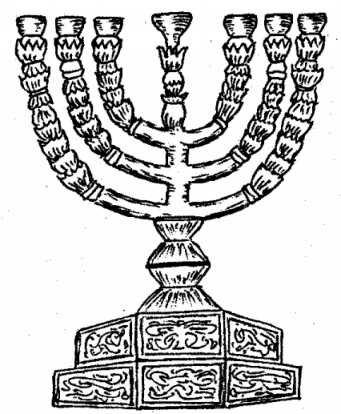
Many years later, when the Jews had returned from captivity in Babylon and were rebuilding their temple, the prophet Zechariah had a vision of a seven-branched temple lampstand. Two olive trees, one each side of the lampstand, fed the lamps miraculously with a continuous supply of oil. This symbolized the continuous supply of God’s supernatural power, which would ensure the satisfactory completion of the temple (Zechariah 4). It probably also symbolized the witness of God’s people (Rev 11:3-4).
In the book of Revelation, lampstands feature in one of the visions that John saw. In this vision, seven lampstands represented seven churches, to which God directed John to write seven letters (Rev 1:11-13; Rev 1:20). Each church was to be a witness to Jesus Christ, but if it failed in its task and ignored God’s warnings, God could ‘remove the lampstand’ by bringing the church to an end (Rev 2:5).