
A city south of Judah, Josh. x.23. The word signifies, she walks, from Jalac.
La´chish, a city in the south of Judah, in the plain between Adoraim and Azekah (Jos 10:3; Jos 10:5; Jos 10:31; Jos 15:39). It was rebuilt and fortified by Rehoboam (2Ch 11:9), and seems after that time to have been regarded as one of the strongest fortresses of the kingdom of Judah, having for a time braved the assaults of the Assyrian army under Sennacherib (2Ki 18:17; 2Ki 19:8; 2Ch 32:9). Eusebius and Jerome place it seven Roman miles from Eleutheropolis towards the south. There has not been any more recent notice of the place, and no modern, vestige of the name or site has been discovered.
A city in the southwest part of Judah, Jos 10:3,5,31 ; fortified by Rehoboam, 2Ch 11:9, and strong enough to resist for a time the whole army of Sennacherib, 2Ki 18:17 19:8 2Ch 32:1,9,21 Mic 1:13 . It was here that king Amaziah was slain, 2Ki 14:19 . For a wonderful confirmation of the truth of Scripture, see SENNACHERIB.\par
La’chish. (invincible). A city lying south of Jerusalem, on the borders of Simeon, and belonging to the Amorites, the king of which joined with four others, at the invitation of Adonizedek, king of Jerusalem, to chastise the Gibeonites for their league with Israel. Jos 10:3; Jos 10:5. They were routed by Joshua at Beth-horon, and the king of Lachish fell a victim, with the others under the trees at Makkedah. Jos 10:26. The destruction of the town shortly followed the death of the king. Jos 10:31-33.
In the special statement that the attack lasted two days, in contradistinction to the other cities which were taken in one (see Jos 10:35, we gain our first glimpse of that strength of position, for which Lachish was afterward remarkable. Lachish was one of the cities fortified, and garrisoned by Rehoboam, after the revolt of the northern kingdom. 2Ch 11:9.
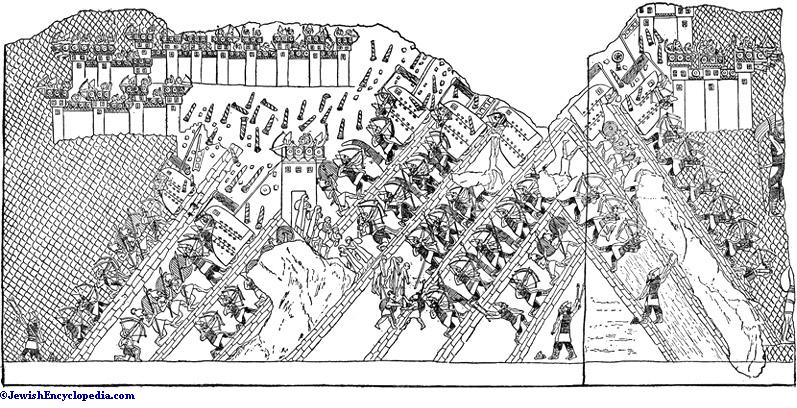
In the reign of Hezekiah, it was one of the cities taken by Sennacherib. This siege is considered by Layard and Hincks, to be depicted on the slabs found by the former, in one of the chambers of the palace at Kouyunjik. After the return from captivity, Lachish with its surrounding "fields" was reoccupied by the Jews. Neh 11:30.
A royal Canaanite city which joined the confederacy against Gibeon for submitting to Israel, and was taken by Joshua (Jos 12:11; Jos 10:3; Jos 10:5; Jos 10:31-32) "on the second day," which shows its strength; the other cities were taken in one day (Jos 10:35). Assigned to Judah, in the
It held out against Nebuchadnezzar (Jer 34:7). Sennacherib’s siege of Lachish is still to be seen at Koyunjik represented on the slabs of his palace walls as successful, with the inscription "Sennacherib, the mighty king of Assyria, sitting on the throne of judgment before the city of Lachish, I give permission for its slaughter." The Assyrian tents appear pitched within the walls, and the foreign worship going on. The town, as in Scripture, is depicted as on hilly ground, one part higher than the other. The background shows a hilly country covered with vines and fig trees; but immediately round the town are palms, indicating its nearness to the maritime plain where the palm best flourishes. His boasted success is doubtful from 2Ch 32:1, "Sennacherib encamped against the fenced cities, and thought to win them for himself"; 2Ki 19:8; Jer 34:7.
Lachish was foremost in adopting some of the northern idolatry. Hence, Micah (Mic 1:13) warned the inhabitants of Lachish to flee on the swift beast (there’s a play of like sounds between Lachish and
Lachish (lâ’kish), invincible. A city of the Amorites, lying south of Jerusalem, and toward the border of Simeon. Jos 10:1-43; Jos 3:1-17. It was one of the Canaanitish cities which was subdued by Joshua and included in Judah; fortified by Jeroboam. 2Ch 11:9. King Amaziah was killed there. 2Ki 14:19. Lachish was besieged by Sennacherib and perhaps taken. 2Ki 18:13-14; Isa 36:1-2. The siege is considered by some to be depicted on the slabs found in one of the chambers of the palace at Kouyunjik. Lachish has lately (1892) been identified with Tel-el-Hesy on the Mediterranean Sea, where remarkable tablets, records, and letters of the king of Lachish have been found, written before the exodus.
[La’chish]
An Amorite city in the lowlands of Judah. Its king was one of the four called upon by the king of Jerusalem to join him in attacking Gibeon because it had made peace with the Israelites. But the Amorites were smitten, and Lachish was taken by Joshua after a siege of two days. It was a fortified city in the route running from north to south. On the division of the kingdom it was garrisoned by Rehoboam. It was taken by Sennacherib, and among the slabs discovered at Nineveh is one representing the king sitting on his throne, with captives from Lachish kneeling before him, while his troops, passing in review, show the spoils they have taken. The inscription reads, "Sennacherib, king of multitudes, king of Assyria, sitteth upon a lofty throne, and the spoil of the city of Lachish passeth before him." This slab is now in the British Museum. Jos 10:3-35; Jos 12:11; Jos 15:39; 2Ki 14:19; 2Ki 18:14; 2Ki 18:17; 2Ki 19:8; 2Ch 11:9; 2Ch 25:27; 2Ch 32:9; Neh 11:30; Isa 36:2; Isa 37:8; Jer 34:7; Mic 1:13. Identified by some with Tell el Hesy, 31° 33’ N, 34° 44’ E.
At this mound 60 feet have been dug through and explored. The ruins of as many as eight cities have been discovered, which are judged by the marks on the pottery, etc., to extend back to about 1500 B.C. Nearer the surface have been found scarabs (beetles) and an inscription which makes it evident that at one time it was subject to Egypt. This is proved also by records on the Tell Amarna Tablets, alluded to under ’Egypt’.
By: Emil G. Hirsch, Ira Maurice Price
Siege of Lachish by the Troops of Sennacherib.(From Layard's "Monuments of Nineveh.")
The city of Lachish was located in Judah (Josh. xv. 39). It is first heard of in Josh. x. 3 et seq. Its king, Japhia, together with the kings of Jerusalem, Hebron, Jarmuth, and Eglon—all Amorites—formed a coalition against Gibeon because it had made peace with the Israelites. These kings were routed, caught in a cave, killed, and their bodies hanged. Joshua in this campaign besieged and captured Lachish (ib. x. 31, 32), and made prisoners also those who helped the city. Lachish is next mentioned in the list of cities built, or probably rebuilt, by Rehoboam (II Chron. xi. 9), the first king of Judah after the division of the kingdom. Amaziah, King of Judah, was so detested by his people that, to avoid the wrath of a conspiracy, he fled to Lachish (II Kings xiv. 19); but he was pursued and slain.
Probably the greatest battle fought under the walls of Lachish was fought by Sennacherib's army in 701 B.C. (II Kings xviii. 14). While the Assyrians were besieging the city, Hezekiah sent and asked the price of forgiveness and absolute safety. The cost of such submission was quickly named, was collected by Judah's king, and sent to the King of Assyria at Lachish. From this same seat of war Sennacherib sent his officers "with a great army" against Jerusalem. Some time thereafter those officers returned to find that Lachish had been reduced, and the army transferred to Libnah. Sennacherib does not mention this city in his annals; but the walls of his palace at Kuyunjik were decorated with two elegant pictures: one representing in remarkable detail the methods of the besiegers, and the other showing, as a brief inscription says, Sennacherib, king of nations, King of Assyria, seated on the throne, and the captives from Lachish paraded before him. Both of these are beautifully executed and give the graphic outlines of the siege of one of the most interesting smaller cities of ancient Judah. The religious influence of Lachish in this period is hinted at in Micah (i. 13, R. V.): "Bind the chariot to the swift steed, O inhabitant of Lachish: she was the beginning of sin to the daughter of Zion." Lachish is named as one of the fortified cities which the King of Babylon captured (Jer. xxxiv. 7) when he shattered and carried captive the kingdom of Judah. It is named also (Neh. xi. 30) as one of the cities occupied by the Jews who returned from the Captivity.
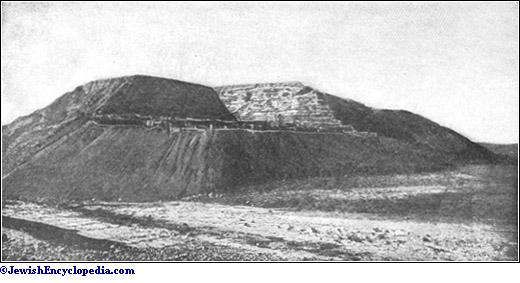
The site of ancient Lachish is generally identified to-day with Tell al-Ḥasi, occupying a position between the maritime plain and the hill-country of Judea, about sixteen miles east of Gaza. Petrie excavated here in 1890, and published his results in "Tell el-Hesy" (1891). Bliss excavated at this mound during four seasons and cut through a section of it down to the native soil. He found eight superimposed cities: (1) an Amorite one, fortified by a strong wall, and dating about 1700 B.C.; (2) dating about 1500 (the date being determined by Egyptian scarabs); (3) covered by a mass of ashes; here was found a cuneiform tablet of the time of Amen-hotep IV. of Egypt, on which Zimrida, governor of the city, is named; (4) dating about 1400-1000, with an abundance of Phenician pottery; (5) dating about 1000, and (6) dating from 800, Jewish articles prevail; (7, 8) which furnished many specimens of black-figured Greek pottery, pointing to 500-400. No remains that indicate a later date have been discovered. Bliss's finds show a "Mound of Many Cities," as he entitles his book (1898), where many and fierce battles were fought during more than 1,200 years.
Tell al-Ḥasi, Site of Ancient Lachish.(From a photograph.)
LACHISH.—A town in the south country of Judah referred to several times in the Tell el-Amarna tablets. In the Biblical records it first appears as joining the coalition headed by the king of Jerusalem against the Gibeonites (Jos 10:3), and as being in consequence reduced by Joshua (Jos 10:31) in spite of the assistance given to it by the king of Gezer (Jos 10:33). It is enumerated among the cities of the tribe of Judah (Jos 15:39). Rehoboam fortified it (2Ch 11:9). Hither Amaziah, king of Judah, fled from conspirators, and here he was murdered (2Ki 14:19). In the reign of Hezekiah, Sennacherib took Lachish, and while he was quartered there Hezekiah sent messengers to him to make terms (2Ki 18:13-17). Sennacherib’s Lachish campaign is commemorated by a sculpture from Nineveh, now in the British Museum. Lachish and Azekah were the last cities to stand against the king of Babylon (Jer 34:7). Lachish was one of the towns settled by the children of Judah after the Exile (Neh 11:30). Micah’s denunciation of Lachish as ‘the beginning of sin to the daughter of Zion’ (Mic 1:13) doubtless refers to incidents of which we are quite ignorant.
Lachish was identified by Conder with Tell el-Hesy, an important mound in the Gaza district, which was partially excavated with success by Flinders Petrie and Bliss for the Palestine Exploration Fund (1890–1893). Another site in the neighbourhood, of Roman date, called Umm Lakis, probably represents a later dwelling of the representatives of the ancient Lachishites, and preserves the name of the city.
R. A. S. Macalister.
1. Location:
A town in the foothills of the Shephelah on the border of the Philistine plain, belonging to Judah, and, from the mention of Eglon in connection with it, evidently in the southwestern portion of Judah’s territory. Eusebius, Onomasticon locates it 7 miles from Eleutheropolis (
2. History:
We first hear of it in the history of Israel when Joshua invaded the land. It was then an Amorite city, and its king, Japhia, joined the confederacy formed by Adonizedek, king of Jerusalem, to resist Joshua. They were defeated in the remarkable battle at Gibeon, and the five confederate kings were captured and put to death at Makkedah (Josh 10 passim; Jos 12:11). Lachish was included in the lot of Judah (Jos 15:39), and it was rebuilt, or fortified, by Rehoboam (2Ch 11:5, 2Ch 11:9). It was besieged by Sennacherib in the reign of Hezekiah and probably taken (2Ki 18:13) when he invaded Judah and besieged Jerusalem, but the other references to the siege leave it doubtful (2Ki 18:14, 2Ki 18:17; 2Ki 19:8; 2Ch 32:9; Isa 36:2; Isa 37:8). The Assyrian monuments, however, render it certain that the place was captured. The sculptures on the walls of Sennacherib’s palace picture the storming of Lachish and the king on his throne receiving the submission of the captives (Ball, Light from the East, 190-91). This was in 701 BC, and to this period we may assign the enigmatical reference to Lachish in Mic 1:13, “Bind the chariot to the swift steed, O inhabitant of Lachish: she was the beginning of sin to the daughter of Zion.” The cause of the invasion of Sennacherib was a general revolt in Phoenicia, Palestine, and Philistia, Hezekiah joining in it and all asking Egypt for aid (Rawlinson, Five Great Monarchies of the Ancient Eastern World, chapter ix). Isaiah had warned Judah not to trust in Egypt (Isa 20:5, Isa 20:6; Isa 30:1-5; Isa 31:1), and as Lachish was the place where communication was held with Egypt, being a frontier fortress, perhaps even having an Egyptian garrison, it would be associated with the “sin” of the Egyptian alliance (HGHL, 234).
The city was evidently rebuilt after its destruction by Sennacherib, for we find Nebuchadnezzar fighting against it during his siege of Jerusalem (Jer 34:7). It was doubtless destroyed by him, but we are informed by Nehemiah (Neh 11:30) that some of the returned Jews settled there after the captivity. It is very likely that they did not reoccupy the site of the ruined city, but settled as peasants in the territory, and this may account for the transference of the name to
The important town of Lachish was located in the mountain pass that led from Hebron down to the Mediterranean coast. It was conquered by Israel in the time of Joshua (Jos 10:3-5; Jos 10:32) and later became an important military outpost for the defence of Jerusalem and other highland towns (2Ki 18:13-17; 2Ch 11:5; 2Ch 11:9; Jer 34:7; Mic 1:13; see PALESTINE). It was resettled after the Jews’ return from captivity, but never regained its previous importance (Neh 11:25; Neh 11:30).