
There is somewhat very blessed in eyeing the Lord Jesus in this character, His church must always find in this view of their Lord a very high satisfaction. His is the blessed: office, in this royal character, to govern, rule, maintain, support, to pardon, reward, countenance, favour, and bless all his kingdom. He hath indeed made all his kings and priests to God and the Father. And what a rapturous thought is it to recollect, that his kingdom is for ever, and his dominion that which shall have no end! While we behold the Lord Jesus inthis exalted point of view, it becomes an interesting enquiry of the soul, whether we are subjects of his kingdom. (See Rom. vi. 16.)
King, a title applied in the Scriptures to men (Luk 22:25; 1Ti 2:1-2; 1Pe 2:13-17), to God (1Ti 1:17; 1Ti 6:15-16), and to Christ (Mat 27:11; Luk 19:38; Joh 1:49; Joh 6:15; Joh 18:32-37)—to men, as invested with regal authority by their fellows; to God, as the sole proper sovereign and ruler of the universe; and to Christ, as the Messiah, the Son of God, the King of the Jews, the sole Head and Governor of His church.
Regal authority was altogether alien to the institutions of Moses in their original and unadulterated form. Their fundamental idea was that Jehovah was the sole king of the nation (1Sa 8:7): to use the emphatic words in Isa 33:22, ’The Lord is our judge, the Lord is our lawgiver, the Lord is our king.’ We consider it as a sign of that self-confidence and moral enterprise which are produced in great men by a consciousness of being what they profess, that Moses ventured, with his half-civilized hordes, on the bold experiment of founding a society without a king, and that in the solicitude which he must have felt for the success of his great undertaking, he forewent the advantages which a regal government would have afforded. Nor is such an attempt a little singular and novel at a period and in a part of the world in which royalty was not only general, but held in the greatest respect, and sometimes rose to the very height of pure despotism. Its novelty is an evidence of the divine original to which Moses referred all his polity. Equally honorable is the conduct of Moses in denying to his lower nature the gratifications which a crown might have imparted, and it is obvious that this self-denial on the part of Moses, this omission to create any human kingship, is in entire accordance with the import, aim, and spirit of the Mosaic institutions, as being divine in their origin, and designed to accomplish a special work of Providence for man; and, therefore, affords, by its consistency with the very essence of the system of which it forms a part, a very forcible argument in favor of the divine legation of Moses.
That great man, however, well knew what were the elements with which he had to deal in framing institutions for the rescued Israelites. Slaves they had been, and the spirit of slavery was not yet wholly eradicated from their souls. They had, too, witnessed in Egypt the more than ordinary pomp and splendor which environ a throne, dazzling the eyes and captivating the heart of the uncultured. Not improbably the prosperity and abundance which they had seen in Egypt, and in which they had been, in a measure, allowed to partake, might have been ascribed by them to the regal form of the Egyptian government. Moses may well, therefore, have apprehended a not very remote departure from the fundamental type of his institutions. Accordingly he makes a special provision for this contingency (Deu 17:14), and labors, by anticipation, to guard against the abuses of royal power. Should a king be demanded by the people, then he was to be a native Israelite; he was not to be drawn away by the love of show, especially by a desire for that regal display in which horses have always borne so large a part, to send down to Egypt, still less to cause the people to return to that land; he was to avoid the corrupting influence of a large harem, so common among Eastern monarchs; he was to abstain from amassing silver and gold; he was to have a copy of the law made expressly for his own study—a study which he was never to intermit till the end of his days; so that his heart might not be lifted up above his brethren, that he might not be turned aside from the living God, but observing the divine statutes, and thus acknowledging himself to be no more than the vicegerent of heaven, he might enjoy happiness, and transmit his authority to his descendants.
The Jewish polity, then, was a sort of sacerdotal republic—we say sacerdotal, because of the great influence which, from the first, the priestly order enjoyed, having no human head, but being under the special supervision, protection, and guidance of the Almighty. The nature of the consequences, however, of that divine influence avowedly depended on the degree of obedience and the general faithfulness of the nation. The good, therefore, of such a superintendence in its immediate results was not necessary, but contingent. The removal of Moses and of Joshua by death soon left the people to the natural results of their own condition and character. Anarchy ensued. Noble minds, indeed, and stout hearts appeared in those who were termed Judges; but the state of the country was not so satisfactory as to prevent an unenlightened people, having low and gross affections, from preferring the glare of a crown and the apparent protection of a scepter, to the invisible and, therefore, mostly unrecognized arm of omnipotence. A king accordingly was requested. The misconduct of Samuel’s sons, who had been made judges, was the immediate occasion of the demand being put forth. The request came with authority, for it emanated from all the elders of Israel, who, after holding a formal conference, proceeded to Samuel, in order to make him acquainted with their wish. Samuel was displeased; but, having sought in prayer to learn the divine will, he is instructed to yield to the demand on a ground which we should not assuredly have found stated, had the book in which it appears been tampered with or fabricated for any courtly purposes or any personal ends, whether by Samuel himself, or by David, or any of his successors—’for they have not rejected thee (Samuel), but they have rejected me, that I should not reign over them’ (1Sa 8:7, see also 1Sa 8:8). Samuel was, moreover, directed to ’protest solemnly unto them, and show them the manner of the king that shall reign over them.’ Faithfully did the prophet depict the evils which a monarchy would inflict on the people. In vain: they said, ’Nay, but we will have a king over us.’ Accordingly, Saul the son of Kish, of the tribe of Benjamin, was, by divine direction, selected, and privately anointed by Samuel ’to be captain over God’s inheritance;’ thus he was to hold only a delegated and subordinate authority. Under the guidance of Samuel, Saul was subsequently chosen by lot from among the assembled tribes; and though his personal appearance had no influence in the choice, yet when he was plainly pointed out to be the individual designed for the scepter, Samuel called attention to those qualities which in less civilized nations have a preponderating influence, and are never without effect, at least, in supporting ’the divinity which doth hedge a king:’ ’See ye him whom the Lord hath chosen, that there is none like him among all the people,’ for he was higher than any of the people from his shoulders and upward; ’and all the people shouted, God save the king.’
Emanating as the royal power did from the demand of the people and the permission of a prophet, it was not likely to be unlimited in its extent or arbitrary in its exercise. The government of God, indeed, remained, being rather concealed and complicated than disowned, much less superseded. The king ruled not in his own right, nor in virtue of the choice of the people, but by concession from on high, and partly as the servant and partly as the representative of the theocracy. How insecure, indeed, was the tenure of the kingly power, how restricted it was in its authority, appears clear from the comparative facility with which the crown was transferred from Saul to David; and the part which the prophet Samuel took in effecting that transference points out the quarter where lay the power which limited, if it did not primarily, at least, control the royal authority. We must not, however, expect to find any definite and permanent distribution of power, any legal determination of the royal prerogatives as discriminated from the divine authority; circumstances, as they prompted certain deeds, restricted or enlarged the sphere of the monarch’s action. Thus, in 1Sa 11:4, sq., we find Saul, in an emergency, assuming, without consultation or deliberation, the power of demanding something like a levy en masse, and of proclaiming instant war. With the king lay the administration of justice in the last resort (2Sa 15:2; 1Ki 3:10, sq.). He also possessed the power of life and death (2 Samuel 14). To provide for and superintend the public worship was at once his duty and his highest honor (1 Kings 8; 2Ki 12:4; 2Ki 18:4; 2Ki 23:1). One reason why the people requested a king was, that they might have a recognized leader in war (1Sa 8:20). The Mosaic law offered a powerful hindrance to royal despotism (1Sa 10:25). The people also, by means of their elders, formed an express compact, by which they stipulated for their rights (1Ki 12:4), and were from time to time appealed to, generally in cases of ’great pith and moment’ (1Ch 29:1; 2Ki 11:17). Nor did the people fail to interpose their will, where they thought it necessary, in opposition to that of the monarch (1Sa 14:45). The part which Nathan took against David shows how effective, as well as bold, was the check exerted by the prophets; indeed, most of the prophetic history is the history of the noblest opposition ever made to the vices alike of royalty, priesthood, and people. When needful, the prophet hesitated not to demand an audience of the king, nor was he dazzled or deterred by royal power and pomp (1Ki 20:22; 1Ki 20:38; 2Ki 1:15). As, however, the monarch held the sword, the instrument of death was sometimes made to prevail over every restraining influence (1Sa 22:17).
After the transfer of the crown from Saul to David, the royal power was annexed to the house of the latter, passing from father to son, with preference to the eldest born, though he might be a minor. Jehoash was seven years old when he began to reign (2Ki 11:21). This rule was not, however, rigidly observed, for instances are not wanting in which nomination of a younger son gave him a preferable title to the crown (1Ki 1:17; 2Ch 11:21): the people, too, and even foreign powers, at a later period, interrupted the regular transmission of royal authority (2Ki 21:24; 2Ki 23:24; 2Ki 23:30; 2Ki 24:17). The ceremony of anointing, which was observed at least in the case of Saul, David, and Solomon (1Sa 9:14; 1Sa 10:1; 1Sa 15:1; 1Sa 16:12; 2Sa 2:4; 2Sa 5:1; 1Ki 1:34; 1Ki 19:16), and in which the prophet or high-priest who performed the rite acted as the representative of the theocracy and the expounder of the will of heaven, must have given to the spiritual power very considerable influence. Indeed, the ceremony seems to have been essential to constitute a legitimate monarch (2Ki 11:12; 2Ki 23:30); and thus the authorities of the Jewish church held in their hands, and had subject to their will, a most important power, which they could use either for their own purposes or the common good. We have seen in the case of Saul that personal and even external qualities had their influence in procuring ready obedience to a sovereign; and further evidence to the same effect may be found in Psa 45:3; Eze 28:12 such qualities would naturally excite the enthusiasm of the people, who appear to have manifested their approval by acclamations (1Sa 10:24; 1Ki 1:25; 2Ki 9:13; 2Ki 11:13; 2Ch 23:11). Jubilant music formed a part of the popular rejoicings (1Ki 1:40); thank-offerings were made (1Ki 1:25); the new sovereign rode in solemn procession on the royal mule of his predecessor (1Ki 1:38), and took possession of the royal harem—an act which seems to have been scarcely less essential than other observances which appear to us to wear a higher character (1Ki 2:13; 1Ki 2:22; 2Sa 16:22). A numerous harem, indeed, was among the most highly estimated of the royal luxuries (2Sa 5:13; 1Ki 11:1; 1Ki 20:3). It was under the supervision and control of eunuchs, and passed from one monarch to another as a part of the crown-property (2Sa 12:8). The law (Deu 17:17), foreseeing evils such as that by which Solomon, in his later years, was turned away from his fidelity to God, had strictly forbidden many wives; but Eastern passions and usages were too strong for a mere written prohibition, and a corrupted religion became a pander to royal lust, interpreting the divine command as sanctioning eighteen as the minimum of wives and concubines. In the original distribution of the land no share, of course, was reserved for a merely possible monarch; yet the kings were not without several sources of income. In the earlier periods of the monarchy the simple manners which prevailed would render copious revenues unnecessary; and a throne which was the result of a spontaneous demand on the part of the people, would easily find support in free-will offerings, especially in a part of the world where the great are never approached without a present. There seems also reason to conclude that the amount of the contributions made by the people for the sustenance of the monarch depended, in a measure, on the degree of popularity which, in any particular case, he enjoyed, or the degree of service which he obviously rendered to the state (1Sa 10:27; 1Sa 16:20; 2Sa 8:11; 1Ki 10:11; 1Ki 10:25, sq.). That presents of small value and humble nature were not despised or thought unfit for the acceptance of royalty, may be learned from that which Jesse sent to Saul (1Sa 16:20), ’an ass, with bread and a bottle of wine, and a kid.’ The indirect detail ’of the substance which was King David’s,’ found in 1Ch 27:25, sq. (comp. 1Sa 8:14; 2Ch 26:10, sq.), shows at how early a period the Israelitish throne was in possession of very large property, both personal and real. The royal treasury was replenished by confiscation, as in the case of Naboth (1Ki 21:16; comp. Eze 46:16, sq.; 2Sa 16:4). Nor were taxes unknown. Samuel had predicted (1Sa 8:15), ’He will take the tenth of your seed and of your vineyards,’ etc.; and so in other passages (1Ki 5:13; 1Ki 9:21) we find that levies both of men and money were made for the monarch’s purposes; and, in cases of special need, these exactions were large and rigorously levied (2Ki 23:35), as when Jehoiakim ’taxed the land to give the money according to the commandment of Pharaoh; he exacted the silver and the gold of the people of the land, of every one according to his taxation.’ So long, however, as the native vigor of a young monarchy made victory easy and frequent, large revenues came to the king from the spoils of war (2Sa 8:2, sq.). Commerce also then supplied abundant resources (1Ki 10:15).
According to Oriental custom, much ceremony and outward show of respect were observed. Those who were intended to be received with special honor were placed on the king’s right hand (1Ki 2:19). The most profound homage was paid to the monarch, which was required not merely by common usage, but by the voice of religious wisdom (Pro 24:21)—a requirement which was not unnatural in regard to an office that was accounted of divine origin, and to have a sort of vice-divine authority. Those who presented themselves before the royal presence fell with their face towards the ground till their forehead touched it (1Sa 25:23; 2Sa 9:6; 2Sa 19:18), thus worshipping or doing obeisance to the monarch, a ceremony from which even the royal spouse was not exempted (1Ki 1:16). A kiss was among the established tokens of reverence (1Sa 10:1; Psa 2:12), as were also hyperbolical wishes of good (Dan 2:4; Dan 3:9). Serious offences against the king were punished with death (1Ki 21:10).
Deriving their power originally from the wishes of the people, and being one of the same race, the Hebrew kings were naturally less despotic than other Oriental sovereigns, mingled more with their subjects, and were by no means difficult of access (2Sa 19:8; 1Ki 20:39; Jer 38:7; 1Ki 3:16; 2Ki 6:26; 2Ki 8:3). After death the monarchs were interred in the royal cemetery in Jerusalem: ’So David slept with his fathers, and was buried in the city of David’ (1Ki 2:10; 1Ki 11:43; 1Ki 14:31). But bad kings were excluded ’from the sepulchers of the kings of Israel’ (2Ch 28:27). In 1 Kings 4 will be found an enumeration of the high officers of state under the reign of Solomon (see also 1Ki 10:5; 1Ki 12:18; 1Ki 18:3; 2Ki 8:16; 2Ki 10:22; 2Ki 18:18; 2Ki 19:2; 1Ch 27:25; Isa 22:15; Jer 52:25). The misdeeds of the Jewish crown, and the boldness with which they were reproved, may be seen exemplified in Jeremiah 22 : ’Thus saith the Lord, Execute judgment and righteousness, and do no wrong; do no violence to the stranger, the fatherless, nor the widow; neither shed innocent blood. But if ye will not hear these words, this house shall become a desolation,’ etc.
King. "a chief ruler, one invested with supreme authority over a nation, tribe or country." -- Webster. In the Bible, the word does not necessarily imply great power or great extent of country. Many persons are called kings whom we should rather call chiefs or leaders. The word is applied in the Bible to God as the sovereign and ruler of the universe, and to Christ the Son of God as the head and governor of the Church.
The Hebrews were ruled by a king during a period of about 500 years previous to the destruction of Jerusalem, B.C. 586. The immediate occasion of the substitution of a regal form of government for that of judges seems to have been the siege of Jabesh-gilead by Nahash king of the Ammonites. 1Sa 11:1; 1Sa 12:12. The conviction seems to have forced itself on the Israelites that they could not resist their formidable neighbor unless they placed themselves under the sway of a king, like surrounding nations.
The original idea of a Hebrew King was twofold: first, that he should lead the people to battle in time of war; and, a second, that he should execute judgment and justice to them in war and in peace. 1Sa 8:20. In both respects, the desired end was attained. Besides being commander-in-chief of the army, supreme judge, and absolute master, as it were, of the lives of his subjects, the king exercised the power of imposing taxes on them, and of exacting from them personal service and labor.
In addition to these earthly powers, the king of Israel had a more awful claim to respect and obedience. He was the vicegerent of Jehovah, 1Sa 10:1; 1Sa 16:13, and as it were his son, if just and holy, 2Sa 7:14; Psa 2:6-7; Psa 89:26-27, he had been set apart as a consecrated ruler. Upon his head had been poured the holy anointing oil, which had hitherto been reserved exclusively for the priests of Jehovah. He had become, in fact, emphatically "the Lord’s anointed." He had a court of Oriental magnificence.
The king was dressed in royal robes, 1Ki 22:10; 2Ch 18:9, his insignia were, a crown or diadem of pure gold, or perhaps radiant with precious gems, 2Sa 1:10; 2Sa 12:30; 2Ki 11:12; Psa 21:3, and a royal sceptre. Those who approached him did him obeisance, bowing down and touching the ground with their foreheads, 1Sa 24:8; 2Sa 19:24, and this was done even by a king’s wife, the mother of Solomon. 1Ki 1:16.
His officers and subjects called themselves his servants or slaves. He had a large harem, which was guarded by eunuchs. The law of succession to the throne is somewhat obscure, but it seems most probable that the king, during his lifetime, named his successor. At the same time, if no partiality for a favorite wife or son intervened, there would always be a natural bias of affection in favor of the eldest son.
Moses (Deu 17:14-17) contemplated the contingency of a king being set up in Israel as in all the adjoining nations. The theocracy and the law could be maintained under kings as under a commonwealth. God’s promise was," kings of people shall be of Sarah" (Gen 17:16). Other allusions to kings to come occur (Gen 36:31; Num 24:17; Deu 28:36). The request of the people (1Sa 8:5, etc.), "make us a king to judge us like all the nations," evidently is molded after Deu 17:14; so Samuel’s language in presenting Saul to the people (1Sa 10:24) as "him whom the Lord hath chosen" alludes to Moses’ direction (Deu 17:15), "thou shalt in any wise set him king over thee whom the Lord thy God shall choose." It was not the mere desire for a king which is blamed, but the spirit of their request and the circumstances under which they made it.
They set aside Samuel, though appointed by the heavenly King, on the pretext "behold thou art old," though he took a leading part in state affairs for 35 years afterward (1Sa 8:5), "they have not rejected thee but ... Me that I should not reign over them"; they distrusted God’s power and will to save them from Nahash (1Sa 12:12), though He had delivered them from the Philistines (1 Samuel 7). Samuel’s sons were corrupt, but that did not warrant their desire to set aside himself, whom none could accuse of corruption (1 Samuel 12). Impatience of God’s yoke (the laws of the theocracy), eagerness to imitate the nations around, and unbelief in trial, instead of seeking for the cause of their misfortunes in themselves, were the sin of their request. God in retribution "gave them a king in His anger" (Hos 13:10-11).
Samuel by God’s direction warned them of the evil results of their desire, the prerogative to dispose of their property and their children at will, which he would claim; yet they refused to obey: "nay, but we will have a king, that we also may be like all the nations, and that the king may judge us and go out before us and fight our battles." The sacred record of Solomon’s multiplying horses and chariots from Egypt, and foreign wives who turned away his heart, alludes to the prohibition (Deu 17:16-17; compare Deu 7:3-4; Exo 34:16), and proceeds to verify the prediction of the results of disobedience to it. God saves not by horses and horsemen, but by the Lord His people’s God (Hos 1:7). Moses’ caution against "returning to Egypt" accords with his experience (Num 14:4). After the kingdom was set up in Israel the danger was no longer of a literal (but see Jer 42:14) but of a spiritual backsliding return to Egypt (Hos 11:5; Isa 30:1-2; Isa 36:9; Eze 17:15).
Solomon’s multiplication of horses and chariots from Egypt entailed constant traffic with that idolatrous nation, which the prohibition, Deu 17:16, was designed to prevent. The king when set up, as the judge previously, was but God’s viceroy, enjoying only a delegated authority. The high priest, priests, and Levites, as God’s ministers, were magistrates as well as religious officers. Saul was elected by the divine oracle from an obscure family, so that all saw his authority was held solely at God’s pleasure. The king had the executive power under God; God reserved to Himself the executive. The words "Jehovah is our Judge, Jehovah is our Lawgiver, Jehovah is our King," embody the theocracy (Isa 33:22). The land itself was His (Lev 25:23-42; Lev 25:55); and the people, as His servants, could not be permanently bondservants to men.
The king was closely connected with the priesthood, and was bound to "write (i.e. have written for him) a copy of the law out of that before the priests and Levites; he should read therein all his life, to keep all the words, that his heart might not be lifted up above his brethren, to the end that he might prolong his days in his kingdom" (Deu 17:18-20). Instead of being, like Eastern kings, of a distinct royal caste, he was simply to be first among equals, like his subjects bound by the fundamental law of the nation (compare Mat 23:9). None of the Israelite kings usurped the right to legislate. The people chose their king, but only in accordance with God’s "choice" and from their "brethren" (1Sa 9:15; 1Sa 10:24; 1Sa 16:12; 1Ki 19:16; 1Ch 22:10). The rule ("one from among thy brethren shalt thou set king over thee," Deu 17:15) that no stronger should reign gives point to the question
The unlimited polygamy of Eastern kings was forbidden. Samuel wrote down "the manner of the kingdom" (1Sa 10:25), i.e. the rights and duties of the king in relation to Jehovah the supreme King, and to the nation. Despotic murders were committed as that of the 85 priests at Nob, besides the other inhabitants, by Saul (1Sa 22:18-19); but mostly the kings observed forms of law. Even Ahab did not seize at once Naboth’s vineyard, but did it with the show of a trial. David slew Rechab and Baanah because they were self convicted of Ishbosheth’s murder. The king was commander in chief, supreme judge, and imposer of taxes (Menahem, 2Ki 15:19-20; Jehoiakim, 2Ki 23:35) and levies of men (1Ki 5:13-15). He was "the Lord’s anointed," consecrated with the holy oil heretofore reserved for the priests (Exo 30:23-33; 1Ki 1:39; 2Sa 7:14; Psa 89:19-20; Psa 89:26-27; Psa 2:2; Psa 2:6-7). It was sacrilegious to kill him, even at his own request (1Sa 24:5-6; 1Sa 24:10; 1Sa 26:9; 1Sa 26:16; 2Sa 1:14; Lam 4:20).
Type of Messiah (Dan 9:26). The prophets were his advisers, reprovers (2 Samuel 12, 1 Kings 21) and intercessors with God (1Ki 12:21-24; Isa 37:22-36; Jer 37:17; Jer 38:2; Jer 38:4; Jer 38:14-26). He was bound to consult God by the Urim and Thummim of the high priest in every important step (1Sa 14:18-19; 1Sa 28:6; 2Sa 2:1; 2Sa 5:19; 2Sa 5:23). He held office on condition of loyalty to his supreme Lord. Saul, failing herein, forfeited his throne; he usurped the place of God’s will: "we inquired not at the ark in the days of Saul" (1Ch 13:3). David, on the contrary, could not bear that God’s throne, the ark, should lie neglected while his throne was so elevated, and he stripped off his royal robe for the linen ephod to do homage before the symbol of God’s throne (2Sa 6:14).
The king selected his successor, under God’s direction, as David chose Solomon before the elder son Adonijah (1Ki 1:30; 1Ki 2:22; 2Sa 12:24-25); compare 2Ch 11:21-22, Rehoboam, Abijah; the firstborn was usually appointed (2Ch 21:3-4). The queen mother was regent during a son’s minority, and always held a high position of power at court (1Ki 2:19; 2Ki 24:12; 2Ki 24:15; 2Ki 11:1-3; Athaliah). His chief officers were the recorder, who wrote annals of his reign (2Sa 8:16); the scribe or secretary wrote dispatches and conducted his correspondence (2Sa 8:17); the officer over the house, arrayed in a distinctive robe of office and girdle (Isa 22:15, etc., Isa 36:3); the king’s friend or companion (1Ki 4:5); the captain of the body guard (2Sa 20:23; 1Ki 2:25; 1Ki 2:34; 1Ki 2:46), who was also chief executioner; the commander in chief under the king (2Sa 3:30-39; 2Sa 20:23); his counselor (2Sa 216:20-23; 2Sa 217:1-14; 1Ch 27:32). Besides
KING.—The primitive Christian Church regarded herself as the vassal of Jesus Christ, her exalted Lord and King, under whose regal sway she had been brought by Divine grace (Col 1:13). The current belief was that Jesus had been installed in His royal office by the Resurrection; in that event God had made Him both Lord and Christ (Act 2:36), and in it had been fulfilled the prophecy regarding the Messianic King, ‘Thou art my son; this day have I begotten thee’ (Psa 2:7, cf. Act 13:33), as also another prophetic utterance, ‘Sit thou at my right hand’ (Psa 110:1; cf. Act 2:34, Rev 3:21). This sovereignty is indeed temporary; it will come to an end with the final overthrow of the enemies of God: ‘Then shall he deliver up the kingdom to God, even the Father’ (1Co 15:24; 1Co 15:28). It was the conviction of the primitive community that the idea of a Messianic kingdom upon earth—whether eternal (Luk 1:33) or of limited duration (Rev 20:4 ff.)—as it gleams through the Jewish Apocalyptic and in the earlier Messianic hope, had at last been realized in the Kingdom of Christ, i.e., the Church as subject to her exalted King.
Now the question which we seek to answer in the present article is this:—Did Jesus Himself in His lifetime put forward a claim to be the Messianic King? Here we light upon a problem which is vigorously canvassed among theologians, particularly at the present day. While there are scholars of high repute, such as Wellhausen and Wrede,* [Note: Wellhausen, IJG3, Comm. zu den Synopt. Evangelien, Einleit. in die drei ersten Evangelien (1905), 89 ff.; Wrede, Das Messiasgeheimniss in der Evangelien, 1901.] who deny that Jesus thought of Himself as the Messiah at all, there are others who are convinced that He was in possession of some kind of ‘Messianic consciousness’; and among the latter the controversy turns upon the peculiar significance and the specific colouring of the implied claims and expectations. It is impossible in the space at our disposal to discuss the problem in all its bearings; for the details reference must be made to other works of the present writer.†
The prophecy regarding Jesus uttered by the angel Gabriel: ‘The Lord shall give unto him the throne of his father David, and he shall reign over the house of Jacob for ever, and of his kingdom there shall be no end’ (Luk 1:32 f.), was not brought to fulfilment in the lifetime of Jesus. But the writer of the Gospel of the Infancy in Lk. would hardly have recorded the prediction, had he not entertained the hope that its fulfilment was but a matter of time. It is beyond question that the earliest Jewish Christian communities believed that Jesus would come again in kingly glory, as is acknowledged by the repentant thief upon the cross (Luk 23:42, reading
To the question of Pilate, ‘Art thou the King of the Jews?’ Jesus answers, according to Mar 15:2, neither yea nor nay, but replies only in the words ‘Thou sayest it.’ Is this an affirmative? St. Mark certainly regarded it as such (cf. 14:62), but St. Luke shows unmistakably that the words were not so understood by Pilate, since, if he had regarded them as equivalent to yea, be could not have said, ‘I find no fault in this man’ (23:4): a claimant to the throne must necessarily have been convicted of sedition. St. John also indicates that Jesus at first replied evasively to the question (18:33f.), but that afterwards He frankly avowed His claim to the title of King, though with the reservation that His Kingdom was ‘not of this world’ (18:36). Even more clearly than in the Synoptists we see in St. John’s account a definite purpose: he aims at showing that Jesus was no political usurper, no pretender to the crown, who designed by force of arms to deliver His people from the thraldom of Rome, and to reinstall the dynasty of David. Notwithstanding the obvious tendency of the writer of the Fourth Gospel, we must grant that in this instance his narrative, equally with those of the earlier Evangelists, is essentially faithful to fact.
That Jesus harboured no design of restoring the Davidic monarchy may be asserted without misgiving. To the policy of the violent, who would take the Kingdom by force (Mat 11:12), He lent no countenance, and when, after the feeding of the multitude, they wanted to make Him a King, he betook Himself elsewhere (Joh 6:15). We shall be asked, however, if He did not, on the occasion of His Triumphal Entry into Jerusalem, carefully organize and carry through a demonstration designed to further His royal claims. In answer to this it is to be said that St. Mark’s account of the episode (11:1f.) cannot be taken as historical; and we must either accept the narrative of Jn. (12:12ff.), according to which the demonstration emanated from His supporters among the people and was only permitted by Him, and which weakens the impression of the incident by its quotation from Zec 9:9;* [Note: cit. i. i. 163.] or else we must abandon the hope of winning from the event any light for our theme at all. Had the Triumphal Entry been of such capital importance and of such a striking character as St. Mark represents, the authorities would certainly have intervened, and the matter would have figured in the trial of Jesus as a count in the indictment [but see Entry into Jerusalem].
In the discourses of Jesus we find telling arguments, both positive and negative, in favour of the view that He either made no claim whatever to the title of Messianic King, or that He did so in a most unobtrusive way. To His descent from David, if He gave it credence at all, He did not attach the slightest importance; indeed, He even sought to convince the scribes that in regarding the coming Messiah as the Son of David they fell far short of the truth. To all appearance He desired to eradicate from the minds of His hearers the prevailing idea of a Davidic ruler, and to substitute for it another Messianic figure, viz. the ‘Son of Man,’ the ‘Man’ who, as Daniel (7:13f.) had prophesied, was to come in the clouds of heaven at the end of the age. This ‘Son of Man’ is no earthly monarch, but a Being of Divine and heavenly nature; not one who by means of a revolution rises from his native obscurity to a throne, but one who descends from heaven to earth. With such a figure dominating the outlook of Jesus, there is no place for a Messianic King. It is thus quite in keeping with these facts that He announces, not that God is about to send forth the Messiah, the Son of David, not that the kingdom of David is at hand, but that ‘the kingdom of God is at hand.’ The purport of this message has been dealt with elsewhere:†
Johannes Weiss.
By: Emil G. Hirsch, Joseph Jacobs, Solomon Schechter
Chief ruler of a nation.
—Biblical Data:
In Jewish history the first ruler called "king" was Saul, son of Kish, but in Palestine almost every chieftain bore this title. According to Josh. xi. 1-2, the country contained numbers of kings, and in the Song of Deborah (Judges v. 19) reference is made to the "kings of Canaan." These can have had little more power than a modern sheik. Some of them, doubtless, held more extensive sway than others, and the ruler of the federation of the five cities of the Philistines might more deservedly be dignified with the name. The special need of a military leader in primitive times was due to the constant warfare in which even the more settled population of the country passed its existence, and while in the nomad state the Israelites needed a warrior chief like Moses or Joshua to keep them united and under discipline. As soon as the Israelites were settled in the Holy Land decentralizing tendencies became paramount, and the local jurisdiction of the elders superseded the earlier régime, This led to various attempts at reconstruction under the Judges. In two cases, those of Gideon and Abimelech, attempts were made to found petty kingdoms. Similarly, Jephthah seems to have established a minor kingdom east of the Jordan, in Gilead (Judges xi. 6-11); but none of these attempts were sufficient to unite the whole of the Israelitish tribes for warlike purposes against their enemies in plain and mountain.
In the time of Samuel, however, the tribes were for a time united. The manifest advantages of thisunion led Samuel himself to arrange later for a secular head of the Israelite forces, who should be sanctified by the choice of the oracles of God; Saul, therefore, became, by election, the first King of Israel. Dissatisfied with Saul's conduct, the imperious Samuel selected David to replace him, who, after Saul's death, immediately succeeded in ruling over Judah, and some years later was acknowledged king of all Israel. David had taken possession of the great fortress of Jerusalem, and, possibly influenced by the career of the king-maker Samuel, attempted to combine the ecclesiastical and the military headship by making his chapel royal, or Temple, the center of the national worship. This policy was carried out by his son Solomon, who attempted further to break down the old tribal divisions by dividing the whole country into twelve or thirteen districts (I Kings iv. 7), severally presided over by one of his officers; each of these officers, it has been conjectured, was required to supply the court or the army with provisions during one month of each year. But this attempt proved premature, and after Solomon's death his kingdom was divided into two parts (see Israel; Judah). The advantages of a rallying-point for the national forces was nevertheless thenceforth clearly recognized, and both divisions were ruled by kings till the superior forces of the surrounding nations destroyed for a time the national independence.
Functions.
As indicated by the sketch above, the chief duty of the king was to act as war-lord and commander-in-chief of the army. One result of the establishment of the kingship was the foundation of a standing army, which began with the three thousand men kept by Saul in the field against the Ammonites (I Sam. iii. 2). The "Gibborim," or the mighty men who formed the body-guard of the king, constituted the nucleus of this force. War being regarded by the Hebrews as a sacred occupation (see Schwally, "Kriegsaltertümer," 1901), the king was intimately connected with the religious organization of the people, and it is possible that at an early stage he was regarded as the center of it, though there are no such traces of taboos around Hebrew royalty as are found among other primitive nations (see Frazer, "Golden Bough," i., passim). It is certain that the king performed priestly functions. Saul offered sacrifices (I Sam. xiii. 9-11), and David wore the ephod (I Sam. vii. 19); Solomon addressed the people in the Temple (I Kings viii. 14); the high priests received their appointment from the king, at any rate in the earlier stages of the monarchy (II Sam. viii. 17; I Kings ii. 26-27). The fact that Solomon built a temple and dedicated it shows the intimate relation of the king with the national sanctuary, which was attached to his palace. In addition to their military and ecclesiastical functions, the Jewish kings, like all Oriental monarchs, discharged those of judges (comp. I Kings iii. 16 et seq.), and in the palace there was a special porch for judgment (I Kings vii. 7). How far the king had the right to originate laws is doubtful. Later legislation required him to agree to abide by the Deuteronomic Law (Deut. xvii. 18, 19), but he must have had considerable latitude in interpreting it.
Selection and Anointing.
In the cases of Saul and David, the fact that they had already proved themselves redoubtable leaders in warfare was doubtless the reason why Samuel chose them for the kingly office when he had reluctantly come to the conclusion that such a head for the nation was necessary. When once the kingship had been established, the hereditary principle arose naturally. For nearly eight years. Saul's son Ishbosheth retained the position of his father among the more northern tribes. The king appears to have had the right to select his successor from his descendants, as was done by David in the case of Solomon (I Kings i.), who seems to have been the youngest among his sons (see Junior Right). Although the act of selection was the monarch's, the priestly caste seems to have had some voice in the (decision, while the elders and the people generally expressed by acclamation their satisfaction at the result (II Kings xiv., xxi., xxiii.; see also Josephus, "B. J." i. 33, § 9).
The chief ceremony by which a ruler was consecrated king was that of anointing, mentioned in the cases of Saul (I Sam. x. 1), David (II Sam. ii. 4), Jehu (II Kings ix. 6), and Joash (II Kings xi. 12). In all these cases, excepting the last, the function appears to have been a private one, and hence it has been suggested that it was performed with the beginning of a new dynasty. The general reference to the king as "the anointed one," or "the Lord's anointed" (I Sam. ii. 10; Ps. ii. 2; Lam. iv. 20), seems to show that anointing was the normal and characteristic part of a king's inauguration, though it occurred also in the appointment of a high priest (see Anointing; Messiah; see also Wellhausen in Archiv für Religionswissenschaft," 1904).
The chief external signs of dignity were the crown (II Kings xi. 12), which was worn by Saul even on the battlefield (II Sam. i. 10; see Crown), and the scepter (Ps. xlv. 7 [A. V. 6]). It is doubtful whether the spear, so often mentioned in connection with Saul (I Sam. xx. 33, xxii. 6, xxvi. 7), was used by him as a sign of his dignity; it is not mentioned elsewhere in connection with the kings, though modern sheiks use it for that purpose (Tristram, "Land of Israel," p. 59). Naturally, the king's house was of larger dimensions and of more pretentious architecture than that of any of his subjects, and special accounts are given of the palaces of Solomon (I Kings vii.), Jehoiakim (Jer. xxii. 13, 14), and Ahab (I Kings xxii. 39). The king's seat was known as the "throne" or "judgment-seat." An elaborate description is given of that of Solomon I Kings x. 18 et seq.; see Throne).
Officers.
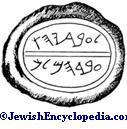
The chief officer of the king was the "captain of the host" (II Sam. ii. 8). Another high military officer was the captain of the body-guard (II Sam. viii. 16, xx. 23), who, for prudential reasons, was not placed under the orders of the commander-in-chief. Of the officials connected with the royal household the chief appears to have been the high chamberlain, or the officer "over the household" (II Kings xviii. 18). Next come the "sofer," or scribe, who acted as secretary of state (ib.), and the "mazkir," or historiographer (ib.). An official less frequently mentionedwas the "king's servant" (II Kings xxii. 12); a seal that belonged to one of these king's servants, whose name was Obadiah, has recently been discovered. Besides these, several minor officials, as "keeper of the wardrobe" (II Kings xxii. 14) and "chamberlains" II Kings xxiii. 11), were connected with the royal household. Other titles, like those of "king's friend" and "counselor," can scarcely be regarded as official.
Seal of Obadiah, "Servant of the King."(After Benzinger.)
Revenue.
The means by which this state was maintained were various, and doubtless differed with the period. The royal domains and flocks (partly obtained by escheat) must have contributed much to its support (I Chron. xxvii. 25-28). The kings may have claimed a tithe of the produce of the land (I Sam. viii. 15-17), but no later evidence is given of this, and such a claim would conflict with the similar claims of the priesthood. Regular presents, doubtless, were made by the king's chief vassals (I Kings x. 25), and tributes were brought in by conquered tribes (I Kings iv. 21; II Chron. xxvii. 5). Solomon probably derived some profit from his trading ventures (I Kings ix. 28), as well as from the customs levied on the foreign merchants trading in Palestine (I Kings x. 14). Resources such as these enabled the king to keep up considerable state. He dressed in royal robes (I Kings xxii. 10; II Chron. xviii. 9), drank from gold vessels (I Kings x. 21), and possessed a large harem (II Sam. xvi. 21). All who approached him bowed down and touched the ground with the forehead (I Sam. xxiv. 8; II Sam. xix. 24). After the destruction of the monarchy, memories of its glory still remained in Israel, and Ezekiel regarded royalty as inseparable from the ideal Jewish state (Ezek. xlvii.). The term "king" was applied symbolically to any great leader, even to death (Job xviii. 14); but above all it was applied to God as the "King of Kings" (see Theocracy). It is likewise applied to a crocodile (ib. xxiv. 34).
Bibliography:
Benzinger, Hebräische Archäologie, pp. 303-315;
K. Budde, Schätzung des Königtums im Alten Testament, Marburg, 1903.
E. G. H. J.—In Rabbinical Literature:
In Talmudic times every official position on earth was regarded as of divine appointment, and the rule of the king was compared with that of God (Ber. 58a). One had, therefore, to pray for a good king (Ber. 55a) and for the good of the king (Abot iii. 2). The office was regarded as hereditary (Hor. 11b; comp. Zeb. 102a). There was a special benediction to be pronounced on seeing a king, and no one should avoid greeting him appropriately (Ber. 58a). Even prayers may in certain cases be interrupted to answer a king (Ber. 32b). Intriguers against the royal majesty lost in certain cases their property and were put to death (Sanh. 48b), while any disrespectful gesture was punished (Pes. 57b). To defraud the customs was a great crime against the king (Ned. 28a), and he received one-thirteenth of all booty captured in war (B. B. 122a). The anointing of the king was done with balsam before he was crowned (Hor. 12a).
But a king must stand during the reading of the Law (Soṭah 41b), and must not arise from his knees until he has finished his prayer (Ber. 34b). The glory of a king is truth (Ta'an. 32a), and, therefore, his word must be irrevocable (B. B. 3b). He should set an example to all in his obedience to the Law (Suk. 30a).
The relations of a king to his courtiers was a favorite subject of the Rabbis in their parables. I. Ziegler has collected no less than nine hundred and thirty-seven parables of this kind, scattered through Midrashic literature, but it is clear from the descriptions of the king's regalia that the model before the Rabbis was the Roman emperor with his purple mantle, laurel crown, and curule chair. These parables, though interesting in their way, seldom throw light upon the rabbinical views about kings, being more of the nature of folk-tales.
Bibliography:
Lewysohn, in Orient, Lit. 1850, No. 33;
I. Ziegler, Die Königsgleichnisse des Midrasch, Breslau, 1903.
KING
1. Etymology and use of the term.—The Heb. name for ‘king’ (melek) is connected with an Assyr.
2. The office of king in Israel
(1) Institution. The settlement of the people of Israel in Canaan, and the change from a nomadic to an agricultural life, laid the incomers open to ever fresh attacks from new adventurers. Thus in the time of the judges we find Israel ever liable to hostile invasion. In order to preserve the nation from extermination, it became necessary that a closer connexion and a more intimate bond of union should exist between the different tribes. The judges in the period subsequent to the settlement seem, with the possible exception of Gideon (Jdg 8:22), to have been little more than local or tribal heroes, carrying on guerilla warfare against their neighbours. The successes of the warlike Philistines made it clear to patriotic minds that the tribes must be more closely connected, and that a permanent leader in war was a necessity. Accordingly Saul the Benjamite was anointed by Samuel (1Sa 10:1), and appointed by popular acclamation (1Sa 10:24, 1Sa 11:14). The exploits of Saul and his sons against the Ammonites (1Sa 11:11 ff.), against the Amalekites (1Sa 15:7), and against the Philistines (1Sa 14:1 ff.) showed the value of the kingly office; and when Saul and his sons fell on Mt. Gilboa, it was not long till David the outlaw chief of Judah was invited to fill his place.
(2) The duties of the king are partly indicated by the history of the rise of the kingship. The king was (a) leader in war. He acted as general, and in person led the troops to battle (cf. Saul on Mt. Gilboa, 1Sa 31:2; Ahab at Ramoth-gilead, 1Ki 22:29 ff.), By and by a standing army grew up, and fortresses were placed on the frontiers (cf. 1Ki 12:21 f., 2Ch 17:2). (b) Besides being leader of the army in war, the king was the supreme Judge (cf. 2Sa 14:5; 2Sa 15:2, 1Ki 3:15). Before the institution of the monarchy judicial functions were exercised by the heads of the various houses—the elders. These elders were gradually replaced by officials appointed by the king (2Ch 19:5-11), and the final appeal was to the king himself, who in Amo 2:3 is called ‘the judge.’ (c) Further, according to the usual Semitic conception, the king was also the chief person from a religious point of view. This idea has been lost sight of by later Jewish writers, but there is little doubt that in early times the king regarded himself as the supreme religious director, the chief priest. Thus Saul sacrifices in Samuel’s absence (1Sa 13:9-11; 1Sa 14:33 ff.), so also David (2Sa 6:13; 2Sa 6:17; 2Sa 24:25); while both David and Solomon seem to appoint and dismiss the chief priest at pleasure (cf. 2Sa 8:17, 1Ki 2:26-27; 1Ki 2:35), and both bless the people (2Sa 6:18, 1Ki 8:14). Jeroboam sacrifices in person before the altar in Bethel (1Ki 12:32-33), and Ahaz orders a special altar to be made, and offers in person on it (2Ki 16:12). In later times, however, the priestly functions of the kings were less frequently exercised, priests being appointed, who are usually regarded as royal officials and numbered among other civil servants (2Sa 20:23 ff.).
(3) The kingship hereditary. It was a fixed idea in ancient Israel that the office of the kingship passed from father to son, as the judgeship passed from Gideon to his sons (Jdg 9:2), or from Samuel to his sons (1Sa 8:1). Although Saul was chosen by the people and David invited by the elders of Judah to be king, yet Saul himself regarded it as the natural thing that Jonathan should succeed him (1Sa 20:30 ff.). Adonijah assumed that, as David’s son, he had a right to the throne (1Ki 2:15), and even the succession of his younger half-brother Solomon was secured without any popular election. It is impossible to speak of an elective monarchy in Israel. The succession in Judah remained all along in the house of David, and in the kingdom of the Ten Tribes father always succeeded son, unless violence and revolution destroyed the royal house and brought a new adventurer to the throne.
(4) Power of the king. While the monarchy in Israel differed considerably from other Oriental despotisms, it could not be called a limited monarchy in our sense of the term. The king’s power was limited by the fact that, to begin with, the royal house differed little from other chief houses of the nation. Saul, even after his election, resided on his ancestral estate, and came forth only as necessity called him (cf. 1Sa 11:4 ff.). On the one hand, law and ancient custom exercised considerable restraint on the kings; while, on the other hand, acts of despotic violence were allowed to pass unquestioned. A powerful ruler like David or Solomon was able to do much that would have been impossible for a weakling like Rehoboam. Solomon was practically an Oriental despot, who ground down the people by taxation and forced labour. David had the power to compass the death of Uriah and take his wife, but public opinion, as expressed by the prophets, exerted a considerable influence on the kings (cf. Nathan and David, Elijah and Ahab). The idea was never lost sight of that the office was instituted for the good of the nation, and that it ought to be a help, not a burden, to the people at large. Law and ancient custom were, in the people’s minds, placed before the kingly authority. Naboth can refuse to sell his vineyard to Ahab, and the king is unable to compel him, or to appropriate it till Naboth has been regularly condemned before a judicial tribunal (1Ki 21:1 ff.). Thus the king himself was under law (cf. Deu 17:14-20), and he does not seem to have had the power to promulgate new enactments. Josiah bases his reform not on a new law, but on the newly found Book of the Law (2Ki 23:1-3), to which he and the elders swear allegiance.
(5) Royal income. The early kings, Saul and David, do not seem to have subjected the people to heavy taxation. Saul’s primitive court would be supported by his ancestral estate and by the booty taken from the enemy, perhaps along with presents, more or less compulsory, from his friends or subjects (1Sa 10:27; 1Sa 16:20). The census taken by David (2Sa 24:1) was probably intended as a basis for taxation, as was also Solomon’s division of the land into twelve districts (1Ki 4:7). Ezekiel (Eze 45:7-8; Eze 48:21) speaks of crown lands, and such seem to have been held by David (1Ch 27:26 ff.). The kings in the days of Amos laid claim to the first cutting of grass for the royal horses (Amo 7:1). Caravans passing from Egypt to Damascus paid toll (1Ki 10:16), and in the days of Solomon foreign trade by sea seems to have been a royal monopoly (1Ki 10:16). It is not quite certain whether anything of the nature of a land tax or property tax existed, though something of this kind may be referred to in the reward promised by Saul to the slayer of Goliath (1Sa 17:25); and it may have been the tenth mentioned in 1Sa 8:15; 1Sa 8:17. Special taxes seem to have been imposed to meet special emergencies (cf. 2Ki 23:35), and the kings of Judah made free use of the Temple treasures.
(6) Royal officials have the general title ‘princes’ (sârîm). These included (a) the commander-in-chief, ‘the captain of the host,’ who in the absence of the king commanded the army (e.g. Joab, 2Sa 12:27). (b) The prefect of the royal bodyguard, the leader of the ‘mighty men of valour’ of AV
W. F. Boyd.
The title is applied to rulers of various degrees of sovereignty. We find it employed to designate the tetrarch Agrippa II. (Act_25:13); Aretas of Arabia (2Co_11:32); Agrippa I., whose territory was co-extensive with that of Herod the Great, and who seems to have received the royal title (Act_12:1); and the Roman Emperor, whom it appears to have been the custom for Greeks and Orientals so to designate (1Ti_2:2, 1Pe_2:13; 1Pe_2:17). An instance of the elasticity of the term is provided in Revelation 17, where the seven kings in Rev_17:10 are Roman Emperors, while the ten kings in Rev_17:12 are vassal kings.
1. Christ as King
(1) The nature of Christ’s Kingship.-It was made an accusation against St. Paul and Silas at Thessalonica (Act_17:7) that they were guilty of treason, inasmuch as they proclaimed another king, one Jesus. It was the revival of the charge brought against the Master (Luk_23:2). It is true that the Christians did claim Kingship for their Lord, but His Kingdom was not of this world (Joh_18:36). His throne is in heaven, where He is set down with His Father (Rev_3:21). There are various representations of His Kingship in the apostolic writings.
At one time His reign seems to have already begun. This is the thought suggested by the frequently recurring phrase, based on Psa_110:1, ‘sitting at the right hand of God’ (Rom_8:34, Eph_1:20, Col_3:1), which signifies Christ’s participation in the Divine government. According to this view, Christ enters into His âáóéëåßá immediately on His Exaltation (B. Weiss, Bib. Theol. of the NT, Eng. translation , ii. [1883] § 99), in recognition of His obedience unto death (Rev_3:21, Heb_12:2, Php_2:8 f.). On the literal interpretation of Col_1:13, the Kingdom of the Son is present even now, and believers are already translated into it (so Lightfoot and Haupt, while others interpret the phrase proleptically). Their citizenship is in heaven, whence they look for Christ (Php_3:20). The law they obey is called íüìïò âáóéëéêüò (Jam_2:8), in virtue of its emanating from the King (Deissmann, Licht vom Osten, p. 265). At limes this heavenly Kingship of Christ is represented as undisturbed by further conflict, and as peaceful sway over the powers which have been brought into subjection. So in 1Pe_3:22 He is on the right hand of God, ‘angels and authorities and powers being made subject unto him’ (cf. Eph_1:20 f.); and in Heb_10:12 f. He is represented as sitting down for ever at the right hand of God, ‘from henceforth expecting till his enemies be made his footstool.’ According to this view, His work is finished; His present state is one of royal rest, and it remains for God to complete the subjugation of the hostile powers.
But there are other representations of Christ’s Kingship. The most general view of His âáóéëåßá in the NT represents it as not already realized, but beginning at the Parousia (so O. Pfleiderer, Paulinism, Eng. translation , 1877, i. 268); and according to the programme sketched by St. Paul in 1Co_15:24 ff., His reign is no peaceful sway, but a ceaseless conflict against the powers of darkness. ‘He must reign, till he hath put all enemies under his feet’ (1Co_15:25). The last enemy to be overcome is Death; and when that is accomplished, then cometh the end, when He delivers up the sovereignty to God (1Co_15:24). According to this outline, Christ’s reign is of the nature of an interregnum, to be terminated (in opposition to the åἰò ôὸ äéçíåêÝò of Heb_10:12) when He resigns the power into the hands of God.
In the later Epistles this programme is not adhered to. In accordance with their more developed Christology, Christ becomes the end of Creation (Col_1:16), and the final consummation is now represented, not as the reign of God, who is to be ‘all in all’ (1Co_15:28), but as the Kingdom of Christ and God (Eph_5:5), or even of Christ alone (2Ti_4:1), whose Kingdom is an everlasting one (2Pe_1:11), and whose sovereignty is declared to extend to the future aeon (Eph_1:21). Again, in the earlier representation Christ’s Kingdom is to be established on earth at His Coming, but in the later versions it becomes a heavenly kingdom (2Ti_4:18), corresponding to the kingdom of the Father which St. Paul had expected to succeed the interregnum of the Son.
In Revelation we again meet with the conception of a temporary reign of Christ, its duration being put at 1,000 years (20:4). It is questionable whether that reign is here regarded as one of uninterrupted peace and blessedness, or of continuous conflict against the powers of evil. H. J. Holtzmann (NT Theologie2, 1911, i. 542f.) thinks that the only original contribution made by the author of the Revelation in this picture of the millennium is the representation of the interregnum as a period of peace and rest (Rev_20:2-3; Rev_20:7). On the other hand, F. C. Porter (Hasting's Dictionary of the Bible (5 vols) iv. 262) contends that the 1,000 years’ reign is part of the last conflict against evil, the reigning and judging of Christ and His saints being the gradual subjugation of the powers of evil, and that there is no suggestion in Rev. that peace and rest characterize the millennium.
(2) Christ and earthly kings.-In the Pauline references to the sovereignty of Christ the hostile forces which He overcomes are not earthly potentates but the angelic principalities and powers, the world-rulers of this darkness (Eph_6:12, 2Co_4:4, Col_1:13). To this corresponds the conflict with Satan in Revelation. But in the latter book there is also frequent representation of Christ’s sovereignty over earthly potentates. He is Prince of the kings of the earth (Rev_1:5), King of kings and Lord of lords (Rev_17:14, Rev_19:16). Out of His mouth goeth a sharp sword with which to smite the nations, and He rules them with a rod of iron (Rev_19:15). The kings of earth who have committed fornication with Babylon (Rev_17:2), and who marshal their armies in support of the Beast (Rev_19:19), are numbered among the enemies whom He has to subdue. Corresponding to this attitude of hostility to Christ on the part of the kings of the earth in Rev. is the spirit of hatred to the Roman Empire which the book breathes, as contrasted with that recommended in the other apostolic writings. St. Paul as a citizen of the Roman Empire recognizes in the higher powers the ordinances of God, and regards subjection to them as a religious duty (Rom_13:1 ff.). St. Peter recommends submission to every ordinance of man for the Lord’s sake, and exhorts to fear God and honour the king (1Pe_2:13; 1Pe_2:17). In 1Ti_2:2 the injunction is given to pray for kings and for all in authority. But in Rev. we find a fierce hatred of Rome and longing for her destruction, She is to the author the throne of the Beast (Rev_16:10), the very incarnation of the sin which Christianity sought to destroy, and his attitude towards the Imperial power is the direct opposite of that taken up by St. Paul.
2. God as King.-There is no power but of God (Rom_13:1), and all kingly authority ultimately proceeds from Him who is King of kings and Lord of lords (1Ti_6:15). Christ has ultimately to deliver up the sovereignty to the Father, being subject to Him that put all things under Him, that God may be all in all (1Co_15:24-28). In the song of Moses and of the Lamb (Rev_15:3) God is praised as the King of nations, and in 1Ti_1:17 a doxology is sounded to Him as King of the aeons. The phrase may be chosen with reference to the Gnostic series of aeons, and may mean ‘King of the worlds.’ Others take it as ‘King of the world times,’ the ruler who decrees what is to happen from age to age; while others render it, as in the Authorized Version , ‘the King eternal.’
3. Believers as kings.-In Rev_1:6 the Authorized Version runs: ‘and hath made us kings and priests unto God.’ This is based on the reading âáóéëåῖò, which must be abandoned for the better-attested âáóéëåßáí. But in Rev_5:10, where the same phrase occurs in the song of the angels concerning the Church (though here again there is a variant âáóéëåῖò, which, however, would render the concluding clause superfluous), there is the further addition: êáὶ âáóéëåýïõóéí ἐðὶ ãῆò. à reads âáóéëåýóïõóéí; and if we accept that reading, then the reference is to the future dominion of believers as represented in Rev_20:4, where they live and reign with Christ 1,000 years. Other references to this future sovereignty are found in Rom_5:17, 2Ti_2:12, and 1Co_6:2 f. (where they judge the world and the very angels). But if âáóéëåýïõóéí be retained, then the standpoint of the author is that already that sovereignty of the saints prophesied in Dan_7:22; Dan_7:27 has begun. The Church, down-trodden and oppressed, is already the dominant power in the world. St. Paul ironically congratulates the Corinthians on the assumption of kingly authority (1Co_4:8). Their vaunting may have been due to a perversion of this doctrine of the present sovereignty of the saints.
Literature.-The various handbooks, on NT Theol.; H. Weinel, Die Stellung des Urchristentums zum Staat, 1908; A. Deissmann, Licht vom Osten, 1908.
G. Wauchope Stewart.
Son 1:4 (c) In this way we see the Lord JESUS CHRIST in His glory as the sovereign ruler of His church.
As the sovereign ruler of the universe, God is the all-powerful and glorious king who reigns for ever and rules over all (Psa 10:16; Psa 24:8; Psa 24:10; Psa 95:3; Psa 103:19; Jer 51:57 : Dan 4:17; 1Ti 1:17; Rev 15:3). In particular he is king to his people, who live under his absolute lordship (Psa 98:6; Mal 1:14). This was well illustrated in the covenant that God made with Israel at Mt Sinai. In response to God’s sovereign act of graciously taking Israel to be his people, the Israelites promised to live in obedience to all his commands (Exo 19:5-6; Exo 24:3).
During the period of the Old Testament, Israel’s national life functioned under various kinds of government – the absolute leadership of Moses (Num 12:6-8), a federation of self-governing tribes (Jos 24:1), a united monarchy (1Sa 11:15), a divided monarchy (1Ki 12:17-20; 1Ki 15:1) and a governorship controlled by a foreign overlord (Neh 5:14). However, the people were to regard God as their king, regardless of the kind of government they lived under. The New Testament teaches that the same principle applies to Christians, who in different countries and eras may live under different kinds of governments (Luk 20:25; 1Pe 2:13-17; see GOVERNMENT).
Establishment of Israel’s monarchy
In the early days of Israel’s settlement in Canaan, there was no monarchy and no central government. The various tribes looked after their own affairs (Jdg 21:25). During this period, the people of Israel were repeatedly unfaithful and disobedient to God, and this brought God’s judgment upon them in the form of repeated invasions from hostile neighbours (Jdg 2:13-19). In their search for greater national stability, the people decided to follow the pattern of neighbouring nations and appoint a king who would rule over the whole nation through a central government (1Sa 8:4).
This desire for a king was really a rejection of God – not in the sense that an Israelite monarch replaced God as the leader of the government, but in the sense that the people tried to solve their problems without submitting to God. Their troubles arose from their sins, not from their system of government. Therefore, the way to overcome those troubles was to turn from their sins to God. Instead they chose to ignore God and to try to solve their problems by changing the political system. They did not want a way of life where their well-being depended on their spiritual relationship with God (1Sa 8:7-8).
Samuel warned that having a king would not improve matters if the people remained disobedient. In the days before they had a king they had been punished for disobedience, and under a king they would be punished just the same (1Sa 12:9-15).
Characteristics of the kings
During the period before the setting up of the monarchy, God had rescued Israel from foreign oppression by raising up deliverers (called judges) in response to the people’s repentance. Through the power of God’s Spirit, these leaders carried out God’s judgment on the oppressors and restored Israel’s independence (Jdg 2:16-19; Jdg 3:10; Jdg 6:34; Jdg 11:29; Jdg 13:25). This sort of activity continued into the reign of Israel’s first king, Saul (1Sa 10:6; 1Sa 10:10; 1Sa 11:6), but the next king, David, was the last of the Spirit-gifted leaders (1Sa 16:13-14). David established the sort of dynasty that the people had looked for. They wanted a system where the throne would pass on automatically from the king to his son, generation after generation. Such a system had no need of God’s provision of specially gifted people.
From what they had seen in the nations round about, the Israelites knew that kings could be oppressive because of their desire for personal power and wealth. But when Samuel warned them of this, they ignored him (1Sa 8:9-20).
Centuries earlier, Moses had anticipated this desire for an Israelite king. He therefore gave specific instructions to prevent Israelite kings from following the pattern of other kings, who built for themselves military glory, large harems and excessive wealth (Deu 17:14-17). Above all, the Israelite king was to have a personal copy of God’s law and study it carefully, so that he might govern Israel justly and righteously according to God’s standards (Deu 17:18-20; cf. 2Sa 23:3-7; Psalms 101).
The history of the Israelite monarchy records the development of the sorts of problems that Moses and Samuel had expected. Only by taxing the people heavily could many of the kings support their large royal households, finance their extravagant building programs and pay foreign overlords to support their throne (1Ki 4:1-7; 1Ki 5:13-17; 1Ki 12:4; 2Ki 15:20; 2Ki 23:35). Some kings brought justice and peace to the people, but others were cruel and corrupt (1Ki 21:1-14; 2Ki 18:1-6; 2Ki 21:16; 2Ch 17:3-4; 2Ch 17:9; Jer 22:13-17). The entire period of the monarchy was marked by a striking mixture of obedience and disobedience to the instructions set out in the law of Moses (Deu 17:14-20; cf. 1Ki 3:9; 1Ki 3:28; 1Ki 10:14-22; 1Ki 10:26; 1Ki 11:1-7; 2Ki 11:12; 2Ki 22:11-13; 2Ch 19:4-11).
Repeated disobedience among the kings was one reason for the nation’s decline and fall. In the end the nation was conquered, the people taken into captivity, and the monarchy brought to an end (2Ki 17:21-23; 2Ki 21:10-15; 2Ki 23:26-27).
The ideal king
With the increasing disorder that characterized Israelite life during the period of the monarchy, people looked back to the time of David as the nearest Israel had ever been to having an ideal king (Psa 89:20-21; Act 13:22). Each king of the dynasty of David was, in a sense, God’s son, because through him God exercised his rule. The coronation ceremony was the occasion when God formally adopted the king and anointed him for the task of ruling his people (2Sa 7:14-16; Psa 2:7; Psa 20:6; Psa 45:7; Psa 89:3-4; Psa 89:26-29).
In spite of the failure of their kings and the termination of the monarchy, the Israelite people still hoped for the day when the dynasty of David would be restored to power. They looked for one who would be the ideal king, the great descendant of David whom they called the Lord’s ‘anointed one’, or, in the Hebrew language, ‘the Messiah’ (Isa 11:1; Jer 23:5; Eze 34:23-24; Eze 37:24; see MESSIAH). In contrast to the kings of a former era, this king would rule with perfect wisdom, power, love and justice (Isa 9:6-7; Isa 11:2-5; Jer 33:15).
Jesus Christ was this promised king (Mat 2:2; Mat 21:5; Mat 21:9). However, he was not the sort of king many of the Jews expected; for his chief concern was not with bringing in a political golden age, but with bringing sinful people to submit to the rule of God in their lives. His kingdom was not concerned with national glory; it was a kingdom of a different kind from the political kingdoms of the world (Joh 6:15; Joh 12:13-16; Joh 18:33-37; see KINGDOM OF GOD). Unrepentant sinners did not want a king whose concern was for such a kingdom, and in the end they had him crucified (Mat 27:29; Mat 27:37; Mat 27:42; Joh 19:15; Joh 19:19; cf. Luk 19:14).
Through the resurrection and exaltation of Jesus, God showed that Jesus Christ was indeed his chosen king, and the early preachers enthusiastically proclaimed his kingship and his kingdom (Act 2:36; Act 4:26-27; Act 5:31; Act 8:12; Act 17:7; Act 19:8; Act 28:23; Act 28:31; Php 2:9-11). This kingship will be displayed openly on the day when Jesus Christ returns in glory as King of kings and Lord of lords (Rev 17:14; Rev 19:15-16; cf. Mat 25:31; Mat 25:34; Mat 25:40).