
Judges, Book of, the third in the list of the historical compositions of the Old Testament. It consists of two divisions, the first comprising Judges 1-17; the second, being an appendix, Judges 17-21.
That the author, in composing this work, had a certain design in view, is evident from Jdg 2:11-23, where he states the leading features of his narrative. He introduces it by relating (Judges 1) the extent to which the wars against the Canaanites were continued after the death of Joshua, and what tribes had spared them in consideration of a tribute imposed; also by alluding (Jdg 2:1-10) to the benefits which Jehovah had conferred on them, and the distinguished protection with which he had honored them. Next he states his leading object, namely, to prove that the calamities to which the Hebrews had been exposed since the death of Joshua were owing to their apostasy from Jehovah, and to their idolatry. ’They forsook the Lord, and served Baal and Ashtaroth’ (Jdg 2:13); for which crimes they were deservedly punished and greatly distressed (Jdg 2:15). Nevertheless, when they repented and obeyed again the commandments of the Lord, he delivered them out of the hand of their enemies by the ’judges’ whom he raised up, and made them prosper (Jdg 2:16-23). To illustrate this theme, the author collected several fragments of the Hebrew history during the period between Joshua and Eli. Some episodes occur; but in arguing his subject he never loses sight of his leading theme, to which, on the contrary, he frequently recurs while stating facts, and shows how it applied to them; the moral evidently being, that the only way to happiness was to shun idolatry and obey the commandments of the Lord. The design of the author was not to give a connected and complete history of the Hebrews in the period between Joshua and the kings; for if he had intended a plan of that kind, he would also have described the state of the domestic affairs and of the government in the several tribes, the relation in which they stood to each other, and the extent of power exercised by a judge; he would have further stated the number of tribes over whom a judge ruled, and the number of years during which the tribes were not oppressed by their heathen neighbors, but enjoyed rest and peace. The appendix, containing two narratives (that of Micah with his ’house of gods,’ and the brutal outrage committed by the Benjamites of Gibeah), further illustrates the lawlessness and anarchy prevailing in Israel after Joshua’s death.
If the first and second divisions had been by the same author, the chronological indications would also have been the same. Now the author of the second division always describes the period of which he speaks thus: ’In those days there was no king in Israel, but every man did that which was right in his own eyes’ (Jdg 17:6; Jdg 18:1; Jdg 19:1; Jdg 21:25); but this expression never once occurs in the first division. If one author had composed both divisions, instead of this chronological formula, we should rather have expected, ’In the days of the judges,’ ’At a time when there was no judge,’ etc. which would be consonant with the tenor of the first sixteen chapters. The style also in the two divisions is different, and it will be shown that the appendix was written much later than the first part. All modern critics, then, agree in this, that the author of the first sixteen chapters of our book is different from him who composed the appendix. The authorship of the first sixteen chapters has been assigned to Joshua, Samuel, and Ezra. There is no evidence, however, in support of any of these opinions, and various conclusive reasons can be assigned to show that they are incorrect.
But though we cannot determine the authorship of the book of Judges, still its age may be determined from internal evidence. The first sixteen chapters must have been written under Saul, whom the Israelites made their king in the hope of improving their condition. Phrases used in the period of the Judges may be traced in them, and the author must consequently have lived near the time when they were yet current. He says that in his time ’the Jebusites dwelt with the children of Benjamin in Jerusalem’ (Jdg 1:21): now this was the case only before David, who conquered the town and drove out the Jebusites. Consequently, the author of the first division of the book of Judges must have lived and written before David, and under King Saul. If he had lived under David, he would have mentioned the capture of Jerusalem by that monarch, as the nature of his subject did not allow him to pass it over in silence. The omission, moreover, of the history, not only of Samuel but also of Eli, indicates and author who, living in an age very near that of Eli, considered his history as generally known, because so recent. The exact time when the appendix was added to the book of Judges cannot indeed be determined, but its author certainly lived in an age much later than that of the recorded events.
It was published at a time when the events related were generally known, and when the veracity of the author could be ascertained by a reference to the original documents. Several of its narratives are confirmed by the books of Samuel (comp. Jdg 4:2; Jdg 6:14; Judges 11, with 1Sa 12:9-12; Jdg 9:53 with 2Sa 11:21). The Psalms, not only allude to the book of Judges (comp. Psa 68:8-9, with Jdg 7:25), but copy from it entire verses (comp. Psa 68:8-9; Psa 97:5; with Jdg 5:4-5). Philo and Josephus knew the book, and made use of it in their own compositions. The New Testament alludes to it in several places (comp. Mat 2:13-23 with Jdg 13:5; Jdg 16:17; Act 13:20; Heb 11:32). This external evidence in support of the authority of the book of Judges is corroborated by many internal proofs of its authenticity. All its narratives are in character with the age to which they belong, and agree with the natural order of things. We find here that shortly after the death of Joshua the Hebrew nation had, by several victories, gained courage and become valorous (Judges 1, 19); but that it afterwards turned to agriculture, preferred a quiet life, and allowed the Canaanites to reside in its territory in consideration of a tribute imposed on them, when the original plan was that they should be expelled. This changed their character entirely: they became effeminate and indolent—a result which we find in the case of all nations who, from a nomadic and warlike life, turn to agriculture. The intercourse with their heathen neighbors frequently led the uncultivated Hebrews to idolatry; and this, again, further prepared them for servitude. They were consequently overpowered and oppressed by their heathen neighbors. The first subjugation, indeed, by a king of Mesopotamia, they endured but eight years; but the second, more severe, by Eglon, lasted longer: it was the natural consequence of the public spirit having gradually more and more declined, and of Eglon having removed his residence to Jericho with a view of closely watching all their movements (Joseph. Antiq. 5:5). When Ehud sounded the trumpet of revolt, the whole nation no longer rose in arms, but only the inhabitants of Mount Ephraim (Jdg 3:27); and when Barak called to arms against Sisera, many tribes remained quietly with their herds (Jdg 5:14-15; Jdg 5:26; Jdg 5:28). Of the 30,000 men who offered to follow Gideon, he could make use of no more than 300, this small number only being, as it would seem, filled with true patriotism and courage. Thus the people had sunk gradually, and deserved for forty years to bear the yoke of the Philistines, to whom they had the meanness to deliver Samson, who, however, loosed the cords with which he was tied, and killed a large number of them (Judges 15). It is impossible to consider such an historical work, which perfectly agrees with the natural course of things, as a fiction: at that early period of authorship, no writer could have, from fancy, depicted the character of the Hebrews so conformably with nature and established facts. All in this book breathes the spirit of the ancient world Martial law we find in it, as could not but be expected, hard and wild. The conquered people are subjected to rough treatment, as is the case in the wars of all uncivilized people; the inhabitants of cities are destroyed wholesale (Jdg 8:16-17; Jdg 20:1-48). Hospitality and the protection of strangers received as guests is considered the highest virtue (Judges 19; comp. Genesis 19).
In the state of oppression in which the Hebrews often found themselves during the period from Joshua to Eli, it was to be expected that men, filled with heroism, should now and then rise up and call the people to arms in order to deliver them from their enemies. Such valiant men are introduced by our author, and he extols them, indeed, highly; but on the other hand he is not silent respecting their faults, which he discloses in a way proper to true history, but impossible to fiction, which could have no other object than the aggrandizement of the national character and exploits. And this frank, impartial tone pervades the whole work. It begins with displaying the Israelites as a refractory and obstinate people; and the appendix ends with the statement of a crime committed by the Benjamites, which had the most disastrous consequences. At the same time due praise is bestowed on acts of generosity and justice, and valiant feats are carefully recorded.
Objections have been made to the authenticity of this book, in consequence of the remarkable exploits ascribed to its heroes. But it will be easy to show that, when properly understood, these exploits do not necessarily exceed the limits of human power. Extraordinary indeed they were; but they are not alleged by the Scripture itself to have been supernatural. Those, however, who do hold them to have been supernatural cannot reasonably take exception to them on the ground of their extraordinary character. Considering the very remote period at which our book was written—considering also the manner of viewing and describing events and persons which prevailed with the ancient Hebrews, and which very much differs from that of our age—taking, moreover, into account the brevity of the narratives, which consist of historical fragments, we may well wonder that there do not occur in it more difficulties, and that not more doubts have been raised as to its historical authority.
This book is occupied with the period from the death of Joshua to the time of Samuel. Joshua, the man of faith, before he died gave them good advice and solemn warnings. The people answered, "The Lord our God will we serve, and his voice will we obey." They had now, under the guidance and power of God, to work out their own salvation. They served the Lord as long as Joshua lived and the elders he had appointed, and then they forsook God, allied themselves by marriage with the Canaanites, and turned to idolatry. It is a vivid illustration of the history of the professing church, which, after the times of the apostles, rapidly became worldly, and had to be disciplined by God, though there have been revivals, as there were in the time of the Judges.
A long catalogue had to be made of the districts from which the tribes did not drive out the Canaanites. Israel being thus unfaithful, making a league with the inhabitants, and regardless of their evil, the Lord let them remain to prove Israel: in like manner the world-bordering of the church has become a snare to it constantly. The Angel of the Lord was at Gilgal during the book of Joshua (to which place the Israelites should in spirit have constantly returned: it is the place of circumcision, that is, for the Christian, thorough separation from the first man); but now He came to Bochim, and reminded them that He had delivered them from Egypt, and had declared that He would never break His covenant with Israel; they were to make no league with the people of the land, but they had not obeyed His voice. The failure was now irretrievable. The people wept and sacrificed there.
Nevertheless they formed alliances with the Canaanites, and sacrificed to Baalim. Then they were oppressed by their enemies; but as often as they turned to the Lord, He raised up a judge who delivered them from the hand of their oppressors. Yet when the judge died, they returned again to their evil ways. This experience of evil doing - oppression, repentance, and deliverance - occurred again and again during a period of over three hundred years. (The action of the judges is considered under the name of each.)
Judges 17 - Judges 21 are not in historical order, but are grouped together to show the inner life of the people. Judges 17 and Judges 18 disclose a sad attempt to mingle the worship of God with domestic idolatry. See MICAH No. 1.
Judges 19 - Judges 21 show the moral character of the people, especially of Benjamin, who brought upon themselves severe punishment. When the other tribes saw the destruction they had made upon Benjamin they came to the house of God and wept , lamenting that one tribe was lacking in Israel; but no mention is made of their weeping over the sin that had brought it all about.
The book ends by repeating what it had said elsewhere: "In those days there was no king in Israel: every man did that which was right in his own eyes." God would have been their king if they would have been His subjects.
The chronology of the book of Judges presents some difficulties. It is clear from various passages that the periods during which the judges ruled could not all have been consecutive. The 480 years from the Exodus to the fourth year of Solomon, 1Ki 6:1, necessarily shortens the period of the judges, and one passage in the book itself implies that two of the oppressions were going on at the same time, namely, that of the Philistines and of Ammon. Jdg 10:7. In Act 13:20 the A.V. reads that God gave them judges about the space of 450 years until Samuel the prophet. This would not agree with the 480 years of 1Ki 6:1; but there is a different reading in Acts 13, which has been adopted by editors of the Greek Testament and in the R.V. irrespective of all questions of chronology. It reads "He divided to them their land by lot, about 450 years; and afterwards he gave them judges;" thus the 450 years are not applied to the duration of the judges. This period may have been made up thus, reckoning from the birth of Isaac, because the promise was to the seed of Abraham, and Isaac was the child of promise.
YEARS.
Age of Isaac, when Jacob was born, Gen 25:26. 60
" Jacob when lie stood before Pharaoh 130
" Israel in Egypt 215
" Israel in the wilderness 40
" To the division of the land 7
(about 450 years). 452
The 480 years 1Ki 6:1 have been arranged thus though this may not be absolutely correct.
YEARS.
From the Exodus to the crossing the Jordan 40 }
From the Jordan to the division of the land 7 }
Rest under Joshua and the Elders Jdg 2:7. 12 }
Oppression by the king of Mesopotamia Jdg 3:8. 8 }
Othniel judge Jdg 3:11. 40 } About 338 years -
Oppression by the Moabites Jdg 3:14. 18 }
Ehud and Shamgar Jdg 3:30. 80 } the 300 years
Oppression by king Jabin Jdg 4:3. 20 }
Deborah and Barak Jdg 5:31. 40 } in round
Oppression by the Midianites Jdg 6:1. 7 }
Gideon Jdg 8:28. 40 } numbers
Abimelech Jdg 9:22. 3 }
Tola Jdg 10:2. 23 } of
Jair Jdg 10:3. 22 }
In the West. In the East . }
Oppression by the |Oppression by the }
Philistines, during which |Ammonites Jdg 10:8. 18 }
Samson was judge, and |Jephthah Jdg 12:7. 6 }
Samuel after Eli. |Ibzan Jdg 12:9. 7
Jdg 13:1. 40 |Elon Jdg 12:11. 10
From Mizpeh |Abdon Jdg 12:14. 8
(1Sa 7:12-13) |
to the anointing of Saul 9 |
Saul (in the former part of which Samuel was judge) Act 13:21. 40
David 1Ki 2:11. 40
Solomon’s fourth year 1Ki 6:1. 3
492
Deduct for parts of years being reckoned as full years 12
480
(Hebr.  ):
):
By: Emil G. Hirsch, Victor Ryssel
In the Hebrew canon, the second book of the Earlier Prophets, placed between Joshua and Samuel.
§ I. Name:
The book derives its name from the fact that it deals with the "Judges," a term which, according to the statements found in the book (comp. ii. 11-19 and the constantly recurring formulas in iii. 7, vi. 1; iii. 12, iv. 1, x. 6, xiii. 1; iii. 8, iv. 2, 9, x.7), designates men who dealt out justice to the oppressed people (comp.  , Ps. x. 18); hence it is used in the sense of
  = "rescuer" (ii. 16, 18). The word, however, means more than this and more than the modern "judge": it means the leaders or rulers (comp. the Suffetes [=
  ] in Carthage) who took charge of the affairs of the several tribes in case of war with the Canaanites or other neighboring peoples, and who also assumed leadership of their respective tribes in the succeeding times of peace. In accordance with the needs of the time, their functions were primarily judicial (iv. 5). The book itself announces that it will deal with the time of the Judges from the death of Joshua; but the description of Joshua's death at the beginning of the book is doubtless a later addition, and the introduction repeats (i. 1-ii. 5) the theme of the Book of Joshua, namely, the conquest of the country west of the Jordan. Nor does the Book of Judges give the conclusion of the history of the Judges; for the two stories appended to the book in its present form belong not to the end of that period, but to its beginning, and the narratives forming the kernel of the book break off before the period of the Judges ends. The thread is taken up again in the Book of Samuel. It may be assumed, however, that the original Book of Judges was carried down to the end of the period and concluded with the story of Eli and Samuel, which forms the beginning of I Samuel.
§ II. Synopsis of Contents:
Before discussing the several parts and their origin, it may be well to note the peculiar composition of the book. The introduction and additions may clearly be separated from the main text, giving the following three divisions: (1) introduction; (2) Book of Judges proper; and (3) appendixes.
(1) Introduction: (a) i. 1-ii. 5, a general view of the conquest of Canaan. The story is evidently intended to portray the great tribulations of the time of the Judges, which God inflicted because the Israelites partially spared the Canaanites in spite of His command to the contrary (see ii. 1-5, especially verse 3). (b) ii. 6-iii. 6, a general description of the conditions obtaining at the time of the Judges. The chief characteristic of this time is found in the recurring change from apostasy and punishment to repentance and deliverance. The account forms the introduction to the following stories, which are, as it were, summarized in ii. 11-19.
Sections of Book.
(2) The Book of Judges Proper, iii. 7-xvi. 31: This describes Israel's delivery, through divinely appointed judges, from the subjugation to the Canaanites and the neighboring peoples which it had brought upon itself. The accounts of the activities of the several judges vary considerably in length; only the five so-called "Great Judges" are treated in detail. The narratives may be summarized as follows: (a) iii. 12-30, account of the Benjamite Ehud, who overthrew the tyranny of the Moabites; (b) iv.-v., story of Barak (and Deborah), who overthrew the tyranny of the Canaanites (but see § III.); (c) vi. 1-viii. 32, story of Gideon of western Manasseh, who overthrew "the Midianites and the Amalekites and all the children of the East"; (d) x. 6-xii. 7, story of Jephthah the Gileadite of the tribe of Gad, who vanquished the Ammonites; (e) xiii.-xvi., account of the Danite Samson, who vanquished the Philistines; (f) iii. 7-11, story of the Kenazite Othniel, from the tribe of Judah, who vanquished Chushan-rishathaim (iii. 10); together with various incidental remarks relating to the so-called Minor Judges: (g) iii. 31, story of Shamgar; (h) x. 1-5, stories of Tola of Issachar and Jair of Gilead (eastern Manasseh); and (i) xii. 8-15, stories of Ibzan of Beth-lehem, Elon the Zebulonite, and Abdon the Pirathonite of the tribe of Ephraim. With the exception of the priestly tribe of Levi and the two tribes of Reuben and Simeon, which soon became extinct, each of the tribes is represented by at least one judge. The section viii. 33-ix. 57, dealing with the leadership of Abimelech, is not strictly of the same order as the rest.
(3) Appendixes: Two stories from the time of the Judges: (a) xvii. and xviii., the campaign of the Danites, and the transference to Dan (Laish) of the sanctuary of Micah the Ephraimite; (b) xix.-xxi., the outrage at Gibeah, and the resultant punitive war against Benjamin, which is almost destroyed; the measures taken for the preservation of the tribe.
§ III. Sources: The Main Text, iii. 7-xvi. 31:
The earliest sources are found in the stories relating to the five Great Judges:
(1) The account of Ehud, iii. 12-30, which, with the exception of the Deuteronomistic framework (verses 12-15 and 30), is a uniform story, based doubtless on ancient tradition.
Song of Deborah.
(2) The story of Barak and Deborah, iv. and v., in which must be distinguished: (a) the Song of Deborah, v. 2-31, describing the sufferings and the victory of the people, and which was doubtless composed by an eye-witness. It is uncertain, however, whether Deborah herself composed this. Doubt arises from the exhortation (v. 12) "utter a song," and from the fact that the introduction does not say that she composed it, but only that Deborah and Barak sang it (ib. verse 1). Nor does it follow absolutely from the word  (verse 7) that Deborah composed the Song. Although
  is probably intended as the first person and has been so interpreted down to recent times, yet it may also have been intended as an address to Deborah, as the second person feminine singular (=
  ; comp.
  , Jer. ii. 33)—"until thou hast arisen, Deborah!" And even its interpretation as the third person feminine singular (=
  , old form of
  , in which the
Account of Gideon.
(3) The account of Gideon, vi.-viii., consisting of two separate narratives brought into harmony by the passages vii. 25 and viii. 10. According to the main text, including vi. 2-6, 11-24, 33 et seq., vii. 1, and vii. 9-25 (except verse 12), as well as the passages vi. 35; vii. 2-8, 14, 16-22, preserved only in revised form, Gideon delivered the whole of Israel from the inroads of the Midianites, whose camp on Mount Gilboa he surprised. The Ephraimites then captured and killed the fugitives together with their kings Oreb and Zeeb at the fords of the Jordan (comp. especially vii. 24). According to another account, which forms a connected series of additions to the main text (i.e., to vi. 2-viii. 3), and which includes vi. 7-10, 25-32, 36-40 as well as the Deuteronomically revised passage viii. 4-27, Gideon with 300 men captured the Midianite kings Zebah and Zalmunna beyond the Jordan, whither he had pursued them.A valuable remnant of the earliest Hebrew history has been preserved in the story of Abimelech, which is appended to the story of Gideon. Jotham's daring and original parable of the trees in search of a king, included in this story, was (as appears from ix. 57) probably added at a later time by an editor who took it from a source earlier than that of the main story. This parable, one of the few remnants of purely secular writing, can not have originated in the time of Abimelech, who reigned only three years at Shechem, as its criticism of the king was evidently the result of a clearer insight than could have been possessed by a contemporary. It was probably a product of the Northern Kingdom, where the people had unfortunate experiences with elected kings.
(4) The story of Jephthah, xi. 1-xii. 7, is in general uniform; the first two verses, however, are probably revised, as they do not fit in with verse 7, nor with the passage xi. 12-29, which appears as a learned disquisition applying in no wise to the Ammonites, to whom the message was to be addressed, but to the Moabites. In xi. 35-40, also, the editor, intent on abbreviating, seems to have made changes in order not to dwell on the human sacrifice which must have been described in the original narrative.
(5) The story of Samson, xiii-xvi., narrating in twelve sketches his deeds and tragic death. This, also, is a uniform composition, with the exception of a revision in xiii. and xiv., and is evidently the work of a single author.In general, it may be noted in regard to these old heroic stories of the Book of Judges that there is some resemblance in language and manner of description to the narrative sources of the Pentateuch; for this reason Cornill has designated the first version of the story of Gideon, the story of Samson, and the basis of x. 6-16 as Jahvistic in character, and the story of Sisera, the second version of the story of Gideon, together with the stories of Abimelech and Jephthah, as Elohistic (other scholars, however, as Budde, think differently). These resemblances are so slight that they may be explained as contemporaneous work or imitation, rather than as a continuation of the Pentateuch sources.
Original Book.
The main text of Judges, including the above-named stories, constituted, with the exception of later additions, the earlier book, which began therefore with ii. 6; and as the initial words, "And when Joshua had let the people go," correspond with the words introducing the first valedictory in Josh. xxiii. 2, it follows that the original Book of Judges continued the original Book of Joshua. Furthermore, it follows that the second valedictory with the accompanying statements in Josh. xxiv., and the first account of Joshua's death, in Judges ii. 8 et seq., as well as the present introduction to Judges, were added later; this is also apparent from the present beginning of Judges: "Now after the death of Joshua it came to pass."
The Introduction: It has been shown that the introduction is a later addition; and the fact is further proved by its contents, the story of the conquest of the country west of the Jordan, which is the theme of Joshua, being here repeated. But while the Book of Joshua narrates the story of the complete destruction of the Canaanites by the people of Israel under one commander-in-chief, the introduction to Judges says that the tribes of Israel fought singly; and it does not refer to the complete destruction of the Canaanites (comp. Judges i. 27-33, ii. 1-3). Ofthese two accounts the introduction to Judges is doubtless more objective, and shows a better comprehension of the actual facts, while the narrative in Joshua is founded on the Deuteronomistic revision. The introduction itself, however, is not uniform; according to i. 8, the children of Judah conquered and burned Jerusalem and killed its inhabitants, while, according to i. 21, the children of Benjamin did not drive the Jebusites out of that city, but dwelt together with them in Jerusalem "unto this day" (according to the parallel account in Josh. xv. 63, some scholars read in this passage  instead of
  , which is derived from Josh. xviii. 28). Cornill ascribes a Jahvistic origin to the passages i.-ii. 1a, 5b, 23a; iii. 2-3, and an Elohistic origin to i. la; ii. 13, 20-22a; iii. 5-6.
The Priest of Micah.
The Appendixes: The first appendix, xvii. and xviii., is a very valuable old story. Bertheau, Budde, Kittel, Cornill, and others assert that two accounts must be here distinguished. According to one, the Ephraimite Micah made an ephod and teraphim, and hired a Levite to be to him "a father and priest"; 600 Danites then persuaded the Levite to go with them and become their priest, whereupon they conquered Laish and set up there for their tribal sanctuary the image that Micah had made. According to the other account, Micah made a "pesel" (graven image) and "massekah" (molten image), and engaged a young Levite as priest, whom he held as a son; but the Danites, who stole the pesel and massekah, made Jonathan, Moses' grandson, their tribal priest instead of the Levite, and through the descendants of Jonathan the priesthood was transmitted in the tribe of Dan. But according to Oort, Wellhausen, Kuenen, Baudissin, and others, it is more probable that the discrepancies in the narrative may be explained on the ground of interpolations (compare  and
and  , which always follow
  and
and  ). The story itself is unique in that it describes a cult and a priesthood which are nowhere else found in the Old Testament. This fact itself points to an early date of composition.
As two dates are given in the text, xviii. 30 and 31, the question arises which of these two statements is the original—that is, the earlier—one. The first statement, xviii. 30, points to the time of the fall of Ephraim (722 B.C.), or at least to that of the deportation of the northern and eastern inhabitants of the country (735 B.C.); the second, to a time near the beginning of the royal house of Israel, as the destruction of the Temple of Shiloh probably occurred during the Philistine wars, in which the priestly house of Eli, officiating at Shiloh, perished. The first statement, also, originated at a time that had become remote to later generations, as is shown by the fact that the ascription of these deeds to a grandson of Moses caused offense to the people, and a copyist tried to remove it by interpolating a  so as to change the name to
  (this has recently been denied by Sinker).
The second appendix, xix.-xxi., in its main text, which can now hardly be determined with certainty, might similarly be traced back to an ancient story, as is indicated by expressions similar to those found in the first appendix; e.g., the Levite sojourning as a stranger in the country (xix. 1). The formula common to both appendixes, "in those days there was no king in Israel, but every man did that which was right in his own eyes" (xvii. 6, xxi. 25; comp. xviii. 1, xix. 1), perhaps also indicates that the original text was composed before the Exile; although it is possible that in the second appendix it is a later addition, or was introduced by the author in imitation of the first appendix. For the story as a whole dates from a very late period, since there is evidence that it is based on the Priestly Code. This is especially evident in the fact that the community of Israel is represented as a compact body pronouncing punishment upon Benjamin as with one voice, while elsewhere in Judges every tribe attends to its own affairs. The fact that all the personages named, with the exception of Aaron's grandson Phinehas in xx. 28, are anonymous indicates that this is a piece of fiction and not a historical narrative. The story may have some historical foundation; for Hosea (x. 9), speaking of course quite independently of this story, also mentions the sin of Israel since the days of Gibeah. Nor is it impossible that the story, as Nöldeke was the first to assume, describes the ruin of Benjamin by the war between David and Saul's son and the insurrections under David.
§ IV. Combination and Revision of The Sources: Additions by Deuteronomist.
The earlier Book of Judges, a compilation of the stories of the five Great Judges together with the additions of the redactor, was practically Judges in its present form, with the exception of the Deuteronomistic framework (together with the story of Othniel), the six Minor Judges, and some later revised additions. The Deuteronomistic editor added to the earlier book the following passages; namely, ii. 6-9 and iii. 7-11 (the account of Othniel being taken from Josh. xv. 17), all the additions by which he adapted the old material to his conception of history, and the strictly chronological arrangement taken from I Kings vi. 1, the 480 years being divided by him into 12x40 years or generations, 20, 40, or 80 years respectively being assigned to each of the judges. This Deuteronomistic arrangement was again supplemented by an editor following the Priestly Code, who partly revised the work, inserted passages of his own (viii. 29-31 and x. 17, 18), and added the portions relating to the five Minor Judges (x. 2-5 and xii. 8-15), in order to round out the number of the twelve judges. This last-named portion has been skilfully harmonized with the chronological arrangement of the Deuteronomistic editor; for the sum of the years of office of the five Minor Judges (23 + 22 + 7 + 10 + 8 = 70) is practically equal to that of the years of oppression under the five Great Judges (8 + 18 + 20 + 7 + 18 = 71). The last editor, finally, added to iii. 31 the personage of Shamgar (from the Song of Deborah, v. 6) because at his time the judgeship of Abimelech caused offense, and the editor wished to remove Abimelech without disturbing the number of the judges.
§ V. Age of the Sources: Story of Samson.
The sources from which the material for the various heroic stories was taken are in part very old, the Song of Deborah having originated as early as the time of the Judges.These old sources, however, were committed to writing a considerable time after the date of the events which they narrate. Samson certainly lived a long time before the account of his life was written down, because it has a very evident admixture of mythic elements, as, for instance, his heroic deeds and the virtue ascribed to his hair. His deeds remind one of the deeds of Hercules, and his name ( = "the sunny") shows a resemblance in attributes to the Phenician sun-god Melkart, the prototype of the Greek Herakles. Although the story of Samson may be based on historical fact, it must be noted that Samson's deeds differ from those of the other warrior judges in that these latter are "saviors of their tribe" while Samson fights with the Philistines on his own account. Hence the compilation of the stories of the five Great Judges must be dated soon after the division of the kingdom. Single passages, like the basis of ch. xvii. and xviii., may be much older. The editor who combined his own additions with the book containing the stories, producing thereby the earlier Book of Judges, probably wrote in the last decades of the kingdom of Israel. The Deuteronomistic edition was undertaken during the Exile, at which time the other additions were probably also incorporated. The two appendixes were added very much later, as appears not only from the date of composition of the second appendix (xix.-xxi.), but also from the fact that the Deuteronomistic revision, which may be traced throughout the Book of Judges down to ch. xvi., did not include the two appendixes. Had they been added earlier, moreover, they would have been inserted in a different place, namely, in the beginning, where they belong, according to the dates mentioned in them (xviii. 30 and xx. 28). Although these references to the time may be glosses, they can not have been added after the book was completed.
§ VI. Literary Characteristics:
As a result of difference in sources originating at different times, the book has no literary unity. Side by side with the stereotyped formulas, which reveal the historical point of view of the compiler of the earlier Book of Judges (iii. 7, vi. 1; iii. 12, iv. 1, x. 6, xiii. 1; iv. 2, 9, x. 7), and the passages added in the spirit of these formulas, there are stories popular in character, to which have been added snatches of old folk-poetry, old proverbs, descriptions of popular customs, popular etymologies, and other characteristics of naive popular composition. The mythological elements, which are especially predominant in the story of Samson, are also derived from popular beliefs. Yet the historical narrative, in spite of various legendary additions, is on the whole true to fact, as appears from the frankness with which religious and moral conditions, widely differing from later customs, are discussed.
Bibliography: Commentaries:
G. L. Studer, Das Buch der Richter, 2d ed. 1842;
J. Bachmann, Das Buch der Richter, mit Besonderer Rücksicht auf die Gesch. Seiner Auslegung und Kirchlichen Verwendung Erklärt, vol. i., ch. i.-v., 1868-1869;
E. Bertheau, Das Buch der Richter und Ruth, in Kurzgefasstes Exegetisches Handbuch, 1845, 1883;
P. Cassel, in Lange's Theologisch-Homiletisches Bibelwerk. 2d ed. 1887;
C. F. Keil, Josua, Richter, Ruth, in Biblischer Kommentar, 2d ed. 1874;
S. Oettli, Das Deuteronomium und die Bücher Josua und Richter, in Strack and Zöckler, Kurzgefasster Kommentar, 1893;
G. F. Moore, A Critical and Exegetical Commentary on Judges, in The International Critical Commentary, 1895;
K. Budde, Das Buch der Richter, in K. H. C. 1897;
W. Nowack, Richter und Ruth, in Nowack's Hand-Kommentar, 1900.
Criticism of Sources: Th. Nöldeke, Untersuchungen zur Kritik des A. T. 1869, pp. 173-198;
J. Wellhausen, in Bleek's Einleitung, 4th ed. 1878, pp. 181-205;
idem, Prolegomena zur Gesch. Israels, 4th ed. 1895, pp. 229-247;
B. Stade, in Stade's Zeitschrift, 1881, i. 339-343;
S. R. Driver, in J. Q. R. 1889, i. 258-270;
K. Budde, Die Bücher Richter und Samuel, Ihre Quellen und lhr Aufbau, 1890, pp. 1-166;
Rudolph Kittel, Die, Pentateuchischen Urkunden in den Büchern Richter und Samuel, in Theologische Studrien und Kritiken, 1892, pp. 44-71;
G. Kalkoff, Zur Quellenkritik des Richterbuches (Gymnasial-Programm), Aschersleben, 1893;
W. Frankenberg, Die Composition des Deuteronomischen Richterbuches (Richter ii. 2-xvi.) Nebst einer Kritik von Richter xvii-xxi. 1895;
G. Moore, Judges, in Cheyne and Black, Encyc. Bibl.;
H. Winckler, Alttestamentliche Untersuchungen, 1892, pp. 55-59 (on Judges iii. 12-31), and 42 et seq., 93 (on vi.-ix.);
and the following articles in Stade's Zeitschrift: Ed. Meyer, in i. 117 et seq., B. Stade, in i. 146 et seq., and K. Budde, in vii. 93-166 and in viii. 148, on Judges i. 1-ii. 5;
W. Böhme, in v. 86, 251 et seq. on Judges vi.-ix.;
B. Stade, in iv. 250-256, and W. Böhme, in v. 251-274, on Judges xiii. et seq.;
K. Budde, in viii. 285-300 on Judges xvii-xxi.;
W. Böhme, in v. 30-36 on Judges xxi.;
Güdemann, in Monatsschrift, xviii. 357 et seq.
Criticism of Texts and Translations: O. F. Fritzsche, Liber Judicum Secundum LXX Interpretes, 1867;
A. van Doorninck, Bijdrage tot de Tekstkritick van Richteren i.-xvi. 1879;
P. de Lagarde, Septuaginta-Studien, 1892, pp. 1-72 (Abhandlungen der K. Gesellschaft der Wissenschaften zu Göttingen, 1891, xxxvii.);
A. Mez, Die Bibel des Josephus, 1895.
On the historical substance of the book see bibliography to Judges, Period of;
and on the mythological elements of the story of Samson see F. Schwally, Semitische Kriegsaltertümer: I. Der Heilige Krieg im Alten Israel, 1901.
For the Song of Deborah: J. Marquart, Fundamente Israelitischer und Jüdischer Gesch. 1896, pp. 1-10;
G. A. Cooke, The History and Song of Deborah, 1896;
C. Bruston, Le Cantique de Debora, 1901;
and the bibliography to Deborah, The Song of.
Text: edition G. F. Moore, in S. B. O. T.
The seventh book of the Bible. It is thus called because it relates the deeds of those temporary leaders who, under the name of "Judges" (practically they were dictators), ruled over a part at least of the Tribes of Israel, between the death of Josue and the days of Samuel. The book may be divided as follows:
Introduction describing the political and religious conditions of the Jews after Josue’s death (1-3).
Selected episodes from the history of the Judges, valiant leaders raised by God at different points of the territory, to free the people from their oppressors, after each one of their many apostasies (3,7, to 17); the best known are: Debbora and Barac (4, 5), Gedeon (6 to 10,5), Jephte (10, 6, to 12, 15), and Samson (13-15).
Two appendices (18-21) relate two very sad episodes which illustrate the lawlessness of the times, viz., the migration of Dan (17, 18) and the crime of the Benjamites, with the frightful war that followed (19-21).
The purpose of the author is evidently to illustrate this truth which is the key to the whole history of the Jewish people, viz., that their apostasies are invariably punished and their fidelity to God invariably rewarded.
1. Title
2. Place in the Canon
3. Contents
(1) Introductory, Judges 1 through 2:5
(2) Central and Main Portion, Judges 2:6-16
(3) An Appendix, Judges 17 through 21
4. Chronology
5. Authorship and Sources
6. Relation to Preceding Books
7. Relation to Septuagint and Other versions
8. Religious Purpose and Value
LITERATURE
1. Title:
The English name of the Book of Jdg is a translation of the Hebrew title (
2. Place in the Canon:
In the order of the Hebrew Canon the Book of Judges invariably occupies the 7th place, following immediately upon Joshua and preceding Samuel and Kings. With these it formed the group of the four “earlier prophets” (
3. Contents:
The Book of Jdg consists of 3 main parts or divisions, which are readily distinguished.
(1) Introductory, Judges 1 Through 2:5.
A brief summary and recapitulation of the events of the conquest of Western Palestine, for the most part parallel to the narrative of Joshua, but with a few additional details and some divergences from the earlier account, in particular emphasizing (Jdg 1:27-36) the general failure of the Israelites to expel completely the original inhabitants of the land, which is described as a violation of their covenant with Yahweh (Jdg 2:1-3), entailing upon them suffering and permanent weakness. The introductory verse (Jdg 1:1), which refers to the death of Joshua as having already taken place, seems to be intended as a general indication of the historical period of the book as a whole; for some at least of the events narrated in Jdg 1 through 2:5 took place during Joshua’s lifetime.
(2) The Central and Main Portion, Jdg 2:6 through Jdg 16:1.
A series of narratives of 12 “judges,” each of whom in turn, by his devotion and prowess, was enabled to deliver Israel from thralldom and oppression, and for a longer or shorter term ruled over the people whom he had thus saved from their enemies. Each successive repentance on the part of the people, however, and their deliverance are followed, on the death of the judge, by renewed apostasy, which entails upon them renewed misery and servitude, from which they are again rescued when in response to their prayer the Lord “raises up” for them another judge and deliverer. Thus the entire history is set as it were in a recurrent framework of moral and religious teaching and warning; and the lesson is enforced that it is the sin of the people, their abandonment of Yahweh and persistent idolatry, which entails upon them calamity, from which the Divine long-suffering and forbearance alone makes for them a way of escape.
(A) Judges 2:6 Through 3:6:
A second brief introduction, conceived entirely in the spirit of the following narratives, which seems to attach itself to the close of the Book of Joshua, and in part repeats almost verbally the account there given of the death and burial of Israel’s leader (Jdg 2:6-9 parallel Jos 24:28-31), and proceeds to describe the condition of the land and people in the succeeding generation, ascribing their misfortunes to their idolatry and repeated neglect of the warnings and commands of the judges; closing with an enumeration of the peoples left in the land, whose presence was to be the test of Israel’s willingness to obey Yahweh and at the same time to prevent the nation from sinking into a condition of lethargy and ease.
(B) Jdg 3:7-11:
Judgeship of Othniel who delivered Israel from the hand of Cushan-rishathaim.
(C) Judges 3:12-30:
Victory of Ehud over the Moabites, to whom the Israelites had been in servitude 18 years. Ehud slew their king Eglon, and won for the nation a long period of tranquillity.
(D) Jdg 3:31:
In a few brief words Shamgar is named as the deliverer of Israel from the Philistines. The title of “judge” is not accorded to him, nor is he said to have exercised authority in any way. It is doubtful, therefore, whether the writer intended him to be regarded as one of the judges.
(E) Judges 4; 5:
Victory of Deborah and Barak over Jabin the Canaanite king, and death of Sisera, captain of his army, at the hands of Jael, the wife of Kenite chief; followed by a Song of Triumph, descriptive and commemorative of the event.
(F) Judges 6-8:
A 7-year oppression at the hands of the Midianites, which is described as peculiarly severe, so that the land became desolate on account of the perpetual raids to which it was subject. After a period of hesitation and delay, Gideon defeats the combined forces of the Midianites and Amalekites and the “children of the east,” i.e. the wandering Bedouin bands from the eastern deserts, in the valley of Jezreel. The locality and course of the battle are traced by the sacred writer, but it is not possible to follow his account in detail because of our inability to identify the places named. After the victory, Gideon is formally offered the position of ruler for himself and his descendants, but refuses; nevertheless, he seems to have exercised a measure of restraining influence over the people until his death, although he himself and his family apparently through covetousness fell away from their faithfulness to Yahweh (Jdg 8:27, Jdg 8:33).
(G) Judges 9:
Episode of Abimelech, son of Gideon by a concubine, who by the murder of all but one of his brethren, the legitimate sons of Gideon, secured the throne at Shechem for himself, and for 3 years ruled Israel. After successfully stamping out a revolt at Shechem against his authority, he is himself killed when engaged in the siege of the citadel or tower of Thebez by a stone thrown by woman.
(H) (I) Jdg 10:1-5:
Tola and Jair are briefly named as successive judges of Israel for 23 and 22 years respectively.
(J) Judges 10:6 Through 12:7:
Oppression of Israel for 18 years by the Philistines and Ammonites. The national deliverance is effected by Jephthah, who is described as an illegitimate son of Gilead who had been on that account driven out from his home and had become the captain of a band of outlaws. Jephthah stipulates with the elders of Gilead that if he undertakes to do battle on their behalf with the Ammonites, he is afterward to be recognized as their ruler; and in accordance with the agreement, when the victory has been won, he becomes judge over Israel (Jdg 11:9 f; Jdg 12:7). See JEPHTHAH.
(K) (L) (M) Jdg 12:8-15:
Three of the so-called “minor” judges, Ibzan, Elon and Abdon, judged Israel in succession for 7, 10 and 8 years respectively. As they are not said to have delivered the nation from any calamity or oppression, it is perhaps to be understood that the whole period was a time of rest and tranquillity.
(N) Judges 13 Through 16:
The history of Samson (see separate article).
(3) An Appendix, Judges 17 Through 21.
The final section, in the nature of an appendix, consisting of two narratives, independent apparently of the main portion of the book and of one another. They contain no indication of date, except the statement 4 times repeated that “in those days there was no king in Israel” Jdg 6; Jdg 18:1; Jdg 19:1; Jdg 21:25). The natural inference is that the narratives were committed to writing in the days of the monarchy; but the events themselves were understood by the compiler or historian to have taken place during the period of the Judges, or at least anterior to the establishment of the kingdom. The lawless state of society, the violence and disorder among the tribes, would suggest the same conclusion. No name of a judge appears, however, and there is no direct reference to the office or to any central or controlling authority. Josephus also seems to have known them in reverse order, and in a position preceding the histories of the judges themselves, and not at the close of the book (Ant., V, ii, 8-12; iii, 1; see E. Konig in HDB, II, 810). Even if the present form of the narratives is thus late, there can be little doubt that they contain elements of considerable antiquity.
(A) Judges 17 Through 18:
The episode of Micah the Ephraimite and the young Levite who is consecrated as priest in his house. A war party, however, of the tribe of Dan during a migration northward, by threats and promises induced the Levite to accompany them, taking with him the priestly ephod, the household goods of his patron, and a costly image which Micah had caused to be made. These Micah in vain endeavors to recover from the Danites. The latter sack and burn Laish in the extreme North of Palestine, rebuilding the city on the same site and renaming it “Dan.” There they set up the image which they had stolen, and establish a rival priesthood and worship, which is said to have endured “all the time that the house of God was in Shiloh” (Jdg 18:31).
(B) Judges 19 Through 21:
Outrage of the Benjamites of Gibeah against the concubine of a Levite lodging for a night in the city on his way from Bethlehem to the hill country of Ephraim. The united tribes, after twice suffering defeat at the hands of the men of Benjamin, exact full vengeance; the tribe of Benjamin is almost annihilated, and their cities, including Gibeah, are destroyed. In order that the tribe may not utterly perish, peace is declared with the 600 survivors, and they are provided with wives by stratagem and force, the Israelites having taken a solemn vow not to permit intermarriage between their own daughters and the members of the guilty tribe.
4. Chronology:
The period covered by the history of the Book of Jdg extends from the death of Joshua to the death of Samson, and adds perhaps a later reference in Jdg 18:31, “all the time that the house of God was in Shiloh” (compare 1Sa 1:3). It is, however, difficult, perhaps impossible, to compute in years the length of time that the writer had in mind. That he proceeded upon a fixed chronological basis, supplied probably by tradition but modified or arranged on a systematic principle, seems evident. The difficulty may be due in part to the corruption which the figures have suffered in the course of the transmission of the text. In 1Ki 6:1 an inclusive total of 480 years is given as the period from the Exodus to the building of the Temple in the 4th year of the reign of Solomon. This total, however, includes the 40 years’ wandering in the desert, the time occupied in the conquest and settlement of the Promised Land, and an uncertain period after the death of Joshua, referred to in the Book of Jdg itself (Jdg 2:10), until the older generation that had taken part in the invasion had passed away. There is also to be reckoned the 40 years’ judgeship of Eli (1Sa 4:18), the unknown length of the judgeship of Samuel (Jdg 7:15), the years of the reign of Saul (compare 1Sa 13:1, where, however, no statement is made as to the length of his reign), the 40 years during which David was king (1Ki 2:11), and the 4 years of Solomon before the building of the Temple. The recurrence of the number 40 is already noticeable; but if for the unknown periods under and after Joshua, of Samuel and of Saul, 50 or 60 years be allowed - a moderate estimate - there would remain from the total of 480 years a period of 300 years in round numbers for the duration of the times of the Judges. It may be doubted whether the writer conceived of the period of unsettlement and distress, of alternate oppression and peace, as lasting for so long a time.
The chronological data contained in the Book of Judges itself are as follows:
A total of 410 years, or, if the years of foreign oppression and of the usurpation of Abimelech are omitted, of 296.
It has been supposed that in some instances the rule of the several judges was contemporaneous, not successive, and that therefore the total period during which the judges ruled should be reduced accordingly. In itself this is sufficiently probable. It is evident, however, that this thought was not in the mind of the writer, for in each case he describes the rule of the judge as over “Israel” with no indication that “Israel” is to be understood in a partial and limited signification. His words must therefore be interpreted in their natural sense, that in his own belief the rulers whose deeds he related exercised control in the order named over the entire nation. Almost certainly, however, he did not intend to include in his scheme the years of oppression or the 3 years of Abimelech’s rule. If these be deducted, the resultant number (296) is very near the total which the statement in 1Ki 6:1 suggests.
No stress, however, must be laid upon this fact. The repeated occurrence of the number 40, with its double and half, can hardly be accidental. The same fact was noted above in connection with earlier and later rulers in Israel. It suggests that there is present an element of artificiality and conscious arrangement in the scheme of chronology, which makes it impossible to rely upon it as it stands for any definite or reliable historical conclusion.
5. Authorship and Sources:
Within the Book of Jdg itself no author is named, nor is any indication given of the writer or writers who are responsible for the form in which the book appears; and it would seem evident, also, that the 3 parts or divisions of which the book is composed are on a different footing as regards the sources from which they are drawn. The Talmudic tradition which names Samuel as the author can hardly be seriously regarded. The historical introduction presents a form of the traditional narrative of the conquest of Palestine which is parallel to but not identical with that contained in the Book of Joshua. Brief and disconnected as it is, it is of the greatest value as a historical authority, and contains elements which in origin, if not in their present form, are of considerable antiquity. The main portion of the book, comprising the narratives of the judges, is based upon oral or written traditions of a local and perhaps a tribal character, the value of which it is difficult to estimate, but which undoubtedly in some instances have been more carefully preserved than in others. In particular, around the story of Samson there seem to have gathered elements derived from the folklore and the wonder-loving spirit of the countryside; and the exploits of a national hero have been enhanced and surrounded with a glamor of romance as the story of them has passed from lip to lip among a people who themselves or their forefathers owed so much to his prowess. Of this central part of Jdg the Song of Deborah (Judges 5) is the most ancient, and bears every mark of being a contemporary record of a remarkable conflict and victory. The text is often difficult, almost unintelligible, and has so greatly suffered in the course of transmission as in some passages to be beyond repair. As a whole the song is an eloquent and impassioned ode of triumph, ascribing to Yahweh the great deliverance which has been wrought for His people over their foes.
The narratives of Jgs, moreover, are set in a framework of chronology and of ethical comment and teaching, which are probably independent of one another. The moral exhortations and the lessons drawn from hardships and sufferings, which the people of Israel incur as the consequence of their idolatry and sin, are conceived entirely in the spirit of Deuteronomy, and even in the letter and form bear a considerable resemblance to the writings of that book. In the judgment of some scholars, therefore, they are to be ascribed to the same author or authors. Of this, however, there is no proof. It is possible, but perhaps hardly probable. They certainly belong to the same school of thought, of clear-sighted doctrine, of reverent piety, and of jealous concern for the honor of Yahweh. With the system of chronology, the figures and dates, the ethical commentary and inferences would seem to have no direct relation. The former is perhaps a later addition, based in part at least upon tradition, and applied to existing accounts, in order to give them their definite place and succession in the historical record. Finally, the three strands of traditional narrative, moral comment, and chronological framework were woven into one whole by a compiler or reviser who completed the book in the form in which it now exists. Concerning the absolute dates, however, at which these processes took place very little can be determined.
The two concluding episodes are distinct, both in form and character, from the rest of the book. They do not relate the life or deeds of a judge, nor do they, explicitly at least, convey any moral teaching or warning. They are also mutually independent. It would seem therefore that they are to be regarded as accounts of national events or experiences, preserved by tradition, which, because they were understood to have reference to the period of the Judges, were included in this book. The internal nature of the narratives themselves would suggest that they belong rather to the earlier than the later part of the time during which the judges held rule; and their ancient character is similarly attested. There is no clue, however, to the actual date of their composition, or to the time or circumstances under which they were incorporated in the Book of Jgs.
6. Relation to Preceding Books:
The discussion of the relation of the Book of Jdg to the generally recognized sources of the Pentateuch and to Joshua has been in part anticipated in the previous paragraph. In the earliest introductory section of the book, and in some of the histories of the judges, especially in that of Gideon (Judges 6 through 8), it is not difficult to distinguish two threads of narrative, which have been combined together in the account as it now stands; and by some scholars these are identified with the Jahwist (Jahwist) and the Elohist (E) in the Pentateuch. The conclusion, however, is precarious and uncertain, for the characteristic marks of the Pentateuch “sources” are in great measure absent. There is more to be said for the view that regards the introduction (Jdg 1 through 2:5), with its verbal parallels to Joshua as derived ultimately from the history of JE, from which, however, very much has been omitted, and the remainder adapted and abbreviated. Even this moderate conclusion cannot be regarded as definitely established. The later author or compiler was in possession of ancient documents or traditions, of which he made use in his composite narrative, but whether these were parts of the same historical accounts that are present in the books of Moses and in Joshua must be regarded as undetermined. There is no trace, moreover, in Jdg of extracts from the writing or school of P; nor do the two concluding episodes of the book (Judges 17 through 21) present any features which would suggest an identification with any of the leading “sources” of the Pentateuch.
The moral and religious teaching, on the other hand, which makes the varied national experiences in the times of the Judges a vehicle for ethical instruction and warning, is certainly derived from the same school as Deuteronomy, and reproduces the whole tone and spirit of that book. There is no evidence, however, to identify the writer or reviser who thus turned to spiritual profit the lessons of the age of the Judges with the author of Deuteronomy itself, but he was animated by the same principles, and endeavored in the same way to expound the same great truths of religion and the Providence of God.
7. Relation to Septuagint and Other Versions:
There are two early Greek translations of the Book of Jgs, which seem to be on the whole independent of one another. These are represented by the two great uncial manuscripts, B (Codex Vaticanus) and A (Codex Alexandrinus). With the former is associated a group of cursive manuscripts and the Sahidic or Upper Egyptian version. It is therefore probable that the translation is of Egyptian origin, and by some it has been identified with that of Hesychius. It has been shown, moreover, that in this book, and probably elsewhere, the ancient character of the text of B is not always maintained, but in parts at least betrays a later origin. The other version is contained in A and the majority of the uncial and cursive manuscripts of the Greek texts, and, while certainly a real and independent translation from the original, is thought by some to show acquaintance with the version of B. There is, however, no definite evidence that B’s translation is really older. Some of the cursives which agree in general with A form sub-groups; thus the recension of Lucian is believed to be represented by a small number of cursives, the text of which is printed by Lagarde (Librorum VT Canonicorum, Pars Prior, 1883), and is substantially identical with that in the “Complutensian Polyglot” (see G. F. Moore, Critical and Exegetical Commentary on Judges, Edinburgh, 1895, xliii ff). It is probable that the true original text of the Septuagint is not represented completely either by the one or the other version, but that it partially underlies both, and may be traced in the conflicting readings which must be judged each on its own merits.
Of the other principal versions, the Old Latin and the Hexaplar Syriac, together with the Armenian and the Ethiopic, attach themselves to a sub-group of the manuscripts associated with A. The Bohairic version of the Book of Jdg has not hitherto been published, but, like the rest of the Old Testament, its text would no doubt be found to agree substantially with B. Jerome’s translation follows closely the Massoretic Text, and is independent of both Greek VSS; and the Peshitta also is a direct rendering from the Hebrew.
8. Religious Purpose and Value:
Thus the main purpose of the Book of Judges in the form in which it has been preserved in the Old Testament is not to record Israel’s past for its own sake, or to place before the writer’s contemporaries a historical narrative of the achievements of their great men and rulers, but to use these events and the national experiences of adversity as a text from which to educe religious warning and instruction. With the author or authors spiritual edification is the first interest, and the facts or details of the history, worthy of faithful records, because it is the history of God’s people, find their chief value in that they are and were designed to be admonitory, exhibiting the Divine judgments upon idolatry and sin, and conveying the lesson that disobedience and rebellion, a hard and defiant spirit that was forgetful of Yahweh, could not fail to entail the same disastrous consequences. The author is preeminently a preacher of righteousness to his fellow-countrymen, and to this aim all other elements in the book, whether chronological or historical, are secondary and subordinate. In his narrative he sets down the whole truth, so far as it has become known to him through tradition or written document, however discreditable it may be to his nation. There is no ground for believing that he either extenuates on the one hand, or on the other paints in darker colors than the record of the transgressions of the people deserved. Neither he nor they are to be judged by the standards of the 20th century, with its accumulated wealth of spiritual experience and long training in the principles of righteousness and truth. But he holds and asserts a lofty view of the character of Yahweh, of the immutability of His wrath against obstinate transgression and of the certainty of its punishment, and yet of the Divine pitifulness and mercy to the man or nation that turns to Him with a penitent heart. The Jews were not mistaken when they counted the Book of Jdg among the Prophets. It is prophecy, more than history, because it exhibits and enforces the permanent lessons of the righteousness and justice and loving-kindness of God.
Literature.
A complete bibliography of the literature up to date will be found in the Dicts. under the word “Judges,” DB2, 1893; HDB, II, 1899; EB, II, 1901; compare G. F. Moore, Critical and Exegetical Commentary on Jgs, Edinburgh, 1895; SBOT, Leipzig, 1900; R. A. Watson, “Jgs” and “Ruth,” in Expositor’s Bible, 1889; G. W. Thatcher, “Jgs” and “Ruth,” in Century Bible; S. Oettli, “Das Deuteronomium und die Bucher Josua und Richter,” in Kurzgefasster Kommentar, Munchen, 1893; K. Budde, “Das Buch der Richter,” in Kurzer Hand-Kommentar zum Altes Testament, Tubingen, 1897; W. Nowack, “Richter,” in Hand-kommentar zum Altes Testament, 1900.
Between Israel’s conquest of Canaan and the setting up of the monarchy, there was a period of about two hundred years known as the period of the judges. With no formal or centralized administration, Israel relied largely on specially gifted men or women whom God raised up to provide leadership. They were called judges because they carried out God’s judgment, either by driving out enemies who forced their rule upon the Israelites, or by settling disputes among the Israelites themselves. The activities of the judges are described in the book of Judges and in the opening chapters of the first book of Samuel (Jdg 3:10; Jdg 4:4; Jdg 10:2-3; Jdg 12:7-14; Jdg 15:20; 1Sa 4:18; 1Sa 7:15-17).
Features of the era
The basic cause of the Israelites’ troubles during the period of the judges was their disobedience. They had failed to carry out God’s instructions to destroy the Canaanite people left in the land after Joshua’s conquest (Deu 7:2-4; Deu 9:5; Jdg 1:21; Jdg 1:27-36). The result was that the Israelites followed the false religious practices of the Canaanites.
In judgment God used the Canaanites, along with people from neighbouring lands, to oppress Israel (Jos 23:4-5; Jos 23:12-13; Jdg 2:11-15; Jdg 2:20-23). When, after years of oppression, the Israelites cried to God for help, he raised up deliverers (judges) from among them to overthrow the enemy (Jdg 3:9; Jdg 3:15; Jdg 4:3; Jdg 10:10-16). But once they were enjoying peace and prosperity again, the people slipped back into idolatry (Jdg 2:16-20; Jdg 8:33; see BAAL).
Israel’s territory was at the time divided into tribal areas. Of the twelve tribes, nine and a half occupied the region between the Jordan River and the Mediterranean Sea (i.e. Canaan itself). The other two and a half tribes occupied the plateau region east of Jordan. The enemy conquests usually involved only part of Israel, and in some cases different enemies controlled different parts of the country during the same period (e.g. Jdg 10:7-8; Jdg 11:5; Jdg 13:1).
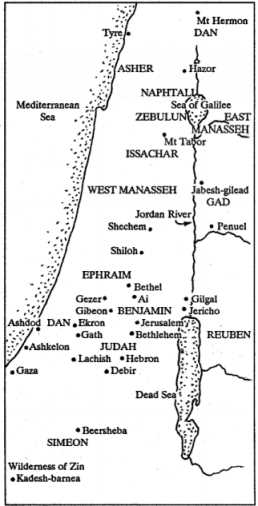
There was little unity between the Israelite tribes during the period of the judges. They were separated from each other by settlements of the unconquered Canaanite peoples (Jdg 1:19; Jdg 1:27-36; Jdg 4:2-3) and were usually slow to help each other in times of crisis (Jdg 5:16-17; Jdg 12:2). Most people were concerned only for their own interests (Jdg 15:9-13; Jdg 20:12-14).
If the people had loved and served God, their loyalty to him would have bound them together in a true unity. The demand for a monarchy would not have arisen. Instead, they took advantage of the absence of a central government to do as they pleased (Jdg 17:6; Jdg 21:25).
Contents of the book
A summary of Joshua’s conquests that introduces the book shows that the conquest was incomplete (1:1-36) and that the reason for this was Israel’s disobedience (2:1-10). The writer then outlines the characteristics of Israel’s national life during this time – departure from God, Baal worship, foreign domination, cry to God, deliverance by judges, peace, then departure from God and repetition of the pattern (2:11-3:6).
The first oppression of Israel came from the north, lasted eight years, and was overthrown by Othniel of Judah (3:7-11). Then Moab, helped by Ammon and Amalek, oppressed some of the eastern tribes along with parts of Benjamin and Ephraim west of Jordan. After eighteen years Moab was overthrown by Ehud, a man from the tribe of Benjamin (3:12-30). Shamgar delivered part of the coastal region from Philistine domination (3:31). Deborah and Barak, with help from a number of tribes, conquered the oppressors who for twenty years had controlled the Galilean region in the north (4:1-5:31).
Invaders from Midian were the next to trouble Israel. They approached from the east, crossed the Jordan, and for seven years raided the helpless Israelites as far west as Gaza and as far north as Naphtali. They were finally driven out by Gideon, who came from the tribe of Manasseh in central Canaan (6:1-8:35). After Gideon’s death, one of his sons, Abimelech, tried to establish himself ruler in central Canaan. After a short but violent reign he was killed (9:1-57).
Little is known of the activities of the judges Tola and Jair (10:1-5). Then for eighteen years the Ammonites imposed a cruel rule over the area east of Jordan (and over parts of some western tribes as well). They were conquered by Jephthah, one of the eastern tribes’ greatest heroes (10:6-12:7). After Jephthah came the judges Ibzan, Elon and Abdon (12:8-15). For forty years the Philistines dominated the territory inland from the coast, spreading across the tribal territories of Dan and Judah. With his spectacular one-man victories against them, Samson began the movement that eventually broke their dominance (13:1-16:31).
A separate section at the end of the book highlights the lack of a central government to administer justice in inter-tribal affairs. As a result people did as they pleased, something that was well illustrated by the actions of the tribes Dan and Benjamin.
Dan was originally located on the central coast, but it found itself being squeezed out of its territory by oppression from the Philistines and expansion from the stronger tribes that bordered it (Judah and Ephraim). Determined to maintain its tribal identity and its independence, Dan went looking for a new location. With a ruthless disregard for the rights of others, it gained its new territory in the far north (17:1-18:31).
The tribe of Benjamin became involved in an inter-tribal dispute when some of its people were guilty of violence against members of another tribe. When it ignored a nationwide demand for justice and refused to punish the offenders, the other tribes attacked it and almost wiped it out (19:1-21:25).