
The sea - port in Palestine in the Mediterranean. The name signifies beauty - - from Japhah, Here it was that Jonah went to flee from the presence of the Lord. (Jonah i. 3.). Here Peter dwelt when sent for by Cornelius And Tabitha also lived here, whom Peter by the Lord raised from the dead. (See Acts ix. 36. and x. 5, 6.)
called also Japho in the Old Testament, which is still preserved in its modern name of Jaffa or Yafah, a sea port of Palestine, situated on an eminence in a sandy soil, about seventy miles north-west of Jerusalem. Joppa was anciently the port to Jerusalem. Here all the materials sent from Tyre for the building of Solomon’s temple were brought and landed; it was, indeed, the only port in Judea, though rocky and dangerous. It possesses still, in times of peace, a considerable commerce with the places in its vicinity; and is well inhabited, chiefly by Arabs. This was the place of landing of the western pilgrims; and here the promised pardons commenced. Here St. Peter raised Dorcas from the dead, and resided many days in the house of one Simon, a tanner, Act 9:36-43; and it was from this place that the Prophet Jonah embarked for Tarshish.
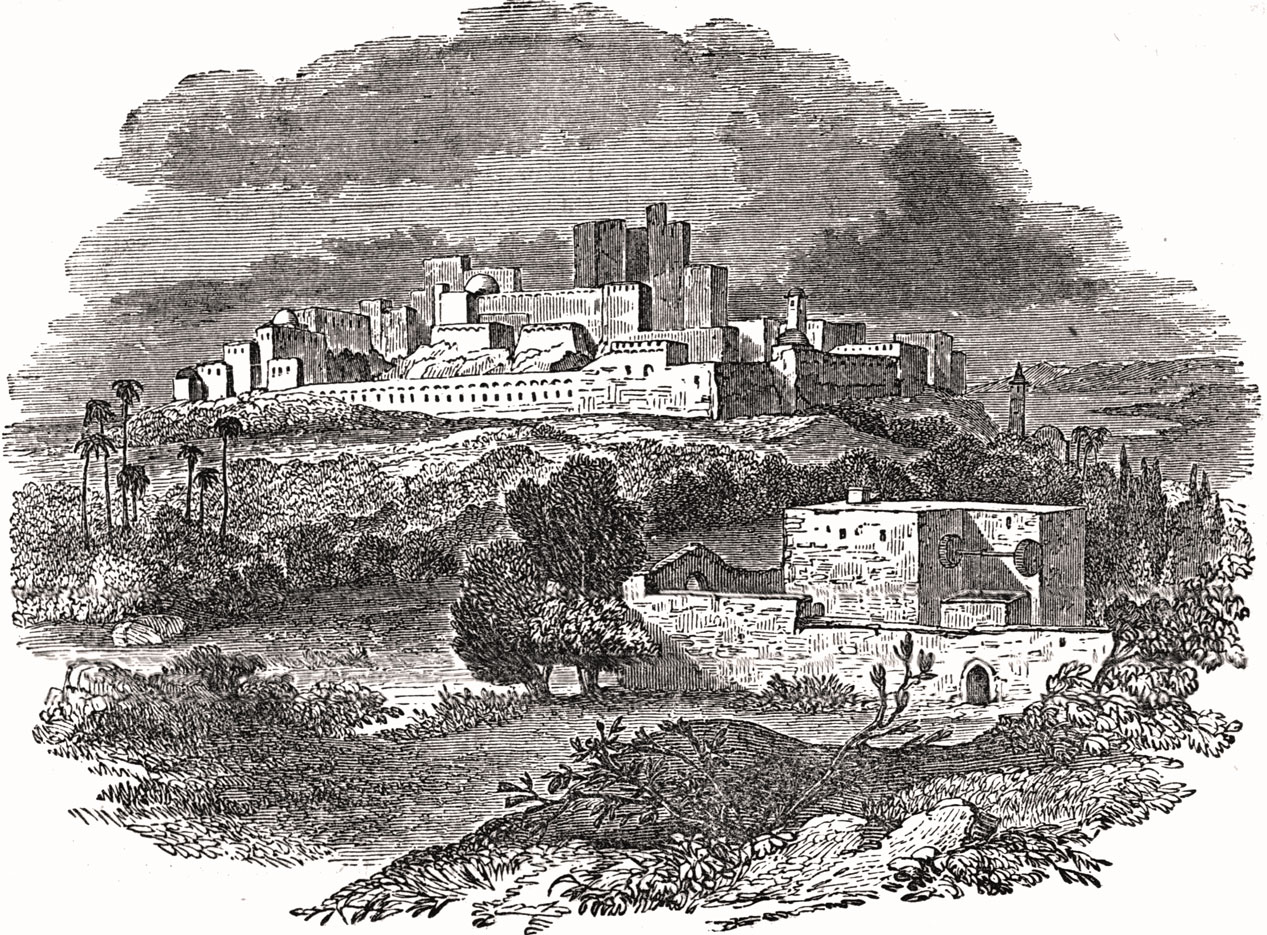
Fig. 235—Joppa
Jop´pa, a sea-port town and haven on the coast of Palestine, situated on an eminence, in a sandy soil, about forty miles N.W. of Jerusalem, and nine miles W.N.W. from Ramleh. It was a very ancient town. To say nothing respecting the fabulous accounts of its great antiquity, it existed when the Israelites invaded the land of Canaan, and is mentioned as lying on the border of the tribe of Dan (Jos 19:46). Joppa was the only port possessed by the Israelites till Herod formed the harbor at Cesarea; and hence it was here that the timber from Lebanon destined for both the first and second temples was landed (1Ki 5:9; 2Ch 2:16; Ezr 3:7). It was the place to which Jonah went, in expectation of finding a ship bound on some distant voyage, and where he found one going to Tarshish (Jon 1:3). Joppa belonged to the powers which were successively dominant on this shore; and it does not again appear in Jewish history till the time of Judas Maccabeus, when the inhabitants having, contrary to the faith of treaties, thrown 200 Jews into the sea, the hero, to avenge them, surprised the haven by night, and set the shipping on fire (2Ma 12:3-7). It is mentioned in the New Testament only in connection with the visit of the Apostle Peter, who here raised Tabitha from the dead, and lodged in the outskirts of the town with Simon, the tanner, when favored with the vision which taught him to ’call no man common or unclean’ (Act 9:36-39; Act 10:5; Act 10:18; Act 11:5). From the first crusade down to our own day Joppa has been the landing-place of pilgrims going to Jerusalem. There is still here an hospital for pilgrims, dependent on the convent of St. Salvador in Jerusalem, and occupied by Spanish monks. In 1797 the place was taken by storm by the French army under Napoleon, and was sacked without mercy; when the Turkish prisoners, to the number of 500 or 600, were carried to the neighboring sand-hills and put to death by his order.
Joppa is naturally very unfit for a haven. The port is so dangerous, from exposure to the open sea, that the surf often rolls in with the utmost violence, and even so lately as 1842 a lieutenant and some sailors were lost in pulling to the shore from an English steamer that lay in the harbor. But however bad, it was the only port which existed within reach of the important district which lay behind it inland: and the miserable state of the ancient roads, or rather perhaps the absence of any roads, made a near harbor, however incommodious, of more immediate consequence than a good one at a greater distance.
The town is approached on the land side through rich and extensive gardens and orchards, and is very picturesquely situated upon an eminence or promontory, which is crowned by a castle. It chiefly faces the north; and the buildings appear, from the steepness of the site, as if standing upon one another. The aspect of the whole is mean and gloomy, and inside the place has all the appearance of a poor though large village. There are no public buildings to engage the eye, and the houses are mean and comfortless. No ancient ruins have been observed, nor are any to be expected in a place so often destroyed in war. There are three mosques in Joppa, and Latin, Greek, and Armenian convents. The former is that in which European pilgrims and travelers usually lodge. The town still enjoys a considerable trade with the neighboring coasts. Its chief manufacture is soap, which is largely consumed in the baths of Cairo and Damascus; and its excellent fruits are exported in large quantities, especially watermelons, which are very extensively cultivated here and in other parts of the Plain of Sharon. The inhabitants are said not to exceed 4000, of whom one-fourth are reckoned to be Christians. A British consul is now resident in the place.
Hebrew JAPHO, is one of the most ancient seaports in the world. It was a border town of the tribe of Dan, Jos 19:46, on the coast of the Mediterranean sea, thirty miles south of Caesarea, and about thirty-five north-west of Jerusalem. Its harbor is shoal and unprotected from the winds; but on account of its convenience to Jerusalem, it became the principal port of Judea, and is still the great landing-place of pilgrims. Here the materials for building both the first and the second temple, sent from Lebanon and Tyre, were landed, 2Ch 3:16 Ezr 3:7 . Here Jonah embarked for Tarshish. Here, too, Peter raised Dorcas from the dead; and in the house of Simon the tanner, by the seaside, was taught by a heavenly vision that salvation was for Gentiles as well as Jews, Mal 9:1-11:30. Joppa was twice destroyed by the Romans. It was the seat of a Christian church for some centuries after Constantine. During the crusades it several times changed hands; and in modern times, 1799, it was stormed and sacked by the French, and twelve hundred Turkish prisoners, said to have broken their parole, were put to death.\par The present town of Jaffa, or Yafa, is situated on a promontory jutting out into the sea, rising to the height of about one hundred and fifty feet, crowned with a fortress, and offering on all sides picturesque and varied prospects. Towards the west is extended the open sea; towards the south are spread the fertile plains of Philistia, reaching as far as Gaza; towards the north, as far as Carmel, the flowery meads of Sharon present themselves; and to the east, the hills of Ephraim and Judah raise their towering heads. The town is walled round on the south and east, towards the land, and partially so on the north and west, towards the sea. Its environs, away from the sand-hills of the shore, are full of gardens and orchards. From the sea, the town looks like a heap of buildings, crowded as closely as possible into a given space; and from the steepness of its site, they appear in some places to stand one on the other. The streets are very narrow, uneven, and dirty, and might rather be called alleys. The inhabitants are estimated at about fifteen thousand, of whom more than half are Turks and Arabs. There are several mosques; and the Latins, Greeks, and Armenians have each a church, and a small convent for the reception of pilgrims.\par
Jop’pa. (beauty). Joppa or Japho, now Jaffa or Yafa. A town on the southwest coast of Palestine, in the portion of Dan. Jos 19:46. Having a harbor attached to it -- though always, as still, a dangerous one -- it became the port of Jerusalem, in the days of Solomon, and has been ever since. Here, Jonah "took ship to flee from the presence of his Maker." Here, on the house-top of Simon the tanner, "by the seaside," St. Peter had his vision of tolerance. Act 11:5. The existing town contains about 4000 inhabitants. See Japho.
From
He had come from the neighbouring Lydda to Joppa to raise Tabitha from death; that became the raising of many to spiritual life (Act 9:36-42). Thence at Cornelius’ call he went to quicken the Gentiles through the word then first preached to them with the Holy Spirit accompanying it. A vast plain surrounded it. Its situation was between Jamnia and Caesarea, which latter town Peter could reach on "the morrow" from leaving Joppa (Act 10:24). It has now a soap manufacture. The oranges, pomegranates, and water melons are noted. it is one of the oldest cities in the world. Cepheus, its earliest king, may represent Caphtor (Gen 10:14; Deu 2:23). It belonged to the Philistines, a Mizraimite colony of Caphtorim. The kindred to the Phoenicians is implied in the name of Cepheus’ brother Phineus. It is N. of Askelon, S. of Caesarea, and 36 miles N.W. from Jerusalem.
Joppa (jŏp’pah), or Japho (jâ’pho), beauty, now Jaffa. A town on the southwest coast of Palestine, in the territory of Dan. Jos 19:46. The harbor, though always as now a dangerous one, became the port of Jerusalem in the days of Solomon, and has been ever since. Here Jonah took ship to flee from the presence of his Maker. Here, on the housetop of Simon, the tanner, "by the seaside," Peter had his vision that led him to preach the gospel to Gentiles. Act 11:5. In population Joppa has greatly increased within 25 years. A Turkish calendar enumerates 865 Moslem, 135 Greek, 70 Greek Catholic, 50 Latin, 6 Maronite, and 5 Armenian families. It now has daily railway trains to Jerusalem. There are flourishing colonies settled in the vicinity, which foster various industries.
[Jop’pa]
Town and sea-port in the tribe of Dan. It was the port of Jerusalem. Timber was cut in Lebanon and brought in ’floats’ by sea to Joppa, for the temple at Jerusalem. 2Ch 2:16; Ezr 3:7. It was the port from which Jonah took ship to go to Tarshish. Jon 1:3. It was where Dorcas was restored to life, and where Peter had the vision of the sheet from heaven, with instructions to visit Cornelius. Act 9:36-43; Act 10:5-33; Act 11:5; Act 11:13. It was originally called JAPHO, Jos 19:46; and is now called Jaffa or Yafa , 32° 3’ N, 34° 45’ E.
It has been destroyed many times, but now it is part of Tel Aviv, the major city and port of Israel. In its vicinity fine palms, oranges, pomegranates, figs, bananas, and water-melons are grown and exported.
See JAFFA (Hebr. Yafo; A. V. Joppa; Greek, Joppe; Arabic, Yaffa):
JOPPA.—The principal seaport of S. Palestine; a place of high antiquity, being mentioned in the tribute lists of Thothmes iii., but never before the Exile in Israelite hands, being in Philistine territory. It was theoretically assigned to the tribe of Dan (Jos 19:46), and is spoken of as a seaport in 2Ch 2:16 and Ezr 3:7 [where RV
R. A. S. Macalister.
1. Ancient Notices:
“The gate of Joppa” is mentioned in the Tell el-Amarna Letters (214, 32 f; compare 178, 20), as guarded by an Egyptian officer for Amenhotep IV. It was conquered by Thothmes III, and old Egyptian records speak of the excellence of its gardens and fruit trees. Sennacherib claims to have taken Jonathas after a siege (Keilinschriftliche Bibliothek, 2, 93). To Jonathas, the Chronicler tells us, the cedars of Lebanon were brought in floats for transportation to Jerusalem by the workmen of the king of Tyre (2Ch 2:16).
2. Biblical References:
The city does not appear in the history as Philistine, so we may, perhaps, infer that it was held by the Phoenicians, the great seamen of those days. It was doubtless a Phoenician ship that Jonah found here, bound for Tarshish, when he fled from the presence of the Lord (Jon 1:3). In Ezra’s time, again, cedars were brought here for the buildings in Jerusalem (Ezr 3:7). Having been brought by messengers from Lydda to Jonathas, Peter here raised the dead Dorcas to life (Act 9:36 f). On the roof of Simon’s house by the sea, the famous vision was vouchsafed to this apostle, from which he learned that the gospel was designed for Jew and Gentile alike (Act 10:1 ff; Act 11:5 ff).
3. History from Maccabean Times:
The men of Joppa, having treacherously drowned some 200 Jews, Judas Maccabeus fell upon the town “and set the haven on fire by night, and burned the boats, and put to the sword those that had fled thither” (2 Macc 12:3 ff). Jonathan took the city, in which Apollonius had placed a garrison (1 Macc 11:47 ff). It was not easy to hold, and some years later it was captured again by Simon, who garrisoned the place, completed the harbor and raised the fortifications (1 Macc 12:36 f; 13:11; 14:5-34). It is recorded as part of Simon’s glory that he took it “for a haven, and made it an entrance for the isles of the sea,” the Jews thus possessing for the first time a seaport through which commerce might be fully developed. It was taken by Pompey and joined to the province of Syria (Ant., XIV, iv, 4; BJ, I, vii, 7). Caesar restored it to the Jews under Hyrcanus (Ant., XIV, x, 6). It was among the cities given by Antony to Cleopatra (XV, iv, 1). Caesar added it to the kingdom of Herod (vii. 3; BJ, I, xx, 3), and at his death it passed to Archelaus (Ant., XVII, xi, 4; BJ, II, vi, 3). At his deposition it was attached to the Roman province. The inhabitants were now zealous Jews, and in the Roman wars it suffered heavily. After a massacre by Cestius Gallus, in which 8,400 of the people perished, it was left desolate. Thus it became a resort of the enemies of Rome, who turned pirates, and preyed upon the shipping in the neighboring waters. The place was promptly captured and destroyed by Vespasian. The people took to their boats, but a terrific storm burst upon them, dashing their frail craft to pieces on the rocks, so that vast numbers perished (BJ, III, ix, 2-4). At a later time it was the seat of a bishopric. During the Crusades it had a checkered history, being taken, now by the Christians, now by the Moslems. It was captured by the French under Kleber in 1799. It was fortified by the English, and afterward extended by the Turks (Baedeker, Palestine, 130).
4. Description:
The modern
(Ἰüððç; Josephus, Ἰüðç; Arab. Yâfâ; modern name Jaffa)
Joppa is a maritime town of Palestine, 33 miles S.W. of Jerusalem. Built on an eminence visible far out at sea-whence its name, ‘the conspicuous’-it owes its existence to a ridge of low and partly sunken rocks running out in a N.W. direction from the S. side of the town, and forming a harbour which, though small and insecure, is yet the best on the whole coast of Palestine.
Down to the time of the Maccabees, Joppa was a heathen town, which the Jews sometimes used but never possessed. Jonah’s ship of Joppa was manned by a heathen crew (Jon_1:5). One of the strongest proofs of the political sagacity of the three famous Maccabaean brothers lay in their resolve to make Judaea a maritime power. Each of them attempted to capture Joppa, and Simon succeeded. On the family memorial at Modin, meant for the eyes of ‘all that sail on the sea,’ he caused carved ships to be represented (1Ma_13:29). The historian, in eulogizing his career, says: ‘And amid all his glory he took Joppa for a haven, and made it an entrance for the isles of the sea’ (14:5). From that time, with but few interruptions, Joppa remained in the possession of the Jews for more than two centuries. When Pompey (66 b.c.) included Judaea in the province of Syria, Joppa was one of the cities which ‘he left in a state of freedom’ (Jos. Ant. xiv. iv. 4); and Julius Caesar decreed ‘that the city of Joppa, which the Jews had originally when they made a league of friendship with the Romans, shall belong to them as it formerly did’ (x. 6).
No city was more completely judaized than this late possession. Joppa became as zealous for the Law, us patriotic, as impatient of Gentile control and culture, as Jerusalem herself. Herod the Great, who did much to hellenize Palestine, left the Pharisaic purity of Joppa untainted. Yet this stronghold of Jewish legalism was the city in which St. Peter received the vision which taught him that Jew and Gentile, as spiritually equal before God, must be impartially welcomed into the Church of Christ (Act_10:9-16). Nowhere was the contrast between the clean and the unclean-the devoutly scrupulous observers of the Law and the jostling crowd of foreigners-more marked. St. Peter probably never realized so intensely the need of ceremonial purification before his midday meal as when he brought into the tanner’s house the defilement of contact with so many lawless and profane people. To his Jewish instincts such contamination was intolerable. But he experienced a swift and mysterious reaction, which was probably the result of much past brooding as well as of present prayer. While he lingered upon the housetop, waiting the call to eat, he became unconscious of the sights and sounds of the harbour beneath, and fell into a trance, in which he learned how different are God’s thoughts of religious purity from man’s. He became convinced that all manner of meats-and, inferentially, all manner of men-that were commonly counted unclean, were clean in God’s sight. It is as the birthplace of this revolutionary principle, which virtually gave the deathblow to Judaism, that the old town of Joppa has a place in the history of human thought. St. Peter, always impulsive and uncalculating, went straight to pagan Caesarea, and delivered a speech which opened the gates of Christ’s Church to ‘every nation’ (Act_10:35). Joppa has also a place in the history of Christian beneficence. It is remembered as the home of a gentlewoman who was believed to have been raised from death to life, and whose example has in all ages been an incentive to ‘good works and almsdeeds’ (Act_9:36-42).
To the ancient Greeks Joppa was known as the place where ‘Andromeda was exposed to the sea-monster’ (Strabo xvi. ii. 28). By primitive fancy the fury of the sea was ascribed to serpents and dragons. Modern writers rationalize the phenomenon. ‘More boats are upset, and more lives are lost in the breakers at the north end of the ledge of rocks that defend the inner harbour, than anywhere else on this coast.’ One cannot ‘look without a shudder at this treacherous port, with its noisy surf tumbling over the rocks, as if on purpose to swallow up unfortunate boats. This is the true monster which has devoured many an Andromeda, for whose deliverance no gallant Perseus was at hand’ (W. M. Thomson, The Land and the Book, 1864, p. 516).
Jaffa is now famous for its orange gardens and orchards, each of which has an unlimited supply of water. ‘The entire plain seems to cover a river of vast breadth, percolating through the sand en route to the sea’ (W. M. Thomson, loc. cit.).
Literature.-E. Schürer, History of the Jewish People (Eng. tr. of GJV).] ii. i. [1885] 79-83; G. A. Smith, Historical Geography of the Holy Land (G. A. Smith) , 1897, p. 136f.; H. B. Tristram, Bible Places, 1897, p. 70f.; V. Guérin, Description géographique … de la Palestine: ‘Judée,’ 1869, i. 1f.
James Strahan.
In Old Testament days Joppa was Israel’s only port on the Mediterranean coast. It lay between the plain of Sharon to the north and the land of the Philistines to the south.
When timber was brought from Lebanon to be used in the construction of Solomon’s temple, it was floated down from Tyre and Sidon in rafts, received at Joppa, and then taken to Jerusalem (2Ch 2:16). A similar arrangement was apparently used four hundred years later when Zerubbabel rebuilt the temple (Ezr 3:7). Joppa was the port where Jonah boarded a ship when he tried to flee from God (Jon 1:3; for map see JONAH).
Joppa was one of the first places outside Jerusalem that the apostles visited in the early days of the church. There Dorcas was raised to life (Act 9:36-43) and there Peter had a remarkable vision that changed his ideas about the evangelization of the Gentiles (Acts 10). The town still exists today, as part of Tel Aviv, and is known as Jaffa (or Yafo).