
One of the apostles of Christ. There were two of this name, and both apostles; one the son of Salome, the other of Mary. Hence by way, of distinction, they are called James the Elder, and James the Less. The former was the brother of John, (Matt. 4: 21.) the latter is called by Paul the Lord’s brother, (Gal. i. 19.) not so in reality, as we now mean by the term brother, but as the custom then was, from tribes and families, Mary, James’s mother, was sister to the blessed Virgin. James the Elder was the son of Zebedee; James theLess the son of Alpheus, (Matt. x. 2, 3.) The former was killed by Herod, (Acts x2: 1); the latter we have no scriptural relation of his death. It is to this man, under God the Holy Ghost, that we are indebted for that gracious Epistle which bears his name.
‘
James the less was a person of great prudence and discretion, and was highly esteemed by the Apostles and other Christians. Such, indeed, was his general reputation for piety and virtue, that, as we learn from Origen, Eusebius, and Jerom, Josephus thought, and declared it to be the common opinion, that the sufferings of the Jews, and the destruction of their city and temple, were owing to the anger of God, excited by the murder of James. This must be considered as a strong and remarkable testimony to the character of this Apostle, as it is given by a person who did not believe that Jesus was the Christ. The passages of Josephus, referred to by those fathers upon this subject, are not found in his works now extant.
JAMES, GENERAL EPISTLE OF. Clement of Rome and Hermas allude to this epistle; and it is quoted by Origen, Eusebius, Athanasius, Jerom, Chrysostom, Augustine, and many other fathers. But though the antiquity of this epistle had been always undisputed, some few formerly doubted its right to be admitted into the canon. Eusebius says, that in his time it was generally, though not universally, received as canonical; and publicly read in most, but not in all, churches; and Estius affirms, that after the fourth century, no church or ecclesiastical writer is found who ever doubted its authenticity; but that, on the contrary, it is included in all subsequent catalogues of canonical Scripture, whether published by councils, churches, or individuals. It has, indeed, been the uniform tradition of the church, that this epistle was written by James the Just; but it was not universally admitted till after the fourth century, that James the Just was the same person as James the less, one of the twelve Apostles; that point being ascertained, the canonical authority of this epistle was no longer doubted.
think,” says Dr. Doddridge, “it can hardly be doubted but they were better judges of the question of its authenticity than the Gentiles, to whom it was not written; among whom, therefore, it was not likely to be propagated so early; and who at first might be prejudiced against it, because it was inscribed to the Jews.”
The immediate design of this epistle was to animate the Jewish Christians to support with fortitude and patience any sufferings to which they might be exposed, and to enforce the genuine doctrine and practice of the Gospel, in opposition to the errors and vices which then prevailed among them. St. James begins by showing the benefits of trials and afflictions, and by assuring the Jewish Christians that God would listen to their sincere prayers for assistance and support; he reminds them of their being the distinguished objects of divine favour, and exhorts them to practical religion; to a just and impartial regard for the poor, and to a uniform obedience to all the commands of God, without any distinction or exception; he shows the inefficacy of faith without works, that is, unless followed by moral duties; he inculcates the necessity of a strict government of the tongue, and cautions them against censoriousness, strife, malevolence, pride, indulgence of their sensual passions, and rash judgment; he denounces threats against those who make an improper use of riches; he intimates the approaching destruction of Jerusalem; and concludes with exhortations to patience, devotion, and a solicitous concern for the salvation of others. This epistle is written with great perspicuity and energy, and it contains an excellent summary of those practical duties and moral virtues which are required of Christians. Although the author wrote to the Jews dispersed throughout the world, yet the state of his native land passed more immediately before his eyes. Its final overthrow was approaching; and oppressions, factions, and violent scenes troubled all ranks, and involved some professing Christians in suffering, others in guilt.
Two, if not three persons of this name are mentioned in the New Testament.
James , 1
James, the son of Zebedee, and brother of the Evangelist John. Their occupation was that of fishermen, probably at Bethsaida, in partnership with Simon Peter (Luk 5:10). On comparing the account given in Mat 4:21; Mar 1:19, with that in John 1, it would appear that James and John had been acquainted with our Lord, and had received him as the Messiah some time before he called them to attend upon him statedly—a call with which they immediately complied. Their mother’s name was Salome. We find James, John, and Peter associated on several interesting occasions in the Savior’s life. They alone were present at the Transfiguration (Mat 17:1; Mar 9:2; Luk 9:28); at the restoration to life of Jairus’ daughter (Mar 5:42; Luk 8:51); and in the garden of Gethsemane during the agony (Mar 14:33; Mat 26:37; Luk 21:37). With Andrew they listened in private to our Lord’s discourse on the fall of Jerusalem (Mar 13:3). James and his brother appear to have indulged in false notions of the kingdom of the Messiah, and were led by ambitious views to join in the request made to Jesus by their mother (Mat 20:20-23; Mar 10:35). From Luk 9:52, we may infer that their temperament was warm and impetuous. On account, probably, of their boldness and energy in discharging their Apostleship, they received from their Lord the appellation of Boanerges, or Sons of Thunder. James was the first martyr among the Apostles. Clement of Alexandria, in a fragment preserved by Eusebius, reports that the officer who conducted James to the tribunal was so influenced by the bold declaration of his faith as to embrace the Gospel and avow himself also a Christian; in consequence of which he was beheaded at the same time.
James , 2
James, the son of Alphaeus, one of the twelve Apostles (Mar 3:18; Mat 10:3; Luk 6:15; Act 1:13). His mother’s name was Mary (Mat 27:56; Mar 15:40); in the latter passage he is called James the Less, either as being younger than James the son of Alphaeus, or on account of his low stature (Mar 16:1; Luk 24:10).
James , 3
James, ’the brother of the Lord’ (Gal 1:19). Whether this James is identical with the son of Alphaeus, is a question which Dr. Neander pronounces to be the most difficult in the Apostolic history, and which cannot yet be considered as decided. It is probable, however, that he was a different person.
Surnamed the greater, or the elder, to distinguish him from James the younger, was one of the twelve apostles, brother of John the evangelist, and son of Zebedee and Salome, Mat 4:21 27:56. Compare Mar 15:40 . James was of Bethsaida in Galilee, and left his earthly occupation to follow Christ, Mar 1:29,20 . His mother Salome was one of those women who occasionally attended our Savior in his journeys, and one day desired that her two sons might be seated at his right and left hand in the kingdom, Mat 20:20-23 .\par James and John were originally fishermen, with Zebedee their father, Mar 1:19 . They were witnesses of our Lord’s transfiguration, Mat 17:1,2 ; and when certain Samaritans refused to receive him, James and John wished for fire from heaven to consume them, Luk 9:54 . For this reason, or because of their zeal and energy as ministers of Christ, the name of Boanerges, or sons of thunder, was afterwards given to them, Mar 3:17 . Together with Peter they appear to have enjoyed special honors and privileges among the disciples, Mar 1:29 5:37 9:2 13:3 14:33 Lu 8:51. After the ascension of our Lord, at which James was present, he appears to have remained at Jerusalem, and was put to death by Herod, about A. D. 44, the first martyr among the apostles, Mal 12:1,2 .\par Another apostle, son of Alphaeus, or Cleophas, Mat 10:3 Mar 3:18 Luk 6:15 . His mother’s name was Mary, (3) and his brethren were Joses and Judas, (3) Mat 27:56 ; Mar 15:40 . He is here called THE LESS, or the younger, to distinguish him from James the son of Zebedee.\par "The Lord’s brother," Gal 1:19 ; either a brother a Christ, being a son of Joseph and Mary; or as many think, a cousin of Christ, and identical with the James above, 2. He resided at Jerusalem, Mal 15:13 ; and is called "the Just" by Josephus, and said to have been stoned to death, about A. D. 62. The epistle of James is ascribed to him by those who distinguish him from James the Less. The question of his true relationship to Christ is involved in much doubt. The gospels repeatedly mention James, Joses, Juda, and Simon, as "brothers" of our Lord, and speak in the same connection of his "mother" and his "sisters," Mat 12:46 13:56 Mar 3:31 6:3 Lu 8:19; moreover, the inspired writers expressly distinguish the brothers of Christ from the apostles both James the Less and Jude, Joh 2:12 7:3-10 Mal 1:13,14, thus furnishing strong reasons, as many believe, for the opinion that James the Just was literally a brother of our Lord.\par
James. (the Greek form of Jacob, supplanter).
1. James, the son of Zebedee, one of the twelve apostles. He was elder brother of the evangelist John. His mother’s name was Salome. We first hear of him in A.D. 27, Mar 1:20, when, at the call of the Master, he left all, and became, one and forever, his disciple, in the spring of A.D. 28. Mat 10:2; Mar 3:14; Luk 6:13; Act 1:13. It would seem to have been at the time of the appointment of the twelve apostles that the name of Boanerges, [sons of thunder] was given to the sons of Zebedee. The "sons of thunder" had a burning and impetuous spirit, which twice exhibits itself. Mar 10:37; Luk 9:54.
On the night before the crucifixion, James was present at the agony in the garden. On the day of the ascension, he is mentioned as persevering, with the rest of the apostles and disciples, in prayer. Act 1:13. Shortly before the day of the Passover, in the year A.D. 44, he was put to death by Herod Agrippa I. Act 12:1-2.
2. James, the son of Alpheus, one of the twelve apostles. Mat 10:3. Whether or not this James is to be identified with James the Less, the son of Alphaeus, the brother of our Lord, is one of the most difficult questions in the gospel history. By comparing Mat 27:56 and Mar 15:40 with Joh 19:25, we find that the Virgin Mary had a sister named, like herself, Mary, who was the wife of Clopas or Alpheus, (varieties of the same name), and who had two sons, James the Less and Joses.
By referring to Mat 13:55 and Mar 6:3, we find that a James the Less and Joses, with two other brethren called Jude and Simon, and at least three sisters, were sisters with the Virgin Mary at Nazareth. By referring to Luk 6:16 and Act 1:13, we find that there were two brethren named James and Jude among the apostles.
It would certainly be natural to think that we had here, but one family of four brothers and three or more sisters, the children of Clopas and Mary, nephews and nieces of the Virgin Mary. There are difficulties however, in the way of this conclusion into which we cannot here enter; but in reply to the objection that the four brethren in Mat 13:55 are described as the brothers of Jesus, not as his cousins, it must be recollected that adelphoi, which is here translated "brethren," may also signify cousins.
"Jacob" in Greek; the name appearing in our Lord’s apostles and contemporaries for the first time since the patriarch. Son of Zebedee, brother of John. Their father’s "hired servants" and fishing vessel imply some degree of competence. John probably was the one with Andrew (Joh 1:35-41), who, on John the Baptist’s pointing to the Lamb of God, followed Jesus. The words Andrew "first findeth his own brother Simon" imply that John secondly found and called his own brother James to Jesus, or vice versa. Some months later the Lord saw Zebedee, James, and John, in the ship mending their nets. At His call James and John "immediately left the ship and their father and followed Him" (Mat 4:22). Their LEAVING THEIR FATHER "WITH THE HIRED servants" (Mar 1:20, a minute particular, characteristic of Mark’ s vivid style and his knowledge through Peter of all which happened) was not an unfilial act, which it would have been if he had no helpers.
The next call was after an unsuccessful night’s fishing, when the fishermen had gone out of their ships and had washed (Luk 5:2, Vaticanus and Cambridge manuscripts read
(1) to friendly acquaintance (Joh 1:37);
(2) to intimacy (Mat 4:18);
(3) to permanent discipleship (Luk 5:11);
(4) (toward the close of the first year of our Lord’s ministry) to apostleship (Mat 10:1);
(5) to renewed self dedication, even unto death (Joh 21:15-22).
In Matthew and Luke (Luk 6:14), of the four catalogs of apostles, Andrew follows Peter on the ground of brotherhood.
James was probably the elder brother, whence John is twice called "brother of James" (Mar 5:37; Mat 17:1). No official superiority was given, for no trace of it occurs in New Testament; it was the tacitly recognized leadership which some took above the others. James and John were called Boanerges to express their natural character and the grace which would purify and ennoble it, making James the first apostle martyr and John the apostle of love.
James and John "saw" some actual collision between the Samaritans and the messengers who were sent before and whom our Lord and His apostles followed presently; just as Elijah in the same Samaria had called for fire upon the offenders face to face (2Ki 1:10; 2Ki 1:12). In Luk 9:55-56, "ye know not what manner of spirit ye are (not the fiery judicial spirit which befitted Elijah’s times, but the spirit of love so as to win men to salvation, is the spirit of Me and Mine), for the Son of man is not come to destroy men’s lives but to save them," is not in Alex., Vat., and. Sin. manuscripts The same John subsequently (Act 8:14-17) came down with Peter to confer the Spirit’s gifts on Samaritan believers. What miracles in renewing the heart does the gospel work! Salome the mother of Zebedee’s children, impressed by Christ’s promise that the twelve should sit on thrones judging the twelve tribes of Israel, begged, and her two sons joined in the prayer, that they might sit one on His right the other on His left hand in His glory (Mar 10:35-37).
They prefaced it with pleading His own promise, "Master, we would that Thou shouldest do for us whatsoever we shall desire" (Mat 7:7; Luk 11:9; Mar 11:24). Perhaps jealousy of Peter and Andrew, their rivals for the nearest place to Him, actuated them (Mat 20:20-24). He told them that they should drink of His cup (Sin. and Vat. manuscripts omit in Mat 20:22-23 the clause as to the "baptism") of suffering (Act 12:1-2; James; Rev 1:9; John), but to sit on His right and left, said He, "is not Mine to give, except to those for whom it is prepared of My Father" (so the Greek). The ten were indignant at the claim. James was among those who abode in the upper room and persevered in prayer; the apostles, the women, and the Lord’s brethren, after the ascension (Act 1:13). In A. D. 44 Herod Agrippa I, a pliant politician but strict Jew, "very ambitious to oblige the people, exactly careful in the observance of the laws. and not allowing one day to pass without its appointed sacrifice" (Josephus, Ant. 19:7, section 3), in consonance with his well known character, "laid hands (Greek) on certain of the church."
The Passover had brought James and Peter to Jerusalem (Act 12:1-3). So he took the opportunity just before the Passover to kill the most fiery of the two first, namely, "James the brother of John." "The sword" was the instrument of his execution, Herod preferring the Roman method to the Jewish punishment of seducers to strange worship, namely, stoning. Clement of Alexandria (Hypotyposeis, 7; Eusebius, H. E., 2:6) records a tradition that James’s prosecutor was moved by his bold confession to declare himself a Christian on the spot; he begged James’s forgiveness, and the apostle kissed him, saying "peace be to thee"; they were both beheaded together. A Roman Catholic legend says that he preached in Spain, and that his remains were transported to Compostella there!
James, surnamed "the Less" or "Little." Son of Mary (Mar 15:40; Mat 27:56; Luk 24:10). Brother of Jude (Jud 1:1; Luk 6:16; Act 1:13). "The brother of the Lord" (Mat 13:55; Mar 6:3; Gal 1:19). "Son of Alphaeus" (Mat 10:3; Mar 3:18; Luk 6:15; Act 1:13). Writer of the epistle; president of the church at Jerusalem (Jas 1:1; Act 12:17; Act 15:13; Act 15:19; Gal 2:9; Gal 2:12). Clopas (Alexandrinus and Vaticanus manuscripts, Joh 19:25) or Cleophas (Sinaiticus manuscript) is the Hebrew, Alphaeus the Greek, of the same name: he married Mary, sister of the Virgin Mary, and had by her James, Joses, Jude, and Simon, and three daughters (Mary is sometimes designated "mother of James and Joses," Mat 27:56, as these were the two oldest); he died before our Lord’s ministry began, and his widow went to live with her sister the Virgin Mary, a widow also herself (for Joseph’s name never occurs after Luke 2), at Nazareth (Mat 13:55), Capernaum (Joh 2:12), and Jerusalem (Act 1:14).
Living together the cousins were regarded as "brothers" and "sisters" of Jesus. Being His elders, they went on one occasion to "lay hold on Him," saying that He was "beside Himself"; as He was so pressed by multitudes that He and His disciples "could not so much as eat bread," His cousin brethren thought they would restrain what seemed to them mad zeal (Mar 3:20-21; Mar 3:31-33). The statement in Joh 7:3-5, "neither did His brethren believe in Him," does not imply that all of them disbelieved; James and Jude believed. Or if all are included, the negation of belief is not a negation of all belief, but of such as recognized the true nature of His Messiahship. They looked for a reigning Messiah, and thought Jesus’ miracles were wrought with a view to this end: "depart hence (from obscure Galilee) and go into Judea, that Thy disciples also may see the works that Thou doest, for there is no man that doeth anything in secret and (yet) he himself seeketh to be known openly (which they take for granted He seeks); if Thou do these things, show Thyself to the world."
The theory that denies any of the Lord’s brethren to have place among the apostles involves the improbability that there were two sets of four first cousins, named James, Joses, Jude, Simon, without anything to show which is son of Clopas and which his cousin. Luke in enumerating the twelve calls Jude: "the brother of James," he must mean brother of the "James, son of Alphaeus," before mentioned. Jude appears in Mar 6:3; Mat 13:55, as "brother of the Lord"; therefore James the son of Alphaeus must have been" brother," i.e. cousin, of our Lord. This proves the identity of Juntos the apostle with James the Lord’s brother. Luke moreover recognizes only two Jameses in the Gospel and Acts down to Act 12:17; the James there must then mean the son of Alphaeus. An apostle is more likely to have presided over the Jerusalem church, wherein he is placed even before Cephas and John, than one who was an unbeliever until after the resurrection (Gal 1:19; Gal 2:9-12); compare Act 9:27, which calls those to whom Paul went "apostles"; now Peter and James were those to whom he went, therefore James was an apostle.
After the resurrection Christ appeared to James (1Co 15:7). The spurious " Gospel according to the Hebrew" says "James swore he would not eat bread from the hour that he drank the cup of the Lord until he should see Him risen again." Christ’s special appearance to James strengthened him for the high position, tantamount to "bishop," which he subsequently held at Jerusalem. Christ’s command to the collected apostles to preach the gospel everywhere is compatible with each having a special sphere besides the general care of the churches. To him and Peter Barnabas, A.D. 40, introduced Saul, three years subsequently to his conversion in A.D. 37 on his first visit to Jerusalem, and through their influence he was admitted to free intercourse with the disciples, who at first had been "all afraid of him, not believing he was a disciple" (Act 9:26-28; Gal 1:18-19).
When Peter was delivered by the angel, A.D. 44. he said to the assembly at Mary’s house "Go show these things unto James" (Act 12:17). In A.D. 49 at the Jerusalem council James gives authoritative opinion, "My sentence is" (Act 15:13; Act 15:19). At the same time Paul recognizes as "pillars of the church" "James, Cephas and John" (James standing first): Gal 2:9. It was "certain who came from James," president of the mother church of Jerusalem, who led Peter to his Judaizing vacillation at Antioch (Gal 2:11-12). Finally in A.D. 57 Paul, having been on the previous day "received gladly" by the brethren, went in officially, with Luke and his other assistant ministers, in the presence of all the elders, and "declared particularly what God had wrought among the Gentiles by his ministry" (Act 21:17-19).
Besides Clement of Alexandria who speaks of his episcopate (Hypot. 6, in Eusebius H. E., 2:1), Hegesippus, a Jewish Christian in the middle of the second century, writes much of James, that he drank not strong drink, nor had a razor upon his head, and wore no woolen clothes, but linen, so that he alone might go into the holy place; in short he was a rigid Nazarite ascetic, following after legal righteousness, so that the Jews regarded him as possessing priestly sanctity; such a one when converted to Christ was likely to have most influence with the Jews, who called him "the just one," and therefore to have been especially suited to preside over the Jerusalem church. So we find him recommending to Paul a conformity to legal ceremonialism in things indifferent (Act 21:18-25), which however proved in the end really inexpedient. Hegesippus says James was often in the temple praying for forgiveness for the people.
At the Passover shortly before the destruction of Jerusalem (foretold in his epistle, Jas 5:1) the scribes and Pharisees set him on a pinnacle of the temple, and begged him to restrain the people who were "going astray after Jesus as though He were the Christ." "Tell us, O just one," said they before the assembled people, "which is the door of Jesus?" alluding to his prophecy "the coming of the Lord draweth nigh ... behold the Judge standeth before the doors" (Greek, Jas 5:8-9), wherein he repeats Jesus’ words (Mat 24:33), "when ye shall see all these things, know that He (margin) is near, even at the doors." James replied with a loud voice, "Why ask ye me concerning Jesus, the Son of Man? He sitteth at the right hand of power, and will come again on the clouds of heaven." Many cried "Hosanna to the Son of David."
But James was cast down by the Pharisees. Praying, "Father, forgive them, for they know not what they do," he was stoned in spite of the remonstrance of a Rechabite priest ("Stop! the just one is praying for you!"), then beaten to death with a fuller’s club. Thus the Jews wreaked their vengeance on him, exasperated at his prophecy of their national doom in his epistle, which was circulated not only in Jerusalem but by those who came up to the great feasts, among "the twelve tribes scattered abroad" to whom it is addressed. James was probably married (1Co 9:5). Josephus makes Ananus, the high priest after Festus’ death, to have brought J. before the Sanhedrin for having broken the laws, and to have delivered him and some others to be stoned.
In Heb 13:7 there may be allusion to James’ martyrdom, "Remember them which had (not have) the rule (spiritually) over you, (Hebrew, over whom he presided) who have spoken unto you the word of God, whose faith follow, considering the end of their conversation" (their life walk). If this be the allusion, the Epistle to Hebrew was probably A.D. 68, and James’s martyrdom A.D. 62. His apprehension by Ananus was very probably in this year; but according to Hegesippus he was not martyred until just before the destruction of Jerusalem, A.D. 69, to which, as near, Heb 5:1 may refer.
James, the General Epistle of. The author of this epistle was in all probability James the "brother of the Lord." It was written from Jerusalem, probably before a.d. 62. Its object is to comfort the dispersed Jews, commending to them patience in suffering, joy in sorrow, and prayer in trouble. There is a close resemblance between the pastoral letter in Act 15:23 and this epistle. Both commence with "greeting." Jas 1:1.
JAMES (Heb.
2. James the brother of John (Mat 10:2, Mar 3:17, Luk 6:14, Act 1:13), elder* [Note: The usual order is ‘James and John.’ St. Luke sometimes inverts it (8:51, 9:28, Act 1:13), probably because of the early death of James and the subsequent prominence of John.] son of Zebedee, a well-to-do† [Note: He had ‘Hired servants’ (Mar 1:20). his Wife Was one of those who ministered to Christ ‘of their substance’ (Mar 15:41, Luk 8:3).] Galilaean fisherman, most probably a native of Capernaum. The call of James to Apostleship is related in Mat 4:21-22, Mar 1:19-20 and (perhaps) Luk 5:10.‡ [Note: The question whether the Lukan narrative refers to the same incident as that related by Ml. is not easy to decide. Hammond, Trench, Wordsworth, and other commentators answer it in the affirmative; Alford, Greswell, etc., in the negative. Plummer (‘St. Luke’ in Internat. Crit. Com.) is doubtful. A. Wright regards it as a conflation of the Markan narrative with that found in Joh 21:1-6. The characteristic features of the Lukan account are: (1) there is no mention of Andrew or Zebedee; (2) St. Peter is the prominent figure; (3) there is no command to follow Christ; (4) the fisherman are washing (not casting or mending) their nets; (5) there is a miraculous draught of fishes.] The two sons of Zebedee appear to have been partners (
3. James the son of Alphaeus, one of the Twelve (Mat 10:3, Mar 3:18, Luk 6:15, Act 1:13). In each list he stands at the bead of the third group along with Simon Zelotes (with whom he is coupled by St. Luke), Judas of James (= Thaddaeus, with whom he is coupled by Mt. and Mk.), and Judas Iscariot. The Gospels tell us nothing more about him, but he was most likely a brother of Matthew, who also was a ‘son of Alphaeus’ (cf. Mat 9:9 with Mar 2:14). He has been identified with (4) and (5); but the probabilities seem to the present writer to be against the former identification, while the latter is almost certainly wrong.
4. James
5. James the Lord’s brother. He is mentioned by name twice in the Gospels (Mat 13:55, Mar 6:3). He is the eldest of four brothers, James, Joseph, Judas, and Simon (Simon and Judas, Mat 13:55). Other references to the Brethren of the Lord are found in Mat 12:46-50, Mar 3:31-35, Luk 8:19-21, Joh 7:3-5. From these passages we learn that they thought Him mad, and opposed His work. St. John tells us plainly that His brethren did not believe in Him.
The following passages outside the Gospels have to do with this James: 1Co 15:7, Act 1:13; Act 12:17; Act 12:15 (passim) Act 21:18-25, Gal 1:18-19; Gal 2:1-10; Josephus Ant. xx. ix. 1; Eusebius, Historia Ecclesiastica ii. 1 (quotation from Clement of Alexandria), ii. 23 (quotation from Hegesippus), vii. 19; Jerome, de Vir. Illus. (quotation from the Gospel according to the Hebrews); Clementine Homilies (ad init.); Apostolic Constitutions, viii. 35. From these passages we learn that he was converted to a full acknowledgment of Christ (probably by the Resurrection), that the Lord appeared to him specially, that he became head of the Church of Jerusalem, and that he was put to death by the Jews either just before the siege (Hegesippus) or some ten years earlier (Josephus). He was surnamed the Just by his fellow-countrymen, and was greatly respected by all classes in Jerusalem.
The Epistle bearing his name, which is almost universally attributed to the brother of the Lord, is of the greatest interest to students of the Gospels. There is no Epistle which contains in a small compass so many allusions to the teaching of Christ subsequently contained in the Gospels as we have them. The following list includes all the more striking parallels: Mat 5:3; Mat 5:7; Mat 5:9; Mat 5:11; Mat 5:22; Mat 5:34-37 = Jas 2:5; Jas 2:13; Jas 3:18; Jas 1:2; Jas 1:19; Jas 5:12; Mat 6:19; Mat 6:24 = Jas 5:2; Jas 4:4; Mat 7:1; Mat 7:7-8; Mat 7:12; Mat 7:16; Mat 7:24 = Jas 4:11-12; Jas 1:5; Jas 2:8; Jas 3:11-12; Jas 1:22 (all these are from the Sermon on the Mount). Cf. also Mat 12:38 with Jas 3:1-2, Mat 18:4 with Jas 4:6; Luk 6:24 = Jas 5:1; Luk 12:16-21 = Jas 4:14; Luk 8:15; Luk 21:19 (
A second point to be noticed is that the Epistle of James is clearly the work of one trained in the strict observance of the Law, while at the same time his obedience to it is the obedience of zealous love, as far removed as possible from the Pharisaic formalism denounced by our Lord (Jas 1:22-27; Jas 2:8-12; Jas 4:5-7; Jas 5:10-11). Both in his case and in that of St. Paul, although they developed on somewhat different lines, the Law was a
The Western Church, in regarding James the Lord’s brother as identical with James the son of Alphaeus, seems to have been influenced by the authority of Jerome, who, in replying to Helvidius (circa 383 a.d.), urges that, as James the Lord’s brother is called an Apostle by St. Paul (Gal 1:18-19), he must be identified with James the son of Alphaeus, since James the son of Zebedee was dead; and, further, that he was our Lord’s first cousin. (Jerome does not identify Alphaeus with Clopas). But it may be observed (1) that Jerome himself seems to have abandoned this view (Ep. cxx. ad Hedibiam); (2) that
Literature.—Besides the authorities quoted above, see articles in Hasting’s Dictionary of the Bible (by J. B. Mayor), Encyc. Bibl. (by Orello Cone), Smith’s DB [Note: Dictionary of the Bible.] 2 [Note: designates the particular edition of the work referred] (by Meyrick, with lull list of the views of British theologians); Herzog, PRE [Note: RE Real-Encyklopädie fur protest. Theologic und Kirche.] 3 [Note: designates the particular edition of the work referred] (by Sieffert, with Bibliography); Commentaries of Swete (on Mk.), Alford, Meyer (English translation , Edin. 1882), Plumptre (Cambridge Bible), von Soden (Hand-Commentar, Freiburg, 1890), Plummer (in Expositor’s Bible, 1891); W. Patrick, James the Lard’s Brother, 1906.
H. W. Fulford.
(English equivalent for
By: Kaufmann Kohler
Name of three persons prominent in New Testament history.
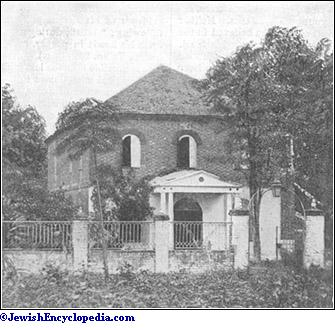
Synagogue at Spanish Town, Jamaica.(From a photograph.)
1. Son of Zebedee (Aramaic, "Ya'ḳob bar Zabdai"); with his brother John one of the first disciples of Jesus. Like their father, both were fishermen of Galilee (Matt. iv. 21; Mark i. 19; Luke v. 10); their mother, apparently Salome, is mentioned among the women watching at the grave of Jesus (Matt. xxvii. 56; Mark xv. 40); she was possibly sister to Mary, the mother of Jesus (John xix. 25). James and his brother John are mentioned immediately after Peter and Andrew in the list of the Twelve Apostles (Matt. x. 2-4; Luke vi, 14-16); Mark iii. 17 has preserved the story that when calling them to the apostleship Jesus surnamed them "Bene Ra'ash" or "Bene Rogez" (Job xxxvii. 2) (the text has "Boanerges, which is, The sons of thunder"). This by-name was probably expressive of their impetuous nature (comp. Luke ix. 55 and Mark x. 37). James and his brother John together with Peter were the inseparable followers of Jesus (Mark v. 37, ix. 2, xiii.3, xiv. 33), and after the death of their master they with the other apostles remained in the city of Jerusalem "steadfast in prayer" (Acts i. 14). James was the first one of the apostles to suffer a martyr's death (Acts xii. 2). What action of James and the other disciples provoked the wrath of Herod Agrippa is not stated. Legend added new features to the martyrdom (Eusebius, "Hist. Eccl." ii. 9); and Spain, whose patron saint James became, surrounded his life with miraculous incidents.
2. Son of Alphæus (Aramaic, "Ḥalfai" or "Ḥolpai" = "Cleophas"; see John xix. 25; Eusebius, "Hist. Eccl." iii. 11, iv. 22), an apostle mentioned in the list of the twelve (Matt. x. 2-4; Mark iii. 16-19; Luke vi. 14-16; Acts i. 13). Probably he was the brother of "Levi the son of Alphæus" (Mark ii. 14), better known as Matthew (Matt. ix. 9); nothing else is known of him. He is often identified with James the Little ("ha-Ḳaṭan," Mark xv. 40; A. V., incorrectly, "the less," John xix. 25; but see No. 3, below). According to Hegesippus (see Eusebius, l.c.), James was a cousin, and his father an uncle, of Jesus.
3. Brother of Jesus; also called James the Just. James is mentioned as the first among the brothers of Jesus, the others being Joses, Simon, and Judas (Matt. xiii. 55; Mark vi. 3), all of whom were, according to Luke ii. 7, younger than Jesus. Neither James nor any of the other brothers believed in the miraculous powers of Jesus (John vii. 5; Matt. xii. 47 et seq.; Mark iii. 31). But after the crucifixion James, the brother of Jesus, is said by Paul to have seen the risen Jesus in a vision after Peter, the twelve, and the five hundred had seen him (I Cor. xv. 7); and when Paul went to Jerusalem to defend his claim to the assumed apostleship to the heathen, James was the head of the Church (Gal. i. 19; ii. 9, 12; Acts xii. 17, xv. 13, xxi. 18). According to Clement of Rome, quoted by Eusebius ("Hist. Eccl." ii. 1), James, surnamed "the Just" on account of his great virtue, was the first bishop of the Church elected at Jerusalem. About his martyrdom Clement writes that" he was cast from a wing of the Temple and beaten to death with a fuller's club." Somewhat differently Josephus writes: "The younger Anan, a high priest belonging to the sect of the Sadducees, who are very rigid in judging offenders, had James, the brother of Jesus, the so-called 'Christ,' together with some of his companions, brought before the Sanhedrin on the charge of having broken the Law, and had them delivered over to be stoned. This act of Anan caused indignation among the citizens best known for their fairness and loyalty" ("Ant." xx. 9, § 1). Hegesippus, quoted by Eusebius (l.c. ii. 23), gives the following description of James:"James, the brother of the Lord, succeeded to the government of the Church in conjunction with the Apostles. He was holy from his mother's womb; he drank no wine nor did he eat flesh. No razor came upon his head, nor did he anoint himself with oil or use any [warm] bath. He alone was permitted to enter the Holy Place, for he wore not woolen, but linen garments; he was in the habit of entering alone into the Temple, and was frequently found upon his knees praying for forgiveness for the people, so that his knees became hard as those of a camel. . . . Because of his exceeding great justice ["Ẓaddiḳut"] he was called 'the Just' ["Ya'aḳob Ḳobal 'Am" = "Jacob, the bulwark of the people"] and 'Ẓaddiḳ Yesod 'Olam' [= "the righteous are the foundation of the world "; Prov. x. 25, Hebr.]. Now, when some of the seven sects which existed among the people [the Sadducees] asked him: 'What is the gate of salvation?' ["sha'ar ha-yeshu'ah"; comp. Lev. R. xxx.; Ps. cxviii. 20; for which some copyist wrote "sha'ar Yeshua'" = "the gate of Jesus "] he replied that it was the Messiah. James's words were understood to refer to Jesus, and led many to believe in him. . . . The Scribes and the Pharisees, fearing lest the people would all be led over to the belief in Jesus, asked James to place himself upon a wing of the Temple and address the people assembled there on account of the Passover, and persuade them not to be led astray."Whereupon James said: 'Why do ye ask me concerning Jesus the Son of Man? He sitteth in heaven at the right hand of great Power, and is about to come upon the clouds of heaven.' And when many cried 'Hosannah to the Son of David,' the Scribes and Pharisees cast him down and stoned him. And James before dying said: 'Lord, God, Father, forgive them; for they know not what they do' [the words ascribed to Jesus; Luke xxiii. 34]. And one of the Rechabites cried out: 'Cease! What do ye? The just one prayeth for you.' Then one of the crowd, a fuller, took the club with which he beat out clothes and struck the just man on the head. Thus he suffered martyrdom; they buried him on the spot by the Temple where his monument still remains. Immediately after this, Vespasian besieged them."
It is difficult to say whether this legendary record contains any actual facts or not. The Essene character of James "the Little," or "the Just," seems to rest on authentic tradition. According to Epiphanius ("Hæres." lxxviii. 14), he wore a golden plate on his forehead (comp. Meg. iv. 8, where this is characterized as "the way of the Gnostics" ["derek minut" or "ḥizonim"]), and no sandals. Another evidence of his Essene piety manifests itself in the following: "When, during a drought, he stretched forth his hands in prayer, rain immediately came" (comp. Ta'an. 23a et seq.).
It is possible that the last words ascribed to Jesus were original with James the Just. The idea that Mary, the mother of Jesus, should afterward have borne other children became obnoxious to the ascetics of the Church, and consequently either the brotherhood of James was explained to have been on the father's side only (so Clement, in Eusebius, l.c. ii. 1; "Clementine Recognitions," xi. 35), or Mary, the mother of James the Little and of Joses, was differentiated from Mary, the mother of Jesus (Matt. xxvii. 56; Mark xv. 40, 47; Luke xxiv. 10; but comp. John xix. 25). This, again, gave rise to a number of different versions in the early literature of the Church, many claiming that James the Little was identical with the son of Alphæus, the cousin of Jesus, and was as such called brother (see Lightfoot on Colossians, 10th ed., pp. 260-267, London, 1896).
JAMES
1. James, the son of Zehedee, one of the Twelve, the elder brother of John. Their father was a Galilæan fisherman, evidently in a thriving way, since he employed ‘hired servants’ (Mar 1:20). Their mother was Salome, and, since she was apparently a sister of the Virgin Mary (cf. Mat 27:56 = Mar 15:40 with Joh 19:25), they were cousins of Jesus after the flesh. Like his brother, James worked with Zebedee in partnership with Simon and Andrew (Luk 5:10), and he was busy with boat and nets when Jesus called him to leave all and follow Him (Mat 4:21-22 = Mar 1:19-20). His name is coupled with John’s in the lists of the Apostles (Mat 10:2 = Mar 3:17 = Luk 6:14), which means that, when the Twelve were sent out two by two to preach the Kingdom of God (Mar 6:7), they wentin company. And they seem to have been men of like spirit. They got from Jesus the same appellation, ‘the Sons of Thunder’ (see Boanerges), and they stood, with Simon Peter, on terms of special intimacy with Him. James attained less distinction than his brother, but the reason is not that he had less devotion or aptitude, but that his life came to an untimely end. He was martyred by Herod Agrippa (Act 12:2).
2. James, the son of Alphæus (probably identical with Clopas of Joh 19:25 RV
Tradition says that he had been a tax-gatherer, and it is very possible that his father Alphæus was the same person as Alphæus the father of Levi the tax-gatherer (Mar 2:14), afterwards Matthew the Apostle and Evangelist. If these identifications he admitted, that family was indeed highly favoured. It gave to the Kingdom of heaven a father, a mother, and three sons, of whom two were Apostles.
3. James, the Lord’s brother (see Brethren of the Lord). Like the rest of the Lord’s brethren, James did not believe in Him while He lived, but acknowledged His claims after the Resurrection. He was won to faith by a special manifestation of the risen Lord (1Co 15:7). Thereafter he rose to high eminence. He was the head of the Church at Jerusalem, and figures in that capacity on three occasions. (1) Three years after his conversion Paul went up to Jerusalem to interview Peter, and, though he stayed for fifteen days with him, he saw no one else except James (Gal 1:18-19.). So soon did James’s authority rival Peter’s. (2) After an interval of fourteen years Paul went up again to Jerusalem (Gal 2:1-10). This was the occasion of the historic conference regarding the terms on which the Gentiles should be admitted into the Christian Church; and James acted as president, his decision being unanimously accepted (Act 15:4-34). (3) James was the acknowledged head of the Church at Jerusalem, and when Paul returned from his third missionary journey he waited on him and made a report to him in presence of the elders (Act 21:18-19).
According to extra-canonical tradition, James was surnamed ‘the Just’; he was a Nazirite from his mother’s womb, abstaining from strong drink and animal food, and wearing linen; he was always kneeling in intercession for the people, so that his knees were callous like a camel’s; he was cruelly martyred by the Scribes and Pharisees: they cast him down from the pinnacle of the Temple (cf. Mat 4:5, Luk 4:9), and as the fall did not kill him, they stoned him, and he was finally despatched with a fuller’s club.
This James was the author of the NT Epistle which bears his name; and it is an indication of his character that he styles himself there (Jas 1:1) not ‘the brother,’ but the ‘servant of the Lord Jesus Christ.’ See next article.
4. James, the father of the Apostle Judas (Luk 6:16 RV
David Smith.
Greek form of Jacob
(1) The Son of Zebedee, one of the Twelve Apostles (
A) the Son of Zebedee
I. In the New Testament
1. Family Relations, Etc
To the Synoptists alone are we indebted for any account of this James. He was the son of Zebedee and the brother of John (Mat 4:21; Mar 1:19; Luk 5:10). As the Synoptists generally place the name of James before that of John, and allude to the latter as “the brother of James,” it is inferred that James was the elder of the two brothers. His mother’s name was probably Salome, the sister of the mother of Jesus (compare Mat 27:56; Mar 15:40; Joh 19:25), but this is disputed by some (compare BRETHREN OF THE LORD). James was a fisherman by trade, and worked along with his father and brother (Mat 4:21). According to Lk, these were partners with Simon (Luk 5:10), and this is also implied in Mk (Mar 1:19). As they owned several boats and employed hired servants (Luk 5:11; Mar 1:20), the establishment they possessed must have been considerable.
2. First Call
The call to James to follow Christ (Mat 4:18-22; Mar 1:16-20; Luk 5:1-11) was given by Jesus as He was walking by the sea of Galilee (Mat 4:18). There He saw “James the son of Zebedee, and John his brother, in the boat with Zebedee their father, mending their nets; and he called them. And they straightway left the boat and their father, and followed him” (Mat 4:21, Mat 4:22). The account of Luke varies in part from those of Matthew and Mark, and contains the additional detail of the miraculous draught of fishes, at which James and John also were amazed. This version of Luke is regarded by some as an amalgamation of the earlier accounts with Joh 21:1-8.
3. Probation and Ordination
As the above incident took place after the imprisonment of John the Baptist, when Jesus had departed into Galilee (Mat 4:12; Mar 1:14), and as there is no mention of James among those who received the preliminary call recorded by John (compare Jn 1:35-51; Joh 3:24, and compare ANDREW), it is probable that while Peter and Andrew made the pilgrimage to Bethany, James and the other partners remained in Galilee to carry on the business of their trade. Yet, on the return of Peter and Andrew, the inquiries of James must have been eager concerning what they had seen and heard. His mind and imagination became filled with their glowing accounts of the newly found “Lamb of God” (Joh 1:36) and of the preaching of John the Baptist, until he inwardly dedicated his life to Jesus and only awaited an opportunity to declare his allegiance openly. By this is the apparently abrupt nature of the call, as recorded by the Synoptists, to be explained. After a period of companionship and probationership with his Master, when he is mentioned as being present at the healing of Simon’s wife’s mother at Capernaum (Mar 1:29-31), he was ordained one of the Twelve Apostles (Mat 10:2; Mar 3:17; Luk 6:14; Act 1:13).
4. Apostleship
From this time onward he occupied a prominent place among the apostles, and, along with Peter and John, became the special confidant of Jesus. These three alone of the apostles were present at the raising of Jairus’ daughter (Mar 5:37; Luk 8:51), at the Transfiguration (Mr Joh 17:1-8; Mar 9:2-8; Luk 9:28-36), and at the Agony in the Garden of Gethsemane (Mat 26:36-46; Mar 14:32-42). Shortly after the Transfiguration, when Jesus, having “stedfastly set his face to go to Jerusalem” (Luk 9:51), was passing through Samaria, the ire of James and John was kindled by the ill reception accorded to Him by the populace (Luk 9:53). They therefore asked of Jesus, “Lord, wilt thou that we bid fire to come down from heaven, and consume them?” (Luk 9:54). “But he turned, and rebuked them” (Luk 9:55). It was probably this hotheaded impetuosity and fanaticism that won for them the surname “Boanerges, which is, Sons of thunder,” bestowed on them when they were ordained to the Twelve (Mar 3:17). Yet upon this last occasion, there was some excuse for their action. The impression left by the Transfiguration was still deep upon them, and they felt strongly that their Lord, whom they had lately beheld “in his glory” with “countenance altered” and “glistering raiment,” should be subjected to such indignities by the Samaritans. Upon the occasion of Jesus’ last journey to Jerusalem (Mar 10:32), the two brothers gave expression to this presumptuous impetuosity in a more selfish manner (Mar 10:35-45). Presuming on their intimacy with Jesus, they made the request of him, “Grant unto us that we may sit, one on thy right hand, and one on thy left hand, in thy glory” (Mar 10:37). In the account of Matthew (Mat 20:20-28), the words are put in the mouth of their mother. The request drew forth the rebuke of Jesus (Mar 10:38), and moved the ten with indignation (Mar 10:40); but by the words of their Lord peace was again restored (Mar 10:42-45). After the arrival of Jesus in Jerusalem, when He “sat on the mount of Olives over against the temple,” James was one of the four who put the question to Him concerning the last things (Mar 13:3, Mar 13:1). He was also present when the risen Jesus appeared for the 3rd time to the disciples and the miraculous draught of fishes was made at the sea of Tiberias (Joh 21:1-14).
5. Death
James was the first martyr among the apostles, being slain by King Herod Agrippa I about 44 ad, shortly before Herod’s own death. The vehemence and fanaticism which were characteristic of James had made him to be feared and hated among the Jewish enemies of the Christians, and therefore when “Herod the king put forth his hands to afflict certain of the church ... he killed James the brother of John with the sword” (Act 12:1, Act 12:2). Thus did James fulfill the prophecy of our Lord that he too should drink of the cup of his Master (Mar 10:39).
II. In Apocryphal Literature
According to the “Genealogies of the Twelve Apostles” (compare Budge, Contendings of the Apostles, II, 49), “Zebedee was of the house of Levi, and his wife of the house of Judah. Now, because the father of James loved him greatly he counted him among the family of his father Levi, and similarly because the mother of John loved him greatly, she counted him among the family of her father Judah. And they were surnamed ’Children of Thunder,’ for they were of both the priestly house and of the royal house.” The Acts of John, a heretical work of the 2nd century, referred to by Clement of Alexandria in his
(1) James is the patron saint of Spain. The legend of his preaching there, of his death in Judea, of the transportation of his body under the guidance of angels to Iria and of the part that his miraculous appearances played in the history of Spain, is given in Mrs. Jameson’s Sacred and Legendary Art, I, 230-41.
(2) James the son of Alpheus (
This James is generally identified with James the Little or the Less, the brother of Joses and son of Mary (Mat 27:56; Mar 15:40). In Joh 19:25 this Mary is called the wife of Cleophas (the King James Version) or Clopas (Revised Version), who is thus in turn identified with Alpheus. There is evidence in apocryphal literature of a Simon, a son of Clopas, who was also one of the disciples (compare NATHANAEL). If this be the same as Simon Zelotes, it would explain why he and James (i.e. as being brothers) were coupled together in the apostolic lists of Luke and Acts. Some have applied the phrase “his mother’s sister” in Joh 19:25 to Mary the wife of Clopas, instead of to a separate person, and have thus attempted to identify James the son of Alpheus with James the brother of our Lord. For a further discussion of the problem, see BRETHREN OF THE LORD.
(3) James, “the Lord’s brother” (
I. New Testament References
1. In the Gospels
This James is mentioned by name only twice in the Gospels, i.e. when, on the visit of Jesus to Nazareth, the countrymen of our Lord referred in contemptuous terms to His earthly kindred, in order to disparage His preaching (Mat 13:55; Mar 6:3). As James was one of “his brethren,” he was probably among the group of Christ’s relatives who sought to interview Him during His tour through Galilee with the Twelve (Mat 12:46). By the same reasoning, he accompanied Jesus on His journey to Capernaum (Joh 2:12), and joined in attempting to persuade Him to depart from Galilee for Judea on the eve of the Feast of Tabernacles (Joh 7:3). At this feast James was present (Joh 7:10), but was at this time a non-believer in Jesus (compare Joh 7:5, “Even his brethren did not believe on him”).
2. In the Epistles
Yet the seeds of conversion were being sown within him, for, after the crucifixion, he remained in Jerusalem with his mother and brethren, and formed one of that earliest band of believers who “with one accord continued steadfastly in prayer” (Act 1:14). While there, he probably took part in the election of Matthias to the vacant apostleship (Act 1:15-25). James was one of the earliest witnesses to the resurrection, for, after the risen Lord had manifested Himself to the five hundred, “he was seen of James” (1Co 15:7 the King James Version). By this his growing belief and prayerful expectancy received confirmation. About 37 or 38 ad, James, “the Lord’s brother” (Gal 1:19), was still in Jerusalem, and had an interview there for the first time with Paul, when the latter returned from his 3 years’ sojourn in Damascus to visit Cephas, or Peter (Gal 1:18, Gal 1:19; compare Act 9:26). In several other passages the name of James is coupled with that of Peter. Thus, when Peter escaped from prison (about 44 ad), he gave instructions to those in the house of John Mark that they should immediately inform “James and the brethren” of the manner of his escape (Act 12:17). By the time of the Jerusalem convention, i.e. about 51 ad (compare Gal 2:1), James had reached the position of first overseer in the church (compare Act 15:13, Act 15:19). Previous to this date, during Paul’s ministry at Antioch, he had dispatched certain men thither to further the mission, and the teaching of these had caused dissension among the newly converted Christians and their leaders (Act 15:1, Act 15:2; Gal 2:12). The conduct of Peter, over whom James seems to have had considerable influence, was the principal matter of contention (compare Gal 2:11). However, at the Jerusalem convention the dispute was amicably settled, and the pillars of the church, James, John and Cephas, gave to Paul and Barnabas the right hand of fellowship (Gal 2:9). The speech of James on this occasion (Acts 15:13-29), his sympathy with the religious needs of the Gentile world (Act 15:17), his desire that formalism should raise no barrier to their moral and spiritual advancement (Act 15:19, Act 15:20, Act 15:28, Act 15:29), and his large-hearted tributes to the “beloved Barnabas and Paul” (Act 15:25, Act 15:26), indicate that James was a leader in whom the church was blessed, a leader who loved peace more than faction, the spirit more than the law, and who perceived that religious communities with different forms of observance might still live and work together in common allegiance to Christ. Once more (58 ad), James was head of the council at Jerusalem when Paul made report of his labors, this time of his 3rd missionary Journey (Act 21:17). At this meeting Paul was admonished for exceeding the orders he had received at the first council, in that he had endeavored to persuade the converted Jews also to neglect circumcision (Act 21:21), and was commanded to join in the vow of purification (Act 21:23-26). There is no Scriptural account of the death of James. From 1Co 9:5 it has been inferred that he was married. This is, however, only a conjecture, as the passage refers to those who “lead about a sister, a wife” (the King James Version), while, so far as we know, James remained throughout his life in Jerusalem.
This James has been regarded as the author of the Epistle of James, “a servant of God and of the Lord Jesus Christ”; compare JAMES, EPISTLE OF. Also, for details concerning his relationship to Christ, compare BRETHREN OF THE LORD.
II. References in Apocryphal Literature
James figures in one of the miraculous events recorded in the Gnostic “Gospel of the Infancy, by Thomas the Israelite philosopher,” being cured of a snake-bite by the infant Jesus (compare Hennecke, Handbuch zu den neutestamentlichen Apokryphen, 73). According to the Gospel of the Hebrews (compare ib, 11-21), James had also partaken of the cup of the Lord, and refused to eat till he had seen the risen Lord. Christ acknowledged this tribute by appearing to James first. In the Acts of Peter (compare Budge, Contendings of the Apostles, II, 475), it is stated that “three days after the ascension of our Lord into heaven, James, whom our Lord called his ’brother in the flesh,’ consecrated the Offering and we all drew nigh to partake thereof: and when ten days had passed after the ascension of our Lord, we all assembled in the holy fortress of Zion, and we stood up to say the prayer of sanctification, and we made supplication unto God and besought Him with humility, and James also entreated Him concerning the descent of the Holy Ghost upon the Offering.” The Preaching of James the Just (compare Budge, II, 78-81) tells of the appointment of James to the bishopric of Jerusalem, of his preaching, healing of the sick and casting out of devils there. This is confirmed by the evidence of Clement of Alexandria (Euseb., HE, II, 1). In the Martyrdom of James the Just (compare Budge, II, 82-89), it is stated that J., “the youngest of the sons of Joseph,” alienated, by his preaching, Piobsata from her husband Ananus, the governor of Jerusalem. Ananus therefore inflamed the Jews against James, and they hurled him down from off the pinnacle of the temple. Hegesippus, quoted by Eusebius (Historia Ecclesiastica, II, 23), and Josephus (Ant., XX, ix, 1), testify to the general truth of this. It is thus probable that James was martyred about 62 or 63 ad.
Besides the epistle which bears his name, James was also the reputed author of the Protevangelium Jacobi, a work which originated in the 2nd century and received later additions (compare Henn, NA, 47-63; also JOSEPH, HUSBAND OF MARY).
(Hebrew, Jacobus) (Matt 13)
- Four or five James’ appear in the New Testament:
(1) The apostle James, son of Zebedee. See also James the apostle following;
(2) The apostle James, son of Alphaeus (see also James the apostle following), who is possibly the same as:
(3) James, son of Clopas and the Mary who was present at the crucifixion. "Clopas", "Cleophas" or "Cleopas" may be the same person as the Aramaic "Alphaeus";
(4) James, father of the apostle Judas (Luke 6:16) - not Judas Iscariot; and
(5) James (Matt 13) , the brother of Jesus, who in the Acts of the apostles becomes a leader of the church in Jerusalem after Jesus’ resurrection. Also author of the Letter of James.