a small river which falls into the Jordan below the sea of Tiberias. Near this brook the angel wrestled with Jacob, Gen 32:22. Mr. Buckingham thus describes it: “The banks of this stream are so thickly wooded with oleander and plane trees, wild olives, and wild almonds in blossom, with many flowers, the names of which were unknown to us; with tall and waving reeds, at least fifteen feet in height; that we could not perceive the water through them from above, though the presence of these luxuriant borders marked the winding of its course, and the murmur of its flow, echoing through its long deep channel, was to be heard distinctly from afar. On this side of the stream, at the spot where we forded it, was a piece of wall, solidly built upon the inclined slope, constructed in a uniform manner, though of small stones, and apparently finished at the end toward the river, so that it never could have been carried across, as we at first supposed, either for a bridge, or to close the pass. This was called by the Arabs ‘Shugl beni Israel,’ or the work of the sons of Israel; but they knew of no other traditions regarding it. The river, where we crossed it at this point, was not more than ten yards wide, but it was deeper than the Jordan, and nearly as rapid; so that we had some difficulty in fording it. As it ran in a rocky bed, its waters were clear, and we found their taste agreeable.”
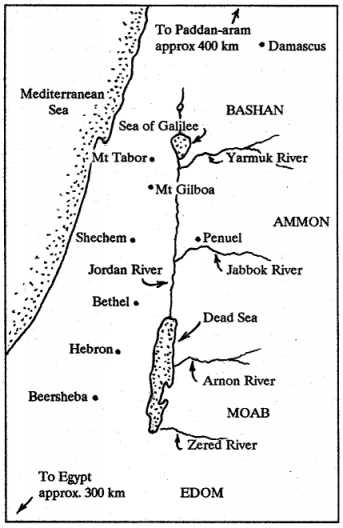
Jab´bok, one of the streams which traverse the country east of the Jordan, and which, after a course nearly from east to west, falls into that river about thirty miles below the lake of Tiberias. It seems to rise in the Hauran mountains, and its whole course may be computed at sixty-five miles. It is mentioned in Scripture as the boundary which separated the kingdom of Sihon, king of the Amorites, from that of Og, king of Bashan (Jos 12:1-6); and it appears afterwards to have been the boundary between the tribe of Reuben and the half-tribe of Manasseh. The earliest notice of it occurs in Gen 32:22. The Jabbok now bears the name of Zerka. In its passage westward across the plains it more than once passes underground; and in summer the upper portion of its channel becomes dry. But on entering the more hilly country immediately east of the Jordan, it receives tribute from several springs, which maintain it as a perennial stream, although very low in summer. On approaching the Jordan it flows through a deep ravine, the steep banks being overgrown with the Solanum furiosum, which attains a considerable size. But the ravine is not so well wooded as the immediate neighborhood. The water is pleasant, and the bed being rocky the stream runs clear.
Now the Zerka, a perennial stream, flowing into the Jordan midway between the sea of Galilee and the Dead sea, about thirty miles from each, after a westerly course of some sixty miles. It traverses at first an elevated and desert region, and receives a branch from the north and another from the south. This latter branch separated the Ammonites from Israel. The eastern part of the Jabbok is dry in summer. Towards the west, it flows through a deep ravine. Penuel, where Jacob wrestled with the Angel, was a fording-place of the Jabbok, Gen 32:32 .\par This stream divided the territory of Og from that of Sihon, Jos 12:2 12:5\par
Jab’bok. (emptying). A stream which intersects the mountain range of Gilead, compare Jos 12:2; Jos 12:5, and falls into the Jordan on the east, about midway between the Sea of Galilee and the Dead Sea. It was, anciently, the border of the children of Ammon. Num 21:24; Deu 2:37; Deu 3:16.
It was on the south bank of the Jabbok, that the interview took place between Jacob and Esau, Gen 32:22, and this river, afterward, became, toward its western part, the boundary between the kingdoms of Sihon and Og. Jos 12:2; Jos 12:5. Its modern name is Wady Zurka.
("pouring out or emptying".) A stream which traverses Gilead, and falls into Jordan midway between the sea of Galilee and the Dead Sea. Now wady Zerka. The northern bound of Sihon’s kingdom, as the Arnon was the southern bound (Num 21:24) The rugged territory of Ammon, the eastern defiles of Gilead, also reached the upper Jabbok. In its early course it flows eastward under Rabbah of Ammon, a strong fortress upon a tributary of the Jabbok. Then northward and westward in a curve to a short distance from Gerasa; it reaches Jordan 45 miles N. of the Arnon. Between Rabbah and Gerasa it formed the Ammonite border. W. of this the territory had been wrested from Ammon by the Amorites (Jos 13:25), and was still claimed by Ammon after Israel had in turn wrested it from Sihon, whence the Jabbok is still called "the border of the children of Ammon" (Deu 3:16; Jos 12:2; Jdg 11:13; Jdg 11:21-22).
Though now it is one vast pasture, the numerous ruins of cities show how thickly it was once peopled. The eastern territory to which Ammon was confined in Moses’ time is as yet little known to travelers. Sihon the Amorite king was unable to pursue his conquests further E., "for the border of the children of Ammon was strong," Rabbah was too strong for him. Israel was restricted by God’s prohibition from touching the Ammonite land, which He had given to the children of Lot (Deu 2:19; Deu 2:37). On the southern bank of the Jabbok Jacob met Esau (Gen 32:22). Its western part was the bound between the kingdoms of Sihon and Og (Jos 41:2; Jos 41:5). Its lower course is fringed with cane and oleander, the banks above are covered with oaks. The water is perennial toward its mouth, and there are great floods in winter. Paine objects to identifying Jabbok with the Zerka, as there is nothing in that region to correspond with Mahanaim and Penuel; he identifies Jabbok with the Yabis, 13 miles further N. On a tributary of the Yabis is found a ruin, Mahana = Mahanaim.
Jabbok (jăb’bok), emptying. A stream rising about 25 miles east of the north end of the Dead sea, and flowing east, then northward and westward, and finally into the Jordan about midway between the Sea of Galilee and the Dead sea. It is now called the Zerka or "blue" river. Across this stream Jacob sent his family, and here his wrestling for a blessing occurred. Gen 32:22-24. The Israelites conquered the kingdoms of Og and Sihon, but not the Ammonite country nor the upper Jabbok, which explains Deu 2:37. Compare Num 21:24; Deu 3:16; Jos 12:2; Jdg 11:13; Jdg 11:22. The Jabbok, before it enters the Jordan valley, flows through a deep, narrow ravine, the hills being from 1500 to 2000 feet in height. The stream abounds in small fish of excellent flavor.
[Jab’bok]
Stream on the east of the Jordan, near to which the angel wrestled with Jacob. It was afterwards called ’the border of the children of Ammon.’ Gen 32:22; Num 21:24; Deu 2:37; Deu 3:16; Jos 12:2; Jdg 11:13; Jdg 11:22. In some parts it runs in a deep ravine, and in winter is impassable in places. It enters the Jordan about 32° 6’ N, and is now called Wady Zerka.
( ):
):
By: Emil G. Hirsch, M. Seligsohn
One of the principal tributaries of the Jordan; first mentioned in connection with the meeting of Jacob and Esau and with the struggle of Jacob with the angel (Gen. xxxii. 23 et seq.). It was the boundary separating the territory of Reuben and Gad from that of Ammon, the latter being described as lying along the Jabbok (Num. xxi. 24; Deut. ii. 37, iii. 16; Josh. xii. 2). The territory of Sihon is described as extending "from Arnon unto Jabbok" (Num. xxi. 24), and it was reclaimed later by the King of Ammon (Judges xi. 13, 22). Eusebius ("Onomasticon," ed. Larsow-Parthey, pp. 222, 224, Berlin, 1862) places the river between Gerasa and Philadelphia. The Jabbok is identified with the Wadi or Nahr al-Zarḳa, a river that rises in Mount Hauran, and, after receiving many tributaries, empties into the Jordan between Gennesaret and the Dead Sea (Schwarz, "Das Heilige Land," p. 30; comp. Estori Farḥi, "Kaftor wa-Feraḥ," ed. Luncz, p. 63, Jerusalem, 1897). The general opinion is that the name "Zarḳa" is given to this river on account of the bluish color of its water; but Schwarz (l.c.) says that it is because the river in its course touches the fortress of Zarḳa on the route between Damascus and Mecca.
JABBOK.—A river now called Nahr ez-Zerka (‘the Blue River’), which rises near Ammân the ancient Rabbatb-ammon, and after running first N. E., then N., N. W., W., finally bends S. W. to enter the Jordan. On almost the whole of its curved course of 60 miles it runs through a deep valley, and forms a natural boundary. On its curved upper reaches it may be said practically to bound the desert, while the deep gorge of its lower, straighter course divides the land of Gilead into two halves. It is mentioned as a frontier in Num 21:24, Deu 2:37; Deu 3:16, Jos 12:2, Jdg 11:13; Jdg 11:22. The Jabbok is famous for all time on account of the striking incident of Jacob’s wrestling there with the Angel (Gen 32:24 f.).
E. W. G. Masterman.
To the east of the Jordan River was a high tableland region divided into two by the Jabbok River. Before Joshua’s conquest of Canaan, the area north of the Jabbok was controlled by the Amorite king Og. The area south of the Jabbok was controlled by another Amorite king, Sihon, who had taken the territory from the nations of Ammon and Moab. Israel conquered both kings, and the territory became the homeland of the two and a half tribes of Israel that settled east of Jordan (Num 21:21-26; Num 21:31-35; Num 32:33). The town of Penuel, on the Jabbok River close to its junction with the Jordan, became a strategically important defence outpost (Jdg 8:9; Jdg 8:17; 1Ki 12:25; see PENUEL).