
The mountain where Aaron died, the fortieth year of Israel’s departure from Egypt. The name of Hor means, who conceives.
This mountain, in its general acceptation, is probably the same with Mount Seir, Hor being the name by which that mountainous tract was denominated before it was exchanged for Seir. But one particular mountain of this region retained the name of Hor long after; as it was a mountain of this name, “by the coast of the land of Edom,” that Aaron was commanded to ascend, in order to die there, Num 20:23. This mountain, or at least the one to which tradition assigns the tomb of Aaron, was visited by Burckhardt; from whose account it appears to form a conspicuous object in the chain of the Djebel Shera, or Mount Seir, rising abruptly from the valley of El Araba, or desert of Zin, about fifty miles north of Akaba, or Ezion-Geber.
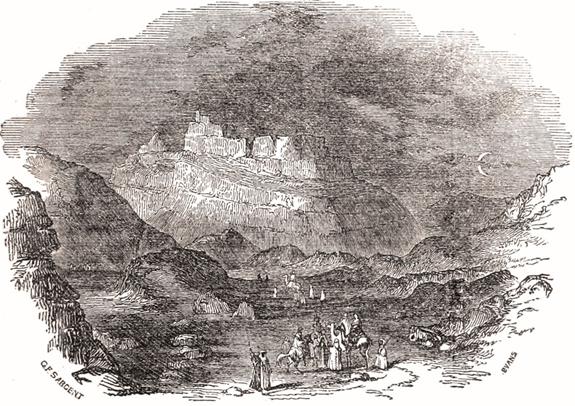
Mount Hor
A mountain of Arabia Petræa, on the confines of Idumaea, and forming part of the mountain of Seir or Edom. It is only mentioned in Scripture in connection with the circumstances recorded in Num 20:22-29. The Israelites were encamped before it, when Aaron was summoned to its top to die there, in the presence of his brother and son, who alone witnessed his final departure [AARON].
The mountain now identified with Mount Hor is the most conspicuous in the whole range of Mount Seir, and at this day bears the name of Mount Aaron (Jebel Haroun). It is in N. lat. 30° 18′, E. long. 35° 33′, about mid-way between the Dead Sea and the Ælanitic Gulf. It may be open to question if this is really the Mount Hor on which Aaron died, seeing that the whole range of Seir was anciently called by that name; yet, from its height and the conspicuous manner in which it rises among the surrounding rocks, it seems not unlikely to have been the chosen scene of the high-priest’s death. To this may be added that Josephus affirms Mount Hor to have been near Petra: and near that place there is certainly no mountain which can contest the distinction with the one now in view. The base of the highest pinnacle of this mountain is in fact but a little removed from the skirts of the city to the westward. The account of it given twenty years since by Captains Irby and Mangles, in their then unpublished volume of Travels, is the best we yet possess, and we therefore present the substance of their description slightly abridged.
’The ascent of the mountain is extremely steep and toilsome. Much juniper grows on it almost to the very summit, and many flowering plants which we had not observed elsewhere; some of these are very beautiful; most of them are thorny. On the top there is an overhanging shelf in the rock which forms a sort of cavern. The tomb itself is enclosed in a small building, differing not at all in external form and appearance from those of Muhammadan saints common throughout every province of Turkey. It has probably been rebuilt at no remote period: some small columns are bedded in the walls, and some fragments of granite and slabs of white marble are lying about. The door is near the south-west angle, within which a constructed tomb, with a pall thrown over it, presents itself immediately upon entering: it is patched together out of fragments of stone and marble that have made part of other fabrics.
’Not far from the north-west angle is a passage, descending by steps to a vault or grotto beneath. The roof is covered, but the whole is rude, ill-fashioned, and quite dark. Towards the further end of this dark vault lie the two corresponding leaves of an iron grating, which formerly prevented all nearer approach to the tomb; they have, however, been thrown down, and we advanced so as to touch it; it was covered by a ragged pall.’
It is highly interesting to know what view it was which last greeted the eyes of the dying high-priest from this lofty eminence; and it is the more so from the fact that the region over which the view extends is that in which the Israelites wandered for forty years. Our travelers supply this information:—
’The view from the summit of the edifice is extremely extensive in every direction, and the eye rests on few objects which it can clearly distinguish to give a name to, although an excellent idea is obtained of the general face and features of the country. The chain of Idumaean mountains, which form the western shore of the Dead Sea, seem to run on to the southward, though losing considerably in their height. They appear in this point of view barren and desolate. Below them is spread out a white sandy plain, seamed with the beds of occasional torrents, and presenting much the same features as the most desert parts of the Ghor. Where this desert expanse approaches the foot of Mount Hor, there arise out of it, like islands, several lower peaks and ridges, of a purple color, probably composed of the same kind of sandstone as that of Mount Hor itself, which, variegated as it is in its hues, presents in the distance one uniform mass of dark purple. Towards the Egyptian side there is an expanse of country without features or limit, and lost in the distance. The lofty district which we had quitted in our descent to Wady Mousa shuts up the prospect on the south-east side; but there is no part of the landscape which the eye wanders over with more curiosity and delight than the crags of Mount Hor itself, which stand up on every side in the most rugged and fantastic forms, sometimes strangely piled one on the other, and sometimes as strangely yawning in clifts of a frightful depth…. An artist who would study rock-scenery in all its wildest and most extravagant forms would find himself rewarded should he resort to Mount Hor for that sole purpose.’
A mountain of a conical form in the range of mount Seir, on the east side of the Arabah, or great valley running from the Dead sea to the Elanitic gulf. It is an irregularly truncated cone, with three rugged peaks, overlooking a wilderness of heights, cliffs, ravines, and alone with his brother and son, Num 20:22-29 ; 33:38. It is still called Jebel Neby Haroon, mount of the prophet Aaron; and on its summit stands a Mohammedan tomb of Aaron, on the site of a still more ancient structure, and marking perhaps the place of his burial.\par
Hor. (mountain). Mount Hor.
1. The mountain on which Aaron died. Num 20:25; Num 20:27. It was "on the boundary line," Num 20:23, or "at the edge," Num 33:37, of the land of Edom. It was the halting-place of the people, next after Kadesh, Num 20:22; Num 33:37, and they quitted it for Zalmonah, Num 33:41, on the road to the Red Sea. Num 21:4. It was during the encampment at Kadesh that Aaron was gathered to his fathers.
Mount Hor is situated on the eastern side of the great valley of the Arabah, the highest and most conspicuous of the whole range of the sandstone mountains of Edom, having close beneath it on its: eastern side the mysterious; city of Petra. It is now the Jebel Nebi-Harim, "the mountain of the prophet Aaron". Its height is 4800 feet above the Mediterranean; that is to say, about 1700 feet above the town of Petra, 4800 above the level of the Arabah, and more than 6000 above the Dead Sea.
The mountain is marked far and near by its double top, which rises like a huge castellated building from a lower base, and is surmounted by a circular dome of the tomb of Aaron, a distinct white spot on the dark red surface of the mountain. The chief interest of Mount Hor consists in the prospect from its summit, the last view of Aaron -- that view which was to him, what Pisgah was to his brother.
2. A mountain, entirely distinct from the preceding, named in Num 34:7-8 only, as one of the marks of the northern boundary of the land, which the children of Israel were about to conquer. This Mount Hor is the great chain of Lebanon itself.
1. The mount in which Aaron died (Num 20:22-23; Num 20:25-28). An archaic form of
It is an ordinary Moslem weh; over the door is an inscription stating that the building was restored by Es Shimani, son of Mohammed Calain, sultan of Egypt, by his father’s orders, in the year 739 of the Hegira; square almost, 28 ft. by 33 ft., having two chambers one above the other. The host encamped in the Arabah below at Moseroth (Num 33:30), or Mosera (Deu 10:6).
2. The name Hor is applied to the whole western crest of Lebanon, 80 miles long from the E. of Sidon to the entering in of Hamath (Kalat el Husn close to Hums, i.e. ancient Hamath); the northern boundary appointed to Israel (Num 34:8).
Hor (hôr), mountain, Mount. 1. The mountain on which Aaron died. Num 20:25-27; Num 33:37. It was on the" boundary line," or "at the edge" of the land of Edom. It was the halting-place of the people next after Kadesh, Num 20:22; Num 33:37, and they quitted it for Zalmonah, Num 33:41, in the road to the Red sea. Num 21:4. It was during the encampment at Kadesh that Aaron died. Mount Hor is on the western side of the great valley of the Arabah, the highest and most conspicuous of the whole range of the sandstone mountains of Edom, having close beneath it on its eastern side the strange city of Petra. It is now called Jebel Nebi-Harûn, "the mountain of the prophet Aaron." Its height is 4800 feet above the Mediterranean; or about 1700 feet above the town of Petra, and more than 6000 above the Dead sea. The mountain is marked far and near by its double top, which rises like a huge castellated building from a lower base and is now surmounted by a circular dome of the tomb of Aaron, a distinct white spot on the dark red surface of the mountain. The chief interest of Mount Hor consists in the prospect from its summit, the last view of Aaron—that view which was to him what Pisgah was to Moses. 2. A mountain, distinct from, the preceding, named in Num 34:7-8, only, as one of the marks of the northern boundary of the land which the children of Israel were to conquer. This Mount Hor is the great chain of Lebanon itself.
( ):
):
By: Emil G. Hirsch, M. Seligsohn
1. Mountain on the border-land of Idumæa; the next stopping-place after Kadesh of the children of Israel during their wanderings in the wilderness; famous as the scene of Aaron's death (Num. xx. 22 et seq., xxxiii. 37, and elsewhere). Josephus ("Ant." iv. 4, § 7), without giving the name, says that Aaron died on a mountain near Petra; the same topography is indicated by Eusebius ("Onomasticon," s.v. "Or"). This corresponds with the situation of Jabal Harun ("the mountain of Aaron"), a two-peaked mountain on the eastern edge of Wadi al-'Arabah. The double peak may account for the Biblical name "Hor ha-Har" ("a mountain on a mountain"; comp. Rashi to Num. xx. 22).
2. Mountain which marked the northern limit of the inheritance of the Israelites in the land of Canaan (Num. xxxiv. 7-8). The line was to be drawn from the Mediterranean Sea to Mount Hor, and thence to Hamath. The term "Hor ha-Har" (Num. l.c.) indicates, probably, some conspicuous mountain, perhaps Mount Hermon. But pseudo-Jonathan renders it, as well as No. 1, by "Ṭawros Umanos"; and the Jerusalem Targum renders it by "Ṭawros Manos" (= "Mount Amanus"), apparently identifying it with the "Amana" of Cant. iv. 8. In the Talmud the northern limit of the Holy Land is Ṭure Amnon (Giṭ. 8a) or Ṭure Amanah (Yer. Sheb. vi. 1), on which mountain there is a place called "Ḳapelaria." According to Estori Farḥi ("Kaftor wa-Feraḥ," ed. Berlin, ii. 42), the Biblical Mount Hor is to be identified with Jabal al-Aḳra', the ancient Mons Casius, between Latakia and Antioch. He supports his contention by identifying several places in the territory of Asher, along the northern frontier, with towns in the neighborhood of Jabal al-Aḳra'. His contention is also supported by the Targum of Jerusalem, which renders the "Hamath" of Num. xxxiv. 8 by "Antioch." Schwarz ("Das Heilige Land," p. 18), refuting Estori's opinion, identifies Mount Hor with the Ras al-Shaḳḳa, on the road from Tripoli to Beirut.
Bibliography:
Neubauer, G. T. pp. 8, 9;
McClintock and Strong, Cyc. s.v.;
Smith, Dict. of Bible, s.v.
HOR.—1. A mountain ‘in the edge of the land of Edom’ (Num 33:37), where Aaron died. Constant tradition, at least since Josephus, sees Mount Hor in Jebel Harûn, ‘the Mountain of Aaron,’ above Petra. This is regarded by the Arabs as the mountain sacred to the great high priest, and his tomb is shown and reverenced under a small dome on its summit. Some modern writers, especially H. C. Trumbull, have doubted the tradition and endeavoured to fix other sites, such as Jebel Madâra, N. W. of ‘Ain Kadis. Jebel Harûn rises 4780 ft. above the sea-level. Its western side is an unscalable precipice; it is ascended from the pass leading into Petra. A very wide view over the Arabian desert, down to the Red Sea and up to the Ghôr, is commanded from the summit. 2. A mountain mentioned in Num 34:7-8, as in the northern boundary of the Promised Land. In all probability this is meant for Hermon.
R. A. S. Macalister.
Progenitor