
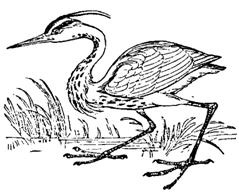
Ardea Cinerea
Heron (Lev 11:19; Deu 14:18). The original word anaphahis a disputed name of an unclean bird, and which has also been translated kite, woodcock, parrot, and crane. For the first of these see Glede; the second is rare and only a momentary visitor in Palestine; the third, surely, required no prohibition where it was not a resident species, and probably not imported till the reign of Solomon; and as the crane, we have already shown it to have been likewise exotic, making only a momentary appearance, and that rarely, in Syria. If the Hebrew name be derived from a word signifying ’to breathe short,’ or ’to sniff through the nostrils with an irritated expression,’ the most obvious application would be to the goose, a bird not, perhaps, otherwise noticed in the Hebrew Scriptures, though it was constantly eaten in Egypt, was not held unclean by the Jews, and, at some seasons, must have frequented the lakes of Palestine. The heron, though not constantly hissing, can utter a similar sound of displeasure with much more meaning, and the common species is found in Egypt, and is also abundant in the Hauran of Palestine, where it frequents the margins of lakes and pools, and the reedy watercourses in the deep ravines, striking and devouring an immense quantity of fish.
H’eron. Lev 11:19; Deu 14:18. A common large, wading, unclean bird. Nearly all of the species known in English ornithology are found in the vicinity of Palestine. Canon Cook and others think the bird intended is the plover, (Charadrius aedicnemus), a greedy, thick kneed, high-flying migratory bird, very common in the East, on the banks of rivers and shores of lakes. -- Editor.
[He’ron]
A bird that was unclean to the Israelites. The name anaphah cannot be identified, but several species of heron are found throughout Palestine, which are doubtless included because of the words ’after her kind.’ The Ardea cinerea is a heron common in Palestine. They live upon fish, frogs, and reptiles. (R.V. margin has ’ibis.’) Lev 11:19; Deu 14:18.
( ):
):
By: Emil G. Hirsch, I. M. Casanowicz
Enumerated among the unclean birds (Lev. xi. 19 [R. V. margin, "ibis"]; Deut. xiv. 18; comp. Targ.  , where the context points to some bird of the Ardeidœ family). There are at least seven species of heron common in Palestine, especially in the marshy regions; and the addition of "after its kind" ("leminehu") in the passages mentioned above would imply that various species were included under "anafah."
In the Talmud the heron is characterized, in allusion to the etymology of its name ("anaf"), as a cruel and irascible bird, and is contrasted with the pious stork (Ḥul. 63a; comp. Rashi to Lev. xi. 19).
Bibliography:
Tristram, The Natural History of the Bible, p. 241;
L. Lewysohn, Zoologie des Talmuds, p. 169.
HERON.—The Heb. word ’anâphâh designates an unclean bird (Lev 11:19, Deu 14:18), not otherwise mentioned in the Bible, but sufficiently well known to be taken as a type of a class. The occurrence of this name immediately after stork, and followed by the expression ‘after her kind,’ makes it probable that the EV
Heron. The Bible mentions herons only in the lists of unclean birds (Lev 11:19; Deu 14:18). Several species of herons and egrets made their home in Palestine. Egyptian carvings picture herons and their nests among the reeds of marshes and lakes.
A tall, graceful bird, the heron flies with its neck curled and its long legs stretched out behind. The heron eats fish, frogs, and small reptiles, which it spears swiftly with a long, sharp beak.