
Herodias [HERODIAN FAMILY]
A granddaughter of Herod the Great and Mariamne, daughter of Aristobulus, and sister of Herod Agrippa I. She was first married to her Uncle Herod Philip, but afterwards abandoned him and connected herself with his brother Herod Antipas. It was by her artifice that Herod was persuaded to cause John the Baptist to be put to death, she being enraged at John on account of his bold denunciation of the incestuous connection which subsisted between her and Herod. When Herod was banished to Lyons, she accompanied him, Mat 14:3,6 Mar 6:17 Luk 3:19 . See HEROD III.\par
Hero’dias. Daughter of Aristobulus, one of the sons of Mariamne and Herod the Great, and consequently, sister of Agrippa I. She first married Herod Philip I; then she eloped from him to marry Herod Antipas her step-uncle. The head of John the Baptist was granted at the request of Herodias. Mat 14:8-11; Mar 6:24-28. (A.D. 29). She accompanied Antipas into exile to Lugdunum.
Herodias (he-rô’di-as). Daughter of Aristobulus, one of the sons of Mariamne and Herod the Great, and consequently sister of Agrippa I. She first married Herod Philip I.; then she eloped from him to marry Herod Antipas, her step-uncle. The head of John the Baptist was granted at the request of Herodias. Mat 14:8-11; Mar 6:24-28, a.d. 29.
[Hero’dias] See HEROD ANTIPAS and HEROD’S FAMILY.
HERODIAS (
Literature.—Schürer, GJV [Note: JV Geschichte des Jüdischen Volkes.] 3 [Note: designates the particular edition of the work referred] i. 435–449 (English translation , cf. Index); E. S. Ffoulkes in Smith’s DB [Note: Dictionary of the Bible.] 2 [Note: designates the particular edition of the work referred] ii. 1055 f.; Sieffert in PRE [Note: RE Real-Encyklopädie fur protest. Theologic und Kirche.] 3 [Note: designates the particular edition of the work referred] vii. 769 f.; Woodhouse in Encyc. Bibl. ii. 2033; Headlam in Hasting’s Dictionary of the Bible ii. 360; I. Broydé in Jewish Encyc. vi. 360 f.; J. D. Davis, DB [Note: Dictionary of the Bible.] 293 f.
W. P. Armstrong.
By: Joseph Jacobs, Isaac Broydé
Pedigree of the Herodian Dynasty.
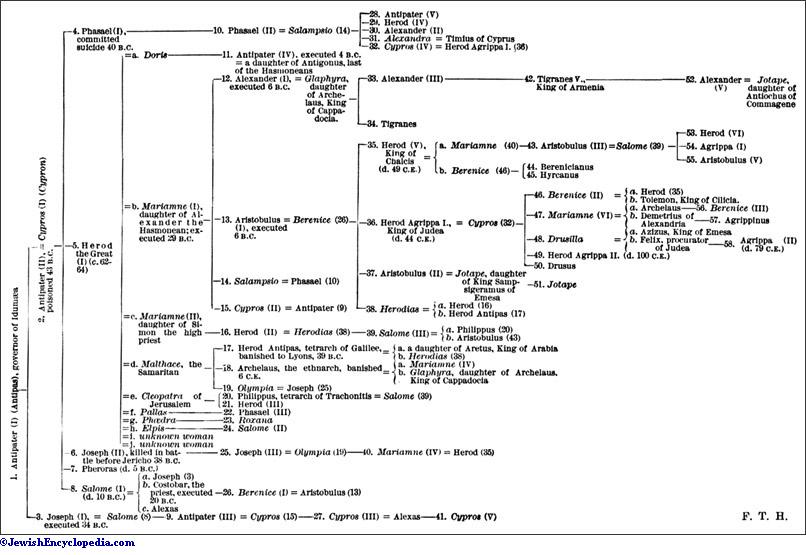
Daughter of Aristobulus and Berenice and granddaughter of Herod I. and of his sister Salome. She was first married to her uncle Herod (not Philip, as in Mark vi. 17; see Schürer, "Gesch." i. 435, note 19), son of Herod I. by the second Mariamne, with whom she lived in Rome upon the revenues assigned to them by Herod I. and Salome. From this union issued Salome, the wife of the tetrarch Herod Philip. While on a visit to Rome Herodias' uncle and brother-in-law, Herod Antipas, fell in love with her and proposed marriage, to which she readily assented. He then divorced his first wife, the daughter of Aretas VI., King of Arabia, and, contrary to Jewish law, married Herodias. This union brought misfortune to Antipas. It first involved him in a war with Aretas, who wished to avenge his abandoned daughter; then Herodias, who had married Antipas from motives of ambition, urged him to appeal to Caligula for the royal title, an appeal which brought about his downfall. Herodias, however, showed great fortitude in adversity; she preferred going with Antipas into exile at Lugdunum to remaining with her brother, Agrippa I., and sharing the advantages of his elevation, as proposed by Caligula.
The Gospels attribute to Herodias the execution of John the Baptist, whom she hated for having denounced her unlawful marriage. While celebrating Antipas' birthday, Salome, the daughter of Herodias, so delighted the tetrarch by her dancing that he promised her to fulfil any wish she might express. At the instigation of her mother she demanded that the head of John should be brought to her in a charger (Matt. xiv. 3 et seq.; Mark vi. 17 et seq.). This, however, is not corroborated by Josephus, who assigns political reasons for the execution of John.
Bibliography:
Josephus, Ant. xviii. 5;
Winer, B. R. i. 486;
Keim, in Schenkel's Bibellexikon, iii. 46-49;
Schürer, Gesch. i. 435 et seq.
HERODIAS.—See Herod, No. 3, and John the Baptist.
Daughter of Aristobulus, son of Herod the Great and Mariamne, descendant of the Machabees. She entered into an adulterous union with Herod Antipas, Tetrarch of Galilee, who was thereupon rebuked by John the Baptist. Her hatred aroused, she, by the dance of her daughter Salome, brought about the death of the saint. She preferred a life of exile with Antipas at Lyons, Gaul, to one of splendor in the palace of her brother, Agrippa.
Herodias, daughter of Aristobulus -- son of Herod the Great and Mariamne -- was a descendant of the famous Hasmonean heroes, the Machabees, who had done so much for the Jewish nation. Having married Herod Philip, her own uncle, by whom she had a daughter, Salome, Herodias longed for social distinction, and accordingly left her husband and entered into an adulterous union with Herod Antipas, Tetrarch of Galilee, who was also her uncle (Jos., Ant., XVIII, v, 1, 4). St. John the Baptist rebuked Antipas for this union and thus aroused the hatred of Herodias, who by the dance of her daughter brought about the death of the prophet (Matthew 14:3-12; Mark 6:17-29). Josephus gives the main facts, but adds that John was put to death because Herod feared his influence over the people (Ant., XVIII, v, 2, 4). Schurer admits that here both the Evangelists and Josephus may be right; since all the motives mentioned may have urged Herod to imprison and murder John [Hist. (Eng. tr.) Div. I, V, ii, 25].When Agrippa, the brother of Herodias became king, she persuaded Antipas to go to Rome in search of the royal title, as his claim to it was far greater than that of her brother. Instead of a crown, however, he found awaiting him a charge of treason against the Romans, with Agrippa as chief accuser, who in advance had sent messengers to defeat the ambitious plans of Antipas. He was therefore banished to Lyons in Gaul. At the same time Herodias, spurning the kind offers of the emperor, preferred exile with Antipas to a life of splendour in the palace of her brother Agrippa (Jos., Ant., XVIII, vii). This generosity, if we may so style it, came from her Hasmonean blood, but her cruelty she inherited from her grandfather Herod (see HEROD under ANTIPAS).----------------------------------- JOSEPHUS, Ant., XVIII, v, vii; IDEM, de Bell. jud., I, xxviii, II, ix; also authorities mentioned under HEROD. JOHN J. TIERNEY Transcribed by Robert B. Olson Offered to Almighty God for the conversion of people who persecute others for their Christian Faith. The Catholic Encyclopedia, Volume VIICopyright © 1910 by Robert Appleton CompanyOnline Edition Copyright © 2003 by K. KnightNihil Obstat, June 1, 1910. Remy Lafort, S.T.D., CensorImprimatur. +John Cardinal Farley, Archbishop of New York
Herodias was daughter of Aristobulus, son of Herod the Great, by Mariamne, daughter of Hyrcanus. Her second husband (compare above) was Herod Antipas, tetrarch of Galilee and Peraea (circa 4-39 ad), son of Herod the Great by Malthace. Herod Antipus was thus the step-brother of Aristobulus, father of Herodias. Regarding the first husband of Herodias, to whom she bore Salome, some hold that the Gospel accounts are at variance with that of Josephus. In Mat 14:3; Mar 6:17; Luk 3:19, he is called Philip the brother of Herod (Antipus). But in Mat 14:3 and Luk 3:19 the name Philip is omitted by certain important manuscripts. According to Josephus, he was Herod, son of Herod the Great by Mariamne daughter of Simon the high priest, and was thus a step-brother of Herod Antipas (compare Josephus, Ant, XVIII, v, 4). It is suggested in explanation of the discrepancy (1) that Herod, son of Mariamne, bore a second name Philip, or (2) that there is confusion in the Gospels with Heroal-Philip, tetrarch of Trachonitis, who was the son of Herod the Great and Cleopatra, and who was in reality the husband of Salome, daughter of Herodias (compare also A. B. Bruce, The Expositor’s Greek Testament., I, 381; A. C. Headlam, article “Herod” in HDB, II, 359, 360). According to Josephus (Ant., VIII, vii, 2; XVIII, vii, 1) the ambition of Herodias proved the ruin of Herod Antipas. Being jealous of the power of Agrippa her brother, she induced Herod to demand of Caligula the title of king. This was refused through the machinations of Agrippa, and Herod was banished. But the pride of Herodias kept her still faithful to her husband in his misfortune.
- see Herod Family