
“Doth the hawk fly by thy wisdom?” The real meaning is, “Doth she know, through thy skill or wisdom, the precise period for taking flight, or migrating and stretching her wings toward a southern or warmer climate?” The passage is well rendered by Sandys:—
“Doth the wild haggard tower into the sky, And to the south by thy direction fly?”
Her migration is not conducted by the wisdom and prudence of man, but by the superintending and upholding providence of the only wise God.
Hawk, an unclean bird (Lev 11:16; Deu 14:15; Job 39:26). The English name is an altered form of the old word ’fawk’ or ’falk.’ Western Asia and Lower Egypt, and consequently the intermediate territory of Syria and Palestine, are the habitation or transitory residence of a considerable number of species of the order Raptors, which, even including the shortest-winged, have great powers of flight, are remarkably enterprising, live to a great age, are migratory, or followers upon birds of passage, or remain in a region so abundantly stocked with pigeon and turtle-dove as Palestine, and affording such a variety of ground to hunt their particular prey—abounding as it does in mountain and forest, plain, desert, marsh, river and sea-coast. We shall here enumerate, so far as our information will permit, the Falconidæ of this region, exclusive of those mentioned in other articles [EAGLE; GLEDE; KITE; OSPRAY].
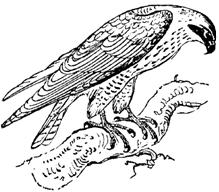
Peregrine Falcon
Falcons, or the ’noble’ birds of prey used for hawking, have for many ages been objects of great interest, and still continue to be bought at high prices. They are consequently imported from distant countries, as central Asia, Iceland, Barbary. etc. Their love of liberty often renders them irreclaimable when once on the wing; and their powers and boldness, independent of circumstances, and the extent of range which the long-winged species in particular can take, are exemplified by their presence in every quarter of the globe. The Peregrine falcon is so generally diffused as to occur even in New Holland and South America.
Next we may place Falco Aroeris of Sir J.G. Wilkinson, the sacred hawk of Egypt. This, if it be not in reality the same as, or a mere variety of the Peregrine, should have retained the ancient epithet of Hierax, and the hawker’s name of Sacre. Innumerable representations of it occur in Egyptian monuments.
The Hobby is no doubt a second or third species of sacred hawk, having similar gernonia. Both this bird and the tractable Merlin are used in the falconry of the inferior Muslim landowners of Asiatic Turkey.
Besides these the Kestril occurs in Syria, and the lesser Kestril in Egypt; and it is probable that both species visit these two territories according to the seasons.
To the ’noble’ birds we may add the Gerfalcon, which is one-third larger than the Peregrine: it is imported from Tartary and sold at Constantinople, Aleppo, and Damascus. The great birds fly at antelopes, bustards, cranes, etc.; and of the genus Astur, with shorter wings than true falcons, the Goshawk, and the Falcon Gentil are either imported, or taken in their nests, and used to fly at lower and aquatic game. The smaller and less powerful hawks of the genus Nisus are mostly in use on account of the sport they afford being less fatiguing, as they are employed to fly at pigeons, partridges, quails, etc.
Hawk. Lev 11:16; Deu 14:15; Job 39:26. The hawk includes various species of the Falconidae. With respect to the passage in Job (l.c). which appears to allude to the migratory habits of hawks, it is curious to observe that of the ten or twelve lesser raptors (hawk tribe) of Palestine, nearly all are summer migrants. The kestrel remains all the year, but the others are all migrants from the south.
The Hebrew word is nets, and is held to embrace the different species of hawk, of which there are several, as indeed is implied by the words ’the hawk after his kind.’ They were birds of prey and were pronounced to be unclean. Lev 11:16; Deu 14:15. Some at least of the hawks are migratory, and this is supposed to be alluded to in Job 39:26, in the expression "stretch her wings toward the south." The most common of the smaller hawks in Palestine is the Kestrel, Tinnunculus alaudarius.
By: Joseph Jacobs, I. M. Casanowicz
The rendering of  given by the English versions; it is enumerated among the unclean birds in Lev. xi. 16; Deut. xiv. 15. The Hebrew word, to which is added "after its kind," may designate any of the smaller diurnal birds of prey, which are numerous in Palestine. Of the Falconidœ the kestrels (Tinnunculus alaudarius and Tinnunculus cenchris) are very common in Palestine. Others, less numerous, are the hobby-hawk (Falco subbuteo), the Eleonora falcon (Falco eleonorœ), etc. In Job xxxix. 26 the hawk is described as stretching its wings "toward the south," in reference to the migratory habits of the smaller birds.
In the Talmud (Ḥul. 42a) the hawk is said to kill small birds, while another bird, the "gas," kills large ones. The latter term may denote the Falco islandicus, used in hunting.
Bibliography:
Tristram, Natural History of the Bible, p. 189;
Lewysohn, Zoologie des Talmuds, p. 164.
HAWK.—Some eighteen species of hawk are known to exist in Palestine. The common kestrel (Falco tinnunculus) and the sparrow-hawk (Accipiter nisus) are the commonest. The traveller through the land sees them everywhere. Hawks were ‘unclean’ birds (Lev 11:16, Deu 14:16). The migratory habits of many species of Palestine hawks are referred to in Job 39:26.
E. W. G. Masterman.
“Is it by thy wisdom that the hawk soareth,
And stretcheth her wings toward the south?”
Aside from calling attention to the miraculous flight,, this might refer to migration, or to the wonderful soaring exhibitions of these birds. See GLEDE; KITE; NIGHT-HAWK; FALCON.
Hawk. Hawks are the fierce little brothers in the eagle and vulture family. Adult hawks vary from one to two feet in length. They are known for their exceptional eyesight, which is about eight times as keen as man’s. Solomon remarked, "Surely, in vain the net is spread in the sight of any bird" (Pro 1:17).
The farsighted hawk not only detects nets from a distance, but he can also see mice, insects, and birds. He strikes with devastating swiftness, his powerful claws crushing his prey, which he eats whole.
Some 18 species of hawk exist in Palestine, among them the small sparrow hawk. This hawk, which Egyptians considered sacred, nests in a hollow tree, amid old ruins, or upon a rock. As winter approaches, it migrates to a warmer climate.
Harrier hawks are found in the valleys and low-lying plains. They glide nearer the ground and "harry" other birds by forcing them to land.
Kites (gledes) are a larger breed of hawk, with long narrow wings (Deu 14:13). Red kites, black kites, and Egyptian kites are found in Palestine. Kites in Syria hide their nests by draping them with cloth scraps or animal skins. Just as they abstained from eating other birds of prey, Israelites did not eat hawks (Lev 11:16; Deu 14:15).