
Jonah’s gourd makes the thing itself memorable, which without the circumstance referring to him, would have formed nothing more important in the church than any other plant. The Hebrews called it Kikajon. The wild gourd is of another genus, and called Pekaah. It is said to be so bitter, that it is called "the gall of the earth." (2 Kings 4: 89.) Some have thought, that Jonah’s gourd is the same as the Palma Christi. See Palm tree. I would only observe under this article of Jonah’s gourd, how beautiful a lesson was the prophettaught (and, consequently, we ought to learn from it, ) had he been wise to have improved it, how little to be valued are all earthly comforts, which even a poor worm of the earth may destroy. A night brings forth our worldly enjoyments; and a night is more than enough to destroy them. Oh! how blessed to live upon an unchangeable God in Christ, "the same yesterday, and to - day, and for ever!"
2. We read of the wild gourd in 2Ki 4:39; that Elisha, being at Gilgal during a great famine, bade one of his servants prepare something for the entertainment of the prophets who were in that place. The servant, going into the field, found, as our translators render it, some wild gourds, gathered a lapful of them, and having brought them with him, cut them in pieces and put them into a pot, not knowing what they were. When they were brought to table, the prophets, having tasted them, thought they were mortal poison. Immediately, the man of God called for flour, threw it into the pot, and desired them to eat without any apprehensions. They did so, and perceived nothing of the bitterness whereof they were before sensible. This plant or fruit is called in Hebrew
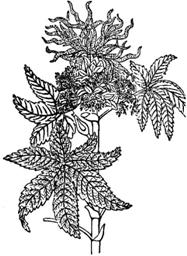
Ricinus Communis
The word thus rendered (kikayon) occurs only in Jonah 4, where it is several times mentioned, as in Jon 4:6-7; Jon 4:9-10. In the margin of the English Bible, Palm-Christ is given. In the Vulgate it is translated ’ivy.’ Neither the gourd nor ivy is considered by modern writers to indicate the plant intended; which is remarkable for having given rise to some fierce controversies in the early ages of the Church. The difficulties here, however, do not appear to be so great as in many other instances. But before considering these, it is desirable to ascertain what are the characteristics of the plant as required by the text. We are told, ’The Lord God prepared a gourd (kikayon), and made it to come over Jonah, that it might be a shadow over his head’ (Jon 4:6). ’But God prepared a worm when the morning rose the next day, and it smote the gourd that it withered’ (Jon 4:7). And in Jon 4:10 it is said of the gourd that it ’came up in a night, and perished in a night.’ Hence it appears that the growth of the kikayon was miraculous, but that it was probably a plant of the country, being named specifically; also that it was capable of affording shade, and might be easily destroyed. There does not appear anything in this account to warrant us in considering it to be the ivy, which is a plant of slow growth, cannot support itself, and is, moreover, not likely to be found in the hot and arid country of ancient Nineveh, though we have ourselves found it in more southern latitudes, but only in the temperate climate of the Himalayan Mountains. ’The Christians and Jews of Mosul (Nineveh) say it was not the keroa whose shadow refreshed Jonah, but a sort of gourd, el-kera, which has very large leaves, very large fruit, and lasts but about four months’ (Niebuhr, Arabia, as quoted by Dr. Harris). So Volney: ’Whoever has traveled to Cairo or Rosetta knows that the species of gourd called kerra will, in twenty-four hours, send out shoots near four inches long’ (Trav. i. 71).
The Hebrew name kikayon is so similar to the kiki of Dioscorides, that it was early thought to indicate the same plant. The kiki or croton corresponds with the castor-oil plant, of which the seeds have some resemblance to the insect commonly called tick in English, and which is found on dogs and other animals. It has also been called Penta-dactylus and Palma Christi, from the palmate division of its leaves. It was known at much earlier times, as Hippocrates employed it in medicine; and Herodotus mentions, when speaking of Egypt:—’The inhabitants of the marshy grounds make use of an oil which they term kiki, expressed from the Sillicyprian plant.’ That it has been known there from the earliest times is evident from Cailliaud having found castor-oil seeds in some very ancient sarcophagi. This oil was not only employed by the Greeks, but also by the Jews, being the kik-oil of the Talmudists, prepared from the seeds of the ricinus. Lady Calcott states that the modern Jews of London use this oil, by the name of oil of kik, for their Sabbath lamps, it being one of the five kinds of oil which their traditions allow them to employ.
Having ascertained that the kiki of the Greeks is what is now called Ricinus communis, or castor-oil plant, we shall find that its characters correspond with everything that is required, except the rapidity of growth, which must be granted was miraculous. Dr. Harris indeed states that the passage means, ’Son of the night it was, and as a son of the night it died;’ and that, therefore, we are not compelled to believe that it grew in a single night, but rather, by a strong Oriental figure, that it was of rapid growth. This, there is no doubt, it is highly susceptible of in warm countries where there is some moisture. It attains a considerable size in one season; and though in Europe it is only known as a herb, in India it frequently may be seen, especially at the margins of fields, the size of a tree. So at Busra Niebuhr saw an el keroa which had the form and appearance of a tree. The stems are erect, round, and hollow; the leaves broad, palmate, 5 to 8 or 10 lobed, peltate, supported on long foot-stalks. From the erect habit, and the breadth of its foliage, this plant throws an ample shade, especially when young. From the softness and little substance of its stem, it may easily be destroyed by insects, which Rumphius describes as sometimes being the case. It would then necessarily dry up rapidly. As it is well suited to the country, and to the purpose indicated in the text, and as its name kiki is so similar to kikayon, it is doubtless the plant which the sacred penman had in view.
It has been supposed that Jonah’s gourd was the Ricinus Communis, or castor-oil plant. It grows in the East to the height of eight to twelve feet, and one species much higher. Its leaves are large, and have six or seven divisions, whence its name of Palma Christi. Since, however, it is now known that in the vicinity of the ancient Nineveh, a plant of the gourd kind is commonly trained to run over structures of mud and brush, to form booths in which the gardeners may protect themselves from the terrible beams of he Asiatic sun, this goes far to show that this vine, called in the Arabic ker’a, is the true gourd of Jonah. If the expression, "which came up in a night," Jon 4:10, is to be understood literally, it indicates that God "prepared" the gourd, Jon 4:6, by miraculously quickening its natural growth.\par The WILD GOURD is a poisonous plant, conjectured to mean the colocynth, which has a cucumber-like vine, with several branches, and bears a fruit of the size and color of an orange, with a hard, woody shell, within which is the white meat or pulp, exceedingly bitter, and a drastic purgative, 2Ki 4:39 . It was very inviting to the eye, and furnished a model for the carved "knops" of cedar in Solomon’s temple, 1Ki 6:18 7:24.\par
Gourd.
1. Kikayan occurs only in Jon 4:6-10. The plant which is intended by this word, and which afforded shade to the prophet Jonah before Nineveh, is the Ricinus commnunis, or castor-oil plant, which, a native of Asia, is now naturalized in America, Africa and the south of Europe.
This plant varies considerably in size, being in India, a tree, but in England, seldom attaining a greater height than three or four feet. The leaves are large and palmate, with serrated lobes, and would form an excellent shelter for the sun-stroken prophet.
The seeds contain the oil so well known under the name of "castor oil," which has for ages been in high repute as a medicine. It is now thought by many that the plant meant is a vine of the cucumber family, a gemline gourd, which is much used for shade in the East.
2. The wild gourd of 2Ki 4:39 which one of "the sons of the prophets" gathered ignorantly, supposing them to be good for food, is a poisonous gourd, supposed to be the colocynth, which bears a fruit of the color and size of an orange, with a hard, woody shell.
As several varieties of the same family, such as melons, pumpkins, etc., are favorite articles of refreshing food amongst the Orientals, we can easily understand the cause of the mistake.
1. Jon 4:6-10. So Augustine, the Septuagint, and the Syriac explain the Hebrew
2. Wild gourds (2Ki 4:38-41),
Gozan. A river (1Ch 5:26; 2Ki 17:6; 2Ki 18:11). There the captive Israelites were transported by Shalmaneser and Esarhaddon. Now the Kizzit Ozan, the golden river of Media, which rises in Kurdistan and ultimately falls into the White River, and so into the Caspian Sea. A country also bore the name of the river, Gauzanitis (Ptolemy, Geog. v. 18); Mygdonia is the same name with the "M" prefixed. So Habor was a region and a river (the Khabour, the affluent of the Euphrates). The region is one of great fertility (Layard, Nineveh and Babylon). G. in G. Rawlinson’s view was the district on the river Habor or Khabour.
is the rendering in the Auth. Vers. of two Heb. words.
1. JONAH’S GOURD (
This opinion, however that the first-named plant above is the true representative of Jonah’s gourd, is viewed by the Reverend H. Lobdell, M.D., missionary in Assyria, in a letter published in the Bibliotheca Sacra April 6, 1855, page 395 sq., who says, "The Mohammedans, Christians, and Jews all agree in referring the, plant to the hera, a kind of pumpkin peculiar to the East. The leaves are large, and the rapidity of growth astonishing. Its fruit is for the most part eaten in a fresh state, and is somewhat like the squash. It has no more than a generic resemblance to the gourd of the United States, though I suppose that both are a species of the cucurbita. It is grown ins great abundance o n the alluvial banks of the Tigris, and on the plain between the river and the ruins of Nineveh, which is about a mile wide... The castor-oil plant is cultivated, indeed, to some extent here, but is never trained, like the kera, to run over structures of mud and brush to form booths in which the gardeners may protect themselves from the teerible heats of the Asiatic sun. I have seen a at a single glance dozens of these booths these lodges in the fields of melons and cucumbers around the old walls of Nineveh (Isa 1:8) covered with the vines of the kera, of which there are numerous species, the fruit of which weighs from one to fifty pounds. One species, growing in Kurdistan, a few days distant from Mosul, is a genuine gourd; but. there is no probability that it ever flourished on the hot plains of Mosul." The same view is taken by Thomson (Land and Book, 1:96 sq.), who says that "Orientals never dream of training a castor-oil plant over a booth, or planting it for shade; and they would have but small respect for anyone who did. It is in no way adapted for that purpose, while thousands of arbors are covered with various creepers of the gourd family. The gourd grows with extraordinary rapidity. In a few day’s after it has begun to run the whole arbor is covered. It forms a shade absolutely impenetrable to the sun’s rays even at noonday. It flourishes best in the very hottest part of nummer. Lastly, when injured, or cut, it withers away with equal rapidity." SEE JONAH.
2. WILD GOURDS (
(4.) The bitterness which was probably perceived on eating of the pottage, and which disappeared on the addition of meal, is found in many of the cucumber tribe, and conspicuously in the species which have usually been selected as the pakkuoth, that is, the Colocynth (Cucumis Colocynthis), the Squirting Cucumber (Momordica elaterium), and Cucumis prophetarum; all of which are found in Syria, as related lay various travelers. The first, or Coloqusntida, is essentially a desert plant. Kitto says: "In the desert parts of Syria, Egypt, and Arabia, andson the banks of the rivers Tigris and Euphrates, its tendrils run over vast tracts of ground, offering a prodigious number of gourds, which sare crushed under foot by camels, horses, and men. In winter we have seen the extent of many miles covered with the connecting tendrils and dry gourds of the preceding season, the latter exhibiting precisely the same appearance as in our shops, and when crushed, with a crackling noise, beneath the feet, discharging, in the. form of a light powder, the valuable drug which it contains" (Pict. Bible, note ad loc.). In the Arabic version, hunzal (which is the Colocynth) is used as the synonyme for pakkuoth in 2Ki 4:39. The third, or Globe Cucumber, "derives its specific name (Cucumis prophetam) from the notion that it afforded the gourd which ’the sons of the prophets’ shred by mistake into their pottage, and which made them declare, when they came to taste "it, that there was ’death in the pot.’ This plant is ’smaller in every part than the common melon, and has a nauseous odor, while its fruit is to the full as bitter as the Coloquintida. The fruit has a rather singular assurance from the manner in which its surface is armed with prickles, which are "however, soft and harmless" (Kitto, Pict. Palestine; Physical Geog. page 281). But this plant, the fruit not being bigger than a cherry, does not appear likely to have been that which was shred into the pot. Celsius, however, is of opinion that the second of the above-named species, the Cucumis aerestis of the ancients, and which was found by Belos in descending from Mount Sinae, was the plant, being the Cucumis asinsisus of the druggists. This plant is a well-known drastic purgative, element enough in its actions to be considered even a poison. Its fruit is ovate, obtuse, and scabrous, and likely to have been the plant mistaken for oroth, as it miglit certainly be mistaken for young gherkins. The wild cucmmber bursts, at the touch of the finger. and scatters its seeds, which the colocynth does not (Rosenmuller, ’Alterthumsk 4 part 1, etc.). The etymology of the word from
Gourd. 1. Jon 4:6-10. The plant intended is the Ricinus communis, or castor-oil plant, which, a native of Asia, is now naturalized in America, Africa, and the south of Europe. 2. The wild gourd of 2Ki 4:39, gathered by one of "the sons of the prophets," is a poisonous gourd, supposed to be the colocynth, which bears a fruit of the color and size of an orange. Orientals can easily understand the cause of the mistake.
qiqayon. This was some gourd of rapid growth that afforded Jonah needed shelter. Jon 4:6-10. The margin of the R.V. calls it the Palma Christi. Others identify it with the Lagenaria vulgaris, which is often seen in Palestine as affording shelter. It grows rapidly, but rapidly withers, as by the gnawing of its bark by a snail, etc. Its fruit, emptied of seeds, is used for bottles.
See BOTANY:
GOURD (kîkâyôn, Jon 4:5).—The similarity of the Heb. to the Egyp. kiki, the castor-oil plant, suggests this as Jonah’s gourd. This plant, Ricinus communis, often attains in the East the dimensions of a considerable tree. The bottle-gourd, Cucurbita lagenaria, which is often trained over hastily constructed booths, seems to satisfy the conditions of the narrative much better.
Wild gourds (pakkû‘ôth, 2Ki 4:39) were either the common squirting-cucumber (Ecballium elalerium), one of the most drastic of known cathartics, or, more probably, the colocynth (Citrullus colocynlhis), a trailing vine-like plant with rounded gourds, intensely bitter to the taste and an irritant poison.
E. W. G. Masterman.
Jon 4:6 (c) This is a type of some gracious provision of GOD which is temporary in character and is intended to serve only for a certain purpose. The Lord gives and the Lord takes away and we should rejoice in both instances.
Gourd. A fast-growing shrub which grew to a height of three to four meters (10-12 feet). One of Elisha’s servants put the fruit of the gourd into a pot of stew ( 2Ki 4:39).
The gourd ( Jon 4:6-10); (KJV, NEB) is identified as the plant under which Jonah found shade. Some biblical scholars suggest this may have been pumpkin, squash, or ivy.
Many types of wild gourds also flourished in the Mediterranean region. Some of these were poisonous. The decorations used on the Temple called ornamental buds ( 1Ki 6:18; 1Ki 7:24) are thought to be a type of wild gourd.