
The purchased wife of the prophet Hosea. She is said to have been the daughter of Diblaim - - whether Father or mother - - for it might the either. Her name signifies to finish or complete. (See Hos. i. 2, 3. and Hos 3:1 - 3.) The history as it is given to us in the Bible, both of the prophet and this adulteress, appears very singular and surprising. But some light is thrown upon it from the account given us by writers concerning the customs of the east. Contracts for marriages, it is said, were never formed without giving with the womana certain measure of corn, as well as money, for a marriage portion. The corn intimated the hope of fruitfulness in children. But it should seem in the case of Hosea, that the portion here was not given by the parents, but by the prophet; and that this was of the Lord. The Lord said unto Hosea, "Go take unto thee a wife of whoredoms." And hence the prophet saith, "So I bought her to me for fifteen pieces of silver, and for an homer of barley, and an half homer of barley." (Hos. 3: 2.) The spiritual sense of it is more plainthan the literal. For the marrying an adulteress, and by the Lord’s command, and the union of a prophet of the Lord with such a character, seems a measure not easily explained. But as typical of the Lord’s being married to his adulteress Israel, the subject is not only clear, but highly instructive. We see in it God’s grace amidst all our undeservings; and that "where sin hath abounded grace doth much more abound." To what a degree of spiritual adultery and fornication was our nature gone, when Christ betrothed that natureto himself! Here surely the prophet typified Christ, when he said, "Go yet, love a woman (beloved of her friend, yet an adulteress) according to the love of the Lord toward the children of, Israel." (Hos. 3: 1.)
the eldest son of Japheth, by whom a great part of Asia Minor was first peopled, and particularly that extensive tract which was called Phrygia, including the subdivisions of Mysia, Galatia, Bithynia, Lycaonia, &c. The colonies of Gomer extended into Germany, Gaul, (in both of which traces of the name are preserved,) and Britain, which was undoubtedly peopled from Gaul. Among the descendants of the ancient inhabitants of this island, namely, the Welsh, the words Kumero and Kumeraeg, the names of the people and the language, sufficiently point out their origin. In fact, under the names of Cimmerii, Cimbri, Cymrig, Cumbri, Umbri, and Cambri, the tribes of Gomerians extended themselves from the Euxine to the Atlantic, and from Italy to the Baltic; having added to their original names those of Celts, Gauls, Galatae, and Gaels, superadded.
Go´mer
1. The eldest son of Japhet, son of Noah, whose descendants Bochart supposes to have settled in Phrygia (Gen 10:3; comp. 1Ch 1:5). Most of the interpreters take him to be the ancestor of the Celtæ, and more especially of the Cimmerii, who were already known in the time of Homer. To judge from the ancient historians, they had in early limes settled to the north of the Black Sea, and gave their name to the Crimea, the ancient Chersonesus Taurica. But the greater part of them were driven from their territories by the Scythians, when they took refuge in Asia Minor, B.C. 7.
In the Scriptures, however, the people named Gomer imply rather an obscure and but vaguely known nation of the barbarous north.
Josephus says expressly, that the ancestor of the Galatians, a Celtic colony, was called Gomer.
2. The name of the daughter of Diblaim, wife of the prophet Hosea (Hos 1:3).
1. Gen 10:2,3 ; 1Ch 1:5 ; Eze 38:6, a son of Japheth, and father of Ashkenaz, Riphath, and Togarmah. He is believed to have settled the northern shores of the Black Sea, and given name to the ancient Cimmerians and to the Crimea. About 700 B. C. a part of his posterity diffused themselves in Asia Minor. Traces of his name and parentage are also found in the Cymbri, Umbri, and Cambri of historians, in Kumero and Kumeraeg, the names of the Welsh people and language, and among various nations of Europe.\par 2. A harlot whom the prophet Hosea appears to have married in prophetic vision, as directed by God, that the Jews might be led to reflect on the guilt of their spiritual uncleanness or idolatry, Hos 1:1-11 .\par
Go’mer. (perfect).
1. The eldest son of Japheth, Gen 10:2-3, the progenitor of the early Cimmerians, of the later Cimbri, and the other branches of the Celtic family, and of the modern Gael and Cymri.
2. The wife of Hosea. Hos 1:3.
1. Japhet’s oldest; son; father of Ashkenaz, Riphath, and Togarmah (Gen 10:2-3). A warlike ally of Magog (Scythia) Gog (Eze 38:6), coming from the N. The Cimmerians warred in northwestern Asia from 670 to 570 B.C. Originally dwelling in what is now southern Russia, the Ukraine (the Crimea betrays their name, the Cimmerian Bosphorus); then being dispossessed by the Scythians, they fled across the Caucasus into Armenia and Asia Minor; they warred with Lydia, and burnt the temple of Diana of Ephesus
They are the stock of the Cymry (as the Welsh call themselves; the English gave them the name "Welsh," i.e. foreigners, though originally they occupied the whole of the British isles but were driven back by succeeding invaders to the northwestern extremities, which their two divisions, the Gael of Ireland and Scotland and the Cymry of Wales, occupy), and gave their name to Cumber-land. They once occupied the Cimbrie Chersonese (Denmark). The Galatians were Celts, and so sprung from Gomer.
2. Daughter of Diblaim. Gomer ("completion or ripeness"), namely, of consummate wickedness; daughter of doubled layers of grape-cake (Hos 1:3). One completely given up to sensuality. Hosea in vision (not in external act, which would be revolting to purity)takes by God’s command Gomer to wife, though a woman "of whoredoms"; symbolically teaching that out of this world, which whorishly has departed from the Lord, God takes a church to be sanctified by communion with Himself in Christ, as Gomer was sanctified by communion with the prophet, (1Co 7:14). The Savior unites to Himself the unholy, to make it holy. But
(Heb. id.
Gomer (go’mer), perfect. 1. The eldest son of Japheth, Gen 10:2-3, the father of the early Cimmerians, of the later Cimbri and the other branches of the Celtic family. 2. The wife of Hosea. Hos 1:3.
[Go’mer]
1. Eldest son of Japheth, and father of Ashkenaz, Riphath, and Togarmah. Gomer is supposed to be the progenitor of the early Cimmerians who occupied the Tauric Chersonese, of which the name of the Crimea is a relic. In the 7th century they devastated the western part of Asia Minor. Gen 10:2-3; 1Ch 1:5-6; Eze 38:6.
2. Daughter of Diblaim, and ’wife’ of Hosea. Hos 1:3.
( ):
):
By: Emil G. Hirsch, M. Seligsohn
1. Eldest son of Japheth, and father of Ashkenaz, Riphath, and Togarmah (Gen. x. 2, 3; I Chron. i. 5, 6). In Yoma 10a and Yer. Meg. i. 9 "Gomer" is explained to be the same as  which stands either for
  ("Cimmerii") or for
  ("Germany"). In Gen. R. xxxvii. "Gomer" is Africa, and "Magog" is Germany (comp. Lenormant, "Origines," ii. 332). Gomer, standing for the whole family, is mentioned in Ezek. xxxviii. 6 as the ally of Gog, the chief of the land of Magog.
2. Daughter of Diblaim, and wife of the prophet Hosea (Hosea i. 3).
GOMEZ:
By: Joseph Jacobs, Elvira N. Solis
Genealogical Tree of the Gomez Family.
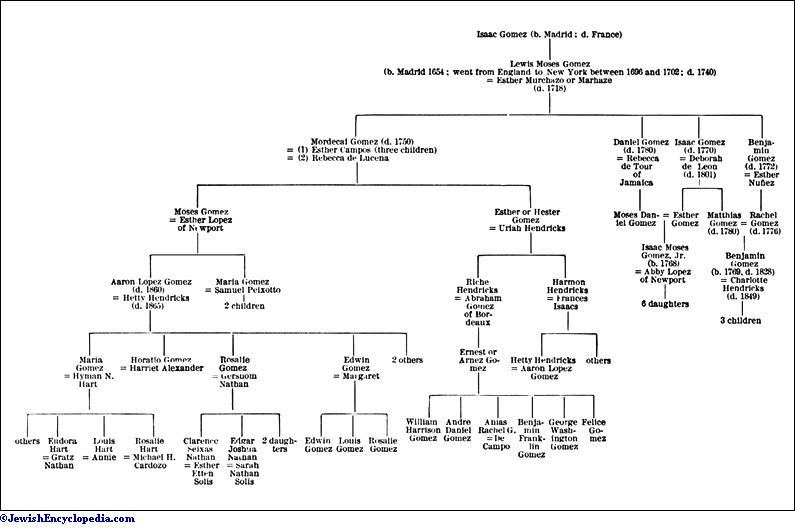
The Gomez family, or rather that branch of it which has established itself in America, traces its descent from Isaac Gomez, a Marano who left Madrid early in the seventeenth century and went to Bordeaux, whence his son Lewis removed to London and, later, to New York. His descendants have intermarried with most of the old-time American Jewish families. For the genealogical tree of the Gomez family see page 41.
GOMER.—1. One of the sons of Japheth and the father of Ashkenaz, Riphath, and Togarmah (Gen 10:2 f., 1Ch 1:5 f.), who along with Togarmah is included by Ezekiel in the army of Gog (Eze 38:6). Gomer represents the people termed Gimirrâ by the Assyrians, and Cimmerians by the Greeks. Their original home appears to have been north of the Euxine, but by the 7th cent. b.c. they had completely conquered Cappadocia and settled there.
2. Daughter of Diblaim, wife of the prophet Hosea (wh. see).
L. W. King.
Eldest son of Japheth (Genesis 10). His tribe, the Cimmerians, an Aryan people who inhabited the Crimea and the adjoining districts of southern Russia, came into western Asia through the Caucasus in the 7th century B.C. They attacked the northern frontier of the Assyrian empire, besieged Sardis, invaded Lydia and Phrygia, and conquered Cappadocia. They were finally crushed by Ardys (655-625) and the Assyrians in Cilicia.