
Menu

Glede

11 sources
Popular Cyclopedia of Biblical Literature by John Kitto (1856)

glede

Milvus Ater

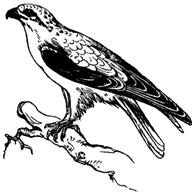
Glede (Deu 14:13) is an obsolete name for the common kite. It is a species that rises to a towering height, hangs apparently motionless in the sky, and darts down with immense velocity; but the legs and claws being weak, it is cowardly, and feeds upon carrion, fish, insects, mice, and small birds. About Cairo kites are particularly abundant, mixing with the carrion vultures in their wheeling flight, and coming in numbers to the daily distribution of food awarded them. But the question whether the kite of Europe and that of Egypt are the same species, is not decided, though there is no want of scientific names for both species found in the valley of the Nile; one of which is certainly distinct from the European, and the other, if not so, is still a strongly marked variety. The bill of this species is dark; head and throat whitish, with brown streaks; body above dark gray brown, pale ferruginous below; tail but slightly forked; legs yellow. It is found in hieroglyphic paintings colored with sufficient accuracy not to be mistaken. The other species, which we figure above as Milvus ater, is the black kite. It has the head, neck, and back dark rusty gray; scapulars bordered with rusty; wing-coverts and primaries black, the last mentioned tipped with white; tail rusty gray above, white beneath; bill dark; legs yellow. The manners of both species are much the same: it is likely that they are equally abundant at Cairo, and spread into Palestine [HAWK].

American Tract Society Bible Dictionary by American Tract Society (1859)

A kind of hawk or kite, Deu 14:13 . The same Hebrew word is translated vulture in Lev 11:14 .\par

Smith's Bible Dictionary by William Smith (1863)

Glede. The old name for the common kite, (Milvus ater), occurs only in Deu 14:13, among the unclean birds of prey.

Fausset's Bible Dictionary by Andrew Robert Fausset (1878)

The kite (Deu 14:13). Raah, so-called from its acute vision.

Cyclopedia of Biblical, Theological and Ecclesiastical Literature by John McClintock & James Strong (1880)

the old English name for the common kite (milvu’s afer), occurs only in Deu 14:13 (רָאָה, raah’) among the unclean birds of prey. But in the parallel passage, Lev 11:14, we find דָּאָה, daah’, "vulture." That this difference has arisen from a permutation of the ד and the ר is evident, but which is the original form of the word is not certain. Bochart decides (Hieroz. 2:191) for daah on the ground that, assuming the bird to be the kite or glede, it is more probable that it would receive its name from דָּאָה, to fly swiftly than from רָאָה, to see; while others, presuming that it is the vulture, prefer the latter derivation, and the reading, consequently, raah, on account of the sharp sight of these birds. But both these qualities are marked traits of the vulture as well as the kite. Thus far the evidence is therefore equal, nor do the versions help us to a decision; for while the Sept. gives in both passages γύψ, vulture, the Vulg., has milvus, kite, in both. The Codex Samar., however, reads דאה in Deu 14:13, which favors the supposition that this is the proper reading; but it still remains uncertain whether by this term we are to understand the glede or the vulture. The A.V. makes it the one in the one passage and the other in the other. As the דאה is distinguished from the דיה (Deu 14:13), and as the latter is probably one of the vulture genus (comp. Isa 34:14), it is probable that the former belongs to the kites. The kite has, in comparison with its bulk, very long wings, and a forked tail extending beyond them. It is a species that rises to a towering height, hangs apparently motionless in the sky, and darts down with immense velocity; but the legs and claws being weak, it is cowardly, and feeds upon carrion, fish, insects, mice, and small birds. About Cairo kites are particularly abundant, mixing with the carrion vultures in their wheeling flight, and coming in numbers to the daily distribution of food awarded themun. But the question whether the kite of Europe and that of Egypt are the same species is not decided, though there is no want of scientific names for both species found i the valley of the Nile, one of which is certainly distinct from the European, and the other, if not so, is a strongly-marked variety. We find it noticed in various stages of plumage as Milvus Ictinus, Milvus Etolis, Savigny; Falco Agyptiacus and Falco Forskahlii, Gmelin; Falco cinereo-ferrugineus, Forskahl; Falco Arda, Savigny; probably, also, Falco parasiticus, Lath. The bill of this species is dark; head and throat whitish, with brown streaks; body above dark gray brown, pale ferruginous below; tail but slightly forked; legs yellow. It is found in hieroglyphic paintings, colored with sufficient accuracy not to be mistaken. The other species, which we figure below as Milvus ater, is the black kite, Falco melanoterus, Daudin; Elanus Coesius, Savigny; Falco Souninensis, Lath.; Le Blac, Le Vaill., and the Kouhich of the Arabs. It has the head, neck, and back dark rusty gray; scapulars bordered with rusty; wing-coverts and primaries black, the last-mentioned tipped with white; tail rusty gray above, white beneath; bill dark; legs yellow. The manners of both species are much the same; it is likely that they are equally abundant at Cairo, and spread into Palestine. SEE HAWK.

People's Dictionary of the Bible by Edwin W. Rice (1893)

Glede. Some unclean bird of prey. Deu 14:13. It is not certain what particular bird is meant, but most probably one of the buzzards, of which three species inhabit Palestine. The original Hebrew word is rendered "vulture" in Lev 11:14, R. V., "kite."

New and Concise Bible Dictionary by George Morrish (1899)

raah. One of the unclean birds. Deu 14:13. In the parallel passage in Lev 11:14 the word is omitted, as it is by the LXX, the Samaritan, and four Hebrew MSS. What bird is referred to is unknown.

Jewish Encyclopedia by Isidore Singer (ed.) (1906)

See PREY, BIRDS OF:

(Redirected from GLEDE.)

Dictionary of the Bible by James Hastings (1909)

GLEDE.—See Kite.

International Standard Bible Encyclopedia by James Orr (ed.) (1915)

glēd (ראה, rā’āh; γύψ, gúps): A member of the hawk species. It is given among the list of abominations in Deu 14:13, but not in the Lev list (Lev 11:14). The kite is substituted. The Arabs might have called one of the buzzards the glede. In England, where specimens of most of these birds appear in migration, the glede is synonymous with kite, and was given the name from glide, to emphasize a gliding motion in flight. See illustration, p. 1235.

Plants and Animals of the Bible by David Cox (1970)

See Hawk

Everything we make is available for free because of a generous community of supporters.

Donate