
Girdle f1 the symbol of power, and strength, and defence, and honour. Thus in Job 12:18, "He girdeth their loins with a girdle," is explained to signify that God gives them their honour and strength to defend themselves and be obeyed; and in Job 12:21, "He looseth the girdle of the strong," is explained by "he weakeneth the strength of the mighty." So Job 30:11, "because he hath loosed my cord, and afflicted me." The latter expression explains the former; my cord is H3499; the same word signifies excellency.
The same signification is also collected from Isa 11:5. In Isa 22:21, the prophet saith, "I will strengthen him with thy girdle, and I will commit thy government into his hand," where this latter expression appears to be synonymous to the former, as it often happens in the prophets.
Isa 23:10, "There is no more girdle," is explained in the translation by strength. So in Isa 45:1, "I will loosen the loins of kings," signifies, I will take away their strength: so in the 5th verse, "I girded thee," signifies, I strengthened thee. And so in other places, to gird is the same as to strengthen, and to arm.f2 So in profane authors putting on of armour is expressed by girding.f3
As to the Oneirocritics, they explain a girdle of the principal servant or keeper of the house, which is indeed the strength thereof. So say the Persian and Egyptian Interpreters, ch. 244.
Concerning a golden girdle, the Indian, Egyptian, and Persian say, "that the being girded with it signifies, that the person who so dreams shall arrive, in the middle of his age, to the greatest power and renown, and have a son to succeed him."
There are several sorts of girdles spoken of in Scripture. The Jews, in general, wore girdles. Soldiers wore belts for their swords; (Neh. 4: 18.) and the priests had their girdles also. (Exod. xx. 4 - 8.) The holy Scriptures, by a beautiful allusion to this strengthener of a man’s loins by the girdle, conveys to the church a most lively and striking idea of God’s strengthening himself in his faithfulness to his people. "Righteousness shall be the girdle of his loins, and faithfulness the girdle of his reins." (Isa. xi. 5.) The meaning is, that asthe labourer goeth forth in the morning of the day to his labour, and strengthens himself for the work by bracing up his loins with his girdle; so the Lord, speaking after the manner of men, takes his righteousness for the girdle of his administration, which cleaves to him as the girdle to the loins of a man; and his faithfulness becomes the bandage of his word and truth to all his covenant promises, as the rectitude of his reins. And to carry on the figure - - As the Lord is thus clad with both, and they surround him like a girdle, sohis people are called upon to take hold of both, or either, as occasion requires, whether before or behind, and hang upon the gracious assurances of a gracious faithful covenant God in Christ. "Wherefore (saith one of the apostles, ) gird up the loins of your mind; be sober, and hope to the end; for the grace that is to be brought unto you at the revelation of Jesus Christ. (1 Pet. i. 13.)
The girdle is an indispensable article in the dress of an oriental: it has various uses; but the principal one is to tuck up their long flowing vestments, that they may not incommode them in their work, or on a journey. The Jews, according to some writers, wore a double girdle, one of greater breadth, with which they girded their tunic when they prepared for active exertions: the other they wore under their shirt, around their loins. This under girdle they reckon necessary to distinguish between the heart and the less honourable parts of the human frame. The upper girdle was sometimes made of leather, the material of which the girdle of John the Baptist was made; but it was more commonly fabricated of worsted, often very artfully woven into a variety of figures, and made to fold several times about the body; one end of which being doubled back, and sewn along the edges, serves them for a purse, agreeably to the acceptation of
2. To loose the girdle and give it to another was, among the orientals, a token of great confidence and affection. Thus, to ratify the covenant which Jonathan made with David, and to express his cordial regard for his friend, among other things, he gave him his girdle. A girdle curiously and richly wrought was among the ancient Hebrews a mark of honour, and sometimes bestowed as a reward of merit: for this was the recompense which Joab declared he meant to bestow on the man who put Absalom to death: “Why didst thou not smite him there to the ground? and I would have given thee ten shekels of silver, and a girdle,” 2Sa 18:11. The reward was certainly meant to correspond with the importance of the service which he expected him to perform, and the dignity of his own station as commander in chief: we may, therefore, suppose that the girdle promised was not a common one of leather, or plain worsted, but of costly materials and richly adorned; for people of rank and fashion in the east wear very broad girdles, all of silk, and superbly ornamented with gold and silver, and precious stones, of which they are extremely proud, regarding them as the tokens of their superior station and the proof of their riches. “To gird up the loins” is to bring the flowing robe within the girdle, and so to prepare for a journey, or for some vigorous exercise.
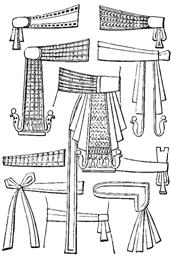
Girdles
The original word translated ’girdle’ literally means a band or bandage, and from the places in which it occurs it appears to have been made of fine linen, variously wrought and used to bind as a girdle about the body of persons in authority, especially the Jewish priests (Exo 29:9; Exo 28:39; Exo 39:29; Lev 8:13; Isa 22:21). These girdles may be considered as fairly represented by those which we observe on such persons in the Egyptian paintings.
Girdle. An essential article of dress in the East, and worn by both men and women. The common girdle was made of leather, 2Ki 1:8; Mat 3:4, like that worn by the Bedouins of the present day. A finer girdle was made of linen, Jer 13:1; Eze 16:10, embroidered with silk, and, sometimes, with gold and silver thread, Dan 10:5; Rev 1:13; Rev 15:6, and frequently studded with gold and precious stones or pearls.
The military girdle was worn about the waist; the sword or dagger was suspended from it. Jdg 3:16; 2Sa 20:8; Psa 45:3. Hence, ’girding up the loins,’ denotes preparation for battle or for active exertion. Girdles were used as pockets, as they still are among the Arabs, and as purses, one end of the girdle being folded back for the purpose. Mat 10:9; Mar 6:8. See Dress.
Worn by men and women. The
The
an essential article of dress in the East, and worn both by men and women. The corresponding Hebrew and Greek words are:
1.
An article of dress always worn in the East, both by the rich and the poor, and needed there because of their flowing robes. For the poor they were of the plainest material, but for the rich they were more or less costly, and were highly ornamented. They were thus suitable articles for presents. 1Sa 18:4; 2Sa 18:11. John the Baptist wore a leathern girdle, or one of skin. Mat 3:4; Mar 1:6: cf. 2Ki 1:8. In the Revelation the Lord has on a golden girdle, and the seven angels who come out of the temple have the same. Rev 1:13; Rev 15:6. The priests wore girdles, and one for Aaron was a ’linen’ girdle, Lev 16:4, and with the breastplate was the CURIOUS (i.e. embroidered) GIRDLE of the ephod, made of gold, blue, purple, scarlet, and fine-twined linen. Exo 28:8.
The girdle is typical of strength, and ’girding up the loins’ denotes active service. When the Gentiles are gathered by God to discipline Israel, the girdle of their loins shall not be loosed. Isa 5:27. Of the Lord when He comes to reign it is said, "Righteousness shall be the girdle of his loins, and faithfulness the girdle of his reins." Isa 11:5. In the present warfare the Christian is exhorted to have his loins ’girt about’ with truth, Eph 6:14 - the ’truth’ being the very thing that Satan will most oppose, and about which the mass are liable to be indifferent.
Girdles were also used for purses, Mat 10:9; Mar 6:8, where the word signifies a ’belt.’
GIRDLE.—See Dress, p. 498b.
A priestly vestment generally made of white linen, but sometimes of silk, wool, or cotton and of the color of the day, tied around the waist to confine the alb, worn at Mass. It symbolizes chastity. Wrapping it about the alb the priest prays: "Bind me, O Lord, with the cincture of purity and chastity." As a cord, or often as a broad sash, it is included in almost every form of religious or ecclesiastical costume.
In art the girdle is a symbol of Saint Monica and sometimes Saint Margaret.
The references to girdle (æþíç), the article itself being either expressed or implied, admit of a three-fold classification: (1) The girdle in everyday use, which (a) was put on before one vent forth (Act_12:8), and (b) was laid aside indoors (Act_21:11). From the fact that such a girdle could be used to bind hands and feet, we may infer that it was of soft material, such as linen. (2) The girdle as an article of military wear, which enters into the metaphor of Eph_6:13 ff. This transfers us to quite another environment, and to a girdle whose materials were stiffer, e.g. leather or metal, or a combination of these. Presumably (1) and (2) were worn upon the loins, and their use was such as to give rise to the figure of speech which is found in 1Pe_1:13 (cf. Luk_12:35), viz. girding up the loins (of the mind). (3) The girdle in its ornamental aspect, as appearing in Rev_1:13; Rev_15:6. The epithet ‘golden’ is to be taken as applicable to cloth and not metal, i.e. the gold was inwrought in a girdle of linen material (cf. Dan_10:5, a similar passage, where ‘pure gold of Uphaz’ [Heb.] is rendered âõóóßíῳ in Septuagint ). A noteworthy difference emerges in the location of the girdle, loins (Dan.) being replaced by breasts in Rev. (ðñὸò ôïῖò ìáóôïῖò [Rev_1:13], ðåñὶ ôὰ óôÞèç [Rev_15:6]). The girdle is thus an ‘upper’ girdle, and is suggestive of Greek and Roman custom. See also the description in Josephus, Ant. iii. vii. 2. Cf. article Apron.
W. Cruickshank.
Isa 11:5 (b) This is a symbol of a righteous life and a faithful spirit which encompasses a person to make him a useful and dependable servant of GOD. No doubt it is primarily a prophecy concerning the Lord JESUS CHRIST.
Jer 13:1, 10 (a) The Lord tells us in this story that the girdle represents Israel in her decadence, her wickedness and weakness. GOD had intended Israel as a wonderful nation, but she mingled with the world around her and became a rotten, useless people.
Rev 1:13 (c) This golden garment over the heart or the breast of the Lord indicates the purity, beauty and value of the love of CHRIST for His people.