
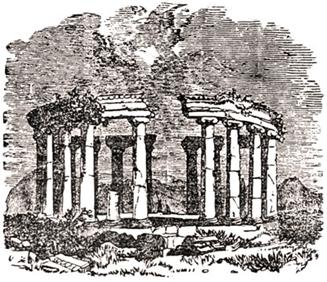
Gerasa Ruins
Ger´asa, not Jerash (not named in the Bible), was in the Decapolis, and formed the eastern boundary of Peraea. It lay on elevated ground, according to Ptolemy, in 68° 15′ == 31° 45′. Its inhabitants were mostly heathen. After the Roman conquests in the East, the country in which Gerasa lies became one of their favorite colonies, and ten principal cities were built on the east of the Jordan, giving the name of Decapolis to the land in which they stood. Gerasa was one, but not the greatest of these. The place was taken by storm by Alexander Jannaeus, who was actuated by a desire of gaining a large treasure. Alexander died near it while besieging Regaba. Before the place had time to recover from this calamity, it was included among the number of those cities which were burnt by the enraged Jews in their vengeance on the Syrians, and on the Roman power generally, for the massacre of a number of their nation at Caesarea. A terrible revenge was taken by other cities, but Gerasa is honorably excepted. Annius, general under Vespasian, took the city; ’after which he set fire to their houses,’ ’and what was remaining was all burnt down.’ Its ruins were first discovered by Seetzen and have often been subsequently visited. They have been pronounce superior to those of Palmyra.
"Gerasenes" is read in Mar 5:1 by the Vaticanus and Sinaiticus manuscripts; also in Luk 8:26 by the Vaticanus A city on the eastern border of Peraea amid the Gilead mountains, 20 miles E. of Jordan, 25 N. of Rubbath Ammon, now Philadelphia. If Gerasa be read for Gadara, "the region of Gerasa" must include Gadara and the coasts of the sea of Tiberius which lay far W. of Gerasa. The ruins are the finest on the E. of Jordan. However Dr. Thomson identifies Gerasa with the Arab Gersa, close to the shore, with a mountain rising at the back, down which the swine might rush and be unable to stop themselves from rushing into the water. In the mountain are ancient tombs which may have been the demoniac’s dwelling.
([
GERASA.—A city of the Decapolis of unknown origin, the first known event in its history being its capture by Alexander Jannæus, about b.c. 83. It was rebuilt by the Romans in a.d. 65, and destroyed in the Jewish revolt. Vespasian’s general, Lucius Annius, again took and destroyed the city. In the 2nd cent. a.d. it was a flourishing city, adorned with monuments of art; it was at this time a centre of the worship of Artemis. It afterwards became the seat of a bishop, but seems to have been finally destroyed in the Byzantine age. An uncertain tradition of some Jewish scholars, favoured by some modern writers, identifies it with Ramoth-gilead. The ruins of the city still exist under the modern name Jerâsh; they lie among the mountains of Gilead, about 20 miles from the Jordan. These are very extensive, and testify to the importance and magnificence of the city, but they are unfortunately being rapidly destroyed by a colony of Circassians who have been established here. The chief remains are those of the town walls, the street of columns, several temples, a triumphal arch, a hippodrome, a theatre, etc.
Gerasa is not mentioned in the Bible, unless the identification with Ramoth-gilead hold. The Gerasenes referred to in Mar 5:1 (RV
R. A. S. Macalister.
A titular see in the province of Arabia and the Patriarchate of Antioch. According to Josephus, it was a city of Decapolis in which a number of Jews resided. Alexander Jannaeus took possession of it, although it was surrounded by a triple wall (Bell. Jud., I, 4, 8). In 68 A.D. Vespasian ravaged the country and sacked the city because the Jews were all-powerful there (op. cit., IV, 9, 1). Simon, the son of Gioras, one of the principal leaders of the rebellious Jews, was born at Gerasa. The city is mentioned as forming a part, sometimes of Arabia, sometimes of Syria, by Ptolemy, Pliny, and Stephen of Byzantium, who also speak of several notable persons of the place. Coins and a number of inscriptions prove that it was sometimes called Antioch on the Chrysorrhoas, the little river by which it is watered. In the Gospel (Matthew 8:28; Mark 5:1; Luke 8:26, 37) there is question of the country of the Gerasans, but if this name is to be read instead of Gadarenians or Gergesians, the reference is to another locality, near the Lake of Tiberias. The prosperity of Gerasa, once considerable, dates from the first centuries of our era, its buildings date from the emperors of the second and third centuries. Its destruction was brought about by earthquakes and the Arab invasions. We know three Greek Bishops of Gerasa: Exairesius, fourth century; Plancus, 451; Aeneas, who built the church of St. Theodore in the sixth century. In 1121 Baldwin II attempted in vain to conquer it, and at the beginning of the thirteenth century the geographer Yakut informs us that it was no longer inhabited. In modern times, several thousand Tcherkesses have established themselves amid its ruins and have unfortunately destroyed most of the Graeco-Roman monuments which time had spared. Until recently Djerasch was the best preserved city of Roman antiquity and the one which afforded us the most exact idea of Roman civilization. Its ramparts, in a state of partial preservation, are still to be seen; also a magnificent triumphal arch, with three openings about 82 feet wide by 29 high; a "naumachia", or circus for naval combats; two theatres; the forum with fifty-five columns still standing; the great colonnade which crosses the city from north to south, and which still retains from 100 to 150 of its columns; several aqueducts; some propylaea; a temple of the Sun, the columns of which are about 40 feet high, and several other temples, baths, etc. Greek and Latin inscriptions are very numerous among the ruins. The ramparts of the city cover a distance of about three miles.-----------------------------------S. VAILHÉ Transcribed by Gerard Loiselle The Catholic Encyclopedia, Volume VICopyright © 1909 by Robert Appleton CompanyOnline Edition Copyright © 2003 by K. KnightNihil Obstat, September 1, 1909. Remy Lafort, CensorImprimatur. +John M. Farley, Archbishop of New York
- see Gadarenes, Gerasenes, Gergesenes
Gerasa was a town in Decapolis, south-east of the Sea of Galilee. It lay within the region of Gadara and gave its name to the surrounding district. As a result some of the Gadarenes were at times called Gerasenes, even though they may not have lived in the town itself (Mar 5:1-2; cf. Mat 8:28). (For map and other details see DECAPOLIS; GADARA.)