
Another city in the land of the Philistines. This was given by Joshua to Judah. (Josh. xv. 47.)
a city of the Philistines, made by Joshua part of the tribe of Judah. It was one of the five principalities of the Philistines, situated toward the southern extremity of the promised land, 1Sa 6:17, between Raphia and Askelon. The advantageous situation of Gaza was the cause of the numerous revolutions which it underwent. It first of all belonged to the Philistines, and then to the Hebrews. It recovered its liberty in the reigns of Jotham and Ahaz, and was reconquered by Hezekiah, 2Ki 18:8. It was subject to the Chaldeans, who conquered Syria and Phenicia. Afterward, it fell into the hands of the Persians. It must have been a place of considerable strength. For two months it baffled all the efforts of Alexander the Great, who was repeatedly repulsed and wounded in the siege; which he afterward revenged in a most infamous manner on the person of the gallant defender Betis, whom, while yet alive, having ordered his ankles to be bored, he dragged round the walls, tied to his chariot wheels, in the barbarous parade of imitating the less savage treatment of the corpse of Hector by Achilles.
Dr. Wittman gives the following description of his visit to Gaza: “In pursuing our route toward this place, the view became still more interesting and agreeable: the groves of olive trees extending from the place where we had halted to the town, in front of which a fine avenue of these trees was planted. Gaza is situated on an eminence, and is rendered picturesque by the number of fine minarets which rise majestically above the buildings, and by the beautiful date trees which are interspersed. The suburbs of Gaza are composed of wretched mud huts; but within side the town the buildings make a much better appearance than those we had generally met with in Syria. The streets are of a moderate breadth. Many fragments of statues, columns, &c, of marble were seen in the walls and buildings in different parts of the town. The suburbs and environs of Gaza are rendered infinitely agreeable by a number of large gardens, cultivated with the nicest care, which lie in a direction north and south of the town; while others of the same description run to a considerable distance westward. These gardens are filled with a great variety of choice fruit trees, such as the fig, the mulberry, the pomegranate, the apricot, the peach, and the almond; together with a few lemon and orange trees. The numerous plantations of olive and date trees which are interspersed contribute greatly to the picturesque effect of the scene exhibited by the surrounding plains. These, on our arrival, were overspread with flowers, the variegated colours of which displayed every tint and every hue. Among these were the chrysanthemum, scarlet ranunculus, lupin, pheasant-eye, tulip, china-aster, dwarf-iris, lintel, daisy, &c, all of them growing wild and abundantly, with the exception of the lupin, which was cultivated in patches, regularly ploughed and sowed, with a view to collect the seeds, which the inhabitants employ at their meals, more especially to thicken their ragouts. The few corn fields, which lay at a distance, displayed the promise of a rich golden harvest; and the view of the sea, distant about a league, tended to diversify still more the animated features of this luxuriant scene.” This and similar descriptions of modern travellers, which are occasionally introduced into this work, are given both as interesting in themselves, and to show that relics of the ancient beauty and fertility of the Holy Land are still to be found in many parts of it.
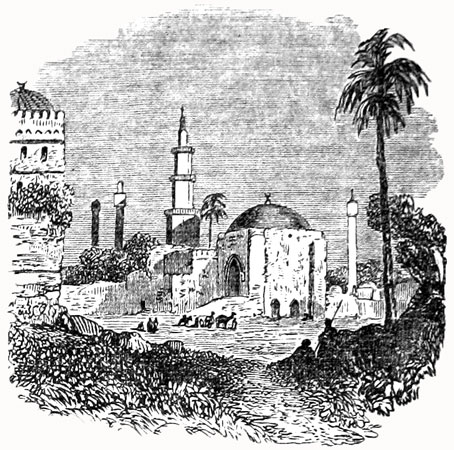
Gaza
Ga´za lies on the road leading from Akabah to Hebron, which passes along nearly the whole length of the great Wady-el-Arabah. It is on the sea-coast, in lat. 31° 29´, long. 34° 29´ in the country of the Philistines (Jos 15:47). It is a very ancient place, as we find it mentioned in Gen 10:19, where it is given as one of the border-cities of the Canaanites. In Deu 2:23, it is found as the place unto which the Avim dwelt. Joshua smote the Canaanites as far as Gaza (Jos 10:41), but spared the Anakim (giants) that dwelt there (Jos 11:21-22). In the division of the land, Gaza fell to the lot of Judah (Jos 15:47), and was taken by him with the coast thereof (Jdg 1:18), but its inhabitants were not exterminated (Jdg 3:3). Gaza was one of the five Philistine cities which gave each a golden emerod as a trespass-offering to the Lord (1Sa 6:17). Solomon’s kingdom extended as far as Gaza (1Ki 4:24). But the place appears always as a Philistine city in Scripture (Jdg 3:3; Jdg 16:1; 1Sa 6:17; 2Ki 18:8). Hezekiah smote the Philistines as far as Gaza (2Ki 18:8). Gaza, fell into the hands of the Egyptians, probably Pharaoh-Necho (Jer 47:1; comp. Herod. ii. 159). The prophets speak in severe terms against it (Jer 25:20; Jer 47:5; Amo 1:6-7; Zep 2:4; Zec 9:5). After the destruction of Tyre it sustained a siege of two months against Alexander the Great. Jonathan Maccabaeus destroyed its suburbs; Simon Maccabaeus took the city itself, though not without extraordinary efforts. Alexander Jannaeus spent a year in besieging it and punishing its inhabitants. The place was rebuilt by Gabinius. It was among the cities given by Augustus to Herod, after whose death it was united to the province of Syria.
Gaza is celebrated for the exploit recorded of Samson (Jdg 16:1-3), who ’took the doors of the gate of the city, and the two posts, and went away with them, bar and all, and put them on his shoulders, and carried them up to the top of a hill that is before Hebron.’ The Philistines afterwards took Samson, and put out his eyes, and brought him to Gaza, and bound him with fetters of brass, and he did grind in the prison-house: he, however, pulled down the temple of Dagon, god of the Philistines, and slew, together with himself, ’all the lords of the Philistines,’ besides men and women (Jdg 16:21-30). It was near Gaza—on the road from Jerusalem to that place—that Philip baptized the eunuch ’of great authority under Candace, queen of the Ethiopians’ (Act 8:26, sq.).
Gaza lay some distance from the sea, though it had a port on the sea, called ’Gaza on the sea’ called also Majuma, which Constantine called Constantia, from the name of his son, giving it, at the same time, municipal rights. Julian took away this name and ordered it to be called the port of Gaza. Subsequent emperors restored the name and the privileges of the place. It was afterwards called the sea-coast of Gaza.
Ga’za. (the fortified; the strong). (properly Azzah). One of the five chief cities of the Philistines. It is remarkable for its continuous existence and importance from the very earliest times. The secret of this unbroken history is to be found in the situation of Gaza. It is the last town in the southwest of Palestine, on the frontier towards Egypt. The same peculiarity of situation has made Gaza important in a military sense. Its name means "the strong"; and this was well elucidated in its siege by Alexander the Great, which lasted five months.
In the conquest of Joshua, the territory of Gaza is mentioned as one which he was not able to subdue. Jos 10:41; Jos 11:22; Jos 13:3. It was assigned to the tribe of Judah, Jos 15:47, and that tribe did obtain possession of it, Jdg 1:18, but did not hold it long, Jdg 3:3; Jdg 13:1, and apparently, it continued through the time of Samuel, Saul and David to be a Philistine city. 1Sa 6:17; 1Sa 14:52; 1Sa 31:1; 2Sa 21:15.
Solomon became master of "Azzah," 1Ki 4:24, but, in after times, the same trouble with the Philistines recurred. 2Ch 21:16; 2Ch 26:6; 2Ch 28:18.
The passage where Gaza is mentioned in the New Testament, Act 8:26, is full of interest. It is the account of the baptism of the Ethiopian eunuch on his return from Jerusalem to Egypt.
Gaza is the modern Ghuzzeh, a Mohammedan town of about 16,000 inhabitants, situated partly on an oblong hill of moderate height and partly on the lower ground. The climate of the place is almost tropical, but it has deep wells of excellent water. There are a few palm trees in the town, and its fruit orchards are very productive; but the chief feature of the neighborhood is the wide-spread olive grove to the north and northeast.
("fortified".) One of the five Philistine cities, Mentioned in the first and latest books of Scripture, and even now exceeding Jerusalem in size. It is the most southwesterly town toward Egypt, and lay on the great route between Syria and that country, being in position and strength (as its name means) the key of the line of communication. It withstood Alexander’s siege with all his resources for five months. It is called Azzah Gen 10:19 margin; Deu 2:23; Jer 25:20. Gaza was assigned by Joshua to Judah (Jos 15:47), but not occupied until afterward (Jdg 1:18; compare Jos 10:41), the Anakims occupying it still (Jos 11:22; Jos 13:8). The Philistines soon recovered it (Jdg 13:1; Jdg 16:1-21), and there Samson perished while destroying his captors. Solomon ruled over it (1Ki 4:24).
Hezekiah gave the decisive blow to the Philistines, "even unto Gaza and the borders thereof, from the tower of the watchmen to the fenced city" (2Ki 18:8). Amos (Amo 1:6) threatened from God. "for three transgressions of Gaza and for four (i.e. for sin multiplied on sin, Exo 20:5; Pro 30:15. Three and four make seven, the number implying completion of the measure of guilt) I will not turn away the punishment thereof, because they carried away captive the whole captivity (i.e. they carried all away and left none; see 2Ch 21:17; 2Ch 28:18) to deliver them up to Edom (the Philistines of Gaza, instead of hospitably sheltering the Jewish refugees fleeing before Sennacherib and other Assyrian, invaders, sold them as captives to their bitter foes, the Edomites; compare Isa 16:4). But I will send a fire on the wall of Gaza, which shall devour the palaces thereof."
"Pharaoh" Necho fulfilled the prophecy on returning from slaying Josiah at Megiddo (2Ch 35:20) (Grotius). Or "Pharaoh" Hophra, on his return from the unavailing attempt to save Jerusalem from Nebuchadnezzar (Jer 37:5; Jer 37:7; Jer 47:1) (Calvin) In Zep 2:4 there is a play on like sounds;
In Act 8:26, "go toward the S. unto the way that goeth down from Jerusalem unto Gaza which (not Gaza, but which way) is desert," refers to the portion of the road between Eleutheropolis and Gaza, which is without villages and exposed to Bedouin marauders of the desert. The words "which is desert" are the angel’s words (not Luke’s), to inform Philip, then in Samaria, on what route he would find the eunuch, namely, on the S. route, thinly peopled, but favorable for chariots, Robinson (2:748) found an ancient road direct from Jerusalem to Gaza through the wady Musurr, now certainly without villages.
The water in wady el Hasy was probably the scene of the eunuch’s baptism. Once Gaza was the seat of a Christian church and bishop; but now of its 15,000 inhabitants only a few hundreds are Christians, the rest Muslims. The great mosque was formerly the church of John when Gaza was a Christian city. An extensive olive grove lies N. of the modern Ghuzzeh., from whence arises its manufacture and export of soap. Its trade in grain is considerable, and still is heard the "grinding" of grain with millstones such as Samson was forced to work with in his prison house at Gaza. The Tel el Muntar or "hill of the watchman," east of Gaza, is the hill to which Samson carried up the gates. It commands a lovely and striking view on every side.
(Heb. Azzah’,
The time of the conquest of Gaza by the Philistines is not known. It must have been long before Abraham’s time, for they were then firmly established in the country, and possessed of great power (Gen 21:32). Gaza was from the first their principal stronghold. Joshua smote the Canaanites as far Gaza (Jos 10:41), but spared the Anakim (giants) that dwelt there (Jos 11:21-22). In the division of the land, Gaza fell to the lot of Judah (Jos 15:47), and was taken by him with the coast thereof (Jdg 1:18), but its inhabitants ("Gazites," Jdg 16:2; "Gazathites," Jos 13:3) were not exterminated (Jdg 3:3). Gaza was one of the five Philistine cities which gave each a golden emerod as a trespass-offering to the Lord (1Sa 6:17). Gaza is celebrated for the exploit recorded of Samson (Jdg 16:1-3), who "took the doors of the gate of the city, and the two posts, and went away with them, bar and all, and put them on his shoulders, and carried them up to the top of a hill that is before Hebron." The Philistines afterwards took Samson, and put out his eyes, and brought him to Gaza, and bound him with fetters of brass, and he did grind in the prison-house: the, however, pulled down the temple of Dagon, god of the Philistines, asnd slew, toget her with himself, "all the lords of the Philistines," besides men and women (Jdg 16:21-30). Solomon’s kingdom extended as far as Gaza (1Ki 4:24). But the place always appears as a Philistine city in Scripture (Jdg 3:3; Jdg 16:1; 1Sa 6:17; 2Ki 18:8). Hezekiah smote the Philistines as far as Gaza (2Ki 18:8). Gaza fell into the hands of the Egyptians, probably Pharaoh- Necho, as a diversion of Nebuchadnezzar in his designs against Jerusalem (Jar. 47:1), an event to which has been incorrectly referred (Rawlson, Herod. 1:411) the statement of Herofotun (2:159) respecting the capture of Cadytis by the Egyptians. SEE JERUSALEM.
During this period of Jewish history, it seems that some facts concerning the connection of Gaza with the invasion of Sennacheerib may be added from the inscriptions found at Nineveh (Layard’s Nineveh and Babylon, page 144). SEE CUNEIFORM INSCRIPTIONS. The prophets speak in severe terms against it (Jer 25:20; Jer 47:5; Amo 1:6-7; Zep 2:4; Zec 9:5). — After the destruction of Tyre it sustained a siege of two (Quint. Curt. 4:6, 7, says five) months against Alexander the Great (Josephus, Ans. 11:8, 4), a fact that illustrates the propriety of its name and its military, importance. As Van de Velde says (page 187), it was the key of the country. So vigorously was it then defended by the forces under the command of the eunuch Batis, and of such massive strength were its walls, that the engineers of Alexander’s army found themselves completely baffled in their attempts to effect a breach. They emere obliged to erect an enormous mound 250 feet in height, and about a quarter of a mile in width, on the south side; of the town; and even with this advantage, and the use also of the engines that had bean employed at the siege of Tyre, the besiegers were frequently repulsed, and Alexander bimself sustained no slight bodily injury. It was at last carried by escalade, and the garrison put to the sword. The town itself was not destroved, but most of the inhabitants that remained were sold into slavery, and a fresh Arab population settled in their stead (Arrian, 2:27). What had happened in thee times of the Pharaohs (Jar. 47:1) and Cambyses (Pomp. Mel. 1:11) happened again in the struggles between the Ptolemies and the Seleucidae (Polybius, 5:68; 16:40). Jonathan Maccabus (1Ma 11:61) destroyed its, suburbs; Simon Maccalaeus (1Ma 13:43) took the city itself, though not without extraordinary efforts. Alexander Jannaeus spent a year (B.C. cir. 96) in besieging it and punishing its inhabitants (Josephus, Ant. 13:13, 3). The place was rebuilt by Gabinius (Josephus, Ant. 14:5, 3).
It was among the cities given by Augustus to Herod (Josephus, Ant. 15:7, 3), after whose death it was united to the province of Syria (Josephus, Ant. 17:11, 4). It was near Gaza — on the road from Jerusalem to that place that Philip baptized the eunuch "of great authority under Candace, queen of the Ethiopians" (Act 8:26 sq.). As Gaza lay some distance from the sea (Arrian, 2:26), it had a port on the sea (?
Gaza (gâ’zah), Hebrew Azzah, strong. The chief of the five cities of the Philistines, 60 miles southwest of Jerusalem, 3 miles from the Mediterranean, now called Ghŭzzeh. Gaza was peopled by the descendants of Ham, Gen 10:19; by the Anakim, Jos 11:22; given to Judah, Jos 15:47; the scene of Samson’s exploits, Jdg 16:1-31; under Solomon’s rule and called Azzah, 1Ki 4:24; smitten by Egypt, Jer 47:1; Jer 47:5; prophesied against, Amo 1:6-7; Zep 2:4; Zec 9:5; noticed in New Testament only in Act 8:26; a chief stronghold of paganism and the worship of the god Dagon. The town is now without walls or gates, but is in the midst of olive-orchards and has about 20,000 inhabitants.
[Ga’za]
1. One of the five royal cities of the Philistines. We read of it as early as Gen 10:19 as a border of the Canaanites. The Anakim dwelt there, but Judah was able to take Gaza and the coasts thereof. Jos 11:22; Jdg 1:18. In the time of Samson, however, the Philistines were in possession, and he was made a prisoner there. Jdg 16:21. It was held afterwards by Solomon, 1Ki 4:24 (where it is called AZZAH, as it is also in Deu 2:23 and Jer 25:20); but had to be taken again by Hezekiah. 2Ki 18:8. It was afterwards smitten by Pharaoh. Jer 47:1; Jer 47:5. Having been a stronghold of the Philistines, woes were pronounced against it by the prophets. Amo 1:6-7; Zep 2:4; Zec 9:5.
Gaza was the S.W. frontier town of Palestine, and did a large trade with the caravans to and from Egypt. It was taken by Cambyses, the Ptolemies, and by Alexander the Great, and was held in the twelfth century by the Knights Templars. Gaza is now under Palestinian rule. It is situate at 31° 30’ N, 34° 28’ E. Act 8:26 signifies that the way from Jerusalem to Gaza was desert. This is supposed to refer to the road through Hebron, for after leaving that city it is comparatively desert.
2. City of Ephraim, 1Ch 7:28; but here many MSS read Ayyah.
( ):
):
By: M. Franco, Richard Gottheil
Palestinian city on the Mediterranean, about 85 kilometers southeast of Jerusalem. In early times it was one of the terminals of the trade-route from South Arabia, as well as from Petra and Palmyra. Gaza was condemned by Amos (i. 6) for trafficking in slaves with Edom. On account of its position its possession was bitterly contested by the Pharaohs from the sixteenth to the fourteenth century, and by the Ptolemies in the third and the second. The history of Gaza goes back to remotest antiquity. It is mentioned in Gen. x. 19 as the boundary of Canaan. Conquered by the tribe of Judah (Judges i. 18, where LXX. introduces "not," probably having later conditions in mind), and retaken by the Philistines, it was the scene of Samson's prowess; he is said to have carried the two gates of the city up the neighboring mountain, and to have perished subsequently in overturning the temple of Dagon (Judges xvi.). It was accounted one of the five chief Philistine cities (Josh. xiii. 3), and at the time of Solomon was the southern limit of the kingdom (I Kings v. 4, Hebr.). When Alexander the Great went from Tyre to Egypt, he took Gaza and left a garrison there. The city later capitulated to Jonathan Maccabeus, who destroyed the suburbs by fire. The Jewish king Alexander Jannæus destroyed Gaza after a siege of a year (96 B. C.); it was wrested from the Jews by Pompey, and was rebuilt and fortified by the Roman general Gabinius in 57. In 30 it was given by Augustus to Herod; but at the beginning of the last Jewish war it was completely destroyed. Jerome, however, speaks of it as a large city in his time. In the Talmudic period residence there was permitted to Jews, though its inhabitants were pagans. The Arabs under Amr took it in 634, but it was restored by the Christians under Baldwin III. In 1152 it came into the possession of the Templars. In 1187 Saladin recaptured it.
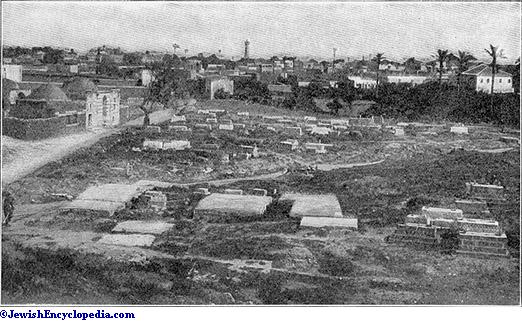
View of Modern Gaza.(From a photograph.)
Notwithstanding all these changes of rulership, scarcely anything is known of the Jews of Gaza. Meshullam of Volterra (1481) found sixty Jewish householders there and four Samaritans. The wine of the place was all grown by the Jews (Luncz, "Jerusalem," i. 193). Obadiah of Bertinoro (1488) mentions as rabbi of Gaza when he was there a certain Moses of Prague, who had come from Jerusalem ("Zwei Briefe," ed. Neubauer, p. 19). The Karaite Samuel b. David found a Rabbinite synagogue there in 1641 (ed. Gurland, p. 11). It may, however, be assumed that a Jewish community existed at Gaza at the end of the sixteenth century, and that the Najjara family supplied some of the rabbis of the place. Israel Najjara, son of the Damascene rabbi Moses Najjara, the author of the songs "Zemirot Yisrael," was chief rabbi of Gaza and president of the tribunal in the middle of the seventeenth century. In 1666 the pseudo-Messiah Shabbethai Ẓebifound there his most devoted follower, Nathan of Gaza, son-in-law of a rich and pious Jew of that community. A certain R. Ẓedaḳah of Gaza is mentioned in a Bodleian manuscript (Steinschneider, "Cat. Bodl." col. 579, No. 1658). There were Jews at Gaza as late as 1799, but they fled in numbers before Napoleon's army; and Volney, who accompanied the latter, and who describes Gaza in detail, does not allude in any way to the Jews. About 1880 a group of them settled in the town, in which at present there are about ninety.
Bibliography:
S. Munk, Palestine, p. 63, Paris, 1845;
M. Franco, Histoire des Israélites de l'Empire Ottoman;
Najjara, Zemirot Yisrael, Preface;
Böttger, Lexicon zu den Schriften des Flavius Josephus, P. 127;
Neubauer, Géographie du Talmud, p. 67;
G. A. Smith, Hist. Geography of the Holy Land, pp. 181 et seq.
GAZA.—A city of the Philistine Pentapolis. It is referred to in Genesis (Gen 10:19) as a border city of the Canaanites, and in Jos 10:41 as a limit of the South country conquered by Joshua; a refuge of the Anakim (Jos 11:22), theoretically assigned to Judah (Jos 15:47). Samson was here shut in by the Philistines, and escaped by carrying away the gates (Jdg 16:1-3); he was, however; brought back here in captivity after being betrayed by Delilah, and here he destroyed himself and the Philistines by pulling down the temple (Jdg 16:21-30). Gaza was never for long in Israelite hands. It withstood Alexander for five months (b.c. 332). In b.c. 96 it was razed to the ground, and in b.c. 57 rebuilt on a new site, the previous site being distinguished as ‘Old’ or ‘Desert’ Gaza (cf. Act 8:26). It was successively in Greek, Byzantine Christian (a.d. 402), Muslim (635), and Crusader hands; it was finally lost by the Franks in 1244. A Crusaders’ church remains in the town, now a mosque. It is now a city of about 16,000 inhabitants, and bears the name Ghuzzeh.
R. A. S. Macalister.
(Hebrew: the strong)
City in Syria, the modern Ghuzzeh, 50 miles southwest of Jerusalem, one of the oldest cities in the world, mentioned in Genesis, 10, and first occupied by the Hevites. One of the five cities of the Philistines, who constantly molested the Jews, when Samson arose and avenged his people; Gaza was the scene of his last triumph and death (Judges, 16). Mentioned in Acts, 8, when the eunuch of Candace, Queen of Ethiopia, returning from Jerusalem where he had gone to worship, met Philip the Deacon and invited him into his chariot, that he might explain the writings of the prophet Isaias as they drove along; Philip "preached unto him Jesus," baptized him at his own request, "and the eunuch went on his way rejoicing."
(Heb. ’Azzah, "the strong")A titular see of Palaestina Prima, in the Patriarchate of Jerusalem.Gaza is one of the oldest cities in the world. Its first inhabitants were the Hevites (Deuteronomy 2:23). The Rephaim and the Enacim, expelled later by Josue, inhabited the surrounding mountains (Joshua 11:22). The Hevites were driven forth by the Philistines who came from Caphtor (D.V., Cappadocia; Deuteronomy 2:23; Amos 9:7; Jeremiah 47:4). Little else is known as to the origin of this warlike people, who occupied the whole Mediterranean coast between Phoenicia and Egypt, and whom the Hebrews could never wholly subdue. It is agreed, however, that they came from the southern coast of Asia Minor and the islands of the Aegean. Jeremias (xlvii, 4) speaks of the island of Caphtor, the isle of Cappadocia in D.V. According to Stephen of Byzantium ("De Urbibus," s.vv. Gaza, Minoa) the city of Gaza was a colony from Crete (cf. Soph., ii, 5). This statement is in accordance with the Biblical narrative which tells of reprisals made by the "Cerethi" (Cretans), a Philistine tribe. Philistines were established in the vicinity of Gaza as early as the time of Abraham; their leader, Abimelech, who bore the title of king, resided at Gerara (Genesis 21:33; 26:1). Some critics, however, hold that the title of "King of the Philistines" was given to Abimelech, not because he was himself a Philistine, but because he dwelt in the country afterwards inhabited by that people. In any case the Philistines certainly possessed Gaza when Moses and the Hebrews arrived in the Holy Land. Though it was assigned to the tribe of Juda, the city could never be conquered by Josue on account of its high wall (Genesis 15:18; Joshua 15:47; Amos 1:7). The tribe of Juda possessed the city by right but not in fact.Gaza appears to have been the metropolis of the five satrapies which formed the territory of the Philistines; and like the four other cities, Ascalon, Accaron, Azotus, and Geth, it had a king whose power extended to all the cities and villages of the region. Samson, to escape from the hands of the Philistines, bore the gates of the city away on his shoulders during the night to the neighbouring mountain (Judges 16:3); it was at Gaza that, blind and a prisoner of the Philistines, he pulled down the temple of Dagon on himself and his enemies (Judges xvi, 21-30). Dagon was not the special deity of Gaza. He is to be met with also at Ascalon, Azotus, and the other Philistine cities to which the term "Beth-dagon" is applied. To a certain extent the Philistines had transformed into a national deity this god of Assyrian origin, a monster in part the shape of a fish, in part also, the form of a man. The Israelites, who had captured Gaza before the time of Samson (Judges 1:18), were still in possession of it in the time of Solomon (1 Kings 4:24). It is probable, however, that at this later date the city merely paid tribute, retaining its autonomy.The people of Gaza continued to manifest their hatred for the Jews, and carried on a brisk commerce in Jewish slaves (Amos 1:6), which drew upon them the terrible maledictions of the prophets of Israel (Amos 1:6-7, Zechariah 9:5; Jeremiah 25:20; 47:5). The evils foretold began when the rulers of Egypt and those of Assyria or Chaldea engaged in their long and eventful struggle for the domination of Asia and world-supremacy. Being on the great highway of the conquering armies, Gaza was destined to special suffering. About 734 B.C., Theglathphalasar III numbered among his vassals Hanon, the King of Gaza, who had joined Rasin and Phacee, Kings of Syria and Israel, in revolt against the Assyrian monarch. On the approach of the Assyrian army Hanon fled to Egypt and the city was taken and sacked. But the victors had scarcely departed when Hanon returned to Gaza; and in 720 B.C. we find him on the battlefield of Raphia, among the allies of Pharao Shabaka, where he was defeated and taken prisoner. Shortly after this the Philistines of Gaza were defeated by Ezechias, King of Juda (2 Kings 18:8), and were forced to revolt with him against the Assyrians; the latter, however, returned and again compelled the Philistines to submit. Asarhaddon and Assurbanipal numbered among their tributaries Tsilbel, King of Gaza. When the Assyrian empire had been destroyed Egypt sought to enrich itself from the spoils, and Pharao Necho II captured Gaza (Jeremiah 47:1; Herodotus II, clix) on his way towards Carchemish, where he was defeated by the Babylonians, who, under the leadership of Nabuchodonosor (Nebuchadnezzar), took the offensive and recaptured Gaza. The city was especially ill-treated, and had afterwards to pay tribute to King Nabonides for the building of the great temple of Sin at Haran. Later the Babylonians gave way to the Persians. Cambyses, on the occasion of his expedition to Egypt in 525 B.C., besieged Gaza, which alone dared to resist his march (Polybius, XVI, 40). It submitted, nevertheless, and under the Persian dominion, according to Herodotus (III, xv), who compares it to Sardis, one of the most beautiful cities of Asia, it enjoyed great prosperity. The people of Gaza, who seem to have been very courageous and very loyal to their masters, whoever they might be, refused to open the gates to the army of Alexander the Great (332 B.C.). He was forced to begin a regular siege, which lasted two months and cost him many men. After storming the city, Alexander laid waste to Gaza, put the men to the sword, and sold the women and children into slavery. He afterwards allowed the place to be re-colonized; but the new-comers were of a different stock from the old inhabitants. The Philistine stronghold made way for an Hellenic city (Diodorus Siculus, XVII, xlviii, 7; Arrian, II, xxxvi; Quintus Curtius, IV, xxxiii). Henceforth there is little peace for Gaza. For several centuries it was the battlefield for Egyptian, Syrian, and Jewish armies. It was taken three times by Ptolemy I, King of Egypt (320, 312, and 302 B.C.), and twice by Antigonus (315 and 306 B.C.). Finally it fell to the Lagidae, who retained it for almost a century. In 219 B.C. Antiochus of Syria took possession of it, and organized there the invasion of Egypt; but he was defeated at Raphia in 217 B.C., and compelled to abandon his conquest to the Egyptians. In 198 B.C. he again took Gaza, routed the Egyptians in the following year, and this time was able to retain his conquest. Jonathan Machabeus appeared with his army before Gaza, which refused to open its gates, so the suburbs were burnt, and the inhabitants compelled to give hostages, 145-143 B.C. (1 Maccabees 11:60-62).Alexander Jannaeus besieged the city for a whole year (98 B.C.) and finally captured it, through treachery, sacked it and slew a large number of the inhabitants (Josephus, "Ant. Jud.," XIII, xiii, 3; "Bel. Jud.," I, iv, 2). It was rebuilt later by Pompey and by Gabinius (Josephus, "Ant. Jud.," XIV, iv, 4; Appian, "Syr.," 51). Anthony ceded to Cleopatra the whole of the Mediterranean coast between Egypt and Phoenicia, and Augustus gave Gaza to Herod the Great (30 B.C.). At Herod’s death it became subject to the governor of Syria. In A.D. 66 the revolted Jews sacked the city, which was of course soon recaptured by the Romans (Josephus, "Bel. Jud.," II, xviii, 1). The era of Gaza, found on its coins and on numerous pagan and Christian inscriptions, dates from a journey of Pompey through Palestine, 28 October, 61 B.C. Gaza is mentioned only once in the New Testament (Acts 8:26), in connection with the route followed by the eunuch of Queen Candace. The Hellenistic city had transformed its Oriental deities into Graeco-Roman gods, and was long hostile to Christianity, which as late as the first quarter of the fourth century had scarcely secured a foothold there. It is true that Philemon, to whom St. Paul addressed an epistle, is spoken of as its first bishop; but this is merely an unreliable tradition. St. Sylvanus, its first bishop, martyred (310) at the mines of Phaeno, is called "bishop of the churches about Gaza" (Eusebius, "Hist. Eccl.," VIII, xiii; "De Mart. Palaest.," xiii, iv); Asclepas, his successor, is also called "bishop of the churches about Gaza." He assisted at the Council of Nicaea in 325, and was one of the Catholic bishops most feared by the Arians. He is always found among those who suffered the most severely in the Arian conflict, with men like St. Athanasius, Marcellus of Ancyra, and others of that type.Constantine the Great forcibly introduced Christianity into Gaza, but such was the hostility of the pagan population that Bishop Asclepas deemed it prudent to build the church outside the city. Near the church, but likewise without the walls, arose later the oratory of the martyr St. Timothy; in the same place were relics of the martyrs St. Major and St. Thea. Christianity, however, spread rapidly in Majuma, the port of Gaza, between two and three miles from the city and owing dependence to it. The citizens of the port obtained from Constantine the privilege of municipal independence for their city, under the name of Constantia, with the right to have its own bishops. When, later, Julian the Apostate withdrew rights from Majuma, it still retained its bishops, the most famous of whom were Peter the Iberian, a Monophysite ascetic, and St. Cosmas, foster brother and friend of St. John Damascene. In the neighbouring cities, e.g. Anthedon, Bethelia, and Menois, Christianity was also introduced with difficulty. Under Julian the Apostate three brothers, Eusebius, Nestabos, and Zeno, were put to death at Gaza by the populace. St. Hilarion, born in the neighbouring Thabatha, a small village, was compelled to flee to Sicily to escape persecution by the pagans (Sozom., "Hist. Eccl.," V, ix; Greg. Naz., "Invect. I in Jul.," 66-67). The first church built in Gaza itself was the work of St. Irenion (d. 393) whose feast is 16 December. He was succeeded by Aeneas, and later by St. Porphyry (395-420), the true restorer of Christianity in Gaza. This holy bishop first sent Marcus, his deacon and historian, to Constantinople to obtain an order to close the pagan temples. The Christians then scarcely numbered 200 in Gaza; though the rest of the empire was gradually abandoning its idols, Gaza was stubborn in its opposition to Christianity. The decree was granted by the emperor, and the temples closed, with the exception of the Marneion, the temple sacred to Zeus Marnas, which had replaced that of Dagon. There was no great change, however, in the sentiments of the people; so St. Porphyry decided to strike a decisive blow. He went himself to Constantinople during the winter of 401-402 and obtained from Arcadius a decree for the destruction of the pagan temples, which Cynegius, a special imperial envoy, executed in May, 402. Eight temples, those of Aphrodite, Hecate, the Sun, Apollo, Core, Fortune, the Heroeion, and even the Marneion, were either pulled down or burnt. Simultaneously soldiers visited every house, seizing and burning the idols and books of magic. On the ruins of the Marneion was erected, at the expense of the empress, a large church called the Eudoxiana in her honour, and dedicated 14 April, 407. Paganism had thus ceased to exist officially.Gaza, now a Christian city, became rich and prosperous; and during the fifth and sixth centuries was the seat of a famous school of Christian rhetoricians. Monasticism also flourished there; and the Church recognizes as saints many religious of Gaza, e.g. Dorotheus, Dositheus, Barsanuphius, and John the Prophet; the Monophysite monks were also, for a time, actively engaged in its environs. At the Arab invasion, about 637, the city fell before General Amr. The Eudoxiana was converted into a mosque, and the Roman garrison, consisting of sixty soldiers under the command of Callinicus, having refused to apostatize, was slain at Eleutheropolis and Jerusalem ("Analecta Bollandiana," XXIII, 289-307; "Echos d’ Orient," VIII, 1905, 40-43). The Arabs venerate the city as the burial-place of Hachem, the grandfather of Mahomet. When the Crusaders came, Gaza was almost in ruins; owing, however, to its situation on the way from Egypt to Syria, it soon regained prosperity. Baldwin III built a fortress there (1149) and confided it to the Templars. Saladin pillaged the city in 1170, but the fortress did not fall until 1187. Richard the Lionhearted held it for a brief time. In 1244 the combined forces of Christians and Saracens were defeated by the Kharezmians. The Turks finally took Gaza in 1516; and in 1799 Bonaparte held it for a few days. It is now known as Ghazzeh, and is a kaimakamat in the sandjak of Jerusalem. It numbers over 40,000 inhabitants, nearly all Mussulmans. There are only 1000 Greek schismatics, 150 Jews, 50 Protestants, and 150 Catholics. The latter have a Catholic pastor under the Patriarch of Jerusalem. The Greek Church contains the tomb of St. Porphyry. Mosques are very numerous, among the most remarkable being Djamia-el-Kebir, the ancient cathedral of the crusaders, dedicated to St. John the Baptist; also Nebi-Hachem, in which is the tomb of the grandfather of Mahomet. The city is unclean, and its streets narrow and crooked. But seen from a distance, amid its surrounding vegetation, it appears magnificent. The entire district is well irrigated and cultivated; the soil is extremely rich, and the trade of the city rather prosperous.-----------------------------------MARCUS DIACONUS, Vita Porphyrii episcopi Gazensis (Leipzig, 1895); SIBER, De Gaza Palestinoe oppido ejusque episcopis (Leipzig, 1715); LE QUIEN, Oriens Christianus, III, 603-622; STARK, Gaza und die philistaeische Kueste (Jena, 1852); SEITZ, Die Schule von Gaza (Heidelberg, 1892); ROUSSOS, Trois Gazeens (Greek; Constantinople, 1898); SCHUERER, Der Kalender und die Aera von Gaza (Berlin, 1896); GATT in VIG., Dict. de la Bible, s.v.S. VAILHÉ Transcribed by John Fobian In memory of Joseph and Concetta Bula The Catholic Encyclopedia, Volume VICopyright © 1909 by Robert Appleton CompanyOnline Edition Copyright © 2003 by K. KnightNihil Obstat, September 1, 1909. Remy Lafort, CensorImprimatur. +John M. Farley, Archbishop of New York
(ÃÜæá)
Gaza, the most southern of the five chief cities of Philistia, was important as the last place of call on the road to Egypt. It was ‘the frontier city of Syria and the Desert, on the south-west, as Damascus on the north-east’ (Stanley, Sinai and Palestine, London, 1877, p. 259). Writing about the beginning of the Christian era, Strabo (xvi. ii. 30) describes it as ‘once famous, but razed by Alexander [the Great] and remaining deserted’ (êáὶ ìÝíïõóá ἔñçìïò). The last clause can scarcely be correct, for Gaza was a strong city in the time of Jonathan the Maccabee (1Ma_11:61 f.), and it stood a year’s siege before it was destroyed by Alexander Jannaeus in 96 b.c. (Jos. Ant. xiii, xiii. 3). This was Old Gaza (ἡ ðáëáéὰ ÃÜæá), so called by Diodorus and Porphyry (see the references in Schürer, History of the Jewish People (Eng. tr. of GJV).] II. i. [Edinburgh, 1885] 70). New Gaza (ἡ íÝá ÃÜæá) was built by Gabinius, Governor of Syria (Jos. Ant. xiv. v. 3), apparently at some distance from the former site (Jerome, Onomast., ed. Lagarde, Göttingen, 1870, p. 125). In the time of Claudius, Mela describes it as ‘ingens et munita admodum’ (i. 11). It is said to have been destroyed by the Jews in a.d. 65 (Jos. Bellum Judaicum (Josephus) ii. xviii. 1), but the ruin cannot have been more than partial. In the time of Eusebius and Jerome it was still a notable Greek city, where paganism stoutly resisted Christianity; and it played an important part in the time of the Crusades. To-day it is a flourishing town of 16,000 inhabitants, built on and around a hill rising 100 ft. above the plain, and separated from the sea by three miles of yellow sand-dunes. Well watered, with broad gardens, and a great olive grove stretching northwards, it drives a considerable trade with the nomadic Arabs.
Gaza is mentioned once in the NT (Act_8:26): ‘Arise,’ said the angel of the Lord to Philip, ‘and go toward the south (marg. [Note: margin.] , at noon) unto the way that goeth down from Jerusalem to Gaza: the same is desert’ (áὔôç ἐóôὶí ἔñçìïò). It is a much-disputed point whether ‘the same’ refers to the way or to Gaza. (l) If the former interpretation, which is the ordinary one, is right, the tract which the road traversed was ‘desert’ only in a qualified sense, for the writer expressly states that in passing through it Philip came upon water, in which he baptized the eunuch. The guiding angel’s words may refer merely to the solitariness of the road, being spoken ‘to bring out Philip’s trustful obedience, where he could not foresee the end in view’ (J. V. Bartlet, Acts [Century Bible, 1901], p. 214), or simply to prepare him for the uninterrupted interview which he enjoys with the eunuch. It is always possible that ‘the same is desert’ is a remark added by the narrator himself. (2) G. A. Smith (Historical Geography of the Holy Land (G. A. Smith) , London, 1897, p. 186ff.) and Cheyne (Encyclopaedia Biblica , 1650) hold that ‘the same (áὔôç) refers to Gaza. The former, to whom it seems impossible to describe any route from Jerusalem to Gaza as desert, suggests that while New Gaza was built by the seashore, the road to Egypt passed the inland and at least comparatively deserted Old Gaza. This view, however, puts a strained meaning upon ‘the same,’ while Schürer (ii. i. 71) holds that the new city, to which áὕôç would naturally refer, also lay inland, probably a little distance to the south of the old. Some scholars (Beza, Hilgenfeld, Schmiedel, and others) have contended that ‘the same is desert’ is an explanatory gloss. Schmiedel suggests that it was set down in the margin by a reader who had been misled by Strabo, and then incorporated in the text.
Literature.-See, in addition to the works mentioned above, E. Robinson, Biblical Researches in Palestine, London, 1841, p. 373ff.; V. Guérin, Description géographique … de la Palestine, pt. i.: ‘Judée,’ Paris, 1869; L. Gautier, Souvenirs de Terre-Sainte, Lausanne, 1897, p. 116ff.; T. Zahn, Introd. to the NT, Eng. translation , Edinburgh, 1909, ii. 438.
James Strahan.
The town of Gaza, on the Mediterranean coastal plain, was one of the ‘five cities of the Philistines’. The other four were Gath, Ashdod, Ashkelon and Ekron (Jos 13:3; 1Sa 6:17-18).
Gaza features in a number of Old Testament stories, among them those concerning Samson (Jdg 16:1-3; Jdg 16:21-30). (For a map of the region and details of the Old Testament history of Gaza see PHILISTIA.) The sole New Testament reference to the town is in the story of Philip’s meeting with an African official whom he led to faith in Christ (Act 8:26-38). The present-day town of Gaza has been built on or beside the ruins of the old town.