
It would be wholly unnecessary to notice the name of garden (taken from the Hebrew word Gan), being so generally understood, were it not that the church of Christ is so frequently represented under the similitude. Indeed, the church is sometimes called gardens, to denote both their number and variety; by which is meant, the particular names of the churches of Jesus, such as the apostles of Christ; yea, Christ himself directed Epistles to the churches at "Rome, Corinth, Galatia, Philippi, " and the like, and the seven churchesinAsia. But though these were diversified, and scattered abroad in the earth, yet still, after all, the church of Christ is but one and the same. So said Christ himself. "My dove, my undefiled, is but one; she is the only one of her mother: she is the choice one of her that bare her." (Song vi. 9.) The Jerusalem which is above, and which is the mother of us all, knows but of one church, of which Jesus is the Head; for both Jew and Gentile will ultimately be brought into one fold. And in the meantime all true believers in Christhave one faith, one hope, one spirit, one heart and affections; all united to their glorious Head, and all united to each other, as members of his body, his flesh, and his bones." (Gal. 4: 26. John x. 16. Ephes. 4: 4, 5; v. 30.) And what endears the whole, and renders it most blessed is, that Christ the glorious Head, to whom the whole body is united, supplies all, justifies all, sanctifies all, and is himself the all of life and strength, and the portion to his people, in grace here, and glory hereafter. So sung the church, and so allthe redeemed know. A fountain of gardens is my beloved, said the church, a well of living water, and streams from Lebanon." (Song 4: 15.)
And while we eye Jesus as the source of life and fruitfulness to his garden the church, it is blessed to see how very lovely the similitude of a garden, corresponds to the state of Christ’s church. As first a garden is an enclosure, separated and fenced round; so the church stands in the midst of the world’s wide wilderness, gathered from it by sovereign grace. (Song 4: 12. Isa. v. l, 2.) Secondly, a garden is the property of some owner; it is not alike common or open to all: so is the church. Jesus hath bought it with his blood; theFather hath given it to Christ by grace; and the Holy Ghost hath made it Christ’s, by the sealing act of covenant faithfulness. Thirdly, a garden is distinguished from the common fields or hedges of the highway, by having nothing growing there but what has been planted; exactly thus with the church. Every thing in it is of the Lord’s right hand planting; for Jesus saith himself, Every plant which my heavenly Father hath not planted shall be rooted up." (Matt. xv. 13.) Fourthly, in a garden there are great varieties of plants andshrubs, and fruit - trees and flowers; so in Christ’s church the fruits of the Spirit appear in a beautiful and regular order, some by the exercise of one grace, and others by another, but all these worketh that one and the self - same Spirit, dividing to every man severally as he will." (1 Cor. xii, 11.) Fifthly, a garden is under the eye and inspection of its owner, and very frequently visited by him; and the Lord Jesus is said to have his eyes upon his Judea from the one end of the year even to the other end of the year. Yea, the LordJesus walks in his garden the church, and makes this his sacred haunt, where he delights to come and visit his people. The church speaks of her Lord to this effect: "My beloved is gone down into his garden, to the beds of spices, to feed in the gardens and to gather lilies." (Song vi. 2.) And elsewhere she invites Jesus to come into his garden, and to eat of his pleasant fruits. And Jesus as instantly accepts the invitation, and saith, "I am come into my garden, my sister, my spouse! I have gathered my myrrh with my spice."(Song 4: 16; v. 1.) Sixthly, a garden requires much care in dressing, and pruning, and weeding, and the like; so the church of Jesus hath the constant care of her Lord. He saith himself, "I the Lord do keep it; I will water it every moment, lest any hurt it; I will keep it night and day." (Isa. 27. 3.) And how, through pruning dispensations weeding out the remains of indwelling corruption in the heart, and by the digging round and nourishing the graces of her Lord’s own planting, doth Jesus keep alive and cause to flourish the several circumstances of his church and people. And lastly, to mention no more, as in gardens the owners gather for their use the several productions of their gardens, so Jesus for his own glory gathers the fruits of his own Holy Spirit, planted in the hearts of his redeemed while on earth, gathers their persons at death, and transplants them into his garden above, to flourish under his almighty hand in glory for ever. So very beautiful is the similitude of a garden to the church; and, no doubt, under several other particulars theallusion might be found to correspond. Jesus! I would say, let thy garden thy church be always blessed with thy presence!
Several gardens are mentioned in the Scriptures, as the garden of Eden (Gen 2:8-10; Gen 2:15), Ahab’s garden of herbs (1Ki 21:2), the royal garden near the fortress of Zion (2Ki 21:18; 2Ki 25:4), the royal garden of the Persian kings at Susa (Est 1:5; Est 7:7-8), the garden of Joseph of Arimathea (Joh 19:41), and the garden of Gethsemane (Joh 18:1). It is clear, from Isa 5:5, and Lam 2:6, that gardens were generally hedged or walled, as indeed Josephus expressly states respecting the gardens near Jerusalem. In Neh 3:15, and Joh 20:15 gardeners and keepers of gardens by occupation are indicated.
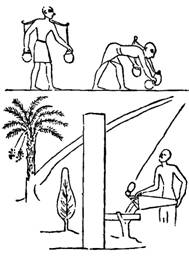
Watering Garden
Gardens were planted not only with fragrant and beautiful plants, but with various fruit-bearing and other trees (Gen 2:9; Jer 29:5; Amo 9:14). Thus we find mention of nut-gardens (Son 6:11), pomegranate-gardens (Son 4:13), olive gardens (Deu 8:8; 1Ch 27:28), vine-gardens (Son 4:2; Son 8:8). Here, however, we are not to suppose that the gardens were exclusively occupied by these fruits, but that they were severally predominant in the gardens to which they gave name. The distinction, for instance, between a vine-garden and a vineyard would be, that, in the latter, the vine was cultivated solely for use, whereas in the former it was planted for solace and ornament, to cover walls, and to be trained in arbors and on trellises.
Gardens were, when possible, planted near streams, which afforded the means of easy irrigation. This explains such passages as Gen 2:9, sq., and Isa 1:30. But streams were few in Palestine, at least such as afforded water in summer, when alone water was wanted for irrigation; hence rain-water, or water from the streams which dried up in summer, was in winter stored up in reservoirs, spacious enough to contain all the water likely to be needed during the dry season. In fact many of our own large nurseries are watered in the same manner from reservoirs of rain-water. The water was distributed through the garden in numerous small rills, which traversed it in all directions, and which were supplied either by a continued stream from the reservoir, or had water poured into them by the gardeners, in the manner shown in the Egyptian monuments. These rills being turned and directed by the foot, gave rise to the phrase ’watering by the foot,’ as indicative of garden irrigation (Deu 11:10). The adjoining representation (fig. 196) very clearly shows the way in which water was raised, by a balanced lever, from the stream or reservoir, and poured into a trough, whence it flowed into the various canals for irrigation. This method is still in use.
Gardens were dedicated to various uses among the Hebrews, such as we still find prevailing in the East. One most essential difference between them and our own is that they are not attached to or in any way connected with the residence but are situated in the suburbs. We have known gardens from half a mile to a mile distant from the houses of the persons to whom they belonged. It is manifest that all the gardens mentioned in Scripture were outside the several towns. This is, however, to be understood of regular gardens, for shrubs and flowers were often planted in the open courts of the dwelling-houses.
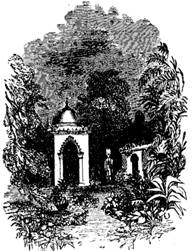
Garden Houses
People repair to their suburban gardens to take the air, to walk, and to refresh and solace themselves in various ways. For their use there is mostly in each garden a kind of summer-house or pavilion, fitted up with much neatness, gaily painted, and furnished with seats, where the visitants may sit and enjoy themselves. Here sometimes banquets were and are still given, attended by singing and music (Isa 51:3; Isa 65:3). The custom of burying the dead in gardens is indicated in Gen 23:19-20; 1Ki 2:34; 1Sa 25:1; Mar 15:46; and still occurs sometimes in the East, but is not very prevalent. We find it also among the Greeks and the Romans.
It is evident that the gardens of the Hebrews were in a very considerable degree devoted to the culture of medicinal herbs, the preparation of which in various ways was a matter of much solicitude with them (Jer 8:22). This is still the case in the East, where vegetable simples are as much employed in medicine as they were in this country in the times of Gerarde and Culpepper.
It would seem that the Jews were much in the habit of performing their devotions in gardens (Gen 24:63; Mat 6:28-30; Joh 1:48; Joh 18:1-2). This interesting practice, however, was idolatrously abused; for the worship of idols in these shady seclusions was not of infrequent occurrence, and is often mentioned in Scripture (1Ki 14:23; 2Ki 16:4; 2Ki 17:10; 2Ch 14:3; Isa 65:3; Isa 66:17; Jer 2:20; Jer 3:6; Eze 20:28).
Such are the principal points of information concerning gardens which may be collected from Scripture, or which may be connected with the Scriptural intimations.
There is no reason to suppose that the gardens of the ancient Jews differed in any material respect from those which are still found in Palestine. Such difference as did exist was doubtless occasioned chiefly by the minute rules which were founded upon the law forbidding the intermixture of diverse plants and seeds. The gardens of the Holy Land have been mentioned by travelers in terms too vague and general to afford the basis of a satisfactory description. Dr. Olin seems to have paid most attention to them. Of the gardens near Shechem he says, ’Upon turning an angle in the steep gorge we found ourselves, as if by enchantment, in the midst of fruitful gardens filled with vegetables, flowers, and fruit-trees, and all in the highest perfection of luxuriance and beauty. Olives, vines, acacias, pomegranates, figs, mulberries, and several species of trees which I did not recognize, are crowded together in small enclosures, forming an impervious shade as well as an impenetrable thicket; and yet the capabilities of the soil seem not to be overburdened. Each separate tree and plant thrives to admiration, and seems rather to profit than suffer from the thick dark canopy of branches and foliage, which entirely excludes the sun’s rays from the tangled huddle of trunks and roots. A beautiful mountain stream runs through the midst of this forest of gardens, in a channel mostly artificial and sometimes covered; but the water often rises into small fountains, and forms several cascades.’ The orange and citron trees which abound in these gardens near Shechem were probably those not recognized by Dr. Olin, from their not being in fruit at the time of his visit.
Garden. Gardens in the East, as the Hebrew word indicates, are enclosures on the outskirts of towns, planted with various trees and shrubs. From the allusions in the Bible, we learn that they were surrounded by hedges of thorn, Isa 5:5, or walls of stone. Pro 24:31. For further protection, lodges, Isa 1:8; Lam 2:6, or watchtowers, Mar 12:1, were built in them, in which sat the keeper, Job 27:18, to drive away the wild beasts and robbers, as is the case to this day.
The gardens of the Hebrews were planted with flowers and aromatic shrubs, Son 6:2; Son_ 4:16, besides olives, fig trees, nuts or walnuts, Son 6:12, pomegranates, and others for domestic use. Exo 23:11; Jer 29:5; Amo 9:14. Gardens of herbs, or kitchen gardens, are mentioned in Deu 11:10 and 1Ki 21:2. The rose garden in Jerusalem, said to have been situated westward of the Temple mount, is remarkable as having been one of the few gardens which, from the time of the prophets, existed within the city walls. The retirement of gardens rendered them favorite places for devotion.
An enclosure in the suburbs, fenced with a hedge or wall (Isa 5:5; Pro 24:31), planted with flowers, shrubs, and trees, guarded (from whence comes "garden") by watchmen in a lodge or tower (Isa 1:8, when the lodge is forsaken by the keeper, the bore poles leaning every way and the green boughs of the roof scattered, there could scarcely be a more vivid picture of Zion’s desolation, Mar 12:1) to drive away wild beasts and robbers (Job 27:18). The quince, citron, almond, and other fruits, also herbs (1Ki 21:2), cucumbers, lettuce, mustard, are mentioned as in gardens. The balsam, according to Pliny, grew only in two royal gardens of Judea, not elsewhere. Syria was so famed for gardens that the Greeks had a proverb, "the many garden herbs of the Syrians." The rose garden W. of the temple was peculiar in being within the walls; the smell from weeds and manure was the cause of gardens being usually forbidden within the walls.
A reservoir cistern, or still better a fountain of water, was essential to a good garden. Compare Son 4:15, "a fountain of gardens,"
Not only are his fruits (the tree’s proper fruit, Rev 22:2) good in themselves, but are in season (Ecc 3:1-11; contrast Mat 21:19). "His leaf" also has its beauty and use and is "unwithering" (Eze 47:12); even his minor traits of character are good after their kind, and his smallest undertaking, blessed because done unto the Lord and so shall abide. The law against mixing diverse seeds was observed by separating the various productions by light fences of reed. The "orchards" (Hebrew: "paradises") were especially for fruit trees, dates, figs, sycamores, etc. The occurrence of no less than 250 botanical terms in Old Testament shows the Israelite predilection for flowers, fruits, and pleasure grounds. The vine wound round the trellis or outer staircase, the emblem of the loving and fruitful wife and the happy home (Psa 128:3). The house court or area generally had its shady terebinth.
Under the shadowing fig leaves Nathanael communed with his God (Joh 1:48). The ripe grain in harvest joy was decorated with lilies; Son 7:2, "thy bodice (of amber color) is a heap of wheat set about with lilies" (white or scarlet, answering to her scarf round her person). The Hebrew used gardens also as burial places (Joh 19:41). Here Jesus’ sacred body was entombed in Joseph’s new sepulchre. Manasseh and Amen were buried in Uzza’s garden (2Ki 21:18; 2Ki 21:26). Machpelah’s field, Abraham’s burial ground, was a garden with "trees in it, and in all the borders round about it" (Gen 23:17). The garden of Gethsemane was Jesus’ favorite resort for devotion (Mat 26:36; Joh 18:1). Gardens were in idolatrous periods made the scene of superstition and image worship, the awful counterpart of the primitive Eden (Isa 1:29; Isa 65:3; Isa 66:17).
Solomon’s gardens and orchards with all kinds of fruits and pools of water for irrigation (Ecc 2:4-6) doubtless suggested the imagery Son 4:12-15. It was in a garden of light Adam fell; in a garden of darkness, Gethsemane, the Second Adam overcame the tempter and retrieved us. The "streams from Lebanon" imply that the fountain is lowly, the source lofty. Christ (and so Christ’s church) springs up on the earth, but has His source in heaven; no longer "sealed" but "open" streams (Rev 22:10; Rev 22:17).
The site near Bethlehem assigned to Solomon’s garden is probably correct. It is a suitable retreat, near the capital, and the names of localities about confirm the tradition: wady Urtas, "the valley of the garden"; gebel-el-Fureidis, "the hill of the little paradise"; "fig vale"; "peach hill"; "walnut walk"; "garden of nuts." The "king’s garden" (2Ki 25:4; Neh 3:15; Jer 34:4; Jer 52:7) was near the pool of Siloam, at the Tyropoeon valley, where the valleys of Jehoshaphat and Hinnom met.
(
4. Gardens were dedicated to various uses among the Hebrews, such as we still find prevailing in the East. One most essential difference between them and our own is that they are not attached to or in any way connected with the residence, but are situated in the suburbs, sometimes from half a mile to a mile distant from the houses of the persons to whom they belong. It is manifest that all the gardens mentioned in Scripture were outside the several towns. This is, however, to be understood of regular gardens, for shrubs and flowers were often planted in the open courts of the dwelling- houses. People repair to their suburban gardens to take the air, to walk, and to refresh and solace themselves in various ways. For their use there is mostly in each garden a kind of summer-house or pavilion, fitted up with much neatness, gayly painted, and furnished with seats, where the visitants may sit and enjoy themselves. Here sometimes banquets were and are still given, attended by singing and music (Isa 51:3; Isa 65:3). SEE GARDEN-HOUSE.
The kings and nobles had their country houses surrounded by gardens (1Ki 21:1; 2Ki 9:27), and these were used on festal occasions (Son 5:1). So intimately, indeed, were gardens associated with festivity, that horticulture and conviviality are, in the Talmud, denoted by the same term (Buxtorf, Lex. Talm. s.v.
It would seem that the Jews were much in the habit of performing their devotions in gardens, on account of their retirement (Gen 24:63; Matthew 16:30; 26:36; John 2:48; Joh 18:1-2). This interesting practice, however, was idolatrously abused; for the worship of idols in these shady seclusions was not of unfrequent occurrence, and is often mentioned in Scripture (1Ki 14:23; 2Ki 16:4; 2Ki 17:10; 2Ch 18:4; Isa 1:29; Isa 65:3; Isa 66:17; Jer 2:20; Jer 3:6; Eze 20:28). SEE GROVE.
The custom of burying the dead in.gardens is indicated in Gen 23:19-20; 2Ki 21:4; 2Ki 21:18; 2Ki 21:26; 1Sa 25:1; Mar 15:46; Joh 19:41; and still occurs sometimes in the East, but is not yery prevalent. We find it also among the Greeks (Heliodorus, ,Ethiop. 1:2, page 35), and the Romans (Suetonius, Galba, 20). SEE GRAVE.
5. Gardens were planted not only with fragrant and beautiful plants (Son 6:2; Son 4:16), but with various fruit-bearing and other trees (Gen 2:9; Exo 23:11; Jer 29:5; Amo 9:14). Thus we find mention of nut-gardens (Son 6:11), pomegranate-gardens (Son 4:13), olive-gardens (Deu 8:8; 1Ch 27:28), vine-gardens (Son 4:2; Son 8:8). Here, however, we are not to suppose that the gardens were exclusively occupied by these fruits, but that they were severally predominant in the gardens to which they gave name. The distinction, for instance, between a vine-garden and a vineyard would be, that, in the latter, the vine was cultivated solely for use, whereas in the former it was planted for solace and ornament, to cover walls, and to be trained in arbors and on trellises. The quince, medlar, citron, almond, and service trees are among those enumerated in the Mishna as cultivated in Palestine (Kilaim, 1:4). Gardens of herbs, or kitchen-gardens, are mentioned in Deu 11:10, and 1Ki 21:2. Cucumbers were grown in them (Isa 1:8; Bar 6:70), and probably also melons, leeks, onions, and garlic, which are spoken of (Num 11:5) as the productions of a neighboring country. In addition to these, the lettuce, mustard-plant (Luk 13:19), coriander, endive, one of the bitter herbs eaten with the paschal lamb, and rue, are particularized in the precepts of the Mishna, though it is not certain that they were all, strictly speaking, cultivated in the gardens of Palestine (Kilaim, 1:8). It is well known that, in the time of the Romans, the art of gardening was carried to great perfection in Syria. Pliny (20:16) speaks of it as proverbially elaborate, and again (12:54) he describes the balsam plant as growing in Judea alone, and there only in two royal gardens. It is evident that the gardens of the Hebrews were in a very considerable degree devoted to the culture of medicinal herbs, the preparation of which in various ways was a matter of much solicitude with them (Jer 8:22). This is still the case in the East, where vegetable simples are employed in medicine. SEE MEDICINE.
In addition to the ordinary productions of the country, we are tempted to infer from Isa 17:10, that in some gardens care was bestowed on the rearing of exotics. To this conclusion the description of the gardens of Solomon in the Targum on Ecc 2:5-6 seems to point: "I made me well-watered gardens and paradises, and sowed there all kinds of plants, some for use of eating, and some for use of drinking, and some for purposes of medicine; all kinds of plants of spices. I planted in them trees of emptiness (i.e., not fruit- bearing), and all trees of spices which the specters and daemons brought me from India, and every tree which produces fruit; and its border was from the wall of the citadel, which is in Jerusalem, by the waters of Siloah. I chose reservoirs of water, which, behold! are for watering the trees and the plants, and I made me fish-ponds of water, some of them also for the plantation which rears the trees to water it." In large gardens the orchard(
Garden. Gardens In the East were surrounded by hedges of thorn, Isa 5:5, or walls of stone. Pro 24:31. For further protection lodges, Isa 1:8; Lam 2:6, or watchtowers, Mar 12:1, were built in them, in which sat the keeper, Isa 5:2; Isa 21:6, to drive away the wild beasts and robbers. The gardens of the Hebrews were planted with flowers and aromatic shrubs, Son 6:2; Son 4:16, besides olives, fig trees, nuts or walnuts, Son 6:11, pomegranates, and others for domestic use. Exo 23:11; Jer 29:5; Amo 9:14. Gardens of herbs, or kitchen gardens, are mentioned in Deu 11:10 and 1Ki 21:2. The retirement of gardens rendered them favorite places for devotion.
GARDEN (
The fact of its being artificially and continually watered, distinguishes the garden proper from the ordinary grain field, the vineyard, and the plantation of olive or fig trees. The necessity, however, of having a protecting wall for fruit trees gives also to such an enclosure in a more general sense the name and character of a garden. These may be resorted to and passed through without objection except during summer and autumn, when the fruit is ripening. Such may have been the garden of Gethsemane, to which Christ retired with His disciples (Joh 18:1-2). In the garden containing the tomb in which Christ’s body was laid, Mary’s expectation of meeting with the gardener or caretaker (Joh 20:15) at the time of Easter would rather point to the more careful cultivation of the irrigated garden.
To the Oriental the garden is a place of retirement and rest. Its sound of falling or running water is one of the luxuries of life. Its shade affords escape from the glare of the sun, and its recognized privacy forbids the introduction at the close of the day of disturbing news, exacting claims, or perplexing decisions. The voice of nature seems to say, ‘I will give you rest.’ It has thus become a symbol of Heaven, and supplies a common term of immortal hope to the three great monotheistic religions, inasmuch as the Christian ‘Paradise’ is the equivalent of the Jewish Gan-Eden, ‘Garden of Eden,’ and the Moslem il-Gannat, ‘the Garden.’
G. M. Mackie.
See HORTICULTURE:
GARDEN (Heb. gan [lit. ‘enclosure’], gannah, which, like the Persian [mod. Armenian] pardçs [Neh 2:8 etc.], and the Arab
The gardens, with their luxuriant foliage and soft obscurities, were greatly resorted to for purposes of idolatry (Isa 56:3, Bar 6:70). There the Moslem may be seen to-day, spreading his cloth or garment under orange, fig, or mulberry, and performing his devotions. The garden furnishes the charms of his heaven (el-jannah, or Firdaus): see artt. Paradise, Eden [Garden of].
Tombs were often cut in the rock between the trees (2Ki 21:18 etc.); in such a tomb the body of Jesus was laid (Joh 19:41).
W. Ewing.
Such gardens are still common throughout the Levant. They are usually situated on the outskirts of a city (compare Joh 18:1, Joh 18:26; Joh 19:41), except in the case of the more pretentious estates of rich pashas or of the government seats (compare 2Ki 21:18; Est 1:5; Est 7:7, Est 7:8; Neh 3:15; 2Ki 25:4; Jer 39:4; Jer 52:7). They are enclosed with walls of mud blocks, as in Damascus, or stone walls capped with thorns, or with hedges of thorny bushes (compare Lam 2:6 the American Revised Version, margin), or prickly pear. In nearly treeless countries, where there is no rain during 4 or 5 months, at least, of the year, the gardens are often the only spots where trees and other vegetation can flourish, and here the existence of vegetation depends upon the water supply, brought in canals from streams, or raised from wells by more or less crude lifting machines (compare Num 24:7). Such references as Gen 2:10; Num 24:6; Deu 11:10; Isa 1:30; Isa 58:11; Son 4:15 indicate that in ancient times they were as dependent upon irrigation in Biblical lands as at present. The planning of their gardens so as to utilize the water supplies has become instinctive with the inhabitants of Palestine and Syria. The writer has seen a group of young Arab boys modeling a garden out of mud and conducting water to irrigate it by channels from a nearby canal, in a manner that a modern engineer would admire. Gardens are cultivated, not only for their fruits and herbs (compare Son 6:11; Isa 1:8; 1Ki 21:2) and shade (compare Son 6:11; Luk 13:19), but they are planned to serve as dwelling-places during the summer time when the houses are hot and stuffy. That this was an ancient practice is indicated by Son 5:2; Son 6:2; Son 8:13. A shaded garden, the air laden with the ethereal perfumes of fruits and flowers, accompanied by the music of running water, a couch on which to sit or recline, suggest a condition of bliss dear to the Oriental. Only one who has traveled for days in a dry, glaring desert country and has come upon a spot like the gardens of such a city as Damascus, can realize how near like paradise these gardens can appear. Mohammed pictured such a place as the future abode of his followers No doubt the remembrances of his visit to Damascus were fresh in his mind when he wrote.
Gardens were used as places of sacrifice, especially in heathen worship (Isa 1:29; Isa 65:3; Isa 66:17). They sometimes contained burial places (2Ki 21:18, 2Ki 21:26; Joh 19:41).
Figurative: The destruction of gardens typified desolation (Amo 4:9); on the other hand, fruitful gardens figured prosperity (Num 24:6; Job 8:16; Isa 51:3; Isa 58:11; Isa 61:11; Jer 29:5, Jer 29:28; Jer 31:12; Amo 9:14).
Num 24:6 (a) A word which is used to describe the fragrant and fruitful nation of Israel as seen by the Lord through the eyes of Balaam from the mountain top. GOD looked down through the smoke of the sacrifice. He did not see the iniquities and evils of Israel, but rather describes them in this beautiful way.
Job 8:16 (a) By this term Bildad describes the beautiful life filled with radiance and fragrance of that one who walks with GOD, and lives for His glory.
Son 4:12 (c) We may take the expression as a picture of the Church in which GOD’s people are the flowers, and their worship is the fragrance. (See also Son 5:1; Son 6:2; Son 6:11).
Isa 1:8 (a) Here is a type which describes the woeful conditions of the nation of Israel which should have been filled with useful and beautiful fruit, but instead produced only a strange, worthless useless fruit of the cucumber vine. The cucumber was one of the articles of food that Israel had to eat in Egypt when they were slaves. It is not a stable fruit as apples, but soon decays, and even while it is in good form it is of little use for sustaining life. This is like the pleasures which the world offers. Sports exhilarate for a few moments, but leave no permanent value in the lives of those who see them. The pleasures which GOD offers are for evermore. (See also verses 29 and 30).
Isa 51:3 (a) Here we find that the Lord gives His definite promise that the nation of Israel which now is of so little use to GOD will one day be a fruitful nation blessing the earth, and bringing joy to the heart of GOD.
Isa 58:11 (a) Here we see a beautiful type of the happy condition of the soul of that one who walks with the Lord, learns from His Word, and rejoices in the presence and the ministry of the Holy Spirit.
Isa 66:17 (b) Probably this type refers to the lives of those who live in wealth with plenty for their bodies to enjoy, while their souls are in rebellion against GOD.
Jer 31:12 (a) By this type the Lord is describing to us the blessing that will rest upon the nation of Israel in the millennium when they have turned back to GOD, and He has removed all cause for the grief and sorrow.
Lam 2:6 (b) In this way the Lord is referring to the transient character of Israel. He is telling us that He will remove the nation as the small shelterhouse in a garden is easily removed and destroyed.
Luk 13:19 (b) Here is a picture of the fair earth in which foul religions develop. It is also a picture of the nation of Israel in which false beliefs and practices arose and flourished.
Joh 19:41 (c) Joseph of Arimathea, a rich man, had a garden in which Calvary was located. It was not a bare hill as we often sing. No garden is a bare, rocky, lonely hill. It was a beautiful place in which the Cross was erected. Men sometimes build gardens for themselves with a mansion, flowers, and all the peculiar treasures of the wealthy, but arrange no place for CHRIST.
He is crucified afresh. He is not permitted to rule and reign.