
a country of Europe, having an area of 204,092 square miles, and in 1886 a population of 38,218,403 inhabitants.
I. CHURCH HISTORY. —
1. From the first Establishment of Christianity until the 16th Century. — France, or, as it was formerly called, Gaul, was among the first of the European countries in which Christian churches were founded. Roman Catholic writers tell us that the apostle Peter ordained bishops for Limoges, Toulouse, Bordeaux, Rheims, Aries, Sens, le Mans, Vienne, Chalons, Bourges, Clermont, and Saintes. This statement is not historical; but it is certain that Christianity was planted in many parts of Gaul at least as early as the 2d century. The first Christians in Gaul doubtless came from Asia Minor. We may assume as certain that the number of churches was already tolerably large at the time of Irenseus (q.v.) who in 198 presided at three provincial synods, and seems to have established a school of catechists at Lyons. At the beginning of the 4th century there was no province in Gaul as to which we have not accounts of bishoprics, or at least of Christian churches. Of the nations which founded new kingdoms in Gaul in the 5th century the Burgundians were already Christians when they left the southern districts of Germany, and settled between the rivers Saone and Rhone and the Alps, before the year 417. Among the Franks, king Clovis (q.v.) first embraced Christianity, together with more than 3000 soldiers, after the battle of Tolbiacum, in 496. In the mean time Christianity became so generally extended in all parts of the country, in the north has well as in the south, that Church provinces began to be farmed everywhere, the capital of each political province generally becoming also thee neat of the metropolitan. The Franks, embracing the Catholic faith while a considerable part of Europe was still under the rule of the Arians, began soon to be regarded as the chief Catholic nation of Europe. Through the establishment of the empire of Charlemagne, France seemed for a time to become only a part of the union of all the German nations, but soon after the division of the empire in 843 it recommenced its development as an independent state. King Lothaire I was obliged to humble himself before the pope, as the hostile princes of his own family stood ready to execute the papal threats, and the Frankish bishops did not object to have the spurious decretals, SEE PSEUDO-DECRETALS, used for the first time against, Hincmar (q.v.) of Rheims, for they thought it better to obey a distant pope than a threatening metropolitan at home. But when, after the death of Lothaire I (869), Hadrian II attempted to interfere in the political and ecclesiastical controversies of France, Hincmar gave him to understand that in France a wide distinction was made between spiritual and secular power, and that the bishops of older times had had independent privileges. The emperor Charles the Bald compelled the French bishops to acknowledge Ansegius archbishop of Sens, as the primate and papal vicar for Gaul and Germany; but, under the counsel of Hincmar, they persisted in obeying the holy father only as far as was consistent with the rights of all the metropolitans and with the laws of the Church. In general, the bishops of France, as well as the kings, resisted more energetically than any other nation the ever- growing claims of the popes, and their unceasing efforts to establish an absolute sway over all bishops, synods, and kings. The Gallican Church stands forth ins Church History as the prominent defender of national and episcopal rights against papal usurpations. Urban II, at the Council of Clermont (1095), excommunicated king Philip for his adulterous connection with the countess Bertrade, and, aided by the sympathy of the people, compelled him to give up his paramour. Louis IX (q.v.), though so firmly attached to the doctrines and usages of his Church that, after his death, he was declared a saint, confirmed the rights of the nation by the Pragmatic Sanction in 1269, the great palladium of the Gallican Church. SEE GALLICANISM.
In opposition to pope Boniface VIII, who declared every one a heretic who did not believe that the king in temporal as well as in spiritual matters was subject to the pope, the three estates of France, convened in a General Diet (1302), were unanimous in maintaining the independence of the French kingdom, The pope pronounced an interdict upon the whole of France, but popular opinion effectually protested against all attempts to blend the spiritual with the secular authority. In 1303 the king of France even succeeded in having a pope elected who took up his residence at Avignon (q.v.), and for more than a hundred years (until 1408) the papacy remained a tool in the bands of the French kings. The concordat which Martin V proposed to France was rejected in 1418 by the Parliament, which has ever since remained the steadfast advocate of Gallican liberties. The kings, however were not equally steadfast in their opposition to the demands of thee popes, and often made concessions in the hope, with the aid of the popes, of increasing their power at home. Thus the new Pragmatic Sanction, which the Council of Bourges (q.v.) established in 1438, was soon set aside by the succeeding kings. In all the great ecclesiastical movements of the Middle Ages France took a prominent part. Most of the efforts made either to overthrow the papacy for the purpose of restoring a purer forma of Christianity, SEE WALDENSES; SEE ALBIGENSES, or to reform the Church from within, either centred in France, or found there the most vigorous support.
2. History of the Roman Catholic Church since the beginning of the 16th Century. At the beginning of the 16th century Francis I concluded a concordat, August 18, 1516, in which he sacrificed many of the liberties of the Gothican Church. After the rise of the Reformation the Roman Church succeeded in securing her ascendency by long-continued and cruel persecution (see below, History of the French Reformed Church). Henry IV, when contesting the throne of France, found the public sentiment so strongly in favor of the. old Church that he thought it expedient, from political reasons,. to change his faith. Henceforth the ascendency of the Roman Church over Protestantism was secured, and the reformatory movements of the Jansenists (q.v.) and others were likewise suppressed, at the request of the popes, by. the secular arm. The Golden Age of France, under Louis XIV, produced also in the Church some master minds, as Bossuet, Fenelon, Bourdaloue and many others, who were ornament of their Church, but were not able to stay the rising tide of an infidel philosophy. The episcopate, under the leadership of Bossuet, reaffirmed the liberties of the Gallican Church at the famous assembly held in 1682.. This assembly, which consisted of eight archbishops, twenty-six bishops, and thirty-eight other clergymen, unanimously affirmed the principles of the Regale (the Pragmatic Sanction of 1438), announcing them in the forms of four propositions, which were registered by the Parliament of Paris March 23, 1682. Though the popes often succeeded in enforcing obedience to their decrees, most of the great theologians of the 17th and 18th centuries adhered to Gallican doctrines, and the Regale continued in force until the revolution of 1789. Monasticism, in the same period reached the climax of literary culture in some congregations of the French Benedictines and Oratorians. Nevertheless the very foundations of the Roman Church were gradually undermined by the spread of French philosophy, and the success of the French Revolution seemed for a time to sweep away the entire Church of France. The National Assembly decreed (November 27, 1790) that all ecclesiastical officers, under penalty of losing their offices, should take an oath for the civil constitution of thee clergy, which Pius VI declared (April 13, 1791) inadmissible. Bishops were chosen in accordance with the new law, and consecrated without having the confirmation of the pope. In 1793 Christianity itself was declared to be. abolished. Napoleon, though perhaps personally indifferent towards all churches, regarded the re-establishment of the Roman Church as the religion of the state as indispensable to. the tranquillity of the country, and therefore concluded in 1801 a concordat, SEE CONCORDAT, the introduction of which was solemnized in 1802. Napoleon added to the concordat certain organic laws, which make the promulgation of papal decrees dependent on the authorization of the government, establish an appeal to the Council of State against the abuses of ecclesiastical power, and bind, the theological seminaries to the four propositions of the Gallican clergy of 1682. Two years later Napoleon was crowned emperor by the pope.
When, however, the States of the Church were taken possession of by the French (1808), and when the pope declared every one who laid his hand upon the patrimony of St. Peter excommunicated, Napoleon had the pope arrested and brought to France. An attempt to render, by means of a synod convoked at Paris (1811), the French Church independent of Rome, failed. In. 1813 Napoleon extorted, in a new concordat, some important concessions from the imprisoned pope; and when the pope revoked all he had done, Napoleon published the concord at as the law of the empire on the. very next day (March 25). After the overthrow of Napoleon (1815), Louis XVIII recognised the Roman Church as the religion of the state, though granting religious toleration to every form of public worship. Powerful efforts were made to re-estasblish among the French the belief in the doctrines of the Roman Church, and the leaders in this contest Lamennais (q.v.), de Maistre (q.v.), and the “priests of the Mission” (q.v.) attached themselves more closely to the papal than to the Gallicans school. Gallicanism, at least is its ancient form, began to die out. The Apostolic Congregation, though in opposition to the. inclinations of the prudent king, obtained a concordat (1817) by which the concordat of 1801 was revoked, and that of 1516 substituted for it. So decided, however, was the opposition of public opinion that it was never laid before the Chamber of Deputies. Without the consent of the Chambers, the government of Louis XVIII, and still more that of Charles X, did as much for the Church as was in their power, although, to appease public excitement, a royal ordinance (June 16, 1828) had to close the schools of the Jesuits. The revolution of 1830 was connected with some outbreaks of popular indignation against the Church, which lost the prerogative of being the religion of the state. Yet Louis Philippe made as great concessions to the Church as the origin of his own authority would allow. Lamennais, Lacordaire, Maontalembert, and others anticipated great results from a union between ultramontanism and democracy, but the condemnation of their organ, L’Avenir, by the pope, put a stop to their novel schemes, and drove Lamennais out of the Church. An attempt, made by. the abbe Chatel in 1830, to found a new French Catholic Church, in the spirit of an extravagant liberalism, and without any Christian basis, was an utter failure.
A plan of national education, which placed (1833) the public schools under the superintendence of the: university was violently assailed by the Church, yet the government never ceased. to seek a reconciliation, or at least a compromise, with the Church; and when Thiers called up in the Chamber of Deputies the laws still in existence against the Jesuits, the government executed them with the utmost possible mildness. To the Republican Revolution of 1848 the Church offered no opposition, and. the priests did not hesitate to bless the tree of liberty and pray for the sovereign people. The Church received almost everything she had been in vain demanding during the reign of Louis Philippe. Nevertheless, the dread of the Red Republic made most of the clergy and of the leaders of the Catholic party partisans of Louis Napoleon. Having become emperor, Napoleon III attached a majority of the bishops and of the ultramontane school to his interests by increasing the salaries of the bishops, raising their influence in the supreme educational and political boards of the state and by permitting the bishops to revive the provincial councils which had been in desuetude for more than a hundred years. The ultramontane school, headed by the Univers, readily approved of all the measures of the government by which the political liberties of the nation were curtailed, and many hoped that the emperor would realize their boldest dream — the restoration of a politico- ecclesiastical theocracy under the rule of the pope. Yet many leading men in the Church, especially among the laity, dissented from this view, and organized a moderate school, which not only opposed the political views of the government and of the ultramontanes, but also accused the latter of ultraism in their defense of ecclesiastical institutions and practices. Montalembert, Lacordaire, prince de Broglie, Falloux, Lenormant, and bishop Dupanloup of Orleans were the most distinguished men of the party, the Correspondent and the Ami de la Religion its most important organs. The controversy between the two parties grew not only very bitter and violent; but even led several times to a split between the bishops, whose sympathies were almost equally divided between the two parties. Several bishops. took decided ground against the Univers, and even in Paris it required the mediation of the pope to prevent its prohibitions by archbishop Siboiur. An entire change in the relation of Napoleon to the Church and the so-called Catholic party took place is consequence of the war in Italy (1857) and the attitude of Napoleon with regard to the temporal sovereignty of the pope. The war silenced all the eulogies of the emperor, and only a few solitary voices, like that of Lacordaire, dared to express sympathy with the cause of Italian independence. But after Napoleon had advised the pope to give up a portion of his states, both thee parties, the ultramontane and the moderate, turned against the government. All the bishops except one condemned, more or less explicitly, the course pursued my the government, and every ecclesiastical journal in France took the same ground. Thee government used all means to keep down the agitation of thee public mind on the subject, and to force the leading advocates of the ecclesiastical interests to submission. The Univers and several Catholic papers in the provinces were suppressed, and almost every other organ of the party received an official warning; and the bishops were threatened, in the case of a continuance of the agitation, with the re- enforcing of the organic articles. It is generally admitted that thee Roman Church in France has grown strong in comparison with its condition during the 18th and at the beginning of the 19th century. All the leading religious societies, confraternities, and associations of the Roman Church center in France, which contributes for some religious purposes, as the foreign missions, more than the rest of the Roman Church together.
3. The History of French Protestantism. — The Reformation of the 16th century, soon after its rise in Germany and Switzerland, found many friends and patrons in France; but it met at once with a determined opposition on the part of the University of Paris, which declared against it in 1521. Among the earliest preachers of the Reformed faith were Bucer, Melancthon, Lefevre, and Farel;, somewhat later, Calvin published his Institutes of the Christian Religion, with a dedication to king Francis I. In 1521 the first Protestant congregation was formed at Meaux, the bishop of which city, Briconnet (q.v.), was one of the converts of Lefevre and Farel. The bishop subsequently yielded to persecution and recanted, but the congregation maintained itself. (For a fuller account of the beginnings. of Protestantisms in France, SEE REFORMATION. )
Under the reign of Henry II (1547-59), the members of the French Reformed Church had increased so greatly in numbers and strength that it became difficult to treat them any longer as holders of a forbidden religion. The Protestants did not content themselves with seeking to secure toleration, hut, regarding the Roman Church as doomed to destruction, and themselves as called by God to take its place, they often entered into plans for establishing Protestantism as the religion of the state. The adhesion to the Reformation of several members of the royal, family, as the king of Navarre and his brother, the prince of Conde, and several grandees of the empire (among whom the three brothers Chatillon and the noble admiral Coligny distinguished themselves), early introduced into the Protestant Church a political element which: was: strengthened by the cruel rigor with which the princes generally persecuted. it. This element was developed the more strongly as the general spirit of those. times was democratic, and as Calvin himself, the father of the Reformed Church, inclined to theocratic principles. “In 1555 the first avowed French Reformed church was established in Paris. All the chief towns followed this example. The first synod of the French Protestant Church assembled privately in Paris, May 25, 1559. Owing to the danger of the enterprise only thirteen churches sent deputies. Nevertheless, the foundations of an important superstructure were then and there laid. A complete system of ecclesiastical polity was speedily adopted, for the members of the synod had too vivid a sense: of the dangers to which they were exposed to waste time in unprofitable discussions among themselves. The form of government thus established was thoroughly Presbyterian in its character. It seems to have corresponded very closely to that of the Church of Scotland. The Consistory maybe viewed as representing the Kirk Session, the, Colloquy the Presbytery, while the Provincial Synods of each are analogous; and the National Synod corresponds to the General Assembly. The Consistory was elected at first by the whole congregation over which it was to rule, but vacancies occurring afterwards were filled up by the Colloquy. The ministers were elected by the Colloquy. A minister, on being thus elected, was required to preach before the congregation on three consecutive Sabbaths; whereafter, if no objection was made, the congregation was considered as acquiescing in the appointment. If there was any objection, the matter was referred to the Provincial Synod, whose decision was final. These provincial synods have been generally sixteen in number. The National Synod has met but seldom, owing to the severe persecutions to which the Church has been exposed, and the increasing restrictions which have been imposed upon her. The Confession of Faith adopted at the first synod consisted of forty articles. Its doctrines were strictly Calvinistic. Though the Church was much harassed by persecution during the reign of Henry II, still it greatly increased; so much so that we are told that Beza, who died in 1605, could count 2150 churches in connection with the Protestant Church of France; and the churches were not small or insignificant in point of strength. In some there were, 10,000 members. The church of Orleans had 7000 communicants, and the ministers in such churches were proportionally numerous: two ministers to a church was common, and that of Orleans had five. At this period there were 305 pastors in the one province of Normandy, and in Provence there were 60” (Eadie, s.v.). The cruel persecution to which the Calvinists were subjected after the death of Henry II, under the reign of Francis II, led them to organize the Conspiracy of Amboise, in which some discontented members of the Roman Catholic Church also took part, though the majority of the conspirators were Calvinists, Its aim was the overthrow of the proud duke of Guise and his brother, the cardinal of Lorraine, who were the uncles of the king, and the chief instigators of the persecution of the Protestants. The conspiracy was betrayed, and many of the participants lost their lives. Calvin and Beza had been notified of the enterprise, but discouraged it, though they did not feel themselves bound to betray it. The weak king of Navarre, and still more his brother, the prince of Conde, were implicated in the plot, and nothing but the death of the king saved their lives. The Calvinists henceforth received the name Huguenots, a name whose etymology is not quite certain. SEE HUGUENOTS.
During the regency of Catharine of Medicis the Huguenots increased in number, and the court party, which feared that their extirpation was not possible without exposing France to the terrors of civil war was inclined to grant them religious toleration. The dukes of Guise saw the necessity of enlarging and consolidating the Catholic party. They prevailed on the aged and vainglorious constable of Montmorency to form with them a triumvirate, which was soon also joined by the king of Navarre, who was induced by false promises to abandon the cause of the Huguenots. The cardinal of Lorraine even feigned an inclination to the Confession of Augsburg, and, contrary to the wishes of his own party, brought about a, religious conference with the Calvinists at Poissy (1561), at which Beza brilliantly defended the Reformation against the whole prelatic strength of the Roman Church. A committee, consisting of five members of each party was appointed to conciliate the views of the two churches concerning the doctrine of the Lord’s Supper. It succeeded in drawing up a formula which was accepted by the Calvinists, as well as by the queen-mother and the cardinal. But the Sorbonne declared it to be heretical, and it was soon generally abandoned. The celebrated edict of January, 1562, granted to the Huguenots provisionally the right to assemble for religious worship outside of the towns, until further provisions should be made by an oecumenical council. Beza and the Huguenots in general accepted this trifling concession with gratitude, but a number of Parliaments, especially that of Paris, raised against it the strongest remonstrances. The duke of Guise threatened to cut it with the edge of his sword, and commenced hostilities in the same year at Vassy, where a number of the Huguenots were massacred. A bloody civil war ensued, in which the Huguenots suffered heavy losses, and which was ended by the Peace of St. Germain (1570), in which the government gave to the Huguenots four fortified towns as security for the future. The Huguenots conceived new hopes; their chief defender, Henry of Navarre, was married to the king’s sister; but when all their chief men were assembled at Paris to celebrate the nuptials, the queen mother gave treacherously the sign for that general and bloody massacre known in history as the Night of St. Bartholomew, in which from 20,000 to 100,000 Protestants perished, and among them the great Coligny (q.v.). The Protestants again rose in despair, and received new concessions in the Edict of Poitiers (1577), but the Holy League, which had been organized by the duke of Guise and his brother, compelled the king to revoke everything, and to take a pledge not to rest until the last heretic should be extirpated from France. The assassination of the duke of Guise and his brother by order of the king, who wished to free himself from the influence of the League, stirred up anew the fanaticism of the Catholic population, and led to the expulsion, and, later, to the assassination of the king himself. The legitimate heir to the throne, Henry of Navarre, had been the head of the Protestants, yet, to overcome the hostility of the Roman Catholic party, he believed it necessary to join the Roman Church (1593)He gave, however, to his former co-religionists, by the Edict of Nantes (1598), which he declared irrevocable, freedom of faith and of public worship (with only a few restrictions), their rights as citizens, and great privileges as an organized political corporation. They were declared eligible for admission into the university, and for appointments in the public service, and received an annual grant of 1000 crowns. The remonstrances of several magistrates and provinces against this decree were in vain. Thus brighter days seemed to approach. During the twenty-six years which intervened between the massacre of St. Bartholomew and the publication of the Edict of Nantes only six National Synods had been held, and the only thing that had served to cheer up the drooping hearts of Protestants had been the publication of anew and improved edition of the Genevan version of the Bible. After the assassination of Henry IV (1610) the Protestants were again forced by persecution to take up arms in defense of their rights; but they were disarmed as a political party by cardinal Richelieu, though, by an act of amnesty at Nismes (1629), he secured to them their former ecclesiastical privileges. About this time their number had been reduced to only about half of what it was before the massacre of St. Bartholomew. Louis XIV regarded it as his special mission to break the power of Protestantism in the state. The Protestants were deprived of a great many churches and schools; the utmost efforts were made to convert all who were accessible to fear, promises, or persuasion; children were taken from their parents; “booted missions of dragoons” were sent in every direction (after 1681), and at last the Edict of Nantes was formally repealed in 1685. SEE NANTES, EDICT OF.
One mountain tribe, SEE CAMISARDS, in the Cevennes took up arms against the king, but its prophets and heroes either perished on the battle- field, or gained only the privilege of going into exile (1704). It is calculated that from 30,000 to 40,000 Protestants fled from France at this time. Nevertheless, two millions of the Reformed remained, with no congregations except in the wilderness, and in 1744 they again held Their first National Synod. “In the closing years of thee reign of Louis XIV, and during the regency of Philippe d’Orleans, the Protestants were more leniently dealt with. Though now enjoying external peace, the Church began to exhibit signs of internal declension. The chief causes producing this effect were the want of trained and educated men to fill the office of pastor, and the spirit of fanaticism which had sprung up among the members of the Church. These defects were remedied mainly by the exertions of Antoine Court, who has been styled the ‘Restorer of the Protestantism of France.’ He instituted prayer-meetings wherever he could, and also held synods or conferences of the ministers,. along with a few intelligent laymen. By thus exciting a spirit of prayer and a love of order he much benefited the Church. But, while the Protestant Church was gradually recovering from, its depressed condition, it was startled by the proclamation by Louis XV, on May 14, 1724, of the last great law against the Protestants, This law re-enforced the most severe measure of Louis XIV. It sought not so much to intimidate Protestants into a recantation, or to punish them if they refused but rather sought to force them, willing or not, to receive the ordinances of the Roman Catholic Church. For instance, it made baptism by the parish curate compulsory in every case, and declared that no marriage was valid unless performed by a Roman priest. This attempt to force people into the Church of Rome only drove them further from it. Antoine Court (q.v.) was supported by multitudes.
The Provincial Synods, which he had reinvigorated, multiplied; and, to meet the want of pastors, he opened a school of theology at Lausanne, which continued to supply the Protestant, Church with pastors until the time of Napoleon. From 1730 to 1744 the Protestants enjoyed quiet. In the latter years a National Synod was held in Lower Languedoc. When the news of the holding of this synod reached Paris, it caused the king sand his ministers to embark in a new crusade of horrors against the defenseless Protestants. This caused a new emigration. Calmer days followed the storm, and, after 1760, principles of toleration began to prevail. The school of Voltaire, while doing incalculable injury to the cause of religion and morality generally, did good service in spreading the principles of toleration and of religious liberty. The nation gradually became leavened with these principles. Louis XVI, though rather inclined to the opposite principles, was ultimately obliged to yield to the spirit of the age, and in November, 1788, be published an edict of tolerance. The privileges granted by this edict to those who were not Roman Catholics are the following: ‘The right of living in France, and of exercising a profession or trade in the kingdom, without being disturbed on account of religion; the permission to marry legally before the officers of justice; the authority to record the births of their children before the local judge.’ It also included a provision for the interment of those who could not be buried according to the Roman Catholic ritual” (Eadie, s.v.).
The Reformation of Luther found early adherents in France, some of whom suffered martyrdom for them faith, SEE REFORMATION IN FRANCE, but the influence of Calvin soon prevailed. In 1648, Alsace, and a, number of other districts and towns in which the Lutheran Church was either exclusively or partly established, were ceded to France by the Peace of Westphalia. Religious liberty was guaranteed to the Lutherans, and again confirmed by the Peace of Nymvegen in 1678. On the same terms France acquired, in 1681, Strasburg, and in 1696, from Wurtemberg, Mompelgard. The congregations of these districts gradually coalesced into the one evangelical Lutheran Church of France, showing the diversities of its origin by the variety of liturgies, hymn-books, catechisms, etc. which are still in use. The free exercise of their worship has not on the whole, been interfered with; yet many royal decrees have favored the Roman Church and proselytism, and the number of entire congregations which have been brought back to the Roman Church is said to be over sixty.
The National Assembly of 1789 gave to all religious denominations equal rights, yet the Revolution soon. afterwards raged against thee Protestant churches as much as against the Roman Catholic. Peace and order were first restored by the decree of 1802, in which Napoleon assigned to the clergymen of the French Reformed and the French Lutheran churches salaries from the public treasury, and gave them, of his own authority, a new constitution. The principal points of this constitution were as follows: The lowest ecclesiastical board for both denominations, is the Consistory, which consists of the pastors of the consistorial district, and from six to twelve laymen. There is to be one Consistory for every 6000 souls, no matter whether they belong to one or to several congregations. The lay members are elected every other year from the number of those citizens who pay the highest taxes. The Cosnsistory is presided over by the oldest pastor. In the Reformed Church five consistorial districts form one synodal district. The Provincial Synod consists of one pastor and one elder from every congregations The president is elected. The synod cannot be convoked without the permission of the government; cans discuss only subjects which have previously been brought to the knowledge of the minister, of public worship, and in the presence of the prefect or an officer delegated by him; and can remain in session only six days. The Lutheran Church is divided into Inspections, the assemblies of which correspond to the Provincial Synods of the Reformed Church, with this difference, however, that the assemblies of the Lutheran Church elect for lifetime one inspector, and two lay, adjuncts, who have the right to visit the churches. Above these provincial synods stands in the Lutheran Church a kind of central synod, called the General Consistory. It consists of a lay president and two clerical inspectors, appointed by the government for life, and of one lay deputy from every Inspection elected for life. This board is subject to the same restrictions ass the Provincial Synods and the Assemblies of the Inspections.
In the interval between the sessions, a committee, consisting of the president, the elder of the two inspectors, two lay members designated by the General Consistory, and a commissary appointed by the head of the state, acts as the supreme administrative board of the Church. This responsible committee, is called the Directory. At first this new constitution was regarded with great favor by the Protestants, but its defects soon revealed themselves. The Reformed Church complained that the Provincial Synods cere never convoked. The want of Presbyterial Councils was so palpable that they were organized in spite of the silence of the law, in the Reformed Church, under the name of Consistoires Sectionnaires; in the Lutheran Church, under the name Conseils Presbyteraux. The larger Reformed congregations also appointed deacons, to have the care of the poor, and this example was imitated by the Lutheran congregation of Colmar. During the reign of Napoleon and that of the Bourbons, no improvement of the law could be expected, because the one was too absolute, and the other too hostile to Protestantism. Under Louis Philippe several attempts were made to reorganize the Church, but dissension between the government and the Church boards, and, in the Lutheran Church, between the Inspections and the General Consistory, frustrated all these efforts. After the Revolution of 1848, both churches availed themselves of the liberty granted to them, and held General Assemblies, which prepared drafts of new constitutions, and also expressed a desire for union between the two churches. Louis Napoleon returned to the principles of the former legislation, and by a decree of March 26, 1852, re-established the law of 1802, with a few alterations. According to these alterations, Presbyterial Councils, based on universal suffrage, are established in both churches; from them Consistories proceed, which elect their clerical president, who must, however, be approved by the government. The Reformed Church receives, moreover, from the government a Conseil Central, as supreme ecclesiastical board, the members of which are appointed by the government. But the Consistories have not yet admitted the authority of the Conseil, which, in fact, is only an organ for the government rather than for the churches. In the Lutheran Church the inspectors are in future to be appointed for life by the government, instead of being elected by the district assemblies. The supreme Church board is called the Supreme Consistory, and the government appoints its president and one member. All the inspectors are also members of this Supreme Consistory, with two lay deputies from each inspection district, and one deputy of the theological seminary.
The election of these latter two classes is left to the Church. The Directory has the right of appointing all pastors, subject to the. approval of the government. Soon after the publication of the decree of March 26, a new division and an increase of the consistories of the two churches, and of the Inspections of the Lutheran Church, took place. This reorganization of the two churches afforded to both this theoretical advantage, that each department was assigned to a Consistory, and that henceforth congregations could be formed without having to encounter obstacles on the part of Roman Catholic boards. On the other hand, it was pernicious to the interests of the dissenters, many of whose churches and schools were closed in the purely Roman Catholic districts. In consequence of the hostility of the bishops, and their influence in the provinces, the Protestants had frequently to suffer from articles 291, 292, and 294 of the Napoleonic Criminal Code, according to which all associations of twenty persons or more, without previous authorization of the government, are forbidden. This law has frequently been put in force against the religious meetings of the Protestants, both in the state and in the free churches, in places where there are no church edifices. Many of these grievances were redressed on the establishment of the Republic, when a minister of public worship declared those articles not to be applicable to religious meetings. But a decree of Louis Napoleon, issued March 25, 1852, extended it again to “all public meetings,” and subjected the Protestants to many new annoyances. They hope to find some relief from a recent law of March 19, 1859, which takes the authorization of new churches, chapels, and oratories out of the hands of the prefects, and transfers it to the State Council, which is less suspected of yielding to the influence of the bishops and the Roman Catholic party. A great revival in the Protestant churches commenced about 1820. Those who, under the influence of this revival, sought to unite themselves by closet spiritual bonds than the state churches afforded them were generally designated by the name Methodists, although they were not organized as a Methodist denomination. Many of the converts kept themselves aloof from the state churches, and began to lay the foundation of independent congregations. In the state Church a violent contest arose between the Evangelical and the Rationalistic parties. The “Evangelical Association,” founded in 1833, was supported as a home missionary society by evangelical Christians both in and out of the state churches. A large number of religious societies sprung up, partly supported by only one of the great parties, but partly also by both. In 1848, Frederick Monod (q.v.), with several other clergymen of the Evangelical school, seceded from the Reformed State Church because the synod of the Church refused to demand from all ministers an adhesion to the fundamental articles of the evangelical faith. With the assistance of count de Gasparin and others, he succeeded in having all the dissident churches united into a Union des eglises evangeliques de France,” which held its first General Synod in 1849. The churches belonging to this union, are entirely independent of the state, and their General Synods now meet biennially. In both the state churches some leading men and journals of the Rationalistic party have gone so far as to avow undisguised deistical views, and all attempts to force them out of the Church have failed. On the other hand, when a pastor of the Evangelical school showed an inclination towards Baptist views, the choice was left to him either to recant or to secede.
II. Ecclesiastical Statistics of France. — 1. The Roman Catholic Church. — The Roman Catholic Church had, at the beginning of the year 1869, eighteen archbishoprics, viz. Aix, Alby, Algiers (established in 1867), Auch, Avignon, Besancon, Bordeaux, Bourges, Cambrai, Chambery, Lyons, Paris, Rheims, Rennes (established in 1859), Rouen, Sens, Toulouse, and Tours. A number of the archbishops are generally cardinals (in 1868, five), who, as such, are senators of the empire, and receive a higher salary. The number of bishoprics is 69 in France, 2 in Algeria, 3 in the colonies (Martinique, Guadeloupe, and Reunion); total, 74. Since the overthrow of Louis Philippe, the bishops have claimed the right to meet, without previous authorization from the government, in Provincial Synods, and many such synods have since been held. The archbishops and bishops are assisted in the administration of their dioceses by vicar-generals, whose number ranges from two to fifteen, and by two or three secretaries. The ecclesiastical courts have risen in importance since the re-establishment of the provincial and diocesan synods, and consist of a president, an official, a vice-official, a promoteur, one or several assessors, and one greffier. As the bishops are not elected, but nominated by the government, the chapters have less importance than in other countries. The canons of these chapters, all of whom are appointed by the bishops, form three classes, called chanoines d’ honneur, chanoines honoraires, and chanoines titulaires. The third class contains the active resident members. The first class contains bishops of other dioceses; the second class (the most numerous), many pastors, vicars, professors of theological faculties, presidents of seminaries, colleges, and institutions, both Frenchmen and foreigners. Rural deaneries, other chapters, and the office of archdeacon were swept away by the Revolution, but a new chapter of St. Denys (Dionysius), prominent not so much by influence as by high position, has been founded, near the tomb of the imperial family, by Louis Napoleon. It has two classes of members: first, the bishops who have retired; and, secondly, ten canons, with ten honorary members, these latter including the imperial chaplains. The lower clergy are divided into cures, desservants, and vicaires. There are about 3600 of the first, about 32,000 of the second, and more than 9000 of the third class. Besides, there are a number of aumoniers (chaplains) appointed for the lyceums, colleges, normal schools, hospitals, and jails; also for. the army and the navy, each of which has its aumonier en chef. Thus the total number .of the lower (secular) clergy exceeds 40,000. Ins the administration of the secular affairs of the parishes, some members of the laity take part as marguilliers de paroisse (treasurers), or members of the so-called Fabrique (church council).
In the Roman, Church, the religious orders and communities of thee clergy, and societies and confraternities among the laity, are very numerous. Among the monastic orders the Jesuits (q.v.) occupy a prominent position, both by the number of their establishments and by their influence. Some of their members (e.g. Ravignan and Felix) have shone as the greatest pulpit orators of modern France. The Benedictines (q.v.) have re-established a convent at Solemnes, and have resumed the, literary labors of their order, but have not been able as yet to obtain many members. The Dominicans, though not very numerous, have gained prestige from the reputation of Lacordaire, who re-established the order ins France. Nearly all the monastic orders of the Roman Church have now some establishments is France, and a. number of new ones (e.g. the Oblates, Marists, and society of Piepus) have been founded. Many of the religious orders and communities. devote. themselves with great zeal to the work of foreign missions. At the head of them are the Lazarists (q.v.), whose principal establishment is in Paris. With them vies especially the Seminary of Foreign Missions at Paris, which was founded in 1663, abolished in 1792, and re-established in 1825. It is under the administration of a superior and six directors, and sends out every year large numbers of missionaries to Eastern Asia. The Oblates, the Marists, the Piepus Society, the Jesuits, the Priests of Mercy, the Capuchins, and many other orders and congregations; sustain missions in foreign lands. A new missionary seminary for the missions in Africa was established at Lyons in 1858.
The communities of women, who nurse the sick and the aged poor, or devote themselves to teaching and to the reformation of prisoners and wretched females, are very numerous and prosperous. Many of these congregations and societies as the Sisters of Charity (q.v.), the congregation of the Good Shepherd (q.v.), the Little Sisters of the Poor, etc. increase with a rapidity which is almost without example in the entire history of the Roman Church. The religious societies among the laity also increase in strength and numbers every year. The most important among them are the Society for the Propagation of the Faith, the central missionary society of the Roman Church, to which now nearly all countries of the world contribute. It was founded in France in 1822, has its centers at Paris and Lyons, and its contributions amount to about 5,000,000 francs annually, more than one half of which is contributed by France. The society publishes a bimonthly, Annals of the Propagation of Faith, in various languages. The central children’s missionary society of the Church, called the Society of the Holy Childhood; has its central organization in France. Its annual income amounts to about 1,000,000 francs. The St. Vincent Society, for visiting and assisting the poor, has established branch associations is sore than 3000 localities, and expends for the assistance of the poor more than 3, 000,000 francs annually. Primary education in France is almost entirely under the control of the bishops.
Most of the schools are conducted by religious congregations, such as the Brothers of the Christian Schools, the Brothers of the Christian Doctrine, the Brothers of St. Joseph, Brothers of Mary, Brothers of the Society of Mary, Daughters of thee Holy Spirit, and many others. The seminaries, in which those who have the priesthood: its view are educated from their early boyhood (Grands et Petits Seminaires) are now, as they always have, been, under the sole control of the bishops. The relations of the Church to the State colleges were, until the Revolution of 1848, not to the satisfaction of the bishops, although every college had its chaplain. The controversy between Church and State on this point was terminated by the law of March 15, 1850, which grants to the Church the liberty to found free colleges. This permission has called into existence a very considerable number of Roman Catholic colleges and boarding- schools. Faculties of theology exist at Paris (the Sorbonne), at Lyons, Rouen and Bordeaux, but, as the professors and deans are appointed by the Minister of public worship, they do not — enjoy the patronage of the bishops, and have but a limited number of students. Moreover, the course of studies at the three last-named is by no means superior to that of the Grands Seminaires. In order to promote the study of scientific theology, which, on the whole, is cultivated but little, the bishops have organized at Paris an Ecole ecclesiastique des hautes etudes.
Nominally, the immense majority of the population of France is still connected with the Roman Catholic Church. The census of 1851 claimed out of the entire population (35,781,627) 34,931,032 as Roman Catholics. At the last French census the religious denominations were not taken into consideration. In 1866 the Roman Catholic population of the French dominions was estimated as follows: France, 36,000,000; French possessions in America, 314,000; Algeria, 190,000; other French possessions in Africa, 133,000; possessions in Asia, 200,000; possessions in Oceanica, 30,000. A very large portion of these, however, ase practically not only without any connection whatever with the Church, but even decided opponents of it. Among the daily journals published at Paris only a few are considered as Roman Catholic papers. The number of religious journals, ins proportion both to the Roman population of France and to the religious press of other Roman Catholic countries, is small. The most important among the Roman Catholic papers are the Monde and the Univers, both dailies of Paris, and counted among the most important organs of the ultramontane party in the world.
The following table gives the list of ecclesiastical provinces, with number of dioceses, clergy and religious communities in each, as reported in 1868:
2. Protestantism. — Of the Protestant churches of France, two, the Reformed and the Lutherans are recognised as state churches. The French government appropriates a certain sum of money every year for their support. The budget for 1861 gave, as the total sum of this appropriation, 1,462,236 francs — a little less than 300,000 dollars. It was divided as follows, namely: for the salaries of Reformed pastors, 890,400 francs; salaries of Lutheran pastors, 415,750 francs; in aid of theological schools, 32,000 francs. The remainder was devoted to buildings and repairs, to the support of widows, and to incidental expenses. The salaries are allotted by law, according to the population of the communes, or districts. The pastors of Paris receive 8000 francs; pastors of communes with a population of over 30,000 souls have 2000 francs; from 30,000 down to 5000 souls, 1800 francs; below 5000 souls, 1500 francs. Thus a pastor in one of the state churches in the poorest village in France, or in a remote country parish, is insured a salary of 300 dollars a year. The communes are allowed to add to the stated salary where they are able and willing to do so. Some of the parishes, especially in the departments of the Doubs, Bas-Rhin, Haut-Rhin, and Vosges, have funded or real property, the proceeds of which are devoted either to the support of the pastor, or to repairs, church expenses, etc. Collections for parish purposes, or for the poor, are taken up at the church-doors every Sunday. In general, the parishes have parsonages; where they have not, the communes are bound by law to furnish a subsidy for rent, unless the funds of the parish afford sufficientincome for the purpose. "A garden," to cite the language of the law, "is not de rigueur, but the communes are authorized to provide it" (Napoleon’s Decree of May 5, 1806). The state also provides for two Protestant theological seminaries — one at Strasburg, for the Lutheran Church, and the other at Montauban, for the Reformed Church. None but French citizens. can become pastors. No doctrinal decision or formulary, whether called a confession of faith or by any other title, can be published, or be made the basis of instruction, without authorization from the government, nor can any change of discipline to made without the same authorization. No one can be admitted to the ministry before twenty-five years of age. No parish can augment its number of ministers without the consent of the government. No religious service at which more than twenty persons shall assemble can be held except in an authorized place of worship. No preacher is allowed to inculpate individuals, directly or indirectly, in his sermons, or to attack the Roman Catholic religion, or, any other authorized by the state. The highest Church judicatories are, in part, filled with nominees of the government, and no real autonomy of the churches is allowed. The professors in the theological schools, though nominated by the Church authorities, are appointed by the government.
Reformed Church. — The highest judicatory of the Reformed Church, as already stated, is the Conseil General (Central Council) at Paris. The decree of 1852, which established this council, ordered that it should be composed, "for the first time, of eminent Protestants appointed by the government, together with the two oldest pastors in Paris." How vacancies are to be filled was not stated. Its president for 1868 was General Dautheville, of the Engineers; secretary, M. Sayous, sub-director of the non-Catholic cults in the Ministry of Worship. Besides them there were 11 other members. The Council is the organ of communication between the Reformed Church and the government of the state. Its functions are not. clearly defined, and its working, on the whole, has not been satisfactory. The governing bodies of the Church, under the Central Council, are the Consistories, Synods, and Presbyterial Councils. The whole of France was in 1868 divided, for the Reformed Church, into 104 Consistorial Districts, intended to embrace at least 6000 souls each, though this result can only be approximately reached. The Consistory is composed of all the ministers of the Consistorial District, and of a body of laymen elected by the Presbyterial Councils of towns other than the chief town of the parish. The Presbyterial Council of the chief town belongs to the Consistory ex-officio. The president is elected by the Consistory, subject to the approbation of the government of the state. The functions of the Consistory are to see that church-worship and discipline are regularly observed; to receive, judge of; and transmit to the government the acts of the Presbyterial Councils; and to superintend the schools of the district. It has no legislative power whatever, but superintends the general interests, both religious and financial, of the parishes under its jurisdiction. It nominates to the government pastors for vacant parishes. The Presbyterial Council is a body oflaymnien in each parish, not less than four in number, nor more than seven. They are elected by the parish every three years. The minister of the parish is president of the council. Its functions are to administer the property, order, and discipline of the parish, under the authority of the Consistory. The Synods are essentially ecclesiastical bodies, superintending the spiritual element, as the Consistories do the general administration of the Church.. Five consistorial churches constitute a Synodal District, and each send a clerical and layi deputy to the Synod, which thus consists of ten members. Of these Provincial Synods there are twenty-one in France. No periodical sessions are thowcd, nor can any session be called without the permission of the government, to whom the questions to be treated at the session must be stated beforehand. A prefect, or sub-prefect, must be present at the sessions, which cannot last more than six days. The result of all these restrictions may readily be imagined. The Provincial Synods either do not meet at all, or, if they do, their sessions have no impoit for the life and government of the Church. No National Synod is provided for, and none is held. Thus the Reformed Church of France lacks the most vital element of presbyterian connectional government, a General Assembly. The feebleness of the Church government is lamentably manifest in many points.. The present contest about Rationalism brings this weakness out in the strongest Nght. The old French confession of faith is nominally the standard of doctrine, but a man may preach Unitarianism. Universalism, or even Pantheism, and there is no power to call him to an account before any ecclesiastical tribunal competent to try him and to depose him. The Theological Seminary of the Reformed Church is at Montauban, in the South of France (Tarn et Garonne). No one can be a minister in the Reformed Church of France without a certificate that he has studied at one of the theological schools (of France or Geneva), and the diploma of bachelor in theology. All the regulations of the theological schools must be approved by the government. According to Th. de Prat, Annnaire Protestant, 1868-1870 (Paris, 1868), the statistics of the Reformed Church in 1868 were as follows: Consistories, 104; parishes, 508, with 597 "annexes;" temples or oratories, 903; schools, or "salles d’asile," 1385; official pastors, 606; auxiliary pastors, suffraganu and aumoniers (chaplains), 86. The population reported by the Consistories (eight Consistories which made no report being estimated) amounts to 630,000.
Lutheran Church. — The highest judicatories of the Lutheran Church are the Higher Consistory and the Directory. Under these are Inspections, Consistories, and Presbyterial Councils. The Higher Consistory consists of 27 members, all holding office for life. It is composed of a president and one layman nominated by the government; of 16 laymen chosen by the Inspections or Inspectoral Assemblies; of one professor from the theological seminary, chosen by the faculty; and of eight pastors, who are at the same time inspectors. It meets at least once a year, and at any other time when summoned by the government. Its duty is to watch over the constitution, discipline, and worship of the Church; to form a final court of appeal; to audit the account of lower judicatories. Its seat of government is Strasburg, but it is represented officially by the Consistory of Paris. The Directory consists of five members, also holding office for life; the president, appointed by the government (who is also president of the Higher Consistory); one lay member and one clerical inspector appointed by governsment; and. two deputies named by. the Higher Consistory. Its functions are purely administrative, but that means a great deal in France. It nominates to thee govsernment all the pastors, and has full authority over the schools and the theological seminary, not only to name the professors, but to direct the course of instruction. The Inspections are territorial districts, under the government of Inspectors or Inspectoral Assemblies. Of those there are now eight in France, composed of one or more Consistories; the largest Inspection includes nine Consistories. The Inspectoral Assembly includes all the pastors embraced in the district, and an equal number of laymen chosen by the Consistories. They. meet only at times fixed by the state. — In each Inspection there is an ecclesiastical inspector appointed by the government, who convokes and presides over the Inspectoral Assemblies. These inspectors, under the authority of the Directory, visit each parish at least once in four years; ordain and install ministers; have supervision over the publication of books for schools, etc.; and, in fact, have general administrative supervision of the district. The Consistories of the Lutheran Church of France are forty-four in number. They are composed of both lay and clerical members, the laymen holding office for three years. All the pastors of the district, with the members of the Presbyterial Council of the chief city, and an equal numher of laymen chosen by the more popular parishes, constitute the Consistory. The functions and jurisdiction of the. Consistories are very much the same as those of the Consistories of the Reformed Church, which havem already been described. One of the most important points of difference between them is, that in the Reformed Church the Consistomies nominate the pastors, while in the Lutheran this function is discharged by the Directory, as above stated. The powers and duties of the Presbyterial Councils are similar to those of the Reformed Church. The theological seminary of the Lutheran Church is at Strasburg. The president of thee Directory is ex- officio director of the seminary. — There are six professors, whose salaries are paid by the, state. The faculty of theology are also professors in the Seminary of Strasburg, which leas, besides, five other professors in philosophy and philology. The school is well organized and conducted.
According to the Annuaire Protestant, the statistics of this Church in 1868 were as follows: 44 Consistories, 233 parishes, 202 annexes, 386 temples (96 were subject to the simultaneum, or joint use by the Reformed Church), 713 schools, 271 official pastors, 46 vicars auxiliary pastors, and aumonirs. According to the reports furnished by 42 Consistories, and estimatesi for the two other Consistories, the. Lutheran population amounted to 305,000.
In Algeria, the United Protestant Church (Reformed and Lutheran) has 3 Consistories, 16 parishes (9 Reformed, 7 Lutheran), 66 annexes, 255 temples or oratories, 14 schools; 16 official, pastors (7 Reformed, 9 Lutheran).
Independent Churches. — The largest body of independent (i.e., not state) Protestants in France is that which is organized under the name Union des Eglises Evangeliques de France (Union of Evangelical Churches of France). Five churches in Paris, with nine stations, are connected with the Union. — The number of provincial churches is 40. There are 18 additional stations connected with the provincial churches. Time total membership is 2735, an average of 60 to each church. The largest church is that of the Taitbout, in Paris with 210 members. There are seven independent churches not in connection with the Union, and numerous small. congregations served by pastors of the societies. In Algeria the Union has six stations, As yet the Union has no theological seminary. Its candidates for the ministry study at Geneva or Lausanne, and aid is furnished by an education society to such students as need it. There is great vitality in this organization; it numbers Pressense, Bersier, and de Gasparin among its leaders.
The Evangelical Society of France is a powerful auxiliary to the Union of Evangelical. Churches. It reported for 1868 the following statistics: Expenditure, £5240; agents aided by its funds, nearly 50 of whom 11 are pastors, 8 evangelists and 27 teachers.
The Independent, Evangelical Church of Lyons (not included in the Union) had in 1868 six places of worship, with five pastors and eight evangelists. Number of members, 700, mostly converts from Roman Catholicism; children in Sunday-schools, 250; in day-schools, 300. The Church has eight libraries, an infirmary for the indigent, and a retreat for aged ceomen.
The Baptists have had societies in France for more than twenty years. They are in relation with the American Baptist Missionary Union, from whose funds they derive a part of their support. Their number of members in 1868 was reported at about 300, mostly converts from Romanism; nine churches, ten pastors, and perhaps forty preaching-places.
Though there were Methodists ins France before the beginning of the 19th century, they were not organized as a French denomsination until 1852. Their Conference embraces also French Switzerland. The theological students attend the lectures of the theologicalh faculty of the Free Church of the Canton of Vaud. At the seventeenth Conference, held in Paris in June, 1868, the following statistics were reported: districts, 3; circuits, 16; chapels and preaching-rooms, 184; millisters and. probationers, 30; colporteurs and day-schoolmasters, 20; local preachers, 110; members, 1979; on trial, 146; day-schools, 11; Sunday-scbools, 57; Sunday-school teachers, 277; scholars, 2588. The Annuaire Protestant gives five Moraviaes and four "Anabaptist" churches. It has no statistics of the Darbyites, Irvingites, Hinschists, and other small sects, of which it says there are some churches in France.
The Jews have 10 high rabbis, with salaries of from 3500 to 7000 francs; 66 rabbis, with incomes ranging from 800 to 1500 francs; and 64 precentors, with allowances of from 500 to 2000 francs. The Jewish population in 1866 was estimated at 159,000 in France, and 35,700 in Algeria.
See Herzog, Real-Encyklopadie, 4:489 sq., 529 sq.; Gallia Christiana in provincias ecclesiasticas distributa opere et studio Dionysii Sammartbani [St. Marthe] (Paris, 1715-25, Volumes 1-3; Opere et studio monach. cong. S. Mauri. 1728-70; volume 4-12; 1785, volume 13); Fisquet, La France Pontlicale (Gallia Christiana) Hist. chronologique et biographique des archeveques et eveqes de tous les dioceses, etc. (Paris, 1865, volume 1; 1866, volume 2); Jager, Histoire de l’Eglise Catholique en France depuis son origine jusq’au Concordat de Pie VII (Paris, 1863-66, volumes 1-13); (Beza), Histoire ecclesiastique des eglises reformees de royaume de France; De Felice, Hist. des Protestants de France (Paris, 1850); Vincent; Vues sur le Protestantisme en France (Nismes, 1829, 2 volumes); Bost, Memoires pour servir a l’histoire du reveil religieux des eglises prot. de la Suisse et de la France (Paris, 1854, 2 volumes); Mader, Die protestant. Kirche Frankreichs von 1787 bis 1846 (ed. by Gieseler, Leipzig, 1848, 2 volumes); Reuchlin, Das Christenthum in Frankreich (Hamburgh, 1837); Puaux, Hist. de la Reformation Francaise (Paris, 1863-64, 6 volumes, of popular caste and little scientific value); Soldan, Gesch. des franz. Protestantismus bis zum Tode Carl’s IX (1853, 2 volumes); Polenz, Gesch. des franz. Calvinismus (Gotha, 5 volumes). — A periodical specially devoted to the history of French Protestantism is published by Haag (Bulletin de la Societe de l’Histoire d’Protestantisme Francais). A biographical dictionary of celebrated French Protestants was also published by Haag (La France Protestantes,8 volumes). For the statistics of France, see Wiggers, Kirchl. Statistik, 2:60-84; Neher, Kirchl. Geographie und Statistik, volume 2 (Ratisbon, 1864); La France Ecclesiastique (annual, Paris) gives the statistics of the Roman Catholic Church; De Prat, L’Annuaire Protestante, 1868-70 (Paris, 1868); M’Clintock, in The Methodist, 1861, February, March, and April. (A.J.S.)
(formerly called Gaul):
By: Joseph Jacobs, Israel Lévi, Executive Committee of the Editorial Board., Isaac Broydé
Table of Contents
Country forming the most westerly part of Central Europe.
Church Laws Against Jews. —Roman-Gallic Epoch:
The banishment of Archelaus to Vienne in Gaul in the year 6 (Josephus, "Ant." xvii. 13, §§ 2-3; idem, "B. J." ii. 7, § 3; Dion Cassius Cocceianus, "Hist. Romæ," lv. 27; Strabo, xvi. 2, 46), and that of Herod Antipas to Lugdunum (Lyons) in the year 39 (Josephus, "Ant." xviii. 7, § 2, but differently in "B. J." ii. 9, § 6), were assuredly not the determining factors in the Jewish immigration into the Gallic provinces. The immigration was due rather to economic causes and to chance trading-journeys. There is no documentary proof of the presence of Jews in this country dating earlier than the fourth century, but they were certainly there before that period. Hilary of Poitiers (died 366) is praised for having fled from their society (Venantius Fortunatus, "Vita S. Hilarii," iii.). A decree of the emperors Theodosius II. and Valentinian III., addressed to Amatius, prefect of Gaul (July 9, 425), prohibited Jews and pagans from practising law and from holding public offices ("militandi"), in order that Christians should not be in subjection to them, and thus be incited to change their faith ("Constit. Sirmond." vi., ed. Hoenel, "Corpus Juris Antejustin." i. 458). At the funeral of Hilary, Bishop of Arles, in 449, Jews and Christians mingled in crowds and wept, while the former sang psalms in Hebrew (Honoratus "Vita Hilarii," 22; "Prosperi et Honorati Opera," ed. Salinas, p. 304, Rome, 1732). From the year 465 the Church took official cognizance of the Jews. The Council of Vannes (465) for bade the clergy to partake of the meals of the Jews or to invite them to their own, because, Christian food being placed under the ban by the Jews, the clergy would appear inferior to them if they accepted Jewish food while the Jews refused to eat the food which Christians offered them ("Concil. Vanet." can. 12; Mansi, "Sacrorum Conciliorum Nova et Amplissima Collectio," vii. 954). In 472 Sidonius Apollinarius recommended a Jew to Eleutherius of Tournai, saying that "these people are accustomed to having good causes to plead." On two occasions in 473 he made use of the services of a Jew named Gozolas to send a letter to one of his correspondents. At the same date he recommended another Jew, who had been baptized, to Nonnechius, Bishop of Nantes ("Sidon. Apollin." ed. Baret, iii. 8, p. 252; iv. 8, p. 277; vi. 8, p. 350; viii. 4, p. 410).
Jews were found in Marseilles in the sixth century (Gregory of Tours, "Historia Francorum," v. 11, vi. 17; Gregory the Great, "Epistol. Greg." 1, 47; Migne, lxxvii. 500), at Arles (ib. vii. 24), at Uzès ("Vita Ferreoli"), at Narbonne (Gregory of Tours, viii. 1), at Clermont-Ferrand (ib. iv. 12; v. 11), at Orleans (Gregory, "Vit. Patr." vi. 7), at Paris, and at Bordeaux (Gregory, "De Virt. S. Martini," 3, 50). These places were generally centers of Roman administration, located on the great commercial routes, and there the Jews possessed synagogues (for Clermont, see Gregory of Tours, "Hist. Franc." v. 11; for Orleans, ib. viii. 1). In harmony with the Theodosian code, and according to an edict addressed in 331 to the decurions of Cologne by the emperor Constantine, the internal organization of the Jews seems to have been the same as in the Roman empire. They appear to have had priests (rabbis or ḥazzanim?), archisynagogues, patersynagogues, and other synagogue officials ("Cod. Theod." 4, xvi. 8: "Hieros et archisynagogos et patres synagogarum et ceteros qui synagogis deserviunt").
The Jews were principally merchants (Gregory of Tours, "Hist. Franc." iv. 12, 35; vi. 5, "Concil. Matisc." can. 2; Mansi, ix. 932) and slave-dealers ("Epist. Greg." 7, 24; Migne, lxxvii. 877); they were also tax-collectors (Gregory of Tours, "Hist. Franc." vii. 23), sailors (idem, "De Gloria Conf." 97), and physicians (idem, "Hist. Franc." v. 6).
They probably remained under the Roman law until the triumph of Christianity, with the status established by Caracalla—on a footing of equality with their fellow citizens. The emperor Constantius (321) compelled them to share in the curia, a heavy burden imposed on citizens of townships ("Cod. Theod." 3, xvi. 8). There is nothing to show that their association with their fellow citizens was not of an amicable nature, even after the establishment of Christianity in Gaul. It is known that the Christian clergy participated in their feasts ("Council of Agda," 506); intermarriage between Jews and Christians sometimes occurred (Council of Orleans, 533); the Jews made proselytes, and their religious customs were so freely adopted that at the third Council of Orleans (539) it was found necessary to warn the faithful against Jewish "superstitions," and to order them to abstain from traveling on Sunday and from adorning their persons or dwellings on that day.
Merovingian Period: Decrees of Church Councils.
During this period the Church endeavored to modify existing conditions in the interests of Christianity. In the provincial councils the bishops adopted a series of measures for the purpose of creating a chasm between Jews and Christians, and of marking the inferiority of the Jews. As stated above, the Council of Vannes prohibited the clergy from taking their meals with them ("Concil. Vanet." can. 12; Mansi, vii. 954; compare the action of the Council of Elvira in 305). This prohibition was repeated at the Council of Agda in 506 ("Concil. Agath." can. 40; Mansi, viii. 331), again at the Council of Epaon in 517 ("Concil. Epaon." can. 15; Mansi, viii. 561), and once more at the third Council of Orleans ("Concil. Aurel." iii. can. 13; Mansi, ix. 15). The second Council of Orleans (533), that of Clermont (535), and that of Orleans (538) prohibited all intermarriage of Jews and Christians. Christians who would not agree to dissolve such unions were to be excommunicated ("Concil. Aurel." ii. can. 19; Mansi, viii. 838; "Concil. Arvern." can. 6; Mansi, viii. 861; "Concil. Aurel." iii. can. 13; Mansi, ix15). The Council of Clermont (535) forbade the appointing of Jews as judges ("Concil. Arvern." can. 9; Mansi, viii. 861). The third Council of Orleans (538) and again that of Mâcon (581) decreed that "since, by the grace of God, we live under the rule of Catholic kings," the Jews should not appear among Christians for four consecutive days after Good Friday ("Concil. Aurel." iii. can. 30; Mansi, ix. 19; "Concil. Matisc." can. 14; Mansi, ix. 934). The fourth Council of Orleans (541) decreed among other things that whenever a Jew made a proselyte ("advena"), or reconverted to his religion a Jew who had been baptized, or possessed himself of a Christian slave, or converted to Judaism any one born of Christian parents, he should be punished by the loss of all his slaves. If any one born of Christian parents became a Jew, and obtained his freedom on condition of remaining such, the condition must be considered void, for it was unjust that one living as a Jew should enjoy the freedom attaching to Christian birth ("Concil. Aurel." iv. can. 31; Mansi, ix. 118). The Council of Mâcon (581) reiterated the prohibition against appointing Jews as judges, and closed to them also the office of tax-collector, "in order that Christians may not be subjected to those whom God rejects" ("Concil. Matisc." can. 13; Mansi, ix. 934). To the prohibition against appearing in public during Holy Week were added the obligation to show reverence to ecclesiastics and the interdiction against walking before them. Those who broke this law were to be punished by the local magistrates (ib. can. 14; Mansi, ib.). Despite the decrees of previous councils, Jews living in some of the towns continued to hold Christian slaves. The Council of Mâcon, therefore, decreed that such slaves were to be ransomed for twelve sous, and either be set at liberty or continue in servitude under their new masters. If the Jews refused to free them, the slave, until his master accepted the price of his redemption, should be free to dwell among Christians wherever he chose. If a Jew succeeded in converting a Christian slave to Judaism he lost his property rights over that slave and the right of making him an object of testamentary bequest (ib. can. 16; Mansi, ix. 935). The Council of Narbonne forbade Jews to sing psalms at burials of their own people; those who transgressed this decree were compelled to pay a fine to the lord of the city ("Concil. Narbon." can. 9; Mansi, ix. 1016). The fifth Council of Paris (614) prohibited the Jews from asking or from exercising civic or administrative rights over Christians, unless they and their families should accept baptism from the bishop of the place ("Concil. Paris," v. can. 17; Mansi, x. 542). The same prohibition was renewed at the Council of Rheims in 624-625 ("Concil. Rem." can. 11; Mansi, x. 596). This council returned to the question of Christian slaves and decreed that if a Jew converted or tormented his Christian slaves they should revert to the state treasury (ib.).
Under Childebert and Chilperic.
It may be seen that these different measures were not in any way founded upon the supposition that the Jews were morally debased, but harmonized rather with the views of theologians and politicians. The Church, it will be observed, no longer content with issuing prohibitions concerning the conduct of Christians with relation to the Jews, now placed Jews themselves, in certain cases, under its own jurisdiction, and at the same time made it to the interest of the civil authorities to assist in carrying out its measures. The council found it necessary also to obtain the sanction of the temporal power for its canons, an aim which it pursued unflaggingly and with much success, for the Merovingian kings in general showed themselves willing to accept its authority. Yet they were not all submissive to the requests of the clergy. Pope Gregory the Great (599) rebuked Queen Brunhilda, Thierry, king of the Burgundians, and Theodebert, king of Austrasia, for allowing the Jews to hold Christian slaves. But such resistance was infrequent: the power of the Church at that time, in an almost barbarous state, is well known. Childebert was the first fanatic king, and he ratified the decisions of the third Council of Orleans concerning the presence of Jews in public during Holy Week ("Concil. Matisc." can. 14; Mansi, xiv. 836; according to Boretius, however, it is not certain that the article became a part of the constitution; (see "Beiträge zur Capitularienkritik," p. 21). He banished Ferreol (555), the Bishop of Uzès, for having had too friendly relations with the Jews ("Vita Ferreoli, apud Marcus Antonius Dominicy, Ausberti Familia Rediviva," App., p. 27, Paris, 1648). Chilperic was similarly influenced. In 582 he drove many Jews to the baptismal font, but they were not all sincere, and many returned to their former "perfidy." He employed as treasurer or as purchasing agent a Jew named Priscus, whom he had vainly urged to be baptized, and whom, happening once to be at Nogentsur-Marne, he even asked Gregory of Tours to convert. Finally, he cast him into prison "in order to compel him to believe despite himself." Priscus promised to come to a conclusion in due time. In the interval a dispute arose between Priscus and a certain Phatir, a converted Jew for whom the king had stood sponsor. While Priscus was on his way to the synagogue with his companions Phatir slew him, and took refuge in the basilica of St. Julien. The murderer was afterward killed in the kingdom of Gontran by the relatives of Priscus (Gregory of Tours, "Hist. Franc." vi. 17). Gontran was in no way inferior to Chilperic in point of fanaticism. On the occasion of his entry into the city of Orleans (585), as the Jews had joined with the population in "singing his praises in their own tongue," the king said at table: "Wo unto this wicked and perfidious Jewish race, that thrives only by knavery. To-day they were lavish with their blatant flattery; all people, said they, should reverence me as their lord, and this only to induce me to rebuild at the state's expense their synagogue which the Christians destroyed long ago. That I shall never do, for God forbids it" (Gregory of Tours, "Hist. Franc." viii. 1). Clotaire II., who had been raised to the throne at a prelates' congress, hastened to legalize (Oct. 18, 614) the canon of the fifth Council of Paris (Oct. 10, 614) relating to the Jews ("Chlotar. Edit." cap. x., ed. Boretius, i. 22). Gondebaud, fourth king of the Burgundians, in his struggleagainst Clovis (500) had been exposed to the enmity of the clergy. Forced to submit, he agreed to embrace Christianity. It was then that what is known as the "Loi Gombette" was drawn up, which among other things forbade all marriage between Jews and Christians, such unions, in accordance with the law of Theodosius IX., being declared adulterous by the "Loi Gombette" ("Lex Rom. Burg." tit. xix. 4; "Monum. Germ. LL." iii. 609). About the year 517 the same Gondebaud prescribed, in the law which is attributed to him, that any Jew who struck or kicked a Christian should be punished by having his hand cut off, though he might compromise by paying a compensation of 75 sous and a fine of 12 sous. For striking a priest the penalty was death and confiscation of property ("Libr Leg. Gundob." 102, 1-3; "Monum. Germ. LL." iii. 573).
Conversion of Jews.
In order to insure the public triumph of the Church, the clergy endeavored to bring the Jews to the acceptance of baptism. A certain Simon who was converted about the year 350 even became Bishop of Metz ("Pauli et Petri Carmina," 25, 25: Migne, "Patrol. Lat., Poet. Lat. Carol." i. 60). The Council of Agda (506) determined the conditions on which Jews were admitted to baptism. Ferreol, Bishop of Uzès, converted them by living in familiar intercourse with them. Having been severely rebuked for this by Childebert, Ferreol ordered the Jews of his diocese to meet in the Church of St. Theodoric, and preached to them a baptismal sermon. Some Jews abjured their faith; he forbade the others to remain in the city, and expelled them from his diocese (558) ("Vita Ferreoli," l.c.). Saint Germain (568) converted a Jew at Bourges named Sigerich (Venantius Fortunatus, "Vita S. Germ." cap. 62). Avitus, Bishop of Clermont, strove long but vainly to make converts. At length in 576 a Jew sought to be baptized. One of his former coreligionists poured fetid oil over his head. The following Sunday the mob that accompanied the bishop razed the synagogue to the ground. Afterward the bishop told the Jews that unless they were willing to embrace Christianity they must withdraw, since he as bishop could have but one flock. It is said that five hundred Jews then accepted baptism, and the rest withdrew to Marseilles (Gregory of Tours, "Hist. Franc." v. 11; Venantius Fortunatus, "Carm." v. 5, a poem written at the command of Gregory). The example of Avitus was imitated by Virgilius, Bishop of Arles, and by Theodore, Bishop of Marseilles, and it became necessary for Pope Gregory the Great, on an appeal from the Jews who were engaged in commerce at Marseilles, to enjoin more moderation and the employment of only suasion for the conversion of the incredulous ("Epist. Greg." i. 47; ed. Migne, lxxvii. 509). Sulpicius, Bishop of Bourges (before 644), engaged with equal ardor in the work of conversion ("Vita S. Sulpicii," i. 14).
The Jews were not unconcerned in the troubles which devastated the country during the struggles with the "barbarians." With their fellow citizens they defended the city of Arles, which was besieged in 508 by the Franks and the Burgundians. When Cæsarius, the bishop, gave evidence of Burgundian leanings and one of his kinsmen passed over to the hostile forces, the Jews and the Goths taxed the bishop with treason. According to the historian, he found a Jew to open negotiations with the enemy and to propose the surrender of the city ("Vita S. Cæsarii Episc. Arelat." i., by S. Cyprius, Bishop of Toulouse; ed. Migne, "Patrol. Lat." lxvii.). This story has been rightly mistrusted (see Israel Levi in "R. E. J." xxx. 295 et seq.).
Under Dagobert.
In 629 King Dagobert proposed to drive from his domains all Jews who would not accept Christianity. He was instigated to this step by Heraclius, Emperor of the East, to whom astrology had predicted the destruction of his empire by a circumcised people (Fredeg. "Chron." 65, ed. Monod, p. 147; comp. "Gesta Dagoberti," c. 24; Bouquet, ii. 586). The story, fabulous in itself, was not invented until after the Arab conquest in 632. It is known from other sources that the clergy were never so powerful under any Merovingian king as under Dagobert. From his reign to that of Pepin the Short no further mention of the Jews is found. But in the south of France, which was then known as "Septimania" and was a dependency of the Visigothic kings of Spain, the Jews continued to dwell and to prosper. From this epoch (689) dates the earliest known Jewish inscription relating to France, that of Narbonne ("R. E. J." xix. 75). The Jews of Narbonne, chiefly merchants, were popular among the people, who often rebelled against the Visigothic kings. It is noteworthy that Julian of Toledo ("Hist. Rebel. Adversus Wambam Insultatio in Tyrann. Galliæ," i. 25; ed. Migne, xcvi. 797) accuses Gaul of being Judaized. Wamba (672-680) decreed that all the Jews of his realm should either embrace Christianity or quit his dominions. This edict, which "threatened the interests of the country," provoked a general uprising. The Count of Nimes, Hilderic; the abbot Ramire; and Guimaldus, Bishop of Maguelon, took the Jews under their protection, and even compelled their neighbors to follow their example. But the insurrection was crushed, and the edict of expulsion was put into force in 673 (ib. 28). The exile of the Jews was not of long duration, since in 681 the twelfth Council of Toledo took cognizance of them, and at the seventeenth, in 694, Egica demanded the punishment of relapsed Jews, but excepted from this measure those who inhabited the provinces of Gaul, in order that they might assist these regions in recovering from the losses they had sustained, and, in general, that the Jews who dwelt in the country might help the duke who was its governor and might contribute to the reestablishment of the province by their talent and by their care and industry. But this was always with the understanding that they be converted to the Catholic faith (Dom Vaissette, "Hist. Générale de Languedoc," ed. Privas, i. 750-751).
Carlovingian Period: "King of the Jews" at Narbonne.
From a letter of Pope Stephen III. (768-772) to Bishop Aribert of Narbonne it is seen that in his time the Jews still dwelt in Provence, and even in the territory of Narbonne, enjoying hereditary allodial tenure, and being exempt from high taxation in the towns and outskirts by concession of "the kings of France." They owned fields and vineyards and employed Christians ("StephaniPapæ Epist." 2; ed. Migne, cxxix. 857). This concession is probably connected with a curious episode in the struggle with the Arabs. The "Roman de Philomène" (Dom Vaissette, ed. Du Mège, addit. to iii. 30) recounts how Charlemagne, after a fabulous siege of Narbonne, rewarded the Jews for the part they had taken in the surrender of the city; he yielded to them, for their own use, a part of the city, and granted them the right to live under a "Jewish king," as the Saracens lived under a Saracen king. Meïr, son of Simon of Narbonne (1240), in his "Milḥemet Miẓwah" refers to the same story. It is a well-known fact, he adds, that at the siege of Narbonne King Charles, having had his horse killed under him, would himself have been killed but for a Jew who dismounted and gave the king his horse at the cost of his own life, for he was killed by the Saracens. A tradition that Charles granted to them a third part of the town and of its suburbs (Neubauer, in "R. E. J." x. 98-99) is partly confirmed by a document which once existed in the abbey of Grasse, and which showed that under the emperor Charlemagne a "king of the Jews" owned a section of the city of Narbonne, a possession which Charlemagne confirmed in 791 (Note of Du Mège, "Mémoires de la Société des Antiquaires," 1829, viii. 340). In the Royal Letters of 1364 (Doat Collection, 53 et seq. 339-353) it is also stated that there were two kings at Narbonne, a Jew and a Saracen, and that one-third of the city was given to the Jews. A tradition preserved by Abraham ibn Daud, and agreeing in part with the statement of Benjamin of Tudela, his contemporary, attributes these favors to R. Makir, whom Charlemagne summoned from Babylon, and who called himself a descendant of David (Neubauer, "Med. Jew. Chronicles," i. 82). The Jewish quarter of Narbonne was called "New City" ("Hist. Littér. de la France," xxvii. 561), and the "Great Jewry" (Tournai, "Catal. du Musée de Narbonne"). The Makir family bore, in fact, the name "Nasi" (prince), and lived in a building known as the "Cortada Regis Judæorum" (Saige, "Hist. des Juifs du Languedoc," p. 44). The granting of such privileges would certainly seem to be connected with some particular event, but more probably under Charles Martel or Pepin the Short than under Charlemagne. A similar story of the surrender of Toulouse to the Saracens by the Jews is rejected as a fable by Catel ("Mémoires de l'Histoire du Languedoc," p. 517), and also by Dom Vaissette (iii. 252).
Under Charlemagne. Earliest Known Inscription Relating to the Jews of France, Dated Narbonne, 689.
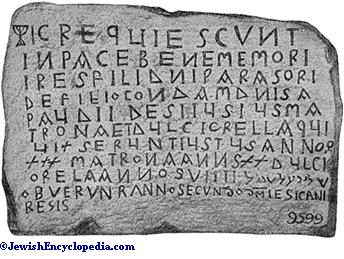
Whatever be the amount of truth in these stories, it is certain that the Jews were again numerous in France under Charlemagne, their position being regulated by law. A formula for the Jewish oath was fixed ("Capit. de Judæis," cap. 4; Boretius, i. 258). They were allowed to enter into lawsuits with Christians ("Capit. Miss. Aquisgran. Alt." cap. 13; Boretius, i. 152), and in their relations with the latter were restrained only from making them work on Sunday (ib.). They must not, however, take in pawn goods belonging to the Church ("Capit. de Judæis," cap. 1-3; Boretius, i. 258: though it is doubtful whether this paragraph dates from Charlemagne). They must not trade in currency, wine, or corn (ib.; also a doubtful paragraph according to Boretius). Of more importance is the fact that they were tried by the emperor himself, to whom they belonged (ib.). They engaged in export trade, an instance of this being found in the Jew whom Charlemagne employed to go to Palestine and bring back precious merchandise ("Mon. Sangal." i. 16; "Monum. Germ., Scriptores," ii. 737). Furthermore, when the Normons disembarked on the coast of Narbonnese Gaul they were taken for Jewish merchants (ib. ii. 14; ii. 757). They boast, says one authority, of buying whatever they please from bishops and abbots ("Capit. Miss. Nuimag. dat." cap. 4; Boretius, i. 131). Isaac the Jew, who was sent by Charlemagne in 797 with two ambassadors to Harun al-Rashid, was probably one of these merchants ("Einh. Annal." ad ann. 801; "Monum. Germ., Scriptores," 1, 190). It is a curious fact that among the numerous provincial councils which met during Charlemagne's reign not one concerned itself with the Jews, although these had increased in number. In the same spirit as in the above-mentioned legends he is represented as asking the Bagdad calif for a rabbi to instruct the Jews whom he had allowed to settle at Narbonne ("Sefer ha-Ḳabbalah," ed. Neubauer, in "Med. Jew. Chron." i. 82). It is also stated that he wished to transplant the family of Kalonymus from Lucca to Mayence ("'Emeḳ ha-Bakah," p. 13). From this time forward mention is made of rabbis. A certificate of the son of Charlemagne is delivered to a rabbi, Domatus, Donnatus, or Dematus (see below). Hrabanus Maurus, Bishop of Fulda, states that in compilinghis works he consulted with Jews who knew the Bible (Migne, cix. 10). Bishop Agobard relates that in his diocese the Jews have preachers who go to hear the Christians, and he tells of the opinions which they held and which they doubtless placed on record in their writings (see below).
Under Louis le Débonnaire.
Louis le Débonnaire (814-833), faithful to the principles of his father, granted strict protection to the Jews, to whom he gave special attention in their position as merchants. The language which he uses in regard to them is characteristic; it is carefully weighed and free from all fanaticism. Louis takes under his protection (before 825) Rabbi Domatus and Samuel, his little son by Septimania; he gives orders against their being molested in the possession of their property, permits them to change or to sell it, to live according to their law, to hire Christians for their work, and to buy and sell foreign slaves within the empire. He prohibits Christians from diverting such slaves from their duties by offering baptism to them. These Jews being under the protection of the king, any who should plan or perpetrate their death were to be punished. It was equally forbidden to submit them to the ordeal by water or fire. The diploma granting these privileges was to be shown not only to civil officials, but also to the bishops, abbots, etc. ("Formul. Imp." 30; Rozière, "Recueil," No. 27; Bouquet, vi. 649). Louis accorded his protection to others also, and ("Formul. Imp." 31; Rozière, l.c. No. 28) not alone to individuals, but likewise to the Jews of the whole country. This is seen in an incident which occurred to the Jews of Lyons.
Agobard's Account.
Between 822 and 825 Agobard, bishop of the diocese of that city, had come to the court of Louis to protest against the law concerning the baptism of the pagan slaves of Jews. The substance of his complaint was that the privileges of the Jews were rigidly upheld. The Jews had a master ("magister Judæorum"), that is to say, a preserver of their privileges, appointed by the emperor, and charged with seeing that they were carried out. This master of the Jews threatened Agobard with the arrival of "missi dominici" who would punish him for his audacity. In fact, these missi had come to Lyons, and they showed themselves terrible toward the Christians, but gentle toward the Jews, who had charters declaring that they were in the right. It was said that the Jews, far from being objects of hatred to the emperor, were better loved and considered than the Christians (see Agobard).
Agobard, with two other bishops, also wrote to the emperor a memoir relating all that the Church of Gaul and its heads, as well as the bishops, had done to keep the two religions distinct. In the letter to which he here makes allusion he refers to the "superstitious ideas and absurd beliefs of the Jews," citing traits which recall the "Shi'ur Ḳomah," "Sefer Yeẓirah," the Talmud, and divers Midrashim of late date (it may be remembered that Hai Gaon, in "Ṭa'am Zeḳenim," reports that the French Jews boast of possessing mystical works from Naṭronai). In their books these Jews, after their fashion, recount the history of Jesus and Peter (he seems to refer to a "Toledot Yeshu"); they pretend that the Christians adore idols, and that the powers obtained by the intercession of the saints are in reality secured through the devil. In a letter to Nibridius, Bishop of Narbonne, Agobard begs him to work for the separation of Jews and Christians as he himself is doing, enjoining upon the Christians to flee from the society of the Jews at Lyons and in some of the neighboring towns. Promiscuity is dangerous, for as a matter of fact the Christians celebrate the Sabbath with the Jews, desecrate Sunday, and transgress the regular fasts. Because the Jews boast of being of the race of the Patriarchs, the nation of the righteous, the children of the Prophets, the ignorant think that they are the only people of God and that the Jewish religion is better than their own ("Agobardi Opera," ed. Migne, civ.; comp. Bernhard Simon, "Jahrbücher des Fränkischen Reiches Unter Ludwig dem Frommen," i. 393 et seq., Leipsic, 1874). The highly colored picture presented by the letter of Agobard shows not only the policy followed by the Church—the separation of Jews and Christians, and the reproaches then hurled at the Jews—but also the prosperity which the Jews enjoyed as merchants (not usurers), and the commencement of their literary activity.
Amulo's "Against the Jews."
Agobard had a worthy successor in the person of his disciple Amulo (Amolon), who in 846 published a letter ("Contra Judæos," ed. Migne, cxvi.) which took up and carried to completion Agobard's arguments; his memoir affords new information on the situation of the Jews of his diocese. The people had not yet perceived the danger of intermingling with the Jews, and the leaders were afflicted with the same blindness. Wine, even for religious purposes, was always purchased from the Jews; Christian freemen continued to take service with them, both in the city and elsewhere; the ignorant still claimed that the Jews preached to them better than did the priests. He states that certain converted Jews have informed him that in some places Jewish farmers of revenue abuse their power by compelling those of little spirit, the weak-minded, to deny Jesus. It is in this way that the deacon Bodon has been deceived into becoming a Jew. On several occasions Amulo has ordered his flock to keep aloof from the Jews, and has ordered the bishops to come into closer relationship with their charges in order that danger may be averted. Amulo likewise denounces the aberrations and superstitions of the Jews, who devote themselves entirely to their traditions, which they make the subject of discourses and sermons every Saturday in the synagogues. He mentions also the invidious expressions of which they make use to designate the Apostles and the Gospel, and their arguments in defense of their Messianic ideas (which accord with those of the "Sefer Zerubbabel" and the "Ma'aseh of R. Joshua b. Levi"). This memoir is contemporary with two synods which met at Meaux (June 17, 845) and at Paris (Feb. 14, 846). At these councils, in which Amulo took part, the king was urged in the terms of the "Contra Judæos" to observe toward the Jews the ancient laws and edicts ("Concil. Meld." can. 73; Labbe, xiv. 836). The king, however, paid little attention to the exhortationsof the bishops (Prudentius of Troyes, "Annales," ed. Migne, cxv. 1399), and did not ratify the canon on the Jews ("Capitularium Sparnaci"). The attempt had failed once again. According to the legend related in the Annals of Hincmar (ad ann. 877; "Monum. Germ., Scriptores" i. 504, 589), Charles the Bald paid for this imprudence, being poisoned in Mantua by his Jewish doctor Sedecias (Annalista Saxo, ib. 584). The king also employed Jews on foreign missions (Diego, "Historia de los Condes de Barcelona," p. 26). The Jews, who continued to devote themselves to commerce, differed in their privileges from the Christians only in the amount of duty levied on them, paying one-tenth of the value of the goods, while Christians paid one-eleventh (Bouquet, vii. 104: if this capitulary is authentic). Ibn Kordadhbeh, who speaks of the southern French Jews about 850, depicts them going as far as the Indies and China ("Journal Asiatique," sixth series, v. 512). See Commerce.
From the middle of the ninth to the twelfth century is certainly an important epoch; it was then that French society became transformed by the development of the feudal system and the organization of the gilds; the arbitrary rapacity of the one oppressing the weak—agricultural serf and Jewish merchant alike—and the jealous exclusiveness of the other prohibiting the exercise of trades by non-Catholics, while both invested all things with the religious fanaticism which later expressed itself in the Crusades. At the same time it is the epoch in which the rabbinical schools, already mentioned in Amulo's account, appeared in full light, when Hebrew literature in France produced its first works, and when famous rabbis made French Judaism illustrious and impressed upon it the character which it was to retain for several centuries. Unfortunately, however, but few details concerning this transition period are known; they are as follows:
At Sens, about 876, the archbishop Ansegise, prelate of Gaul, expelled the Jews and the friars from his city—for a certain reason, according to an eleventh-century historian (Odorani, "Chron."ad ann. 883; Bouquet, viii. 237). As far as concerned the Jews this is, perhaps, the first sign of the triumph of feudalism. In 899 Charles the Simple confiscated, for the profit of the church at Narbonne, all the property held by the Jews and subject to the payment of tithes (Vaissette. iii. 63). According to Saige ("Hist. des Juifs du Languedoc," p. 9), this signifies that the Jews might not possess land upon which Church tithes were levied, but it did not abrogate their right to hold free land. At any rate, in the eleventh century they were in peaceful possession of their landed property around Narbonne.
The First Capets—987-1137: Persecution of Jews in Limoges and Rouen.
According to Richer, a historian who, as stated by Monod, inspires mistrust, Hugh Capet, "whose whole body was covered with sores," was killed by the Jews in 996 ("Richeri Historia," lib. iv., toward the end, p. 308, ed. Guadet). According to Guadet, Richer merely means by this statement that the Jewish physicians were the cause of his death. A Hebrew document (Berliner's "Magazin," iv.; "Oẓar Ṭob," p. 49) states that a Jew of Blois, who had been converted to Christianity, wished to destroy the Limoges community in 996, and accused the Jews of employing on three holidays of the year a wax image of the lord of the land, which they pierced in order to bring about his death, just as they did in the case of the host. But since the fable of the pierced host came into existence several centuries later, the story is open to doubt. Following the accusation of this convert, a priest appears to have counseled his lord no longer to tolerate the Jews in the city. In 1010 Alduin, Bishop of Limoges, offered the Jews of his diocese the choice between baptism and exile. For a month theologians held disputations with them, but without much success, for only three or four of the Jews abjured their faith; of the rest some fled into other cities, while others killed themselves ("Chronicles of Adhémar of Chabannes," ed. Bouquet, x. 152; "Chron. of William Godellus," ib. 262, according to whom the event occurred in 1007 or 1008). A Hebrew text also states that Duke Robert of Normandy having concerted with his vassals to destroy all the Jews on their lands who would not accept baptism, many were put to death or killed themselves. Among the martyrs was the learned Rabbi Senior. A rich and esteemed man in Rouen, Jacob b. Jekuthiel, went to Rome to implore the protection of the pope in favor of his coreligionists, and the pontiff sent a high dignitary to put a stop to the persecution (Berliner's "Magazin," iii.; "Oẓar Ṭob," pp. 46-48). Robert the Pious is well known for his religious prejudice and for the hatred which he bore toward heretics; it was he who first burned sectarians. There is probably some connection between this persecution and a rumor which appears to have been current in the year 1010. If Adhémar of Chabannes, who wrote in 1030, is to be believed, in 1010 the Western Jews addressed a letter to their Eastern coreligionists warning them of a military movement against the Saracens. In the preceding year the Church of the Holy Sepulcher had been converted into a mosque by the Mohammedans, a sacrilege which had aroused great feeling in Europe, and Pope Sergius IV. had sounded the alarm ("Monum. Germ., Scriptores," iv. 137). The exasperation of the Christians, it seems, brought into existence and spread the belief in a secret understanding between the Mohammedans and the Jews. Twenty years later Raoul Glaber (Bouquet, x. 34) knew more concerning this story. According to him, Jews of Orleans had sent to the East through a beggar a letter which provoked the order for the destruction of the Church of the Holy Sepulcher. Glaberadds that on the discovery of the crime the expulsion of the Jews was everywhere decreed. Some were driven out of the cities, others were put to death, while some killed themselves; only a few remained in all the "Roman world." Five years later a small number of those who had fled returned. Count Riant says that this whole story of the relations between the Jews and the Mohammedans is only one of those popular legends with which the chronicles of the time abound ("Inventaire Critique des Lettres Historiques des Croisades," p. 38, Paris, 1880). Another violent commotion arose about the year 1065. At this date Pope Alexander II. wrote to the Viscount of Narbonne,Béranger, and to Guifred, bishop of the city, praising them for having prevented the massacre of the Jews in their district, and reminding them that God does not approve of the shedding of blood ("Concil." ix. 1138 and 1154; Vaissette, 355). A crusade had been formed against the Moors of Spain, and the Crusaders had killed without mercy all the Jews whom they met on their route.
Franko-Jewish Literature.
During this period, which continues till the first Crusade, Jewish culture was awakening, and still showed a certain unity in the south of France and the north. Its domain did not embrace all human knowledge; it included in the first place poetry, which was at times purely liturgical—the echo of Israel's sufferings and the expression of its invincible hope—but which more often was a simple scholastic exercise without aspiration, destined rather to amuse and instruct than to move—a sort of dried sermon. Following this comes Biblical exegesis, the simple interpretation of the text, with neither daring nor depth, reflecting a complete faith in traditional interpretation, and based by preference upon the Midrashim, despite their fantastic character. Finally, and above all, their attention was occupied with the Talmud and its commentaries. The text of this work, together with that of the writings of the Geonim, particularly their responsa, was first revised and copied; then these writings were treated as a "corpus juris," and were commented upon and studied both as a pious exercise in dialectics and from the practical point of view. There was no philosophy, no natural science, no belles-lettres, among the French Jews of this period.
Several names of scholars and poets emerge from the shadows of the tenth century: Makir, the gaon Todros, and Moses b. Abbun, chiefs of the school of Narbonne; Simon of Mans; his son Joseph and his grandson Abbun the Great; Judah b. Meïr ha-Kohen (in French "Leontin"), teacher of Gershon; Moses of Arles. In the eleventh century there were many famous authors who played a rôle of the first importance in the development of Jewish civilization and who left their imprint upon Judaism. The most illustrious of them was Gershon, called the "Light of the Exile," who was originally from Metz, but exercised his activity at Mayence and established the study of the Talmud upon the banks of the Rhine. He was a poet, and his productions breathe an intense emotion, due to the sorrows of the times. As grammarian, he turned his attention to the Masorah; as Talmudist, he was the author of the first Talmudic commentary produced in Europe, as well as of practical treatises of rabbinical casuistry and of responsa. As chief of the school, inspired by circumstances he passed measures ("taḳḳanot") of wide-reaching importance, which have retained the force of law throughout Occidental Judaism. He forbade polygamy and one-sided divorce. He had pupils from France, among others Judah b. Moses of Toulouse, Elias the Elder of Mans, and Simon the Elder of Mans, uncle of Rashi. He corresponded with the French rabbis Simson Cohen, Elias b. Elias, Daniel b. Jacob, Leon, Juston (originally in all probability from Burgundy), Samuel b. Judah, and Joseph b. Perigoros. Close to Gershon must be placed Joseph b. Samuel Ṭob-'Elem (Bonfils), rabbi of Limousin and Anjou, and a remarkable Talmudist. He left to posterity many fine editions of the rabbinical writings of his predecessors. He was also an excellent poet, and the author of interesting decisions and responsa. Liturgical poets, such as Joseph b. Solomon of Carcassonne, Benjamin b. Samuel of Coutances, and Elias the Elder b. Menahem of Mans, were numerous.
Jewish France was so rich in men of learning that she gave some of them to Germany, among them Isaac ha-Levi of Vitry, who became head of the school at Worms, and Isaac b. Judah, who became head of the school of Mayence. Both of these became teachers of Rashi.
Rashi.
The great figure which dominates the second half of the eleventh century, as well as the whole rabbinical history of France, is Rashi (Solomon b. Isaac) of Troyes (1040-1106). In him is personified the genius of northern French Judaism: its devoted attachment to tradition; its naive, untroubled faith; its piety, ardent but free from mysticism. His works are distinguished by their clearness, directness, and hatred of subtlety, and are written in a simple, concise, unaffected style, suited to his subject. His commentary on the Talmud, which was the product of colossal labor, and which eclipsed the similar works of all his predecessors, by its clearness and soundness made easy the study of that vast compilation, and soon become its indispensable complement. His commentary on the Bible (particularly on the Pentateuch), a sort of repertory of the Midrash, served for edification, but also advanced the taste for simple and natural exegesis. The school which he founded at Troyes, his birthplace, after having followed the teachings of those of Worms and Mayence, immediately became famous. Around his chair were gathered Simḥah b. Samuel, R. Samuel b. Meïr (Rashbam), and Shemaia, his grandsons; likewise Shemaria, Judah b. Nathan, and Isaac Levi b. Asher, all of whom continued his work. In his Biblical commentaries he availed himself of the works of his contemporaries. Among them must be cited Moses ha-Darshan, chief of the school of Narbonne, who was perhaps the founder of exegetical studies in France; Menahem b. Ḥelbo; and, above all, Joseph Caro. Thus the eleventh century was a period of fruitful activity in literature. Thenceforth French Judaism became one of the poles of universal Judaism.
The Crusades:
The Jews of France do not seem to have suffered much during the Crusades, except, perhaps, during the first (1096), when the Crusaders are stated to have shut up the Jews of Rouen in a church and to have exterminated them without distinction of age or sex, sparing only those who accepted baptism (Guibert de Nogent, ed. Bouquet, xii. 240; "Chron. Rothomag."; Labbe, "Novæ Bibliothecæ, manuscript Lib." i. 367). According to a Hebrew document, the Jews throughout France were at that time in great fear, and wrote to their brothers in the Rhine countries making known to them their terror and asking them to fast and pray (anonymous text of Mayence, in A. Neubauer and Stern, "Hebräische Berichte über die Judenverfolgungenwährend der Kreuzzüge," p. 47). Happily their fears proved groundless.
R. Tam in the Second Crusade.
At the time of the second Crusade, Jacob Tam, the grandson of Rashi, had cause to lament the actions of the Crusaders, who burst into his house, seized his possessions, destroyed a book of the Law, and carried him off into the open field with the intention of putting him to death. But perceiving one of the nobles, he called him to his aid and was rescued. Ephraim of Bonn is the only writer who tells of this incident; R. Tam himself makes no reference to it ("Judenverfolgungen," p. 64), and even Ephraim adds that in the other communities of France no one was put to death or compelled to abjure his faith. Nevertheless, the consequences of the Crusades were terrible for the Jews, for this great religious movement produced an excitement of the popular imagination which had dire results for them. It was about this time that accusations of ritual murder were bruited; mere manifestations of a mental malady on the part of majorities intolerant of the existence of a minority who kept aloof from them. From the economic and social point of view this epoch was destined to be for the Jews a turning-point. Until that time the Jews had been chiefly merchants; henceforth they become known above all as usurers. St. Bernard, abbot of Clairvaux, who preached the second Crusade, and who intervened with great courage to prevent the massacre of the German Jews, asked King Louis VII. to prohibit the Jews from accepting usurious rates of interest from those who set out for the Holy Land. Moreover, in speaking of their rapacity, and observing that in places where there were no Jews the Christian usurers were worse in their exactions, he says that on this account the latter might justly be accused of Judaizing ("Epistola," 363; ed. Migne, clxxxii. 564). Peter the Venerable, abbot of Cluny, wrote in 1146 to the king that even if he did not counsel the massacre of the Jews, they should at least be punished by being despoiled of their ill-gotten gains and thefts, and that the army of the Crusaders should not spare Jewish treasures ("Epistola," 36; ed. Migne, clxxxix. 366). For having resisted these appeals Louis VII. was accused by a contemporary historian of having been moved by cupidity ("Fragmentum Historicum Vitam Lud. Vll. Summatim Complectens," in Bouquet, xii. 286). Pope Alexander III. in a letter to the Archbishop of Bourges (1179) addressed to him the same reproach (Bouquet, xv. 968). According to Ephraim of Bonn, the provisions of the bull of Pope Eugenius IV. exonerating the Crusaders from their debts to the Jews were carried out in France ("Judenverfolgungen," p. 64).
Blood Accusation.
The accusation of ritual murder in France was closely connected with the Crusades. According to a Jewish account of the second Crusade ("Judenverfolgungen," p. 62), the Crusaders, in order to justify their sanguinary exploits, pretended at times that they were punishing the Jews for the murder of Christians. It was said that the Jews committed this crime not because they had need of Christian blood for ritual purposes, but in order to repeat the crucifixion of Jesus. At Pontoise it was said some time before 1171 that they had crucified an adult Christian of the name of Richard. The dates given vary: it was in 1163 according to Lambert Waterlos, who died in 1170 (Bouquet, xiii. 520); in 1179 according to Rigord; in 1156 according to Geoffroy of the abbey of St. Martial of Limoges, who died in 1184 (Bouquet, xii. 438; see also "Judenverfolgungen," p. 34). The body was carried to Paris and worked numerous miracles in the Church of the Holy Innocents, where it was interred. Similar accusations were made against the Jews at Epernay and at Janville (department of Eure et Loire) about the same time—that is to say, about the year 1170—but no details are known ("Judenverfolgungen," pp. 34-35). The outburst at Blois is the most famous, and cost the lives of 31 persons. The affair was of a most lamentable nature. A man was watering a horse in the Loire. Frightened at the sight of a Jew who was near, the animal reared. This was sufficient to cause the man to return at once and accuse the Jew of having thrown into the stream the body of a Christian child which had been crucified by the Jew's coreligionists. He himself had been afraid of meeting the same death, and the horse had instinctively recoiled. Thibaut de Champagne, Count of Blois, immediately incarcerated all the Jews in the city. A priest suggested that the man should be put to the test by water, and as the test resulted in his favor, the proof of the crime of the Jews was regarded as conclusive. Having rejected baptism, 31 Jews were burned on Wednesday, May 26, 1171. Jacob Tam, who was informed of this sad occurrence, decided that this day should be one of fasting, and the communities of France, Anjou, and the provinces on the Rhine duly observed it as such (statement of Baruch ben Meïr of Orleans; letters of the notables of Orleans; letter of a Jew of Tours to R. Yom-Ṭob; "Martyrology of Ephraim of Bonn"; letter of the notables of Paris in "Judenverfolgungen," pp. 31 et seq.; Robert du Mont, in Bouquet, xiii. 315). Robert du Mont also says that Jews were burned in Paris likewise in 1177 for the murder of St. William. The belief in this legend was destined to be most baneful to the Jews of the entire kingdom of France. Philip Augustus, who, in 1180, at the age of fifteen succeeded Louis VII., his father, had, according to his historian Rigord, often heard the young nobles who were his fellow students in the palace tell how the Jews of Paris went year by year into subterranean retreats on Passover or during the Holy Week, and sacrificed a Christian in order to outrage the Christian religion. Often during his brother's reign (they said) the guilty had been seized and thrown into the flames. Immediately after his coronation, March 14, 1181, he ordered the Jews arrested on a Saturday, in all their synagogues, and despoiled of their money and their vestments (an English chronicler, Raoul of Dicet [ii. 14], says that he released them for a ransom of 15,000 silver marks). The Jews, adds Rigord, were then very numerous, and many rabbis (didascali) had come to sojourn in Paris; they had become enriched to the extent of owning nearly half of the city; they were engaged in usury; their patrons were often despoiled of their possessions, while others were kept on parole in the houses ofcertain of the Jews. After having consulted a hermit who lived in the Vincennes forest, the king released the Christians of his domain from all their debts toward the Jews, with the exception of one-fifth which he transferred to himself.
Expulsion from France, 1182.
In the following April, 1182, he published an edict of expulsion, but according the Jews a delay of three months for the sale of their personal property. Immovable property, however, such as houses, fields, vines, barns, and wine-presses, he confiscated. The Jews attempted to win over the nobles to their side, but in vain. In July they were compelled to leave the royal domains of France; their synagogues were converted into churches (Rigord, "Gesta Philippi Augusti," i., vi. 12-17; ed. Delaborde, pp. 14 et seq.; see also Guillaume le Breton, "Philippidos," i. 389 et seq.; ed. Delaborde, p. 23).
As may be seen, these successive measures were simply expedients to fill the royal coffers. The goods confiscated by the king were at once converted into cash (Leopold Delisle, "Catalogue des Actes du Regne de Philippe Auguste," 20, 21, 22, 27, 51, 58). It is well to add that at that time the royal domains were reduced to a very narrow strip of territory, extending around Paris and Orleans.
During the century which terminated so disastrously for the Jews their condition was not altogether bad, especially if compared with that of their brethren in Germany. Thus may be explained the remarkable intellectual activity which existed among them, the attraction which it exercised over the Jews of other countries, and the numerous works produced in those days. The impulse given by Rashi to study did not cease with his death; his successors—the members of his family first among them—brilliantly continued his work. Research moved within the same limits as in the preceding century, and dealt mainly with the Talmud, rabbinical jurisprudence, and Biblical exegesis. Rabbenu Tam, to whom reference will again be made, investigated at least one section of Hebrew grammar; he undertook the defense of Menahem b. Saruḳ against Dunash b. Labraṭ; as innovator in another direction he composed a poem on the accents and imitated the versification of the Spanish Jews, which impelled Abraham ibn Ezra to ask: "Who is this that has led the French into the temple of poetry?" But in this he had no successors, and did not create a school.
The "Tosafot."
Biblical exegesis, which continued to be distinguished by its simplicity and naturalness, now commenced to place too much importance on interpretations based on the numerical values of letters and on analogous methods (gemaṭria, noṭariḳon). Liturgical poetry was constantly cultivated by a large number of rabbis. Talmudic studies underwent a marked transformation. Exposition of the Talmud having almost reached a limit (for every one aimed to complete Rashi's work), scholars no longer confined themselves merely to understanding the Talmud, but, just as had been done formerly with the Mishnah, they selected from the Talmud their themes for academic and juristic discussions. By the help of parallel passages they shed new light on the text of the Talmud; by comparing analogous passages they sought to establish rules of jurisprudence; and, where the text contained eontradictions, whether real or merely apparent, external or internal, they pointed them out and sought to explain them away. On the other hand, from the Talmud they deduced laws applying to the conditions of contemporaneous life. Their glosses or postils, known under the name of "tosafot" (additions), were originally simple appendixes to the commentary of Rashi, discussing, correcting, or completing them. They represent the result of the discussions of the schools and of the teaching of the masters, and are notes made by the professor or, as was more often the case, collected by the pupils to carry with them when they visited other schools. Study, considered always as a means of salvation, became more and more simple dialectics, aptly compared with that of the scholastics of the time. But even in this extravagant display of ingenuity, of subtlety, and of erudition, the French rabbis, as their contemporaries of Germany, preserved a moderation ignored by their disciples, the Poles of the sixteenth and following centuries. Subtlety did not exclude clearness; logic never lost its rights; order ruled in the editing of their notes. The production of tosafot became the dominant and absorbing occupation of this period, and impressed its distinctive character upon the studies of the time.
Centers of Rabbinic Learning.
The work was participated in by a whole legion of scholars, spread over the north of France, Normandy as well as the Isle of France, Champagne as well as Burgundy and Lorraine. Champagne, however, was the most active center. In these different provinces schools were founded—at Ramerupt after Troyes, at Dampierre, at Auxerre, at Sens, at Falaise, at Paris, etc. To these centers of instruction, just as to the French universities, hastened pupils from distant countries, from Slavic lands, from Bohemia, and from Germany. Like the traveling students of that period, the pupils of the rabbis traversed the land, mocking at distance, insensible to privation, going from one master to another in their thirst for instruction. The earliest masters who gave prestige to this form of instruction were members of the family of Rashi: Judah b. Nathan, his son-in-law and the continuer of his commentary on the Talmud; Meïr, another son-in-law, who became director of the Troyes Academy after Rashi's death; Jacob Tam (called commonly "Rabbenu Tam," the son of Meïr)—the true founder of the school of tosafists, a man of strong will and energetic character, and known to his contemporaries as the supreme authority of French Judaism; his brother Samuel (Rashbam), an excellent exegete, somewhat daring in parts of his Biblical commentary; Samuel de Vitry, a nephew of R. Tam. To the same group belong Samuel de Vitry, a disciple of Rashi, and author of the Maḥzor Vitry; his great-grandson, Isaac b. Samuel the Elder, the famous "RI," whose name occurs frequently in the tosafot, and who was chief of the school at Dampierre (to be distinguished from Isaac b. Abraham, known as "RI ha-Baḥur" (the Younger), who succeeded him); Elhanan, son of Isaac b. Samuel, martyred in 1184. To these names of famous tosafists must also be added the following: Jacob of Orleans(died in London in 1189), who was also an exegete; Samuel b. Ḥayyim of Verdun, disciple of R. Tam; Hoshaiah ha-Levi of Troyes; Menahem b. Perez of Joigny, also an exegete; Yom-Ṭob of Joigny (died at York in 1190), a liturgical poet and Biblical commentator; Samuel b. Aaron and Simon b. Samuel of Joinville; Eliezer b. Samuel of Metz, author of the "Sefer Yere'im"; Moses b. Abraham of Pontoise; Simon b. Joseph of Falaise; Yom-Ṭob; Judah b. Yom-Ṭob; Ḥayyim b. Hananel Cohen; the celebrated Judah b. Isaac, alias Sir Léeon of Paris; Simson de Couçy, one of the most learned of the tosafists; Judah of Corbeil; Joseph and Isaac b. Baruch of Clisson; Eliezer b. Solomon; and the well-known Simson (b. Abraham) of Sens, commentator of the Mishnah and the Sifra. Side by side with these tosafists may be cited a number of scholars renowned for their vast knowledge, such as Joseph Kara, mentioned above in connection with the history of the previous century; Shemaiah, commentator on the Talmud; Joseph b. Isaac of Orleans, better known under the name of "Joseph Bechor Schor," an ingenious exegete; Solomon b. Isaac and Eleazar of Orleans; Samuel b. Jacob of Auxerre; Aaron and Bender d'Epernay; Eliezer of Beaugency, an exegete of authority; Jehiel b. David and Jekuthiel b. Judah of Troyes; Jacob and Isaac de Bray, who died in 1191; David of Brienne; Samuel de Joinville; Joseph b. Solomon de Dampierre; Joseph b. Joseph de Pont Audemer; Samuel b. Joseph of Verdun; Abraham of Toul; Moses of Saumur; Joseph b. Moses and Simson of Troyes; David of Château-Thierry; Meshullam b. Nathan of Melun; Nathan, his son; Jedidia of the same town; Solomon b. Abraham b. Jehiel; Mattithiah b. Moses; Judah b. Abraham; Samuel, Moses, and Jacob b. Samson; Elijah b. Judah of Paris; Joseph Porat of Caen; Joseph the Saint and Samson of Corbeil; Joseph b. Isaac of Chinon; Joseph of Chartres, poet and exegete; Moses of Saumur; Isaac b. Solomon and Eliezer of Sens. This list could be considerably prolonged if all the learned men of the time were mentioned whose birthplace is not exactly known, although they are certainly French.
Synods.
It is sufficient to know that at a synod held at Troyes under the presidency of Samuel b. Meïr and R. Tam, rabbis came from Troyes, Auxerre, the banks of the Rhine, Paris and its environs, from Melun, Normandy and the coast, Anjou, Pontou, and Lorraine. These synods are distinctive of the history of northern France in the twelfth century; in imitation of the local or national councils, and principally at the instigation of R. Tam, the heads of the Israelite community met several times, without doubt at the time of the Champagne fairs, to deliberate upon dubious cases of jurisprudence, or to pass new laws necessitated by changed conditions. Thus, they forbade Jews to buy or to take in pledge crucifixes, church ornaments, or other objects connected with the Catholic form of worship; to summon their coreligionists to appear before non-Jewish judges; to allow themselves to be nominated by the civil authorities as provost or leader of the community without having been previously proposed for this office by the majority of the community. They also decided that the prohibition of R. Gershom against polygamy should be enforced, and that it should not be revoked at any time in the future except under urgent necessity and by a council of at least a hundred rabbis from three different regions—from France, Normandy, and Anjou. The command was renewed to excommunicate traitors who brought false charges against their brethren. Finally a question connected with the matrimonial laws was settled (Neubauer, "R. E. J." xvii. 66-73; Gross, "Gallia Judaica," pp. 231 et seq.).
In the South.
In the south of France the intellectual life of the Jews was equally intense, and for similar reasons. Never had their situation been more happy; rulers and people agreed in treating them with kindness. At Toulouse and at Béziers they had to suffer, it is true, odious restrictions At Béziers, on Palm Sunday, the bishop regularly exhorted the people to take vengeance on the Jews, "who had crucified Jesus." He even went further and gave them permission to attack the deicides and to raze their houses. This the inhabitants always did with such ardor that it resulted in bloodshed. The attack commenced on the first hour of the Saturday before Palm Sunday, and lasted until the last hour of the Saturday after Passover. At Toulouse, as a penalty for the alleged crime of having, in the time of Charlemagne, delivered up the town to the Saracens—a mere legend, since the Moors never entered the town—thrice a year a Jew was compelled to present himself before the church to have his ears boxed. But these two customs were justly abolished in the twelfth century; the latter, at the commencement of the century, was replaced by a fixed payment to the canons of St. Saturnin (Vaissète, ii. 151); that of Béeziers in 1160 by a tax to be used in purchasing ornaments for the cathedral (ib. iii. 813). The favor which the Jews in general enjoyed at that time may be judged from the fact that they were employed by the counts and inferior lords in the position of "bailes." As such they had the administration of lands dependent directly on their lords; they also had a large share in the administration of justice. "Above all, they filled the office of farmers of revenue, and were allowed to farm out the tolls, the receipts of the towns and fiefs, and even certain of the revenues of the chapters and bishops" (Saige, "Les Juifs du Languedoc," pp. 15 et seq.). But if, as is natural, Christian documents impart this information, it does not follow that the Jews drew their revenues exclusively from such offices, for the Hebrew responsa show that they continued to practise the same trades as before. Their prosperity was due altogether to the ever-kindly attitude of the people toward them, and to the liberalism of the counts of Toulouse and the viscounts of Béziers, who had taken them under their protection. Raymond Trencavel and Roger II., viscounts of Béziers, and Raymond V. and VI., were in turn well disposed toward them, and entrusted them with the duties of bailes. The Jews of Béziers took no part in the popular conspiracy of that city, which in 1167 occasioned the assassination of Raymond Trencavel, and they accordingly did not suffer in the massacre with which that crime was avenged in 1169. At a later date, when Raymond VI. was attackedby the Crusaders, one of the direct charges brought against him was that of having, "to the shame of the faith," admitted Jews to public offices. The lords of Montpellier alone were consistently opposed to appointing Jews to the office of baile.
Provençal Learning.
Among the Jews of this district science reached heights even loftier than those to which it attained in northern France. The proximity of Spain, the peaceful condition of the district, and other circumstances which will be mentioned later, made Provence (a name then given to all the south of France) a chosen land for Jewish science, and assured it a brilliant part in the transmission of the civilization of classic times. There, too, rabbinical science was cultivated with ardor and produced remarkable men. Its centers were Arles, Béziers, Lunel, Marseilles, Montpellier, Narbonne, Nimes, Posquières, and St. Gilles. When in 1160 Benjamin of Tudela on his way through Provence stopped at Narbonne, "one of the towns which are most famous for their knowledge, and whence the knowledge of the Law has spread through all the land," he found there Kalonymus, son of the nasi Todros, chief of the rabbinical school; Abraham Ab Bet Din, author of "Sefer ha-Eshkol"; R. Judah; and other learned men, all of whom had numerous pupils. He also found at Béziers another school, under the direction of Solomon Ḥalafta and Joseph b. Nathaniel; at Montpellier he met Reuben b. Todros, Nathan b. Simon, Samuel and Mordecai b. Samuel; at Posquières, the seat of a famous school, he saw Abraham b. David (RABaD), who was renowned for his knowledge, and who supported poor students at his own expense, and also Joseph b. Menahem, Benveniste, Benjamin, Abraham, and Isaac b. Moses; while at St. Gilles was a community comprising about a hundred learned men, with Isaac b. Jacob, Abraham b. Judah, Eliezer, Isaac, Moses, and Jacob b. Levi, and Abba Mari b. Isaac at the head. At Arles was a community of two hundred Israelites, including Moses, Tobias, Isaiah, Solomon, Nathan, and Abba Mari. At Lunel, says Benjamin, "is a holy brotherhood which studies the Law day and night. The celebrated Meshullam b. Jacob teaches there; his five sons, Joseph, Isaac, Jacob (Nazir), Aaron, Asher, famous for their wisdom as well as for their wealth, have withdrawn themselves from all worldly interests, pursue their studies unceasingly, and abstain from eating meat. Moses b. Judah, Samuel he-Ḥazzan, Solomon ha-Kohen, and Judah b. Saul ibn Tibbon, the Spaniard, also live there, and pupils are taught and supported gratuitously" Finally Benjamin stopped at Marseilles, where he saw the wise Simon b. Anatoli, the latter's brother Jacob, and several other rabbis. The number of famous rabbis mentioned in this chronicle as living in the same year is worthy of note. To complete the list, however, there still remain to be mentioned Meïr b. Isaac of Trinquetailles, author of the "Sefer ha-'Ezer"; the famous Zerachiah ha-Levi, originally from Spain and author of the "Sefer ha-Ma'or," who lived at Lunel; Abraham b. Nathan ha-Yarḥi of Lunel, author of the "Sefer ha-Manhig"; the whole Kalonymus family at Narbonne; Isaac b. Merwan ha-Levi; Moses b. Joseph b. Merwan ha-Levi; etc.
Halakic Studies.
A new method lent variety to the studies of these Talmudists. Isaac Alfasi of Spain had composed a sort of compilation of the Talmud, omitting from it all matters not related to jurisprudence. This plan soon found favor with scholars of a methodical frame of mind, and the "Little Talmud," as the work of Alfasi was called, became the object of devoted study in Provence. Abraham Ab Bet Din was the first scholar there to follow its method and to effect a codification of the contents of the Talmud ("Sefer ha-Eshkol"). On the other hand, Zerachiah ha-Levi in his "Ma'or" criticised the "Sefer ha-Eshkol" severely. Abraham b. David thereupon energetically undertook the defense of his master, and was supported by his disciple, Meïr of Trinquetailles, in his "Sefer ha-'Ezer." Much as these ardent polemics agitated the south of France, they were to be surpassed by others of which Abraham b. David was destined to be the cause. To Alfasi's summary was due the creation of a veritable "summa" of the Talmud, the profoundest work and the most methodical that the Talmud ever inspired—the Mishneh Torah of Maimonides, in which for the first time the Talmudic rules were classified and elucidated according to a scientific plan. The author, absorbed in philosophy, intended that this "summa" should enable students to dispense with a too absorbing study of the Talmud.
RABaD and RaMBaM.
RABaD, a follower of tradition, was startled by such boldness, for he saw in the book, and perhaps correctly, a mortal danger to the intellectual activity of Judaism, and the cessation of those studies which, though narrow, furnished intellectual food for legions of scholars. Furthermore, Maimonides, a reverential pupil of Aristotle, and an ardent rationalist, did not hesitate to submit to the judgment of reason the theological opinions of the rabbis of the Talmud. Everything which implied the materiality of the Deity or a belief in the resurrection of the body, and all ordinances having, in his eyes, a superstitious character, were disregarded in the Mishneh Torah, and philosophic principles were placed at the foundation even of the legal code. It was a revolution; Rabad understood this, and he undertook to arrest it. He submitted the work of Maimonides to a criticism, minute, bitter, and sometimes brutal, upholding with all his might the doctrine that absolute faith must be accorded to the teachings of the Talmud. It was the battle of free inquiry against the principle of authority, the resistance of the conservative spirit to the audacity of dangerous innovation. Learned as this criticism was, and great as was the authority with which Rabad's incomparable Talmudic knowledge and highly esteemed works had invested him, his opposition was powerless against the prestige which Maimonides had already gained in Provence. There portions of the Mishneh Torah were received as the work progressed, and its completion was eagerly awaited (letter to Joseph b. Aknin). Maimonides, indeed, was consulted as an oracle in Provence; from Marseilles came requests for his opinion even in matters of astrology. Furthermore, he had written a theological treatise, the "Guide to the Perplexed," of an audacityremarkable for that time, and in which he applied to the Bible the methods of Aristotle and sought for a rational explanation of the religious ordinances.
The Translators.
Far from being scandalized at this, the communities, such as that of Lunel, asked him to translate the work from the Arabic into Hebrew, in order that they might study it thoroughly; and at the end of the twelfth century the translation was undertaken by an inhabitant of Lunel. Such a phenomenon, new to France, is explained by the relationship which existed between the Jews there and those across the Pyrenees, where free inquiry was eagerly pursued. An event which rendered this Spanish influence still more potent was the persecution of the Almohades, who drove many Spanish scholars from Spain into Provence, and thereby brought about in miniature a renaissance similar in its way to that which the conquest of Constantinople afterward produced. Two families, the Ibn Tibbons and the Ḳimḥis, transplanted into Provence the Arabic-Jewish civilization of Spain, and the medium for utilizing the forces thus presented was found in the person of Meshullam b. Jacob, who desired to play the part of an intellectual Mæcenas, and who may justly claim to have been the author of the scientific movement among the southern Jews. He it was who called forth the talent of Judah b. Saul ibn Tibbon, originally from Granada, then a fugitive at Lunel. Meshullam and his son Asher insisted that Judah should translate the principal works of the Jews, which, being written in Arabic, could not be read by all. With their assistance Judah translated into Hebrew Baḥya's "Ḥobot ha-Lebabot," Solomon ibn Gabirol's "Tiḳḳun Middot ha-Nefesh," Judah ha-Levi's "Cuzari," Saadia's "Sefer ha-Emunot weha-De'ot," and even Ibn Janaḥ's Hebrew grammar. Judah ibn Tibbon became the head of a dynasty of translators who spread through the Occident all the sciences cultivated in Spain by the Arabs and the Jews. Concurrently with Judah ibn Tibbon, Joseph Ḳimḥi, also a refugee from Spain, translated tḥe "Ḥobot ha-Lebabot." But while the talent of the Ibn Tibbons was directed to translating, that of the Ḳimḥis was on the whole devoted to Biblical exegesis and grammar. Through Joseph Ḳimḥi and his sons Moses and David were made accessible to Provence all those treasures of exegetical and grammatical science of which Jewish Spain had enjoyed the benefit. The simple haggadic exegesis current in the north of France was replaced by a freer, bolder interpretation of the Bible based upon a knowledge of grammar, and made profounder and more rigorous by a comparative study of Arabic grammar. The Ibn Tibbons finished the conquest of Provence commenced by Abraham ibn Ezra. When this Bohemian genius entered the country, bringing with him a whiff of the free air of Spain, and dazzling all with his display of Biblical knowledge and with the originality of his interpretation, he was received with enthusiasm; and his visit was long remembered.
Beside these two forces—conservatism on the one side, knowledge freeing itself from tradition on the other—appeared at this time a third, mysticism, which was destined soon to show itself all-powerful. Isaac the Blind, son of Abraham b. David (RABaD), was the founder of Cabala, and Isaac's son Asher was also a renowned cabalist, while even Abraham himself manifested a tendency toward mysticism. The same is true of the family of Meshullam b. Jacob, whose sons Aaron and Jacob are likewise reputed to have inclined toward such speculations (Gross, in "Monatsschrift," 1874, p. 173).
Thus from north to south French Judaism of the twelfth century affords the spectacle of an intense intellectual excitement.
Thirteenth Century. Northern France: Recalled by Philip Augustus, 1198.
This century, which opened with the return of the Jews to France proper (then reduced almost to the Isle of France), closed with their complete exile from France in a larger sense. In the month of July, 1198, Philip Augustus, "contrary to the general expectation and despite his own edict, recalled the Jews to Paris and made the churches of God suffer great persecutions" (Rigord). The king adopted this measure from no good will toward the Jews, for he had shown his true sentiments a short time before in the Bray affair. But since then he had learned that the Jews could be an excellent source of income from a fiscal point of view, especially as money-lenders. Not only did he recall them to his estates, but, as has been pointed out by Vuitry ("Etudes sur le Régime Financier de la France," i. 315 et seq.), he gave state sanction by his ordinances to their operations in banking and pawnbroking. He placed their business under control, determined the legal rate of interest, and obliged them to have seals affixed to all their deeds. Naturally this trade was taxed, and the affixing of the royal seal was paid for by the Jews. Henceforward there was in the treasury a special account called "Produit des Juifs," and the receipts from this source increased continually. At the same time it was to the interest of the treasury to secure possession of the Jews, considered as a fiscal resource. The Jews were therefore made serfs of the king in the royal demain, just at a time when the charters, becoming wider and wider, tended to bring about the disappearance of serfdom. In certain respects their position became even harder than that of serfs, for the latter could in certain cases appeal to custom and were often protected by the Church; but there was no custom to which the Jews might appeal, and the Church laid them under its ban. The kings and the lords said "my Jews," just as they said "my lands," and they disposed in like manner of the one and of the other (Vuitry, l.c. after Brussel, "Nouvel Examen de l'Usage Général des Fiefs en France," i., book ii., ch. xxxix., pp. 569 et seq., Paris, 1750; "Ordonnances des Rois de France," i. 35, 44). The lords imitated the king: "they endeavored to have the Jews considered an inalienable dependence of their fiefs, and to establish the usage that if a Jew domiciled in one barony passed into another, the lord of his former domicil should have the right to seize his possessions." This agreement was made in 1198 between the king and the Count of Champagne in a treaty, the terms of which provided that neither should retain in his domains the Jews of the otherwithout the latter's consent, and furthermore that the Jews should not make loans or receive pledges without the express permission of the king and the count (Vuitry, l.c.). Other lords made similar conventions with the king (see Brussel, l.c.). Thence-forth they too had a revenue known as the "Produit des Juifs," comprising the taille, or annual quit-rent, the legal fees for the writs necessitated by the Jews' law trials, and the seal duty. A thoroughly characteristic feature of this fiscal policy is that the bishops (according to the agreement of 1204 regulating the spheres of ecclesiastical and seigniorial jurisdiction) continued to prohibit the clergy from excommunicating those who sold goods to the Jews or who bought from them.
Innocent III.
Indeed, king and lords even took a firm stand against Pope Innocent III. when he protested in 1205 against this new condition of affairs. The pontiff wrote to the king to censure him for his indulgence. If he was to believe what he had heard, the Jews by their usurious practises had gotten into their power the goods of the Church, they occupied castles, they acted as stewards and managers for the nobles, they had Christian servants, and Christian nurses on whom they committed abominable crimes. The civil authorities attached more faith to a deed signed by a debtor at the moment of the loan than to the witnesses whom he produced denying this deed. At Sens the Jews had been permitted to construct a synagogue higher than a church near which it stood, and there they sang so loudly as to disturb the service in the church. On Easter Day they walked in the streets and offered insults to the faith, maintaining that he whom their ancestors had crucified had been only a peasant. Their houses remained open till the middle of the night and served to receive stolen goods; assassination even occurred, as in the case of a poor scholar who had recently been found dead in the house of a Jew ("Diplòme de Brequigny," ii. 2, 610; Bouquet, xix. 471). The pope wrote in the same spirit to the Duke of Burgundy and to the Countess of Troyes and the Count de Nevers (1208; Bouquet, xix, 497). But his efforts were of no avail. Eudes, Duke of Burgundy, having been informed by Philip Augustus that the pope had taken the Crusaders under his protection and had exempted those who set out for Jerusalem from the payment of the interest due their creditors, replied that "the pope can not, without the consent of the king, make any arrangement which may prejudice the rights of the king and the barons," and he counseled the latter to resist the innovations which would thus be introduced into the kingdom.
Under Louis VIII. and St. Louis.
It is probably at this epoch that the rule was established, "Li meuble au Juif le roi sunt au roi," or "Li meuble au Juif sunt au baron" ("Etablissements de St. Louis," ed. Viollet, ii. 249-250, ch. 132-133, drawn from the "Customs of Anjou"). Louis VIII. (1223-1226), in his "Etablissement sur les Juifs" of 1223 ("Ordonnances," i. 47), while more inspired with the doctrines of the Church than his father, Philip Augustus, knew also how to look after the interests of his treasury. Although he declared that from Nov. 8, 1223, the interest on Jews' debts should no longer hold good, he at the same time ordered that the capital should be repaid to the Jews in three years and that the debts due the Jews should be inscribed and placed under the control of their lords. The lords then collected the debts for the Jews, doubtless receiving a commission. Louis furthermore ordered that the special seal for Jewish deeds should be abolished and replaced by the ordinary one (Petit-Dutailles, "Etude sur la Vie et le Regne de Louis VIII." Paris, 1894, in 101st fascicle of the Bibliothèque de l'Ecole des Hautes Etudes). In spite of all these restrictions designed to restrain, if not to suppress, the operations of loans, Louis IX. (1226-70), with his ardent piety and his submission to the Church, unreservedly condemned loans at interest. He was less amenable than Philip Augustus to fiscal considerations. Despite former conventions, in an assembly held at Melun in December, 1230 ("Ordonnances," i. 53), he compelled several lords to sign an agreement not to authorize the Jews to make any loan. No one in the whole kingdom was allowed to detain a Jew belonging to another, and each lord might recover a Jew who belonged to him, just as he might his own slave ("tanquam proprium servum"), wherever he might find him and however long a period had elapsed since the Jew had settled elsewhere. At the same time the ordinance of 1223 was enacted afresh, which only proves that it had not been carried into effect. Both king and lords were forbidden to borrow from the Jews. In 1234 the king went a step further; he liberated his subjects from the third part of their registered debts to the Jews. It was ordained that the third should be restored to those who had already paid their debts, but that the debtors should acquit themselves of the remaining two-thirds within a specified time. It was forbidden to imprison Christians or to sell their real estate in order to recover debts owed to the Jews ("Ordonnances," i. 54). The king wished in this way to strike a deadly blow at usury.
Increased Restrictions Under St. Louis.
Before his departure for the Crusade in 1249 his increasingly stringent piety suggested to him the expulsion of the Jews from the royal domains and the confiscation of a part of their possessions, but the order for the expulsion was only partly enforced if at all (see on this obscure question Bouquet, xxiii. 214; Matthew Paris, iii. 104; I. Loeb, in "R. E. J." xx. 26). Later he became conscience-stricken, and, overcome by scruples, he feared lest the treasury, by retaining some part of the interest paid by the borrowers, might be enriched with the product of usury. Also in 1257 or 1258 ("Ordonnances," i. 85), wishing, as he says, to provide for his safety of soul and peace of conscience, he issued a mandate for the restitution in his name of the amount of usurious interest which had been collected on the confiscated property, the restitution to be made either to those who had paid it or to their heirs. Later, after having discussed the subject with his son-in-law, Thibaut, King of Navarre and Count of Champagne, he decided to seize the persons and the property of the Jews (Sept. 13, 1268). But an order which followed close upon this last (1269) shows that on this occasion also St. Louis reconsidered the matter. Nevertheless, at the request of Paul Christian (PabloChristiani), he compelled the Jews, under penalty of a fine, to wear at all times the "rouelle" or badge decreed by the Lateran Council in 1215. This consisted of a piece of red felt or cloth cut in the form of a wheel, four fingers in circumference, which had to be attached to the outer garment at the chest and back.
Disputations Between Jews and Christians.
The pious zeal of St. Louis manifested itself in other ways also. One day, according to Joinville ("Vie de Saint Louis," ed. De Wailly, pp. 18-19), a great disputation between the clergy and the Jews was held at the monastery of Cluny. A knight, having demanded from the abbot permission to speak first, said to the leader of the Jews: "Do you believe that the Virgin Mary, who bore God in her body and arms, gave birth while a virgin and was mother of God?" On the reply of the Jew in the negative the knight, calling himself a fool for having entered the Jew's house, struck him. The Jews fled, carrying their wounded rabbi with them. When the abbot reproached the knight for his conduct, the latter replied that it was a greater fault to hold such disputations, since good Christians, through a misunderstanding of the arguments of the Jews, would become infidels. With regard to this, St. Louis said to the chronicler: "No one, unless he be very well instructed, shall be allowed to dispute with them, but if a layman hear the Christian law reviled, he shall defend it with his sword, of which he shall force as much into his body as he can make enter." These controversies were never sought for by the Jews, who were well acquainted with the danger of discussions. But the clergy and the friars were possessed by the desire, not so much to convert the Jews, as to let Christians see the defeat of the Synagogue. The very existence of the Jews was a subject which troubled simple souls, and it was well to explain to them that the obduracy "of those rebels" was due to the stupidity of their beliefs. With this end in view, various treatises had as early as the twelfth century been composed against the Jews, such as "Annulus seu Dialogus Christiani et Judei de Fidei Sacramentis," by Rupert; "Tractatus Adversus Judæorum Inveteratum Duritiem," by Pierre le Venerable, but attributed wrongly to William of Champeaux; "Tractatus Contra Judæum," anonymous; "Liber Contra Perfidiem Judæorum," by Pierre de Blois (on these works see Israel Lévi in "R. E. J." v. 239 et seq., and Isidore Loeb, "La Controverse Religieuse Entre les Chrétiens et les Juifs au Moyen Age en France et en Espagne," in "Revue de l'Histoire des Religions," 1888, p. 17).
In the thirteenth century such treatises were composed not only in Latin but also in French; e.g., "De la Disputaison de la Sinagogue et de la Sainte Eglise" (Jubinal, "Mystères du XVe Siècle," ii, 404-408), and "La Disputaison du Juyf et du Crestien" ("Hist. Littèr. de la France," 23, 217). From Hebrew works it is evident that the rabbis were sometimes tormented by the Christians, generally by the members of the clergy or of the orders (Geiger, "Proben Jüdischer Vertheidigung Gegen Christ. Angriffe im Mittelalter," in Breslauer's "Jahrbuch," i. and ii., 1850-51). Of interest for the Jewish side of the disputations is a curious collection of the thirteenth century containing replies made "to infidels and Christians" by Joseph l'Official and several members of his family (Zadoc Kahn, "Le Livre de Joseph le Zelateur," in "R. E. J." i. 222 et seq., iii. 1 et seq.). Among the Christian disputants were some of the most distinguished members of the French clergy: the Archbishop of Sens, the Chancellor of Paris, the confessor of the queen, the bishops of Mans, of Meaux, of Poitiers, of Angoulême, of Angers, of Vannes, of St. Malo, the Abbot of Cluny, and the Dominican friars. "The astonishing and extraordinary point in their replies is the free spirit of the Christian clergy and the free speech of the Jews." The "infidels" to whom the responses of the Jews were addressed were converts who with all the ardor of neophytes showed themselves as the bitter enemies of their former coreligionists. St. Louis favored conversions; several of the proselytes were held at the baptismal font by the king himself, and were named after him. As the property of converts was confiscated because of the loss which resulted to the treasury from the cessation of the payment of the taxes imposed on Jews, the king granted them pensions (Tillemont, "Vie de St. Louis," ed. J. de Gaulle, v. 296 et seq.). In 1239 Nicholas Donin, a convert from La Rochelle, brought before Pope Gregory a formal accusation against the Talmud, charging that it contained blasphemies against Jesus, against God, against morality, and against the Christians, not to speak of many errors, follies, and absurdities. The pope thereupon addressed bulls to the bishops of France, England, and Castile, to the bishop and to the priors of the Dominicans and the Franciscans of Paris, directing that all copies of the Talmud should be seized and that an investigation of the contents of this work should be made. In France alone, it seems, was this order obeyed. On March 3, 1240, while the Jews were in the synagogues, all copies of the Talmud were seized.
Burning of the Talmud.
On June 12, 1240, a public debate was opened between Donin and four representatives of the Jews: Jehiel of Paris, Judah b. David of Melun, Samuel b. Solomon (perhaps Sir Morel de Falaise), and Moses de Couçy. The most weighty arguments were advanced by Jehiel, who has left a procès verbal of the controversy. After the disputation a tribunal was appointed to pass judgment upon the Talmud, among its members being Eudes de Chateauroux, Chancellor of the University of Paris; Guillaume d'Auvergne, Bishop of Paris; and the Inquisitor Henri de Cologne. After the same rabbis had been heard a second time, the Talmud was condemned to be burned. Two years after (in the middle of 1242) twenty-four cartloads of Hebrew books were solemnly burned at Paris. Doubtless all the copies had not been found, for in 1244 Innocent IV. wrote to St. Louis to institute a new confiscation. A little later, while at Lyons, the pope listened to the complaints of the Jews, and in 1247 he asked Eudes de Chateauroux to examine the Talmud from the Jewish standpoint, and to ascertain whether it might not be tolerated as harmless to the Christian faith, and whether the copies which had been confiscated might not be returned to their owners. Therabbis had represented to him that without the aid of the Talmud they could not understand the Bible or the rest of their statutes. Eudes informed the pope that the change of attitude involved in such a decision would be wrongly interpreted; and on May 15, 1248, the Talmud was condemned for the second time (Isidore Loeb in "R. E. J." i. 116, 247 et seq., ii. 248 et seq., iii. 39 et seq.; A. Darmesteter, ib. i. 140; Noël Valois, "Guillaume d'Auvergne," Paris, 1880). This was a fatal blow to Talmudic study in northern France, and from that moment it began to decline.
Under a king so pious and so hostile to the Jews as St. Louis, the Church could give free vent to its desire for regulating their condition. Never were so many councils occupied with their fate as in his reign: those of Narbonne (1227), Château Gautier (1231), Béziers (1246), Valence (1248), Alby (1254), Montpellier (1258), and Vienne (1267) all passed decrees affecting the Jews (Labbe, xi. 305, 444, 685, 698, 737, 781, 863). A comparison of these decrees with the ordinances of St. Louis shows that usually the pious king merely sanctioned the measures dictated by the bishops. But at length, in order to bring about the conversion of the Jews, St. Louis compelled them in 1269 to listen to the famous Paul Christian (Pablo Christiani, a converted Jew who had become a Dominican), to reply to the questions which he might put to them pertaining to religion, and to show him whatever books they had (Le Nain de Tillemont, v. 294; Ulysse Robert in "R. E. J." iii. 216). According to a Hebrew text (Neubauer in "J. Q. R." v. 713), a controversy appears to have taken place at Paris in 1273 between this Paul (wrongly called "Cordelier") and some French rabbis having at their head Abraham b. Solomon of Dreux; some of the sessions were held at the court of St. Louis' successor, Philip the Bold (1270-85), and some at the monastery of the Franciscans, the Archbishop of Paris and high dignitaries of the Church being present. The disputation appears to have provoked the massacre of more than a thousand persons, but even this failed to effect the conversion of any of the Jews. No Christian text has recorded this occurrence.
Under Philip the Bold and Philip the Fair.
Philip the Bold continued to treat the provisions of the canonical law as though they were a part of the common law. He reminded the royal officers that by the terms of the ordonnance of 1269 the Jews were compelled to abstain from all usury and to wear on their coats a colored badge ("Ordonnances," i. 312). At the Parliament of Pentecost in 1280, in accordance with a resolution adopted by the councils of 1279 and 1280, a new statute was passed prohibiting Jews from keeping Christian servants in their houses. And finally, in his ordinance of April 19, 1283, the king ordered the bailes to carry out the law preventing the Jews from repairing their synagogues and from possessing copies of the Talmud (Langlois, "Philippe le Hardi," p. 298). With Philip the Fair the Jews reached the nadir of their misfortune. It was not for nothing that the wearing of the badge was required, and that accusations of sorcery had been made (Ordonnance on the improvement of morals of 1254); and now the belief in ritual murder was to reappear. Since the previous century it had been scarcely mentioned in France. At Valreas, however, in 1247 it had caused several Jews to be sentenced to torture ("R. E. J." vii. 304); at Pons in Saintonge Jews seem to have been accused of the same crime, but at what date is not known ("Joseph le Zelateur" in "R. E. J." iii. 15); and at Troyes on April 25, 1288, for the pretended murder of a Christian child thirteen Jews chosen from among the richer members of the community were condemned by the Inquisition to perish in the flames. Several elegies, and a very fine French ballad written in Hebrew characters, commemorate this last event (A. Darmesteter in "R. E. J." ii. 199 et seq.).
Blood Accusation and Host Desecration.
Two years later at Paris a Jew and his wife living in the Rue des Billettes were burned together, but this time on a new charge, that of piercing the host. The heinous crime was discovered by the clots of blood which sprang from the host and which nothing could stop. Ballads perpetuated the story of this miracle; the stained-glass windows of many churches commemorated it; and later, in the controversies between Catholic and Protestant theologians concerning the Real Presence, it furnished an argument for the former in favor of their thesis. Even to-day the "miracle of the Rue des Billettes" is recalled each year in the Church St. Jean-St. François, Rue Charlot, Paris (Bouquet, xx. 658; xxi. 127, 132; xxii. 32). But it was not superstition which guided Philip the Fair, who was a very practical politician. Even before ascending the throne, as Vuitry justly remarks (new series, i. 91), he had perceived the value of the Jews from a financial standpoint. In taking possession of Champagne in 1284 in the name of his wife, he received 25,000 livres as a gift from the Jews of that province, in return for which he confirmed their terms of settlement. In 1288 he even claimed that in his royal capacity all the Jews belonged to him; but he was compelled to recognize the right of the lords to the possession of some of them (Boutaric, "La France sous Philippe le Bel," p. 300). Submitted to his caprices, the Jews were by turns protected and persecuted, according to the interests of the moment. In 1288, considering that they were a fruitful possession for his demain, he refused to allow them to be imprisoned upon the requisition of the Church without the seneschal or the baile being informed ("Ordonnances,"i. 317).
Increasing Taxation.
Advised in 1302 that the Inquisitors wished to inquire into certain cases concerning the Jews, on the plea that charges of usury and sorcery were involved, he forbade the officers and royal judges to arrest or even disturb any Jew at the request of the Inquisitors (ib. 346). Nevertheless in 1290 he had expelled all the Jews coming from Gascony and England (ib. 317), doubtless to avoid all dispute with his powerful neighbor, the English king. In 1292 he levied, through the agency of the Jew Manasseh of Croise, an extra tax on the Jews (Boutaric, p. 300); in 1295 he arrested them all, ordering that an inventory of their goods should be drawn up, and that they should not be released without a special order from him. Their money was to beturned over to receivers; objects of value which had been left in pawn with them might be repurchased by their owners during a period of eight days, after which they would be sold for the benefit of the treasury (Boutaric, p. 301). But this was only a threat to compel the Jews to satisfy the royal demands. In 1299 the king imposed on them another tax, and at the same time renewed the edict of 1230 ("Ordonnances," i. 333; Brussel, p. 609). Again in 1303 he imposed a tax upon them; but the Jews alleged this time that since they had not been able to obtain the payment of moneys due to them, they were not in a position to pay the new tax punctually. The king thereupon ordered his officers to compel the debtors of the Jews to pay their debts ("Ordonnances," i.545). Thenceforth, although the Jews found themselves unable to meet any further exactions, the demands of Philip the Fair became more imperious.
Exile of 1306.
Toward the middle of 1306 the treasury was nearly empty, and the king, as he was about to do the following year in the case of the Templars, decided to kill the goose that laid the golden egg. He condemned the Jews to banishment, and took forcible possession of their property, real and personal (Bouquet, xxi. 27; "Continuation de Nangis," p. 355). Their houses, lands, and movable goods were sold at auction; and for the king were reserved any treasures found buried in the dwellings that had belonged to the Jews. That Philip the Fair intended merely to fill the gap in his treasury, and was not at all concerned about the well-being of his subjects, is shown by the fact that he put himself in the place of the Jewish moneylenders and exacted from their Christian debtors the payment of their debts, which they themselves had to declare. Furthermore, three months before the sale of the property of the Jews the king took measures to insure that this event should be coincident with the prohibition of clipped money, in order that those who purchased the goods should have to pay in undebased coin. Finally, fearing that the Jews might have hidden some of their treasures, he declared that one-fifth of any amount found should be paid to the discoverer (Vuitry, "Etudes," new series, i. 91 et seq.; Simeon Luce, "Catalogue des Documents du Trésor des Chartres Relatifs aux Juifs sous le Regne de Philippe le Bel"). It was on July 22, the day after the Ninth of Ab, that the Jews were arrested. In prison they received notice that they had been sentenced to exile; that, abandoning their goods and debts, and taking only the clothes which they had on their backs and the sum of 12 sous tournois each, they would have to quit the kingdom within one month ("R. E. J." ii. 15 et seq.; Saige, pp. 27, 28, 87 et seq.). Speaking of this exile, a French historian has said: "The expulsion of 1306 was, taking all things into account, practically the revocation of the Edict of Nantes issued by the Louis XIV. of the Middle Ages [i.e., Philip the Fair]. In striking at the Jews Philip the Fair at the same time dried up one of the most fruitful sources of the financial, commercial, and industrial prosperity of his kingdom" (Simeon Luce in "R. E. J." ii. 16).
Although the history of the Jews of France in a way began its course again a short time afterward, it may be said that in reality it ceased at this date. It was specially sad for them that during the preceding century the kingdom of France had increased considerably in extent. Outside the Isle of France, it now comprised Champagne, the Vermandois, Normandy, Perche, Maine, Anjou, Touraine, Poitou, the Marche, Lyonnais, Auvergne, and Languedoc, reaching from the Rhöne to the Pyrenees—Provence, as the Jews called it. The exiles could not take refuge anywhere except in Lorraine, the county of Burgundy, Savoy, Dauphiné, Roussillon, and a part of Provence. It is not possible to estimate the number of fugitives; that given by Grätz, 100,000 ("Gesch." 3d ed., vii. 245), has no foundation in fact.
Conference of Franco-Jewish Rabbis. Thirteenth Century.(After a miniature in the Bibliothéque Nationale, Paris.)
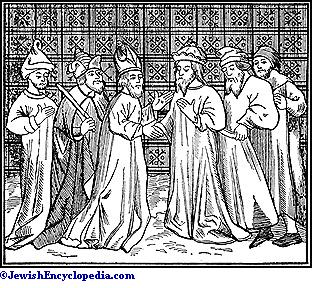
Thirteenth Century. Southern France: Policy of Alphonse of Poitiers.
The fate of the Jews of the south in the course of the thirteenth century by no means resembled their previous experience. It was a period of reaction. The coalition of the pope, the Church, and the enemies of the counts of Toulouse now forced the counts, who with their vassals had a century before protected the Jews so efficaciously, to yield to the intolerance of the times. The crusade against the Albigenses had partly for its cause the fact that Raymond VI. and his vassals had confided certain public offices to the Jews; and this wrong was one of those for which the Count of Toulouse and a dozen of his principal vassals made the amende honorable at the Council of St. Gilles (1209), by swearing not to entrust public or private offices to Jews in the future(Vaissette, iii. 162-163). In his territory they were not allowed even to lease the tolls, imposts, or other revenues. At Narbonne, however, they continued to act as brokers down to 1306. Their condition became worse when in 1229 Raymond VII. had to give up to Blanche of Castile, mother of St. Louis, the portion of Lower Languedoc extending from Carcassonne to Beaucaire; and still more precarious when, after Raymond's death in 1249, his daughter Jeanne, wife of Alphonse of Poitiers, the brother of St. Louis, inherited the remainder of his dominions. Alphonse of Poitiers' policy toward the Jews was similar to that of his brother, with this difference, however, says Boutaric, his biographer (p. 318), that, while St. Louis undertook to drive usury out of his kingdom, Alphonse desired to enrich himself. As Count of Poitou, in 1249 he granted to the inhabitants of La Rochelle the privilege of no longer harboring Jews in their city. He even agreed to expel the Jews from Poitiers, St. Jean d'Angely, Niort, Saintes, and St. Maxient, on condition that those cities indemnify him for his loss. But the Jews apparently offered larger sums in order to be allowed to remain; in a record dated 1250 it is in fact noted that the Jews of Poitou had made a partial payment of 1,000 livres. Alphonse, like his brother, ordered the Jews to wear the circular badge (1269), but he subsequently sold them exemption from this law (Archives Nationales, J. J. 24d, fol. 720). Being in need of money, in 1268 he again followed his brother's example and arrested all the Jews in his domains, sequestrating their property. He desired to do the same in the territory of the barons, but the latter protested, since they had received large sums from the Jews in return for permission to dwell there; and Alphonse was obliged to yield (Boutaric, pp. 320, 321). The arrest of the Jews proved so obnoxious that the count consented to liberate the poor, the sick, the children under fourteen years, and all those that agreed to declare the amount of their possessions. The seneschals received orders to promise the prisoners liberty in return for a ransom, and to bid them send two of the wealthiest among them to the count, who would confer with them directly. A number of the Jews who had made false statements in regard to their property were kept close prisoners. Others, weary of confine ment, turned informers. One of these reported to the seneschal of Poitou that certain treasures had been hidden in cellars. This report proved true, and the success of the search soon reached the ears of the other seneschals. One of the informers incurred the enmity of Jews and Christians to such an extent that he did not dare remain in the territory of the count. The Jews were finally liberated on payment of large sums, which those under each seneschal's jurisdiction undertook to pay jointly, as follows: those of Poitou 8,000 livres, of Saintonge 6,000 livres, of Rouergue 1,000 livres, and of Auvergne 2,000 livres. Those of Toulouse promised to pay 3,500 livres, Alphonse having estimated their possessions at only 1,300 livres, but he now ordered them to pay 5,000 livres (ib.). This spoliation was not as profitable as the count had expected, for his agents filled their own pockets with the sums extorted from the Jews. In 1270 Alphonse again harassed the Jews, commanding them to return to their debtors all sums which they had received as usury. He himself derived the benefit of this procedure, for the pope had authorized him to devote such sums to defraying in part the expenses of the Crusade. On the death of Alphonse of Poitiers his estates came into possession of Philip the Bold, and the Jews of these provinces now shared the fate of their coreligionists of the north, whose history has been recounted above. (On the relation of the Jews to the local seigniors, see Saige, passim.)
Relations with the Inquisition.
The Inquisition, which had been instituted in order to suppress the heresy of the Albigenses, finally occupied itself with the Jews of southern France also. The popes complained that not only were baptized Jews returning to their former faith, but that Christians also were being converted to Judaism. In March, 1273, Gregory X. formulated the following rules: Relapsed Jews, as well as Christians who abjured their faith in favor of "the Jewish superstition," were to be treated by the Inquisitors as heretics. The instigators of such apostasies, as well as those who received or defended the guilty ones, were to be punished in the same way as the delinquents. It was in accordance with these rules that on Jan. 4, 1278, the Jews of Toulouse, who had buried a Christian convert in their cemetery, were brought before the Inquisition for trial, and their rabbi, Isaac Males, was condemned to the stake (Vaissette, original ed., iv., documents, col. 5). Philip the Fair, as mentioned above, at first ordered his seneschals not to imprison any Jews at the instance of the Inquisitors, but in 1299 he rescinded this order (see Israel Lévi, "Les Juifs et l'Inquisition dans la France Méridionale," 1891; Lea, "History of the Inquisition," ii. 96).
The Schools of Paris and Elsewhere.
When the edict of exile was suddenly pronounced in 1306, the intellectual decadence of the Jews of northern France was already far advanced. But down to the time of the burning of the Talmud, that is, down to the first half of the thirteenth century, the rabbinical schools flourished and preserved their prestige. Talmudic scholars continued the work of the tosafists; the school of Sir Leon (d. 1224) at Paris attracted many disciples, and flourished still more under his successor, Jehiel b. Joseph, alias Sir Vives of Meaux. Among the 300 pupils that the latter gathered around him were Isaac of Corbeil, his son-in-law; Perez b. Elijah, of the same city; Judah ha-Kohen, probably of Mayence; and the celebrated Meïr of Rothenburg. On account of Jehiel's eminence he was chosen to direct the disputation relating to the Talmud, referred to above. After the condemnation of that work, however, the school of Paris declined. Jehiel even sent an emissary to Palestine to collect subsidies for his academy; he finally left France (c. 1260) to end his days in the Holy Land. A part of his tosafot, consultations, and decisions have been preserved. Jehiel's school ceased to exist after his departure. Samuel of Evreux, a distinguished tosafist, and a contemporary of Jehiel, taught at Château-Thierry. Hiselder brother, Moses of Evreux, was the author of the "Tosafot of Evreux." Samuel b. Solomon of Falaise, alias Sir Morel, who took part in the disputation of Paris, also conducted a famous school; he was considered one of the most learned tosafists. Judah b. David, Sir Morel's companion in the disputation, taught at Melun. Moses of Coucy, the fourth of the disputants, was distinguished for his oratorical ability. In 1235-36 he traveled through France and Spain, preaching the observance of the religious ordinances, and the practise of justice and charity toward all, Jews and non-Jews alike; and in 1250 he edited a collection of Jewish laws ("Sefer Miẓwot Gadol," or "SeMaG") which had great authority. His tosafot and his commentaries to the Pentateuch added to his fame. Isaac of Corbeil, Jehiel's son-in-law, who presided over the school of Corbeil, published in 1277 an abridged edition of the "Semag" under the title "'Ammude ha-Golah" or "Sefer Miẓwot Ḳaṭan" ("SeMaḲ"), a sort of Talmudic breviary, containing a miscellany of religious and moral reflections and some fables. Perez b. Elijah of Corbeil, who also taught in that city, was the last tosafist; a voluminous writer, he composed, in addition to some well-known tosafot, Talmudic commentaries and glosses, and several ritual collections. His contemporary, Isaac b. Isaac of Chinon, was called "head of the Talmudic schools of France." Previous to Perez b. Elijah, Nathaniel the Holy had directed the rabbinic school of Chinon (after 1224). Eliezer of Touques, likewise one of the last tosafists, collected extracts from the tosafot of Sens, of Evreux, and of other schools, and added to them some of his own. The unsettled character of the times induced the rabbis to be content with merely collecting the work of their predecessors, so that the Talmudists of the second half of the thirteenth century, in contrast to those of the preceding century, were chiefly compilers. Nor can the Bible commentaries of this century compare with those of the preceding century; the tosafot to the Torah, Aaron b. Joseph's "Gan" (1250), Isaac ha-Levi b. Judah's "Pa'aneaḥ Raza," and Hezekiah b. Manoah's "Ḥazḳunni" (1240) are interesting compilations, in which are contained many ingenious interpretations, but in which the Haggadah, and to a greater degree gemaṭria, occupy a too prominent place. Berechiah ha-Naḳdan stands out from among these men of somewhat limited views; he was interested in theologic questions, translated a lapidary and Adelard of Bath's "Quæstiones Naturales," and composed a charming collection of fables in rimed prose intermixed with verse (I. Lævi, in "R. E. J." xlvi. 285).
Jewish Learning in Southern France.
The Jews of the south of France were meanwhile studying not only the Talmud, the Bible, and questions pertaining to the ritual, but also the humanities; and they even cultivated poetry. Science was introduced in the form of translations from the Arabic. Samuelibn Tibbon (flourished 1199-1213) translated into Hebrew Maimonides' "Guide" and several of his smaller writings, Aristotle's "Meteorology," a philosophical treatise of Averroes, and various medical works; and also wrote original theses on these subjects. His son-in-law, Jacob b. Abba Mari b. Anatoli, who stood in friendly relation with Michael Scot, may be said, with the latter, to have introduced Averroism into the West. He was also the first to apply the rationalism of Maimonides to the interpretation of the Bible. His "Malmad ha-Talmidim" is a collection of philosophic-allegorical homilies on the Bible and the Haggadah. An advanced thinker, he attacked Christianity and Mohammedanism, as well as in general the belief in miracles, the monastic life, and the ignorance and hypocrisy of his time. In his explanations of the text of the Scriptures he does not hesitate to have recourse to the erudition of "Michael, the great scholar."
Moses b. Samuel ibn Tibbon surpassed his predecessors in the extent of his labors. He made accessible to the Jews almost all the commentaries of Averroes; the "Principles" of Alfarabi; Euclid; the "Almagest"; Avicenna's "Canons"; the "Aphorisms" of Hippocrates, of Ḥunain b. Isaac, and of Razes; the medical works of Maimonides, as well as all the latter's other works that had not yet been translated. Samuel's grandson, Jacob b. Machir ibn Tibbon, called "Profatius," equaled Moses in productivity as a translator, and in addition wrote scientific works. Solomon b. Moses of Melgueil, the translator of Avicenna, belongs to the same group of scholars.
Secular poetry, escaping from the fetters of religion, flourished in this liberal atmosphere. Isaac Gorni spread his compositions all over southern France, and gave a vivid picture of Jewish life. The more prolific Abraham b. Isaac Bedersi composed liturgical poems, elegies, satires, and didactic verse, in which he often displays originality of expression and delicacy of feeling. His master, Joseph b. Hanan Ezobi, devoted himself to religious poetry, while Isaiah, son of Samuel, and Phinehas ha-Levi b. Yehosifya cultivated secular poetry as well. Jedaiah Penini, son of Abraham Bedersi (alias En Bonet b. Abraham or Bonet Profiat), who belongs to the thirteenth and fourteenth centuries, was a man of science and a philosopher, as well as the most remarkable poet produced in French Judaism. His "Beḥinat 'Olam," which has been translated a number of times, is a world-poem of sadness and melancholy.
Polemics and Apologetics.
Controversy was introduced into Provence by the Ḳimḥis. Although northern France had the work of Joseph the Zealot, this is merely a collection of brief discussions entered into in connection with certain verses of the Bible. Southern France, on the other hand, produced regular treatises in defense of Judaism against the attacks of Christianity. Joseph Ḳimḥi, who wrote the "Sefer ha-Berit" (Book of the Covenant), was followed by Meïr b. Simon of Narbonne with his "Milḥemet Miẓwah" (Holy War), which contains much information concerning the unfortunate condition of the Jews of that time. Mordecai b. Yehosifya, in his "Maḥaziḳ Emunah," defends Judaism against the attacks of Paul Christian. But the Ḳimḥis, curiously enough, could not introduce into Provence the severe and grammatical exegesis which they hadbrought from Spain; for the advanced exegetes, like Jacob Anatoli, Nissim of Marseilles, and Levi of Villefranche, mentioned above, went further than the Ḳimḥis in their free treatment of the text, and, dominated by a boundless admiration for Maimonides, could permit no other than the allegorical interpretation of the Scriptures. The Talmud continued to be assiduously studied by numbers of scholars; but they were not leaders in the intellectual world, and even their principal works contain nothing particularly striking. Nevertheless, the following may be mentioned: Meshullam b. Moses of Béziers, with his "Sefer ha-Shelamah"; Abraham ha-Levi b. Joseph b. Benvenisti, with his novellæ and his "Bedeḳ ha-Bayit," a criticism of Solomon b. Adret's "Torat ha-Bayit"; and Menahem b. Solomon Meïri (Don Vidal Solomon), with his commentaries on the Talmud and his "Bet ha-Beḥirah," an introduction to the commentary of Abot, and interesting for the information it gives concerning the rabbis of the time. The novellæ ("ḥiddushim"), which were characteristic of Provence, no longer showed any originality. There was a fundamental difference between the new learning originating with Maimonides and the traditional learning centering in the Talmud; and this difference, as was to be expected, soon led to controversies, which form one of the most interesting chapters in the history of the Jews, not only of southern France, but of entire Judaism.
Maimonists and Anti-Maimonists.
The publication of Maimonides' Mishneh Torah had aroused the indignation of Abraham ibn Daud, as well as of the Spanish Talmudist Meïr b. Todros Abulafia ha-Levi, nasi of Toledo. The latter wrote his impressions to one of Maimonides' correspondents, Jonathan Cohen of Lunel: he was especially scandalized by the way in which Maimonides had juggled with the doctrine of the Resurrection; it had disturbed the Jews, and was leading them to an absolute denial of the future life. Aaron b. Meshullam of Lunel came to the defense of Maimonides, answering the Spanish scholar with much warmth. As Meïr felt that his views were not finding favor at home, he turned to the rabbis of northern France, and made Solomon of Dreux, Simson of Sens, Simson of Corbeil, David of Château-Thierry, Abraham of Touques, Eliezer b. Aaron of Bourgogne, and others, judges in the dispute. They sided with Meïr, but their discussions were confined to an exchange of letters, the dates of which are not known, though they must have been written at least before 1210, since Aaron b. Meshullam died in that year. But after Samuel ibn Tibbon translated Maimonides' "Guide of the Perplexed," the popularity of the works of the Jewish philosopher thoroughly aroused the orthodox rabbis of southern France, who regarded the dissemination of Maimonides' rationalism as dangerous to Judaism. The Talmudist Solomon b. Abraham of Montpellier, assisted by two of his pupils, David b. Saul and Jonah of Girona, threatened to excommunicate any one who should read Maimonides' works. This was the first time within Judaism that such a step had been taken; the Rabbis were doubtless influenced by the example of the Inquisition, which then held sway in that region. The Jews of southern France, who had been taught from infancy to admire Maimonides, considered it presumptuous to treat him as a heretic, and no rabbi of Provence was found willing to join Solomon of Montpellier in uttering the ban. The latter, at the instance of Meïr Abulafia, appealed for cooperation to the French rabbis, who were known for their unswervable attachment to tradition; he sent Judah of Girona to them, and he obtained their promise to support the sentence of excommunication. Thereupon all the Jews of Provence rose in protest; the rabbis of Lunel, Béziers, and Narbonne, and following them those of all the communities of that region, answered in kind, excommunicating Solomon and his two disciples. The quarrel spread across the Pyrenees, and the communities of Aragon and Castile sided with Maimonides (1232). The community of Toledo alone did not respond; this alarmed Solomon's opponents, and one of them, the famous David Ḳimḥi, who had at first been suspected of rationalism by the rabbis of northern France, but had succeeded in convincing them of his true position, set out for Spain in order to bring the community of Toledo into line. But before reaching that city he learned that its foremost scholar, Judah b. Alfakar, with whom he had previously corresponded, had published a letter in which he sided against Maimonides, declaring that the doctrine of Judaism had nothing in common with the philosophy of Aristotle. This letter had already provoked many replies. But David Ḳimḥi received at the same time the astounding news that Solomon b. Abraham, abandoned by almost all his followers, had, seemingly in a fit of madness, denounced to the Inquisition in Montpellier the "Sefer Madda'" (the introduction to the Mishneh Torah) and the "Guide" of Maimonides. The whole city of Montpellier, where the partizans and adversaries of Solomon had carried their quarrels even into the streets, was filled with consternation when the books of the famous Jewish theologian were solemnly burned (1234 or 1235). The adversaries of Maimonides were confounded by their triumph. Some, including Jonah, repented of their action in public; the vanquished heaped scorn upon the victors. It even seems that Jaime, seignior of Montpellier, who was greatly attached to two partizans of Maimonides, caused to be arrested and condemned for calumny those who had attacked Maimonides and his followers. The excitement in southern France was not allayed for a long time, and later, when the contest took place between the liberal and orthodox parties, although it too was based on Maimonides' teachings, no one dared mention his name or attack his opinions. The quarrel was in fact renewed in 1303 by Abba Mari b. Moses b. Joseph (also known as "En Astruc") of Lunel, assisted by Simon b. Joseph ("En Duran") of Lunel.
Dispute About Philosophical Studies
In several letters addressed to Solomon b. Adret of Barcelona, the foremost rabbinical authority of the time, Abba Mari pointed out the errors of the philosophical school, which interpreted as allegories not only passages of the Talmud, but also Bible stories. Thus Abraham and Sarah were taken to signify the union of matter and form; the twelve tribes to mean the twelve planets; etc. Furthermore, the writer complained that instead of praying andreciting the Psalms, the people read Aristotle and Plato; and that on Sabbaths and festivals the young people studied works devoted to dangerous interpretations. He declared that steps must be taken to check this peril, and that the books dangerous to the faith must be excommunicated. Although Solomon b. Adret shared the views of his correspondent, he did not dare to take the initiative in so grave a matter, but desired to wait until the communities interested in the question should force the action upon him. Abba Mari then took the matter into his own hands, and wrote successively to most of the rabbis of Provence. Levi of Villefranche, a scholar who was visiting Samuel Sulami, was charged with having interpreted the Scriptures allegorically, and his host no longer dared to keep him in his house. Soon the communities were again divided. A letter from Barcelona, signed by Solomon b. Adret and fourteen other rabbis, and threatening with excommunication any one who should engage in philosophic studies before the age of thirty, was brought to Montpellier. This letter was not published immediately, as the community desired to examine it first. After long discussions Abba Mari, in spite of the opposition of the famous Jacob b. Machir, one of the Ibn Tibbons, finally decided to read it in the synagogue of Montpellier. But because many of the faithful rallied to the support of Jacob b. Machir, Abba Mari was forced to abandon the matter. The quarrel between the orthodox and the liberal factions became ever more bitter, and both sides wrote to the rabbis of Barcelona explaining the state of affairs. Solomon b. Adret, frightened by the attitude of his adversaries, did not dare to take part openly against them, but asked Abba Mari to reconsider the matter, being himself disposed to rest satisfied with the open repentance of Levi of Villefranche, the only guilty one. Solomon took this stand in consequence of the increasing number of protests that reached him. That sent by Jacob b. Machir, imperious in tone, defended philosophic studies and taxed Solomon b. Adret with duplicity. Adret was hard pressed by Abba Mari and the other rabbis, and finally, in the month of Ab, 1305, the interdiction against studying "Greek" books before the age of twenty-five, and against interpreting the Scriptures allegorically, was pronounced in the synagogue of Barcelona. The liberal party of Montpellier, headed by Solomon of Lunel, instead of confessing itself defeated, applied to the governor of Montpellier, without whose authorization the sentence of excommunication could not be uttered against the Jews of the city; and Solomon then pronounced an anathema upon all who should forbid their children the study of science. The quarrel continued, and rabbis from all parts of Provence took sides for or against the sentence of excommunication pronounced by Solomon b. Adret. The poet Jedaiah Penini wrote a strong letter to the rabbi of Barcelona, entreating him for the honor of Judaism and in the interest of science to revoke his sentence of excommunication. At this point the edict of Philip the Fair put a sad end to the quarrel.
Return of the Jews to France, 1315:
Nine years had hardly passed since the expulsion of 1306 when Louis X. (1314-16) recalled the Jews. In an edict dated July 28, 1315, he permitted them to return for a period of twelve years, authorizing them to establish themselves in the cities in which they had lived before their banishment. He issued this edict in answer to the demands of the people. Geoffroy of Paris, the popular poet of the time, says in fact that the Jews were gentle in comparison with the Christians who had taken their place, and who had flayed their debtors alive; if the Jews had remained, the country would have been happier; for there were no longer any money-lenders at all (Bouquet, xxii. 118). The king probably had the interests of his treasury also in view. The profits of the former confiscations had gone into the treasury, and by recalling the Jews for only twelve years he would have an opportunity for ransoming them at the end of this period. It appears that they gave the sum of 122,500 livres for the privilege of returning. It is also probable, as Vuitry states, that a large number of the debts owing to the Jews had not been recovered, and that the holders of the notes had preserved them; the decree of return specified that two-thirds of the old debts recovered by the Jews should go into the treasury. The conditions under which they were allowed to settle in the land are set forth in a number of articles; some of the guaranties which were accorded the Jews had probably been demanded by them and been paid for. They were to live by the work of their hands or to sell merchandise of a good quality; they were to wear the circular badge, and not discuss religion with laymen. They were not to be molested, either with regard to the chattels they had carried away at the time of their banishment, or with regard to the loans which they had made since then, or in general with regard to anything which had happened in the past. Their synagogues and their cemeteries were to be restored to them on condition that they would refund their value; or, if these could not be restored, the king would give them the necessary sites at a reasonable price. The books of the Law that had not yet been returned to them were also to be restored, with the exception of the Talmud. After the period of twelve years granted to them the king might not expel the Jews again without giving them a year's time in which to dispose of their property and carry away their goods. They were not to lend on usury, and no one was to be forced by the king or his officers to repay to them usurious loans. If they engaged in pawnbroking, they were not to take more than two deniers in the pound a week; they were to lend only on pledges. Two men with the title "auditors of the Jews" were entrusted with the execution of this ordinance, and were to take cognizance of all claims that might arise in connection with goods belonging to the Jews which had been sold before the expulsion for less than half of what was regarded as a fair price. The king finally declared that he took the Jews under his special protection, and that he desired to have their persons and property protected from all violence, injury, and oppression ("Ordonnances," i. 604; Brussel, p. 617; Vuitry, l.c. p. 98).
Under Philip V.
Philip V. the Tall (1316-22) at first continued the policy of Louis X. with regard to the Jews. By his decrees of April, 1317, and Feb., 1319, he grantedthem certain privileges, and somewhat ameliorated their social status; but the financial consideration that induced these measures is apparent. The king modified the sentences that might be pronounced upon them; exacted the wearing of the circular badge only in the cities; placed the Jews under the jurisdiction of their own bailiffs; determined and regulated the financial operations in which they might engage; and even authorized them to own houses ("Ordonnances," i. 646, 682; Vuitry, l.c. 101). But while he decreed that they should no longer be subject to mortmain, and that their estates were to descend to their families, still the same general rule obtained as in the time of St. Louis, that the property of the Jews belonged to the seignior within whose domains they dwelt; and the king expressly declared that they were to remain subject to tallage and to pay taxes in proportion to the amount of their fortunes. While they were enjoined to sell only merchandise of a good quality, they were to indemnify the treasury, and not the deceived buyer, in cases of fraud.
Unfortunately for the Jews, this was a period of physical and intellectual misery. In 1320 appeared the Pastoureaux, a band of peasants and herdsmen, mostly less than twenty years of age, eager for battle, adventure, and pillage. They were led by unscrupulous men—a priest driven from his church on account of his misdeeds, and an unfrocked monk—and they were reenforced by hordes of miscreants and bandits. To the number of 40,000 they overran Languedoc, attacking principally the Jews, whom no one dared to protect. Five hundred of the latter sought refuge in the fortress of Verdun-sur-Garonne, and defended themselves valiantly; but, seeing their efforts useless, they decided that the eldest among them should put the others to death; he was aided in this work of martyrdom by a vigorous youth, and soon all had perished except the children, who had not been given to the sword; these were baptized. The governor of Toulouse, attempting to check this band of brigands, imprisoned some in that city, but they were liberated by the mob, who then turned to massacre the Jews. The Pastoureaux were everywhere supported by the mob, and sometimes by the citizens, who either encouraged the massacre or were afraid to protect the Jews. At Alby the consuls tried to stop the horde at the city gates, but the Pastoureaux forced their way in, shouting that they had come to kill the Jews; the populace received them as friends and brothers, "for the love of Christ, against the enemies of the faith."
Under Charles IV.
At Lezat the consuls made common cause with them. Even the officials sometimes shared the popular fanaticism. The progress of the Pastoureaux was arrested only in the district of the seneschal of Carcassonne (P. Lehugeur, "Hist. de Philippe le Long," 1897; Grätz, "Geschichte," 3d ed., pp. 255 et seq.). Charles IV. subsequently appointed commissioners to inquire into the affair in the districts of the seneschals of Toulouse, Périgord, and Carcassonne; but his action was taken only because the royal treasury had suffered as a result of the riots; the cities in which the troubles had occurred were sentenced to pay a fine. Various instances show both the weakness of the authorities and the prevalent hostility toward the Jews. At Château-Thierry in 1318 the synagogue was entered, the tabernacle broken open, and the scrolls of the Law carried off ("Actes du Parlement de Paris," 5230). In 1319 certain impostors traversed the country, and, pretending to be the king's agents, searched the houses of the Jews, and despoiled them in the name of the law. At Troyes the Jews were accused of having entered the churches, and also of having shouted so loudly in their synagogues as to disturb divine services in the churches; Philip the Tall thereupon (Feb. 26, 1320) directed the bailiff of Troyes to punish the Jews so severely that in future they would cease committing such outrages ("Bibliothèque de l'Ecole de Chartres," 1849, p. 414). On July 12, 1317, the king had ordered the arrest of several persons on suspicion of having killed a child, and two Jews of Chinon had been hanged on this charge. In Puy the Jews were similarly accused (Mandet, "Hist. du Velay," iv. 117). According to one historian, "the people of that time were seized with a delirium that begat epidemics of frenzy. The public mind was disturbed by imaginary terrors; common gossip treated of nothing but compacts, witchcraft, and magic" (Fleury, "Hist. Eccl." ch. 92). In their excitement the people of Guienne imagined that the lepers had formed a conspiracy to destroy their countrymen, either by leaving the infirmaries in order to infect the healthy, or by poisoning the wells and fountains. Thereupon they seized some of these unfortunates, and without any form of trial burned them at the stake. The king, too weak to quell this uprising, sought to profit by it. He instituted an investigation; the lepers were arrested, and those that yielded to torture and confessed were condemned to the stake, and their property was confiscated. All this happened before June 21. The Bishop of Alby then took it on himself to follow the king's example, but was forced to desist and mulcted in a fine. The Jews, who, like the lepers, lived apart from the rest of the community, and who, like them, were objects of public dread, soon suffered from the same charges as had been brought against the lepers. Some of the latter, on examination, alleged that the Jews, who themselves did not dare to poison the rivers, had induced them to commit this crime.
Conditions at Tours.
According to a later version of the story, it was a Jew who had thrown poison into the river at Tours. When the king was informed of this alleged crime, he condemned the Jews to pay a fine of 150,000 livres; their goods were confiscated, and the wealthiest among them were imprisoned as security for the fine. Then letters were produced, alleged to have been written by the kings of Tunis and Granada to the Jews, and offering them commissions to poison the Christians. These forgeries, however, were dated July 2, i.e., after sentence had been pronounced. According to one chronicle, some of the Jews were condemned to the stake, but the official documents disagree with this statement. While the people had attacked the lepers before the latter's condemnation, they attacked the Jews insome places only after sentence had been pronounced. On Aug. 27 one hundred and sixty Jews were thrown into a burning furnace at Chinon, among them being the famous rabbi Eliezer b. Joseph of Chinon (Estorhi Farḥi, "Kaftor wa-Feraḥ," written in 1322; on the date see D. Kaufmann in "R. E. J." xxix. 298). Doubtless other massacres took place in Languedoc, and records of them have been preserved in Kalonymus b. Kalonymus' "Eben Boḥan" (written in 1322). At Vitry le Brûlé forty Jews, imprisoned and facing death, commissioned two of their number to kill the remainder. In many places, as at Tours, Chaumont, and Vitry, the Jews, like the lepers, were put on the stand (a fact of which Kalonymus bitterly complains), and were asked to denounce their accomplices (Duplès-Agier, "Rev. de l'Ecole de Chartres," 1857, p. 267; Lehugeur, l.c.; L. Lazard, in "R. E. J." xvii. 210; Vaissette, x. 616; "Continuation de Guillaume de Nangis," Bouquet, xx. 628-629; "Continuatio Chronici Gerardi de Fracheto," xxi. 56; Jean de Saint Victor, xxi. 674; "Chron. de Saint Louis," xx. 704; "Chron. Anonyme," xxi. 140, 152; Mandet, "Hist. du Velay," iv. 117; Labbe, "Collectio Concil." xxv. 568; Brussel, p. 607; "Actes du Parlement, Mandement du 8 Février, 1322"). The entire chronology of these occurrences is obscure.
Charles IV., who succeeded Philip the Tall in 1322, undertook to collect the fine which the Jews had been sentenced to pay. While discussing this affair with the seneschals of Languedoc on Feb. 20, 1322, he foresaw that certain of the Jews would desire to leave the country (Vaissette, x. 616). In fact, such an exodus took place; but, according to Brussel, it was not a voluntary one. They were expelled on June 24, 1322. In 1324 the property of Jews was confiscated, either as a consequence of their expulsion, or as indemnity for the non-payment of the fine (Brussel, p. 623). However this may be, there were no Jews in France between 1322 and 1359 (see Isidor Loeb in "Grätz Jubelschrift," pp. 51 et seq.).
Under John the Good.
After the disaster at Poitiers (1356) and the captivity of John the Good, France was in dire straits. The ransom of the king had been fixed at 3,000,000 écus in gold. Soldiers plundered everywhere; there were fields that had not been tilled for three years; the silver mark was worth 102 livres. It was then that the regent, Duke Charles of Normandy, negotiated with Manassier of Vesoul for the recall of the Jews to France; they were to remain for a period of twenty years, were to pay an entrance fee of 14 florins gold for each family, and of one florin and two tournois for each child or servant, and a yearly tax of seven florins for each family, and of one florin for each child or servant ("Ordonnances," iii. 468, 469). The charter granted to them by the dauphin Charles, and ratified March 1, 1360, by King John ("Arch. Nat." J J 89, folios 316-320), was very liberal, the Jews taking precaution to guard against the ills and injustices from which they had suffered on previous occasions. Even two guardians of these privileges were appointed for them, Robert of Outreloue for Languedoc, and the Count of Etampes for the kingdom of France proper ("Ordonnances," iii. 351, 352, 471, 472). As the Jews who returned to France at that time were chiefly engaged in money-lending, the privileges accorded to them bear chiefly on that calling; they were permitted to lend on interest at the rate of four deniers in the pound per week. That the Jews were few in number is clearly shown from the fact that between 1359 and 1394 there is scarcely any trace of Jewish intellectual activity. While John was in the south of France (Dec. 27, 1362) he permitted the Jews to practise medicine and surgery, provided that they had passed an examination before Christian instructors ("Arch. Nat." J J 93, 163; comp. "Ordonnances," iii. 603). But with his well-known duplicity he declared, in Oct., 1363, that the privileges had been abused which had been granted, and were therefore annulled. Further, he compelled them to wear the circular badge again, and in defiance of the charter of 1360 made them subject to the common courts in whatever district they were living ("Ordonnances," iii. 603, 641).
Under Charles V.
Charles V. (1364-80), however, kept the contract that he had made as regent. The Count of Etampes interposed frequently in the Parliament of Paris and in other civil and ecclesiastical tribunals, on behalf of the Jews, to secure their freedom from the general jurisdiction.
Meanwhile the Jews of Paris lived quietly in the district of St. Antoine, near the dwelling of Hugues Aubriot, the grand provost of Paris, who protected them. Aubriot's enemies subsequently explained this good will by saying that he was fond of the beautiful Jewesses. He was also reproached with having restored to the Jews children that had been baptized ("Chronique des Quatre Premiers Valois," p. 295). Thefts committed against the Jews were promptly and severely punished, even when the offenders belonged to the nobility (Simeon Luce, "Rev. Hist." vii. 362 et seq.). But this state of affairs excited jealousy, and the creditors of the Jews, among whom were some of the noblemen of the highest rank, again endeavored to have them expelled from the kingdom. Thus toward the end of 1367 or the beginning of 1368 King Charles issued a decree of banishment, but revoked it before it had been put into effect ("Mandements de Charles V." ed. Delisle, No. 430, pp. 216, 217). In Languedoc, where the distress was very great and the rate of interest necessarily higher than in other parts of the country, the Jews were more bitterly hated. Attempts were made to compel them to attend service in the churches. On the complaint of Deys (or Denis) Quinon, attorney-general for the Jews, Charles V. put an end to this grievance on March 22, 1369, because, unless this was done, "the Jews might suffer great bodily harm" ("Ordonnances," v. 167, 168).
In 1370, when the king increased the general taxes, he solemnly confirmed the privileges that he had granted to the Jews, demanding of them only 1,500 francs. In 1372 he restored to them certain manuscripts which had been confiscated. But at the same time he did not lose sight of his own interests, and when he was in need of money, in 1378, he made an agreement with the Jews in accordance with which, in return for being exempted from all other imposts, they were to pay him 20,000 francs in gold, in four instalments, and 200 francs a week ("Ordonnances,"vi. 339). In 1379 he granted them an important concession in connection with the fairs of Champagne and Brie. On visiting the fairs the Jews were accustomed to take mortgages on the property of their creditors. But they could foreclose these mortgages only when solvent Christians acted as sureties, and they complained that, since they could not in general find any one to act as surety, they always lost their claims. The king therefore decreed that Jews might in future be accepted as sureties ("Ordonnances," vi. 439).
Under Charles VI.
With the death of Charles V. in 1380, evil days set in for this band of money-lenders, whose sojourn in France was dependent on the interests of the treasury and the enforcement of authority. On the accession of the new king, Charles VI., the people of Paris, impatient to have the special taxes levied by Charles V. revoked, marched to the palace to make their request. This being granted, they retired; whereupon certain of the nobles, who had joined the crowd, proposed that the expulsion of the Jews be demanded. Only a short time before, the right of remaining had been granted to the Jews on the payment of certain sums. As the chancellor did not send an immediate reply, the people gathered in the streets and seized the records and the money in the public treasury. Then they rushed into a district where the Jews occupied forty houses, pillaging and plundering on all sides. In this work they were encouraged by the nobles and the bourgeoisie, who had joined the mob in order that they might seize such of their notes as were held by the Jews. Pillaging was followed by slaughter; all the Jews met were killed; such as escaped fled to the Châtelet, where they asked to be confined with the prisoners and thus be saved from the fury of the mob. The king did not yield to the people; the next day he ordered the Jews to return to their homes, and commanded, under severe penalties, the restoration of their property. But very few obeyed the royal order ("Chron. des Réligieux de St. Denis"; "Chron. de Charles VI." i. 53-57, in "Documents Inédits de l'Hist. de France"). In consequence of this riot several Jews left Paris, while others accepted baptism (Félibien-Lobineau, "Hist. de Paris," iii.).
In 1382 there was another disturbance, known as the "Riot of the Maillotins." This was caused also by the exigencies of the treasury, a new tax having been levied at the rate of a twelfth of the value of all commodities. The rioters, armed with mallets, fell upon the appraisers, and then attacked the houses of the Jews, which they pillaged for four days ("Arch. Nat." J J 122, fol. 55; 136, fol. 114). The mob looked upon the Jews as accomplices of the treasury; indeed, as a matter of fact, a large part of the usury which they exacted went into the public coffers. This riot was followed by others outside Paris. When the news came to Mantes the inhabitants of that town, incited by the soldiers, who assured them of the king's consent, pillaged the Jewish quarter ("Arch. Nat." J J 122, fol. 96; Douet d'Arcq, "Pièces Inédites Relative an Règne de Charles VI." i. 45, 56). This time again the king supported the Jews. In a letter of Charles VI. dated 1387 ("Ordonnances," vii. 169) the Jews of Paris and of several other parts of the kingdom are said to have represented themselves as having been despoiled of their property and of the pledges which they had been unable to restore to their owners ("Ordonnances," vi. 563); adding that they had become so poor and reduced in numbers that unless their coreligionists of Languedoc were compelled to bear part of the burden of the tax, they would be unable to pay the contribution levied upon them ("Ordonnances," vii. 169, 233). In proportion to the needs of the treasury, the Jews, in addition to paying the usual taxes, were compelled to advance still greater sums to the king. In return they received various dangerous concessions. They had the privilege of exacting interest at the rate of a denier in the pound per week, but were forbidden to take compound interest. Yet some thought they were authorized to exact this, and the public prosecutor and the officers of justice proceeded against the guilty ones, but when they complained to the king the latter imposed "perpetual silence" on the prosecutor and granted the Jews immunity from all persecution for the period of ten years ("Ordonnances," vii. 170). They also obtained the suppression of the "letters of regret" which persons indebted to them had caused to be issued by royal authority. In 1388 the king declared that letters of this class which had been signed by him would in the future be regarded as void, but he demanded of the Jews 10,000 livres for affixing his seal to this concession ("Ordonnances," vii. 170). The judiciary, however, jealous of its privileges, and dissatisfied with having them set aside by the king to further his own interest, imprisoned in the Conciergerie such Jews as had been guilty of exacting compound interest. In return for another subsidy the king delivered the Jews once again from persecution in 1394 ("Ordonnances," vii. 643). Then, according to the chronicler of St. Denis, an incident occurred that brought matters to a crisis. The Jews of Paris were accused of having induced Denis Machault of Ville-Parisis, who had accepted baptism, to return to Judaism. The case was tried before the provost of Paris, assisted by various lawyers and theologians, and seven Jews who had been arrested were condemned to be burned at the stake. But the Parliament changed this sentence, ordering that the Jews should be publicly flogged on three successive Saturdays, and should then be banished, and that their property should be confiscated (Félibien-Lobineau, "Hist. de Paris; Pièces Justificative," iv. 546; Joannes Galli, in "Sauval," ii. 524).
Expulsion.
On Sept. 17, 1394, Charles VI. suddenly published an ordinance in which he declared, in substance, that for a long time he had been taking note of the many complaints provoked by the excesses and misdemeanors which the Jews committed against Christians; and that the prosecutors, having made several investigations, had discovered many violations by the Jews of the agreement they had made with him. Therefore he decreed as an irrevocable law and statute that thenceforth no Jew should dwell in his domains ("Ordonnances," vii. 675). According to the "Réligieux de St. Denis," the king signed this decree at the instance of the queen ("Chron. de Charles VI." ii. 119). The decreewas not immediately enforced, a respite being granted to the Jews in order that they might sell their property and pay their debts. Those indebted to them were enjoined to redeem their obligations within a set time; otherwise their pledges held in pawn were to be sold by the Jews. The provost was to escort the Jews to the frontier of the kingdom. Subsequently the king released the Christians from their debts.
Levi b. Gershon. Map of France Showing Chief Towns Where Jews Dwelt Before the Expulsion of 1394.
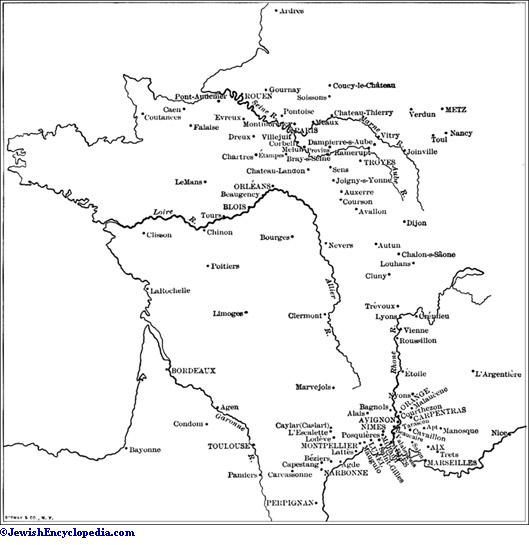
The banishment of the Jews from Languedoc and Languedoil put an end to a condition that had long been precarious, and the number of them that went into exile was probably not large. No references to this exodus have been preserved in Jewish literature, yet many traces exist to show the decline of Judaism during the thirty-six years that elapsed between their return and their expulsion. At the time of the return there were not more than five or six Talmudists within the limits of old France. Mattithiah b. Joseph Trèves, who was acknowledged as rabbi by Charles V. and as such exempted from wearing the circular badge ("Responsa of Isaac b. Sheshet," pp. 270-272; "Ordonnances," v. 498), endeavored to found a school in Paris, but trained only eight rabbis. On his death his son Johanan was called upon to resist the claims of a competitor, Isaiah b. Abba Mari (Astruc of Savoy), who, with the approbation of Meïr b. Baruch ha-Levi of Vienna, claimed the sole right of ordaining rabbis in France. Johanan was obliged to apply to the Spanish rabbis, Ḥasdai Crescas, Isaac b. Sheshet, and Moses Halawa, for aid in maintaining his rights, for at that time Languedoc had neither scholars nor rabbis of authority, and writers were found only in the Comtat Venaissin, in Provence proper, and in Roumillon. Nevertheless, Jewish science and literaturecontinued to prosper in Provence during the first half of the fourteenth century. The ban that had been laid upon scientific studies had stimulated, instead of arrested, their progress. Rationalism was never more potent, and philosophy was never more eagerly listened to. Levi b. Gershon (RaLBaG) was a Peripatetic who had attended the school of Averroes, and, as Munk has pointed out ("Mélanges," p. 497), was the most daring of Jewish philosophers—he even admitted the eternity of the world. Few scholars of the Middle Ages had such encyclopedic learning; he wrote commentaries to most of the works of Averroes, and at the same time to the Bible; he wrote on theology, into which he introduced astronomy; he invented an instrument for observation—the "staff of Levi." At the request of Philip of Vitry he composed a treatise on harmony; he was the author of works on arithmetic, trigonometry, algebra, and geometry; he was known for his medical skill; and at the same time he gained the respect of rabbinical authorities by his knowledge of the Talmud. His Biblical exegesis is remarkable, being largely philosophical and ethical. The stories of the Bible he regards as lessons which he loves to cite and develop. Ecclesiastes is a statement of various propositions from among which the reader has the right to make his choice.
Narboni, Kalonymus, and Others.
Moses Narboni of Perpignan was hardly less daring in his conclusions; he also explained philosophically the ethical treatises of the Bible, commented on Averroes, wrote on philosophy, theology, medicine, and the exact sciences; but he veiled his thoughts more skilfully, and selected the commentary as his vehicle for expressing them. Kalonymus b. Kalonymus, who lived somewhat earlier than these two scholars, was also one of the representatives of Jewish civilization in southern France. His relations with King Robert of Naples are well known. He continued the work of translation, and turned into Hebrew many scientific works written in Arabic, including works on medicine, geometry, mathematics, cosmography, astronomy, and various commentaries to Averroes. He wrote also many original works on philosophy and arithmetic. But among Jews he is most famous for his satirical treatise on morals, in which he derided the vices not only of the world in general, but also of the mystics, astrologers, grammarians, poets, and Talmudists; and for his parody on the treatise Megillah, in which he reviewed all the eccentricities of mankind. Averroes was then in vogue, and his commentaries were often translated, as by Moses of Beaucaire, Kalonymus b. David b. Todros of Arles, Samuel b. Judah, or Miles of Marseilles (who was imprisoned at Beaucaire in 1322 in connection with the affair of the lepers), and the prolific translator Todros Todrosi. A number of others translated Ghazzali and Arnault of Villeneuve. Joseph b. Abba Mari, Don Bonafoux of Argentière (1279-1340), was one of the most prolific writers of the time, a thinker of moderate views, opposed to the exaggerations of the school of allegory, but a firm supporter of science. His commentaries to the Bible, his treatises on grammar and lexicography, his philosophic notes to the Scriptures, his interpretation of the "Moreh" are clear and often apt, without pretending at originality.
To the same school belong David of Roquemartine, Abba Mari b. Eligdor, Sen Astruc of Noves, David of Estella—all disciples of Maimonides. Remembering the controversies of 1303-06, they did not touch upon the burning questions of Biblical history or legislation, but dealt rather with the Wisdom series—Proverbs, Job, and Ecclesiastes—which lend themselves more easily to philosophic speculations.
Nor was there a lack of scientists; such were the physicians Abraham Caslari; Isaac Lattes, who was also a theologian and Talmudist; Immanuel b. Jacob of Tarascon, called "Bonfils," a mathematician and astronomer, author of the treatise "Shesh Kenafayim" on conjunctions and eclipses, and the translator of a story of Alexander; Isaac b. Todros, the hygienist; and Jacob Bonet, son of David Bonform, the astronomer.
There were, however, fewer Talmudists. The most famous, such as Aaron b. Jacob ha-Kohen of Narbonne, the author of the ritual collection "Orḥot Ḥayyim," and Jeruham, the author of a similar work, "Toledot Adam we-Ḥawah," left France in 1306. Among those who remained—not in the territory of the king, but in the neighboring provinces—were Simson b. Isaac of Chinon, the author of the "Sefer Keritut," an introduction to the Talmud, and Isaac b. Mordecai Ḳimḥi, or Petit of Nyons. It should be noted that all these authors either wrote before the expulsion of 1322 or did not live in France proper. The country beyond the Rhône and the Pyrenean provinces that had not yet been incorporated with France were the refuge of Jewish science and of its last French representatives. And soon the Comtat Venaissin, which formed part of the Pontifical States, was to be their last shelter; for the Jews were expelled in succession from every new province acquired by the French crown. See the articles Brittany; Champagne; Dauphiné; Provence; Savoy.
Bibliography:
Aronius, Regesten;
Bédarride, Les Juifs en-France, en Italie et en Espagne, Paris, 1867;
Bégin, Histoire des Juifs dans le Nord-Est de la France, in Revue Orientale, vols. i. and ii.;
Beugnot, Les Juifs d'Occident, ou Recherches sur l'Etat Civil, le Commcrce et la Littérature des Juifs en France, en Espagne et en Italie, Paris, 1824;
De Boissi, Dissertations pour Servir à l'Histoire des Juifs, Paris, 1785;
Bouquet (Dom Martin), Recueil des Historiens des Gaules et de la France, 23 vols., Paris, 1738;
Carmoly, Biographie des Israélites de France, Frankfort-on-the-Main, 1868;
Depping, Les Juifs dans le Moyen Age, Paris, 1834;
Geiger, Parschandatha, Die Nordfranzösische Exegetenschule, Leipsic, 1855;
Grätz, Gesch.;
Gross, Gallia Judaica, Paris, 1897;
Güdemann, Gesch. i., Vienna, 1880;
Ordonnances des Rois de France de la Troisième Race, Paris, 1723-1849;
Pertz, Monumenta Germaniæ Historica, 1826-74;
Renan-Neubauer, Les Rabbins Français, Paris, 1877;
Labbè, Collectio Conciliorum, Paris, 1671;
Renan-Neubauer, Les Ecrivains Juifs Français, Paris, 1893;
Steinschneider, Hebr. Uebers. Berlin, 1893;
Vaissette (Dom), Histoire Générale de Languedoc;
Weiss, Dor;
Winter and Wünsche, Die Jüdische Litteratur, vols, ii. and iii., Treves, 1893-96;
Zunz, Literaturgesch. Berlin, 1855;
The Rest of France.
The edict of banishment of Charles VI. was enforced with the utmost severity. Nobles whose interests were injured by the expulsion were nevertheless compelled to obey the order. The Duke of Foix, who was favorably inclined toward the Jewish community of Pamiers, endeavored, though unsuccessfully,to maintain them in the duchy. An exception was made in the case of Dauphiné, because in ceding this province to Charles VI. Count Louis II. of Poitiers expressly stipulated that the Jews should be allowed to continue there and to retain their accustomed privileges. The Jews of Dauphiné remained undisturbed until the end of the sixteenth century, when the edict of expulsion was extended to that province also. However, most of them had emigrated before Louis XI. (1461-83) had been long on the throne; for, charging them with excessive usury and with dealings with his enemies while he was in Flanders, he had imposed upon them a fine too heavy for them to pay.
Seventeen years after the annexation of Provence (1481) an edict of banishment was issued against the Jews of that province. This edict, which probably had not been carried out with extreme severity, was renewed by Louis XII. in 1501. After this date, with the exception of Marseilles, where they succeeded in maintaining themselves until 1758, there were no Jews in Provence. Portuguese and Spanish Maranos indeed settled in the sixteenth century at Bordeaux, Bayonne, and in some other localities; but they were tolerated only as "new-Christians"; they began to profess Judaism openly only after 1730.
In the beginning of the seventeenth century Jews began again to penetrate into France. This necessitated a new edict (April 23, 1615), in which Louis XIII. forbade Christians, under the penalty of death and confiscation, to shelter Jews or to converse with them. The Regency was no less severe. In 1683 Louis XIV. expelled the Jews from the newly acquired colony of Martinique. In annexing Alsace and Lorraine, Louis was at first inclined toward the banishment of the Jews living in those provinces, but thought better of it in view of the benefit he could derive from them; and on Sept. 25, 1675, he granted them letters patent, taking them under his special protection. This, however, did not prevent them from being subjected to every kind of extortion, and their position remained the same as it had been under the Austrian government.
While the Alsatian Jews were thus laboring under barbarous legislation, the condition of those of Comtat Venaissin (see Avignon; Carpentras; Cavaillon), which belonged to the Holy See, became unbearable. All the additional measures devised against them by the councils during the fifteenth and sixteenth centuries were applied to the letter in the second half of the seventeenth century and afterward.
Beginnings of Emancipation.
In the course of the eighteenth century the attitude of the authorities toward the Jews was modified. A spirit of tolerance began to prevail, which corrected the iniquities of the legislation. The authorities often overlooked infractions of the edict of banishment; a colony of Portuguese and German Jews was tolerated at Paris. The voices of enlightened Christians, like Dohm, who demanded justice for the proscribed people, began to be heard. An Alsatian Jew named Cerf Berr, who had rendered great service to the French government as purveyor to the army, was the interpreter of the Jews before Louis XVI. The humane minister Malesherbes summoned a commission of Jewish notables to make suggestions for the amelioration of the condition of their coreligionists. This commission included Cerf Berr and eminent representatives of the Portuguese Jews from Bordeaux and Bayonne, like Furtado, Gradis, Isaac Rodrigues, Lopez Dubec, etc. The direct result of the efforts of these men was the abolition, in 1784, of the degrading poll-tax and the permission to settle in all parts of France. Shortly afterward the Jewish question was raised by two men of genius, who subsequently became prominent in the French Revolution—Count Mirabeau and the abbé Grégoire, the former of whom, while on a diplomatic mission in Prussia, had made the acquaintance of Mendelssohn and his school, who were then working toward the intellectual emancipation of the Jews. In a pamphlet, "Sur Moses Mendelssohn et la Reforme Politique" (London, 1787), Mirabeau refuted the arguments of the German anti-Semites like Michaelis, and claimed for the Jews the full rights of citizenship. This pamphlet naturally provoked many writings for and against the Jews, and the French public became interested in the question. On the proposition of Roederer the Royal Society of Science and Arts of Metz offered a prize for the best essay in answer to the question: "What are the best means to make the Jews happier and more useful in France?" Nine essays, of which only two were unfavorable to the Jews, were submitted to the judgment of the learned assembly. The prize was awarded jointly to three essays, written respectively by Salkind Hurwitz, a Polish Jew, interpreter at the Royal Library of Paris; Thierry, a member of Parliament for Nancy; and the abbé Grégoire. Of these three the most important for the Jews was the essay of the abbé Grégoire, because of the character of the author.
Debates in the National Assembly.
Meanwhile the Revolution broke out. The fall of the Bastile was the signal for disorders everywhere in Alsace. In certain districts the peasants attacked the dwellings of the Jews, who took refuge in Basel. A gloomy picture of the outrages upon them was sketched before the National Assembly (Aug. 3) by the abbé Grégoire, who demanded their complete emancipation. The National Assembly shared the indignation of the prelate, but left undecided the question of emancipation; it was intimidated by the anti-Semitic deputies of Alsace, especially by a certain Rewbell, who declared that the decree which granted the Jews citizens' rights would be the signal for their destruction in Alsace. On Dec. 22, 1799, the Jewish question came again before the Assembly in debating the question of admitting to public service all citizens without distinction of creed. Mirabeau, Count Clermont Tannerre, and the abbé Grégoire exerted all the power of their eloquence to bring about the desired emancipation; but the repeated disturbances in Alsace and the strong opposition of the deputies of that province and of the clericals, like La Fare, Bishop of Nancy, the abbé Maury, and others, caused the decision to be again postponed. Only the Portuguese and the AvignoneseJews, who had hitherto enjoyed all civil rights as naturalized Frenchmen, were declared full citizens by a majority of 150 (Jan. 28, 1790). This partial victory infused new hope into the Jews of the German districts, who made still greater efforts in the struggle for freedom. They won over the eloquent advocate Godard, whose influence in revolutionary circles was considerable. Through his exertions the National Guards and the diverse sections pronounced themselves in favor of the Jews, and the abbé Malot was sent by the General Assembly of the Commune to plead their cause before the National Assembly. Unfortunately the grave affairs which absorbed the Assembly, the prolonged agitations in Alsace, and the passions of the clerical party kept in check the active propaganda of the Jews and their friends. A few days before the dissolution of the National Assembly (Sept. 27, 1791) a member of the Jacobin Club, formerly a parliamentary councilor, named Duport, unexpectedly ascended the tribune and said: "I believe that freedom of worship does not permit any distinction in the political rights of citizens on account of their creed. The question of the political existence of the Jews has been postponed. Still the Moslems and the men of all sects are admitted to enjoy political rights in France. I demand that the motion for postponement be withdrawn, and a decree passed that the Jews in France enjoy the privileges of full citizens." This proposition was accepted amid loud applause. Rewbell endeavored, indeed, to oppose the motion, but he was interrupted by Regnault de Saint-Jean, president of the Assembly, who suggested "that every one who spoke against this motion should be called to order, because he would be opposing the constitution itself."
During the Reign of Terror.
Judaism in France thus became, as the Alsatian deputy Schwendt wrote to his constituents, "nothing more than the name of a distinct religion." However, the reactionaries did not cease their agitations, and the Jews were subjected to much suffering during the Reign of Terror. At Bordeaux Jewish bankers, compromised in the cause of the Girondins, had to pay considerable sums to save their lives; in Alsace there was scarcely a Jew of any means who was not mulcted in heavy fines. Forty-nine Jews were imprisoned at Paris as suspects; nine of them were executed. The decree of the convention by which the Catholic faith was annulled and replaced by the worship of Reason was applied by the provincial clubs, especially by those of the German districts, to the Jewish religion. Synagogues were pillaged, the celebration of Sabbath and festivals interdicted, and rabbis imprisoned. Meanwhile the French Jews gave proofs of their patriotism and of their gratitude to the land which had emancipated them. Many of them fell on the field of honor in combating in the ranks of the Army of the Republic the forces of Europe in coalition. To contribute to the war fund candelabra of synagogues were sold, and many Jews deprived themselves of their jewels to make similar contributions.
Attitude of Napoleon.
An attempt to destroy the good work of the Revolution with regard to the Jews was made under Napoleon, who was himself not very favorably inclined toward them. The reactionaries Bonald, Fontanes, Molé, and others led a campaign against them, and a pretext for curtailing their rights was easily found. Charges of excessive usury were brought before Napoleon while, on his return from Austerlitz (1806), he was at Strasburg, where the deep-rooted prejudices against the Jews were still active. He then charged the state council with the revision of the existing legislation concerning the Jews. The majority of the members of this body was not, however, inclined to enact restrictive laws against all the Jews because of the misdeeds of some usurers. Influential persons, among whom was the minister of the interior, Champagny, endeavored to bring Napoleon to a better opinion of the Jews. They called to his attention how quickly they had become proficient in the arts and sciences, in agriculture and handicrafts. Persons were mentioned who had been decorated with the Order of the Legion of Honor for courage in war. But Napoleon, on May 30, 1806, issued a decree by which he suspended for a year the execution of the judgments rendered in favor of Jewish money-lenders in Alsace and in the Rhenish provinces. By the same decree he summoned an assembly of Jewish notables, ostensibly to devise means whereby useful occupations might be made more general among the Jews, but in reality to question the representatives of the Jews concerning the moral character of the Mosaic law. Among the 111 notables chosen, somewhat arbitrarily, by the prefects, were well-known men like Berr Isaac Berr, his son Michel Berr, Abraham Furtado, Sinzheim, Abraham Vita di Cologna, and many others, who were fully aware that they were called to defend Judaism before the world. From the first sitting (Saturday, July 26, 1806), presided over by Abraham Furtado, they disarmed the ill will of Napoleon by their tact and manifestation of patriotism. Although advocating various religious opinions, harmony did not cease to reign between the members, and they were unanimous in their answers to the twelve questions put before them by the commissioner of the government, the reactionary Molé (see Sanhedrin, French). The chief point of the question was whether the Jewish civil and matrimonial laws, the prescriptions concerning the relations between Jews and non-Jews, and the regulations in regard to usury were in accordance with the spirit of modern times.
The Sanhedrin.
On Sept. 18, 1806, the commissioner Molé announced to the Assembly that the emperor was satisfied with the answers and that he intended, in order to give a religious sanction to the principles expressed therein, to call together a Sanhedrin. Like the Sanhedrin of old, this Sanhedrin was to be composed of seventy-one members, two-thirds rabbis and one-third laymen, having at their head one president and two vice-presidents.
The Consistories.
On Feb. 9, 1807, four days after the dissolution of the Assembly of Notables, the Sanhedrin, under the presidency of David Sinzheim, held its first meeting in a hall of the Hôtel de Ville, especially decorated for the occasion. The answers of the Assembly of Notables were the main subject of its discussions. After several sittings they were all approved anddrawn up in French and in Hebrew. Thenceforth the principles laid down by the Assembly of Notables were to have legal force for all the Jews of the French empire. But who was to see to the enforcement of these decisions? Hitherto the Jewish inhabitants of every town formed a separate community which had its own administration, without any connection with the government. Napoleon therefore, in consonance with his general centralizing tendencies, conceived the idea of organizing the Jewish community on a legal basis, and of placing corporate bodies and hierarchical functionaries at its head. By a decree issued from Madrid on March 17, 1808, he instituted the system of consistories which is still in force in France. The spirit by which the emperor was guided in this is seen in the formula of oaths which the members of the first consistories had to take: "I vow and promise before God, on the Holy Bible, to show obedience to the constitutions of the empire and loyalty to the emperor. I promise also to make known anything that I may hear contrary to the interests of the sovereign or of the state." By another decree the Jews were invited to adopt family names. They were not allowed, however, to take names of towns or Biblical names. These decrees, gratifying as they were to the Jews, were unfortunately followed by another, of the same date, which restricted for ten years their commercial freedom. According to the terms of this last decree no foreign Jew was allowed to settle in the German departments, nor one from those departments in any other district. No French Jew was to engage in any trade without the permission of the prefect, which permission was to be granted only on the testimony of the civil magistrates and the consistory as to the good character of the applicant. Contracts of Jews who could not show a patent were to be null and void. No Jew drafted into the army was to be allowed to procure a substitute. Owing to the numerous complaints made by the Jews and to the favorable reports of the authorities, however, exemption from these restrictions was shortly afterward granted to the Jews of Paris, of Leghorn, of the department of the Lower Pyrenees, and of fifteen other districts in France and Italy. At the end of the ten years the restrictions were not renewed, despite the efforts of certain enemies of the Jews.
After the Restoration.
The restoration of Louis XVIII. did not bring any change in the political condition of the Jews. Such of their enemies as cherished the hope that the Bourbons would hasten to undo the good work of the Revolution with regard to the Jews were soon disappointed. Since the emancipation the French Jews had made such progress that the most clerical monarch could not find any pretext for curtailing their rights as citizens. They were no longer poor, downtrodden pedlers or money-lenders, with whom every petty official could do as he liked. Many of them already occupied high positions in the army and the magistracy, and in the arts and sciences. And a new victory was won by French Judaism in 1831.
State Recognition.
Of the faiths recognized by the state, only the Jewish had to support its ministers, while those of the Catholic and Protestant churches were supported by the government. This legal inferiority was removed in that year, thanks to the intervention of the Duke of Orleans, lieutenant-general of the kingdom, and to the campaign led in Parliament by the deputies Rambuteau and Viennet. Encouraged by these prominent men, the minister of education, on Nov. 13, 1830, offered a motion to place Judaism upon an equal footing with Catholicism and Protestantism as regards support for the synagogues and for the rabbis from the public treasury. The motion was accompanied by flattering compliments to the French Jews, "who," said the minister, "since the removal of their disabilities by the Revolution, have shown themselves worthy of the privileges granted them." After a short discussion the motion was adopted by a large majority. In January, 1831, it passed in the Chamber of Peers by 89 votes to 57, and on Feb. 8 it was ratified by King Louis Philip, who from the beginning had shown himself favorable to placing Judaism on an equal footing with the other faiths. Shortly afterward the rabbinical college, which had been founded at Metz in 1829, was recognized as a state institution, and was granted a subsidy. The government likewise liquidated the debts contracted by various Jewish communities before the Revolution.
Assimilation.
Strangely enough, while the Jews had been thus placed in every point the equals of their Christian fellow citizens, the oath "More Judaico" still continued to be administered to them, in spite of the repeated protestations of the rabbis and the consistory. It was only in 1846, owing to a brilliant speech of the Jewish advocate Adolphe Crémieux, pronounced before the Court of Nimes in defense of a rabbi who had refused to take this oath, and to a valuable essay on the subject by a prominent Christian advocate of Strasburg, named Martin, that the supreme court (Cour de Cassation) removed this last remnant of the legislation of the Middle Ages. With this act of justice the history of the Jews of France merges into the general history of the French people. The rapidity with which many of them won affluence and distinction in the nineteenth century is without parallel. In spite of the deep-rooted prejudices which prevail in certain classes of French society, many of them occupy high positions in literature, art, science, jurisprudence, the army—indeed, in every walk of life. Among them there were men whose fame extended beyond the boundaries of their own country, as, for instance, Adolphe Crémienx, Fould, Goudchaux, and Raynal, in politics; Fromenthal Halévy, Samuel David, Jonas Waldteufel, Léonce Cohen, and Ernest Cahen, in music; Solomon Munk, Joseph and Hartwig Derenbourg, Michel Bréal, Jules Oppert, H. Weill, Solomon and Théodore Reinach, Arsène and James Darmesteter, and Joseph Halévy, in classical philology and Oriental languages and literatures; M. Loewy, Albert Levy, and Gabriel Lippmann, in astronomy and science; Bédarrides, A. Bloch, and Lyon-Caen, in jurisprudence; Georges Hayem and Germain Sée, in medicine; Adolphe Franck and H. L. Bergson, in philosophy; Emile Soldi, Emmanuel Hannaux, and Z. Astruc,in sculpture; Emile Lévy, Jules Worms, E. Brandon, Edouard Lièvre, Alphonse Hirsch, and Fribourg, in painting; Joseph Hirsch, Maurice Levy, and L. Bachman, in engineering; Albert Wolff, Blowitz, Joseph Reinach, Arthur Meyer, Catulle Mendès, Henri Avenel, and Henri Michel, in literature and journalism; Ad. d'Ennery, Abraham Dreyfus, Ernest Blum, Hector Crémieux, Albin Valabrègue, and Eugène Manuel, in drama; Rachel, Amélie Hirsch, Rosine Bloch, Worms, and Berr as actors and actresses.
In the last decade of the nineteenth century the reactionaries, having failed in every attempt to overthrow the republic, had recourse to anti-Semitism, by means of which they maintained a persistent agitation for over ten years. The Jews were charged with the ruin of the country and with all the crimes which the fertile imagination of a Drumont or a Viau could invent; and as the accused often disdained to answer such slanderous attacks, the charges were believed by a great number of people to be true. A campaign was started against Jewish army officers, which culminated in the celebrated Dreyfus Case. This unhappy affair, which brought France to the brink of ruin, opened the eyes of the Republicans to the plans of the reactionists; and the heyday of anti-Semitism in France is now fast disappearing.
In compliance with the decree of March 17, 1808, the Jewish population of France was divided into seven consistories, which contained a total of 46,160 inhabitants. Of this number 16,155 belonged to the department of the Lower Rhine, 10,000 to that of the Upper Rhine, and 20,005 to the rest of France. The seats of the consistories were: Paris, Strasburg, Wintzenheim (later Colmar), Metz, Nancy, Bordeaux, and Marseilles. With the increase of the Jewish population new consistories were established at Lyons (1857) and at Bayonne (1859). In 1845 three consistories were established in Algeria. Through the Franco-Prussian war of 1870, French Judaism lost the three most populous consistories of Alsace and Lorraine; but, owing to the great number of Jews who retained French nationality and emigrated from those provinces to France, they were replaced by three new ones established at Vesoul, Lille, and Besançon. At present (1903) the twelve consistories comprise 89 Jewish congregations, divided among 33 rabbis, with a total population of about 100,000 persons, of whom about 60,000 live in Paris.
Mode of Consistorial Election.
Since the establishment of the consistories the method of recruiting their members has undergone many changes. At first they were chosen by the civil authorities of the various departments; in 1844 the right of election was extended to the various municipal and state functionaries; finally, a law was passed in 1846 by virtue of which every Jew who had attained the age of twenty-five was placed on the list of electors. In every congregation there exists an administrative committee or synagogue administration, consisting of five or six members elected either by the consistory, as is the case in the district of Paris, or by the suffrages of the congregation.
According to the terms of the decree of 1808, rabbis may be appointed only to congregations numbering at least 200 members. Where several congregations in separate towns do not possess the number of Jewish inhabitants required by law, they may join together for the purpose, and the seat of the rabbi is fixed in the most important communities. Since 1872 the election of rabbis is confided to the departmental consistories, which are assisted by a certain number of delegates from the various congregations. When the choice is made the name of the candidate is sent to the Central Consistory of Paris. The latter body, after confirming the selection, submits it to the government for final ratification. At the head of each departmental consistory stands the departmental chief rabbi. The supreme chief of the rabbinical hierarchy of France is the rabbi of the Central Consistory of Paris (Le Grand Rabbin du Consistoire Central des Israélites de France), who is elected by a college composed of the twelve members of the Central Consistory and two delegates chosen by universal suffrage from each of the twelve departmental consistories. This office has been held in succession by the following: Segré D. Sinzheim, Abraham Vita di Cologna, Emmanuel Deutz, Marchand Ennery, Ulmann, Isidor, and the present (1903) Rabbi Zadoc Kahn.
Reform in France.
The Reform movement, which between 1830 and 1840 divided German Judaism into two hostile camps, found but a feeble echo in France. The attempts at Reform made by O. Terquem, who in a series of pamphlets, called "Lettres Zarfatiques," attacked all religious institutions and traditions, failed to produce any effect. This is due partly to the indifference of the French public to logical discussion and partly to the spirit of toleration which is innate in the most devout in France. However, Jewish ritual ceremonies and prayers have been given a more modern form. As early as 1831 the Central Consistory had prohibited the preaching of sermons in any other language than French. In 1856 Ulmann summoned to Paris all the rabbis of the consistories to discuss the reorganization of the ritual for French Judaism. Among the innovations introduced by this assembly the most noteworthy are: the permission to employ the organ in the synagogue; the bringing of new-born children to the synagogue to receive the benediction of the rabbi; the religious initiation; the covering of coffins with flowers, the placing of hangings at the entry of the mortuary, and the employment of more luxurious hearses; the adoption of an official dress for rabbis resembling that of the Catholic priest, with the slight difference that the band is of white. Besides these innovations the assembly revised the prayer-book and suppressed some of the prayers.
Bibliography:
Grätz, Gesch. xi., passim;
Jost, Neuere Geschichte, passim;
Théodore Relnach, Histoire des Israélites, pp. 305 et seq.;
Abraham Cahen, Les Juifs dans les Colonies au XVIII Siècle, in Rev. Et. Juives, iv. 127, 236; v. 68, 258;
Léon Bardinet, Antiquité et Organisation des Juiveries du Comtat Venaissin, i. 262, vi. 1, vii. 139;
Brunschwicg, Les Juifs de Nantes et du Pays Nantais, xiv. 80, xvii. 125, xix. 294;
Debré, in Jew. Quart. Review, iii. 366 et seq.;
Bédarride, Les Juifs en France, en Italie et en Espagne, pp. 352 et seq.;
Léon Kahn, Les Juifs à Paris Depuis le VI Siècle, passim;
idem, Les Juifs de Paris Pendant la Révolution, passim;
idem, Les Juifs de Paris sous Louis XV passim;
Lucien Brun, La Condition des Juifs en France Depuis 1789;
Breslau, Les Juifs en France, in Arch. Isr. xiv. 117.
Republic in central Europe. According to tradition, Christianity was introduced in Apostolic times into the Roman province of Gaul which is supposed to have been visited by Saint Lazarus, Saint Mary Magdalen, Saint Martha, Saint Dionysius the Areopagite, and Saint Crescens. Greek culture and Christianity were both implanted by Greek, Asiatic, and Syrian merchants and missionaries, who probably crossed the Mediterranean to Marseilles, ascended the Rhone, founded colonies in the large towns, and established the Church at Lyons with suffragan in Vienne in the 2nd century. The Church in Gaul is first mentioned in history in connection with the persecution at Lyons under Marcus Aurelius (177) which included martyrs from every station in life. Saint Pothinus, first Bishop of Lyons, and his successor, Saint Irenaeus, were both disciples of Saint Polycarp, Bishop of Smyrna. The country was also evangelized by missionaries sent from Rome, including Saint Denis, first Bisohp of Paris, and several sees were organized by the middle of the 3rd century. At the Synod of Arles (314) the sees of Vienne, Marseilles, ArIes, Orange, Vaison, Apt, Nice, Lyons, Autun; Rheims, Rouen, Bordeaux, Gabali, Eauze, Toulouse, Narbonne, Clermont, Bourges, and Paris were in existence. The towns were won first, and missionary work in rural dIstricts increased during the 4th and 5th centuries under Saint Martin of Tours (died c.397) and numerous popular preachers. Religious community life was introduced by Saint Martin and Cassian (died c.435), but no codified rule was adopted until the time of Caesarius of ArIes in the 6th century. Of the heresies which beset the province, Arianism was combated by the exiled Athanasius and Saint Hilary of Poitiers, Priscillianism was condemned at the Synod of Saragossa (380), and Pelagianism was defeated under Saint Caesarius of Arles (529). In the 5th century the Arian kingdom of the Visigoths was established, but their policy of hostility to Catholicity was soon changed for one of moderation, and in the following century the kingdom was seized by the Franks. Clovis, King of the Franks, who had been baptized, 496, by Saint Remigius, Bishop of Rheims, was accepted as the Christian ruler of Gaul, and the Kingdom of France established. The French royal house remained in closest union with the papacy throughout the Middle Ages, and devotion to the Church earned for the rulers of France, of whom the most illustrious was Saint Louis, the title of Most Christian Majesty, retained until the Revolution in the 18th century.
Lutheranism and Calvinism, established in France in the 16th century, were checked by Henry IV’s acceptance of Catholicity and the revocation of the Edict of Nantes, 1685. With Louis XIV Gallicanism came to the throne, resulting on the one hand in persecution of Protestants and Jansenists, and on the other in subjection of papal pronouncements to the king’s approval. The 17th century marked a Catholic awakening under Saint Francis de Sales, Saint Vincent de Paul, and Jean Olier, founder of the Sulpicians, and the development of the grands seminaires began, with increase of missionary activity in America and the East. In the 18th century, the least Christian in the history of France, the Constituent Assembly confiscated the possessions of the Church, and established the "Civil Constitution of the Clergy," giving voters the right to nominate priests and bishops without the approval of Rome, condemned by Pope Pius VI. The Assembly obliged all members of the clergy to swear allegiance to the Constitution, but the majority refused and were persecuted. Persecution increased under the Republic which attempted to dechristianize France, but Catholicity, never entirely suppressed, was restored by the Concordat of Napoleon, 1799. Under the Restoration, the Little Sisters of the Poor were founded (1840), and the conferences of Saint Vincent de Paul instituted (1833). Universal suffrage, established under the Second Republic (1848), was confinned by the Second Empire under Louis Napoleon, and the Third Republic was proclaimed, 1870. Through all these changes of government the foreign policy of France consistently supported the Catholic Church. There is no state religion. In 1905 all Churches were separated from the State and authorized to form self-supporting associations for public worship (associations cultuelles), and all buildings used for public worship were made over to the associations; in the absence of associations, buildings remain at the disposal of the clergy and worshipers, but an administrative act must be secured from the pretet or the mawe. In 1920 diplomatic relations with the Holy See, broken in 1904, were resumed. France is represented in the Vatican City by an ambassador, and a papal nuncio resides in Paris.
French archdioceses:
Aix (-Arles-Embrun)
Albi (-Castres-Lavaur)
Auch (-Condom-Lectoure-Lombez)
Avignon (-Apt, Cavaillon, Carpentras, Orange, e Vaison)
Besançon
Bordeaux (-Bazas)
Bourges
Cambrai
Chambéry (, Saint-Jean-de-Maurienne, et Tarentaise)
Clermont
Dijon
Lyon (-Vienne)
Marseille
Montpellier (, Lodève, Béziers, Agde, e Saint-Pons-de-Thomières)
Poitiers
Rennes (, Dol, e Saint-Melo)
Rouen
Sens (-Auxerre)
Strasbourg
Toulouse (-Narbonne-Saint Bertrand de Comminges-Rieux)
Tours
French dioceses:
Agen
Aire (-Dax)
Ajaccio
Amiens
Angoulême
Annecy
Autun (-Châlon-sur-Saône-Mâcon-Cluny)
Bayeux (-Lisieux)
Bayonne (-Lescar e Oloron)
Beauvais (-Noyon-Senlis)
Belfort-Montbéliard
Belley-Ars
Blois
Cahors
Carcassonne
Châlons
Chartres
Coutances (-Avranches)
Créteil
Digne (-Riez-Sisteron)
Evreux
Evry-Corbeil-Essonnes
France, Faithful of Eastern Rite (Ukrainian) (Apostolic Exarchate)
France, Military (Military Ordinariate)
France, Faithful of Eastern Rites (Ordinariate)
Fréjus-Toulon
Gap
Grenoble
Langres
La Rochelle (-Saintes)
Laval
Le Havre
Le Mans
Le Puy-en-Velay
Lille
Limoges
Luçon
Meaux
Mende
Metz
Mission de France o Pontigny (Territorial Prelature)
Montauban
Moulins
Nancy (-Toul)
Nanterre
Nantes
Nevers
Nice
Nimes (-Uzès e Alès)
Orléans
Pamiers
Périgueux (-Sarlat)
Perpignan-Elne
Pontoise
Quimper (-Léon)
Rodez (-Vabres)
Saint-Brieuc (-Tréguier)
Saint-Claude
Saint-Denis
Saint-Dié
Sainte-Croix-de-Paris (Armenian) (Eparchy)
Saint-Etienne
Saint-Flour
Sées
Soissons (, Laon, e Saint-Quentin)
Tarbes et Lourdes
Troyes
Tulle
Valence (, Die, e Saint-Paul-Trois-Châteaux)
Vannes
Verdun
Versailles
Viviers
New Catholic Dictionary
The fifth in size (usually reckoned the fourth) of the great divisions of Europe. DESCRIPTIVE GEOGRAPHYThe area of France is 207,107 square miles; it has a coastline 1560 miles and a land frontier 1525 miles in length. In shape it resembles a hexagon of which the sides are: (1) From Dunkirk to Point St-Matthieu (sands and dunes from Dunkirk to the mouth of the Somme; cliffs, called falaises, extending from the Somme to the Orne, except where their wall is broken by the estuary of the Seine; granite boulders intersected by deep inlets from the Orne to Point St-Matthieu. (2) From Point St-Matthieu to the mouth of the Bidassoa (alternate granite cliffs and river inlets as far as the River Loire; sandy stretches and arid moors from the Loire to the Garonne; sands, lagoons, and dunes from the Garonne to the Pyrenees). (3) From the Bidassoa to Point Cerbére (a formation known as Pyrenean chalk). (4) From Point Cerbére to the mouth of the Roya (a steep, rocky frontier from the Pyrenees to the Tech; sands and lagoons between the Tech and the Rhone, and an unbroken wall of pointed rocks stretching from the Rhone to the Roya). (5) From the Roya to Mount Donon (running along the Maritime, the Cottain, and the Graian Alps, as well as the mountains of Jura and the Vosges). (6) From Mount Donon to Dunkirk (an artificial frontier differentiated by few marked physical peculiarities).France is the only country in Europe having a coast line both on the Atlantic and on the Mediterranean; moreover, the passes of Belfort. Côte d’Or and Naurouse open up ready channels of communication between the Rhine, the English Channel, the Atlantic, and the Mediterranean. Furthermore, it is noteworthy, that wherever the French frontier is defended by lofty mountains (as, for instance, the Alps, the Pyrenees), the border people are akin to the French either in race, speech, or customs (the Latin races), while on the other hand, the Teutonic races, differing so widely from the French in ideas and sentiment, are physically divided from them only by the low-lying hills and plains of the North-East. Hence it follows that France has always lent itself with peculiar facility to the spread of any great intellectual movement, coming from the shores of the Mediterranean, as was the case with Christianity. France was the natural high road between Italy and England, between Germany and the Iberian peninsula. On French soil, the races of the North mingled with those of the South; and the very geographical configuration of the country accounts in a certain sense for the instinct of expansion, the gift of assimilation and of diffusion, thanks to which France has been able to play the part of general distributor of ideas. In fact, two widely different worlds meet in France. A journey from north to south leads through three distinct zones: the grain country reaching from the northern coast to a line drawn from Mézières to Nantes; the vine country and the region of berries, southward from this to the latitude of Grenoble and Perpignan; the land of olive-garths and orange groves, extending to the southern boundary of the country. Its climate ranges from the foggy promontories of Brittany to the sunny shores of Provence; from the even temperature of the Atlantic to the sudden changes which are characteristic of the Mediterranean. Its people vary from the fair-haired races of Flanders and Lorraine, with a mixture of German blood in their veins, to the olive-skinned dwellers of the south, who are essentially Latin and Mediterranean in their extraction. Again Nature has formed, in the physiography of this country, a multitude of regions, each with its own characteristics -- its own personality, so to speak -- which, in former times, popular instinct called separate countries. The tendency to abstraction,however, which carried away the leaders of the Revolution, is responsible for the present purely arbitrary divisions of the soil, known as "departments". Contemporary geography is glad to avail itself of the old names and the old divisions into "countries" and "provinces" which more nearly correspond to the geographical formations as well as the natural peculiarities of the various regions. "Massif Central" (the Central Plateau), a rugged land inhabited by a stubborn race that is often glad to leave its fastness, and those lands of comfort that lie along the great Northern Plain, the valley of the Loire, and the fertile basin in which Paris stands. But in spite of this variety, France is a unit. These regions, so unlike and so diversified, balance and complete each other like the limbs of a living body. As Michelet puts it, "France is a person." STATISTICSIn 1901, France had 31,031,000 inhabitants. The census no longer inquires as to the religion of French citizens, and it is only by way of approximation that we can compute the number of Catholics at 38 millions; Protestants, 600,000; Jews 68,000. The population of the French colonies amounts to 47,680,000 inhabitants, and in consequence France stands second to England as a colonizing power; but the difference between them is very great, the colonies of England having more than 356 millions of inhabitants.There are two points to be noted in the study of French statistics. The annual mean excess of births over deaths for each 10,000 inhabitants during the period 1901-1905 in France was 18, while in Italy it was 106, in Austria 113, in England 121, in Germany 149, in Belgium 155. In 1907, the deaths were more numerous than the births, the number of deaths being 70,455, while that of births was only 50,535 -- an excess of 19,920 deaths -- and this is notwithstanding the fact that in 1907 there were nearly 45,000 more marriages than in 1890. Official investigations attributed this phenomenon to sterile marriages. In 1907, in only 29 of 86 departments, the number of births exceeded the number of deaths. It may perhaps be legitimately inferred that the sterility of marriages coincides with the decay of religious belief. Again it is important to note the increase in population of the larger cities between the years 1789 and 1901: Marseilles, from 106,000 to 491,000; Lyons, from 139,000 to 459,000; Bordeaux, from 83,000 to 256,000; Lille, from 13,000 to 210,000; Toulouse, from 55,000 to 149,000; Saint-Etienne, from 9000 to 146,000. Paris, which in 1817 had 714,000 inhabitants, had 2,714,000 in 1901; Havre and Roubaix, which in 1821 had 17,000 and 9000 respectively, now have 130,000 and 142,000. In these great increases the multiplication of parishes has not always been proportionate to the increase in the population, and this is one of the causes of the indifference into which so many of the working people have fallen. In should be remembered that in former days nine-tenths of the people in France lived in the country; that while 556 of every 1000 Frenchmen lived by agriculture in 1856, that number had fallen to 419 in 1891. The emigrants from the country hurried into the industrial towns, many of which multiplied their population by fifteen, and there, accustomed as they had been to the village bell, they found no church in the neighbourhood, and after a few brief generations the once faithful family from the country developed the faithless dweller in the town. HISTORY TO THE THIRD REPUBLICThe treaty of Verdun (843) definitely established the partition of Charlemagne’s empire into three independent kingdoms, and one of these was France. A great churchman, Hincmar, Archbishop of Rheims (806-82), was the deviser of the new arrangement. He strongly supported the kingship of Charles the Bald, under whose scepter he would have placed Lorraine also. To Hincmar, the dream of a united Christendom did not appear under the guise of an empire, however ideal, but under the concrete form of a number of unit States, each being a member of one mighty body, the great Republic of Christendom. He would replace the empire by a Europe of which France was one member. Under Charles the Fat (880-88) it looked for a moment as though Charlemagne’s empire was about to come to life again; but the illusion was temporary, and in its stead were quickly formed seven kingdoms: France, Navarre, Provence, Burgundy beyond the Jura, Lorraine, Germany, and Italy. Feudalism was the seething-pot, and the imperial edifice was crumbling to dust. Towards the close of the tenth century, in the Frankish kingdom alone, twenty-nine provinces or fragments of provinces, under the sway of dukes, counts, or viscounts, constituted veritable sovereignties, and at the end of the eleventh century there were as many as fifty-five of these minor states, of greater or lesser importance. As early as the tenth century one of the feudal families had begun to take the lead, that of the Dukes of Francia, descendants of Robert the Strong, and lords of all the country between the Seine and the Loire. From 887 to 987 they successfully defended French soil against the invading Northmen, and the Eudes, or Odo, Duke of Francia (887-98), Robert his brother (922-23), and Raoul, or Rudolph, Robert’s son-in-law (923-36), occupied the throne for a brief interval. The weakness of the later Carlovingian kings was evident to all, and in 987, on the death of Louis V, Adalberon, Archbishop of Reims, at a meeting of the chief men held at Senlis, contrasted the incapacity of the Carlovingian Charles of Lorraine, the heir to the throne, with the merits of Hugh, Duke of Francia. Gerbert, who afterwards became Sylvester II, adviser and secretary to Adalberon, and Arnoul, Bishop of Orléans, also spoke in support of Hugh, with the result that he was proclaimed king. Thus the Capetian dynasty had its rise in the person of Hugh Capet. It was the work of the Church, brought to pass by the influence of the See of Reims, renowned throughout France since the episcopate of Hincmar, renowned since the days of Clovis for the privilege of anointing the Frankish kings conferred on its titular, and renowned so opportunely at this time for the learning of its episcopal school presided over by Gerbert himself.The Church, which had set up the new dynasty, exercised a very salutary influence over French social life. That the origin and growth of the "Chansons de geste", i.e., of early epic literature, are closely bound up with the famous pilgrim shrines, whither the piety of the people resorted, has been recently proved by the literary efforts of M. Bédier. And military courage and physical heroism were schooled and blessed by the Church, which in the early part of the eleventh century transformed chivalry from a lay institution of German origin into a religious one, by placing among its liturgical rites the ceremony of knighthood, in which the candidate promised to defend truth, justice, and the oppressed. The Congregation of Cluny, founded in 910, which made rapid progress in the eleventh century, prepared France to play an important part in the reformation of the Church undertaken in the second half of the eleventh century by a monk of Cluny, Gregory VII, and gave the Church two other popes after him, Urban II and Pascal II. It was a Frenchman, Urban II, who at the Council of Claremont (1095), started the glorious movement of the Crusades, a war taken up by Christendom when France had led the way.The reign of Louis VI (1108-37) is of note in the history of the Church, and in that of France; in the one because the solemn adhesion of Louis VI to Innocent II assured the unity of the Church, which at the time was seriously menaced by the Antipope Antecletus; in the other because for the first timer Capetian kings took a stand as champions of law and order against the feudal system and as the protectors of public rights. A churchman, Suger, abbot of St-Denis, a friend of Louis VI and minister of Louis VII (1137-80), developed and realized this ideal of kingly duty. Louis VI, seconded by Suger, and counting on the support of the towns -- the "communes" they were called when they had obliged the feudal lords to grant them charters of freedom -- fulfilled to the letter the rôle of prince as it was conceived by the theology of the Middle Ages. "Kings have long arms", wrote Suger, "and it is their duty to repress with all their might, and by right of their office, the daring of those who rend the State by endless war, who rejoice in pillage, and who destroy homesteads and churches." Another French Churchman, St. Bernard, won Louis VII for the Crusades; and it was not his fault that Palestine, where the first crusade had set up a Latin kingdom, did not remain a French colony in the service of the Church. The divorce of Louis VII and Eleanor of Acquitain (1152) marred the ascendancy of French influence by paving the way for the growth of Anglo-Normal pretensions on the soil of France from the Channel to the Pyrenees. Soon, however, by virtue of feudal laws, the French king, Philip Augustus (1180-1223), proclaimed himself suzerain over Richard Coeur de Lion and John Lackland, and the victory of Bouvines which he gained over the Emperor Otto IV, backed by a coalition of feudal nobles (1214), was the first even in French history which called forth a movement of national solidarity around a French king. The war against the Albigensians under Louis VIII (1223-26) brought in its train the establishment of the influence and authority of the French monarchy in the south of France.St. Louis IX (1226-1270), "ruisselant de piété, et enflammé de charité", as a contemporary describes him, made kings so beloved that from that time dates that royal cult, so to speak, which was one of the moral forces in olden France, and which existed in no other country of Europe to the same degree. Piety had been for the kings of France, set on their thrones, set on their thrones by the Church of God, as it were a duty belonging to their charge or office; but in the piety of St. Louis there was a note all his own, the note of sanctity. With him ended the Crusades, but not their spirit. During the thirteenth and fourteenth centuries, project after project attempting to set on foot a crusade was made, and we refer to them merely to point out that the spirit of a militant apostolate continued to ferment in the soul of France. The project of Charles Valois (1308-09), the French expedition under Peter I of Cyprus against Alexandria and the Armenian coasts (1365-1367), sung of by the French trouvère, Guillaume Machault, the crusade of John of Nevers, which ended in the bloody battle of Nicopolis (1396) -- in all these enterprises, the spirit of St. Louis lived, just as in the heart of the Christians of the east, whom France was thus trying to protect, there has survived a lasting gratitude toward the nation of St. Louis. If the feeble nation of the Marionites cries out today to France for help, it is because of a letter written by St. Louis to the nation of St. Maroun in May, 1250. In the days of St. Louis the influence of the French epic literature in Europe was supreme. Brunetto Latini, as early as the middle of the thirteenth century wrote that, "of all speech [parlures] that of the French was the most charming, and the most in favour with everyone." French held sway in England until the middle of the fourteenth century; it was fluently spoken at the Court of Constantinople at the time of the Fourth Crusade; and in Greece in the dukedoms, principalities and baronies found there by the House of Burgundy and Champagne. And it was in French that Rusticiano of Pisa, about 1300, wrote down from Marco Polo’s lips the story of his wonderful travels. The University of Paris, founded by favour of Innocent III between 1280 and 1213, was saved from a spirit of exclusiveness by the happy intervention of Alexander IV, who obliged it to open its chairs to the mendicant friars. Among its professors were Duns Scotus; the Italians, St. Thomas and St. Bonaventure; Albert the Great, a German; Alexander of Hales, an Englishman. Among its pupils it counted Roger Bacon, Dante, Raimundus Lullus, Popes Gregory IX, Urban IV, Clement IV, and Boniface VIII.France was also the birthplace of Gothic art, which was carried by French architects into Germany. The method employed in the building of many Gothic cathedrals -- i.e., by the actual assistance of the faithful -- bears witness to the fact that at this period the lives of the French people were deeply penetrated with faith. An architectural wonder such as the cathedral of Chartres was in reality the work of popular art born of the faith of the people who worshipped there.Under Philip IV, the Fair (1285-1314), the royal house of France became very powerful. By means of alliances he extended his prestige as far as the Orient. His brother Charles of Valois married Catherine de Courtney, an heiress of the Latin Empire of Constantinople. The Kings of England and Minorca were his vassals, the King of Scotland his ally, the Kings of Naples and Hungary connections by marriage. He aimed at a sort of supremacy over the body politic of Europe. Pierre Dubois, his jurisconsult, dreamed that the pope would hand over all his domains to Philip and receive in exchange an annual income, while Philip would thus have the spiritual head of Christendom under his influence. Philip IV laboured to increase the royal prerogative and thereby the national unity of France. By sending magistrates in feudal territories, by defining certain cases (cas royaux) as reserved to the king’s competency, he dealt a heavy blow to the feudalism of the Middle Ages. But on the other hand, under his rule many anti-Christian maxims began to creep into law and politics. Roman law was slowly re-introduced into social organization, and gradually the idea of a united Christendom disappeared from the national policy. Philip the Fair, pretending to rule by Divine right, gave it to be understood that he rendered an account of his kingship to no on under heaven. He denied the pope’s right to represent, as the papacy had always done in the past, the claims of morality and justice where kings were concerned. Hence arose in 1294-1303, his struggle with Pope Boniface VIII, but in that struggle he was cunning enough to secure the support of the States-General, which represented public opinion in France. In later times, after centuries of monarchical government, this same public opinion rose against the abuse of power committed by its kings in the name of their pretended divine right, and thus made an implicit amende honorable to what the Church had taught concerning the origin, the limits, and the responsibility of all power, which had been forgotten or misinterpreted by the lawyers of Philip IV when they set up their pagan State as the absolute source of power. The election of Pope Clement V (1305) under Philip’s influence, the removal of the papacy to Avignon, the nomination of seven French popes in succession, weakened the influence of the papacy in Christendom, though it has recently come to light that the Avignon popes did not always allow the independence of the Holy See to waver or disappear in the game of politics. Philip IV and his successors may have had the illusion that they were taking the place of the German emperors in European affairs. The papacy was imprisoned on their territory; the German empire was passing through a crisis, was, in fact, decaying, and the kings of France might well imagine themselves temporal vicars of God, side by side with, or even in opposition to, the spiritual vicar who lived at Avignon.But at this juncture the Hundred Years War broke out, and the French kingdom, which aspired to be the arbiter of Christendom, was menaced in its very existence by England. English kings aimed at the French crown, and the two nations fought for the possession of Guienne. Twice during the war was the independence of France imperilled. Defeated on the Ecluse (1340), at Crécy (1346), at Poitiers (1356), France was saved by Charles V (1364-80) and by Duguesclin, only to suffer French defeat under Charles VI at Agincourt (1415) and to be ceded by the Treaty of Troyes to Henry V, King of England. At this darkest hour of the monarchy, the nation itself was stirred. The revolutionary attempt by Etienne Marcel (1358), and the revolt which gave rise to the Ordonnace Cabochienne (1418) were the earliest signs of popular impatience at the absolutism of the French kings, but internal dissensions hindered an effective patriotic defence of the country. When Charles VII came to the throne, France had almost ceased to be French. The king and court lived beyond the Loire, and Paris was the seat of an English government. Blessed Joan of Arc was the saviour of French nationality as well as French royalty, and at the end of Charles’ reign (1422-61) Calais was the only spot in France in the hands of the English.The ideal of a united Christendom continued to haunt the soul of France in spite of the predominating influence gradually assumed in French politics by purely national aspirations. From the reign of Charles VI, or even the last years of Charles V, dates the custom of giving to French kings the exclusive title of Rex Christianissimus. Pepin the Short and Charlemagne had been proclaimed "Most Christian" by the popes of their day: Alexander III had conferred the same title on Louis VII; but from Charles VI onwards the title comes into constant use as the special prerogative of the kings of France. "Because of the vigour with which Charlemagne, St. Louis, and other brave French kings, more than the other kings of Christendom, have upheld the Catholic Faith, the kings of France are known among the kings of Christendom as ’Most Christian’." Thus wrote Philippe de Mézières, a contemporary of Charles VI. In later times, the Emperor Frederick III, addressing Charles VII, wrote "Your ancestors have won for your name the title Most Christian, as a heritage not to be separated from it." From the pontificate of Paul II (1464), the popes, in addressing bulls to the kings of France, always use the style and title Rex Christianissimus. Furthermore, European public opinion always looked upon Bl. Joan of Arc, who saved the French monarchy, as the heroine of Christendom, and believed that the Maid of Orléans meant to lead the king of France on another crusade when she had secured him in the peaceful possession of his own country. France’s national heroine was thus heralded by the fancy of her contemporaries, by Christine de Pisan, and by that Venetian merchant whose letters have been preserved for us in the Morosini Chronicle, as a heroine whose aims were as wide as Christianity itself.The fifteenth century, during which France was growing in national spirit, and while men’s minds were still conscious of the claims of Christendom on their country, was also the century during which, on the morrow of the Great Schism and of the Councils of Basle and of Constance, there began a movement among the powerful feudal bishops against pope and king, and which aimed at the emancipation of the Gallican Church. The propositions upheld by Gerson, and forced by him, as representing the University of Paris, on the Council of Constance, would have set up in the Church an aristocratic regime analogous to what the feudal lords. profiting by the weakness of Charles VI, had dreamed of establishing in the State. A royal proclamation in 1518, issued after the election of Martin V maintained in opposition to the pope "all the privileges and franchises of the kingdom," put an end to the custom of annates, limited the rights of the Roman court in collecting benefices, and forbade the sending to Rome of articles of gold or silver. This proposition was assented to by the young King Charles VII in 1423, but at the same time he sent Pope Martin V an embassy asking to be absolved from the oath he had taken to uphold the principles of the Gallican Church and seeking to arrange a concordat which would give the French king a right of patronage over 500 benefices in his kingdom. This was the beginning of the practice adopted by French kings of arranging the government of the Church directly with the popes over the heads of the bishops. Charles VII, whose struggle with England had left his authority still very precarious, was constrained, in 1438, during the Council of Basle, in order to appease the powerful prelates of the Assembly of Bourges, to promulgate the Pragmatic Sanction, thereby asserting in France those maxims of the Council of Basle which Pope Eugene had condemned. But straightway he bethought him of a concordat, and overtures in this sense were made to Eugene IV. Eugene replied that he well knew the Pragmatic Sanction -- "that odious act" -- was not the king’s own free doing and a concordat was discussed between them. Louis XI (1461-83), whose domestic policy aimed at ending or weakening the new feudalism which had grown up during two centuries through the custom of presenting appanages to the brothers of the king, extended to the feudal bishops the ill will he professed toward the feudal lords. He detested the Pragmatic Sanction as an act that strengthened ecclesiastical feudalism, and on 27 November, 1461, he announced to the pope its suppression. At the same time he pleaded, as the demand of his Parliament, that for the future the pope should permit the collation of ecclesiastical benefices to be made either wholly or in part through the civil power. The Concordat of 1472 obtained from Rome very material concessions in this respect. At this time, besides "episcopal Gallicanism", against which pope and king were working together, we may trace, in the writings of the lawyers of the closing years of the fifteenth century, the beginnings of a "royal Gallicanism" which taught that in France the State should govern the Church.The Italian wars undertaken by Charles VIII (1493-98), and continued by Louis XII (1498-1515), aided by an excellent corps of artillery, and all the resources of French furia, to assert certain French claims over Naples and Milan, did not quite fulfill the dreams of the French kings. They had, however, a threefold result in the worlds of politics, religion, and art. Politically, they led foreign powers to believe that France was a menace to the balance of power, and hence arouse alliances to maintain that balance, such, for instance, as the League of Venice (1495), and the Holy League (1511-12). From the point of view of art, their carried a breath of the Renaissance across the Alps. And in the religious world they furnished France an opportunity on Italian soil of asserting for the first time the principles of royal Gallicanism. Louis XII, and the emperor Maximilian, supported by the opponents of Pope Julius II, convened in Pisa a council that threatened the rights of the Holy See. Matters looked very serious. The understanding between the pope and the French kings hung in the balance. Leo X understood the danger when the victory of Marignano opened to Francis I the road to Rome. The pope in alarm retired to Bologna, and the Concordat of 1516, negotiated between the cardinals and Duprat, the chancellor, and afterwards approved of by the Ecumenical Council of the Lateran, recognized the right of the King of France to nominate not only to 500 ecclesiastical benefices, as Charles VII had requested, but to all the benefices in his kingdom. It was a fair gift indeed. But if in matters temporal the bishops were thus in the king’s hands, their institution in matters spiritual was reserved to the pope. Pope and king by common agreement thus put an end to an episcopal aristocracy such as the Gallicans of the great councils had dreamed of. The concordat between Leo X and Francis I was tantamount to a solemn repudiation of all the anti-Roman work of the great councils of the fifteenth century. The conclusion of this concordat was one of the reasons why France escaped the Reformation. From the moment that the disposal of church property, as laid down by the concordat, belonged to the civil power, royalty had nothing to gain from the Reformation. Whereas the kings of England and the German princelings saw in the reformation a chance to gain possession of ecclesiastical property, the kings of France, thanks to the concordat, were already in legal possession of those much-envied goods. When Charles V became King of Spain (1516) and emperor (1519), thus uniting in his person the hereditary possessions of the House of Austria and German, as well as the old domains of the House of Burgundy in the Low Countries -- uniting moreover the Spanish monarchy with Naples, Sicily, Sardinia, the northern part of Africa, and certain lands in America, Francis I inaugurated a struggle between France and the House of Austria. After forty-four years of war, from the victory of Marignano to the treaty of Cateau-Cambrésis (1515-59), France relinquished hopes of retaining possession of Italy, but wrested the Bishoprics of Metz, Toul, and Verdun from the empire and had won back possession of Calais. The Spaniards were left in possession of Naples and the country around Milan, and their influence predominated throughout the Italian Peninsula. But the dream which Charles V had for a brief moment entertained of a world-wide empire had been shattered.During this struggle against the House of Austria, France, for motives of political and military exigency, had been obliged to lean in the Lutherans of Germany, and even on the sultan. The foreign policy of France since the time of Francis I had been to seek exclusively the good of the nation and no longer to be guided by the interests of Catholicism at large. The France of the Crusades even became the ally of the sultan. But, by a strange anomaly, this new political grouping allowed France to continue its protection to the Christians of the East. In the Middle Ages it protected them by force of arms; but since the sixteenth centuries, by treaties called capitulations, the first of which was drawn up in 1535. The spirit of French policy had changed, but it is always on France that the Christian communities of the East rely, and this protectorate continues to exist under the Third Republic, and has never failed them.The early part of the sixteenth century was marked by the growth of Protestantism in France, under the forms of Lutheranism and of Calvinism. Lutheranism was the first to make its entry. The minds of some in France were already prepared to receive it. Six years before Luther’s time, the archbishop Lefebvre of Etaples (Faber Stapulensis), a protégé of Louis XII and of Francis I, had preached the necessity of reading the scriptures and of "bringing back religion to its primitive purity". A certain number of tradesmen, some of whom, for business reasons, had travelled in Germany, and a few priests, were infatuated with Lutheran ideas. Until 1634, Francis I was almost favorable to the Lutherans, and he even proposed to make Melanchthon President of the Collège de France. But on learning, in 1534, that violent placards against the Church of Rome had been posted on the same day in many of the large towns, and even near the king’s own room in the Château d’Amboise, he feared a Lutheran plot; an inquiry was ordered, and seven Lutherans were condemned to death and burned at the stake in Paris. Eminent ecclesiastics like du Bellay, Archbishop of Paris, and Sadolet, Bishop of Carpentras, deplored these executions, and the Valdois massacre ordered by d’Oppède, President of the Parliament of Aix, in 1545. Laymen, on the other hand, who ill understood the Christian gentleness of these prelates, reproached them with being slow and remiss in putting down heresy; and when, under Henry II, Calvinism crept in from Geneva, a policy of persecution was inaugurated. From 1547 to 1550, in less than three years, the chambre ardente, a committee of the Parliament of Paris, condemned more than 500 persons to retract their beliefs, to imprisonment, or to death at the stake. Notwithstanding this, the Calvinists, in 1555, were able to organize themselves into Churches on the plan of that at Geneva; and, in order to bind these Churches more closely together, they held a synod in Paris in 1559. There were in France at that time seventy-two Reformed Churches; two years later, in 1561, the number had increased to 2000. The methods, too, of the Calvinist propaganda had changed. The earlier Calvinists, like the Lutherans, had been artists and workingmen, but in the course of time, in the South and in the West, a number of princes and noblemen joined their ranks. Among these were two princes of the blood, descendants of St. Louis: Anthony of Bourbon, who became King of Navarre through his marriage with Jeanne d’Albret, and his brother the Prince de Condé. Another name of note is that of Admiral de Coligny, nephew of that duke of Montmorency who was the Premier Baron of Christendom. Thus it came to pass that in France Calvinism was not longer a religious force, but had become a political and military cabal; and the French kings in opposing it were but defending their own rights.Such was the beginning of the Wars of Religion. They had for their starting-point the conspiracy of Amboise (1560) by which the Protestant leaders aimed at seizing the person of Francis II, in order to remove him from the influence of Francis of Guise. During the reigns of Francis II, Charles IX, and Henry III, a powerful influence was exercised by the queen-mother, who made use of the conflicts between the opposing religious factions to establish more securely the power of her sons. In 1561, Catharine de’ Medici arranged for the Poissy discussion to try and bring about an understanding between the two creeds, but during the Wars of religion she ever maintained an equivocal attitude between both parties, favouring now the one and now the other, until the time came when, fearing that Charles IX would shake himself free of her influence, she took a large share of responsibility in the odious massacre of St. Bartholomew. There were eight of these wars in the space of thirty years. The first was started by a massacre of Calvinists at Vassy by the troopers of Guise (1 March, 1562), and straightway both parties appealed for foreign aid. Catharine, who was at this time working in the Catholic cause, turned to Spain; Coligny and Condé turned to Elizabeth of England and turned over to her the port of Havre. Thus from the beginning were foreshadowed the lines which the Wars of religion would follow. They opened up France to the interference of such foreign princes as Elizabeth and Philip II, and to the plunder of foreign soldiers, such as those of the Duke of Alba and the German troopers (Reiter) called in by the Protestants. One after another, these wars ended in weak provisional treaties which did not last. Under the banners of the Reformation party or those of the League organized by the House of Guise to defend Catholicism, political opinions ranged themselves, and during these thirty years of civil disorder monarchical centralization was often in trouble of overthrow. Had the Guise party prevailed, the trend of policy adopted by the French monarchy towards Catholicism after the Concordat of Francis I would have been assuredly less Gallican. That concordat had placed the Church of France and its episcopate in the hands of the king. The old episcopal Gallicanism which held that the authority of the pope was not above that of the Church assembled in council and the royal Gallicanism which held that the king had no superior on the earth, not even the pope, were now allied against the papal monarchy strengthened by the Council of Trent. The consequence of all this was that the French kings refused to allow the decisions of that council to be published in France, and this refusal has never been withdrawn.At the end of the sixteenth century it seemed for an instant as though the home party of France was to shake off the yoke of Gallican opinions. Feudalism had been broken; the people were eager for liberty; the Catholics, disheartened by the corruption of the Valois court, contemplated elevating to the throne, in succession to Henry II, who was childless, a member of the powerful House of Guise. In fact, the League had asked the Holy See to grant the wish of the people, and give France a Guise as king. Henry of Navarre, the heir presumptive to the throne, was a Protestant; Sixtus V had given him the choice of remaining a Protestant, and never reigning in France, or of abjuring his heresy, receiving absolution from the pope himself, and, together with it, the throne of France. But there was third solution possible, and the French episcopate foresaw it, namely that the abjuration should be made not to the pope but to the French bishops. Gallican susceptibilities would thus be satisfied, dogmatic orthodoxy would be maintained on the French throne, and moreover it would do away with the danger to which the unity of France was exposed by the proneness of a certain number of Leaguers to encourage the intervention of Spanish armies and the ambitions of the Spanish king, Philip II, who cherished the idea of setting his own daughter in the throne of France.The abjuration of Henry IV made to the French bishops (25 July, 1593) was a victory of Catholicism over Protestantism, but none the less it was the victory of episcopal Gallicanism over the spirit of the League. Canonically, the absolution given by the bishops to Henry IV was unavailing, since the pope alone could lawfully give it; but politically that absolution was bound to have a decisive effect. From the day that Henry IV became a Catholic, the League was beaten. Two French prelates went to Rome to crave absolution for Henry. St. Philip Neri ordered Baronius -- smiling, no doubt, as he did so -- to tell the pope, whose confessor he, Baronius was, that he himself could not have absolution until he had absolved the King of France. And on 17 September, 1595, the Holy See solemnly absolved Henry IV, thereby sealing the reconciliation between the French monarchy and the Church of Rome. The accession of the Bourbon royal family was a defeat for Protestantism, but at the same time half a victory for Gallicanism. Ever since the year 1598 the dealing of the Bourbons with Protestantism were regulated by the Edict of Nantes. This instrument not only accorded the Protestants the liberty of practicing their religion in their own homes, in the towns and villages where it had been established before 1597, and in two localities in each bailliage, but also opened to them all employments and created mixed tribunals in which judges were chosen equally from among Catholics and Calvinists; it furthermore made them a political power by recognizing them for eight years as master of about one hundred towns which were known as "places of surety" (places de sûreté). Under favour of the political causes of the Edict Protestants rapidly became an imperium in imperio, and in 1627, at La Rochelle, they formed an alliance with England to defend, against the government of Louis XIII (1610-43), the privileges of which Cardinal Richelieu, the king’s minister, wished to deprive them. The taking of La Rochelle by the king’s troops (November, 1628), after a siege of fourteen months, and the submission of the Protestant rebels in the Cévenes, resulted in a royal decision which Richelieu called the Grâce d’Alais: the Protestants lost all their political privileges and all their "places of surety" but on the other hand freedom of worship and absolute equality with Catholics were guaranteed them. Both Cardinal Richelieu, and his successor, Cardinal Mazarin, scrupulously observed this guarantee, but under Louis XIV a new policy was inaugurated. For twenty-five years the king forbade the Protestants everything that the edict of Nantes did not expressly guarantee them, and then, foolishly imagining that Protestantism was on the wane, and that there remained in France only a few hundred obstinate heretics, he revoked the Edict of Nantes (1685) and began an oppressive policy against Protestants, which provoked the rising of the Camisards in 1703-05, and which lasted with alternations of severity and kindness until 1784, when Louis XVI was obliged to give Protestants their civil rights once more. The very manner in which Louis XIV, who imagined himself the religious head of his kingdom, set about the Revocation, was only an application of the religious maxims of Gallicanism.In the person of Louis XIV, indeed, Gallicanism was on the throne. At the States-General in 1614, the tiers état had endeavoured to make the assembly commit itself to certain decidedly Gallican declarations, but the clergy, thanks to Cardinal Duperron, had succeeded in shelving the question; then Richelieu careful; not to embroil himself with the pope, had taken up the mitigated and very reserved form of Gallicanism represented by the theologian Duval. As for Louis XIV, he considers himself a God on earth -- his religion is the State’s; every subject who does not hold that religion is outside of the State. Hence the persecution of Protestants and of Jansenists. But at the same time he would never allow a papal Bull to be published in France until his Parliament decided whether it interfered with the "liberties" of the French Church or the authority of the king. And in 1682 he invited the clergy of France to proclaim the independence of the Gallican Church in a manifesto of four articles, at least two of which -- relating to the respective powers of a pope and a council -- broached questions which only an ecumenical council could decide. In consequence of this a crisis arose between the Holy See and Louis XIV which led to thirty-five sees being left vacant in 1689. The policy of Louis XIV in religious matters was adopted also by Louis XV. His way of striking at the Jesuits in 1763 was in principal the same as that taken by Louis XIV to impose Gallicanism on the Church -- the royal power pretending to mastery over the Church. The domestic policy of the seventeenth-century Bourbons, aided by Scully, Richelieu, Mazarin, and Louvois, completed the centralization of the kingly power. Abroad, the fundamental maxim of their policy was to keep up the struggle against the House of Austria. The result of the diplomacy of Richelieu (1624-42) and of Mazarin (1643-61) was a fresh defeat for the House of Austria; French arms were victorious at Rocroi, Fribourg, Nördlingen, Lens, Sommershausen (1643-48), and by the Peace of Westphalia (1648) and that of the Pyrenees (1659), Alsace, Artois, and Roussillion were annexed to French territory. In the struggle Richelieu and Mazarin had the support of the Lutheran prince of Germany and of Protestant countries such as the Sweden of Gustavus Adolphus. In fact in may be laid down that during the Thirty Years War, France upheld Protestantism. Louis XIV, on the contrary, who for many years was arbiter of the destinies of Europe, was actuated by purely religious motives in some of his wars. Thus the war against Holland, and that against the League of Augsburg, and his intervention in the affairs of England were in some respects the result of of religious policy and of a desire to uphold Catholicism in Europe. The expeditions in the Mediterranean against the pirates of Barbary have all the halo of the old ideals of Christendom -- ideals which in the days of Louis XIII had haunted the mind of Father Joseph, the famous confidant of Richelieu, and had inspired him with the dream of crusades led by France, once the House of Austria should have been defeated.The long and complex reign of Louis XIV, in spite of the disasters which mark its close, gained for France the possession of Flanders, and of Franche-Comté, and saw a Bourbon, Philip V, grandson of Louis XIV, seated on the throne of Spain. The seventeenth century in France was par excellence a century of Catholic awakening. A number of bishops set about reforming their diocese according to the rules laid down by the Council of Trent, though its decrees did not run officially in France. The example of Italy bore fruit all over the country. Cardinal de la Rochefoucauld, Bishop of Claremont and afterwards of Senlis, had made the acquaintance of St. Charles Borromeo. Francis Taurugi, a companion of St. Philip Neri, was archbishop of Avignon. St. Francis de Sales Christianized lay society by his "Introduction to the Devout Life", which he wrote at the request of Henry IV. Cardinal de Bérulle and his disciple de Condren founded the Oratory. St. Vincent de Paul, in founding the Priests of the Mission, and M. Olier, in founding the Sulpicians, prepared the uplifting of the secular clergy, and the development of the grands séminaires. It was the period, too, when France began to build up her colonial empire, when Samuel de Champlain was founding prosperous settlements in Acadia and Canada. At the suggestion of Père Coton, confessor to Henry IV, the Jesuits followed in the wake of the colonists; they made Quebec the capital of all that country, and gave it a Frenchman, Mgr. de Montmorency-Laval as its first bishop. The first apostles to the Iroquois were the French Jesuits, Lallemant and de Brébeuf; and it was the French missionaries, as much as the traders who opened postal communication over 500 leagues of countries between the French colonies in Louisiana and Canada. In China, the French Jesuits, by their scientific labours, gained a real influence at court and converted at least one Chinese prince. Lastly, from the beginning of this same seventeenth century, under the protection of Gontaut-Biron, Marquis de Salignac, Ambassador of France, dates the establishment of the Jesuits at Smyrna, in the Archipelago, in Syria, and at Cairo. A Capuchin, Père Joseph du Tremblay, Richelieu’s confessor, established many Capuchin foundations in the East. A pious Parisian lady, Madame Ricouard, gave a sum of money for the erection of a bishopric at Babylon, and its first bishop was a French Carmelite, Jean Duval. St. Vincent De Paul sent the Lazarists into the galleys and prisons of Barbary, and among the islands of Madagascar, Bourbon, Mauritius, and the Mascarenes, to take possession of them in the name of France. On the advice of Jesuit Father de Rhodes, Propaganda and France decided to erect bishoprics in Annam, and in 1660 and 1661 three French bishops, François Pallu, Pierre Lambert de Lamothe, and Cotrolendi, set out for the East. It was the activities of the French missionaries that paved the way for the visit of the Siamese envoys to the court of Louis XIV. In 1663 the Seminary for Foreign Missions was founded, and in 1700 the Société de Missions Etrangères, received its approved constitution, which has never been altered.To repeat a saying of Ferdinand Brunetière, the eighteenth century was the least Christian and least French century in the history of France. Religiously speaking, the alliance of parliamentary Gallicanism and Jansenism weakened the idea of religion in an atmosphere already threatened by philosophers, and although the monarchy continued to keep the style and title of "Most Christian", unbelief and libertinage were harboured, and at times defended, at the court of Louis XV (1715-74), in the salons, and among the aristocracy. Politically, the tradition strife between France and the House of Austria ended, about the middle of the eighteenth century, with the famous Renversement des Alliances (see Choiseul, Etienne-François, Duc de; Fleury, Andre-Hercule de). This century is filled with that struggle between France and England which may be called the second Hundred Years War, during which England had for an ally Frederick II, King of Prussia, a country which was then rapidly rising in importance. The command of the sea was at stake. In spite of men like Dupliex, Lally-Tollendal, and Montcalm, France lightly abandoned its colonies by successive treaties, the most important of which was the Treaty of Paris (1763). The acquisition of Lorraine (1766), and the purchase of Corsica from the Genoese (1768) were poor compensations for these losses; and when, under Louis XVI, the French navy once more raised its head, it helped in the revolt of the English colonies in America, and thus seconded the emancipation of the United States (1778-83).The movement of thought of which Montesquieu, Voltaire, Rousseau, and Diderot, each in his own fashion, had been protagonists, an impatience provoked by the abuses incident to a too centralized monarchy, and the yearning for equality which was deeply agitating the French people, all prepared the explosion of the French Revolution, That upheaval has been too long regarded as a break in the history of France. The researches of Albert Sorel have proved that the diplomatic traditions of the old regime were perpetuated under the Revolution; the idea of the State’s ascendancy over the Church, which had actuated the ministers of Louis XIV and the adherents of Parliament -- the parliamentaires -- in the days of Louis XV reappears with the authors of the "Civil Constitution of the Clergy", even as the centralizing spirit of the old monarchy reappears with the administrative officials and the commissaries of the Convention. It is easier to cut off a king’s head than to change the mental constitution of a people.The Constituent Assembly (5 May, 1789-30 September, 1791) rejected the motion of the Abbé d’Eymar declaring the Catholic religion to be the religion of the State, but it did not thereby mean to place the Catholic religion on the same level as other religions. Voulland, addressing the Assembly on the seemliness of having one dominant religion, declared that the Catholic religion was founded on too pure a moral basis not to be given the first place. Article 10 of the "Declarations of the Rights of Man" (August, 1789) proclaimed toleration, stipulating "that no one ought to be interfered with because of his opinions, even religious, provided that their manifestation does not disturb public order" (pourvu que leur manifestation ne trouble pas l’ordre public établi par là). It was by virtue of the suppression of feudal privileges, and in accordance with the ideas professed by the lawyers of the old regime where church property was in question that the Constituent Assembly abolished tithes and confiscated the possessions of the Church, replacing them by an annuity grant from the treasury. The "Civil Constitution of the Clergy" was a more serious interference with the life of French Catholicism, and it was drawn up at the instigation of Jansenist lawyers. Without referring to the pope, it set up a new division into diocese, gave the voters, no matter who they might be, a right to nominate parish priests and bishops, ordered metropolitans to take charge of the canonical institution of their sufferagans, and forbade the bishops to seek a Bull of confirmation in office from Rome. The Constituent Assembly required all priests to swear to obey this constitution, which received the unwilling sanction of Louis XVI, 26 December, 1790, and was condemned by Pius VI. By Briefs dated 10 March and 13 April, Pius VI forbade the priests to take the oath, and the majority obeyed him. Against these "unsworn" (insermentés) or "refractory" priests a period of persecution soon began. The Legislative Assembly (1 October, 1791-21 September, 1792), while it prepared the way for the republic which both the great parties (the Mountain and the Girondists) equally wished, only aggravated the religious difficulty. On 19 November, 1791, it decreed that those priests who had not accepted the "Civil Constitution" would be required with a week to swear allegiance to the nation, to the law, and to the king, under pain of having their allowances stopped and of being held as suspects. The king refused to approve this, and (26 August, 1792) it declared that all refractory priests show leave France under pain of ten years’ imprisonment or transportation to Guiana.The Convention (21 September, 1792-26 October, 1795) which proclaimed the republic and caused Louis XVI to be executed (21 January, 1793), followed a very tortuous policy toward religion. As early as 13 November, 1792, Cambon, in the name of the Financial Committee, announced to the Convention that he would speedily submit a scheme of general reform including a suppression of the appropriation for religious worship, which, he asserted, cost the republic "100,000,000 livres annually". The Jacobins opposed this scheme as premature, and Robespierre declared it derogatory to public morality. During the first eight months of its existence the policy of the Convention was to maintain the "Civil Constitution" and to increase the penalties against "refractory" priests who were suspected of complicity on the Vendée rising. A decree dated 18 March, 1793, punished with death all compromised priests. It no longer aimed at refractory priests only, but any ecclesiastic accused of disloyalty (incivisme) by any six citizens became liable to transportation. In the eyes of the revolution, there were no longer good priests and bad priests; for the sans-culottes every priest was suspect.Then, from the provinces, stirred up by the propaganda of André Dumont, Chaumette, and Fouché, there began a movement of dechristianization. The constitutional bishop, Gobrel, abdicated in November, 1793, together with his vicars-general. At the feast of Liberty which took place in Notre-Dame on 10 November an altar was set up to the Goddess of Reason, and the church of Our Lady became the temple of that goddess. Some days after this a deputation attired in priestly vestments, in mockery of Catholic worship, paraded before the Convention. The Commune of Paris, on 24 November, 1793, with Chaumette as its spokesman, demanded the closing of all churches. But the Committee of Public Safety was in favour of temporizing, to avoid frightening the populace and scandalizing Europe. On 21 November, 1793, Robespierre, speaking from the Jacobin tribune of the Convention, protested against the violence of the dechristianizing party, and in December the Committee of Public Safety induced the Convention to pass a decree ensuring freedom of worship, and forbidding the closing of Catholic churches. Everywhere throughout the provinces civil war was breaking out between the peasants, who clung to their religion and faith, and the fanatics of the Revolution, who, in the name of patriotism threatened, as they said, by the priests, were overturning the altars. According to the locality in which they happened to be, the propagandists either encouraged or hindered this violence against religion; but even in the every bitterest days of the terror, there was never a moment when Catholic worship was suppressed throughout France.When Robespierre had sent the partisans of Hébert and of Danton to the scaffold, he attempted to set up in France what he called la religion de l’Etre Suprême. Liberty of conscience was suppressed, but atheism was also a crime. Quoting the words of Rousseau about the indispensable dogmas, Robespierre had himself proclaimed a religious leader, a pontiff, and a dictator; and the worship of the Etre Suprême was held up by his supporters as the religious embodiment of patriotism. But after the 9th of Thermidor, Cambon proposed once more the principle of separation between Church and State, and it was decided that henceforth the Republic would not pay the expenses of any form of worship (18 September, 1794). The Convention next voted the laicization of the primary schools, and the establishment, at intervals of ten days, of feasts called fêtes décadaires. When Bishop Grégoire in a speech ventured to hope that Catholicism would some day spring up anew, the Convention protested. Nevertheless the people in the provinces were anxious that the clergy should resume their functions, and "constitutional" priests, less in danger than the others, rebuilt the altars here and there throughout the country. In February, 1795, Boissy-d’Anglas carried a measure of religious liberty, and the very next day Mass was said in all the chapels of Paris. On Easter Sunday, 1795, in the same city which, a few months before, had applauded the worship of Reason, almost every shop closed its doors. In May, 1795, the Convention restored the churches for worship, on condition that the pastors should submit to the laws of the State; in September, 1795, less than a month before its dissolution, it regulated liberty of worship by a police law, and enacted severe penalties against priests liable to transportation or imprisonment who should venture back on French soil. The Directory (27 October, 1795 -- 9 November, 1799), which succeeded the Convention, imposed on all religious ministers (Fructidor, Year V) the obligation of swearing hatred to royalty and anarchy. A certain number of "papist" priests took the oath, and the "papist" religion was thus established here and there, though it continued to be disturbed by the incessant arbitrary acts of interference on the part of the administrative staff of the Directory, who by individual warrants deported priests charged with inciting to disturbance. In this way, 1657 French and 8235 Belgian, priests were driven into exile. The aim of the Directory was to substitute for Catholicism the culte décadaire, and for Sunday observance the rest on the décadis, or tenth days. In Paris, fifteen churches were given over to this cult. The Directory also favored an unofficial attempt of Chemin, the writer, and a few of his friends to set up a kind of national Church under the name of "Theophilanthropy"; but Theophilanthropy and the culte décadaire, while they disturbed the Church, did not satisfy the needs of the people for priests, altars, and the traditional festivals.All these were restored by the Concordat of Napoleon Bonaparte, who became Consul for ten years on 4 November, 1799. The Concordat assured to French Catholicism, in spite of the interpolation of the articles organiques, a hundred years of peace. The conduct of Napoleon I, when he became emperor (18 May, 1804) towards Pius VII was most offensive to the papacy; but even during those years when Napoleon was ill-treating Pius VII and keeping him a prisoner, Catholicism in France was reviving and expanding day by day. Numerous religious congregations came to life again or grew up rapidly, often under the guidance of simple priests or humble women. The Sisters of Christian Schools of Mercy, who work in hospitals and schools, date from 1802, as do the Sisters of Providence of Langres; the Sisters of Mercy of Montauban from 1804; the Sisters of the Sacred Heart of Jesus at St-Julien-du-Gua date from 1805. In 1806 we have the Sisters of Reuilly-sur-Loire, founded by the Abbé Dujarie; the Sisters of St. Regis at Aubenis, founded by the Abbé Therne; the Sisters of Notre Dame de Bon Secours at Charly; the Sisters of Mercy of Billom. the Sisters of Wisdom founded by Blessed Grignon de Montfort, remodeled their institutions at this time in La Vendée, and Madame Dupleix was founding at Lyons and at Durat the Confraternity of Mary and Joseph for visiting the prisons. The year 1807 saw the coming of the Sisters of Christian Teaching and Nursing (de l’Instruction chrétienne et des malades) of St-Gildas-des-Bois founded by the Abbé Deshayes and the great teaching order of the Sisters of Ste-Chrétienne of Metz. In 1809 there appeared in Aveyron the Sisters of the Blessed Virgin Mary; in 1810, the sisters of St. Joseph of Vaur (Ardéche), the Sister Hospitallers of Rennes, and the Sisters of St. Joseph of Cluny. -- Such was the fruit of eight years of religious revival, and the list could easily be continued through the years that followed.In the Wars of the Revolution, which began 20 April, 1792, the French missionary qualities which, under the old regime, had been employed in the service of the Christian ideal were consecrated to "the Rights of Man" and to emancipating the people from "the tyrants"; but in the Napoleonic Wars which followed, these very peoples, fired with the principles of liberty which had come to them from France, expressed their newly developed national consciousness in a struggle against French armies. In this way the propaganda of the Revolution had in the end a disastrous reaction on the very country where its ideals originated. During the nineteenth century France was destined to undertake several wars for the emancipation of nationalities -- the Greek War (1827-28) under the Restoration; the Italian War (1859) under the second Empire -- and it was in the name of the principle of nationality that the Second Empire to grow until, in 1870, it had reached its full growth at the expense of France.Under the Restoration parliamentary government was introduced into France. The revolution of July, 1830, the "liberal" and "bourgeois" revolution asserted against the absolutism of Charles X those rights which had been guaranteed to Frenchmen by the Constitution -- the "Charte" as it was called -- and brought to the throne of Louis Phillipe, Duke of Orléans, during whose reign as "King of the French", the establishment of French rule in Algeria was finally completed. One of the most admirable charitable institutions of French origin dates from the July Monarchy, namely the Little Sisters of the Poor begun (1840) by Jeanne Jugan, Franchon Aubert, Marie Jamet, and Virginie Trédaniel, poor working-women who formed themselves into an association to take care of one blind old woman. In 1900 the congregation thus begun counted 3000 Little Sisters distributed among 250 to 260 houses all over the world, and caring for 28,000 old people. Under the July Monarchy, also, the conferences of St. Vincent De Paul were founded, the first of them at Paris, in May, 1883, by pious laymen under the prompting of Ozanam, for the material and moral assistance of poor families; in 1900 there were in France alone 1224 of these conferences, and in the whole world 5000. In 1895 the city of Paris had 208 conferences caring for 7908 families. The mean annual receipts of the conferences of St. Vincent De Paul in the whole of France amount to 2,198,566 francs ($440,000.00 or £88,000). In 1906 the receipts from the conferences all over the world amounted to 13,453,228 francs ($2,690,645), and their expenditures to 13,541,504 francs ($2,708,300), while, to meet extraordinary demands, they had a reserve balance of 3,069,154 francs ($613,830). The annual expenditure always exceeds the annual amount received. As Cardinal Regnier was fond of saying, "The conferences have taken the vow of poverty."The Revolution of February, 1848, against Louis Philippe and Guizot, his minister, who wished to maintain a property qualification for the suffrage, led to the establishment of the Second Republic and universal suffrage. By granting liberty of teaching (Loi Falloux), and by sending an army to Rome to assist Pius IX, it earned the gratitude of Catholics. At this point in history, when so many social and democratic aspirations were being agitated, the social efficaciousness of Christian thought was demonstrated by Vicomte de Melun, who developed the "Société Charitable" and the "Annales de la Charité" and carried a law on old-age pensions and mutual benefit societies; and by Le Prévost, founder of the Congregation of the Brothers of St. Vincent De Paul, who, leading a rel
igious life in the garb of laymen, visited among the working classes.The Second Empire, the issue of Louis Napoléon Bonaparte’s coup d’êtat (2 December, 1851), affirmed universal sufferage and this secured the victory of French democracy; but it reduced parlementarisme to an insignificant rôle, the Plébescite being employed as an ordinary means of ascertaining the will of the people. It was the second empire, too, that gave Nizza, Savoy, and Cochin-China to France. THE THIRD REPUBLICThe Third Republic -- tumultuously proclaimed, 4 September, 1870, on the ruins of the empire overthrown at Sedan -- was victorious, thanks to Thiers and the army of Versailles, over the Parisian outbreak called the Commune (March-May, 1871). Effectively defined by the Constitution of 1875, it had to acquiesce in the Treaty of Frankfort (1871) by which Alsace and Lorraine were ceded to Germany. On the other hand, it enriched the colonial possessions, or the sphere of influence, of France by the acquisition of Tongking, Tunis, and Madagascar. Under the Third Republic, a parliamentary system with two chambers was established on the double principle of a responsible ministry and a president above all responsibility, the latter elected by the two chambers for a period of seven years. Thiers, MacMahon, Jules Grévy, Sadi-Carnot, Félix Faure, Emile Loubet, Armand Falliérres have been successively at the head of the French state since 1870.Through all these changes in government, French foreign policy, either knowingly or by force of habit and precedent, has been of service to the Catholic Church, service amply repaid by the Church by perpetuating in some measure the Christian ideal of earlier times. The Crimean War, undertaken (1855) by Napoleon III, originated in the desire to protect Latin Christians in Palestine, the clients of France, against Russian encroachments. During the course of the nineteenth century French diplomacy at Rome and in the East has aimed at safeguarding the prerogatives of France as patron of Oriental Christendom, and of thus justifying the traditional trust of the Orientals in the "Franks" as the natural champions of Christianity in the Ottoman Empire. French influence in this field was threatened by Austria, Italy, and German in turn; the first of these powers alleged certain treaties with the sultan, daring from the eighteenth century as giving it the right to defend Catholic interests at the Sublime Porte; the other two made repeated efforts to induce Italian and German missionaries to seek protection from their own consuls rather than those of France. But on 22 May, 1888, the circular "Aspera rerum conditio", signed by Cardinal Simeoni, Prefect of the Propaganda, commanded all missionaries to respect the prerogatives of France as their protecting power. Even at the present time, in spite of the separation of Church and State, the diplomacy of the Third Republic in the East enjoys the prestige acquired by the France of St. Louis and Francis I. And amid all the ideas and tendencies of "laicization" this protectorate continues to exist as relic and a right of Christian France -- "Anticlericalism is not an article for exportation" says Gambetta, and up to recent years this has always been the motto of Republican France. In spite of constant threats under which the congregations have lived during the Third Republic, it is unquestionable that certain important institutes have seen the number of its members increase notably. This is illustrated by the following table: Institute -- Members (1879) -- Members (1900) Socitété des Missions Estrangères -- 480 -- 1200 Sisters of St. Joseph of Cluny -- 2067 -- 4000+ Daughters of Wisdom -- 3600 -- 4650 Sisters of St. Paul of Chartres -- 1119 -- 1732 Brothers of St. Gabriel -- 791 -- 1350 Little Brothers of Mary -- 3600 -- 4850 Little Sisters of the Poor -- 2683 -- 3073 Brothers of the Holy Spirit -- 515 -- 902 Taine has proved that vocations to the religious life increased remarkably in the France of the nineteenth century, when they were entirely spontaneous, as compared with the France of the eighteenth century, when many families, for worldly reasons, placed their daughters in convents. MISSIONARY FRANCE IN THE NINETEENTH CENTURYThe reawakening of British Catholicism at the beginning of the nineteenth century was in some measure due to the influence of the French refugee clergy whom the Revolution had driven into exile. And when, in 1789, in the United States of America, John Carroll was named Bishop of Baltimore, it was to the Sulpician Fathers that he appealed to establish his seminary, thus preparing for the part which that splendid institute of French priests was to take, and still continues to play, in building up the Church in America. The discussion between Monsignor Duborg, Bishop of New Orleans, and Madame Petit, a widow of Lyons, on the spiritual needs of Louisiana (1815), and the letter written by Abbé Jaricot to his sister Pauline, who also lived at Lyons, on the poverty of the foreign missions (1819), led these two ladies to organize, each independently of the other, societies for the collection of alms from the faithful for the propagation of Christianity, and from these first feeble beginnings was born, 3 May, 1822, the great work known to English-speaking Catholics as the "Propagation of Lyons". In 1898, this society collected from one country or another 7,700,921 francs ($1,140,180.00 or £228,000) for missionary purposes. Of this sum, no less than 4, 077, 085 francs was contributed by France alone, while, in 1908, owing to the many needs of the Church at home, France’s contribution fell from 6,402,586 francs to 3,082,131 francs. In 1898, the work of the Sainte-Enfance (The Holy Childhood), also of French origin, which aspires to save both the bodies and the souls of Chinese children, collected 3,615,845 francs (about $723,000.00 or £145,000), of which 1,094,092 francs came from France alone, while in 1908-09, for the reason referred to above, French generosity could only contribute 813,952 francs to this work, the general receipts of which amounted to 3,761,954 francs. That work in 1907-08 helped 236 missions, 1171 orphanages, 7372 schools, and 2480 manual-training establishments. In 1898, again, L’Oeuvre des Ecoles d’Orient, an association for supplying schools in the East, collected in France 584,056 francs, and in other countries only 27,596 francs. In 1898 the Society of African Missions collected 50,000 francs, the Anti-Slavery Society 120,000 francs, while the Good-Friday alms for the maintenance of the Holy Land amounted to 122,000 francs, making in all, for the year 1898, a total of 6,047,231 francs contributed by France to the foreign missionaries without distinction of nationality.But France furnishes not only money but men and women to these missions. On the eve of the Law of 1901 Abbé Kannengieser compiled the following estimations of the religious, men and women, of French nationality engaged in mission work: Socitété des Missions Estrangères -- 1200 Society of Jesus -- 750 Lazarists -- 500 Augustinians of the Assumption -- 216 Brothers of the Christian Schools -- 813 Capuchins -- 160 Dominicans -- 80 Missionaries of St. Francis de Sales -- 60 Carmelites -- 14 Marianists -- 80 Little Brothers of Mary -- 359 Oblates of St. Francis de Sales -- 25 Franciscans -- 95 Fathers of the Holy Spirit -- 429 White Fathers -- 500 African Missions -- 123 Oblates of Mary Immaculate -- 400 Marists -- 320 Picpus Fathers -- 80 Missionaries of Mary -- 46 Brothers of St. Gabriel -- 53 Redemptorists -- 100 Priests of Bétharram -- 80 Christian Brothers of Ploërmel -- 272 Christian Brothers of the Sacred Heart -- 346 Missionaries of the Sacred Heart -- 27 Sulpician Fathers -- 30 Congregation of the Holy Cross -- 40 Fathers of Mercy -- 21 Children of Mary Immaculate -- 15 Brothers of Our Lady of the Annunciation -- 60 Brothers of the Holy Family -- 40 Benedictines of La-Pierre-qui-Vivre -- 25 Fathers of La Salette -- 5 Trappists -- 21 A similar list of the women engaged in religious work on the missions, drawn up on the eve of the Law of 1901, gave a grand total of 7745 religious men and 9150 religious women supplied by France alone for this work. The Missions Estrangères in 1908 had in its missions 37 bishops, 1371 missionaries, 778 native priests, 3050 catechists, 45 seminaries, 2081 seminary students, 305 religious men, 4075 religious women, 2000 Chinese virgins, 5700 churches and chapels, 347 crèches and orphanages, sheltering 20,409 children, 484 pharmacies and dispensaries, 108 hospitals and lepers asylums. Within the same year (1908) it brought about the baptism of 33,169 adults, and 139,956 infants. At Jerusalem Cardinal Lavigerie founded in 1855 the seminary of St. Anne for Oriental rites; the French Dominicans founded in 1890, at Jerusalem, a school for Biblical study, and on the northwest coast of Asia Minor, near Constantinople, the French Assumptionists reorganized the Uniat Greek Church, and prepared the way for the success of the Eucharistic Congress of 1893, presided over by the French Cardinal Langénieux, as legate of Pope Leo XIII, at which Christians of the may oriental rites were assembled. For the Lebanon district, French Jesuits have a school a Beirut with 520 students, for the most part medical, and a printing press unrivalled for its Arabic printing. Besides this they have 125 elementary schools about their university. At Smyrna French Lazarists have a congregation of 16,000 Catholics where, in 1800, there were only 3000. In Smyrna alone, the French schools, or schools under French influence, have upwards of 19,000 pupils, and in the vilayet of Smyrna nearly 3000 pupils. The schools of the French Capuchins in Palestine have 1000 pupils, those of the French Jesuits in European Turkey, 7000 pupils.In 1860, France intervened on behalf of the Christians of the East, who were menaced by the fanaticism of Turks, Arabs, and Druses. It is on this occasion that Faud Pasha is reported to have said, pointing to some religious who were present, "I do not fear the 40,000 bayonets you have at Damascus, but I do fear those sixty robes there". At Mosul some French Dominicans, assisted by Sisters of the Presentation of Tours, have had a residence since 1856; they have established hospitals, workshops, and dispensaries all over Mesopotamia, as well as a Syro-Chaldean seminary. These missionaries won back to Christian unity, under the pontificate of Leo XIII, 50,000 Nestorians, and 30,000 Armenian Gregorians. In like manner, 26 Jesuits of the province of Lyons have been building schools throughout Armenian during the past thirty years. The old See of Babylon was replaced in 1844 by the See of Bagdad where a French bishop rules over 90,000 Catholics of various rites. In Persia, the French Lazarists have a congregation of 80,000 faithful where, in 1840, there were only 400. The French Capuchins established at Aden are breaking ground in Arabia. French Jesuits are evangelizing Ceylon. Under the priests of the Missions Etrangères, who are assisted by five communities of religious women, the number of Catholics in Pondicherry increased tenfold during the nineteenth century. Priests of St. Francis de Sales of Annecy have had charge of the vicariate of Vizagapatam since 1849. The city of Bombay alone has no fewer than twenty-seven conferences of ST. Vincent de Paul. In Burma the priests of the Missions Etrangères minister to 40,000 Catholics, were they were only 5000 in 1800. the mission of Siam, made famous by Fenélon, and ruined at the beginning of the nineteenth century, numbers to-day more than 20,000 souls. And at the Penang seminary, French priests are forming a native clergy. The nine French mission of Tongking and Cochin-China have 650,000 Catholics. It was a missionary, Mgr. Puginier, who, from 1880 to 1892, did so much to open up those regions to French exploration. "Where it not for the missionaries and the Christians", a Malay pirate once said, "The French in Tongking would be as helpless as crabs without legs."China is the mission-field of Jesuits, Lazarists, and French priests of the Missions Etrangères. The French-Corean dictionary published by the priests of the Missions Etrangères; the works on Chinese philosophy, begin in the eighteenth century by the Jesuit Amiot, and carried on in the nineteenth century by the French Jesuits in their Chinese printing establishment at Zi-ka-wei; the researches in natural sciences made in China by the Lazarist David and the Jesuits Heude, Desgodins, Dechevrens; the works accomplished in the fields of astronomy and meteorology by the French Jesuits Zi-ka-wei -- all these achievements of French missionaries have won the applause of the learned world. In the nineteenth century the recovery of Japan to the Church was begun by Mgr Forcade, afterwards Archbishop of Aix, and French Marianists are labouring to build up a native Japanese clergy.In Oceanica, since the year 1836, when Chanel, Bataillion, and a few other Marists came to take possession of the thousands of islands scattered between Japan and New Zealand, the work of evangelizing has gone through Australia, New Zealand, the Wallace Islands, New Caledonia, the New Hebrides, and Sydney Island. The Fathers of the Sacred Heart of Issoudun are in the Gilbert Isles; the Fathers of Picpus are working in the Hawaiian islands, Tahiti, and the Marquesas. The fame of Father Damien (Joseph Damien de Veuster), one of the Picpus Fathers, the apostle of the lepers at Molokai, has spread throughout the world.In Africa Father Libermann (a converted Alsacian Jew) and his Congregation of the Holy Ghost and the Immaculate Heart of Mary undertook, in 1840, the evangelization of the black race. It has now spread over the whole of that pagan continent; and the missionaries established by Mgr Augouard in Ubangi are in the very heart of the cannibal districts. Jesuits, Holy Ghost Fathers, and Lazarists are working in Madagascar; Jesuits are established along the Zambesi River, and the African Missionaries of Lyons have settlements around the Gulf of Guinea, at the Cape of Good Hope, and at Dahomey, while the Oblates of Mary are in Natal. In Senegal Mother Anne-Marie Javouhey, foundress of the Sisters of St. Joseph of Cluny -- she of whom Louis Phillipe said "Madame Javouhey c’est un grand homme" -- opened the first French schools in 1820, and set on foot the first attempts at agriculture in that region. In Egypt, French Jesuits have two colleges; the Lyons missionaries, one; the Brothers of the Christian Schools teach more than 1000 pupils; and 60 parish schools, with more than 3000 children, are under the care of French sisterhoods. French Lazarists minister to 13,000 souls in Abyssinia. The ecclesiastical province of Algeria, which in 1800 reckoned 4000 souls, had at the time of Cardinal Lavigerie’s death 400,000, with 500 priests, 260 churches, and 230 schools, while Tunis, which in 1800 contained but 2000 Catholics, numbered 27,000 ministered to by 153 religious in 22 parishes. The Brothers of the Christian Schools were pioneers of the French language in Tunis, as they had been throughout the Ottoman Empire from Constantinople to Cairo, and the Congregation of the White Fathers, who sent out their first ten missionaries from Algiers on the 17th of April, 1878, towards equatorial Africa, founded, in Uganda and along Lake Tanganyika, Christian communities, one of which, in May, 1886, gave to the Faith 150 martyrs.Side by side with this peaceful conquest of the African continent by the initiative of a French cardinal, a place of honour must be given to the wonderful part played in the colonization and development of French Guiana, since the year 1828, by Mother Javouhey, of whose efforts in Senegal we have already spoken. It was she, who under the July monarch, and at the request of the government, undertook in Guiana the work of civilizing the unfortunate negroes taken by the men-of-war from captured slave ships, and whom she eventually employed as free workmen. Her example alone would suffice to refute the slander so often repeated that the French are not a colonizing race.Only in one part of the world -- the East -- is this vast missionary movement aided, however slightly, by the French Treasury. In the Levant a certain number of church schools received state aid as a help to the spreading of the French language, but of late years these subventions have been opposed and diminished. On 12 December, 1906, M. Dubief, in moving the Budget of Foreign Affairs, proposed to suppressed the sums voted to aid the schools conducted by religious congregations in the East. M. Pichon, minister of Foreign Affairs, promised to hasten the work of laicization, and by means of this promise he secured the continuation of the credit of 92,000 francs. It is a matter of regret that the aim of the Chambers for some years past has been to cut down the assistance given by France to these schools, and to create in the East French educational institutions of a purely secular character. M. Marcel Charlot, in 1906, and M. Aulard, in 1907, the one in the name of the State, the other in the interest of la Mission Laïque, made a critical study of our religious schools in the east, and contributed to the laicizing movement which, if successful, would mean the dissolution of France’s religious clientèle in the East and a lessening of French political influence. FRANCE AT ROMESide by side with the part France has played in the missionary field, the diplomatic activity at Rome of the Third Republic, in its character as a protector of pious institutions, is worth noting. It tends to prove the depth, the reality, the force which underlay the old saying: Gallia Ecclesiæ Primogenita Filia.In 1890, on the occasion of the French workingmen’s pilgrimage, Count Lefebvre de Béhaine, the French ambassador, formally renewed the claims of the French Republic over the chapel of St. Petronilla, founded by Pepin the Short in the basilica of St. Peter. The principal religious establishments over which certain prerogatives were exercised by the French embassy at Rome, until its suppression in 1903, were: the church and community of chaplains of St. Louis the French, the French national church in Rome, dating back to a confraternity instituted in 1454; the pious foundation of St. Yves of the Bretons, which dates from 1455; the church of St. Nicholas of the Lorrainers, which dates from 1622; the church of St. Claudius of the Burgundians, which dates from 1652; the convent of Trinità on the Pincian Hill, which was founded by Charles VIII, in 1494, for the Friars Minor, and became, in 1828, a boarding school under the care of the French ladies of the Sacred Heart. There has also been an ancient bond between France and the Lateran Chapter, by reason of the donations made to the chapter by Louis XI and Henry IV, and the annual grant apportioned to it by Charles X, in 1845, and by Napoleon III, in 1863. Although this grant was discontinued by the republic in 1871, the Lateran Chapter until the suppression of the Embassy of the Holy See (1904) always kept up official relations with the French ambassador whom, on the 1st of January of each year, it charged with a special message of greeting to the President of the Republic. Lastly, since 1230 there has always been a French auditor of the Rota. In 1472 Sixtus IV formally recognized this to be the right of the French nation. The allowance made by France to the auditor was discontinued in 1882, but the office has survived, and the reorganization of the tribunal of the Rota made by Pope Pius X (September and October 1908) was followed by the appointment of a French auditor. ECCLESIASTICAL DIVISIONSIn 1780 France, with the exception of Venaissin, which belonged immediately to the pope, was divided into 135 dioceses; eighteen archbishoprics or ecclesiastical provinces with 106 suffragan sees and eleven sees depending on foreign metropolitans. The latter eleven sees were: Strasburg, suffragan of Mainz; St-Dié, Nancy, Metz, Toul, Verdun, suffragans of Trier; and five in Corsica, suffragans of Genoa or of Pisa. The eighteen archiepiscopal sees were: Aix, Albe, Aries, Auch, Besonçon, Bourdeaux, Bourges, Cambrai, Embrun, Lyons, Narbonne, Paris, Reims, Rouen, Sens, Toulouse, Tours, Vienne. In 1791 the constituent assembly suppressed the 135 dioceses, and created ten metropolitan sees with one suffragan diocese in each department. The Concordat of 1851 set up fifty bishoprics and ten archbishoprics; the Concordat of 1817 made a fresh arrangement, which was realized in 1822 and 1823 by the creation of new bishoprics. France and its colonies are presently divided in to ninety dioceses, of which eighteen are metropolitan and seventy-two suffragan, as follows: Marseilles (Metropolitan) -- Fréjus, Digne, Gap, Nice, Ajaccio. (Suffragans) Albi -- Rodez, Cahors, Mende, Perpignan. Algiers -- Constantine, Oran. Auch -- Aire, Tarbes, Bayonne. Avignon -- Nimes, Valence, Viviers, Montpellier. Besançon -- Verdun, Belley, St-Dié, Nancy. Bordeaux -- Agen, Angoulême, Poitiers, Périgueux, La Rochelle, Luçon, La Basse-Terre (Guadaloupe, W. I.), Réunion (Indian Ocean), Fort-de-France, Martinique, W. I.). Bourges -- Clermont, Limoges, Le Puy, Tulle, St-Flour. Cambrai -- Arras. Chambér -- yAnnecy, Tarentaise, Maurienne. Lyons -- Autun, Langres, Dijon, St-Claude, Grenoble. Paris -- Chartres, Meaux, Orléans, Blois, Versailles. Reims -- Soissons, Châlons-sur-Marne, Beauvais, Amiens. Rennes -- Quimper, Vannes, St-Brieuc. Rouen -- Bayeux, âvreux, Séez, Coutances. Sens -- Troyes, Nevers, Moulins. Toulouse -- Montauban, Pamiers, Carcassonne. Tours -- Le Mans, Angers, Nantes, Laval. THE THIRD REPUBLIC AND THE CHURCH IN FRANCEThe policy known as anticlerical, inaugurated by Gambetta in his speech at Romans, 18 September, 1878, containing the famous catchword "Le cléricalisme, c’est l’ennemi". was due to the influence of the Masonic lodges, which ever since that date have shown their hatred even of the very idea of God. If one carefully follows up the series of aspirations uttered at the Masonic meetings, there will surely be found the first germ of the successive laws which have been framed against the Church. To justify its action before the people, the Government has asserted that the sympathies of a great number of Catholics, including the many of the clergy, were for the monarchical parties. This policy also presented itself as a retaliation for the attempt of the 16th of May, 1877, by which the monarchists had tried to impede in France the progressive actions of the liberals (la Gauche) and of the democratic spirit. Its first embodiments were, in 1879, the exclusion of the priests from the administrative committees of hospitals and of boards of charity; in 1880, certain measures directed against the religious congregations; from 1880 to 1890, the substitution of lay women for nuns in many hospitals; and, in 1882 and 1886, the "School Laws" (lois scolaires) which will later on be discussed in detail.The Concordat continued to govern the relations of Church and State, but in 1881, the method of stoppage of salary (suppression de traitement) began to be employed against priests whose political attitude was unsatisfactory to the Government, and the Law of 1893, which subjected the financial administration of church property to the same rules as civil establishments, occasioned lively concern among the clergy. As early as March, 1888, Leo XIII had written to President Grévy, complaining of the anti-religious bitterness, and expressing a hope that the eldest daughter of the Church would find it possible to abandon this struggle if she would not forfeit that unity and homogeneity among her citizens which had been the source of her own peculiar greatness, and thus oblige history to proclaim that one inconsiderate day’s work had destroyed in France the magnificent achievement of the ages. Jules Grévy replied that the religious feeling complained of way the outcome mainly of the hostile attitude of a section of the clergy to the Republic. Some years later (12 November, 1890), Cardinal Lavigerie, returning from Rome, and inspired by Leo XIII, delivered a speech in the presence of all the authorities, military and civil, of Algeria, in which he said: "When the will of a people as to the form of its government has been clearly affirmed, and when, to snatch a people from the abysses which threatens it, unreserved adhesion to this political form is necessary, then the moment has come to declare the test completed, and it only remains to make all those sacrifices which conscience and honour permit us, and command us, to make for the good of our country." This speech, which caused a great commotion, was followed by a letter of Cardinal Rampolla, Secretary of State to Leo XIII, addressed to the Bishop of St-Flour, in which the cardinal exhorted Catholics to come forward and take part in public affairs, thus entering upon the readiest and surest path to the attainment of that noble aim, the good of religion and the salvation of souls. Lastly, a Brief of Leo XIII to Cardinal Lavigerie, in the early part of the year 1891, assured him that his zeal and activity answered perfectly to the needs of the age and the pope’s expectations.From these utterances dates in France the policy known as "Raillement", and as "Leo’s Republican Policy". At once the Archbishops of Tours, Cambrai, the Bishops of Bayeux, Langres, Digne, Bayonne, and Grenoble declared their adhesion to the "Algiers Programme", and the Monarchical press accused them of "kissing the Republic feet of their executioners". On 16 January, 1892, a collective letter was published by the five French cardinals, enumerating all the acts of oppression sanctioned by the Republic against the Church, and concluding, in conformity with the wish of Rome, by announcing the following programme: Frank and loyal acceptance of political institutions; respect for the laws of the country whenever they do not clash with conscientious obligations; respect for the representatives of authority, combined with steady resistance to all encroachments on the spiritual domain.Within a month the seventy-five bishops subscribed to the above programme, and in the atmosphere thus prepared, the voice of Pope Leo once more spoke out. In the Encyclical "Inter innumeras sollicitudines", dated 10 February, 1892, Leo XIII besought Catholics not to judge the Republic by the irreligious character of its government, and explained that a distinction must be drawn between the form of government, which ought to be accepted, and its laws, which ought to be improved. Thus was the policy of rallying to the Republic precisely stated, as recommended to the Catholics of France, and expounded in the brochures, in Paris, of Cardinal Perraud, and at Rome, of Fr. Brandi, editor of the "Civiltà Cattolica". Anticlericalists and Monarchists were alarmed. The Monarchists protested against the interference of the pope in French politics, and the anticlericals declared that the Republic had not room for "Roman Republicans". Both parties asserted that it was impossible to distinguish between the Republican form of government and the Republican laws. A trifling incident, arising out of a visit paid by some French pilgrims to the Parthenon in Rome, which contains the tomb of Victor Emmanuel, called forth from M. Falliéres, Minister of Justice, a circular against pilgrimages (October, 1891), and occasioned a lively debate in the French Chamber on the separation of Church and State. But in spite of these outbreaks of Anticlericalism, the political horizons, especially after the Encyclical of February, 1892, became more serene. The policy of combining Republican forces by a fusion of Moderates and Radicals to support a common programme of Republican concentration, which programme was incessantly developing new anticlerical measures as concessions to the Radicals -- gradually went out of fashion. After the October elections, in 1893, for the first time in many long years, a homogeneous ministry was formed, one ministry composed exclusively of Moderate Republicans, and known as the Casimir Périer-Spuller Ministry. On 3 March, 1894, in a discussion in the Chamber on the prohibition of religious emblems by the socialist Mayor of Saint-Denis, Spuller, the minister of Public Worship, declared that it was time to take a stand against all fanaticisms whatsoever -- against all sectaries, regardless of the particular sect to which they might belong -- and that the Chamber could rely at once of the vigilance of the Government to uphold the rights of the State, and on the new spirit (esprit nouveau) which animated the Government, and tended to reconcile all citizens and bring back all Frenchmen to the principles of common sense and justice, and of the charity necessary for every society that wishes to survive. Thus it seemed that there would be developing, side by side with the policy of ralliement practised by the Church, a similar conciliatory policy on the part of the State.A letter from Cardinal Rampolla, dated 30 January, 1895, to M. Auguste Roussel, formerly an editor of the "Univers", but who had become editor-in-chief of the "Vérité", found fault with the latter periodical for stirring up feeling against the Republic, fostering in the mind of its readers the conviction that it was idle to hope for religious peace from such a form of government, creating an atmosphere of distrust and discouragement, and thwarting the movement toward general good-feeling which the Holy See desired, especially in light of the elections. This letter created a great sensation, and the newspaper polemics contrasted the Catholics of the "Univers" and the "Croix", docile toward Leo XIII, with the refractory Catholics of the "Vérité". On 5 February, 1896, Félix Faure wrote as follows to Pope Leo: "The President of the Republic cannot forget the generous motives which prompted the advice given by Your Holiness to the Catholics of France, encouraging them to accept loyally the government of their country. Your Holiness regrets that these appeals for harmony and peace have not been everywhere listened to; and we join in those regrets. That enlightened advice given to the opponents of the Republic, for whose consciences the head of the Church is ’all-powerful’, ought to have been followed by all. Nevertheless, we note at the present time, with regret, that there are men who, under the cloak of religion, foment a policy of discord and of strife. It would, however, be unjust not to recognize that, while the salutary instructions of Your Holiness have not produced all the effects that might have been expected of them, very many loyal Catholics have bowed before them. At the same time, this manifestation of goodwill produced among those Republicans who were most firmly attached to the rights of the civil power a spirit of conciliation which has largely contributed to mitigate the conflict of passions which saddened us."This letter, published for the first time at the end of the year 1905, in the "White Book" of the Holy See, places in clear relief the relations existing between the Church and the Republic four years after the encyclical of February, 1892, and three months before the formation of the Méline Ministry, which was to lead the Republic towards even greater moderation. The Méline Ministry (1896-98) secured for Catholics for two years a certain amelioration of their lot. But the division among Catholics persisted, and this division, which arose from their indocility to Leo XIII, was the principal cause of their defeat in the elections of 1898, when the Méline Ministry came to an end. The old Anticlerical Republican party came once more into power; the Dreyfus affair, a purely judicial matter around which political factions grew up, was made the pretext on the morrow of the death of President Faure (16 February, 1899) for beginning a formidable antimiltarist, and anticlerical agitation, which led to the formation of the Waldeck-Rousseau and the Combes Ministries.The Waldeck-Rousseau Ministry (1899-1902) passed fresh legislation against the congregations (it will be found in detail at the end of this article) and brought France to the verge of a breach with Rome over the question of the Nobis nominavit. These two words, which occurred in episcopal Bulls, signified that the priest chosen by the State to fill a bishopric had been designated and presented to the Holy See. On 13 June, 1901, when Bulls were required for the bishops of Carcassonne and Annecy, the Waldeck-Rousseau Ministry proposed that the word Nobis should be omitted, in order to affirm more clearly the State’s right of nomination. The Combes Ministry (1902-05) continued the dispute over this matter, and on 22 November, 1903, the Holy See, in order to avoid a breach with France, agreed to omit the obnoxious word, on condition that, in future, the President of the Republic should demand the canonical institution of bishops by letters patent, containing the words, We name him, and present him to Your Holiness. In spite of this concession by the Holy See, M. Combs set himself the task of planning the separation of Church and State. He felt that public opinion was not yet ripe for this stroke, and all his efforts were directed to making separation inevitable. The laicization of the naval and military hospitals (1903-04), the order prohibiting soldiers to frequent Catholic clubs (9 February, 1904); the vote of the Chamber (14 February, 1904) in favour of the motion to repeal the Falloux Law were episodes less serious than the succession of calculated acts by which the breach with Rome was being approached.Three quarrels succeeded one another. In regard to vacant sees, Combe’s policy was to demand canonical institution for the candidate of his choice without previously consulting Rome. The Holy See refused its consent in the cases of the bishoprics of Maurienne, Bayonne, Ajaccio, and Vannes, and accepted M. Combe’s candidate for Nevers. "All or none", replied M. Combes, on 19 March, 1904, to the nuncio, Mgr Lorenzelli; and all the sees remained vacant. On 25 March, 1904, the chamber agreed, by 502 votes against 12, to allocate a sum of money to defray the expenses of a visit by M. Loubet, President of the Republic, to Rome. M. Loubet was thus the first head of a Catholic State to pay a visit to the King of Italy in Rome. A note from Cardinal Rampolla to M. Nisard, the French Ambassador, dated 1 June, 1903, and a dispatch from the cardinal to the nuncio, Lorenzelli, dated 8 June, had explained the reasons why such a visit would be considered a grave affront to the Holy See. On 28 April, 1904, Cardinal Merry del Val sent a protest to M. Nisard against M. Loubet’s visit to Rome. On 6 May, M. Nisard handed to Cardinal Merry del Val a diplomatic note in which the French government objected to the reasons given by the Holy See and to the manner in which they were presented. At the same time, to prevent the heads of other Catholic counties from following M. Loubet’s example, the Holy See sent a diplomatic note to all the powers in which it was explained that if, in spite of this visit, the nuncio to France had not been recalled, it was only for very grave reasons of an order and nature altogether special. By an indiscretion, which has been attributed to the Government of the Principality of Monaco, "L’Humanité", a newspaper belonging to the socialist deputy, Jaurès, published this note on 17 May. On 20 May, M. Nisard sought an explanation from Cardinal Merry del Val; on 21 May was granted leave of absence by his Government; and on 28 May, in the Chamber, the Government gave it to be understood that M. Nisard’s departure from Rome had a significance much more serious than that of a simple leave of absence. Having learned of a letter from Cardinal Serafino Vannutelli (17 May, 1904) inviting Monsignor Geay, Bishop of Laval, in the name of the Holy Office, to resign his see, and of a letter in which Monsignor Lorenzelli, the papal nuncio, requested Monsignor Le Nordez, Bishop of Dijon, to desist from holding ordinations until further orders, the French Government caused its chargé d’affaires at Rome, M. Robert de Courcel, to inquire into the matter. When on 9 July, 1904, Cardinal Merry del Val cited Mgr Le Nordez to appear at Rome within fifteen days, under pain of suspension, M. Robert de Courcel announced to the cardinal that, unless this letter to Mgr Le Nordez was withdrawn, diplomatic relations between France and the Holy See would cease; and on 30 July, 1904, a note handed by M. Robert de Courcel to Cardinal Merry del Val announced that France had decided to put an end to these relations. In this way the breach was effected without any formal denunciation of the Concordat. On 10 February, 1905, the Chamber declared that "the attitude of the Vatican" had rendered the separation of Church and State inevitable. The "Osservatore Romano" replied that this was an "historical lie". The discussions in the chamber lasted from 21 March to 3 July, and in the Senate from 9 November to 6 December, and on 11 December 1905, the separation Law was gazetted in the "Journal Officiel".Laws Affecting the CongregationsThe Monarchy had taken fiscal measures against property held in mortmain ("the dead hand") but the first rigorous enactments against religious congregations date from the Revolution. The Law of 13 February, 1790, declared that monastic vows were no longer recognized, and that the orders and congregations in which such vows were made were forever suppressed. The Concordat itself was silent as to congregations; but the Eleventh of the Organic articles implicitly prohibited them, declaring that all ecclesiastical establishments except chapters and seminaries were suppressed. Two years later a decree, dated 3 Messidor, Year XII, suppressing certain congregations which had come into existence in spite of the law, added a provision that the civil authority could, by decree, formally authorize such associations after having taken cognizance of their statutes. The Lazarists, the Missions Estrangères, the Friars of the Holy Ghost, and the Sulpicians were, in virtue of this law, authorized by decree in 1804; the Brothers of the Christian Schools, in 1808. Under the restoration, the Chamber of Peers refused the king the right of creating congregations by royal warrant (par ordonnace), asserting that for each particular re-establishment of a congregation a law was necessary.Such was the principle which ruled until the year 1901; but the applications of that principle varied with the changes of government. Under the Second Empire it was admitted in practice that a simple administrative authorization was sufficient to legalize a congregation of women, provided that such congregation adopted the statutes of a congregation previously authorized. Under the Third Republic, it was under the pretext of a strict enforcement of the law that, in 1880, the Society of Jesus was dissolved, and the other congregations were ordered to apply for authorization with three months. The protests of the Catholics, and the criticisms which became general on the archaic character of the laws upon which these decrees were based had this much effect, that, after a brutal application of the decrees to most of the congregations of men, the government dare not apply them to the unauthorized congregations of women; they gradually became a dead letter; and little by little the congregations of men were re-formed in the name of individual liberty. But in this condition of affairs, only the formally authorized congregations could be considered as "moral persons" before the law. Since 1849 the religious congregations had been paying into the treasury a "mortmain tax" (taxe des biens de mainmorte) in lieu of the succession duties which the properties of a "moral person" escapes. On the twofold consideration that this tax did not touch personal estate and that property held in unacknowledged mortmain evaded it, the Third republic passed the following enactments. A law of increment (droit d’accroissement) so called because it was intended to reach that increase in the individual interest of each surviving member in the common estate which should accrue upon the decease of a fellow-member. This duty is represented by a composition tax (taxe abonnement) assessed at the rate of 0.3 percent on the market value of the real and person estate held by the association. On real estate held by associations not subject to the mortmain law, the rate is 0.4 percent. A tax of four percent on the revenue of property owned or occupied by congregations, this revenue being assumed equal to one-twentieth of the gross value of the property. On 1 January, 1901, France numbered 19,424 establishments of religious congregations, with 159,628 members. Of these establishments, 3126 belonged to congregations of men; 16,298 to congregations of women (2870 of the latter being regularly authorized, and 13,428 unrecognized). The members of the male congregations number 30,136, of whom 23,327 belonged to teaching institutes, 552 served in hospitals, and 7277 followed the contemplative vocation [sic]. The value of real property being taxed as held by congregations amounted to 463,715,146 francs (about $92,000,000 or between £18,000,000 and £19,000,000) and in this estimate was included all property devoted by the religious to benevolent and educational purposes. But the Department of Domains, in drawing up its statistical report (which statistics were with justice questioned), explained that, in addition to the real property taxed as belonging to congregations, account should be taken of the real property occupied by them through the complaisance of lay corporations or proprietors whom the State declared to be mere intermediaries (personnes interposées), and the department placed the combined value of these two classes of property at 1,071,775,260 francs. To this unfair estimate may be traced the popular notion -- which was cleverly exploited by certain political parties -- about le milliard des congrégations.The law of associations, as of 1 July, 1901, provided that no congregation, whether of men or of women, could be formed without a legislative authorizing act, which act should determine the function of such congregation. Thus ended the regime of tolerance to congregations of women which had been inaugurated by the Empire. Congregations previously authorized and those which should subsequently obtain authorization had, according to this law, the status of "moral persons", but this status held them to an obligation and kept them perpetually under a threat. On the one hand, it was enacted that they must each year draw up a list of their members, an inventory of their possessions, and a statement of their receipts and expenses, and must present these documents to the prefectoral authority upon demand. On the other hand, it was provided that, to deprive any congregation of its authorization, nothing more was required than an ordinary decree of the Council of Ministers. And lastly, these authorized congregations could found "new establishments" only in virtue of a decree of the Council of State, and the Council of State, in interpreting the law, considers that there is a "new establishment" when laymen in cooperation with one or more members of a congregation set up a school or a hospital. If the master of an industrial enterprise rewards a sister for teaching or caring for the children of this workmen, the law considers that there is a new establishment, for which an authorization of the Council of State is necessary. As for the unauthorized Congregations, the Law of 1901 declared them dissolved, allowing them three months to apply for authorization. Congregations which should re-form after dissolution, or which should in the future be formed without authorization were, by the same law, made liable to pains and penalties (fines of from 16 to 5000 francs; terms of imprisonment of from 6 days to one year); double penalties were to be inflicted on founders and administrators, and the act of providing premises for, and thus abetting, the operation of such congregations was, in 1902, declared an offense entailing the same penalties. Moreover, the law made every member of an unauthorized religious congregation incapable of directing any teaching establishment, or of teaching in one, under pain of fine or imprisonment, and this offense might entail the closing of the establishment. The Government found itself face-to-face with 17,000 unauthorized congregations; it decided to dissolve all of them without exception -- educational establishments, industrial establishments, contemplative establishments -- though charitable establishments were tolerated provisionally.From another point of view the law was singularly arbitrary and juridically defective; it struck at every member of a religious congregation who was not secularized, but it did not precisely state what constitutes secularization. Is it sufficient, for secularization to be effective and sincere, that the religious -- or, to employ the current French term, the congréganiste -- should be absolved from his vows and should re-enter the diocese from which he originally came? The prevalent legal opinion does not admit this; it admits the right of the courts to ascertain whether other elements of fact do not result in a virtual persistence of the congregation. Thus the courts may regard as religious persons who, in the eyes of the Church, are no longer such; and the fact of being a congréganiste, which fact constitutes an offense, is not a precise, material fact defined and limited by the letter of the enactment; it is a point upon which the interpretation of the courts remains the sovereign authority.The principles of liquidation were as follows: property belonging to congréganistes before their entrance to the congregation, or acquired since that time, whether by succession independent of testamentary provision (ab intestat) or by legacy in direct line, was to be restored to them. Gifts and bequests made otherwise than in direct line could not legally be claimed by the former congréganistes unless they established the point that they had not been intermediaries (personnes interposées). Benefactions to congregations could be reclaimed by benefactors or their heirs within a term of six months. After these deductions made by the congréganistes and their benefactors, the residue of the estate of the congregation was to be subject to the disposition of the courts. The law refused to recognize that property created by the labour or thrift of the congréganistes necessarily ought to be distributed among them, and it was held sufficient that, by an administrative ruling of 16 August, 1901, provision was made for allowances to former congréganistes who had no means of subsistence or who should establish the fact of having by their labour contributed to the acquisition of the property under liquidation.The juridical liquidation of the congregational estates had some serious consequences. The Chamber soon perceived that too often the liquidators intentionally complicated the business with which they were charged (it being in their interest to multiple lawsuits the expense of which could not in any case fall upon them) and that the personal profits derived by the liquidators from these operations were exorbitant. In confiding so delicate a business to irresponsible functionaries, the framer of the Law of 1901 had committed a grave error of judgment. On 31 December, 1907, the Senate resolved to nominate a commission of inquiry to examine the accounts of the liquidators, and the report of this commission, published in early September, 1908, revealed enormous irregularities. It was to satisfy these belated misgivings, that the Government, in February, 1908, introduced a bill substituting for the irresponsible judicial liquidation an administrative liquidation under the control of the prefects. But this provision is to apply only to the congregations which shall be dissolved hereafter; what has happened in the past seven years is irreparable, and when Catholic publicists speak of "the evaporation of the famous milliard of the congregations" the champions of the Law of 1901 are painfully embarrassed.The Laicization of Primary Instruction(a) As to the Matter of InstructionThe Law of 28 March, 1882, which made primary instruction obligatory, gratuitous, and secular (laïque), intentionally omitted religious instruction from the curriculum of the public school, and provided one free day every week, besides Sunday, to allow the children, if their parents saw fit, to receive religious instruction; but this instruction was to be given outside of the school buildings. Thus the priest had no right to enter the schools, even outside of class hours, to hold catechism. The school regulations of 18 January, 1887, laid it down that the children could be sent to church for catechism or religious exercises only outside of class hours, and that teachers were not bound either to take them to church or to watch over their behaviour while there. It was added that during the week preceding the First Communion teachers were to allow pupils to leave the school when their religious duties called them to church. The spirit of the Law of 1882 implied that religious emblems should be excluded from the schools, but out of regard for the religious feelings of the people in those neighbourhoods, the prefects allowed the crucifixes to remain in a certain number of schools; they took care, however, that no religious emblems should be placed in any of the newly erected school buildings. This temporizing policy was continued by the ministerial order or 9 April, 1903, but in 1906 and 1907 the administration at last called for the definitive disappearance of the crucifix from all public schools.The Law of 1882 is silent as to the teaching, in the public schools, of the students’ duties toward God. The Senate, after a speech by Jules Ferry, refused to entertain the proposal of Jules Simon, that these duties should be mentioned in the law; but the Board of Education (Conseil Supérieur de l’Instruction Publique), acting on a recommendation of Paul Janet, the Spiritualist philosopher, inserted in the executive instructions, with which it supplemented the text of the law, a recommendation that the teacher should admonish the pupils not to use the name of God lightly, to respect the idea of God, and to obey the laws of God as revealed by conscience and reason. However, in the public schools dependent on the municipality of Paris, the antispiritualist tendency became so violent that, after 1882, the new edition of certain school books expunged, even where they occurred in selected specimens of literature, the words God, Providence, Creator. These early manifestations led Catholics to declare that the laic and neutral school was really a Godless school. In the controversy which arose, some quotations from the public school textbooks became famous. For instance, la Fontaine’s lines Petit poisson deviendra grand, Pourvu que Dieu lui prête vie were made to read "que l’on lui prête vie". And while politicians were deprecating the assertion that the schools were Godless, the Masonic conventicles and the professional articles written by certain state pedagogues were explaining that the notion of God must eventually disappear in the school. In practice, the chapter of duties toward God was one which very few teachers touched upon. In 1894, M. Divinat, afterwards director of the normal school of the department of the Seine, wrote: "To teach God, it is necessary to believe in God. Now how are we to find in these days teachers whose souls are sincerely and profoundly religious? It may be affirmed without any exaggeration that, since 1882, the lay public school has been very nearly the Godless school."This frank and unimpeachable testimony, justifying, as it does, all the sad predictions of the Catholics, has been corroborated by the experience of the last fifteen years. With the cry, Laïciser la laïque, a certain number of teachers have carried on an active campaign for the formal elimination of the idea of God, as a remnant of "Clericalism", from the school programme. The powerful organization known as the "Ligue de l’Enseignement", whose Masonic affinities are indisputable, has supported this movement. For the exponents of the tendency, to be laïque, one must be the enemy of all rational metaphysics -- to be laïque, one must be an atheist.The very idea of neutrality in education, to which anti-religious teachers have not always consistently adhered, is nowadays out of favour with many members of the pedagogical profession. In 1904, the teachers of the Department of the Seine advocated, almost unanimously, in place of "denominational neutrality" (neutralité confessionelle), which they said was a lie (un mensonge), the establishment of a "critical teaching" (enseignement critique), which, in the name of science, should abandon all reserves in regard to denominational susceptibilities. But that neutrality was something very closely resembling a lie, is just what Catholic orators were saying in 1882, and thus the evolution of the primary school, and these fits of candour in which the very truth of the matter is confessed, justify, after a quarter of a century, the fears expressed by Catholics at the very outset. It is to be feared, moreover, that this substitution of critical for neutral teaching will very soon issue in the introduction, even in the primary schools, of lessons on the history of religions which shall serve as weapons against Christian revelation; such a step is already being advocated by the Freemasons and by certain groups of unbelieving savants, and herein lies one of the greatest perils of to-morrow. Bills introduced by MM. Briand and Doumergue impose heavy penalties on fathers whose children refuse to make use of the irreligious books given them by their teachers, and render it impossible for parents to prosecute teachers whose immoral and irreligious instruction may give them reason for complaint. These bills, which are soon to be discussed, are now (June, 1909) producing a very painful impression.(b) Laicization of the Teaching StaffThe Law of 30 October, 1886, drawn and advocated by Renè Goblet, called for the laicization of the teaching staff in the public schools. In the schools for boys this laicization has been an accomplished fact since 1891, since which date no Brother of the Christian Schools has acted either as principal or as teacher in public primary instruction. The difficulty of forming a body of female lay teachers impeded the process of laicizing the public schools for girls, but this, too, has been complete since 1906, except in some few communes, where it is to be effected before the year 1913.Denominational Primary InstructionFrom the eleventh century onwards, history shows unmistakable traces, in most provinces of France, of small schools founded by the Church, such as were recommended by Charlemagne’s capitulary in the year 789. The ever-increasing number of schools, writes Guibert de Nogent in the twelfth century, makes access to them easy for the humblest. The seventeenth century saw the foundation of a certain number of teaching institutes; the Ursulines, who between the year 1602 and the Revolution, founded 289 houses, and who numbered 9000 members in 1792; the Daughters of Charity of St. Vincent De Paul founded in 1630, recognized in 1657; the Congregation of Notre-Dame, founded by St. Peter Fourier, recognized in 1622; the Brothers of the Christian Schools, called, in the eighteenth century, Brothers of Saint-Yon, founded by St. John the Baptist de la Salle, and who had 123 classes in 1719, when their founder died, and 550 classes in 1789. In the last twenty years a large number of monographs which have been given restricted publication in the provinces, have presented historical evidence of the care which the Church was devoting to primary education during the period immediately preceding the Revolution. At the beginning of the Consulate, Fourcroy, anti-religious as he was, alarmed, to use his own words, at the "almost total ineffectiveness of the primary schools" (nullité presque totale), recommended it as a useful expedient, to confide a portion of the primary teaching to the clergy and to revive "the Institute of the Brothers, which had formerly been of the greatest service". In 1805, the Brothers, having re-established a mother-house at Lyons, were solicited to furnish teachers in thirty-six towns. The Government of the First Empire authorized in ten years 880 communities or establishments of teaching sisters; the Restoration, less generous, authorized only 599; the Monarchy of July only 389. Until 1833 these congregations could exercise their functions only in schools controlled by the State, for the University would allow no infringement of its monopoly. The magnificent tribute to the educational activity of the clergy which Guizot uttered during the debates on the Law of 1833 was endorsed by the law itself which, partially suppressing the monopoly of the University, established the principal of free primary teaching. The Law of 25 March, 1850, held "letters of obedience" given by religious associations to their members, to be equivalent to the diplomas given by the State, which legally qualified their recipients to be teachers. Between 1852 and 1860 the Empire issued 884 decrees recognizing congregations or local establishments of teaching sisters; from 1861 to 1869 -- the period of change which followed the Italian war -- while Duruy was Minister of Public Instruction, only 77 of these decrees were issued.The Law of 28 March, 1882, deprived the "letters of obedience" of all their value by providing that every teacher must hold a diploma (brevet) from one of the government jurys, or examining boards. The congrégationistes (see above) submitted to this formality. With this exception, the Law upheld the liberty of private teaching. The Law of 1886 authorized mayors and school inspectors (inspecteurs d’académie) to oppose the opening of any private school on moral or hygienic grounds; in such cases the litigation was taken before one of the university councils (conseils universitaires), in which the private educational establishments were represented by elected delegates, and the council gave a decision. These councils could also take disciplinary action against private teachers, in the form of censure or suspension of teaching licence. The masters and mistresses of private schools might give religious instruction in their schools, and were left free in the choice of methods, programs, and books, but the state authority, after consultation with the Council of Public Instruction (Conseil Supérieur de l’Instruction Publique), might prohibit the introduction and use of books judged contrary to morality, the Constitution, of the law. An order of the Council of State, dated 29 July, 1888, declared that neither departments nor communes had a legal right to grant appropriations, on their respective local budgets, to private schools; thus the establishment and support of these schools has fallen on Catholic charity exclusively. The communes can only give assistance to poor pupils in private schools as individuals.A first, very serious, attack on the principal of freedom of teaching was made by the Law of 7 July, 1904, which formally declared that "teaching of every grade and every kind is forbidden in France to the congregations". The members of the authorized congregations, equally with the rest, fell under the disability thus created. Every Brother, every religious woman, who wished to continue the work of teaching was forthwith compelled to be secularized, and the courts remained, and still remain, competent to contest the legal value of such secularizations. A clause, the legal effect of which was transitory, was introduced empowering the Government, according to the needs of particular localities, to authorize for one or more years the continuance of congréganiste schools; but M. Combes immediately closed 14,404 out of 16,904 such schools, and it is decreed that in 1910 the last of the congréganiste schools shall have disappeared.From time to time the Ministry publishes a list of congréganiste schools which must be closed definitely by the end of the school year, and thus the Government in power is the sole arbiter to accord or to refuse them a few last years of existence. The bishops are seeking to maintain primary Catholic education or to reorganize it with secular or lay teachers. In some diocese a movement is on foot for the acquisition of teaching diplomas for the seminarists. Already in twenty-four diocese there are diocesan organizations for free teaching -- diocesan committees composed of ecclesiastics and laymen, which maintain a strict control of all the private schools in their diocese. These measures have been imperatively demanded in order to repair the losses suffered by free primary education, the number of pupils having fallen, according to statistics complied in 1907 by M. Keller, from 1,600,000 to 1,000,000.Denominational Secondary EducationStatistics published by the Education Commission (Commission d’Enseignement) show that, out of a total of 162,110 pupils in the secondary schools for the year 1898, 50,793 belonged to the lycées, 33,949 to the colleges, 9725 to private establishments taught by laymen, and 67,643 to private establishments taught by ecclesiastics. To these figures must be added 23,497 boys in the petits séminaires. Thus, in the aggregate, the State was giving primary education to 84,742 pupils; the Church to 91,140.The fundamental law on secondary education is still the Falloux Law of 15 March, 1850. Any Frenchman over twenty-five years of age, having the degree of Bachelor, or a special diploma of qualification (brevet de capacité), may, after passing a term of five years in a teaching establishment, open a house of secondary education, subject to objections on moral or hygienic grounds, of which grounds the university councils are the judges. In contrast with the case of private primary education, Catholic establishments of secondary education may be subsidized by the communes or the departments.A first serious stroke at the liberty of secondary education was delivered by the Law of 7 July, 1904, depriving the congréganistes of the right of teaching. Other projects, which the Government has already induced the Senate to accept, are now pending and these would exact much more rigorous conditions as to pedagogic qualifications on the part of Catholic secondary school teachers of either sex; the Catholic establishments would be subject to a compulsory inspection, bearing, as in the case of primary education, upon the conformity of the teaching with the Constitution and the law; the Government would reserve the right to close the establishment by decree. It may be fores
een in the course of the year 1909 all or part of these proposals will become law, and the effects will be disastrous, first, to Catholic girls’ schools, where many of the teachers, whether laywomen or secularized congréganistes, will not immediately be in possession of the requisite diplomas. Such schools will thus be placed at a further disadvantage with the lycées, colleges, and courses for young women organized by the State under the Law of 21 December, 1880, numbering as many as 104, with 8300 pupils, in 1883, and in 1906, numbering 171, with 32,500 pupils. Secondly, for the petits séminaires the results will be still more disastrous.These institutions have hitherto existed under a particular statute, which it will be necessary here to consider. "Secondary ecclesiastical schools", as the petits séminaires were then called, were made by the decrees of 9 April, 1809, and 15 November, 1811, dependent on the University. There was to be only one secondary ecclesiastical school in each department, and its course was to be that of the lycée, or college of the state. A warrant of Louis XVIII, dated 5 October, 1814, allowed a second petit séminaires in each department, subject to the authorization of the head (grand maître) of the University of France; it also gave permission for these institutions to be established in country districts, that the pupils should be obliged to assume the ecclesiastical habit after two years of study, and that the teachers should be directly dependent in the bishops. The circular of 4 July, 1816, forbade the petits séminaires to receive externs, and this prohibition was confirmed by the ordinance of June, 1828, which limited the number of their pupils to 20,000. In this way the Government wished the petits séminaires to be reserved exclusively for the education of future priests, and to be kept from competing with the University in any sense whatever, and upon these conditions it exempted them from taxation and from the control of the University, and granted them the rights of legal personality. The ordinances of 1828 were never formally abrogated, but in practice, since 1850, a certain number of petits séminaires, retaining certain privileges and immunities in recognition of their special mission, have received pupils in preparation not only for the priesthood, but also for a great variety of careers.Legislative projects, the passage of which is now imminent, will be a source of at least temporary embarrassment to the petits séminaires, a certain number of which -- those, namely, which were diocesan institutions -- have disappeared in consequence of the Law of Separation. Statistics show that in 1906, Catholic secondary education possessed 104 fewer colleges, and 22,223 fewer pupils than in 1898, and that the number of pupils in petits séminaires had in eight years decreased by 8711.Denominational Higher EducationUntil 1882 the State supported five faculties of theology: at Paris, Bordeaux, Aix, Rouen, and Lyons. These faculties had no regular pupils, but only attendants at the lectures delivered by their professors; the Church attached no canonical value to the degrees; the state did not make these decrees a condition for any ecclesiastical appointment. The faculties themselves were suppressed by the Ferry Ministry.The Protestants still had two faculties of theology maintained by the State; that of Paris, for Calvinists and Lutherans, and that of Montauban, for Calvinists exclusively. The separation Law of 1905 left these two faculties to be supported by the Protestants, and once detached from the University organizations, they have become free theological schools.The university monopoly, abolished as to primary education by the Law of 1833, and as to secondary education by the law of 1850, was also abolished for higher education by the Law of 12 July, 1875, which permitted any Frenchman, subject to certain conditions, to create establishments of higher education. In the period between 1875 and 1907 the Institut Catholique de Paris admitted twenty-nine doctors of theology, thirteen of canon law, eight of scholastic philosophy, one hundred and ninety-two of law, thirty-two of literature, ten of science. The first three of these degrees have been gained by candidates under tests of the institute itself; the others from state boards (jurys). The institute is preparing to set up a medical course and one in the history of religion. The Institut Catholique de Lille has connected itself with a school of higher industrial and commercial instruction (see Baunard, Louis); the Institut Catholique d’Angers, one of agriculture. The Institut Catholique de Toulouse has but one faculty, that of theology; it is organizing lectures for students of literature and of sciences who are following the courses of the state faculties.Laws Affecting the Applications and Effects of Religion in Civil Life(a) The Sunday RestThe Revolution had abolished all institutions which formerly existed in connection with the Sunday rest and had substituted the décadi (see above) for the Sunday. Under the Restoration the Law of 18 November, 1814, forbade all "exterior" labour on Sunday; a tradesman might not open his shop; by the letter of the law, he might work and cause others to work in his closed shop. What the Restoration really aimed at was a public token of obedience to the precepts of religion. The Law of 12 July, 1880, on the contrary, permitted work on Sunday. The evil social effects of this law were soon perceived. Subtle discussions arose in the Chambers: should the weekly rest, which the labour organizations demanded, be a day fixed by legislation, or should it be Sunday? It was for some time feared that such a legislative prescription would look like a concession to denominationalism, but the decision of the Committee on Labour (conseil supêrieur du travail) and of many labour unions was explicit in favour of Sunday. On 10 July, 1906, a law was passed finally establishing Sunday as the weekly day of rest, and providing, moreover, numerous restrictions and exceptions, the details of which were to be arranged by administrative regulations. An unconscious homage to the Divine law, rendered by an unbelieving Parliamentary majority, this enactment, on account of a certain temporary disturbance which it occasioned in the country’s industry and commerce, and in the supply of commodities, was the object of unfortunate aminadversions on the part of certain journals which were in other respects defenders of Catholic interests. The hostility manifested by a certain number of prominent Catholics towards the Sunday rest, and their cooperation with every attempt to restrict the application of the law, produced a regrettable effect on pubic opinion.(b) OathsThe form of oath administered in courts of justice is not peculiar to any creed. It supposes a belief in God. The images of Christ have disappeared from the courtrooms. Proposals are being considered by the Chambers to suppress the words "devant Dieu et devant hommes" (before God and man) in the legal form of oath, or to authorize a demand on the part of any atheist to have the oath administered to him in a different form.(c) ImmunitiesSince the law made military service a universal obligation in France, three enactments have followed one another: that of 27 July 1872, dispensing ecclesiastics from the obligation; that of 15 July, 1889, which fixed the term of active service for ordinary citizens at three years, and for priests at one; that of 21 March, 1905, fixing the term of active service at two years for priests as for others, and imposing upon them, up to the age of forty-five, all the series of obligations to which members of the reserves and of the territorial army are subject.(d) MarriageUnder the old regime, parish priests officially registered births, deaths, and marriages for the State. In 1787, Louis XVI accorded to the Protestants the same privilege which, indeed, they had enjoyed under the Edict of Nantes, from 1595 to 1685. The Revolutionary law and the code Napoléon deprived the clergy of this status. Civil marriage was instituted, and the priest was forbidden to solemnize any marriage not previously contracted in the presence of a civil functionary. Immediately after the separation of church and State (1905), the question was raised, whether this prohibition was still to be maintained; the Supreme Court of Appeals (Cour de Cassation) replied in the affirmative, and punished a priest who had blessed a marriage not contracted before the mayor. Certain courts have admitted that if, after a civil marriage, one of the two parties, contrary to previous engagements, should refuse to go to church, this would constitute an injury to the other party so grave as to justify a suit for divorce; but this opinion is not unanimous. Catholics, for that matter, wish to abolish the law requiring the previous civil marriage.Some of the impediments defined by the Church are not recognized by the State, such as, e.g., the impediment of spiritual relationship. One impediment recognized by the civil code (articles 148-150), but which the Council of Trent refused to make a canonical impediment, in spite of the solicitation of Charles IX’s ambassadors, is that which results from the refusal of parents’ consent. The Law of 21 June 1907, the chief advocate of which was the Abbé Lamier, considerably loosened the obligations imposed on adults with regard to parental consent, and the discrepancies in this respect between the state law and the Church law have, in consequence, become less serious.The Law of 20 September, 1792, admitted divorce, even by mutual consent, and abolished that form of separation which, while terminating cohabitation and community possessions, maintains the indissolubility of the civil bond. The Civil Code of 1804, though imposing conditions more rigorous than those of the Law of 1792, maintained divorce, and at the same time re-established legal separation (séparation de corps). The Law of 8 May, 1816, abolished divorce and maintained separation. The Law of 27 July, 1884, re-established divorce on the grounds of the condemnation of one party to an afflicting and infamous punishment, of violence, cruelty, and grave injuries, of adultery on the part of either husband or wife; it did not admit divorce by mutual consent; it maintained separation and authorized the courts to transform into a divorce, upon the demand of either party and cause shown, at the end of three years, a separation which had been granted at the suit of either. This law has recently been aggravated by two enactments which permit the adulterous husband to contract marriage with his accomplice and, instead of merely permitting the courts to convert separation into divorce at the end of three years, declare this conversion to be of right upon the demand of either party. The annual proportion of divorces to population has increased, from 3,68 per 10,000 inhabitants in 1900, to 5.57 per 10,000 inhabitants in 1907.(e) Interments and CemeteriesThe Decree of 23 Prairial, Year XII, ordered that there should be distinctions of religious beliefs in regard to cemeteries. This decree was abrogated by the Law of 14 November, 1881, and since then a Protestant or a Jew may be buried in that part of the cemetery which had until then been reserved for Catholics. The Law of 15 November, 1887, on free interments, forbids any proceedings which may contravene the wishes of a deceased person who has, by "an authentic act", expressed a desire to be buried without religious ceremonies. To annul such an "act", the same normal conditions are required as for the revocation of a will, and as a consequence of this law, certain death-bed conversions, when the deceased has not had time to comply with the legal conditions of revocation, have been followed by non-religious burial.The society founded in 1880 to promote cremation brought about, in 1886, the insertion of the word incinération in the law of free interments and, in 1889, the issue of an administrative order defining the conditions in which cremation might be practised. Between 1889 and 1904 the number of incinerations performed in the cemetery of Père Lachaise amounted to 3484.The Decrees of 23 Prairial, Year XII, and of 18 May, 1806, assigned to the public establishments which had been constituted to administer the property and resources devoted to public worship (fabriques and consistoires) a monopoly of all undertaking, that is to say, all monies received on account of funeral processions, burial or exhumations, draperies, and other objects used to enhance the solemnity of funeral processions. Most of the fabriques, in the important towns, exploited this monopoly through middlemen. Some years ago attention was called in the Chambers to the fact that the profits derived from non-religious interments, as well as from religious, were being taken by the fabriques, and upon this pretext, the law of 28 December, 1904, laicized the business of funeral-management, assigning the monopoly of it to the communes. Only the furniture used for the exterior or interior decoration of religious edifices could thenceforward be provided by the fabriques. But the separation law of 1905 intervened, and all such decorative furniture became the property of the associations cultuelles (see below). As no association cultuelle was formed for the Catholic religion, the material fell into the hands of sequestrators of the fabrique property.The Law of Separation"The Law of Separation of the Churches and the State" (Loi de Séparation des Eglises et de l’Etat) of 1905 proceeded from the principle that the state professes no religious belief. Regarded from the viewpoint of the life of the Church, it completely dissociated the State from the appointment of bishops and parish priests. Soon after the passage of the law all the vacant sees received titulars by the direct nomination of Pius X. As to the annual revenue of the Church, the appropriation for public worship (budget des cultes), which in 1905 amounted to 42,324,933 francs, was suppressed. The departments and communes were forbidden to vote appropriations for public worship. The law grants, first, life pensions equivalent in each case to three-fourths of former salary to ministers of religion who were not less than sixty years of age when the law was promulgated and had spent thirty years in ecclesiastical services remunerated by the State. Secondly, it grants life pensions equivalent to one-half the salary to ministers of religion who wee not less than forty-five years of age and had passed more than twenty years in ecclesiastical services remunerated by the State. It makes grants for periods of from four to eight years for ecclesiastics less than forty-five years of age who shall continue to discharge their functions. The law resulted, in the budget of 1907, in the elimination of the item of 37,441,800 francs ($7,488,360) for salaries to ministers of religion and the inclusion of 29,563,871 francs ($5,912,774) for the pensions and allowances of the first year, making a savings of about eight millions. As the allowances are to diminish progressively until the savings are complete, at the end of eight years, and as the pensions are to cease with the lives of the pensioners, the appropriations on account of religious worship will decrease notably as year follows year.With respect to the buildings which the Concordat had placed at the disposal of the church, the law provides that the episcopal residences, for two years, the presbyteries and seminaries (grands séminaires), for five years, the churches, for an indefinite period, should be left at the disposal of the associations cultuelles, which will be discussed later on in this article. In regard to Church property, this consisted of (a) the mensæ episcopales and mensæ curiales (see Mensa), which were composed of the possessions restored to the Church after the concordat, together with the sum total of the donations made to bishoprics or parishes in the course of the intervening century; (b) the property of the parish fabriques, intended to meet all the expenses of public worship, and derived either from possessions restored to the Church after the Concordat or from gifts and legacies, and augmented by pew-rents, collections, and funeral fees. The Law of Separation divided the property of the mensæ and the fabriques into three classes. The first of these classes consisted of property received from the State, and this the State resumed; as to the second, consisting of property not received from the State, and on the other hand burdened with eleemosynary or educational obligations, it was ruled that the representatives of the fabriques could give it to public establishments or to establishments of public utility with eleemosynary or educational character, subject to the approbation of the prefect. Lastly, there was a third category which comprised property not derived from state grants and not burdened with any obligations or only with obligations connected with public worship. It was ruled that such property should pass into the hands of the associations cultuelles, and that if no such body appeared to receive it it should be assigned by decree to communal benevolent institutions within the territorial limits of the parish or diocese.This brings us to the subject of the associations cultuelles. Under the Concordat, the episcopal mensa and the parochial fabrique were public institutions. When religious worship ceased to be a department of the public service, the Chambers, in order to replace the institutions which had been suppressed, wished to call into existence certain private "moral persons", or associations. Without any previous understanding with the Holy See, the rupture with which was already complete, the Chambers decided that in each diocese and each parish associations for religious worship (associations cultuelles) could be created to receive as proprietors the property of the mensa, with the responsibility of taking care of it. The transfer of the property was to be effected by decisions of the former fabriques in favor of these new associations. The law imposed a certain minimum number of administrators on each association, the number varying from seven to twenty-five, according to the importance of the commune, and the administrators might be French or foreign, men or women, priests or laymen. The preparation of statutes for the associations was left entirely free. Very lively controversies arose. It was suggested that the application of this law would be followed by an influx of lay Catholics, members of the associations cultuelles, into the government of the Church. Some thought this anxiety excessive; for, as the law allowed a number of adjacent parishes to be to be administered by a single association cultuelle, it seems that it would have been, strictly speaking, possible for one association, composed of the bishop and twenty-four priests chosen by him, to receive both the property of the mensa and that of all the parishes of the diocese.But other reasons for anxiety appeared when Articles 4 and 8 of the Law were carefully compared. Article 4 provided that these associations must, in their constitutions, "conform to the general rules of organization of public worship", and as a matter of fact, at Riom, in 1907, the court refused the use of the church to a schismatical priest who was supported by a schismatical association cultuelle. But Article 8 provided for the case by which several associations cultuelles, each with its own priest, should lay claim to the same church, and gave the Council of State the right to decide between them, "taking account of the circumstances of fact". Thus, while, according to Article 4, it appeared that the cultuelle recognized by, and in communion with, the hierarchy must naturally be the owner of the property of the fabrique, Article 8 left to the Council of State, a purely lay authority, the settlement of any dispute which might arise between a cultuelle faithful to the bishop and a schismatic cultuelle. Thus it belonged to the Council of State to pronounce upon the orthodoxy of any association cultuelle and its conformity with the "general rules of public worship" as provided by Article 4.A general assembly of the episcopate, held 30 May, 1906, considered the question of the association cultuelles, but the decisions reached were not divulged. Should such associations be formed according to the Law, or must they refuse to form any? In the month of March, twenty-three Catholic writers and members of the Chambers had expressed, in a confidential letter to the bishops, a hope that cultuelles might be given a trial. The publication of this letter had stirred up a bitter controversy, and for some months the Catholics of France were seriously divided. Pius X, in the Encyclical "Gravissimo oficii" (10 August, 1906), gave it as his judgment that this law, made without his assent, and which even purported to be made against him, threatened to intrude lay authority into the natural operation of the ecclesiastical organization; the Encyclical prohibited the formation, not only of associations cultuelles, but of any form of association whatsoever "so long as it should not be certainly and legally evident that the divine constitution of the Church, the immutable rights of the Roman pontiff and the bishops, such as their necessary authority over the property of the Church, particularly over the sacred edifices would, in the said association, be irrevocable and fully secure".The half-contradiction between Article 4 and Article 8 was not the only serious contradiction which the Church could allege. The author of the law had further restricted in a singularly parsimonious fashion the property rights of the future associations cultuelles. They were permitted to establish unlimited reserve funds, but they were to have the free disposal of only a portion equivalent to six times the mean annual expenditure, and the surplus was to be kept in the Caisse des Déspôts et Consignations, and employed exclusively in the acquisition or conservation of real and personal property for the use of religious worship. Moreover, the business transactions of all the cultuelles were to be under state inspection and control.Thus the law on the one hand did not leave to the Church, legally represented by the associations cultuelles, the right of freely possessing the ecclesiastical parsimony, of increasing it at will, of disposing of it at will; and on the other hand it left to the jurisdiction of the State the right, in any case of conflicting claims, to accept or to reject the claims of any cultuelle which might be in communion with the hierarchy.The interdict laid upon the associations cultuelles had several juridical consequences. First, the third of the classes of fabriques property described above was placed under sequestration, to be assigned by the State to communal benevolent institutions, of which every commune possesses at least one -- the free hospital and dispensary. Secondly, the suppressed fabriques were under regular legal obligations, e.g., Masses to be said as consideration for pious foundations. In the intention of the author of the law, the obligation of causing these Masses to be said would have fallen upon the associations cultuelles; as these have not been founded, are the communal institutions, which enjoy the revenue of the foundations, bound to fulfil these obligations? For two years the responses given to this question by the civil authority were hesitating. The Law of 15 April, 1908, laid it down that these institutions shall in nowise be bound to cause Masses to be said in prospective consideration of which the foundations were established; that only the founders themselves or their heirs in direct line, shall have the right to claim, within a period of six months, restitution of the capital of the said foundation, but that certain clerical benefit societies (the mutualités sacerdotal, organized to received the funds of the old diocesan caisses for the support of superannuated priests) could receive income from these foundations and, in return, accept the obligation of the Masses. It appeared to the Holy See, however, that the constitutions of these benefit societies did not adequately safeguard the rights of the bishops, and the French clergy were thenceforward forbidden to avail themselves of this law. As the right of recovery on account of nonfulfillment of the conditions has been allowed only to heirs in the direct line, the numberless pious foundations established by priests or other celibates are forever lost. And at the present writing no pious foundation is legally feasible in France, because there is in the Church no personality legally qualified to receive such a bequest. Hence the absolute impossibility, for any French Catholic, for securing to himself in perpetuity the celebration in his own parish church of a Mass for the repose of his soul.Thirdly, the use of the churches was to be assigned to the associations cultuelles, on the condition that the later should keep up the buildings. The cultuelles not having been formed, would the State take possession of the churches? It dared not; or rather it did not wish to drive home upon the popular mind the effect of the separation. After a brief period of transition, during which ridiculous procés-verbaux were drawn up against the priests who said Mass, the State left the religious edifices at the disposal of the clergy and people, officially placing assemblies for religious worship in the same official category as ordinary public gatherings; it was sufficient for the religious authority to make, at the beginning of each year, a declaration in advance for all the gatherings of public worship to be held during the year. Rome forbade the Church of France to comply with this formality of an annual declaration, thus once more endeavouring to make the State understand that legislation regulating the life of the Catholic Church could not depend on the mere will of the State, and that ecclesiastical authority could not, even by a simple declaration, actively concur in any such legislation. Once more it was thought that the closing of the churches was imminent. Then came two new laws.The Law of 2 January, 1907, permits the exercise of religious worship in the churches purely on sufferance and without any legal title. According to this new law, the clergy have only the actual use of the edifices, the maintenance of which is an obligation incumbent upon the proprietor -- the State or the commune. But grave complications are to be expected. If the proprietor refuses the needful repairs, the church may be closed for the sake of public safety -- unless, that is, the faithful tax themselves to pay for repairs. The Church, tolerated in her own buildings, has no recourse against any mayor who might order the bells to be tolled for a nonreligious funeral. At one time it was believed that the priests would be able to rent the churches on lease, but, owing to the demands of ministerial orders, this last hope had to be abandoned. At last assemblages for religious worship were juridically classified as public meetings, and, as the Church refused to make the anticipatory declaration required by the law of 1881, on public meetings, a law passed of 28 March, 1907, abolished this requirement in respect of all public meetings, those for religious worship included.Such was the patchwork of expedients by which the Government, embarrassed by its own law of 1905, and still refusing to negotiate with Rome, contrived what looked like a modus vivendi. The voter sees that the priest is still in the church, and that Mass is still being said there, and this is all that is needed by the Government to convince the shallow multitude that the Church is not persecuted, and that if the conditions of its existence are not prosperous, the blame must be laid on the successive refusals of the pope -- the refusal to permit the formation of cultuelles, the refusal to permit compliance with the law in the matter of declaring assemblies for public worship, the refusal to let priests to form mutualités approved by the State. All the evils of the situation are due to the fundamental error committed by the State at the very outset when, wishing to reorganize the life of the Church in France, it broke with the Holy See instead of opening negotiations. Hence the impossibility of the church actively co-operating in the execution of laws enacted by the civil authority in a purely one-sided fashion--laws which took the place of a concordat never regularly annulled. (See Concordat of 1801.)Civil Regulation of Public Worship(a) Rules Relating to Religious CeremoniesWhile, under the Concordat, an administrative regulation was necessary for the opening of even a private chapel, it is now lawful to open places of worship without any previous authorization. A mayor can prohibit processions in his commune simply on the pretext of avoiding public disorder; as a matter of fact, in most of the great cities of France, processions do not take place. Mayors can even prohibit the presence in funeral processions of priests wearing their vestments, but very few mayors have ever issued such an order. Both the parish priest and the mayor have authority to cause the bells to be rung. A ministerial circular dated 27 January, 1907, withholds from the mayor the right to have the bells rung for "civil baptisms" or for non-religious marriages or burials, but there is no penal sanction for the transgression of this order. It is now forbidden to erect or affix any religious sign or emblem in public places or upon public monuments; but the existing emblems remain, and private property may be decorated, even externally, with religious emblems.(b) Repression of Interference with Religious WorshipThe law punishes with a fine of from 16 to 200 francs and imprisonment of from six days to two months anyone who by violence, threats, or an act which may be construed as pressure (pression) has attempted to influence an individual to exercise or abstain from exercising any religious worship, or who, by disorderly conduct, interferes with exercise of any such worship. It punishes, with a fine of from 500 to 3000 francs or imprisonment of from two months to one year, outrages or slanders against functionaries, if committed publicly in places of religious worship, and of three months to two years any preacher who shall incite his hearers to resist the laws.The Law of Separation and the Protestants and JewsThe Law of 1905 suppressed the special organic articles which regulated Protestant worship and the Decree of 1844 which had organized Jewish worship, recognized since 1806, and provided, since 1831, with state-paid rabbis. Before 1905 there had been a Reformed Church which was administered in each parish by a presbyterial council elected by the members of the denomination, and at the capital by a consistory to which all the councils sent delegates, and which nominated pastors with the consent of the Government. The Church was very much divided in theology. It included: the Orthodox, who had carried, in the general synod of 1872, by 61 votes to 45, a declaration of faith involving as of necessity the acceptance of certain dogmas; the Liberals, who, in spite of their defeat in 1872, continued to claim for the pastor an unlimited freedom of teaching in his own church; a midway party (centre droit) who were nearer to the Liberals than to the Orthodox. The Law of 1905, in terminating the official existence of a reformed Church, had this interesting result, that the theological divisions of the various groups openly expressed themselves in the formation of three distinct great organizations for the reformed religion: (1) the Union Nationale des Eglises Réformées Evangéliques, formed by the Orthodox at the Synod of Orléans (6 February, 1906), and requiring as a condition the acceptance of the Declaration of Faith of 1872; in this body, the regional synods, in which the delegates of the presbyterial associations meet, and the national synods hold spiritual authority; (2) the Union des Eglises Réformées de France, formed by the centre droit at the synod of Jarnac (June, 1907), with the like synodal organizations, and with the hope, hardly justified so far, of receiving the adhesion of both the extreme parties; (3) the United Reformed Churches (Eglises Réformées Unies), a very vague grouping of independent presbyterial associations, leaving to each Church its autonomy, restricting the functions of the synods, and representing, in place of dogma, the negative tendencies called "liberal". In this new threefold organization one feature, the consistory, disappeared.The Lutheran Church has but sixty-seven parishes in France. It has grouped its cultuelles into one general association.The Jewish denomination has formed the Union des Associations Cultuelles Israélites en France. The central consistory is composed of the grand rabbi, certain rabbis elected by the graduates of the Rabbinical School of France who are employed in educational or religious functions, and lay members elected for a term of eight years by the associations cultuelles. The rabbis are elected, subject to the approval of the consistory.ChaplainciesThe law authorizes the State, the departments, and the communes to pay salaries to chaplains in public institutions such a lycées, colleges, schools, hospitals, asylums, and prisons. In the Army the office of chaplain has not been abolished, but it remains unoccupied. Since 1 January, 1906, no minister of religion has been a member of the staff of any military hospital; the local ministers of religion may enter these hospitals at the request if sick soldiers. A decree dated 6 February, 1907, abolished the naval chaplaincies, but certain ecclesiastics who formerly filled these posts will continue to discharge the functions proper to them. The State does not allow appropriations for the maintenance of chaplaincies in schools were there are no boarders. It is a curious fact that, while the laws forbid priests to enter primary schools, they have, up to the present, admitted to the secondary schools chapl;ains paid out of the public purse; the Government feared that if this guarantee of religious training were wanting parents would send their children to private schools. But a practice recently established in a certain number of lycées tend to relieve the State of the expense of chaplaincies by compelling parents who wish their children to receive religious instruction to pay an additional sum.Political Groups, the Press, and Intellectual and Social OrganizationsPolitically speaking, the Catholic group which receives the active sympathies of the Catholic press is that known as the Action Libérale Populaire, founded by M. Jacques Piou, a Member of the Chambers, on the basis indicated for Catholics by the instructions of Leo XIII. This association, which was legally incorporated 17 May, 1902, comprises 14,000 committees and more than 200,000 adherents. It acts by means of lectures, publications, and congresses. In the Chamber elected in 1906 there were 77 deputies belonging to this association.Catholic daily journalism is represented chiefly by "L’Univers", "La Croix", and the "People Français." The former of these papers, founded 3 November 1833, by the Abbé Migne, had Eugène Veuillot for its editor from 1839 on, and Louis Veuillot after 1844. Its adhesion to the political directions given by Leo XIII detached from the "Univers", in 1893, a group of editors who founded "La Vérité Français": this split ended with the amalgamation of the "Univers" and the Vérité", 19 January, 1907. In October, 1908, under the management of M. François Veuillot, acquired greater importance with an enlarged form. "The Good Press" (Maison de la Bonne Presse), founded in 1873 by the Augustinians of the Assumption, immediately after issued the "Pèlerin", a bulletin of pious enterprises and pilgrimages, and after 1883 a daily paper, "La Croix", which has been edited since 1 April, 1900, by M. Féron Vrau. About a hundred local "Croix" are connected with the Paris "Croix". "The Good Press" publishes "Questions Actuelles", "Cosmos", "Mois Littéraire", and many other periodicals, and with it is connected the "Presse Régionale", which maintains a certain number of provincial papers defending Catholic interests. Many independent papers, either conservative or nominally liberal, are reckoned as Catholic, although a certain number of them have misled Catholic opinion by their opposition to the programme of Leo XIII.The leading Catholic review is "Le Correspondant", founded in 1829, formerly the organ of the Liberal Catholics such as Montalembert and Falloux. Its policy is "to rally all defenders of the Catholic cause, whatever their origin, on the broad ground of liberty for all; to afford them a common centre where, laying aside difficulties which must be secondary in the view of Christians, each one can do his part, in letters, in science, in historical and philosophical science, in social life, to win the victory for Christian ideas." Monarchist by its antecedents, with a public in which Monarchists form a large proportion, the "Correspondant" has had for its editor, since May, 1904, M. Etienne Lamy, of the Académie Française, who was a Republican member of the national Assembly in 1871, and who, in 1881, brought down upon himself the displeasure of the republican electors by his sturdy opposition to the laws suppressing religious congregations.The chief enterprises for the benefit of Catholic students in Paris are the Cercle Catholique du Luxembourg, which was founded in 1847, and in 1902 became the Association Générale des Etudiants Catholiques de Paris; the Olivaint and the Laennec lectures, established in 1875, the former for students in law and letters, the latter for medical students, by fathers of the Society of Jesus; the Réunion des Etudiants founded in 1895 by the Marist Fathers, and of which Ferdinand Brunetière was president of the board of directors until his death. Besides these, the Association Catholique de la Jeunesse Française, founded in 1886, now (June, 1909) unites in one group nearly 100,000 young men, students, peasants, employees of various kinds, and labourers; it has 2400 groups in the provinces, and holds annual congresses in which, for some years past, social questions have been actively discussed. It was at the congregation held by this association at Besançon in 1898, that the conversion of Ferdinand Brunetière was made known in a very remarkable speech of the famous academician. Since 1905 it has been publishing its "Annales", and since 1907 a journal, "La Vie Nouvelle."The extremely original association of the "Sillon" (furrow), attractive to some, disquieting to others, was founded in 1894 in the crypt of the Stanislaus college and became, in 1898, under the direction of M. Marc Sangnier, a focus of social, popular, and democratic action. M. Sangnier and his friends develop, in their Cercles d’études, and propagate, in public meetings of the most enthusiastic character, the twofold idea that democracy is the type of social organization which tends to the highest development of conscience and of civic responsibility in the individual, and that this organization needs Christianity for its realization. To be a sillonniste. according to the adherents of the Sillon, it is not enough merely to profess a doctrine, but one must live a life more fully Christian and fraternal. The Sillon has held a national congress every year since 1902; that of 1909 brought together more than 3000 members. The character of the organization has exposed it to lively criticisms; its reception has not been the same in all dioceses. But in spite of obstacles, the sillonistes continue their activity, often independent of, but never in opposition to, the hierarchy, carrying on their work of penetration in indifferent or hostile surroundings. They have a review, "Le Sillon", and a newspaper, "L’Eveil Démocratique", which in two years has gained 50,000.Catholic undertakings for the benefit of the young people of the poorer classes have developed mightily of late years. In 1900 the "Commission des Patronages" drew up statistics according to which the Catholics had charge of 3588 protectories (patronages) and 32,574 institutions of various kinds giving Christian care to the young. In the city of Paris alone there were at that date, 176 Catholic protectories, with 26,000 young girls under their care. The Gymnastic Federation of the Protectories of France, formed after the gymnastic festival which was held at the Vatican on 5 to 8 October, 1905, numbers to-day (June, 1909) 549 Catholic gymnastic societies and 60,000 young people.The State carries on its fight against the Church in the field of post-academic education; in 1894 there were in France only 34 non-religious (laïques) protectories, 1366 for boys, and 998 for girls. To the political groups, the journalistic work, the good works for the benefit of the young, must be added to the "Catholic social" undertakings, the earliest of which was the Oeuvre dyes Cercles Catholiques d’Ouviers, funded in 1871 by Count Albert de Mun, the chief result of which was the introduction by Catholics in the Legislature of a number of legislative projects on social questions. The last five years have seen in France the birth and development, through the initiative of M. Henri Lorin and the Lyons journal, the "Chronique de Sud-Est", of the institution known as the semaines sociales, a series of social courses which bring together a great many priests and Catholic lay people. This idea has been imitated in Catholic Spain and Italy. Lastly a body of Jesuits have begun a valuable collection of brochures and tracts, under the title "L’Action populaire", which forms a veritable reference library for those who wish to study social Catholicism and an inestimable source of information for those who wish to join actively in the movement.The Church in France During the First Three Years after the Law of SeparationOn 16 December, 1905, a large number of bishops issued a request to the parish priest and members of the fabric committees (fabriques -- see above) not to be present at the taking of inventories of church furniture prescribed by the Law of Separation except as mere witnesses and after making all reserves. A circular, dated 10 January, 1906, ordering the agents of the Department of Public Domains to open the tabernacles, intensified the feeling of indignation and, in consequences of an appellation, was implicitly disavowed, by M. Merlou, the Minister of France. But the feeling lasted and, from the end of January to the end of March, expressed itself, in a certain number of churches, in violent outbreaks against the agents who came to take the inventories. The breaking open of locked doors, the cashiering of military officers who refused to lend the aid of their troops to these proceedings, the arrest and prosecution of people taking part in Catholic demonstrations, and the mortal wounds inflicted on some of them in the departments of Nord, and of Haute-Loire aggravated the public irritation. There was some hope among Catholics that the general elections, which would take place in May, would result in defeat for the Government; but these hopes were not realized; the opposition lost fifty seats in the balloting of 6-20 May.The first general gathering of the bishops was held on 30 May, 1906. The Encyclical "Gravissiomo officii" (10 August, 1906), which rejected the cultuelles, received the absolute obedience of the Catholics. The attempt to form schismatic cultuelles, made by some priests and laymen in eight localities, met with derision and contempt, and these isolated bodies of schismatics failed to obtain possession of the religious edifices even by appealing to the courts. The second and third general gatherings of the bishops (4-7 September, 1906, and 15 January, 1907), thanked Pius X for the encyclical and discussed the organization of public worship, in accordance with a very definite programme for deliberation which the Holy See had sent to Cardinal Richard, Archbishop of Paris. On 12 December, 1906, Mgr. Montagnini, who had remained in Paris as guardian of the pontifical archives, was expelled from France after a minute domiciliary search and the seizures of his papers. The Vatican protested in a circular dated 19 December. Various incidents in the application of the law -- the expulsion of Cardinal Richard from his archiepiscopal residence (15 December, 1906), expulsions of seminarists from the seminaries, the employment of troops at Beaupréau and at Auray to enforce such an expulsion -- called forth lively protests from the Catholic press which saw, in all these episodes, the realization of the settled policy thus expounded by M. Viviani, Minister of Labour, in the Chamber of Deputies, 8 November, 1906: "Through our fathers, through our elders, through ourselves -- all of us together-- we have bound ourselves to a work of anticlericalism, to a work of irreligion. . . . We have extinguished in the firmament lights which shall not be rekindled. We have shown the toilers that heaven contained only chimeras."Successive meetings of the bishops have organized the work of the Denier du Clergé. The organization is diocesan, not parochial. No individual is taxed; the subscriptions are entirely voluntary; but in many diocese the diocesan budget fixes, without, however, imposing, the contribution which each parish ought to furnish. A commission of control, composed of priests and laymen, in many diocese takes charge of the disbursement of the Denier du Clergé, If a parish contributes insufficiently, and that not from lack of means but from lack of goodwill, the bishop can withdraw its parish priest. Two penalties can be inflicted on Catholics who culpably refuse to contribute to the support of religious worship: a diminution of pomp in the administration of the sacraments, and an increase, as affecting such persons, of incidental burdens.The first results of the Denier du Clergé in the various dioceses are not as yet well ascertained; they seem to justify neither over-enthusiastic hopes nor over-pessimistic fears. An inter-diocesan fund (caisse) is beginning to do its work in aiding the poorer dioceses. In many communities, the communal authority, having taken possession of the presbytery, has rented it to the parish priest for a certain sum, but the law declares that the lease, to be valid, must have been ratified by the prefect. By this means the State has sought to prevent the communes from renting presbyteries too cheap. Of 32,093 presbyteries existing in France, 3643 were still occupied rent-free by the parish priests at the beginning of October, 1908. A circular of M, Briand, Minister of Justice, has aminadverted on this fact as an abuse. It appears that in most of the dioceses a central committee, or a diocesan bureau, composed of priests and laymen, is to be formed, with the episcopal authority for its centre, to combine the direction of all the organized work of the diocese. Subject to this committee there will be committees in the several arrondissements, cantons, and parishes. When consulted in May, 1907, Pius X preferred small parochial committees under the curés to the formation of parochial associations (which might be interpreted as an acceptance of the Law of 1901 on associations), with an unlimited number of members. The ecclesiastical seminaries, which the Law of Separation drove out of the buildings they were occupying, have been reconstituted in other homes under the title "Ecoles Supérieures de Théologie."At present one of the most serious preoccupations of the Church in France is the supply of priests. In 1878, when Mgr. Bougaud wrote his book, "Le grand péril de l’Eglise de France," there was a deficiency of 2467 priests in France. Père Dudon, who has studied the question of the supply of priests very profoundly, computes that in 1906, at the breaking of the Concordat, there was a deficiency of 3109, and the very insecurity of the position of the Church before the law furnishes ground for the fear that vocations will go on decreasing in frequency.-----------------------------------Geography. -- Reclus, La France in Géographie universelle (Paris, 1876), II; Vidal de la Blanche, La France (Paris, 1903); Michelet, Tableau de la France in vol. II of the Histoire mentioned below; Dumazet, Voyage en France (47 vols., Paris, 1894-1907); Marshall, Cathedral Cities of France (London, 1907). General History. -- Michelet, Histoire de France (new edition, 17 vols., Paris, 1871-74 -- recommended by the truthfulness of its historical colouring rather than exactness of detail, a picture rather than a narrative); Martin, Histoire de France (19 vols., Paris, 1855-60 -- conscientious research with anti-Catholic tendencies and somewhat out of date); Dareste, Histoire de France, (8 vols., Paris, 1864-73 -- clear and judicious); Bodley, France (2nd. ed., London, 1899); Galton, Church and State in France, 1300-1900 (London, 1907); Kitchen, A History of France (Oxford, 1892-94). A group of specialists under the direction of Lavisse have undertaken the publication of a Histoire of France of which the published volumes bring their subject down to the end of Louis XIV; this work -- the contributors to which are men of learning, each following his own bent, though never violently -- gives the last word of science at the present time. Louis Batiffol, La Renaissance (Paris, 1905), is the only volume which has yet appeared of a collection now being prepared under the title Histoire de France pour tous. Adams, The Growth of the French Nation (London, 1897). No General History of the Church of France is really worthy to be recommended. The principal documents to consult are: Gallia Chistiana (q. v.); Jean, Les archevéques et évéques de France de 1682 à 1801 (Paris, 1891); Hanotaux ed., Instructions des ambassadeurs de France auprès du Saint-Siège (Paris, 1888); Imbart de la Tour, Archives de l’histoire religieuse de la France (4 vols. have appeared); Baunard, Un siècle de l"eglise de France (Tours, 1901 -- dealing with the nineteenth century); L’episcopat français au XIXe siècle (Paris, 1907). On the Sources of the History of France the chief repertories are: Monod, Bibliographie de l’histoire de France (Paris, 1888); Catalogue del l’histoire de France de la Bibliothèque Nationale (Paris, 1855-82); Langlois and Stein, Les archives de l’histoire de France (Paris, 1891); Monlinier, Les sources de l’histoire de France (4 vols., Paris, 1901-04). For bibliography of the French Revolution, see FRENCH REVOLUTION. For France in the Nineteenth Century see NAPOLEON. Also Currier, Constitutional and Organic Laws of France, 1875-1889 (Philadelphia, 1891); Viel-Castel, Histoire de la Restauration (20 vols., Paris, and trans., London, 1888); Thureau-Dangin, Histoire de la monarchie de Julliet (Paris); de la Gorce, Histoire du second Empire (7 vols., Paris); Ollivier, L’Empire libéral (Paris, 1904-06 -- 13 vols. have appeared); Lamy, Etudes sur le second Empire (Paris); Hanotaux, Histoire de la France contemporaine, 1870-1883 (4 vols., Paris, 1902-09); Zévort, Histoire de la troisième République (4 vols., Paris, 1900-05); Coubertin, L’Evolution française sous la troisième République (tr., London, 1898); Parmele, The Evolution of an Empire (New York, 1897). On the Religious History of France under the Third Republic: Deridour, L’Eglise catholique et l’Etat sous la troisième République (2 vols., Paris, 1906-08 -- very anti-Catholic); Lecannet, L’Eglise de France sous la troisième République (Paris, 1907 -- Catholic; brings the subject down to 1878); Du toast à l’encyclique (Paris, 1893). For parochial statistics see the annuals Le clergé Français and le France ecclésiastique. On the Law against Congregations and the Law of Separation: Briand, La séparation (2 vols., Paris, 1907 and 1909); Speeches of Waldeck-Rousseau and Ribot; De Mund, La loi des suspects (2 vols., Paris, 1902) Combes, Une campagne laïque (2 vols, Paris, 1902 and 1906). the Law on Associations has been discussed by Troulliot and Chapsal; that on Separation by Réville, with radical tendencies, and by Taudiére and Lamarzelle, with Catholic tendencies. La Revue d’orgainisation et la défense réligieuse, publishjed by the Good Press since 1906, gives every day the state of the law in relation to Catholic interests. On the Marriage Laws: Sermet, La loi du 21 Jun 1907 sur le Mariage (Toulouse, 1908). -- On the influence of Freemasonry: Prache, La pétition contra la maçonnerie; rapport parlementaire (Paris, 1905); Goyau, La Franc-Maçonnerie en France (Paris, 1899). On the Religious Orders: Mémoire pour la défense des congrégations religieuses (Paris, 1880); Kannengeiser, France et Allemagne (Paris, 1900). On the Missions and the Protectorate: Piolet, Les missions catholiques françaises (six vols., Paris, 1900-03); Bouvier, Loin du pays (Paris, 1808); Rey, La protection diplomatique et consulaire dans les échelles du Levant (Paris, 1899); Goyau, Les nations apôtres. Vieille France, jeune Allemagne (Paris, 1903); Kannengeiser, Les missions catholiques, France et Allemagne (Paris, 1900). On France at Rome: Lacroix, Mémoire historique sur les institutions de la France à Rome (2nd. ed., Rome, 1892). On the School Situation: Speeches of Jules Ferry; Pichard, Nouveau code de l’instruction primaire (18th ed., Paris, 1905); Goyau, L’ecole d’aujourd’hui (2 vols., Paris, 1899 and 1906); Lescoeur, La mentalité laïque à l’école (Paris, 1906); des Alleuls, Histoire de l’enseignement secondaire, 2 vols., Paris, 1900 -- official); Lamarzelle, La crise universitaire (Paris, 1900). On Charitable Institutions: Paris charitable (3rd ed. Paris, 1904); La France charitable (Paris, 1899) -- two collections of monographs published by the office central des institutions charitables. -- On Social Organizations the chief sources are collective reports on Catholic enterprises published at the Exposition of 1900, the Guide annuaire social (annual since 1905) and the Manual social pratique (1909) published by the Action populaire of Reims, with brochures issued by this last association. -- On the Grouping of Religious Movements: Fraenzel, Vers l’union des catholiques (Paris, 1907); Guide d’action religieuse (Paris, 1908).GEORGES GOYAU Transcribed by M. Donahue The Catholic Encyclopedia, Volume VICopyright © 1909 by Robert Appleton CompanyOnline Edition Copyright © 2003 by K. KnightNihil Obstat, September 1, 1909. Remy Lafort, CensorImprimatur. +John M. Farley, Archbishop of New York