
A city of Arabia, meaning, the Wood of the strong. So called from Hets, wood; and Gaber, strong. (1 Kings ix. 26.)
See ELATH.
E´zion-Ge´ber, a very ancient city lying not far from Elath, on the eastern arm of the Red Sea. It is first mentioned in Num 33:35, as one of the stations where the Hebrews halted in their journeyings through the desert (Deu 2:8). From its harbor it was that Solomon (1Ki 9:26) sent the fleet which he had there built to the land of Ophir, whence they fetched four hundred and twenty talents of gold. Here, also, Jehoshaphat (1Ki 22:47; 2Ch 20:35) built a fleet ’to go to Ophir,’ but because he had joined himself with Ahaziah, ’king of Israel, who did wickedly,’ ’the ships were broken that they were not able to go to Tarshish.’ Eziongeber is probably the same with the once populous city Assyan. Robinson says, no trace of Eziongeber seems now to remain, unless it be in the name of a small wady with brackish water, el-Ghudyan, opening into el-Arabah from the western mountain, some distance north of Aqabah.
E’zion-ge’ber. See Eziongaber.
("the giant’s backbone".) A town on the eastern arm of the Red Sea. The last stage in Israel’s march before the wilderness of Zin or Kadesh. The station of Solomon’s navy "beside Eloth, on the shore of the Red Sea, in the land of Edom." The timber was probably brought to Ezion Geber from Tyre to build the ships (2Ch 8:17-18). There Jehoshaphat’s fleet was broken on the jagged rocks on each side (1Ki 9:26; 1Ki 22:48). Now wady Ghadyan (another form of Ezion), a valley running E. into the Arabah, some miles N. of the present head of the Elanitic gulf. A salt marsh marks where the sea anciently reached. A tidal haven was here, at the head of which the city of Ezion Geber stood. On the haven’s eastern side lay Elath (now Akaba), from whence the Elanitic gulf took its name, meaning "trees"; a palm grove is still there; on the W. lay Ebronah (Num 33:35-36).
(Hebrews Etsyon’-Ge’ber,
By: Emil G. Hirsch, M. Seligsohn
A maritime place of Idumæa, situated on the Ælanitic Gulf of the Red Sea, not far from Elath or Eloth (Deut. ii. 8; I Kings ix, 26; II Chron. viii. 17). It was the last encampment of the Israelites before they came to the wilderness of Zin, or Kadesh (Num. xxxiii. 35, 36), and the station for Solomon's navy, whence it sailed to Ophir (I Kings ix. 26). There also the ships of Jehoshaphat were wrecked (ib. xxii. 48), probably on the rocks near the roadstead. This place was called by the Greeks "Berenice" (Josephus, "Ant." viii. 6, § 4); it was near the present Akabah.
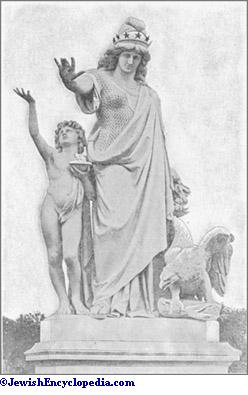
"Religious Liberty," by Moses Ezekiel.(From a photograph.)
More properly Ezion-geber, a city of Idumea, situated on the northern extremity of the Ælanitic Gulf, now called the Gulf of Akabah. it is mentioned six times in the Holy Scriptures: Numbers, xxxiii, 35; Deut., ii, 8; III K. (Vulgate), ix, 26; xxii, 49; II Par. (Chron.), viii, 17; xx, 36. The general site of Asiongaber is indicated in III K., ix, 26 (I K.); but its ruins have disappeared, so that its precise site is a matter of conjecture. The Children of Israel encamped in Asiongaber in their journey through the wilderness (Numbers 33:35). The ships of Solomon and Hiram started from this port on their voyage to Ophir. It was the main port for Israel’s commerce with the countries bordering on the Red Sea and Indian Ocean. Josaphat, King of Juda, joined himself with Ochozias, the wicked King of Israel, to make ships in Asiongaber; but God disapproved the unholy alliance, and the ships were broken in the port (2 Chronicles 20:37).-----------------------------------A.E. BREEN Transcribed by Thomas J. Bress The Catholic Encyclopedia, Volume ICopyright © 1907 by Robert Appleton CompanyOnline Edition Copyright © 2003 by K. KnightNihil Obstat, March 1, 1907. Remy Lafort, S.T.D., CensorImprimatur. +John Cardinal Farley, Archbishop of New York
Ezion-geber (along with its twin town Elath, or Eloth) was situated on the northern tip of the Gulf of Aqabah, the north-eastern arm of the Red Sea. It was the port from which shipping routes went east and overland routes went north (Deu 2:8; 1Ki 9:26). This meant that the nation that controlled Ezion-geber controlled much of the trade in the region (1Ki 9:27-28; 1Ki 10:22). (For fuller details of Ezion-geber’s significance see EDOM.)