
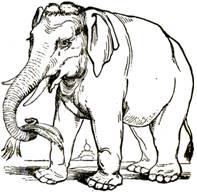
Fig. 173—Asiatic Elephant
Elephant occurs only in 1Ma 6:34. The animals of this genus consist at present of two very distinct species, one a native of Southern Asia, once spread considerably to the westward of the Upper Indus, and the other occupying southern and middle Africa to the edge of the great Sahara. In a fossil state there are besides six more species clearly distinguished. The elephant is the largest of all terrestrial animals, sometimes reaching to above eleven feet of vertical height at the shoulders, and weighing from five to seven thousand pounds: he is of a black or slaty-ash color, and almost destitute of hair. The head, which is proportionately large, is provided with two broad pendulous ears, particularly in those of the African species, which are occasionally six feet in length. The eyes are comparatively small, with a malevolent expression, and on the temples are pores which exude a viscous humor; the tail is long, hanging nearly to the heels, and distichous at the end. But the most remarkable organ of the elephant, that which equally enables the animal to reach the ground and to grasp branches of trees at a considerable height, is the proboscis or trunk; a cylindrical elastic instrument, in ordinary condition reaching nearly down to the ground, but contractile to two-thirds of its usual length, and extensile to one-third beyond it; provided with nearly 4000 muscles crossing each other in such a manner that the proboscis is flexible in every direction, and so abundantly supplied with nerves as to render the organ one of the most delicate in nature. Within is the double canal of the nostrils, and at the terminal opening a finger-like process, with which the animal can take up very minute objects and grasp others, even to a writing pen, and mark paper with it. By means of the proboscis the elephant has a power of suction capable of raising nearly 200 pounds weight; and with this instrument he gathers food from trees and from the earth, draws up drink to squirt it down his throat, draws corks, unties small knots, and performs numberless other minute operations; and, if necessary, tears down branches of trees more than five inches in diameter with no less dexterity than strength. The gait of an elephant is an enormous stride, performed with his high and ponderous legs, and sufficiently rapid to require smart galloping on horseback to outstrip him.
Elephants are peaceable towards all inoffensive animals; sociable among themselves and ready to help each other; gregarious in grassy plains, but more inclined to frequent densely-wooded mountain glens: at times not unwilling to visit the more arid wastes, but fond of rivers and pools, where they wallow in mud and water among reeds and under the shade of trees.
The Asiatic species, carrying the head higher, has more dignity of appearance, and is believed to have more sagacity and courage than the African; which, however, is not inferior in weight or bulk, and has never been in the hands of such experienced managers as the Indian mahouts are, who have acquired such deep knowledge of the character of these beasts that they make them submit to almost incredible operations; such, for example, as suffering patiently the extraction of a decayed part of a tooth, a kind of chisel and mallet being the instruments used for the purpose. Elephants walk under water as long as the end of the proboscis can remain above the surface; but when in greater depth, they float with the head and back only about a foot beneath it. They are steady, assiduous workmen in many laborious tasks, often using discretion when they require some dexterity and attention in the performance. Good will is all man can trust to in directing them, for correction cannot be enforced beyond their patience; but flattery, good treatment, kind words, promises and rewards, even to the wear of finery, have the desired effect. In history they appear most conspicuous as formidable elements of battle. From the remotest ages they were trained for war by the nations of India, and by their aid they no doubt acquired and long held possession of several regions of High Asia westward of the Indus.
(
The animals of this genus consist at present of two very distinct species, one a native of Southern Asia, once spread considerably to the westward of the Upper Indus, and the other occupying southern and middle Africa to the edge of the great Sahara. In a fossil state, however, there are six more species clearly distinguished. The elephant is the largest of all terrestrial animals, sometimes attaining above eleven feet of vertical height at the shoulders, and weighing from five to seven thousand pounds: he is of a black or slaty-ash color, and almost destitute of hair. The head, which is proportionably large, is provided with two broad pendulous ears, particularly in those of the African species, which are occasionally six feet in length. This species has also two molar teeth on each side of the jaw, both above and below, and only three toenails on each of the hind feet, whereas the Asiatic species is provided with only one tooth on each side above and below, and, though both have tusks or defences, the last mentioned has them confined solely to the males: they are never of more than 70 pounds in weight, often much less, and in some breeds even totally wanting; while in the African both sexes are armed with tusks, and in the males they have been known seven feet in length, and weighing above 150 pounds each.
They are most assuredly more sagacious than observers, who, from a few visits to menageries, compare them with dogs, are able to appreciate, for on this question we must take into account, on the one hand, the physical advantages of the proboscis added to the individual experience gained by an animal slow in growth, and of a longevity exceeding a century, but still placed in contact with man after a birth free in every sense, where his powers expand without human education; while, on the other hand, dogs are the offspring of an immense number of generations, all fashioned to the will of a master, and consequently with innate dispositions to acquire a certain education. In Griffith’s Cuvier are found several anecdotes illustrating the sagacity of these animals, to which we shall add only a single one, related by the late Captain Hobson, R.N., as observed by himself at Travancore, where several of these animals were employed in stacking teak-timber balk. They had scarcely any human aid or direction, but each beam being successively noosed and slung, they dragged it to the stack, raised one end up, contrived to shove it forward, nicely watching when, being poised by its own weight, the lower end would rise, and then, placing their foreheads against the butt end, they pushed it even on the stack; the sling they unfastened and carried back to have it fitted again. In a wild state no other animal has the sagacity to break off a leafy branch, hold it as a fan, and use it as a brush to drive away flies.
The Asiatic species, carrying the head higher, has more dignity of appearance, and is believed to have more sagacity and courage than the African, which, however, is not inferior in weight or bulk, and has never been in the hands of such experienced managers as the Indian mohauts are, who have acquired such deep knowledge of the character of these beasts that they make them submit to almost incredible operations; such, for example, as suffering patiently the extraction of a decayed part of a tooth, a kind of chisel and mallet being the instruments used for the purpose. Elephants walk under water as long as the end of the proboscis can remain above the surface, but when in greater depth they float with the head and back only about a foot beneath it. In this manner they swim across the broadest streams, and guide themselves by the sense of smelling till they reach footing to look about them and land. They are steady, assiduous workmen in many laborious tasks, often using discretion when they require some dexterity and attention in the performance. Good will is all man can trust to in directing them, for correction cannot be enforced beyond their patience; but flattery, good treatment, kind words, promises, and rewards, even to the wear of finery, have the desired effect. In history they appear most conspicuous as formidable elements of battle. From the remotest ages they were trained for war by the nations of India, and by their aid they no doubt acquired and long held possession of several regions of High Asia westward of the Indus. They are noticed in the ancient Mahabarata.
According to Sauti, the relative force of elephants in an akshaushini, or great army corps, was one to each chariot of war, three horsemen, and five foot soldiers, or, rather, archers mounted on the animal’s back within a defensible howdah-in the West denominated a castle. Thus one armed elephant, one chariot, and three horsemen, formed a patti or squad of at most eleven men, and, if there were other bodies of infantry in the army, they are unnoticed. This enumeration is sufficient to show that in India, which furnished the elephants and the model of arming them, there were only four or five archers, with or without the mohaut or driver, and that, consequently, when the successors of Alexander introduced them in their wars in Syria, Greece, and even Italy, they could not be encumbered more than perhaps momentarily with one or two additional persons before a charge; for the weight carried by a war-elephant is less than that of one used for burden, which seldom equals 2000 pounds. In order to ascend his back when suddenly required, the animal will hold out one of his hind legs horizontally, allowing a person to step upon it until he has grasped the crupper and crept up. In the West, where they were considered for a time of great importance, no doubt the squad or escort was more considerable than in the East, and may have amounted to thirty-two foot-soldiers, the number given, by some mistake, as if actually mounted, in 1Ma 6:37. Although red colors are offensive to many animals, it may be observed that the use of mulberry-juice or grapes must have been intended as an excitement to their taste, for they are all fond of fruit. Wine, so as to cause an approach to intoxication, would render them ungovernable, and more dangerous than when in a state of fear. They do not require stimulants to urge them on in a modern battle, with all its flashes of fire, smoke, and explosion; and red colors usually employed for their trappings produce more of a satisfactory feeling than rage. Judicious and long-continued training is the only good remedy against sudden surprises caused by objects not yet examined by their acutely-judging senses, or connected with former scenes of danger, which are alone apt to make them turn. It is likely that the disciplined steadiness of well-armed ranks frightened them by their novelty more than the shouts of Macedonian thousands, which must have been feeble in the ears of elephants accustomed to the roar of hundreds of thousands of Indians. It is probable that the Carthaginians made the experiment of training African elephants in imitation of Ptolemy Philadelphus: they are noticed in their army only in the first Punic war; and, from what appears of the mode of managing them, there is reason to believe, as already noticed, that they were never so thoroughly subdued as the Indian elephants (see Penny Cyclopcedia, s.v.).
This is found only in the margin of the A.V. for ’Behemoth’ in Job 40:15; and in ’elephants’ teeth’ for ’ivory’ in 1Ki 10:22; 2Ch 9:21: of. Rev 18:1-2. See IVORY.
By: Henry Hyvernat, Emil G. Hirsch
A pachydermatous mammal of the family of the Elephantidæ. It is now commonly agreed that the elephant (Elephas indicus) is indirectly mentioned in a passage of the Hebrew Bible. In I Kings x. 22 (II Chron. ix. 21), namely, it is said that Solomon had a navy which every three years brought gold, silver, ivory ("shenhabbim"), apes, and peacocks. The word "shenhabbim" is evidently a compound word, the first part of which is well known as meaning a tooth or ivory (I Kings x. 18; Cant. v. 14, vii. 14). The second element has long been a puzzle to etymologists; but now it is well-nigh certain (see, however, Ebony) that it means "elephant," and is probably derived from the Assyrian "alap," with the assimilation of the lamed, "app" = "abb" (see Hommel, "Namen der Säugethiere," p. 324, note 1).
How and when the Hebrews became acquainted with ivory can not be determined. In the Targums of Jonathan and of Jerusalem it is said that the sons of Jacob laid their father in a coffin inlaid with "shendephin" (Gen. l. 1)—probably a substitute for "shendephil," the accepted word for ivory in the East, "pil" meaning "elephant."
The presence of the elephant in Palestine is not recorded before the time of Antiochus Epiphanes, who used the animals in the war against the Jews (I Macc. i. 16, 17; vi. 30). These elephants carried each a wooden turret strapped to its back, and holding a guard of from three to five men (I Macc. ii. 37, "thirty-two men" being certainly a wrong number) and a guide, called the "Indian." A special officer, the elephantarch, was in command of this branch of the military service (II Macc. xiv. 12). Before battle the animals were given intoxicating drinks to make them furious and thus more dangerous, as they were intended to carry confusion into the ranks of the enemy (II Macc. xv. 20; III Macc. v. 2).
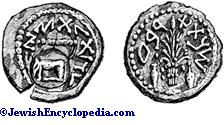
Jewish Coin of the Maccabean Period, Countermarked by an Elephant, the Type of the Seleucid Kings. The Reverse is from a similar Coin.(After Madden, "History of Jewish Coinage.")
The Talmudic and Neo-Hebrew name for elephant is  ; plural,
  (Ber. 55b, 56b), which is the common name also in Syriac and Arabic, and is the Assyrian "pîru" (see Lewy, "Griech. Fremdwörter," p. 5). The elephant's favorite food is the vine-leaf, for which reason Noah laid in a large supply of vine branches (Gen. R. xxxi.; Yer. Shab. xviii. 16c, middle; Shab. 128a).
The time of gestation is given as three years (Bek. 8a). To see an elephant in one's dream was not a good omen (Ber. 57b); but a proverb expressive of impossible things says: "None is shown in his dream a golden date-tree, nor an elephant that goes through a needle's eye" (Ber. 55b). In other contrasts, too, the elephant appears as the extreme in size (see examples given in "Zeitschrift für Alttestamentliches Wissenschaft," xvi. 205; e.g. 
 = "from the gnat to the elephant"; compare in Shab. 77b:
  = "the gnat is the terror of the elephant"; and in Maimonides, Introduction to Zera'im:
  = "from the elephants to the worms").
Bibliography:
Tristram, Natural History of the Bible, London, 1889;
J. G. Woods, Bible Animals, Philadelphia, 1872;
A. Pictet, Sur les Origines de Quelques Noms de l'Eléphant, in Jour. Asiatique, Sept.-Oct., 1843;
Lewysohn, Zoologie des Talmuds, pp. 148, 228, Frankfort-on-the-Main, 1858;
Bochart, Hierozoicon.
ELEPHANT.—Job 40:16 AVm
Elephant. No elephants lived in Palestine. But they were native to the neighboring continents of Africa and Asia. Wealthy Jews sometimes imported the ivory which came from their great tusks. King Solomon "made a great throne of ivory, and overlaid it with pure gold" (1Ki 10:18). And King Ahab built an "ivory house" (1Ki 22:39).