
It would be unnecessary to offer any observations simply on this bird, as it is in itself, but as it is made use of by the Scriptures of God, as figurative of the Holy Ghost, and also by the Lord Jesus, to denote the loveliness of his church, it merits our attention. It was in the form of a dove that the Holy Ghost descended upon the blessed Jesus at his baptism. (Matt. 13. 6.) And it was the dove that brought the tidings of the waters being assuaged into the ark, by the olive branch in his mouth. (Gen. 8. 12.) And Christ compares hischurch to the beauty and gentleness of the dove. (Song. 2: 14.) And the comparison is certainly very just; for as the dove in nature is a very beautiful, and clean, and affectionate creature, so the church in grace, when washed in Christ’s blood, and justified in Christ’s righteousness, and made comely from the comeliness her Lord hath put upon her, is all - glorious within, and hath no spot, or blemish, but is without blame before Jesus in love. Hence, the Psalmist sweetly sings of the church - - "Though she hath lain among thepots, yet shall she be like the wings of a dove, covered with silver, and her feathers with yellow gold." (Ps. l18. 13.)
The following extract from Morier’s Persian Travels illustrates a passage in Isaiah: “In the environs of the city, to the westward, near the Zainderood, are many pigeon houses, erected at a distance from habitations, for the sole purpose of collecting pigeons’ dung for manure. They are large round towers, rather broader at the bottom than the top, and crowned by conical spiracles, through which the pigeons descend. Their interior resembles a honey-comb, pierced with a thousand holes, each of which forms a snug retreat for a nest. More care appears to have been bestowed upon their outside than upon that of the generality of the dwelling houses; for they are painted and ornamented. The extraordinary flights of pigeons which I have seen alight upon one of these buildings afford, perhaps, a good illustration for the passage in Isa 60:8: ‘Who are these that fly as a cloud, and as the doves to their windows?’ Their great numbers, and the compactness of their mass, literally look like a cloud at a distance, and obscure the sun in their passage.”
The first mention of the dove in the Scripture is Gen 8:8; Gen 8:10-12, where Noah sent one from the ark to ascertain if the waters of the deluge had assuaged. She was sent forth thrice. The first time she speedily returned; having, in all probability, gone but a little way from the ark, as she must naturally be terrified at the appearance of the waters. After seven days, being sent out a second time, she returned with an olive leaf plucked off, whereby it became evident that the flood was considerably abated, and had sunk below the tops of the trees; and thus relieved the fears and cheered the heart of Noah and his family. And hence the olive branch has ever been among the fore-runners of peace, and chief of those emblems by which a happy, state of renovation and restoration to prosperity had been signified to mankind. At the end of other seven days, the dove, being sent out a third time, returned no more; from which Noah conjectured that the earth was so far drained as to afford sustenance for the birds and fowls; and he therefore removed the covering of the ark, which probably gave liberty to many of the fowls to fly off; and these circumstances afforded him the greater facility for making arrangements for disembarking the other animals. Doves might be offered in sacrifice, when those who were poor could not bring a more costly offering.
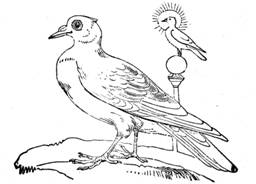
There are probably several species of doves or pigeons included in the Hebrew name joneh. It may contain all those that inhabit Palestine, exclusive of the turtle-doves properly so called. Thus generalized, the dove is, figuratively, next to man, the most exalted of animals, symbolizing the Holy Spirit, the meekness, purity, and splendor of righteousness. By the Hebrew law doves and turtle-doves were the only birds that could be offered in sacrifice, and they were usually selected for that purpose by the less wealthy (Gen 15:9; Lev 5:7; Lev 12:6; Luk 2:24); and to supply the demand for them, dealers in these birds sat about the precincts of the Temple (Mat 21:12, etc.).
All pigeons in their true wild plumage have iridescent colors about the neck, and often reflected flashes of the same colors on the shoulders, which are the source of the silver and gold feathers ascribed to them in poetical diction; and thence the epithet of purple bestowed upon them all, though most applicable to the vinous and slaty-colored species. The coasts and territory of Syria are noted for the great number of doves frequenting them, though they are not so abundant there as in the Coh-i Suleiman chain near the Indus. Syria possesses several species of pigeon; the stock-dove, ring-dove, the common pigeon in several varieties, such as the Barbary, Turkish or Persian carrier, crisp, and shaker. These are still watched in their flight in the same manner as anciently their number, gyrations, and other maneuvers were observed by soothsayers. The wild species, as well as the turtle-doves, migrate from Palestine to the south; but stock and ring doves are not long absent.
The figure we give is that of the more rare species of white and pink carrier, and the Phoenician sacred ensign of the dove.
Dove. The first menton of this bird occurs in Genesis 8.
The dove’s rapidity of flight is alluded to in Psa 55:6,
the beauty of its plumage in Psa 68:13,
its dwelling in the rocks and valleys in Jer 48:28 and Eze 7:16,
its mournful voice in Isa 38:14; Isa 59:11; Nah 2:7,
its harmlessness in Mat 10:16,
its simplicity in Hos 7:11, and
its amativeness in Son 1:15; Son 2:14.
Doves are kept in a domesticated state in many parts of the East. In Persia, pigeon-houses are erected at a distance from the dwellings, for the purpose of collecting the dung as manure. There is probably an allusion to such a custom in Isa 60:8.
Emblem of peace (Gen 8:7-12). After God’s wrath for sin had been executed upon the earth, the dove was thrice sent forth; at the first sending she found no rest for the sole of her foot until she put herself in Noah’s (or "comforter") hand, and was drawn into the ark; on the second trip, she brought back the olive leaf, the earnest of the restored earth; on the third trip, she was able to roam at large, no longer needing the ark’s shelter. As the raven messenger "going forth to and fro," alighting on but never entering into the ark, symbolizes the unbelieving that have "no peace," "like the troubled sea, when it cannot rest" (Isa 57:20-21): so the dove, in its threefold embassy, represents respectively the first return of the soul to its rest, the loving hand of Jesus; its subsequent reception of the dovelike spirit, the earnest of the final inheritance (Eph 1:13-14); and its actual entrance finally on the new heaven and new earth (Revelation 21), where there will be no need of the arklike church to separate between the world and God’s people, between the saved and unsaved, where all shall be safe and blessed forever and the church shall be co-extensive with the world.
As the lamb is the emblem of the Savior, so the dove of the Holy Spirit the Comforter, because of its gentleness, tenderness, innocence, and constant love (Mat 3:16). He changes us into His own likeness. The liquid full soft eye is the emblem of the heavenly bride’s eye, through which the soul beams out (Son 1:15). Contrast the sinner’s eye (Mat 20:15; 2Pe 2:14). The church’s unsheltered innocence in the world calls forth the prayer: "Deliver not the soul of Thy turtle dove unto the multitude of the wicked" (Psa 74:19; Psa 55:11). Their plaintive note symbolizes the mourning penitent (Isa 59:11).
The change from the Egyptian bondage amidst the face blackening potteries to the freedom and beauty of Israel’s theocratic state is expressed in Psa 68:13-14, "though ye have lien (lain) among the pots yet shall ye be as the wings of a dove covered with silver, and her feathers with yellow gold," the dove’s outspread wings reflecting a golden or silver splendor according to the direction in which the sunshine falls on them, typifying the dovelike spirit of joy and peace beaming forth from the believer, once darkness, but now light in the Lord. The dove’s timidity answers to the believer fleeing from sin, self, and wrath, to the refuge in the cleft Rock of ages (Son 2:14; Jer 48:28; Isa 26:4, margin). Its gregariousness answers to the communion of saints, all having flocked together to Christ (Isa 60:8); the returning Israelites shall so flock to Jerusalem, as doves in a cloud to their cotes; and the converted Gentiles to Israel.
Saints must imitate its harmless simplicity (Mat 7:16), but not its silliness (Hos 7:11). The Israelites under God’s visitation of the enemy’s invasion "shall be on the mountains like doves of the valleys" (Eze 7:16); as doves which usually frequent valleys mount up to the mountains when fearing the birdcatcher (Psa 11:1), so Israel, once dwelling in the peaceful valleys, shall flee from the foe to the mountains, once the scene of their highplace idolatries, now retributively the scene of their abject flight. In Jer 25:38, "because of the fierceness of the oppressor" (Hebrew: the dove), the allusion is to the Chaldaean standard, the dove, the symbol of Venus. Semiramis the queen was said to have been nourished by doves when exposed at birth, and at death to have been transformed into a dove. In 2Ki 6:25 the "dove’s dung" sold for food in the famine seems to have been a vegetable or poor grain or vetch pea, so named, that grew in the land not built upon and lying, as is common in the East, within the city.
Linnaeus identified it with the
(
By the Hebrew law, however (see Mishna, Yom Tob, 1:3; Baba Bathra, 2:5 sq.; Bab-kamma, 7:7), doves and turtle-doves were the only birds that could be offered in sacrifice, and they were usually selected for that purpose by the less wealthy (Gen 15:9; Lev 5:7; Lev 12:6; Luk 2:24); and, to supply the demand for them, dealers in these birds sat about the precincts of the Temple (Mat 21:12, etc.). The brown wooddove is said to be intended by the Hebrew name; but all the sacred birds, unless expressly mentioned, were pure white, or with some roseate feathers about the wing coverts, such as are still frequently bred from the carrier-pigeon of Scandiroon. It is this kind which Tibullus notices (1:7). The carrier-birds are represented in Egyptian bas-reliefs, where priests are shown letting them fly on a message. All pigeons in their true wild plumage have iridescent colors about the neck, And often reflected flashes of the same colors on the shoulders, which are the source of the silver and gold feathers ascribed to them in poetical diction; and thence the epithet of purple bestowed upon them all, though most applicable to the vinous and slatycolored species. This beauty of plumage is alluded to in Psa 68:16, where the design of the Psalmist is to present, in contrast, the condition of the Hebrews at two different periods of their history: in the day of their affliction and calamity they were covered as it were with Shame and confusion, but in the day of their prosperity they should resemble the cleanest and most beautiful of birds. The dove was the harbinger of reconciliation with God (Gen 8:8; Gen 8:10, etc.), when Noah Sent one from the ark to ascertain if the waters of the Deluge had assuaged. The association of the dove and the olive is not only natural, but highly emblematical (Thomson, Land and Book, 1:69). The dove is frequently mentioned in the Scriptures as the emblem of purity and innocence, and so it doubtless was viewed by the Psalmist (Psa 55:6-8), although with a special allusion to the swiftness of that bird’s flight (comp. Sophocl. (Ed. Colossians 1081; Eurip. Bacch. 1090).
By an almost anthropomorphic extension of this idea, the dove is, figuratively, next to man, the most exalted of animals, symbolizing the Holy Spirit, a sentiment that appears to be couched in the description of creation (Gen 1:2), where the Spirit is represented as brooding ("moved") over the surface of chaos. (See treatises on this point by Augusti, Die Taube, in Gieseler and Lucke’s Zeitschr. 3:56-64; Moller, De columba, Frib. 1721; Schmid, De columbis, Helmst. 1711, 1731; Schwebel, De columbarum cultu, Onold. 1767; E. F. Wernsdorf, De simulacro columbae,Viteb. 1773; Id. De columba sancta Syrorum, Helmst. 1761; J. C. Wernsdorf, De columba, Helmst. 1770; Ziebich, De columba pentecostali,Viteb. 1737.) The Holy Spirit descended, as a dove descends, upon our Savior at his baptismvisibly with that peculiar hovering motion which distinguishes the descent of a dove (Mat 3:16; Mar 1:10; Luk 3:22; Joh 1:32). (See the treatises on this incident, in Latin, by Adler [Sorav. 1822], Bohmer [Jen. 1727], Christ [Jen. 1727], Riess [Marb. 1736], Kechenberg [Cob. 1741], Varemus [Kil. 1671; Viteb. 1713, 1728], Ziebich [Ger. 1772]; in German by Schulthess [in Winer’s Krit. Jour. 4:257-294].) The dove is also a noted symbol of tender and devoted affection, especially in the Canticles (1:15; 2:14, etc.). The conjugal fidelity of the dove has been celebrated by every writer who has described or alluded to her character (Son 1:15). She admits but of one mate, and never forsakes him until death puts an end to their union. The black pigeon, when her mate dies, obstinately rejects another, and continues in a widowed state for life. Hence among the Egyptians a black pigeon was the symbol of a widow who declined to enter again into the marriage relation. These facts have been transferred, by later authors, to the widowed turtle, which, deaf to the solicitations of another mate, continues, in mournful strains, to deplore her loss until death puts a period to her sorrows. (On the emblematical uses of the dove, see further Wemyss, Symbol. Dict. s.v.) The cooing of the dove, when solitary, is often alluded to in Scripture (Isa 38:14; Isa 59:11; Nah 2:7). SEE PIGEON.
In Christian art, the dove is employed as the emblem of the Holy Ghost, following the literal interpretation, which is doubtless the true one, of Mat 3:16. After images and pictures began to be allowed in churches, the Holy Ghost was represented by the effigies of a silver dove hovering over the altar, and the baptistery had the same. The place over the altar where it was suspended was called peristerion, from
"From the dove being a symbol of purity, it is generally represented white, with its beak and claws red, as they occur in nature. In the older pictures, a golden nimbus surrounds its head, the nimbus being frequently divided by a cross, either red or black. In stained-glass windows we see the dove with seven rays proceeding from it, terminating in seven stars, significative of the seven gifts of the Holy Spirit. Holding an olive-branch, the dove is an emblem of peace. When seen issuing from the lips of dying saints and martyrs, it represents the human soul purified by suffering. A dove with six wings is a type of the Church of Christ; and when so employed, it has the breast and belly of silver, and the back of gold, two wings being attached to the head, two to the shoulders, and two to the feet. The pyx or box for containing the Host (q.v.) in Roman Catholic churches is sometimes made in the form of a dove, and suspended over the altar, and the dove is often placed on the covers of fonts. In this position it may still be seen in parish churches in England" (Chambers, Encyclopaedia, s.v.). See also Martigny, Dict. des Antiquites Chretiennes (Paris, 1865, page 164; Didron, Christian Iconography (Bohn), page 451; Jehan, Dict. des Origines du Christianisme (Paris, 1856), art. Colombe.
Dove’s Dung. In the siege of Samaria by Ben-hadad, a fourth part of a cab of dove’s dung was sold for five shekels. 2Ki 6:25. Bochart supposes chick-peas here meant; but Keil, without deciding the question, produces testimony that excrement has been used for food in famine, and that the literal meaning is not impossible. Dr. Thomson considers dove’s dung a coarse kind of bean. The seeds of millet are called "doves’ seed" by the Hebrews, which favors the bulb or seed of some plant.
yonah ,
There are four species of doves that inhabit Palestine: of these the most abundant is the Rock Pigeon, or Blue Rock Dove, the Columba livia. They shun the habitation of man, and live in holes in the rocks. There are three species of turtle doves known in Palestine, which are both wild and domesticated. Some may often be seen in Jerusalem. The most abundant of these is perhaps the Turtur auritus.
The dove is commonly taken as the emblem of peace . the Holy Spirit descended on the Lord ’like a dove,’ answering to "on earth peace, good will toward men." It is also an emblem of harmlessness: ’wise as serpents, harmless as doves.’ Mat 10:16. In the Canticles the bridegroom three times calls the bride ’my dove,’ and says she has ’doves’ eyes;’ she also says the latter of him. Son 1:15; Son 2:14; Son 4:1; Son 5:2; Son 5:12; Son 6:9. Loving gentleness characterises the dove.
DOVE (
The dove, the emblem of perfect innocence, is used (Mat 3:16 and parallels) as a symbol of the Holy Spirit, who is the power and wisdom of God, acting on the spirits of men. When the dove appeared to sit on the Saviour’s head, it denoted the Divine recognition of His holiness (Mat 3:17), and His official consecration to the Messianic ministry. As the author of the Epistle to the Hebrews says, ‘He was holy, harmless, undefiled, and separate from sinners’ (Mat 7:26).
It has been thought that the dove had a sacrosanct character among the Hebrews. Though it was a favourite food with some neighbouring peoples, it was not eaten in Palestine. Young pigeons and doves were offered in sacrifice, where no sacrificial meal was involved. So we find in the temple courts them that sold doves (Mat 21:12, Mar 11:15, Joh 2:14; Joh 2:16),—no doubt for such sacrifices,—whom Christ drove out, along with the money-changers. In Palestine the dove was considered sacred by the Phœnicians and the Philistines, and the Samaritans were often accused of worshipping it. There were holy doves at Mecca; and, according to Lucian (Dea Syria, 54), doves were taboo to the Syrians; he who touched them being unclean a whole day.
In Christian Art in representations of the Lord’s Baptism, the presence of the Holy Spirit is indicated by the dove. In churches in early times the figure of a dove appeared in the baptisteries, a golden or silver dove being suspended above the font. Lamps, too, were sometimes made in the form of doves. In later times pyxes were sometimes made of gold and silver in the shape of a dove, and used for the reservation of the host.
Exclusive of the turtle-dove, four species of dove are found in Palestine: Columba palumbus, the ring-dove, or wood-pigeon; Columba aenas, the stock-dove, found in Gilead and Bashan and the Jordan Valley; Columba livia, the rock-dove, abundant along the coast and in the uplands; Columba schimperi, closely allied to the preceding, and found in the interior.
Literature.—Hasting’s Dictionary of the Bible , s.v.; Thomson, Land and Book (1878), p. 268 ff.; Expositor, 1st ser. ix. [1879] p. 81 ff.
David M. W. Laird.
By: Emil G. Hirsch, I. M. Casanowicz
One of the most familiar species of pigeon. The most common term for dove in the O. T. is "yonah," comprising the whole family of Columbidœ, but in particular denoting the dove (Columba), as distinguished from the turtle-dove (Turtur), for which "tor" is used exclusively. The dove is first mentioned in the account of the Deluge (Gen. viii. 8-12) as one of the birds sent out from the Ark. In the sacrificial code the dove and turtle-dove were the only birds admitted as sacrifices (Lev. v. 8; xii. 6, 8; xiv. 5, 22; xv. 14, 29). The dove seems to have been early domesticated in Palestine (compare Isa. lx. 8, where the dove-cot ["arubbah"] is referred to). Four species of Columbœ and three of Turtur at present inhabit Palestine in large numbers (see Tristram, "The Natural History of the Bible," pp. 214, 216, London, 1889).
The Talmud mentions about ten species or varieties of Columbidœ, among them being: "tasil" or "ta'ẓil" (Ḥul. 62a. 140b; B. B. 75a); "ẓulẓalta" and "ẓilẓela," abbreviated into "ẓuẓla" (Sanh. 100a; Shab. 80b); "ḥamimta" (Giṭ.69b); "daẓipe" and "kupshana," explained to be "turtles of the street" (Ḥul. 62a); "torin shel reḥabah" (= half-tamed doves). The young dove is called "ben yonah" or "bar gozala" (Ḥul. 22a, 76b). More specific terms for the young of a dove are "pargeyot" and "peridah" (B. M. 24b, 84b; compare Rashi); "niful" denotes the unfledged dove, while "gozal," as in the Bible, indicates the young of any bird, and is even used of helpless babes (Pes. 49a). Of domesticated doves three varieties are mentioned: (1) those kept in the dovecot ("shobak"); (2) those kept in the house (properly the attic, "'aliyyah"); and (3) Herodian doves("hordesi'ot"; Beẓah 24a; Shab. 155b; Ḥul. 138b). The last variety is so named because Herod was accustomed to keep them in pigeon-towers in the gardens surrounding his palace (compare Josephus, "B. J." v.4, § 4). For the regulations concerning the breeding and rearing of doves see B. K. 79b; B. B. 22b, 24b; Shab. 155b.
Betting on the swiftness and endurance of doves was well known in Talmudic times, and those who practised it ("mafriḥe yonim") were placed in one category with gamblers and usurers, and were not admitted as witnesses in court (Sanh. 24b; R. H. 22a). According to Rashi to B. B. 80a, the dove begins to lay when it is two months old, and breeds every month, with the exception of the month of Adar (compare Cant. R. i. 15, iv. 1). For illustrations of the fertility of the dove see Ber. 44a; Lam. R. ii. 4; and Ker. 28a. Mustard is considered the favored food of doves (Shab. 128a). The Temple had a special officer to care for the doves ("ḳinnin") used for sacrifice (Yer. Shek. v. 1). Turtle-doves were preferred for sacrifices because mentioned in the first place in the sacrificial code (Ker. 28a).
The gentleness and grace of the dove make it a favorite simile for female beauty and tenderness (Cant. i. 15; iv. 1; v. 2, 12; vi. 9; compare Ber. 56b), and its faithfulness to its mate is a symbol of conjugal fidelity and devotion ('Er.100b). It is especially an emblem of unjustly persecuted Israel (Ps. lxxiv. 19; compare B. Ḳ. 93a), and its wings, iridescent with silver and gold (Ps. lxviii. 13), are compared with the commandments which hedge around and protect Israel (Ber. 53b; Shab. 49a, 130a). For a detailed comparison of the dove with Israel see Cant. R. i. 15, iv. 1. It is often contrasted with the cunningand treacherous raven (Giṭ. 45a; Ḳid. 70b; compare Sanh. 100b). It is also an image of the Spirit of God (Ḥag. 15a; Targ. to Cant. ii. 12; Rashi to Gen. i. 2; compare Sanh. 108b).
The anecdote of the Samaritans having worshiped the image of a dove on Mt. Gerizim (Ḥul. 6a; compare Yer. 'Ab. Zarah v. 44d) probably arose from the fact that after Hadrian the Romans erected a brazen bird there (compare Jost, "Gesch. der Juden," i. 61, 75; Herzfeld, "Gesch. Israels," ii. 596).
Bibliography:
Tristram, The Natural History of the Bible, pp. 211-220;
L. Lewysohn, Die Zoologie des Talmuds, Frankfort-on-the-Main, 1858, pp. 1, 188, 199-206;
C. L. Schlichter, De Turture Eiusque Qualitat. Usu Antiqu., etc., Halle, 1739;
Lorenz, Die Taube im Alterthum, Leipsic, 1886.
DOVE.—The words translated ‘dove’ apply equally to doves and pigeons. In Palestine seven varieties of the Columbœ are found. The most noticeable are: the wood pigeons or ring-doves (Columba palumbus), which fly in great flocks all over the land; the turtle-dove (Turtur communis), a harbinger of spring, arriving in the land in April (Jer 8:7, Son 2:12); and the palm turtle-dove (Turtur senegalensis), which is common in a semi-domesticated state in the streets and courts of Jerusalem. ‘Dove’ is a favourite name of affection (Son 1:15; Son 4:1; Son 5:2; Son 5:12; Son 6:9), and to-day it is one of the commonest names given to girls by Eastern Jewish parents. It is typical of harmlessness (Mat 10:16), helplessness (Psa 74:19), and innocence. The last quality doubtless makes it typical of the Holy Spirit (Mat 3:16 etc.). Doves were used in sacrifice (Lev 5:7; Lev 12:6 etc.), and have been kept as pets for long ages.
E. W. G. Masterman.
In Christian antiquity, a symbol and a Eucharistic vessel.
As a symbol of the Holy Spirit it is specially connected with Baptism (Matthew 3). In pictures of the Annunciation it signifies the Incarnation of Our Saviour by the power of the Holy Ghost. It also symbolizes marytrdom and the Church. The dove with an olive branch was used on a sarcophagus to signify peace and hope of Resurrection; in flight, it represents the Ascension of Christ or the entrance of saints into glory.
Since early medieval times the Holy Eucharist was reserved for the sick in a dove-shaped vessel suspended to the baldachino over the altar; later the dove was enclosed in a tower upon the altar. A vessel of like form was hung over the early baptisteries.
In art it is the emblem of the following saints,
Saint Agnes of Rome - woman with a dove holding a ring in its beak
Blessed Ambrose Sansedoni of Siena - Dominican with a dove (the Holy Spirit) whispering in his ear as he preaches
Saint Basil the Great - the dove is near the supernational fire that indicates descent of the Holy Spirit on Basil
Saint Colman of Lindisfarne - the name Colman means dove
Saint Colomba of Rieti - Dominican tertiary with a dove indicating the Holy Spirit
Saint Dathus - chosen as bishop when a dove descended on him and those present took it as a sign
Saint David of Wales - as proof of the truth of his preaching, a dove settled on his shoulder as he spoke
Saint Devota - as her martyred body was being taken home, a storm threatened to wreck the boat; a dove emerged from her mouth, and the storm stopped
Saint Dunstan of Canterbury - man writing with a dove (the Holy Spirit) nearby
Pope Saint Fabian - chosen pope when a dove settled on his head and the people took it as a sign
Saint Ida of Herzfield - woman with a dove hovering over her head
Saint Ivo of Kermartin - lawyer surrounded by doves (the Holy Spirit)
Saint Oliva
Saint Scholastica - at her death, her brother, Saint Benedict of Nursia, saw her soul ascend to heaven as a dove
Saint Teresa of Avila - Carmelite nun with a dove (the Holy Spirit) nearby while she writes
Saint Thomas Aquinas - Dominican with a dove (the Holy Spirit) speaking in his ear as he writes
Pope Saint Zachary - with a dove and olive branch to indicate his work as a peace maker
New Catholic Dictionary
(Latin columba).In Christian antiquity the dove appears as a symbol and as a Eucharistic vessel.As an Artistic SymbolAs a Christian symbol it is of very frequent occurrence in ancient ecclesiastical art. As a symbol of the Holy Spirit it appears especially in representations of the baptism of Our Lord (Matthew 3:16) and of Pentecost. St. Gregory the Great (590-604) is generally shown with a dove on his shoulder, symbolizing inspiration or rather Divine guidance. A dove of gold was hung up in the baptistery at Reims after the baptism of Clovis; in general the symbol occurs frequently in connexion with early representations of baptism. In ancient times a dove-like vessel was frequently suspended over the baptismal font and in that case As a symbol of martyrdom it indicated the action of the Holy Spirit in bestowal of the fortitude necessary for the endurance of suffering. As a symbol of the Church, the agent through which the Holy Spirit works on earth. When two doves appear the symbolism may represent, according to Macarius (Hagioglypta, 222), the Church of the circumcision and that of the Gentiles.On a sarcophagus or on other funeral monuments the dove signifies: the peace of the departed soul, especially if, as is often the case in ancient examples, it bears an olive branch in its beak; the hope of the Resurrection. In each case the symbolism is derived from the story of Noah and the Flood. Such is the meaning of the dove (columbula, palumba sine felle) in numerous epitaphs of the Roman catacombs. Occasionally funeral lamps were made in the shape of a dove. Two doves on a funeral monument sometimes signify the conjugal love and affection of the parties buried there. The dove in flight is the symbol of the Ascension of Christ or of the entry into glory of the martyrs and saints (cf. Ps. cxxiii, 7: "Our soul is escaped as a bird from the snare of the hunters, the snare is broken and we are delivered." In like manner the caged dove signifies the human soul yet imprisoned in the flesh and held captive during the period of mortal life. In general, the dove as a Christian emblem signifies the Holy Spirit either personally or in His works. It signifies also the Christian soul, not the human soul as such, but as indwelt by the Holy Spirit; especially, therefore, as freed from the toils of the flesh and entered into rest and glory.As a Eucharistic VesselThe reservation of the Holy Eucharist for the use of the sick was, certainly since early medieval times, effected in many parts of Europe by means of a vessel in the form of a dove, suspended by chains to the baldachino and thus hung above the altar. Mention may be made here of the (two) doves occasionally represented in the Roman catacombs as drinking from a Eucharistic chalice (Schnyder, "Die Darstellungen des eucharist. Kelches auf altchr. Grabinschriften", in "Stromation Archaeologicon", Rome, 1900, 97-118). The idea of the Eucharistic vessel was probably taken from the dove-like receptacle used at an early period in the baptisteries and often suspended above the fonts. These vessels were usually made of gold or silver. This was no doubt always the case if the vessel was designed to be the immediate holder of the Blessed Sacrament, since the principle that no base material ought to be used for this purpose is early and general. But when, as seems generally to have been the case in later times, the dove was only the outer vessel enshrining the pyx which itself contained the Blessed Sacrament, it came about that any material might be used which was itself suitable and dignified. Mabillon (Iter Ital., 217) tells us that he saw one at the monastery of Bobbio made of gilded leather, and one is shown to this day in the church of San Nazario at Milan which is enameled on the outside and silver gilt within. The exact time at which such vessels first came into use is disputed, but it was certainly at some early date. Tertullian (C. Valentinian. cap. iii) speaks of the Church as columbae domus, the house of the dove, and his words are sometimes quoted as exhibiting the use of such vessels in the third century. The reference, however, is clearly to the Holy Spirit. In the life of St. Basil, attributed to St. Amphilochius, is perhaps the earliest clear mention of the Eucharistic dove. "Cum panem divisisset in tres partes . . . tertiam positam super columbam auream, desuper sacrum altare suspendit" (When he had divided the bread into three pieces . . . the third part placed in a golden dove, he suspended, etc., Vita Bas., P. G., XXXIX). St. Chrysostom’s expression concerning the Holy Eucharist, convestitum Spiritu Sancto, clothed with the Holy Spirit (Hom. xiii, ad pop. Antioch.), is generally taken to allude to this practice of reserving the Holy Eucharist in a dove, the emblem of the Holy Spirit. The same idea is expressed by Sedulius (Epist. xii) in the verses, "Sanctusque columbae Spiritus in specie Christum vestivit honore" -- "And the Holy Spirit in the form of a dove has robed Christ in honour".The general, and certainly the earliest custom, both East and West, was to suspend the dove from the ciborium or baldachino. At a later period in some parts of the West, especially in Rome, a custom grew up of placing a tower of precious material upon the altar, and enclosing the dove with the Blessed Sacrament within this tower. Thus, in the "Liber Pontificalis" which contains ample records of the principal gifts made to the great basilicas in the fourth and succeeding centuries, we never find that the dove was presented without the tower as its complement. Thus in the life of Pope Hilary it is said that he presented to the baptistery at the Lateran turrem argenteam . . . et columbam auream. In the life of St. Sylvester (ibid.) Constantine is said to have given to the Vatican Basilica pateram . . . cum turre et columba. Innocent I (ibid.) gave to another church turrem argenteam cum columba.-----------------------------------ARTHUR S. BARNES Transcribed by Michael C. Tinkler The Catholic Encyclopedia, Volume VCopyright © 1909 by Robert Appleton CompanyOnline Edition Copyright © 2003 by K. KnightNihil Obstat, May 1, 1909. Remy Lafort, CensorImprimatur. +John M. Farley, Archbishop of New York
In all, the dove is mentioned about fifty times in the Bible. Many of these references are concerning its use in sacrifice and need not all be mentioned. The others are quoted and explained from a scientific standpoint and in accordance with the characteristics and habits of the birds. The first reference to the dove occurs in Gen 8:8-12, in the history of the flood; then follows its specified use in sacrifice; note of its migratory habits is made, and then in poetry, prophecy, comparison, simile and song, it appears over and over throughout the Bible.
In Gen 8:8-12, we read, “And he sent forth a dove from him, to see if the waters were abated.” Noah first sent out a raven, because it was a strong, aggressive bird and would return to its mate. But the raven only flew over the water and returned to perch on the ark. This was not satisfactory, so Noah in looking for a bird better suited to his purpose, bethought him of the most loving and tender bird he knew - the dove. It not only would return to the ark, but would enter and go to the cage of its mate, and if it found green food it would regurgitate a portion for her or its young, or if not nesting he could tell by its droppings if greenery had been eaten and so decide if the waters were going down. And this is precisely what happened. The dove came back, and the watching Noah saw it feed its mate little green olive leaves, for the dove never carries food in the beak, but swallows and then regurgitates it to mate and young. This first reference to birds was made on account of the loving, tender characteristics of the species; the next, because they were the most loved by the people, and therefore chosen as most suitable to offer as sacrifice (Gen 15:9). In Lev 1:14 f, doves are mentioned as sacrifice: “And the priest shall bring it unto the altar, and wring off its head, and burn it on the altar; and the blood thereof shall be drained out on the side of the altar.” In Lev 5:7 the proper preparation of the sacrifice is prescribed. For method of handling sacrifice see Lev 5:8, Lev 5:9, Lev 5:10. In Lev 12:6 the law for a sacrifice for a mother is given, and Lev 12:8 of same chapter provides that if she be too poor to offer a lamb, doves or pigeons will suffice. In Lev 14:4-8 the reference for the sacrifice of a leper is merely to “birds,” because it is understood that they are pigeons and doves, and it contains the specification that if the victim is too poor to afford so elaborate a sacrifice, a smaller one will suffice. The birds are named in Lev 14:22: “Two turtle-doves, or two young pigeons, such as he is able to get; and the one shall be a sin-offering, and the other a burnt-offering” (compare Lev 15:14, Lev 15:29; Num 6:10). When David prayed for the destruction of the treacherous, he used the dove in comparison, and because he says he would “lodge in the wilderness” he indicates that he was thinking of the palm turtle.
“And I said, Oh that I had wings like a dove!
Then would I fly away, and be at rest” (Psa 55:6).
In chanting a song of triumph, David used an exquisite thought.
“When ye lie among the sheepfolds,
It is as the wings of a dove covered with silver,
And her pinions with yellow gold” (Psa 68:13).
He referred to the rock dove because the metallic luster on its neck would gleam like gold in sunshine, and the soft grayish-white feathers beneath the wings as he would see the bird above him in flight would appear silver-like. By this quotation David meant that in times of peace, when men slept contentedly at home among their folds, their life was as rich with love and as free in peace as the silver wing of the dove that had the gold feathers and was unmolested among the inaccessible caves and cliffs. In Psa 74:19 the term “turtle-dove” is used to indicate people whom the Almighty is implored to protect: “Oh deliver not the soul of thy turtle-dove unto the wild beast: forget not the life of thy poor for ever.”
Solomon uses the dove repeatedly in comparison or as a term of endearment. In Son 1:15; Son 4:1; Son 5:12, he compares the eyes of his bride full, tender, beautiful, with those of a dove. In Son 2:12 he uses the voice of the dove as an indication of spring. In Son 2:14 he addresses the bride as a rock dove, In Son 5:2 is another term of endearment, this time used in the dream of the bride (compare Son 6:9). Isa 38:14 has reference to the wailing, mournful dove note from which the commonest species take the name “mourning dove.” The reference in Isa 60:8 proves that the prophet was not so good an observer, or so correct in his natural history as David, who may have learned from the open. As a boy, David guarded the flocks of his father and watched the creatures around him. When exulting over the glory of the church in the numerous accessions of Gentiles, Isaiah cried, “Who are these that fly as a cloud, and as the doves to their windows?” This proves that he confounded pigeons and doves. Doves were wild, mostly migratory, and had no “windows.” But the clay cotes of pigeons molded in squares so that one large cote sheltered many pairs in separate homes had the appearance of latticed windows and were used as a basis in estimating a man’s wealth. This reference should be changed to read, “and as pigeons to their windows.” In Jer 8:7 the fact is pointed out that doves were migratory; and in Jer 48:28 people are advised to go live in solitary places and be peaceable, loving and faithful, like the rock doves. See also Eze 7:16: “But those of them that escape shall escape, and shall be on the mountains like doves of the valleys, all of them moaning, every one in his iniquity.” This merely means that people should be driven to hide among the caves and valleys where the rock doves lived, and that the sound of their mourning would resemble the cry of the birds. It does not mean, however, that the doves were mourning, for when doves coo and moan and to our ears grow most pitiful in their cries, they are the happiest in the mating season. The veneration cherished for doves in these days is inborn, and no bird is so loved and protected as the dove - hence, it is unusually secure and happy and its mournful cry is the product of our imagination only. The dove is the happiest of birds. Hos 7:11 and Hos 11:11 each compares people with doves; the first, because the birds at times appear foolishly trusting; the second, because, while no bird is more confiding, none is more easily frightened. “And Ephraim is like a silly dove, without understanding: they call unto Egypt, they go to Assyria” (Hos 7:11). “They shall come trembling as a bird out of Egypt, and as a dove out of the land of Assyria; and I will make them to dwell in their houses, saith Yahweh” (Hos 11:11). The reference in Nah 2:7 is to the voice of the birds.
New Testament references will be found in a description of the baptism of Jesus (Mat 3:16). People are admonished to be “harmless as doves” (Mat 10:16). “And Jesus entered into the temple of God, and cast out all them that sold and bought in the temple, and overthrew the tables of the money-changers, and the seats of them that sold the doves” (Mat 21:12). This proves that these birds were a common article of commerce, probably the most used for caged pets, and those customarily employed for sacrifice.
Dove’s Dung (
Dove. Doves and pigeons belong to the same family. They are often mentioned in the Bible as if they are the same animal. The rock dove found in Palestine is the wild ancestor of our common street pigeon. Turtledoves are migrants. They spend the months of April to October in the Holy Land, filling the air with soft cooing when they arrive each Spring (Son 2:11-12).
Doves come in several colors, from pure white to the chestnut-colored palm turtledove. Even the plain gray pigeon has a silver sheen. Solomon waxed poetic over doves’ eyes. David longed for "wings like a dove" (Psa 55:6), so he could fly away from his enemies.
Pigeons were probably the first domesticated bird. When people realized doves could travel long distances and always find their way home, they used them to carry messages. Homing pigeons have keen eyes with which they spot landmarks to help them stay on the right route.
Hebrews ate pigeons and, from Abraham’s time, used them in sacrifice. Even a poor man could provide a pigeon or two for worship, as Joseph and Mary did at Jesus’ circumcision (Luk 2:21-24; Lev 12:8).
Doves appear to express affection, stroking each other, and "billing and cooing." They mate for life, sharing nesting and parenting duties. They are gentle birds that never resist attack or retaliate against their enemies. Even when her young are attacked, a dove will give only a pitiful call of distress.
Because of its innocence and gentle nature, the dove is a common religious symbol. The Holy Spirit took the form of a dove at Jesus’ baptism (Mat 3:16; Mar 1:10; Luk 3:22). The dove also symbolizes peace, love, forgiveness, and the church.