
In 1Ki 21:23, it is said, “The dogs shall eat Jezebel.” Mr. Bruce, when at Gondar, was witness to a scene in a great measure similar to the devouring of Jezebel by dogs. He says, “The bodies of those killed by the sword were hewn to pieces, and scattered about the streets, being denied burial. I was miserable, and almost driven to despair, at seeing my hunting dogs, twice let loose by the carelessness of my servants, bringing into the court yard the heads and arms of slaughtered men, and which I could no way prevent but by the destruction of the dogs themselves.” He also adds, that upon being asked by the king the reason of his dejected and sickly appearance, among other reasons, he informed him, “it was occasioned by an execution of three men, which he had lately seen; because the hyaenas, allured into the streets by the quantity of carrion, would not let him pass by night in safety from the palace; and because the dogs fled into his house, to eat pieces of human carcasses at their leisure.” This account illustrates also the readiness of the dogs to lick the blood of Ahab, 1Ki 22:38; in conformity to which is the expression of the Prophet Jeremiah, Jer 15:3, “I will appoint over them the sword to slay, and the dogs to tear.”
2. The dog was held sacred by the Egyptians. This fact we learn from Juvenal, who complains, in his fifteenth satire,
Oppida tota canem vencrantur, nemo Dianam. “Thousands regard the hound with holy fear, Not one, Diana.”
GIFFORD.
The testimony of the Latin poet is confirmed by Diodorus, who, in his first book, assures us that the Egyptians highly venerate some animals, both during their life and after their death; and expressly mentions the dog as one object of this absurd adoration. To these witnesses may be added Herodotus, who says, that when a dog expires, all the members of the family to which he belonged worship the carcass; and that, in every part of the kingdom, the carcasses of their dogs are embalmed, and deposited in consecrated ground. The idolatrous veneration of the dog by the Egyptians is shown in the worship of their dog-god Anubis, to whom temples and priests were consecrated, and whose image was borne in all religious ceremonies. Cynopolis, the present Minieh, situated in the lower Thebais, was built in honour of Anubis. The priests celebrated his festivals there with great pomp. “Anubis,” says Strabo, “is the city of dogs, the capital of the Cynopolitan prefecture. These animals are fed there on sacred aliments, and religion has decreed them a worship.” An event, however, related by Plutarch, brought them into considerable discredit with the people. Cambyses, having slain the god Apis, and thrown his body into the field, all animals respected it except the dogs, which alone ate of his flesh. This impiety diminished the popular veneration. Cynopolis was not the only city where incense was burned on the altars of Anubis. He had chapels in almost all the temples. On solemnities, his image always accompanied those of Isis and Osiris. Rome, having adopted the ceremonies of Egypt, the emperor Commodus, to celebrate the Isiac feasts, shaved his head, and himself carried the dog Anubis.
3. In Mat 7:6, we have this direction of our Saviour: “Give not that which is holy unto the dogs, neither cast ye your pearls before swine, lest they,” the swine, “trample them under their feet, and,” the dogs, “turn again and tear you.” It was customary, not only with the writers of Greece and Rome, but also with the eastern sages, to denote certain classes of men by animals supposed to resemble them among the brutes. Our Saviour was naturally led to adopt the same concise and energetic method. By dogs, which were held in great detestation by the Jews, he intends men of odious character and violent temper; by swine, the usual emblem of moral filth, he means the sensual and profligate; and the purport of his admonition is, that as it is a maxim with the priests not to give any part of the sacrifices to dogs, so it should be a maxim with you not to impart the holy instruction with which you are favoured, to those who are likely to blaspheme and to be only excited by it to rage and persecution. It is, however, a maxim of prudence, not of cowardice; and is to be taken along with other precepts of our Lord, which enjoin the publication of truth, at the expense of ease and even life.
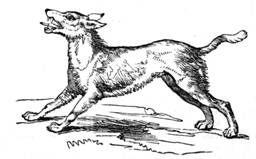
Fig. 150—Dog
Dog occurs in many places of Scripture (Exo 22:31; 1Sa 17:43; 1Sa 24:14; 2Sa 9:8; 2Ki 8:13; Psa 59:6; Psa 59:14-15; Pro 26:11; Pro 26:17, etc.). An animal so well known, whose numerous varieties come under daily observation, requires no detailed description. There is, however, in Asia still extant one, perhaps more than one species, that never have been the companions of man, and there are races of uncertain origin, that may have been formerly domesticated, but which are now feral, and as fierce as wolves; while, from the particular opinions of Oriental nations, there are others, exceedingly numerous, neither wild nor domesticated, but existing in all the cities and towns of the Levant, without owners; feeding on carrion and offal, and still having the true instinct of protecting property, guarding the inhabitants of the district or quarter where they are tolerated; and so far cherished, that water and some food are not unusually placed within their reach.
The true wild species of Upper and Eastern Asia is a low, sharp-nosed, reddish cur-dog, not unlike a fox, but with less tail. In Persia and Turkey there exists a larger dog resembling a wolf, exceedingly savage. Both are gregarious, hunt in packs, but are occasionally seen alone. They are readily distinguished from a wolf by their shorter unfurnished tails. In the time of the sojourning of Israel in Egypt, there were already in existence domestic dogs of the principal races now extant—the cur-dog or fox-dog, the hound, the greyhound, and even a kind of low-legged turnspit. All the above, both wild and reclaimed, there is every reason to believe, were known to the Hebrews, and, notwithstanding the presumed Mosaic prohibition, anterior habits, and, in some measure, the necessity of their condition, must have caused cattle-dogs to be retained as property (Deu 23:18); for we find one of that race, or a house-dog, actually attending on travelers (Tob 5:16; Tob 11:4). It is to be presumed that practically the street-dogs alone were considered as absolutely unclean; though all, as is the case among Muhammadans, were excluded from familiarity.
Beside the cattle-dog, the Egyptian hound and one or two varieties of greyhound were most likely used for hunting—a pastime, however, which the Hebrews mostly pursued on foot.
The street-dog, without master, apparently derived from the rufous cur, and in Egypt partaking of the mongrel greyhound, often more or less bare, with a mangy unctuous skin, frequently with several teeth wanting, was, as it now is, considered a defiling animal. It is to animals of this class, which no doubt followed the camp of Israel, and hung on its skirts, that allusion is more particularly made in Exo 22:31; for the same custom exists at this day, and the race of street-dogs still retains their ancient habits. But with regard to the dogs that devoured Jezebel, and licked up Ahab’s blood (1Ki 21:23), they may have been of the wild races, a species of which is reported to have particularly infested the banks of the Kishon and the district of Jezreel.
The cities of the East are still greatly disturbed in the night by the howlings of street-dogs, who, it seems, were similarly noisy in ancient times, the fact being noticed in Psa 59:6; Psa 59:14; and dumb or silent dogs are not infrequently seen, such as Isaiah alludes to (Isa 56:10).
Dog. An animal frequently mentioned in Scripture. It was used by the Hebrews as a watch for their houses, Isa 56:10, and for guarding their flocks. Job 30:1. Then also, as now, troops of hungry and semi-wild dogs used to wander about the fields and the streets of the cities, devouring dead bodies and other offal, 1Ki 14:11; 1Ki 21:19; 1Ki 21:23; 1Ki 22:38; Psa 59:6, and thus, became so savage and fierce and such objects of dislike that fierce and cruel enemies are poetically styled dogs in Psa 22:16; Psa 22:20, moreover, the dog being an unclean animal, Isa 66:3, the epithets "dog", "dead dog", "dog’s head", were used as terms of reproach or of humility in speaking of one’s self. 1Sa 24:14; 2Sa 3:8; 2Sa 9:8; 2Sa 16:9; 2Ki 8:13.
The watch of the house, and of the flock (Isa 56:10-11; Job 30:1). Sometimes domesticated, as the Syrophoenician woman’s comparison and argument imply, "the household (
(
They continued to be cherished till the Arabian conquest, when they, like the unowned street-dogs, fell under the imprecation of Mohammed, who with reluctance, though with good policy, modified his denunciations and sentence of destruction in favor of hunting-dogs, and even permitted game killed by them to be eaten, provided they had not devoured any portion of it (comp. Exo 22:31). The words of the Lord Jesus to the Syrophoenician woman, and her answer (Mat 15:26-27), certainly imply a domestication and domiciliation of dogs; but simple toleration of their presence is all that can be gathered. They lived on what they could get. Among the Moors of North Africa a similar position of the dog is occasionally seen. They "grant him, indeed, a corner of their tent, but this is all; they never caress him, never throw him anything to eat" (Poiret’s Barbary, 1:253). Besides the cattle-dog, the Egyptian hound, and one or two varieties of greyhound, were most likely used for hunting — a pastime, however, which the Hebrews mostly pursued on foot. On the Assyrian monuments they are depicted in hunting scenes. The street-dog, without master, apparently derived from the rufous-cur, and in Egypt partaking of the mongrel greyhound, often more or less bare, with a mangy, unctuous skin, fre. quently with several teeth wanting, was, as it now is, considered a defiling animal. It is to animals of this class, which no doubt followed the camp of Israel, and hung on its skirts, that allusion is more particularly made in Exo 22:31, for the same custom exists at this day, and the race of streetdogs still retains their ancient habits (Prosp. Alpin. Rev. Egypt. 4:8, page 230 sq.; Russel, Aleppo, 2:55; Rosenmüller, Morgen. 4:76). A portion of the Cairo packs annually become hajis, and go and return with the caravan to Mecca, while others come from Damascus, acting in the same manner; and it is known that the pilgrims from the banks of the Indus are similarly attended to Kerbela: indeed, every caravan is so, more or less, by these poor animals. But with regard to the dogs that devoured Jezebel, and licked up Ahab’s blood (1Ki 21:23), they may have been of the wild races, a species of which is reported to have particularly infested the banks of the Kishon and the district of Jezreel. In illustration of this shocking end of Jezebel, it may be remarked that the more than half-wild street-dogs of the East, living upon their own resources, and without owners, soon make rapid clearance of the flesh of dead bodies left exposed, whether of human creatures or beasts (Bruce, Trav. 4:81).
Among other instances, it is recorded that a number of Indian pilgrims were drowned by the sinking of a ferry-boat in which they were crossing a river. Two days afterwards a spectator relates: "On my approaching several of these sad vestiges of mortality, I perceived that the flesh had been completely devoured from the bones by the Pariah dogs, vultures, and other obscene animals. The only portion of the several corpses I noticed that remained entire and untouched were the bottoms of the feet and insides of the hands, a circumstance that may afford a corroborative proof of the rooted antipathy the dog has to prey upon the human hands and feet. Why such should be the case remains a mystery" (Kitto’s Daily Illust. in loc.). Stanley (S. and P. page 350) states that he saw on the very site of Jezreel the descendants of the dogs that devoured Jezebel, prowling on the mounds without the walls for offal and carrion thrown out to them to consume; and Wood, in his Journal to the source of the Oxus, complains that the dog has not yet arrived at his natural position in the social state (compare Strabo, 17:821; Burckhardt, Trav. 2:870). The dog was employed, however, in sacrifice by some ancient nations (Pausan. 3:14, 9; Arnob. 4:25; Julian, Orat. 5, page 176; Pliny, 18:69; comp. Saubert, De sacrific. c. 23, page 518 sq.), and was even sometimes eaten (Plutarch, De sollert. animal. c. 2; Justin. 19:1). The cities of the East are still greatly disturbed in the night by the howlings of street-dogs, who, it seems, were similarly noisy in ancient times, the fact being noticed in Psa 59:6; Psa 59:14; and dumb or silent dogs are not unfrequently seen, such as Isaiah alludes to (56:10). The same passage has reference to the peculiarly fitful sleep of the dog, and his sudden start as if during a dream (see J.G. Michaelis, Observ. Sacr. 2:50 sq.). The dog was used by the Hebrews as a watch for their houses (Isa 56:10; comp. Iliad, 23:173; Odys. 17:309), and for guarding their flocks (Job 30:1; comp. Iliad, 10:183; 12:302; Varro, R.R. 2:9; Colum. 7:12; see Thomson, Land and Book, 1:301).
Then also, as now, troops of hungry and semi-wild dogs used to wander about the fields and streets of the cities, devouring dead bodies and other offal (1Ki 14:11; 1Ki 16:4; 1Ki 21:19; 1Ki 21:23; 1Ki 22:38; 2Ki 9:10; 2Ki 9:36; Jer 15:3; Psa 59:6; Psa 59:14), and thus became such objects of dislike (comp. Harmar, 1:198 sq.; Host, Nachr. 5. Marokko; page 294; Joliffe, page 327) that fierce and cruel enemies are poetically styled dogs in Psa 22:16; Psa 22:20 (see Jer 15:3; comp. Joseph. Ant. 15:8, 4; Homer, Il. 17:255; 22:335). Moreover, the dog, being an unclean animal (Isa 66:3; Mat 7:6; comp. Horace, Ep. 1:2, 26), as still in the East (Arvieux, 3:189; Hasselquist, page 109), and proverbially filthy in its food (Pro 26:11; 2Pe 2:22), the terms dog, dead dog, dog’s head were used as terms of reproach, or of humility in speaking of one’s self (1Sa 24:14; 2Sa 3:8; 2Sa 9:8; 2Sa 16:9; 2Ki 8:13). Knox relates a story of a nobleman of Ceylon, who, being asked by the king how many children he had, replied, "Your majesty’s dog has three puppies." Throughout the whole East "dog" is a term of reproach for impure and profane persons, and in this sense is used by the Jews respecting the Gentiles (Rev 22:15; compare Schöttgen, Hor. Hebrews 1:1145), and by Mohammedans respecting Christians (Wetstein, 1:424; 2:274). The wanton nature of the dog is another of its characteristics, and there can be no doubt that
Dog. This well-known animal is frequently mentioned in the Bible. But, though it was employed to watch the flocks, Job 30:1, and to guard the house, Isa 56:10, it was by no means regarded as we regard it, the companion and friend of man, but was an unclean animal under Jewish law and regarded with contempt. Exo 22:31; Deu 23:18; 1Sa 17:43; 1Sa 24:14. Dogs were scavengers, half wild, prowling about the fields and the towns, devouring offal and dead bodies, and disturbing the night with their howlings. This is the case now in the east; troops of dogs abounding, recognized in a degree by food and water being occasionally given them, and, according to the instincts of their nature, guarding the place where they congregate, but deemed impure and unclean, just as among the ancient Hebrews. Hence we can understand the comparison of savage and cruel men to dogs, Psa 22:16; Php 3:2, and the contempt and dislike attached to the name of a dog. 1Sa 24:14; 2Sa 3:8; 2Sa 9:8. Solomon contrasts a living dog with a dead lion, Ecc 9:4, and Abner exclaims: "Am I a dog’s head?" 2Sa 8:8, implying that a dog is the meanest thing alive. The same contempt is implied in the charge: "He that sacrifices a lamb,... as if he cut off a dog’s neck." Isa 66:3. In the New Testament it is used to designate vile persons who are shut out of heaven, Rev 22:15, and foolish persons devoted to their folly. 2Pe 2:22. To the present day the word is applied by Jews to Gentiles, and by Mohammedans to Christians, as a term of reproach.
Constantly referred to in scripture as an unclean and debased animal: hence the unclean Gentiles or heathen are compared to dogs. Psa 22:16; Psa 59:6; Psa 59:14. The price of a dog was forbidden to be put into the Lord’s treasury, it was an abomination. Deu 23:18. Hazael, a heathen, said, "Is thy servant a dog?" and the most offensive epithet was to call a man a dead dog. They were, and are, the scavengers of Eastern cities. All refuse is thrown into the streets and the dogs eat it. It was the dogs who ate the body of Jezebel, and licked up the blood of Naboth and of Ahab. In the N.T. it is the same: ’without are dogs,’ ’ beware of dogs’ used symbolically of those cut off and of the unclean: they return to their vomit again. The only apparent exception to the above is when the Lord compared the Syrophenician woman to a dog, and she said, "Yet the dogs eat of the crumbs which fall from their masters’ table." In these passages the diminutive of the word is used, implying ’little dogs or puppies,’ and these are often kept in houses until they grow up. But this does not remove the contempt implied in the term. Mat 15:27. Wyclif translated ’houndis’ and ’litil whelpis’ in Mar 7:27-28.
DOG.—See Animals, p. 64.
( ).
).
By: Solomon Schechter, Kaufmann Kohler
Term of Contempt.
—Biblical Data:
The dog referred to in the Bible is the semisavage species seen throughout the East, held in contempt for its fierce, unsympathetic habits, and not yet recognized for his nobler qualities as the faithful companion of man. He is used chiefly by shepherds or farmers to watch their sheep or their houses and tents, and to warn them by his loud barking of any possible danger (Job xxx. 1; Isa. lvi. 10). He lives in the streets, where he acts as scavenger, feeding on animal flesh unfit for man, and often devouring even human bodies (Ex. xxii. 31; I Kings xiv. 11, xvi. 4, xxi. 23; II Kings ix. 10, 36; Jer. xv. 3). At night he wanders in troops from place to place, filling the air with the noise of his barking (Ps. lix. 7-14; compare Ex. xi. 7), and it is dangerous to seize him by the car in order to stop him (Prov. xxvi. 17). He is of a fierce disposition (Isa. lvi. 11; A. V. "greedy")and therefore the type of violent men (Ps. xxii. 17 [A. V. 16], 21 [20]). Treacherous and filthy (Prov. xxvi. 11), his name is used as a term of reproach and self-humiliation in such expressions as: "What is thy servant, which is but a dog" (II Kings viii. 13, R. V.); or "Am I a dog's head?" (II Sam. iii. 8); or "After whom dost thou pursue? after a dead dog?" (I Sam. xxiv. 15 [A. V. 14]; compare II Sam. ix. 8, xvi. 9; Cheyne's emendation in "Encyc. Bibl." s.v. "Dog," seems unnecessary).
The dog known to the Hebrews in Biblical times was the so-called pariah dog, the shepherd-dog (Job xxx. 7) being the more ferocious species. The Assyrian hunter's dog was probably unknown. The A. V. translation of  ("well girt in the loins") in Prov. xxx. 31 by "greyhound" is incorrect; R. V. (margin) has more correctly "war-horse" (see commentaries ad loc.).
The dog being an unclean animal, "the breaking of a dog's neck," mentioned as a sacrificial rite in Isa. lxvi. 3 (compare Ex. xiii. 13), indicates an ancient Canaanite practise (see W. R. Smith, "Rel. of Sem." p. 273). The shamelessness of the dog in regard to sexual life gave rise to the name  ("dog") for the class of priests in the service of Astarte who practised sodomy ("kedeshim," called also by the Greeks
  as the regular name of priests attached to the temple of Ashtoret at Larnaca has been found on the monuments (see "C. I. S." i., No. 86).
—In Rabbinical Literature:
Two different dogs are mentioned: the ordinary dog and the small Cyprian (not, as commonly explained, "the farmers' dog,"  ). The former species resembles the wolf; the latter the fox; and the crossing of these is forbidden as "kilayim" (mixture of species; Kil. i. 6; compare Aristotle, "Historia Animalium," viii. 27, 8, where the one species of dogs is declared to be a crossing of dogs and wolves, and the other [the Laconian] a crossing of dogs and foxes). While the ordinary dog is counted by R. Meïr among domestic animals ("behemah"), the Cyprian dog is declared to be a wild animal ("ḥayyah"; Yer. Kil. 27a). In the dusk the former is difficult to distinguish from the wolf (Ber. 9b).
As a rule, the dog does not scratch and tear like beasts of prey (Ḥul. 53a), but when driven by hunger he tears and devours young lambs (B. K. 15b); he bites men, but does not break a bone (Pes. 49b). "With his sharp scent he smells the bread hidden three fists deep in the soil" (Pes. 31b). Shepherd-dogs are fed on bread made of flour and bran (Ḥallah i. 8). Two shepherd-dogs are required to save the flock from the attack of wolves (B. M. vii. 9). While dogs hate one another, they are ready to unite against the attacking wolf (Pes. 113b; Sanh. 105a). The dog depends chiefly on the nourishment furnished him by man, but is as a rule greatly neglected, wherefore God has provided him with the faculty of retaining his food in the stomach for three days (Shab. 154b; Beẓah 21a). At times, however, he eats his excrement (B. Ḳ. 92b). The excrement of dogs is used for tanning (Ber. 25a; Ket. 77a).
The barking of dogs at midnight (Ber. 3a) gives people a feeling of safety, wherefore the rule is given: "Dwell not in a town where no barking of dogs is heard" (Pes. 113a). "A dog in a strange city will not bark, and it takes him seven years to feel at home" ('Er. 61a).
The Keeping of Dogs.
The dog is the most shameless of animals (
 , Ex. R. xlii.); he was one of those who would not abstain from cohabitation in the Ark (Gen. R. xxxvii.). The Mishnah (B. Ḳ. vii. 7) forbids the keeping of dogs unless they are chained; in cities, near the seacoast or the frontier, they may for safety's sake be let loose at night (B. Ḳ. 83a). According to Tosef., B. Ḳ. viii. 17, and B. Ḳ. 80b, the raising of small Cyprian dogs is allowed. These seem to be the little dogs (
In the time of the Amoraim the ordinary dog does not appear to have been regarded as ferocious; for it is said: "One should not raise a bad dog [ ] in the house, this being a transgression of Deut. xxii. 8, 'Thou shalt not bring blood upon thine house'" (B. Ḳ. 16b, 46a: compare Shab. 63a; Yer. B. Ḳ. vii. 6a, with reference to Job vi. 14, Hebr., where
  is interpreted as
A wild dog ( =
=
The Faithful Dog.
In the course of time a certain affection for the dog seems to have been developed among the Jews. In Hor. 13a the dog is said to be distinguished from the cat in that he recognizes his master while the latter does not. In the more recent versions of Tobit vi. 1 and xi. 4 (see Grimm's commentary ad loc.; but compare Abrahams in "Jew. Quart. Rev." i. 288) the dog follows Tobias on his journey from home and back. According to Rab, in Gen. R. xxii., the sign given by God to Cain (Gen. iv. 15) is to be explained that he was given a dog as companion or guardian. Idle housewives were known to play with dogs (Ket. 61b). "For his friendly conduct at the exodus of the Hebrews when he did not 'move his tongue against man or beast' (Ex. xi. 7), God compensated the dog by telling the people that the meat forbidden to them should be cast unto him" (Mek., Mishpaṭim, 20, on Ex. xxii. 30).
Especially noteworthy is the fact that the story of the faithful dog which Dunlop ("History of Prose Fiction," ch. vii.; see Index, s.v. "Gellert") and Benfey ("Panchatantra," 1859, i. 482) have traced through the various literatures of the East and the West, isfound for the first time in Yer. Ter. viii. 46a and Pesiḳ. x. 79b as one of R. Meïr's fables used as a haggadic illustration of Prov. xvi. 7. Some shepherds had curdled milk for a meal, when in their absence a serpent ate of it and thus (as was the belief) instilled poison into it. The dog, which had witnessed the act, began to bark when his masters, on their return, proceeded to cat it; but they would not heed his voice of warning. So he hastened to eat it all up and fell down dead, having thus saved his masters' lives. In gratitude, the shepherds reverently buried the faithful dog, and erected a monument to him which is still called "The Dog's Monument" ( ).
).
The Jewish belief was that the howling of dogs ( ) betokened the presence of the angel of death, or death itself in the vicinity (compare Wuttke, "Der Deutsche Volksaberglaube," 1869, §268); their cheerful (sportful) barking (
 ), the presence of the prophet Elijah—that is, some joyful event (B. Ḳ. 60b). "If one goes out to select a wife for himself and hears the barking of dogs, he may divine in their voices an omen of good or of evil" (Gen. R. lix.; the reading, however, is doubtful).
Golden Dogs Barking.
The idol Nibhaz (II Kings xvii. 31; "Nibhan,"  , according to David Ḳimḥi) was taken to have been the image of a dog (Sanh. 63b). The name of "Pene Melek" (Moloch's Face) was to be changed into "Pene Keleb" (Dog's Face; 'Ab. Zarah 46a). The Egyptian dog or jackal-god, as guardian of the dead, together with the two golden images of dogs (jackals) which were used as symbols of the two hemispheres (Brugsch, "Religion und Mythologie der Alten Aegypter," 1888, p. 670), appears in the Haggadah in the following legendary form:
(according to Ex. xi. 7; Pesiḳ. x. 86a; Ex. R. xx.; see Brüll's "Jahrb." i. 150; p. 151, note, for cabalistic comments upon the passage)
"The Egyptians, in order to prevent Joseph's body from being taken from them, had two dogs of gold [or brass] placed on his tomb and endowed by witchcraft with the power of frightening away every intruder by their loud barking. When Moses came to take the bones of Joseph the two dogs began to bark, but he addressed them, saying: 'You are the work of deceit, and you would not move your tongues if you were genuine dogs'".
"Dog" is also the synonym in rabbinical literature for shameless and relentless people, and therefore for wicked heathen. The time of general degeneracy is a time when "the generation will have the face of the dog" (Soṭah ix. 15). R. Joshua ben Levi compares the righteous to the guests invited to the king's table, and the wicked heathen to the dogs who obtain the crums that fall therefrom (Midr. Teh. to Ps. iv. 8, based upon Isa. lvi. 10, 11). R. Ishmael b. R. Jose called the Samaritans dogs, as "being as adhesive to idolatrous customs as the dog is to the flesh of carcasses" (Gen. R. lxxxi.). Just as the dog must be beaten by the master, so must the wicked be smitten by God (Ex. R. ix., with reference to Ps. lix. 7; compare Sanh. 109a: "As the dog scents food from afar, so do the wicked scent the bones of the rich for pillage"). The epithet "dog" used for heathen in the New Testament (Matt. xv. 26; Phil. iii. 2) is explained hereby; but the statement of Eisenmenger, "Entdecktes Judenthum," i. 714-716, that the Jews call non-Jews (Christians) "dogs," repeated often and referred to in Meyer's commentaries to Matthew, l.c., as well as the Talmudical quotations in Herzog-Hauck's "Real-Encyc." s.v. "Hund," and in Cheyne and Black, "Encyc. Bibl." s.v. "Dog" (obviously based on the misunderstood passage in Wünsche, "Neue Beiträge zur Erläuterung der Evangelien," 1878, p. 189), are altogether incorrect. The epithet "keleb" (dog) is given as a nickname to miserly Jews (see Tendlau, "Sprichwörter und Redensarten," 1860, Nos. 270 and 909).
The dog is equally prominent in Jewish folk-lore and in Chaldean magic (see Lenormant, "Magie und Wahrsagekunst der Chaldäer," Jena, 1878, p. 471); being especially connected in mythology with death or the nether world (see the dogs of Hecate in Rhode, "Psyche," 1894, pp. 221, 363, 367, 375; the jackal dog-god Anubis in Egypt in Brugsch, l.c., pp. 252, 670; Zend Avesta, Vendidad, v. 29, in "Sacred Books of the East," iv. 58; compare "Shayast la Shayast," ii. 1, x. 10; Nork, "Etymologisch-Symbolisch-Mythologisches Realwöterbuch," s.v. "Hund").
Bibliography:
Lewysohn, Die Zoologie des Talmuds, 1858, pp. 82-89;
Parthey, Plutarch über Isis und Osiris, 1850, p. 263;
Kohut, Aruch Completum, s.v.  ;
;
Winer, B. R.;
Hamburger. R. B. T. s.v. Hund;
Cheyne and Black, Encyc. Bibl. s.v. Dog;
L. Hopf, Thierorakel und Orakelthiere, Stuttgart, 1888, Index, s.v. Haushund;
Zapletal, Der Totemismus und die Religion Israels, p. 38, Freiburg, 1901.
DOG.—All the Bible references to dogs breathe the modern Oriental feeling with regard to them; they refer to the common pariah dogs. These creatures are in all their ways repulsive, and in the majority of cases they have not even outward attractiveness. They live in and around the streets, and act as scavengers. In the environs of Jerusalem, e.g. the Valley of Hinnom, where carcases are cast out, they may be seen prowling around and consuming horrible, putrid bodies, or lying stretched near the remains of their meal, satiated with their loathsome repast. Whole companies of dogs consume the offal of the slaughter-house. There is not the slightest doubt that they would consume human bodies to-day had they the opportunity; indeed, cases do occur from time to time (cf. 1Ki 14:11; 1Ki 16:4; 1Ki 21:19; 1Ki 21:23; 1Ki 22:38, 2Ki 9:10; 2Ki 9:36, Jer 15:3, Psa 68:23). All night they parade the streets (Psa 59:6; Psa 59:14-15), each company jealously guarding that district which they have annexed, and fighting with noisy onslaught any canine stranger who ventures to invade their territory. Such a quarrel may start all the dogs in the city into a hideous chorus of furious barks. In many parts these creatures are a real danger, and the wise man leaves them alone (Pro 26:17). When they attach themselves, quite uninvited, to certain houses or encampments, they defend them from all intruders (Isa 56:10). To call a man a ‘dog’ is a dire insult, but by no means an uncommon one from an arrogant superior to one much below him, and to apply such an epithet to himself on the part of an inferior is an expression of humility (2Ki 8:13 etc.). A ‘dead dog’ is an even lower stage; it is an all too common object, an unclean animal in a condition of putridity left unconsumed even by his companions (1Sa 24:14 etc.). The feeling against casting bread to a dog is a strong one; bread is sacred, and to cast it to dogs is even to-day strongly condemned in Palestine (Mar 7:27).
The shepherd dog (Job 30:1) is, as a rule, a very superior animal; many of these are handsome beasts of a Kurdish breed, and have the intelligent ways and habits of our best shepherds’ dogs at home.
Greyhounds are still bred by some Bedouin in S. Palestine, and are used for hunting the gazelle; they are treated very differently from the pariah dogs. Pro 30:31 is a very doubtful reference to the greyhound; RVm
The ‘price of a dog’ (Deu 23:18) evidently has reference to degraded practices of the qedçshîm (‘male prostitutes’) connected with the worship at ‘Baal’ temples.
E. W. G. Masterman.
Representation in art associated with
Saint Hubert as part of his connection with hunters
Saint Roch, who was fed during his illness by a dog
Saint Tobias, who had a dog as a travelling companion
See also the patron saints index for patrons of dogs.
Other passages express by inference the low esteem in which dogs are held. Nothing worse could happen to a person than that his body should be devoured by dogs (1Ki 14:11; 1Ki 16:4; 1Ki 21:19, 1Ki 21:23, etc.). Job 30:1 says of the youth who deride him that he disdained to set their fathers with the dogs of his flock. In Php 3:2 and Rev 22:15, dogs are coupled with evil-workers, sorcerers, etc. In Mat 7:6 we read: “Give not that which is holy unto the dogs, neither cast your pearls before the swine.”
Job 30:1 (cited above) refers to the use of dogs to guard flocks; and the comparison of inefficient watchmen with dumb dogs (Isa 56:10) implies that at least some dogs are useful. In the apocryphal Book of Tob, Tobias’ dog is his companion on his travels (Tobit 5:16; 11:4; on this see Expository Times, XI, 258; HDB, IV, 989; Geiger, Civilization of E. Iranians, I, 85ff).
There is further the reference to the greyhound (Pro 30:31 English Versions) as one of the four things which are “stately in their going.” But the rendering, “greyhound,” rests solely upon inference, and is contrary to the Septuagint and Vulgate, which have respectively
Domestic dogs have probably been derived from various species of wolves and jackals. In this connection, it is noteworthy that the dogs of certain regions greatly resemble the wolves of those regions. The pariah dogs of Syria and Palestine resemble the jackals, especially in color and in the tail, differing in their greater size and in the shape of muzzle and ears. It is fair to assume that they are much the same as existed in Bible times. They are in general meek and harmless creatures, and are valuable as scavengers, but disturb the night with their barking. Each quarter of the city has its own pack of dogs, which vigorously resents any invasion of its territory. A dog which for any reason finds itself in foreign territory gets home as quickly as possible, and is lucky if it does not have to run the gauntlet of a pack of vicious foes. The pariah dog is sometimes brought up to be a sheep dog, but the best shepherd dogs are great wolfish creatures, which are usually obtained from Kurdistan.
(êýùí, Php_3:2, 2Pe_2:22, Rev_22:15)
In Palestine the dog plays a very insignificant and contemptible part, and is in consequence the symbol for all that is ignoble and mean. The ordinary pariah street-dogs are from two to three feet long, tawny in colour, have small eyes, short fur, and comparatively little hair on the tail. They act as scavengers, clearing away carcases and offal, which form the staple of their food, and which, but for them, might create pestilence (cf. H. B. Tristram, Natural History10 p. 78). They bark and howl all night (cf. Psa_59:6; Psa_59:14), but as a rule are afraid of men, though on occasions they attack travellers in lonely places. Sometimes they are trained to act as sheep-dogs (cf. Job_30:1), not, however, for driving the sheep, as with us, but for guarding them against the attacks of wolves and jackals at night. Dogs were seldom regarded or treated as pets; this was perhaps due to the fact that the Jews were not a hunting people. Tristram, however, informs us that he had no difficulty in making a pet of a puppy taken from pariah dogs (op. cit. p. 80), while we have clear evidence in Mat_15:27 || Mar_7:27 that they sometimes became household pets; it is, however, noticeable that the term used in these two passages is the diminutive êõíÜñéïí. The only other breed of dog known in Palestine is the Persian greyhound, which resembles our greyhound in general form and appearance, but is larger and stronger, though not so swift. This dog is used by shaikhs for hunting the gazelle.
When used as a personal epithet in OT and NT, ‘dog’ is a term of absolute contempt when applied to others, of extreme humility when applied to oneself. In Php_3:2, St. Paul applies the term to his Judaizing opponents-‘Look to, be on your guard against, the dogs, the workers of mischief, the concision’ (cf. Lightfoot, Philippians4, 1878, p. 143)-a party, clearly, well-defined and well-known to the members of the Philippian Church. In 2Pe_2:22 the ‘dog’ is mentioned along with the ‘sow’ as in Horace (Epp. I. ii. 26)-the dog turning to his own vomit again, and the sow that hath bathed itself (in mud), to wallowing in the mire. The reference is to apostates-those who, after being converted to the way of righteousness and having abandoned the filth in which they had once so zealously ‘bathed,’ return again to wallow in the mire of their former delights. In Rev_22:15, the ‘dogs’ are those who are corrupted by the foul vices of the heathen world, many of whom were doubtless to be found within the pale of the Church (cf. 2:14, 2Co_12:21).
Literature.-For the dog in Palestine see H. B. Tristram, Natural History of the Bible10, 1911, p. 78ff.; also SWP [Note: Memoirs of Survey of Western Palestine.] : ‘The Fauna and Flora of Palatine,’ 1884, p. 21; P. G. Baldensperger, ‘The Immovable East,’ in PEFSt [Note: EFSt Palestine Exploration Fund Quarterly Statement.] , 1903, p. 73, 1904, p. 361; J. E. Hanauer, ‘Palestinian Animal Folk-Lore,’ in PEFSt [Note: Palestine Exploration Fund Quarterly Statement.] , 1904, p. 265; W. M. Thomson, The Land and the Book, new ed., 1910, pp. 178-179. On the texts see especially J. B. Lightfoot, Philippians4, 1878. p. 143f.; C. Bigg, Epp. of St. Peter and St. Jude (International Critical Commentary , 1901), p. 287f.; H. B. Swete, The Apocalypse of St. John, 1907, p. 308.
P. S. P. Handcock.
2Sa 9:8 (a) This poor man felt so desperately unworthy that he compared himself to this animal.
Psa 22:16 (a) These were JESUS’ enemies who wandered around the Cross gaping at Him and desiring to injure Him.
Isa 56:10 (c) These were the leaders of Israel who refused to warn and to protect them from their enemies; or it is any unsaved religious leader who fails to be a blessing to GOD’s people.
Mat 15:26 (a) This troubled woman accepted the place CHRIST gave her and compared herself to a dog waiting to be fed with the crumbs.
Php 3:2 (b) This is a reference to unsaved, religious leaders whose only purpose is to feed themselves and bark out their feelings which give no enlightenment or help to others.
2Pe 2:22 (b) This refers to a religious leader who gets nothing from GOD but gives out that which he has mixed up and concocted within his own mind. He feeds on this himself and offers it to others.
Rev 22:15 (a) GOD is informing us that false leaders, evil teachers and other similar characters who are described as "dogs" in the Old Testament and the New, will not be permitted to enter Heaven.
Dog. In ancient Israel, the dog was not "man’s best friend." In fact, calling someone a dog was one of the most offensive ways of insulting that person. The Bible mentions dogs frequently; most of the references are derogatory. Even in New Testament times, Jews called Gentiles "dogs" (Mat 15:26). The term "dog" also referred to a male prostitute (Deu 23:18). Unbelievers who were shut out of the New Jerusalem were also termed "dogs" (Rev 22:15)-- probably a reference to their sexual immorality. Moslems later applied the insult to Christians.
The dog may have been the first animal in the ancient world to be tamed. Ancient Egyptians raced greyhounds, mentioned by Solomon in his Proverbs (Pro 30:31), (NKJV), and the Greeks raised mastiffs. But dogs in Palestine were more wild than tame. They often banded together in packs and lived off the refuse and food supplies of a village. Some dogs were useful as watchdogs or guardians of sheep, but even they were not altogether reliable (Isa 56:10).