
a celebrated goddess of the Heathens, who was honoured principally at Ephesus, Acts 19. She was one of the number of the twelve superior deities, and was called by the several names of Hebe, Trivia, and Hecate. In the Heavens she was the moon, upon earth she was called Diana, and in hell Hecate. She was worshipped in Palestine, Jer 7:18; Jer 44:17-18.
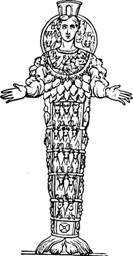
Fig. 147—Goddess Diana
Diana (Act 19:24). Artemis, the Diana of the Romans, is a goddess known under various modifications, and with almost incompatible attributes. As the tutelary divinity of Ephesus, in which character alone she concerns us here, she was undoubtedly a representative of the same power presiding over conception and birth which was adored in Palestine under the name of Ashtoreth.
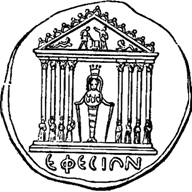
Fig. 148—Diana Coin
Her earliest image, which was said to have fallen from heaven, was probably very rude, and, to judge from its representation on ancient coins, little more than a head with a shapeless trunk, supported by a staff on each side. There is some dispute as to the material of which her image was made. Most authorities say it was of ebony. The later image with the full development of attributes, of which we give a representation (fig. 147), is a Pantheon of Asiatic and Egyptian deities. Even in it, however, we see how little influence Greek art had in modifying its antique rudeness. It is still more like a mummy than a Greek statue. Her priests were called Megabyzi, and were eunuchs.
Or ARTEMIS, a celebrated goddess of the Romans and Greeks, and one of their twelve superior deities. In the heavens she was Luna, (the moon,) on earth Diana, in the unseen world Hectate. She was invoked by women in childbirth under the name of Lucina. She was usually represented with a crescent on her head, a bow in her hand, and dressed in a hunting-habit, because she was said to preside over forests and hunting. Diana was said to be the daughter of Jupiter by Latona, and twin sister of Apollo. As Hectate, she was regarded as sanguinary and pitiless; as goddess of hunting and the forests, she was chaste, but haughty and vindictive; as associated with the moon, she was capricious and wanton. The Diana of Ephesus was like the Syrian goddess Ashtoreth, and appears to have been worshipped with impure rites and magical mysteries, Mal 19:19 . Her image, fabled to have fallen down from Jupiter in heaven, seems to have been a block of wood tapering to the foot, with a female bust above covered with many breasts, the head crowned with turrets, and each hand resting on a staff. It was of great antiquity, and highly venerated.\par The temple of this goddess was the pride and glory of Ephesus. It was 425 feet long, and 220 broad, and had 127 columns of white marble, each 60 feet high. Its treasures were of immense value. It was 220 years in building, and was one of the seven wonders of the world. In the year when Alexander the Great was born, B. C. 356, it was burned down by one Herostratus, in order to immortalize his name, but was afterwards rebuilt with even greater splendor. The "silver shrines for Diana," made by Demetrius and others, were probably small models of the same for domestic use, and for sale to travellers and visitors. Ancient coins of Ephesus represent the shrine and statue of Diana, with a Greek inscription, meaning "of the Ephesians," Mal 19:28,34,35 .\par
Dia’na. This Latin word, properly denoting a Roman divinity, is the representative of the Greek Artemus, the tutelary goddess of the Ephesians, who plays so important a part in the narrative of Acts_19. The Ephesian Diana was, however, regarded as invested with very different attributes, and is rather to be identified with Astarte and other female divinities of the East. The head wore a mural crown, each hand held a bar of metal, and the lower part ended in a rude block covered with figures of animals and mystic inscriptions. This idol was regarded as an object of peculiar sanctity, and was believed to have fallen down from heaven. Act 19:35.
Greek ARTEMIS (Acts 19). Her original temple founded 580 B.C., finished 460, was burnt by Erostratus 356 B.C. The second temple, alluded to in Acts, was built in the reign of Alexander the Great. The Ephesian Diana in attributes resembled the Phoenician
No bloody sacrifices were allowed. As Ephesus was the capital of Asia in the limited sense, Diana of Ephesus was naturally the idol "whom all Asia and the world worshipped."
The inscription orders such votive objects to be carried in procession on certain days from the temple through the. Magnesian gate to the great theater, and thence through the Coressian gate back to the temple. This clause gave a clue to the discovery of the temple. First Mr. Wood found the Magnesian gate, and at a depth of 11 ft. a road with tombs on each side and the bases of piers. Secondly, near the stadium he found the Coressian gate. At the convergence of these two roads he found the enclosing wall of the temple and an inscription that Augustus built it; also a white marble pavement on a level bed of black marble and several drums of columns, 6 ft. 4 inches in diameter, including the sculptures in relief, and Ionic capitals, all now deposited in the British Museum, The intercolumniations are more than 19 ft. Gold was largely used in the decoration.
A fragment was found, composed of two astragals, between which a fold of lead enfolded a fillet strip of gold. Remains of brilliant colors too are found, blue, in the background, red and yellow, prominent. The bases of several of the columns are inscribed with their donors’ names and the dedication to Artemis or Diana. The pro-naos was fenced off from the peristyle, as some of the mortises for the iron standards have been discovered. Remains of a wide portico surrounding the temple on three sides have been discovered. The base of one column remains in situ, of the outer row of columns, also one of the inner row. The temple was octastyle, eight columns in front. It has 18 on the sides, and the intercolumniations are three diameters. making the temple diastyle.
Pliny’s statement is correct, the external and internal pillars being 120. The projection of the sculpture of "the 36 carved columns" is as much as 13 inches. The diameter of the columns them. selves is about 5 ft. 10 inches. The width of the platform measured at the lowest step was 238 ft. 3 1/2 inches, the length is 421 ft. 4 inches; Pliny gives the length 425 ft. The dimensions of the temple itself, "out to out," are 163 ft. 9 1/2 inches by 308 ft. 4 1/2 inches. The height of the platform was 9 ft. 5 3/8 inches. The interior was adorned with two tiers of elliptical columns, Ionic and Corinthian, fragments of which are found near the walls of the cella or inner shrine.
The Artemis of the Greeks (
Her temple at Ephesus was one of the wonders of the world, but its great glory was the
Of this heaven-descended image the great city Ephesus was a “worshipper,”
Diana (dî-â’nah, or dî-ăn’áh):Greek, Artemis. A heathen goddess of the Romans and Greeks, of great renown. The Diana of Ephesus was a different deity from the chaste huntress of the Greeks. She was like the Sidonian goddess Ashtoreth, and appears to have been worshipped with impure rites and magical mysteries. Act 19:19. Her image, which was reputed to have fallen down from Jupiter, seems to have been a block of wood shaped into a female bust above covered with many breasts, the head crowned with turrets, and each hand resting on a staff. The temple of this goddess was the pride and glory of Ephesus, and one of the seven wonders of the world. It was 425 feet long, and 220 broad, and had 127 graceful Ionic columns of white marble, each 60 feet high, and the temple was 220 years in building. When Alexander the Great was born, b.c. 356, an earlier temple was burned down by one Herostratus, in order to immortalize his name: the splendid one above described had been rebuilt in its place. Compare 1Co 3:9-17, written in Ephesus; and Eph 2:19-22. The "silver shrines for Diana," made by Demetrius and others, were probably little models of the temple sold for amulets and household use. Ancient coins of Ephesus represent the shrine and statue of Diana, with a Greek inscription, "of the Ephesians." Act 19:28; Act 19:34-35. Others bear the words which Luke employs, translated "deputy" and "worshipper" of Diana. In her temple at Ephesus were stored immense treasures, and any preaching that tended to lower the shrine in the minds of the people, as Paul’s did, would naturally arouse a great tumult.
[Dia’na]
This is the Latin name of one of the principal goddesses of the Greeks and Romans: the Greek name is Artemis. An image of her was said to have fallen from heaven, or to have been formed of wood or ebony which fell from the clouds. It was worshipped by all Asia. Her temple was at Ephesus, built of choice marble. A Roman coin in the British Museum bears a representation of the temple with the image of the goddess in the centre. Act 19:24-35. Though Ephesus was otherwise an enlightened city, it was dark as to religion, the excited people could shout for two hours "Great is Diana of the Ephesians."
The use of the name ‘Diana’ in Acts 19 (Authorized Version and Revised Version ) to indicate the Ephesian goddess is probably due to the influence of the Latin Vulgate. From a very early time the Romans used the Italian names of their own divinities to indicate also Greek divinities whose characteristics were analogous to those of their own. It was thus that the Greek maiden huntress-goddess Artemis was early equated with the Latin goddess Diana, maiden and huntress. (In the earliest Roman period Diana and Ianus [= Dianus] are male and female divinities corresponding to one another.) But the Artemis of Ephesus is a divinity entirely different in character from the ordinary Greek Artemis; and that such a goddess should come to be represented in English by the name Diana is almost ridiculous.
The goddess of Ephesus, called Artemis by the Greeks, was a divinity of a type wide-spread throughout Anatolia and the East generally (cf., for instance, ch. iii in Ramsay’s Cities and Bishoprics of Phrygia, Oxford, 1895). She represented the reproductive power of the human race. The Oriental mind was from early ages powerfully impressed by this, the greatest of all human faculties, and worshipped it, now under the male form, now under the female. There are still in India, for instance, survivals of phallic worship. The Artemis of Ephesus was represented in art as multimammia, covered with breasts. The worship of such divine reproductive power naturally lent itself in practice to disgusting excesses. Instead of being kept on a spiritual level, it was continually made the excuse for brutalizing and enervating practices-prostitution, incest, etc.
The origin of the name ‘Artemis’ is veiled in obscurity, and the attempts of both ancients and moderns to derive the word have been unsuccessful; the best suggestion is that of Ed. Meyer, that the word is Cognate with ἀñôáìåýò, ἄñôáìïò, ἀñôáìåῖí, and means ‘the female butcher.’ This would suit certain early aspects of the cult very well. But it is as a Nature-goddess that we find the most wide-spread worship of Artemis in the earliest days of which we have any knowledge. She was worshipped on mountains and in valleys, in woods and by streams. Her working and her power were recognized in all life, plant and animal, as beneficent in their birth and growth, as signs of wrath in their destruction and death. With her is sometimes united a male counterpart. She is in any case wife and mother; she nourishes the young, aids women in childbirth, and sets bounds to their life. Afterwards various developments in this original conception take place. The wife and mother element, with the growth of the Apollo legend, both Apollo and Artemis being children of Leto, retires into the background, and Artemis becomes a maiden goddess. She also becomes the goddess of seafaring men, and is patroness of all places and things connected with them. In Homer she appears mainly as the goddess of death of the old Nature religion. From the 5th cent. onwards we meet her as goddess of the moon, while Apollo is god of the sun. On the boundaries of the Greek world her cult is associated with the barbarous ceremonies of other divinities recognized as related.
The most important aspects of the Artemis cult for the NT are naturally those connected with the life of Nature, but the whole idea of Artemis must be sketched as briefly as possible. Various trees are sacred to her. Moisture as fertilizing them is sacred to her-lakes, marshes, and rivers. She is thus also a goddess of agriculture. Her beneficence causes the crops to grow, and she destroys opposing forces; whence offerings of crops are made to her. Of all seasons she loves spring best. She is mistress of the world of wild animals, such as bears, lions, wolves, and panthers, and also of birds and fish. Out of this conception the huntress idea would naturally develop. And it seems that it was in connexion with this that the idea of the goddess as a virgin arose. She was also the protectress of cattle. Further, she was reverenced as the guardian of young people, and to her maidens made offering of the toys, etc., of their childhood. Among her other attributes was that of goddess of childbirth, goddess of women in general, especially goddess of death (particularly for women), and as such she demanded human sacrifice. She was a goddess of war, of the sea, of roads, of markets and trade, of government, of healing, protectress from danger, guardian of oaths (by her women were accustomed to swear), goddess of maidenhood, of beauty, of dancing and music. Finally she was a moon-goddess.
The Ephesian cult was in its origin non-Greek. The application of the name Artemis to a goddess of the characteristics of the Ephesian divinity shows that this identification must have been made in very early times, before any idea of virginity attached to the goddess among the Greeks. The cult of the Ephesian goddess remained Oriental, and she was never regarded as virgin. Her temple was a vast institution, with countless priests, priestesses, and temple-servants. The priests were eunuchs, and were called ìåãÜâõæïé; there was one high priest. The goddess was also served by three grades of priestesses, called ìåëëéÝñáé, ἱåñáß, and ðáñéÝñáé; at the head of these was a high priestess. Under the dominion of these priests and priestesses there was a large number of temple-slaves of both sexes. The cult was wild and orgiastic in its character. As a result of partial hellenization two developments took place. First, the worship of Apollo was sometimes associated with that of his Greek sister. Second, games were established on the Greek model, called Ἀñôåìßóéá or ÏἰêïõìåíéêÜ, and were held annually in the month Artemision (=April).
The Ephesian cult of Artemis was by no means confined to Ephesus. The statement of Acts (Act_19:27), ‘whom all Asia and the Roman world worship,’ was no exaggeration. Evidence of this cult has been found in numerous cities of Asia Minor as well as in the following places further afield: Autun, Marseilles, Rhone Mouth (France), Emporiae, Hemeroscopeum, Rhode (Spain), Epidaurus, Megalopolis, Corinth, Scillus (Greece), Neapolis (Samaria), Panticapaeum (Crimea), Rome, and Syria. The Ephesians were proud of the goddess not only because she was theirs, but because her worship brought countless visitors from every part of the Empire. This of course was also good for trade, so that religion and self-interest went hand in hand. The account in Acts (Act_19:23 ff.) illustrates most vividly the enthusiasm which can be aroused when religious fanaticism and commercial greed are in tune. The manufacture of offerings to the goddess brought in extensive profit to the makers. St. Paul’s preaching, which appealed to the better educated classes, drew many away from the coarse and barbarous cult of Artemis. The demand for offerings decreased; hence the meeting and the riot. The air rang with shouts of ‘Great Ephesian Artemis!’
Ephesians prized very greatly the honorary title of íåùêüñïò, temple-keeper (lit. [Note: literally, literature.] ‘temple-sweeper’) of the great Artemis and of her image which fell down from the sky (Act_19:35). This image was doubtless a meteoric stone of crude shape like the Palladium preserved at Rome.
It was in Ephesus (q.v. [Note: quod vide, which see.] ) that the Artemis worship was at length Christianized in the middle of the 5th cent. by the substitution of the Mother of God (èåïôüêïò). This was the beginning of Mariolatry.
Literature.-On Anatolian religion, see W. M. Ramsay’s article ‘Religion of Greece and Asia Minor’ in Hasting's Dictionary of the Bible (5 vols) , vol. v., and ch. iii. of his Cities and Bishoprics of Phrygia, Oxford, 1895; on Artemis, see L. R. Farnell, Cults of the Greek States, vol. ii., Oxford, 1896, pp. 425-486; Schreiber, ‘Artemis,’ in Roscher’s Lexikon der Mythologie; and Wernicke in Pauly-Wissowa [Note: auly-Wissowa Pauly-Wissowa’s Realencyklopädie.] , to the last of which the present writer is particularly indebted.
A. Souter.