
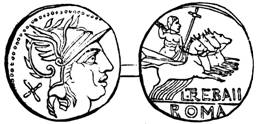
Fig. 145—Denarius
Dena´rius, the principal silver coin of the Romans, which took its name from having been originally equal to ten asses. It was in later times (after B.C. 217) current also among the Jews, and is the coin which is called ’a penny’ in the Auth. Vers. The denarii were first coined in B.C. 269, or four years after the first Punic war, and the more ancient specimens are much heavier than those of later date. Those coined in the early period of the commonwealth have the average weight of 52.5 grains, and those coined under the empire of grains. With some allowance for alloy, the former would be worth 8½ d., and the latter 7½ d.
It has been supposed, however, that the reduction of weight did not take place till the time of Nero; and in that case the denarii mentioned in the Gospels must have been of the former weight and value although 7½ d. is the usual computation. A denarius was the day-wages of a laborer in Palestine (Mat 20:2; Mat 20:9; Mat 20:13); and the daily pay of a Roman soldier was less. In the time of Christ the denarius bore the image of the emperor (Mat 22:19; Mar 12:16) but formerly it was impressed with the symbols of the republic.
Denarius. (containing ten). Authorized Version, "penny," Mat 18:28; Mat 20:2; Mat 20:9; Mat 20:13. A Roman silver coin, in the time of our Saviour and the Apostles, worth about 15 cents. It took its name from its being first equal to ten "asses," a number afterwards, increased to sixteen. It was the principal silver coin of the Roman commonwealth. From the parable of the laborers in the vineyard, it would seem that a denarius was then the ordinary pay for a day’s labor. Mat 20:2; Mat 20:4; Mat 20:7; Mat 20:9-10; Mat 20:13.
(
See WEIGHTS AND MEASURES.
DENARIUS.—See Money.
(Greek,
By: Joseph Jacobs, A. Porter
Roman silver coin, which derived its name from its being at first equal to ten asses; later this number was increased to sixteen. From the second century B.C. it was the chief silver coin of the commonwealth, and under the empire it is probable that it held a similar position up to the fall of Jerusalem. Its normal value was one twenty-fifth of the imperial aureus.
In the English versions the word is rendered "penny"; and it was in this coin that payment was made by the Jews of the civil tribute to the Roman emperors. The coin bore the effigies and titles of the reigning monarch; hence the reply of Jesus to the Pharisees (Matt. xxii. 17-21).
In the Talmud the denarius is identified with the zuz and reckoned to be worth one-fourth of the holy shekel, or a half of the ordinary one, and equivalent to 4 common selas, 4 sesṭerces, 6 obols, 24 asses, or 192 perutas or widow's mites. See also Money; Numismatics.
Bibliography:
Madden, Coins of the Jews (vol. ii. of Numismata Orientalia), pp. 291-292;
Zunz, Z. G. p. 539.
DENARIUS.—See Money, §§ 6, 7.