
Decap´olis. This appears to denote not, as is frequently stated, a particular province or district, but certain Ten Cities, including the adjacent villages, which resembled each other in being inhabited mostly by Gentiles, and in their civic institutions and privileges. In Mat 4:25, it is said, ’Multitudes followed Jesus from Galilee, and from Decapolis, and from Jerusalem, and from Judea, and from beyond Jordan.’ This must be considered as a popular mode of expression, just as, in describing a public meeting in this country, it might be said ’numbers attended it from Kent and Sussex, and from the Cinque Ports.’ We, therefore, cannot agree with Dr. Lightfoot in thinking it ’absurd to reckon the most famed cities of Galilee for cities of Decapolis, when, both in sacred and profane authors, Galilee is plainly distinguished from Decapolis.’ One at least of the Decapolitan towns (Scythopolis, formerly Bethshan) was in Galilee, and several, if not all the rest, were in the country beyond Jordan. Pliny gives the following list, but allows that a difference of opinion existed as to its correctness. 1. Damascus; 2. Philadelphia; 3. Raphana; 4. Scythopolis; 5. Gadara: 6. Hippos; 7. Dion; 8. Pella; 9. Galasa; 10. Canatha. Josephus speaks of Gadara and Hippos as Grecian cities, and calls Scythopolis the greatest city of the Decapolis, from which it may be inferred that he excluded Damascus from the number. For Damascus and Raphana, Cellarius substitutes Caesarea Philippi and Gergesa, and Ptolemy Capitolias. The name Decapolis was in course of time applied to more than ten towns, a circumstance which may in part account for the discrepancies in the lists given by various writers. The Decapolitan towns referred to in the Gospels were evidently situated not far from the Sea of Galilee (Mar 5:20; Mar 7:31).
(From the Greek words, deka, ten, and polis, a city,) a country in Palestine, which contained ten principal cities, on both of the Jordan, chiefly east, Mat 4:25 ; Mar 5:20 ; 7:31. According to Pliny, they were, Scythopolis, Philadelphia, Raphanae, Gadara, Hippos, Dios, Pella, Gerasa, Canatha, and Damascus. Josephus inserts Otopos instead of Canatha. Though within the limits of Israel, the Decapolis was inhabited by many foreigners, and hence it retained a foreign appellation. This may also account for the numerous herds of swine kept in the district, Mat 8:30 ; a practice which was forbidden by the Mosaic Law.\par
Thrice mentioned in Scripture: Mar 5:20, which shows that it was around Gadara (Mar 7:31; Mat 4:25). A district containing ten cities, rebuilt, colonized, and granted special privileges by Rome 65 B.C. Other cities afterward receiving similar privileges cause confusion as to which are the original ten; probably Scythopolis (W. of Jordan), Hippos, Gadara, Philadelphia, Pella, Gerasa, Dion, Canatha, Damascus, Raphana (all E. of Jordan). The region once so populous is now almost without inhabitants, except a few living in savagery amidst the ruins and cavern tombs of Scythopolis, Gadara, and Canatha.
(
Decapolis (de-kăp’o-lĭs), ten cities. A region noticed three times in the Bible. Mat 4:25; Mar 5:20; Mar 7:31. It lay near the Sea of Galilee, probably on both sides of the Jordan. The cities were rebuilt by the Romans about b.c. 65; but as other cities grew up, writers are not agreed as to the names of the ten cities. Pliny gives them as follows: Scythopolis, Hippos, Gadara, Pella, Philadelphia, Gerasa, Dion, Canatha, Raphana, Damascus. Six are deserted, and none have many inhabitants except Damascus.
[Decap’olis]
A district embracing ten cities (as its name implies). After the conquest of Palestine by the Romans these cities were rebuilt and partly colonised, having peculiar privileges. Historians are not quite agreed as to which were the ten cities, but they are now generally held to have been Hippos, Gadara, Pella, Philadelphia, Gerasa, Dion, Canatha, Damascus, Raphana, and Scythopolis. All were on the east of the Jordan except Scythopolis: but the name Decapolis seems to have been used for a district on the west of the Jordan as well as on the east. Mat 4:25; Mar 5:20; Mar 7:31. It was to Pella that the Christians fled just before the destruction of Jerusalem.
DECAPOLIS.—A league of ten Greek cities (
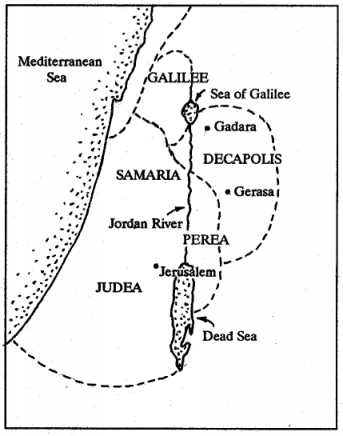
The first references in literature to the Decapolis are found in the Gospels. On our Lord’s first journey through all Galilee, He was attended by crowds from all parts of Palestine, among whom were persons from Decapolis (Mat 4:25). Most likely these were Jews, who formed a considerable part of the population even in Greek cities. The fierce Gerasene demoniac, whom our Lord healed, published in the Decapolis what things Jesus had done for him (Mar 5:20). The presence of two thousand swine on the eastern shores of the Lake of Galilee would of itself suggest the presence of a Gentile population in that vicinity. When our Lord returned from Tyre and Sidon to the Sea of Galilee, He crossed the upper Jordan and passed south through the district governed by the tetrarch Philip to the eastern shore of the Lake. In order to reach the Sea of Galilee, He went ‘through the midst of the borders of Decapolis’ (Mar 7:31). Hippos lay just east of the Lake, Gadara a few miles to the south-east, and in full view from the southern end; Pella and Scythopolis were not far to the south; while the other cities of the Decapolis lay to the north-east, east, and south-east of the Lake. Our Lord visited the Jewish population of Peraea in His later ministry, but He seems never to have made a tour to the great cities of the Decapolis. His rebuff in connexion with the destruction of the herd of swine was rather discouraging (Mar 5:17).
Two famous writers of the latter part of the 1st cent. a.d. speak of the Decapolis. Pliny not only preserves the names of the ten cities (HN v. 18), but also praises the small olives of the region (Mar 15:4). Josephus refers to Decapolis repeatedly. In the 2nd cent. a.d. Ptolemy (v. xv. 22) names eighteen towns as belonging to the league of Decapolis. He omits Raphana from Pliny’s list, and adds nine, most of the new members of the confederation belonging to the district just south of Damascus. In his day Hellenic civilization and commerce in the region beyond the Jordan were at their zenith. The modern traveller, wandering over the ruins of temples, theatres, and baths at Gerasa, Philadelphia, and Gadara, is impressed with the glories of the Grecian life in Palestine during the period of our Lord’s earthly ministry and for some centuries afterwards.
Literature.—Schurer, HJP [Note: JP History of the Jewish People.] ii. i. 94 ff.: G. A. Smith, HGHL [Note: GHL Historical Geog. of Holy Land.] 593 ff.; G. Holscher, Palastina in der pers. u. hellen. Zeit; Schumacher, Across the Jordan; Merrill, East of the Jordan.
John R. Sampey.
DECAPOLIS.—Originally a league of ten cities, Greek in population and constitution, for mutual defence against the Semitic tribes around them. It must have come into existence about the beginning of the Christian era. The original ten cities, as enumerated by Pliny, were Scythopolis, Pella, Dion, Gerasa, Philadelphia, Gadara, Raphana, Kanatha, Hippos, and Damascus. Other cities joined the league from time to time. The region of Decapolis (Mat 4:25, Mar 5:20; Mar 7:31) was the territory in which these cities were situated; that is (excluding Damascus), roughly speaking, the country S.E. of the Sea of Galilee.
R. A. S. Macalister.
(Greek: ten cities)
A district in Palestine east and south of the Sea of Galilee which took its name from the confederation of ten cities of which it was composed; those of interest are Damascus, Gadara, and Pella.
(From Gr. Deka, ten, and polis, city)Decapolis is the name given in the Bible and by ancient writers to a region in Palestine lying to the east and south of the Sea of Galilee. It took its name from the confederation of the ten cities that dominated its extent. The Decapolis is referred to in the New Testament three times: Matt., iv, 25; Mark, v, 20; vii, 31. Josephus, Ptolemy, Strabo, Pliny, and other ancient geographers and historians make frequent reference to it.At the disruption of the army of Alexander the Great, after his burial at Sidon, great numbers of his veterans, their occupation gone, settled down to a life of peace. The coast towns being already peopled, many of the Greeks sought homes farther inland. There they either laid out new cities or rebuilt and transformed older ones. In 218 B. C., according to Polybius, several of these towns were looked upon as strong fortresses. As long as the Seleucidæ ruled in the North and the Ptolemies in the South, the influence of the Greeks remained paramount in Syria; but when, with the rise of the Romans, the power of the descendants of Alexander’s soldiers weakened, the Greek cities were in sore straits. Especially perilous was the plight of these towns in Palestine after the successful rise of the Machabees. In the years 64-63 B. C., however, Pompey overran Syria and made it a Roman province. The Grecian cities, being regarded as bulwarks of Roman rule against any native uprisings, were granted many favours. They enjoyed the right of coinage, preserved their municipal freedom, and were allowed a certain sway over the near-by country.It was after Pompey’s conquest that the league of the Decapolis was formed. There is no record of the year, and although most likely it was soon after the coming of Pompey, yet it may not have been until Herod’s time. The earliest list of the ten cities of the Decapolis is Pliny’s, which mentions Scythopolis, Pella, Hippo, Dion, Gerasa, Philadelphia, Raphana, Canatha, and Damascus. Later, Ptolemy enumerates eighteen cities, thus showing that the term Decapolis was applied to a region. The importance of this league was greatly strengthened by the advantageous positions of the principal towns. Scythopolis, the capital of the Decapolis, lay at the head of the plain of Esdraelon, to the west of the Jordan, guarding the natural portal from the sea to the great interior plateau of Basan and Galaad. The other cities were situated to the east of the Jordan on the great routes along which passed the commerce of the whole country. To-day the cities of the Decapolis, with the exception of Damascus, are deserted and in ruins. Yet even in their ruined state they offer a striking contrast to the near-by cities of the Semites. Their temples, theatres and forums built on a lavish scale, give even to this day clear indication of the genius of the people who built them.Among the cities of the Decapolis of special interest are: Damascus, so often referred to in the Old and New Testament; Gadara, on the Sea of Galilee, whose inhabitants were the Gerasens of the Evangelists — the Gadarenon of one reading of Matt., viii, 28 — whose swine were driven by the devil into the sea; and Pella, the city in the valley of the Jordan to which the Christians withdrew at the first siege of Jerusalem.-----------------------------------SMITH in Encyc. Biblica (New York, 1899), 1, and Historical Geography of Holy Land (1896), c. 28; CONDER, Handbook to the Bible; JOSEPHUS, Autobiography, 65, 74; IDEM, History of the Jewish War, ix, 7.JOSEPH V. MOLLOY. Transcribed by Douglas J. Potter Dedicated to the Immaculate Heart of the Blessed Virgin Mary The Catholic Encyclopedia, Volume IVCopyright © 1908 by Robert Appleton CompanyOnline Edition Copyright © 2003 by K. KnightNihil Obstat. Remy Lafort, CensorImprimatur. +John M. Farley, Archbishop of New York
The Romans gave the name Decapolis (meaning ‘ten cities’) to an extensive region situated largely south and east of the Sea of Galilee. Its inhabitants were mainly Gentiles. The New Testament mentions two of its localities, Gadara and Gerasa, and certain occasions on which Jesus visited the region. On one of these occasions Jesus healed a demon possessed man, though the incident brought him into conflict with local pig farmers (Mat 8:28; Mar 5:1; Mar 5:11-14; Mar 7:31). Many of the people from the area joined the crowds that at one time followed Jesus (Mat 4:25).
DEDAN
Dedan was the name of a nomadic tribal group in northern Arabia. Their people were well known in Bible times as shrewd traders (Isa 21:13; Jer 49:8; Eze 27:20; Eze 38:13; see ARABIA).