
The ten commandments given by God to Moses. The ten commandments were engraved by God on two tables of stone. The Jews, by way of eminence, call these commandments the ten words, from whence they had afterwards the name of decalogue; but they joined the first and second into one, and divided the last into two. They understand that against stealing to relate to the stealing of men, or kidnapping; alleging, that the stealing one another’s goods of property is forbidden in the last commandment. The church of Rome has struck the second commandment quite out of the decalogue; and, to make their number complete, has split the tenth into two. The reason is obvious.
the ten principal commandments, Exo 20:1, &c, from the Greek
Decalogue, the ten words (Exo 34:28; Deu 4:13; Deu 10:4). This is the name most usually given by the Greek Fathers to the law of the two tables, given by God to Moses on Mount Sinai. The Decalogue was written on two stone slabs (Exo 31:18), which, having been broken by Moses (Exo 32:19), were renewed by God (Exo 34:1, etc.). They are said (Deu 9:10) to have been written by the finger of God, an expression which always implies an immediate act of the Deity. The Decalogue is five times alluded to in the New Testament, there called commandments, but only the latter precepts are specifically cited, which refer to our duties to each other (Mat 19:17-19, etc.; Mar 10:19; Luk 18:20; Rom 13:9; Rom 7:7-8; Matthew 5; 1Ti 1:9-10).
The circumstance of these precepts being called the ten words has doubtless led to the belief that the two tables contained ten distinct precepts, five in each table; while some have supposed that they were called by this name to denote their perfection, ten being considered the most perfect of numbers. Philo-Judæus divides them into two pentads, the first pentad ending with Exo 20:12, ’Honor thy father and thy mother,’ etc. or the fifth commandment of the Greek, Reformed, and Anglican churches; while the more general opinion among Christians is that the first table contained our duty to God, ending with the law to keep the sabbath holy, and the second, our duty to our neighbor. As they are not numerically divided in the Scriptures, so that we cannot positively say which is the first, which the second, etc. it may not prove uninteresting to the student in Biblical literature, if we here give a brief account of the different modes of dividing them which have prevailed among Jews and Christians. These may be classed as the Talmudical, the Origenian, and the two Masoretic divisions.
According to the division contained in the Talmud, the first commandment consists of the words ’I am the Lord thy God, who brought thee out of the land of Egypt, out of the house of bondage’ (Exo 20:2; Deu 5:6); the second (Exo 20:4), ’Thou shalt have none other gods beside me; thou shalt not make to thyself any graven image,’ etc. to Exo 20:6; the third, ’Thou shalt not take God’s name in vain etc.; the fourth, ’Remember to keep holy the sabbath day,’ etc.; the fifth, ’Honor thy father and thy mother,’ etc.; the sixth, ’Thou shalt not kill;’ the seventh, ’Thou shalt not commit adultery;’ the eighth, ’Thou shalt not steal;’ the ninth, ’Thou shalt not bear false witness,’ etc.; and the tenth, ’Thou shalt not covet,’ etc. to the end.
The next division is that approved by Origen, and is the one in use in the Greek and in all the Reformed Churches, except the Lutheran.
Although Origen was acquainted with the differing opinions which existed in his time in regard to this subject, it is evident from his own words that he knew nothing of that division by which the number ten is completed by making the prohibition against coveting either the house or the wife a distinct commandment. In his eighth Homily on Genesis, after citing the words, ’I am the Lord thy God, who brought thee out of the land of Egypt,’ he adds, ’this is not a part of the commandment’ The first commandment is, ’Thou shalt have no other gods but me,’ and then follows, ’Thou shalt not make an idol.’ These together are thought by some to make one commandment; but in this case the number ten will not be complete—where then will be the truth of the Decalogue? But if it be divided as we have done in the last sentence, the full number will be evident. The first commandment therefore is, ’Thou shalt have no other gods but me,’ and the second, ’Thou shalt not make to thyself an idol, nor a likeness,’ etc. Gregory Nazianzen and Jerome take the same view with Origen. It is also supported by the learned Jews Philo and Josephus, who speak of it as the received division of the Jewish Church.
It appears to have been forgotten in the Western Church, but was revived by Calvin in 1536, and is also received by that section of the Lutherans who followed Bucer, called the Tetrapolitans. It is adopted by Calmet, and is that followed in the present Russian Church, as well as by the Greeks in general. It appeared in the Bishops’ Book in 1537, and was adopted by the Anglican Church at the Reformation (1548), substituting seventh for sabbath-day in her formularies. The same division was published with approbation by Bonner in his Homilies in 1555.
We shall next proceed to describe the two Masoretic divisions. The first is that in Exodus. According to this arrangement, the two first commandments (according to the Origenian or Greek division), that is, the commandment concerning the worship of one God, and that concerning images, make but one; the second is, ’Thou shalt not take the name of the Lord thy God in vain,’ and so on until we arrive at the two last, the former of which is, ’Thou shalt not covet thy neighbor’s house,’ and the last or tenth, ’Thou shalt not covet thy neighbor’s wife, nor his servant,’ etc. to the end. This was the division approved by Luther, and it has been ever since his time received by the Lutheran Church. This division is also followed in the Trent catechism, and may therefore be called the Roman Catholic division.
Those who follow this division have been accustomed to give the Decalogue very generally in an abridged form: thus the first commandment in the Lutheran shorter catechism is simply, ’Thou shalt have no other gods but me;’ the second, ’Thou shalt not take the name of thy God in vain;’ the third, ’Thou shalt sanctify the sabbath-day.’ A similar practice is followed by the Roman Catholics, although they, as well as the Lutherans, in their larger catechisms (as the Douay) give them at full length. This practice has given rise to the charge made against those denominations of leaving out the second commandment, whereas it would have been more correct to say that they had mutilated the first, or at least that the form in which they give it has the effect of concealing a most important part of it from such as had only access to their shorter catechisms.
The last division is the second Masoretic, or that of Deuteronomy, sometimes called the Augustinian. This division differs from the former simply in placing the precept ’Thou shalt not covet thy neighbor’s wife’ before ’Thou shalt not covet thy neighbor’s house,’ etc.; and for this transposition it has the authority of Deu 5:21. The authority of the Masoretes cannot, however, be of sufficient force to supersede the earlier traditions of Philo and Josephus.
The ten principal commandments, Exo 20:3-17, from the Greek words deka, ten, and logos, word. The Jews call these precepts, The Ten Words. The usual division of the Ten Commandments among Protestants is that which Josephus tells us was employed by the Jews in his day.\par
(
The circumstance of these precepts being called the ten words has doubtless led to the belief that the two tables contained ten distinct precepts, five in each table; while some have supposed that they were called by this name to denote their perfection, ten being considered the most perfect of numbers: so Philo-Judaeus (
1. The Talmudical Division, or that contained in the Talmud (Makkkoth, 24, a), which is also that of the modern Jews. According to this division, the firse commandment consists of the words “I am the Lord thy God, who brought thee out of the land of Egypt, out of the house of bondage” (Exo 20:2; Deu 5:6); the second (Exo 20:3-4), “Thou shalt have none other gods beside me; thou shalt not make to thyself any graven image,” etc. to Exo 20:6; the third, “Thou shalt not take God’s name in vain,” etc.; the fourth, “Remember to keep holy the Sabbath day,” etc.; the fifth, “Honor thy father’ and thy mother,” etc.; the sixth, “Thou shalt not kill;” the seventh, “Thou shalt not commit adultery;” the eighth, “Thou shalt not steal;” the ninth, “Thou shalt not bear false witness,” etc.; and the tenth, “Thou shalt not covet,” etc., to the end. This division is also supported by the Targum of the pseudo-Jonathan, a work of the sixth century, by Aben-Ezra, in his Commentary, and by Maimonides (Sepher Hammizvoth). It has also been maintained by the learned Lutheran, Peter Martyr (Loci Communes, Basle, 1580, loc. 14, p. 684). That this was a very early mode of dividing the Decalogue is further evident from a passage in Cyril of Alexandria’s treatise against Julian, from whom he quotes the following invective: “That Decalogue, the law of Moses, is a wonderful thing: thou shalt not steal; thou shalt not kill; thou shalt not bear false witness. But let each of the precepts which he asserts to have been given by God himself be written down in the identical words, ‘I am the Lord thy God, who brought thee out of the land of Egypt;’ the second follows, ‘Thou shalt have no strange gods beside me; thou shalt not make to thyself an idol.’ He adds the reason, ‘for I, the Lord thy God, am a jealous God, visiting the sins of the fathers upon the children.’ ‘Thou shalt not take the name of the Lord thy God in vain. Remember the Sabbath day. Honor thy father and thy mother. Thou shalt not commit adultery. Thou shalt not steal. Thou shalt not bear false witness, Thou shalt not covet thy neighbor’s goods.’ What nation is there, by the gods, if you take away these two, ‘Thou shalt not adore other gods,’ and ‘Remember the Sabbath,’ which does not think all the others are to be kept, and which does not punish more or less severely those who violate them?”
2. The Origenian Division, or that approved by Origen, which is that in use in the Greek and in all the Reformed churches except the Lutheran. Although Origen was acquainted with the differing opinions which existed in his time in regard to this subject, it is evident from his own words that he knew nothing of that division by which the number ten is completed by making the prohibition against coveting either the house or the wife a distinct commandment. In his eighth Homily on Genesis, after citing the words, “I am the Lord thy God, who brought thee out of the land of Egypt,” he adds, “this is not a part of the commandment.” The first commandment is, Thou shalt have no other gods but me,” and then follows,” Thou shalt not make an idol.” These together are thought by some to make one commandment; but in this case the number ten will not be completed where, then, will be the truth of the Decalogue? But if it be divided as we have done in the last sentence, the full number will be evident. The first commandment therefore is, “Thou shalt have no other gods but me,” and the second, “Thou shalt not make to thyself an idol, nor a likeness,” etc. Origen proceeds to make a distinction between gods, idols, and likenesses. Of gods, he says, “it is written, there are gods many and lords many” (1Co 8:5); but of idols, “an idol is nothing;” an image, he says, of a quadruped, serpent, or bird, in metal, wood, or stone, set up to be worshipped, is not an idol, but a likeness. A picture made with the same view comes under the same denomination. But an idol is a representation of what does not exist, such as the figure of a man with two faces, or with the head of a dog, etc. The likeness must be of something existing in heaven, or in earth, or in the water. It is not easy to decide on the meaning of” things in heaven,” unless it refers to the sun, moon, or stars. The design of Moses he conceives to have been to forbid Egyptian idolatry, such as that of Hecate, or other fancied demons (Opera, 2:156, De la Rue’s ed.). The pseudo-Athanasius, or the author of the Synopsis Scripturae, who is the oracle of the Greek Church, divides the commandments in the same manner. “This book [Exodus] contains these ten commandments, on two tables: first, I am the Lord thy God. Second, Thou shalt not make to thyself an idol, nor any likeness. . . Ninth, Thou shalt not bear false witness against thy neighbor. Tenth, Thou shalt not covet thy neighbor’s wife, nor any thing that is thy neighbor’s” (Athanasii Opera, fol. Paris, 1698).
Gregory Nazianzen, in one of his poems, inscribed “The Decalogue of Moses,” gives the following division (Opera, ed. Caillaud, Paris, 1840):
These ten laws Moses formerly engraved on tables Of stone; but do thou engrave them on thy heart. Thou shalt not know another God, since worship belongs to me. Thou shalt not make a vain statue, a lifeless image. Thou shalt not call on the great God in vain. Keep all sabbaths, the sublime and the shadowy. Happy he who renders to his parents due honor. Flee the crime of murder, and of a foreign Bed; evil-minded theft and witness False, and the desire of another’s, the seed of death.
Jerome took the same view with Origen. In his commentary on Ephesians 6, he thus writes: “‘ Honor thy father and thy mother,’ etc. is the fifth commandment in the Decalogue. How, then, are we to understand the apostle’s meaning in calling it the first, when the first commandment is ‘Thou shalt have no gods but me,’ where some read thus, ‘which is the first commandment with promise,’ as if the four previous commandments had no promise annexed, etc.... . But they do not seem to me to have observed with sufficient accuracy that in the second commandment there is also a promise: ‘Thou shalt not make to thyself an idol, nor the likeness of any thing in heaven above, or in the earth beneath, or in the water under the earth; thou shalt not adore them, nor sacrifice to them; for I, the Lord thy God, am a jealous God, visiting the sins... but showing mercy unto thousands...’ (observe these words of promise showing mercy unto thousands, etc.)” (Hieronymi Opera, vol. 4, Paris, 1693).
The pseudo-Ambrose also writes to the same effect in his Commentary on Ephesians: “How is this the first commandment, when the first commandment says, Thou shalt have no other gods but me? Then, Thou shalt not make a likeness of any thing in heaven above, or in the earth beneath, etc. The third, Thou shalt not take the name of the Lord thy God in vain; the fourth, Keep my sabbaths; the fifth, Honor thy father and thy mother. As the first four appertain to God, they are contained in the first table; the others, appertaining to men, are contained in the second, such as that of honoring parents, not committing murder, adultery, theft, false witness, or concupiscence. These six seem to be written in the second table, the first of which is called the first with promise” (Ambrosii Opera, vol. ii, Paris edition, Append. p. 248, 249).
To these testimonies from the fathers may be added that of Clemens Alexandrinus (Stromata, vi, p. 809); but this writer is so confused and contradictory in reference to the subject, that some have supposed the text to have been corrupted. “The first precept of the Decalogue,” he observes, “shows that one God only is to be worshipped, who brought his people out of Egypt... and that men ought to abstain from the idolatry of the creature. The second, that we ought not to transfer his name to creatures; the third signifies that the world was made by God, who has given us the seventh day to rest; the fifth follows, which commands us to honor our parents; then follows the precept about adultery, after this that concerning theft; but the tenth is concerning coveting.”
But the strongest evidence in favor of the Origenian division is that of the learned Jews Philo and Josephus, who speak of it as the received division of the Jewish Church. Philo, after mentioning the division into two pentads already referred to, proceeds: “The first pentad is of a higher character than the second; it treats of the monarchy whereby the whole world is governed, of statues and images (
This division, which appears to have been forgotten in the Western Church, was revived by Calvin in 1536, and is also received by that section of the Lutherans who followed Bucer, called the Tetrapolitans. It is adopted by Calmet (Dict. of the Bible, French ed., art. Loi). It is supported by Zonaras, Nicephorus, and Petrus Mogislaus among the Greeks, and is that followed in the present Russian Church, as well as by the Greeks in general (see the Catechism published by order of Peter the Great, by archbishop Resensky, London, 1753). It is at the same time maintained in this catechism that it is not forbidden to bow before the representations of the saints. This division, which appeared in the Bishops’ Book in 1537, was adopted by the Anglican Church at the Reformation (1548), substituting seventh for Sabbath-day in her formularies. The same division was published with approbation by Bonner in his Homilies in 1555.
3. We shall next proceed to describe the two Masoretic divisions.
(1.) The first is that in Exodus. We call it the Masoretic division, inasmuch as the commandments in the greater number of manuscripts and printed editions are separated by a
Those who follow this division have been accustomed to give the Decalogue very generally in an abridged form: thus the first commandment in the Lutheran Shorter Catechism is simply “Thou shalt have no other gods but me;” the second, “Thou shalt not take the name of thy God in vain;” the third,” Thou shalt sanctify the Sabbath-day” (Feyertag). A similar practice is followed by the Roman Catholics, although they, as well as the Lutherans, in their Larger Catechisms (as the Douay) give them at full length. This practice has given rise to the charge made against those denominations of leaving out the second commandment, whereas it would have been more correct to say that they had mutilated the first, or at least that the form in which they give it has the effect of concealing a most important part of it from such as only had access to their Shorter Catechisms.
(2.) The last division is the second Masoretic, or that of Deuteronomy, sometimes called the Augustinian. This division differs from the former simply in placing the precept “Thou shalt not covet thy neighbor’s wife” before “Thou shalt not covet thy neighbor’s house,” etc.; and for this transposition it has the authority of Deu 5:21. The authority of the Masorites cannot, however, be of sufficient force to supersede the earlier traditions of Philo and Josephus.
This division was that approved by Augustine, who thus expresses himself on the subject: Following to ‘what he had said (ut sup. p. 538), he observes, “But to me it seems more congruous to divide them into three and seven, inasmuch as to those who diligently lock into the matter, those which appertain to God seem to insinuate the Trinity. And, indeed, the command, ‘Thou shalt have no other gods but me,’ is more perfectly explained when images are forbidden to be worshipped. Besides, the sin of coveting another man’s wife differs so much from coveting his house, that to the house was joined his field, his servant, his maid, his ox, his ass, his cattle, and all that is his. But it seems to divide the coveting of the house from the coveting of the wife when each begins thus: ‘Thou shalt not covet thy neighbor’s wife, thou shalt not covet thy neighbor’s house,’ to which it then begins to add the rest. For when he had said ‘Thou shalt not covet thy neighbor’s wife,’ he did not add the rest to this, saying, nor his house, nor his field, nor his servant, etc. but these seem plainly to be united, which appear to be contained in one precept, and distinct from that wherein the wife is named. But when it is said ‘Thou shalt have no other gods but me,’ there appears a more diligent following up of this in what is subjoined. For to what pertains, ‘Thou shalt not make an idol, nor a likeness; thou shalt not adore nor serve them,’ unless to that which had been said, ‘Thou shalt have none other gods but me.’“ The division of Augustine was followed by Bede and Peter Lombard.
The learned Sonntag has entirely followed Augustine’s view of this subject, and has written a dissertation in vindication of this division in the Theologische Studien und Kritiken (Hamb. 1836-7), to which there was a reply in the same miscellany from Zillig, in vindication of what he terms the Calvinistic division, or that of Origen, which is followed by a rejoinder from Sonntag. Sonntag is so convinced of the necessity of that order of the words, according to which the precept against coveting the wife precedes (as in Deuteronomy) that against coveting the house, etc. that he puts down the order of the words in Exodus as an oversight. The order in the Septuagint version, in Exodus agrees with that in Deuteronomy. The Greek Church follows this order. Sonntag conceives that the Mosaic division of the Decalogue was lost in the period between the exile and the birth of Christ. See Heinze, De ratione praecepta Decalogi numerandi varia et vera (Viteb. 1790); Pflicke, De Decalogo (Dresden, 1788); Thorntonl, Lectures on the Commandments (Lond. 1842). For a list of Expositions, sermons, etc., on the Decalogue, see Darling, Cyclopoedia Bibliographica, 3, 222 sq. SEE LAW.
See COMMANDMENTS, THE TEN.
By: Emil G. Hirsch, Eduard König
A word, derived from the Greek, corresponding to the Biblical  ; LXX.
  (Shabbat 86b) or, without the numeral,
  (B. Ḳ. 54b). As a singular,
—Biblical Data:
The Decalogue is given in the Pentateuch in two versions (Ex. xx. 2-17 and Deut. v. 6-18) that exhibit some variants (see below). According to the Biblical records, it represents the solemn utterances of Yhwh on Mt. Sinai, directly revealed by Him to Moses and the people of Israel in the third month after their deliverance from Egypt, amid wonderful manifestations of divine power marked by thunder and lightning and thick smoke (Ex. xix.). As such, God wrote the Ten Words upon two tablets of stone—"tables of testimony" (
 , Ex. xxiv. 12, xxxi. 18, xxxii. 16) or "tables of the covenant" (
 , Deut. ix. 9, 11, 15)—and gave them to Moses. The people having gone astray, Moses, carried away by righteous indignation, broke the tables (Ex. xxxii. 19), and God subsequently commanded him to hew two other tables like the first (Ex. xxxiv. 1), whereon to rewrite the Ten Words (Ex. xxxiv. 1). According to another passage (Ex. xxxiv. 27, 28), Moses was bidden to rewrite, and did rewrite, the Commandments himself; but in Deut. iv. 13, v. 18, ix. 10, x. 24, God appears as the writer. This second set, broughtdown from Mt. Sinai by Moses (Ex. xxxiv. 29), was placed in the Ark (Ex. xxv. 16, 21; xl. 20), hence designated as the "Ark of the Testimony" (Ex. xxv. 22; Num. iv. 5; compare also I Kings viii. 9).
Contents.
The Decalogue opens with the solemn affirmation, put in the first person, that the speaker is Yhwh, Israel's ("thy") God, who hath led Israel ("thee") out of Egypt. Therefore there shall be for Israel ("thee") no other gods before Yhwh's ("my") face. Prohibition of idolatry follows as a logical amplification of this impressive announcement, and then a caution against taking Yhwh's name in vain. The duty of remembering the Sabbath and that of honoring father and mother are emphasized. Murder, adultery, theft, and false testimony are forbidden, and the Decalogue concludes with an expanded declaration against, covetousness.
—Critical View:
The Decalogue in Deuteronomy does not differ materially from that in Exodus in regard to the affirmations and obligations contained therein. Verbal discrepancies, however, are comparatively numerous, while the reason adduced for the Sabbath is altogether different. In detail these variants may be grouped as follows:
(a) Differences in the consonantal (Masoretic) text, in identical words: For example, "miẓwotai" ( , Ex. xx. 6), which occurs as "miẓwotaw" (
 , Deut. v. 10, in the "Ketib"; this variant is due to an anticipation of the transition from the first to the third person which ensues after this verse). Similarly, there are changes in the use and position of the auxiliary vowel letters; e.g.,
  (Ex. xx 5) and
  (Deut. v. 9);
  (Ex. xx. 12) and
  , (Deut. v. 16).
(b) Syntactical differences: E.g., the syndetic arrangement "children, grandchildren, and great-grandchildren" (Ex. xx. 5, Hebr.), over against the polysyndetic" children and grandchildren and great-grandchildren" (Deut. v. 9, Hebr.); and the asyndetic succession "Thou shalt not kill. Thou shalt not commit adultery. Thou shalt not steal" (Ex. xx. 13-17), over against the polysyndetic "Thou shalt not kill, and thou shalt not, . . . and," etc. (Deut. v. 17, Hebr.).
(c) Stylistic variations: "Covet," occurring twice in Exodus (xx. 17). is replaced in one instance by "desire" in Deuteronomy (v. 18). "Graven image and any likeness" in Ex. xx. 11 (Hebr.) appears as "[the] graven image of any likeness" in Deut. v. 8 (Hebr.). "Remember ( ) the Sabbath" in Ex. xx. 9 corresponds to "Keep" (
 ) in Deut. v. 12.
  ("false witness") in Ex. xx. 16 corresponds to
  ("a witness of iniquity" or "falsehood") in Deut. v. 17 (A.V. 20), the prohibition being furthermore prefixed by "and." The sequence "house and wife" in Ex. xx. 17 is reversed to read "wife and house" in Deut. v. 18 (A.V. 21).
(d) Additions and amplifications: Deuteronomy adds in two places (v. 12, 16) the formula "as Yhwh, thy God, hath commanded thee." Another addition is found in Deuteronomy in the text of the command to honor father and mother (v. 16): "and that It may go well with thee." Ex. xx. 10 summarizes "thy cattle," which in Deut. v. 14 (Hebr.) is expanded to "thine ox and thine ass and all thy cattle," to which is added "that thy man-servant and thy maid-servant may rest as well as thou." Deut. v. 18 (Hebr.) has "his field," which in the corresponding passage of Exodus is wanting.
But of greatest interest is the variation in the reason given for the Sabbath. Ex. xx. 10, 11 connects it with creation (compare Gen. ii. 2); Deuteronomy assigns to it a social purpose and connects it with Israel's liberation from Egyptian bondage. Thus the Sabbath may be said to rest in Exodus on a universal-theological, in Deuteronomy on a national-historical-economic, basis.
A careful analysis of these variants leads to the conclusion that Exodus, on the whole, presents an earlier text than Deuteronomy. The clearly marked effort at stylistic refinement (the substitution of "lo tit'awweh" for " lo taḥmod"; the mention of the "wife" be fore the "house"; even the polysyndetic phrasing, showing a straining after effect) points in this direction. The insertion of the formula "as Yhwh hath commanded" indicates that the appeal rests on a well-known and long-established law. The enumeration of the various kinds of cattle also betrays the hand of a later writer, and so does the explanatory and qualifying gloss "that it may go well with thee."
Earliest Manuscript of Decalogue (Second Century?), Containing Variations from the Masoretic Text. Probably the Oldest Ex. ample of Square Characters in a Hebrew Manuscript.(From "Transactions of Society of Biblical Archeology.")
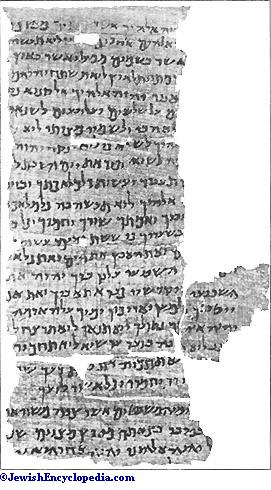
Relation of the Two Versions.
On the other hand, the variants in the command against idolatry point to the priority of the Deuteronomic reading. Exodus is more explicit and strenuous, as if afraid that the laxer wording ("graven image of any likeness") of Deut. v. 8 might not be sufficiently comprehensive to bar every species ofidolatry. The Sabbath law in Deuteronomy, at least in part, appears to confirm this; while the expression "keep" is stronger than that in Exodus, "remember," and would thus indicate a later solicitude for a better observance. Also, its anxiety for the welfare of the servant exhibits a humane spirit not ordinarily to be looked for in documents of antiquity. The introduction of the theological motive in Exodus, where Deuteronomy has the historical-economic, is an element that favors the assumption of the higher antiquity of the Deuteronomic Decalogue.
These variants, however, have been explained as due to scribal carelessness, such as is easily established by a comparison of the texts of other parallel passages; the writers, contrary to the later rabbinic practise and injunction, failing to consult the written text while quoting from memory, and thus mixing with their lines reminiscences of similar but not identical verses (compare Bardowicz, "Studien zur Geschichte der Orthographie des Alt-Hebr." Frankfort-on-the-Main, 1894; Blau, "Studien zum Alt-Hebr. Bücherwesen," Budapest, 1902). But upon examination this plausible theory will be seen to create new difficulties in the matter in point. The Decalogue must be considered, on the basis of the Mosaic authorship of the Pentateuch, to have been fundamental; and as such its wording must have been so accurately fixed as to preclude the possibility of latitude for scribal caprice. The Rabbis, indeed, have felt this difficulty. They have solved it by assuming that both versions are of identical divine origin, and were spoken in a miraculously strange manner at one and the same time ("Bedibbur Eḥad"; see Mek., ed. Weiss, p. 77, Vienna, 1865; Shebu. 20b; R. H. 27b; Yer. Ned. iii. 1; Yer. Shebu. iii. 5; Cant. Rabbah xxviii.; Sifre, Ki Tabo).
Ibn Ezra (to Ex. xx. 1) recognizes the insufficiency of this explanation, but is equally dissatisfied with the solution proposed by Saadia. The latter, conforming to his rigorous theory of inspiration, would not admit that the Masoretic text was other than of divine origin. It is therefore his theory that literally the Deuteronomic Decalogue equally with that of Exodus was divinely inspired. While Exodus presents the reading of the first set of tables, Deuteronomy contains that engraved by divine direction on the second (see "Jour. Asiatique," Dec., 1861, in Neubauer, "Notice sur la Lexicographie," etc.; Geiger's "Jüd. Zeit." i. 292). With profuse professions of regard for Orthodox teachings, Ibn Ezra ventures to hold that these variants are in the nature of linguistic differences often noticeable in the Biblical books.
—Modern Views:
Modern conservative scholars, with few exceptions (G. Livingston Robinson, "The Decalogue and Criticism," 1899), in so far as they do not maintain that the version of Exodus is the original Mosaic, or at least the older, while that of Deuteronomy (also Mosaic) departs from the original text in conformity with the parenetic method and purpose of Deuteronomy, have concluded that both versions are amplifications—those in Deuteronomy on the whole being later than those in Exodus—of an anterior and old (Mosaic) but briefer list of ten statements written in the manner of the prohibitions against murder, adultery, theft, etc. (Strack, "Exodus," p. 241; Franz Delitzsch, in "Zeitschrift für Kirchliche Wissenschaft und Leben," 1882, p. 292; Holzinger, "Exodus," in "Kurzer Hand-Commentar zum A. T." pp. 79 et seq., Tübingen, 1900; Eduard König, "Einleitung," p. 187, and Index, s.v.; Wildeboer, "Die Literatur des A. T." p. 17).
Original Form.
Graphically considered, the writing of the letters (about 620) contained in the Decalogue on two tables of stone of moderately large dimensions does not present, as was long thought, an impossibility. The Mesha stone proves the contrary. The Decalogue written in the style of the latter would fill about twenty of its lines (Holzinger, l.c. p. 69). The unevenness in the length of the first and the second parts is a much stronger indication that the original version was without the amplifications noticeable in the commandments of the first and tenth groups. The tradition, according to which earlier tables were replaced by others, shows that for a long time the knowledge was current of changes in the text, and not, as Holzinger contends (l.c. p. 77), that a Mosaic law had never existed.
The original Ten Words probably opened with (1) "I am Yhwh, thy God," etc. Then followed:
(2) Thou shalt have no other gods before Me [beside Me].
(3) Thou shalt not take the name of Yhwh thy God in vain.
(4) Remember the Sabbath-day.
(5) Honor thy father and thy mother.
(6) Thou shalt not murder.
(7) Thou shalt not commit adultery.
(8) Thou shalt not steal.
(9) Thou shalt not bear false witness.
(10) Thou shalt not covet (Wildeboer, l.c. p. 19).
Eduard König and others (see Lotz in Herzog-Hauck, "Real-Encyc." 3d ed., p. 563) place as the second of these original Ten Words the prohibition against the making and the worshiping of graven images. It is probable that the early Hebrews shared with the Arabs the repugnance to molten plastic idols ( ; see Wellhausen, "Reste Arabischen Heidentums," p. 102); but "maẓẓebot" (pillars or stones) were legitimate accessories of the Yhwh cult down to a much later period than that of such a Mosaic decalogue. Moreover, idolatry was tolerated in North Israel and even in Judea down to the later centuries. Upon these considerations, Kuenen, Wellhausen, Stade, Schultz, and Smend have argued against the ascription of any decalogue to Mosaic times; but with the omission from the original ten of the injunction against idolatry, the mainstay is taken from under the opposition to the authenticity of the tradition connecting Moses with such a lapidary code.
These simple brief statements were amplified in course of time; the fourth, for instance, reflecting in both versions agricultural conditions such as did not obtain in the Mosaic days. So also does the promised reward of the fifth. The reason given in Deuteronomy for keeping the Sabbath also appeals to circumstances of agricultural civilization; that adduced in Exodus is of a theological nature, and can not be much older than the priestly code (P), nor can it antedate the reception into the Pentateuch of Gen. i.and ii. 1-4. Critics have assigned the Exodus version, with this exception, to the ninth century B.C.; the Deuteronomic text, to the seventh century.
Decalogue of Exodus xxxiv.
From the point of view of Pentateuchal analysis Wellhausen ("Die Composition des Hexateuchs und der Historischen Bücher des Alten Testaments," 1885, pp. 84, 85, and passim) maintains that the Jahvist (J) contains an altogether different decalogue; viz., that of Ex. xxxiv. 14-26. Goethe, in his "Zwo Fragen, 1773," was the first modern to suggest this. This decalogue is concerned with ritual affairs. Holzinger (Commentary on Exodus, p. 119) proposes the following brief sentences as its contents:
(1) Thou shalt not worship any strange god.
(2) Thou shalt not make thee any molten images.
(3) Thou shalt observe the Feast of Maẓẓot [Pesaḥ].
(4) The first-born are Mine [Yhwh's].
(5) Thou shalt observe the Feast of Weeks.
(6) Thou shalt observe the Feast of the Ingathering.
(7) Thou shalt not mix with leaven the blood of My offerings.
(8) The fat of My feast shall not remain with thee until the next morning.
(9) The choicest of the first-fruits of the land shalt thou bring to the house of Yhwh, thy God.
(10) Thou shalt not seethe the kid in the milk of its mother.
In order to extract these "ten words" from the passage, many other laws therein contained of seemingly equal importance have to be omitted, as also the reasons assigned for their observance. This attempt to reconstrue another decalogue may be said to be a failure, all the more as it is conceded that the decalogue in P (Ex. xx.) is virtually anterior to that (Ex. xxxiv.) in J (Holzinger, l.c. p. 120). Still less satisfactory, because altogether unreasonable, is the venture to recover the Decalogue from fragments in Ex. xx. 27, 28, and xxiii. 10-16 (Meissner, "Der Deḳalog," Halle, 1893; Staerk, "Das Deuteronomium," pp. 29 et seq., 40, Leipsic, 1894).
Division of the Decalogue.
Written on two stone tables (Deut. iv. 13, v. 19, x. 34), with script on both sides (Ex. xxxii. 15), the Decalogue would most naturally have been divided into two groups, of five "words" each, each group appearing on one stone. In this way, according to Josephus ("Ant." iii. 5, § 4) and Philo ("De Decalogo," § 12,
The Midrash mentions a similar division: 
 (Ex. R. xli.), though, according to R. Nehemiah, each table contained the complete text of the Ten Words (compare Yer. Sheḳ. vi. [quoted in "'En Ya'aḳob"]). The first table would thus have contained 146 of the 172 words of the Exodus Decalogue, but the other only 26. In view of this inequality in the distribution it has been suggested that the one table contained only the first three commandments; the other, the last seven. But if the amplifications were omitted, the grouping in sets of five would result in assigning to the one table 28 words and to the other 27 (Strack, "Exodus," p. 242).
Sequence and Numbering.
The order of the prohibitions against murder, adultery, and theft, as now given in the Masoretic text, in Josephus, and in the Syriac Hexapla, is not followed by the Septuagint, the Codex Alexandrinus, and Ambrosianus (which have "murder, theft, adultery"), nor by Philo (who has "adultery, murder, theft"), nor by the Codex Vaticanus (which reads adultery, theft, murder").
Differences obtain also in regard to the numbering of the various commandments. The traditional Jewish system makes Ex. xx. 2 the first "word," and verses 3-6 are regarded as one; viz., the second (Mak. 24a; Mek., ed. Friedmann, p. 70b, Vienna, 1870; Pesiḳ. R., ed. Friedmann, p. 106b, ib. 1880). This arrangement is found also in the Codex Vaticanus of the LXX. and in the Deuteronomy of Ambrosianus. Still R. Ishma'el counts verse 3 as the first "word" (Sifre to Num. xv. 31; ed. Friedmann, p. 33a, Vienna, 1864). Philo and Josephus count verse 3 as commandment i; verses 4-6 as ii.; verse 7 as iii.; verses 8-11 as iv.; verse 12 as v.; verse 13 as vi.; verse 14 as vii.; verse 15 as viii.; verse 16 as ix.; and verse 17 as x.
The numbering adopted by the Roman Catholic and Lutheran churches combines verses 3-6 into a single commandment which is numbered i., in consequence of which, up to the last, every commandment is advanced by one, the Jewish No. III. becoming II., and so on. In order to maintain the number ten, the Jewish No. X. is divided into IX. ("Thou shalt not covet thy neighbor's wife") and X. ("Thou shalt not covet thy neighbor's house," etc.). This method of numbering is ascribed to Augustine ("quæst. 71 ad Exodum"), but the Codex Alexandrinus, as E. Nestle was the first to notice ("Theol. Studien aus Württemberg," 1886, pp. 319 et seq.), also exhibits it. Modern critics are inclined to accept this latter system of enumeration, partly because the Jewish No. I. is not a "commandment," in which they overlook the Hebrew designation  ("word"), and partly because, as the Jewish enumeration has it, verses 3 and 4-6 certainly constitute one command.
Accentuation of the Commandments.
The "'aseret ha-dibrot" are accentuated in the Hebrew in two ways: one for private reading, when the verses are marked to begin at 2, 3, 4, 5, 6, 7, 8, 9, 10, 11, 12, 13, 17 (13-16 as one verse); the other for solemn public recital, when the first two commandments and the introduction are read without interruption, because God is introduced as the speaker, and every other commandment as a separate verse (Pinsker, "Einleitung in das Babylonisch-Hebräische Punktationssystem," pp. 48-50). It may be possible, though it has been doubted, that this double accentuation preserves the traces of an old uncertainty concerning the numeration of the various "principles" or "words." These accents are respectively known as the "ṭa'am ha'elyon" (superlinear) and the "ṭa'am ha-taḥton" (sublinear). The Oriental Jews know only the division into ten words; i.e., that observed in private reading (W. Wickes, "Accentuation of the Twenty-one Socalled Prose Books of the O. T." p. 130). The superlinear accentuation is generally used for the cantillation of the Decalogue on the Feast of Weeksas the memorial day of the revelation—i.e., the giving of the Torah ( )—while on the ordinary Sabbaths, when the Decalogue is read as a part of the pericope (Yitro and Wa'etḥannan), the sublinear is followed (Japhet, "Die Accente der Heiligen Schrift," 1896, p. 160; Geiger, "Wiss. Zeit. Jüd. Theol." iii. 147 et seq.; also "Urschrift," p. 373, note).
Bibliography:
Sountag, Ueber die Eintheilung der Zehn Gebote, in Theologische Studien und Kritiken, 1836, pp. 61 et. seq.;
Geffken, Ueber die Verschiedenen Eintheilungen des Dekalogs, Hamburg, 1838;
Bertheau, Die Sieben Gruppen Mosaischer Gesetzgeb. Göttingen, 1840;
Ewald, Gesch. des Volkes Israel, ib. 1843;
Graf, Die Geschichtlichen-Bücher des A. T., Leipsic, 1866;
Heilbut, Ueber die Ursprüngliche und Richtige Eintheilung des Dekalogs, Berlin, 1874;
Wellhausen, Die Composition des Hexateuchs, etc., in Jahrb. für Deutsche Theologie, 1876-77;
Lemme, Die Religionsgeschichtliche Bedeutung des Dekalogs, Breslau, 1880;
Reuss, Die Gesch. der Heiligen Schriften d. A. T. Brunswick, 1881;
Franz Delitzsch, Der Dekalog in Exodus und Deuteronomium, in Zeitschrift für Kirchliche Wissenschaft und Kirchliches Leben, 1882, pp. 281-293;
Kuenen, H. K. Onders, i., Leyden, 1885 (German ed., Leipsic, 1887);
Lotz, Gesch. und Offenbarung, Leipsic, 1891;
Budda, Die Gesetzgebung der Mittleren Bücher, in Stade's Zeitschrift, 1891, pp. 193-234.
Baentsch, Das Bundesbuch, Halle, 1892;
Meissner, Der Dekalog, Halle, 1893;
König, Einleitung. Bonn, 1893;
Smend, Lehrbuch der Alttestamentlichen Religionsgesch. Freiburg im Breisgau, 1893;
Holzinger, Einleitung in den Hexateuch, ib. 1893;
Staerk, Das Deuteronomium, Leipsic, 1894;
Steuernagel, Der Rahmen des Deuteronomiums, Halle, 1894;
idem, Die Entstehung des Deut. Gesetzes, Halle, 1896;
Dillmann, Komm. various editions, Leipsic, from 1878 on;
idem, Alttestament. Theologie, ib. 1895;
Driver, Introduction, 10th ed., New York, 1902;
Kraetzschmar, Die Bundesvorstellung im A. T. Marburg, 1896;
Klostermann, Gesch. des Volkes Israel, Munich, 1896;
Holzinger, Exodus, in Marti's Kurzer Hand-Commentar, 1900;
Robinson, The Decalogue, Chicago, 1899;
the Bible dictionaries, s.v. Decalogue;
Stade, Gesch. des Volkes Israel, i.;
Baentsch, Exodus-Leviticus, Göttingen, 1900;
S. A. Cook, in Guardian, London, Dec. 17.1902; Jan. 14, 1903 (description of a recently discovered papyrus containing an early Hebrew recension of the Decalogue, alleged to be of the second century and represented as giving the text followed by the Septuagint).
DECALOGUE.—See Ten Commandments.
(Greek: deka, ten; logos, word)
An extra-biblical term which is a literal translation of the phrase "ten words" (Exodus 34); it designates the Ten Commandments which God imposed on His people in the desert of Sinai. The Decalogue, which is to be found in two sections (Exodus 20; Deuteronomy 5), is invested with full Divine authority, so that obedience to it is the test of holiness for the Chosen People and the individual. Christ resolves the Decalogue into two great commandments, love of God and of one’s neighbor. (Matthew 22)
(Greek deka, ten and logos, word).The term employed to designate the collection of precepts written on two tables of stone and given by God to Moses on Mount Sinai. The injunctions and prohibitions of which it is composed are set forth in Exodus (20:1-17) and in Deuteronomy (5:6-21). The differences discernible in the style of enumerating them in Exodus as contrasted with Deuteronomy are not essential and pertain rather to the reasons alleged for the precepts in either instance than to the precepts themselves. The division and ordering of the commandments in use in the Catholic Church is that adopted by St. Augustine (Quæstiones in Exodum, q. 71). That which is commonly in vogue amongst Protestants seems to have Origen for its sponsor. He regarded Exodus 20:3-6, as containing two distinct commandments and in this hypothesis in order to keep the number ten, verse 17 would have but one. The practice now universally adhered to among Catholics is just the reverse. See COMMANDMENTS OF GOD.-----------------------------------JOSEPH F. DELANY Transcribed by Marcia L. Bellafiore The Catholic Encyclopedia, Volume IVCopyright © 1908 by Robert Appleton CompanyOnline Edition Copyright © 2003 by K. KnightNihil Obstat. Remy Lafort, CensorImprimatur. +John M. Farley, Archbishop of New York
The Ten Commandments found in Exo 20:1-26. Deca means ten in Latin. Logue comes from "logos" which means "word."