
In allusion to Christ, the Scripture meaning of crown is, that all the merit of redemption is his; and as such, he wears the crown. Hence in the book of the Revelations, he is said to have been seen with many crowns on his head, (Rev. x. 12.) meaning, from the different offices and characters which he sustained in accomplishing redemption, the crown of GODHEAD he wears in common with the Father and the Holy Ghost. But the crown of Mediator is peculiarly and personally his own. Hence, he is said to have "power over all flesh, " as a Prince, and a Saviour, "for to give eternal life to as many as the Father hath given him." (John 17. 2.) Hence, when JEHOVAH bringeth in the first begotten into the world, he saith, "Let all the angels of God worship him." (Heb. i. 6.) And the crown of salvation put upon the sacred head of Christ by the church in one full body, and also by every individual of the church, multiplies the crowns of Jesus to an infinite extent, when any and every poor sinner is brought from darkness to light, and willingly and cheerfully ascribes the whole of his own personal salvation to the Lord Jesus Christ.
is a term properly taken for a cap of state worn on the heads of sovereign princes, as a mark of regal dignity. In Scripture there is frequent mention made of crowns; and the use of them seems to have been very common among the Hebrews. The high priest wore a crown, which was girt about his mitre, or the lower part of his bonnet, and was tied about his head. On the forepart was a plate of gold, with these words engraved on it: “Holiness to the Lord,” Exo 28:36; Exo 29:6. New-married persons of both sexes wore crowns upon their wedding day, Sonh of Solomon Exo 3:11; and, alluding to this custom, it is said that when God entered into covenant with the Jewish nation, he put a beautiful crown upon their head, Eze 16:12. The first crowns were no more than a bandelet drawn round the head, and tied behind, as we see it still represented on medals, &c. Afterward, they consisted of two bandelets; by degrees, they took branches of trees of divers kinds, &c; at length they added flowers; and Claudius Saturninus says there was not any plant of which crowns had not been made.
There was always a difference, either in matter or form, between the crowns of kings and great men, and those of private persons. The crown of a king was generally a white fillet bound about his forehead, the extremities whereof being tied behind the head, fell back on the neck. Sometimes they were made of gold tissue, adorned with jewels. That of the Jewish high priest, which is the most ancient of which we have any description, was a fillet of gold placed upon his forehead, and tied with a ribbon of a hyacinth colour, or azure blue. The crown, mitre, and diadem, royal fillet and tiara, are frequently confounded. Crowns were bestowed on kings and princes, as the principal marks of their dignity. David took the crown of the king of the Ammonites from off his head; the crown weighed a talent of gold, and was moreover enriched with jewels, 2Sa 12:30; 1Ch 20:2. The Amalekite who valued himself on killing Saul, brought this prince’s crown unto David, 2Sa 1:10. The crown was placed upon the head of young King Josiah, when he was presented to the people, in order to be acknowledged by them, 2Ch 23:11. Baruch says that the idols of the Babylonians wore golden crowns, Bar 6:9. Queens, too, wore diadems among the Persians. King Ahasuerus honoured Vashti with this mark of power; and, after her divorce, the same favour was granted to Est 2:17. The elders, in Rev 4:10, are said to “cast their crowns before the throne.” The allusion is here to the tributary kings dependent upon the Roman emperors. Herod took off his diadem in the presence of Augustus, till ordered to replace it. Tiridates did homage to Nero by laying the ensigns of royalty at the foot of his statue.
Pilate’s guard platted a crown of thorns, and placed it on the head of Jesus Christ, Mat 27:29, with an intention to insult him, under the character of the king of the Jews. See Thorn. In a figurative sense, a crown signifies honour, splendour, or dignity, Lam 5:16; Php 4:1; and is also used for reward, because conquerors, in the Grecian games, were crowned, 1Co 9:25.
There are two distinct Hebrew terms rendered crown. The one represents such headdresses as we should designate coronet, band, miter, tiara, garland, etc. The other is generally applied to the headdresses of kings.\par The former was a simple fillet or diadem around the head, variously ornamented. Newly-married persons of both sexes wore crowns on their wedding-day, Son 3:11 Eze 16:12 .\par The crowns of kings were sometimes white fillets, bound round the forehead, the ends falling back on the neck; or were made of gold tissue, adorned with jewels. That of the Jewish high priest was a fillet, or diadem, tied with a ribbon of a hyacinth color, Exo 28:36 39:30. Occasionally the crown was of pure gold, and was worn by kings, 2Ch 23:11, sometimes when they went to battle, 2Sa 1:10 12:30. It was also worn by queens, Gen 2:17 . The crown is a symbol of honor, power, and eternal life, Pro 12:4 Lam 5:16 1Pe 5:4 . Crowns or garlands were given to the successful competitors at the Grecian games, to which frequent allusion is made in the Epistle, 2Ti 4:7,8 .\par
Crown. This ornament, which is both ancient and universal, probably originated from the fillets used to prevent the hair from being dishevelled by the wind. Such fillets are still common; they gradually developed into turbans, which, by the addition of ornamental or precious materials, assumed the dignity of mitres or crowns. Both the ordinary priests and the high priest wore them.
The crown was a symbol of royalty, and was worn by kings, 2Ch 23:11, and also by queens. Est 2:17. The head-dress of bridegrooms, Eze 24:17; Isa 61:10; Bar 5:2, and of women, Isa 3:20, a head-dress of great splendor, Isa 28:5, a wreath of flowers, Pro 1:9; Pro 4:9, denote crowns.
In general, we must attach to it, the notion of a costly turban, irradiated with pearls and gems of priceless value, which often form aigrettes for feathers, as in the crowns of modern Asiatics sovereigns. Such was probably the crown which weighed, (or rather "was worth"), a talent, mentioned in 2Sa 12:30 taken by David from the king of Ammon at Rabbah, and used as the state crown of Judah. 2Sa 12:30.
In Rev 12:3; Rev 19:12, allusion is made to "many crowns" worn in token of extended dominion. The laurel, pine or parsley crowns given to victors in the great games of Greece are finely alluded to by St. Paul. 1Co 9:25; 2Ti 2:5, etc.
A band encircling the head by way of honor; the royal badge of kings; the sacerdotal badge of priests; the prize winner’s badge of victory. The Greek
"Crown of life" (Jas 1:12; Rev 2:10; Rev 3:11), "crown of glory that fadeth not away" as the withering garlands of wild olive, ivy, or parsley, given to the victors in the Isthmian and other games (1Pe 5:4). The priests’ miter was a linen crown or fillet. The
The "miter" elsewhere is always used of the high priest; but the anointed king partook of the priestly character, from whence his "diadem" is so-called (Exo 19:6; Exo 28:4; Zec 3:5); also the crown, the emblem of the kingdom; until they be restored and united in the Mediator Messiah (Psa 110:2; Psa 110:4; Zec 6:13). Gold was the chief material of the king’s crown (Psa 21:3); compare 2Sa 12:30, the Ammonites’ crown, with its precious stones, was worth (rather than "weighed") a talent of gold. Those feasting at banquets wore "crowns" or wreaths. Compare Isa 28:1; Isa 28:5; "woe to the crown of pride, to the drunkards of Ephraim, whose glorious beauty is a fading flower"; Samaria, Ephraim’s capital on the brow of a hill, is the proud crown of his drunkards; it shall perish as the flower crown on his drunkard’s brow soon "fades"; but "the Lord of hosts (in striking contrast) shall be for a crown of glory and for a diadem (
The Jews boast of three crowns: the law, the priesthood, the kingly crown. Better than all, a good name. So "crown" is used figuratively (Pro 12:4; Pro 14:24; Pro 17:6; 1Th 2:19). "Crown" is used in the sense of the projecting rim round the top of an altar or a table (Exo 25:25; Exo 30:4; Exo 37:27). Christ’s "crown of thorns" has been supposed to have been made of the
an ornament often mentioned in Scripture, and in such a manner as in most cases to indicate the circumstances under which and the persons by whom it was worn; for crowns were less exclusively worn by sovereigns than among modern nations. Perhaps it would be better to say that the term “crowns” was applied to other ornaments for the head than those exclusively worn by royal personages, and to which modern usage would give such distinctive names as coronet, band, mitre, tiara, garland, etc. This ornament, which is both ancient and universal, probably originated from the fillets used to prevent the hair from being disheveled by the wind. Such fillets are still common, and they may be seen on the sculptures of Persepolis, Nineveh, and Egypt; they gradually developed into turbans (Josephus, Ant. 3, 7, 7), which, by the addition of ornamental or precious materials, assumed the dignity of mitres or crowns. The use of them as ornaments was probably suggested by the natural custom of encircling the head with flowers in token of joy and triumph (“Let us crown ourselves with rosebuds,” Wisdom of Solomon 2:8; 3Ma 7:16; Judah 15:13, and the classical writers, passim). SEE WREATH.
The first crown was said to have been woven for Pandora by the Graces (comp.
The royal crown originated in the diadem, which was a simple fillet fastened round the head, and tied behind. This obviously took its rise among a people who wore long hair, and used a band to prevent it from falling over the face. The idea occurred of distinguishing kings by a fillet of different color from that usually worn; and being thus established as a regal distinction, it continued to be used as such even among nations who did not wear the hair long, or was employed to confine the head-dress. We sometimes see this diadem as a simple fillet, about two inches broad, fastened round the otherwise bare head; we then find it as a band of gold (first cut, above, figs. 2, 5). In this shape it sometimes forms the basis of raised ornamental work (figs. 6, 7, 8, 10), in which case it becomes what we should consider a crown; and, indeed, the original diadem may be traced in most ancient crowns. Fig. 10 is curious, not only from the simplicity of its form, but on account of the metallic loop to be passed under the chin-a mode of securing the crown probably adopted in war or in the chase. Then we find the diadem surrounding the head-dress or cap (figs. 3, 9, 13), and when this also is ornamented, the diadem may be considered as having become a crown. SEE DIADEM.
2. The more general word for a crown is
3. Similar also in construction and material, though not in form, was the ancient Persian crown, for which there is a distinct name in the book of Esther (1. 11; 2:17; 6:8), viz.,
4. Other Hebrews terms rendered “crown” are
With the ancients generally the crown was the symbol of victory and reward, it being customary for conquerors to be crowned, as were also victors in the Grecian games. From ancient coins and medals we may observe that these crowns or wreaths usually consisted of leaves of trees, to which were added flowers. The crown worn by the victor in the Olympian games: was made of the wild olive; in the Pythian games, of laurel; in the Nemean games, of parsley; and in the Isthmian games, SEE CORINTH, of the pine. Indeed, Claudius Saturninus says there was hardly any plant of which crowns had not been made. The Romans had several kinds of crowns or wreaths which were bestowed for various services; but the noblest was the civic crown, given to him who had saved the life of a citizen; it was made of oak leaves, and was presented by the person who had been saved to his preserver. These were all corruptible, for they began to wither as soon as they were separated from the trees or plucked out of the earth. In opposition to these, there is an incorruptible crown, a crown of life, hid up for those who are faithful unto death (Jas 1:12; 1Pe 5:4; Rev 2:10; see Am. Presb. Rev. July, 1863). Pilate’s guard platted a crown of thorns, and placed it on the head of Jesus Christ (Mat 27:29) with an intention to insult him, under the character of the king of the Jews (see below). The laurel, pine, or parsley garlands given to victors in the great games of Greece are finely alluded to by Paul (1Co 9:25; -2Ti 2:5, etc.). SEE GAMES. They are said to have originated in the laurel-wreath assumed by Apollo on conquering the Python (Tertull. de Cor. Mil. 7, 15). (On the Greek and Roman honorary crowns, see Smith, Dict. of Class Antiq., s.v. Corona.) SEE AMA- RANTHINE. “Crown” is often used figuratively in “the Bible as a general emblem of an exalted state (Pro 12:4; Pro 17:6; Isa 28:5; Php 4:1, etc.). The term is also applied to the rims of altars, tables, etc. (Exo 25:25, etc.; Deu 22:8; comp. Vitr. 2:8; Q. Curt. 9:4, 30). The ancients as well as the moderns had a coin called “a crown” (
Stephanos (G4735) Crown
diadema (G1238)
We must not confuse these two words, which are both translated "crown." In classical literature Stephanos does not denote the kingly or imperial crown. Instead, it refers to the crown that symbolized victory in the games, civic worth, military valor, nuptial joy, and festal gladness. A Stephanos was woven of oak, ivy, parsley, myrtle, olive, or gold leaves, which imitated these plants, and of flowers such as violets or roses. A stephanos was a "wreath" or "garland" but never the emblem or sign of royalty.
A diadema was a "token of kingdom," a white linen band or fillet that encircled the brow. The phrase peritithenai diadema ("to put on a crown") commonly indicated the assumption of royal dignity. In Latin only the "diadema" is the "mark of kings." Selden's comments on the distinction between "crowns" and "diadems" also agree with this.
However those names have been from ancient time confounded, yet the diadem strictly was a very different thing from what a crown now is or was; and it was no other than only a fillet of silk, linen, or some such thing. Nor appears it that any other kind of crown was used for a royal ensign, except only in some kingdoms of Asia, but this kind of fillet, until the beginning of Christianity in the Roman Empire.
Another passage in Plutarch confirms this distinction. The kingly crown offered by Antonius to Caesar is described as "a crown [diadema] woven with a wreath [stephano] of laurel." Here Stephanos refers to the garland or laureate wreath that is woven into the diadem proper. Indeed, according to Cicero, Caesar was already coronatus (that is, wreathed, which is equivalent to estephanomenos) as a consul when the offer was made. This distinction helps to explain Suetonius's version of the same incident. Someone placed "a laurel wreath [coronam] bound with white bands" on Caesar's statue. The tribunes did not command the removal of the corona (wreath) but of the fascia, or diadem, which alone suggested Caesar's traitorous claim to kingship.
The accuracy of the distinction made in the Septuagint and Apocrypha between diadema and Stephanos may be seen by comparing the passages in 1 Maccabees where diadema is employed and those where Stephanos appears. Compare these with Isa_62:3, where Israel shall be "a crown [Stephanos] of glory" and "a royal diadem [diadema]."
In the New Testament, Paul always used Stephanos to refer to the conqueror's, not the king's, crown. Although 1Pe_5:4 does not necessarily allude directly to the Greek games, it still contrasts the wreaths of heaven that never fade with the garlands of earth that quickly lose their beauty and freshness. It is unlikely that other New Testament passages that use Stephanos refer to the Greek games, for there was a long-standing Jewish antipathy to them as idolatrous and profane. To have used imagery that referred to the prizes awarded at these games would have repelled, not attracted, the Jewish members of the church. In those passages the Stephanos, or the "crown [Stephanos] of life," is not the emblem of royalty but of highest joy and gladness and of glory and immortality. On the three occasions where John referred to kingly crowns, he employed diadema. Rev_19:12 depicts Christ, the King of kings and Lord of lords, with the words "on his head were many crowns." This phrase would be difficult to understand if the crowns were similar to those worn by present monarchs, but the meaning is immediately apparent if they are "diadems," the narrow fillets that encircle the brow. The "many diadems" will be the tokens of Christ's many kingdomsearth, heaven, and hell (Php_2:10). Satan, the usurper of these kingdoms and of their honors, has his own seven diadems (Rev_13:1), but Christ will rightfully assume his lordship. This may be illustrated by the earthly example of Ptolemy, king of Egypt. When he entered Antioch in triumph, he set two "crowns," or rather "diadems" (diademata), on his head, the "diadem" of Asia and the "diadem" of Egypt (1Ma_11:13). In Diodorus Siculus (1.47) we read of a queen "having three kingdoms on her head." The context plainly shows that these are three diadems, the symbols of a triple royalty.
The only occasion where Stephanos may refer to a kingly crown is Mat_27:29 (cf. Mar_15:17; Joh_19:2). The soldiers mocked Jesus' royalty by placing a crown of thorns (stephanos akanthinos) on his head. The nature of the woven materials, perhaps the Juncus marinus (rush from the sea) or the Lycium spinosum (a prickly thorn bush) would make the word diadema inappropriate, though this word was fit for the purpose the soldiers had in mind.
Crown. "Many crowns" is an expression occurring in Scripture, Rev 19:12; it being customary for those who claimed authority over more than one country to wear double or united crowns. We have a familiar illustration of this in the papal tiara, or triple crown. Crowns of laurel, etc., were given to victors in the ancient games; hence the Christian’s final prize is represented as a crown, the symbol of successful contest, the appropriate ornament of the royal dignity conferred upon him. 1Co 9:25; 2Ti 2:5; 2Ti 4:8; Rev 3:11. The term is also used figuratively elsewhere, as in Pro 12:4; Pro 14:24; Pro 16:31. There were ancient coins called "crowns."
The common ensign of royalty and of victory, 2Ch 23:11; it is also used symbolically for honour or reward; as "a virtuous woman is a crown to her husband." Pro 12:4. Paul speaks of those whom he had been the means of converting as his ’joy and crown;’ his ’crown of rejoicing.’ Php 4:1; 1Th 2:19.
In the A.V. the word ’crown’ represents the word zer , the border or moulding placed round the top of the ark, the table of showbread, and the altar of incense. Exo 37:2-27.
In the N.T. the word commonly rendered ’crown’ is
Another Greek word, also translated ’crown,’ is really DIADEM,
By: Emil G. Hirsch, Frank Knight Sanders, Kaufmann Kohler, Executive Committee of the Editorial Board.
—Biblical Data:
The translation employed for five distinct Hebrew words in the Bible. It renders, first, "zer," a technical term used frequently in the Priestly portions of Exodus for the golden molding with which the Ark (xxv. 11), the table (xxv. 24), its border (xxv. 25), and the altar of incense (xxx. 3) were decorated. While this is an uncommon use, the word is employed secondly and more accurately for the Hebrew "nezer." This carries with it the idea of consecration, and refers solely to the circlet worn on the head by a Hebrew monarch as a symbol of his royal power (II Sam. i. 10; II Kings xi. 12), or to that worn by the high priest (Ex. xxix. 6, xxxix. 30). Because of the significance of the crown, the word is used figuratively for the authority of a king (Prov. xxvii. 24). A third word, "'aṭarah," is used in a perfectly general way both directly (II Sam. xii. 30; Ezek. xxi. 31 [A. V. 26] and figuratively (Job xix. 9, xxxi. 36). It also refers to wreaths used at banquets for purposes of decoration (Isa. xxviii. 1), or at games as rewards (Prov. iv. 9). For "crown" in the phrase "crown royal" in the book of Esther, however, there is another Hebrew word, "keter," which seems to be a Persian loan-word.
In the New Testament the words
In the New Testament a crown symbolizes victory and all that it involves by way of reward. In the Old Testament it is rather a symbol of splendor and dignity (Prov. xii. 4, xvi. 31). Still, if the Hebrew reading is correct, in Ps. cxlii. 8 the crown is indicative of triumph.
Festal Crowns.
—In Post-Biblical Times:
The use of crowns among the Jews in post-Biblical times, both in life and in literature, is varied. Under the influence of Greek custom the guests sat at the festive table with their heads crowned with garlands. In the Book of Wisdom (ii. 8) the ungodly are quoted as saying, with reference to their festal meals: "Let us crown ourselves with rosebuds before they be withered." With these are contrasted the righteous whose reward is with the Lord: "They receive the crown of royal dignity and the diadem of beauty from the Lord's hand (ib. v. 16). The custom of sitting with wreaths round the head at feasts seems to have been quite common among the Jews before the destruction of the Second Temple. Ben Sira describes a Jewish feast at which the symposiarch sits with a crown of honor (Ecclus. [Sirach] xxxii. 1-2). Judith and all the women of Israel celebrated a thanks giving festival after the victory over Holofernes, "dancing, being crowned with olive garlands, and all the men of Israel followed in their armor with garlands" (Judith xv. 13; compare iii. 7). Thus the Jews of Alexandria, after their miraculous deliverance, celebrated a thanksgiving feast "crowned with garlands of all kinds of sweet-scented flowers" (III Macc. vii. 16; compare ib. iv. 8, and Josephus, "Ant." xix. 9, § 1). Likewise, the Jews in Maccabean times celebrated the Feast of Tabernacles sitting in their booths, "with wreaths upontheir heads," as may be learned from the Book of Jubilees, xiv. 30, where Abraham is said to have received an ordinance to this effect for all generations. Obviously, this custom gave rise to the belief that the Tabernacle feast was a Bacchic festival (Plutarch, "Symposium," iv. 5; compare II Macc. vi. 7).
Whether this Greek custom goes back to ancient Semitic life (see Isa. xxviii. 1-5, and Luzzatto's Hebrew commentary) can not be decided. The Sukkah garlands or crowns of wheat ( and
and  , Yer. Sukkah i. 51d; Tosef., Sukkah, i. 7) appear to be a reminiscence of the older "crowning of the head." Possibly the crowning of the cup of blessing at the saying of grace (
 , Ber. 51a; Yer. Ber. vii. 11d; see also Frankel's commentary) is a survival of the Greek symposium.
Crowns of Glory.
Crowns were placed by the Gentiles upon their idols (Epistle of Jeremiah 9; Acts xiv. 13); and accordingly, such "crowns of wheat-ears or of roses" placed upon idols were interdicted (Yer. 'Ab. Zarah iii. 42c, 43d). The Jews, however, modified the custom by placing crowns of gold upon the forefront of the Temple at the dedication feast (I Macc. iv. 57). They also put garlands of olive around the festal steer that led the annual thanksgiving procession, and around the baskets containing the first-fruits (Bik. iii. 3, 9, 10).
God Himself is constantly represented as wearing crowns. The archangel Sandalfon binds wreaths for his Maker (Hag. 13b); and the angel Akatriel ( = "the crowning angel") received his name from his charge of holding the crown of glory over the Most High on His heavenly throne (Ber. 7a). According to the Slavonic Enoch (xiv. 2-3), every evening four hundred angels remove the crown from the head of the sun and lay it before the Lord; and every morning they replace the crown before the sun sets forth upon its daily journey. "The king of light," whose head is surrounded with crowns, "places the crowns of light ever anew upon the angels in the heavens" (Brandt, "Mandäische Schriften," 1893, pp. 13-19). The four and twenty elders in heaven have also "crowns of gold" on their heads; and when prostrating themselves before the Lord they "cast their crowns before the throne" (Rev. iv. 4, 11).
Crowns of Reward.
Most crowns of reward mentioned in Hellenistic and rabbinical literature refer to the world to come. The angel of death says to Abraham (Testament of Abraham, A, xvii.; B, xiii.), "If any one is righteous I take crowns and come to him." "The greatness of thy love toward God becomes a crown upon thy head." (Compare "the crowns and thrones of glory" for the righteous in Ascensio Isaiæ, vii. 22, viii. 26, ix. 10; Hermas, "Similitudes," viii. 2.) Such crowns are especially accorded to the martyrs (see Testament of Job, ix. 13, probably based upon  , Job xxxi. 36; Kohler, in Kohut Memorial Volume, p. 284). "When he has been approved he shall receive the crown of life which the Lord promised to them that love him" (James i. 12, R.V., obviously with reference to Judges v. 31, as interpreted by the Rabbis, Yoma 23a). Likewise, I Peter v. 4: "Ye shall receive a crown of glory that fadeth not" (compare Rev. ii. 10, "a crown of life"). Especially does Paul dwell upon the "incorruptible crown" obtained in the race for the higher things, in contrast to the "corruptible crown" given to the victor in games (I Cor. ix. 25; II Tim. ii. 5; compare II Tim. iv. 8, and Philo, "De Allegoriis Legum," xxvi. § 26). These older conceptions cast light also on later rabbinical passages concerning the Crowns of the Righteous and the Crown of the Law.
Bibliography:
L. LöW, Kranz und Krone, in Ben Chananja, 1867, Nos. 11, 12;
Charles, The Ascension of Isaiah, 1900, p. 61;
J. B. Mayor, The Epistle of St. James, 1892, notes, pp. 40 et seq.;
Hastings, Dict. Bible;
Cheyne and Black, Encyc. Bibl. s.v. Crown.
In the Talmudic Hebrew,  is used (compare the English "crown") for the Biblical
  in the sense of "border" or "rim" (Kelim. v. 3; Oh. xiv. 1). In the Targumim
  is usually rendered by the identical
  or
or  , or sometimes by
  which in sense is equivalent to "crown" or "wreath." For the insignia of royalty the late Biblical "keter" is used, together with "kisse" (throne) and "sharbiṭ" (scepter). While the Biblical
  drops out of use in the Talmudical Hebrew, which restricts the root to its original meaning, "cut off" (hence "devoted," a "nazir"), a new word is introduced, "taga" (
 ), of non-Hebrew stock, in the sense of royal crown and thence of ornament.
The "Three Crowns."
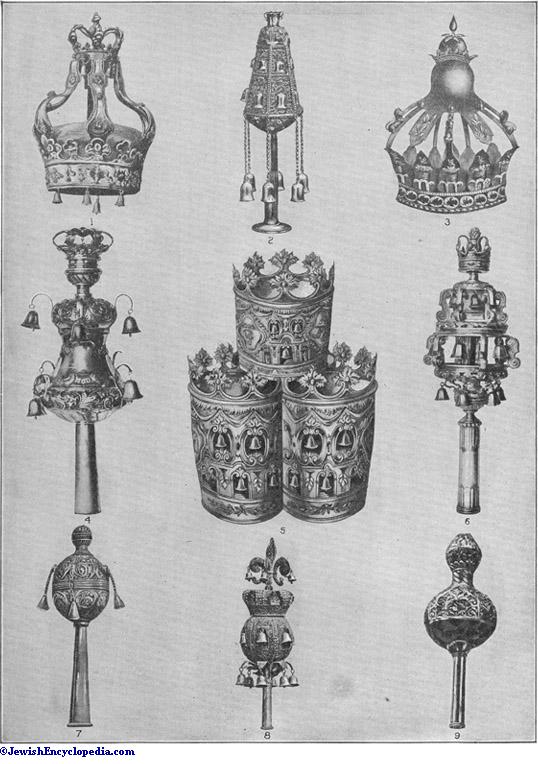
Crowns Of The Law.1. In Hambro' Synagogue, London. 2. In a private collection, New York. 3. In the Synagogue at Pogrebishche, Russia. 4 and 6. In Temple Shearith Israel, New York. 5. In the Synagogue at Casale Monferrato, Italy. 7. Oriental; in the United States National Museum, Washington. 8. In the Victoria and Albert Museum, London. 9. Samaritan; in the possession of the Palestine Exploration Fund.
"Keter," as well as "'aṭeret" and its derivatives, has also the applied meaning of ornament, dignity, and distinction. The righteous will wear crowns in the hereafter (Ber. 17a; compare Meg. 15b, where God is the crown on the head of the pious; Lev. R. xxx.). So also prayer is woven into a crown for the head of God (Ex. R. xxi.). "Three crowns there are: the crown of the Torah, the crown of the priesthood, the crown of royalty; but the crown of a good name is higher than these altogether" (Abot iv. 13). In explanation of this enumeration of the three degrees of distinction Ex. R. xxxiv. and Num. R. iv. must be kept in mind. The crown of the learned man (Pharisee), that of the priest (Sadducee), that of royal blood, men of good repute not only attain but even surpass; that is, learning, birth, and station are worthless, while character is all. R. Simeon ben Joḥai enumerates these crowns in this order: the crown of royalty, that is, the "table of the showbreads," which had a golden border; the crown of the priesthood, that is, the altar; the crown of the Torah, that is, the Ark of the Covenant. Playing upon the vocalization of  (zar and zer), he adds: "If one acquires the Torah, it is for him a zer, a crown; if he does not, it is for him something foreign" (compare Yoma 72b). God is represented in the Talmud as ornamenting the letters
  , as well as the letters
  (on
(on
The most distinguished men are called the crown of their fellows (for instance, in Tosef., Soṭah, xv.). With the death of R. Eleazar ben Azariah passed away the crown of the wise, for the wealth of the wise consists in the crown of learning (compare Soṭah 49b). So also the distinctions conferred on the first day are designated as its ten crowns (Sifra, Shemini Shab. 87b).
Bridal Crowns.
The bride wore a crown—wreath or chaplet—at the marriage feast, and so did the bridegroom, who, indeed, was regarded as a king during the nuptial ceremonies (Nowack, "Lehrbuch des Hebräischen Archäologie," i. 164). This custom was suspended for a time in consequence of the Roman wars (Soṭah ix. 14). These bridal wreaths could not be woven of myrtle or roses, but were made of reeds. The reason for this restriction is found in the idolatrous uses of wreaths of the kind prohibited (Yer. 'Ab. Zarah iv. 43d: "Not only wreaths made of wheat-stalks, but also of roses"; compare also Yer. Bik. i., toward end 64b, top; Soṭah 49a). In Yer. Soṭah ix. 24b, bottom, R. Jeremiah is reported as wearing a crown of olive-branches in order to amuse the bridal party, from which act he came to be known as the rabbi with the (myrtle bridal) crown (compare Gen. R. lxx.; Lam. R. 94b; the verse "the crown is fallen from our head" [Lam. v. 16] was interpreted to refer to him; Lam. R. to the verse, 69d). Mention is also made of ornaments in the shape of wreaths, which were much affected by women (Shab. v. 1 [57a]; Soṭah 49b). Some of these are even said to have shown in engraving the picture of Jerusalem. By later rabbis the custom of placing a wreath or crown on the head of the bridegroom was regarded as a token of mourning for Jerusalem, the olive-branches being bitter" ("'Aṭeret Zeḳenim to "Or ha-Ḥayyim," 560; Ṭur Eben ha'Ezer, 65; Tos. Pes. 36a). See Crown of the Law.
CROWN
1. In the OT.—The word represents several Heb. terms with distinct meanings. (1) zçr, properly an edge or border, with the suggestion of a twisted or wreathed appearance. It occurs only in Ex (Exo 25:11 and frequently). It is always of gold, and in the furniture of the Tabernacle surrounds the ark, the table of shew-bread and its border, the altar of incense. RVm
2. In the NT.—In AV
J. C. Lambert.
The symbol of kingly power. It is used in representations of Christ the King, of Mary as Queen of Heaven, and of saints of royal blood.
1. In Hebrew
The five Hebrew words are as follows: (1)
(1)
(2)
(3)
(4)
(5)
2. In Greek
The two Greek words of the New Testament translated crown are: (1)
(1)
(2)
3. Use and Significance
There are five uses of the crown as seen in the Scripture references studied, namely, decoration, consecration, coronation, exaltation, and remuneration.
(1) Decoration
The
(2) Consecration
The
(3) Coronation
The ordinary use of the crown. There were three kinds of kingly crowns used in coronation services: (a) The
(4) Exaltation
The
(5) Remuneration
Paul, witnessing the races and games, caught the vision of wreath-crowned victors flush with the reward of earnest endeavor. See GAMES. He also saw the persistent, faithful Christian at the end of his hard-won race wearing the symbolic
Psa 103:4 (a) This is the blessed gift of GOD’s lovingkindness and tender mercy resting upon the subject of His grace. This loving care of GOD and the rich reward He gives is compared to a beautiful and valuable crown.
Pro 4:9 (b) Here is a description of the blessing which comes upon one who uses wisdom in his living and grace in his actions.
Pro 14:24 (c) This probably is a type of the power, glory and position which riches give to their possessors.
Pro 16:31 (a) The honor and respect due to old age is represented by this beautiful white hair.
Php 4:1 (a) The Christians at Philippi who were saved through Paul’s ministry were described as a crown for his head in the day when the Lord gives rewards. (See also 1Th 2:19).
The Bible mentions two main kinds of crowns. One was the crown worn by a king, and as such was a sign of royalty and glory (Psa 21:1-3; Isa 28:5; Isa 62:3; Joh 19:2-3; Rev 19:11-16). The other was the circle of leaves placed on the head of the winner of a sporting contest, and as such was a sign of victory (1Co 9:24-27; 1Th 2:19; 2Ti 2:5). This latter kind of crown is referred to frequently in reference to the final victory of Christians who faithfully persevere amid trials, sufferings and persecution (2Ti 4:8; Jas 1:12; 1Pe 5:4; Rev 2:10; Rev 3:11; see also REWARD).
Literally, “wreath,” a ring of leaves
or branches that was placed on the head
of the winners of athletic contests to
honor them. It is a symbol of victory
and reward.