
In Isa 38:14, and Jer 8:7, two birds are mentioned, the
Where do the cranes or winding swallows go, Fearful of gathering winds and failing snow?
Conscious of all the coming ills, they fly To milder regions and a southern sky. PRIOR.
The Prophet Jeremiah mentions this bird, thus intelligent of the seasons by an instinctive and invariable observation of their appointed times, as a circumstance of reproach to the chosen people of God, who, although taught by reason and religion, “know not the judgment of the Lord.”
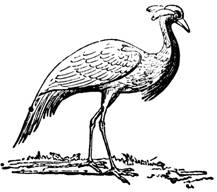
Fig. 137—Numidian Crane: Grus Virgo
Crane (Isa 38:14; Jer 8:7). The correctness of the translation in these passages has however been called in question, for if the ’crane’ of Europe had been meant by either denomination, the clamorous habits of the species would not have been expressed as ’chattering;’ and it is most probable that the striking characteristics of that bird, which are so elegantly and forcibly displayed in Hesiod and Aristophanes, would have supplied the lofty diction of prophetical inspiration with associations of a character still more exalted. It is supposed, therefore, that the ’Ardea virgo’ of Linn, the ’Grus virgo’ of later writers, and ’Anthropoides virgo’ of some, is the bird really meant, though not coming from the north, but from Central Africa, down the Nile, and in the spring arriving in Palestine, while troops of them proceed to Asia Minor, and some as far north as the Caspian. They are frequently found portrayed on Egyptian monuments, and Hasselquist, who saw them on the Nile, afterwards shot one near Smyrna: they visit the swamp above that city, and the lake of Tiberias, and depart in the fall, but do not utter the clangor of the crane, nor adopt its flight in two columns, forming an acute angle, the better to cleave the air. This bird is not more than three feet in length; it is of a beautiful bluish grey, with the cheeks, throat, breast, and tips of the long hinder feathers and quills black, and a tuft of delicate white plumes behind each eye. It has a peculiar dancing walk, which gave rise to its French denomination of ’demoiselle.’
In Isa 38:14 Jer 8:7, two birds are mentioned, the sus and the AGUR, the first rendered in our version crane, the second swallow. Bochart says the sus, or sis, is the swallow; the agur, the crane. The numidian crane, supposed to be referred to, is about three feet in length, is bluish-grey, with the cheeks, throat, breast, and tips of the long hinder feathers black, with a tuft of white feathers behind each eye. "Like a crane, or a swallow, so did I chatter:" there is peculiar force and beauty in the comparison here made between the dying believer and migratory birds about to take their departure to a distinct but more genial clime. They linger in the scenes which they have frequented, but instinct compels them to remove.\par
Crane. The crane (Grus cinerea) is a native of Europe and Asia. It stand about four feet high. Its color is ashen gray, with face and neck nearly black. It feeds on seeds, roots, insects and small quadrupeds. It retires in winter to the warmer climates. Jer 8:7.
Isa 38:14, "like a crane or a swallow, so did I chatter" (rather "twitter"); rather "like a swallow or a crane":
occurs in our version as the translation of
The Teuticon aiber, Dutch oyevaer, Esthonian aigr and aigro, therefore support the view that the latter term is a tribal epithet of one of the great wading birds; but neither the Hebrew text nor the Teutonic names point to the crane of Europe (Ardea grus, Linn., Grus cinerea of later ornithologists), since that species has a loud trumpet voice, and therefore does not “chatter;” but especially because in its migrations it crosses the Mediterranean into Africa, and does not appear in Palestine, unless by accident (driven thither possible by a western storm of wind); and when a troop of cranes alight under these circumstances, it is only for a moment; they do not give evidence of purposely assembling like the swallow. Thus the few characteristics indicated might seem to point out the stork, which does assemble in Syria in flocks before its departure, and is not a clamorous bird, having little or no voice But as the stork is clearly designated by a different appellation in the original, SEE STORK, we must search for another species as the representative of the sus, or at least of the latter term; and we fortunately find one which completely answers to the conditions required; for, being neither a genuine crane, a stork, nor a heron, having a feeble voice, and striking, but distinct manners, it is remarkable for beauty, numbers, residence, and periodical arrival and departure. The Numidian crane (Ardea virgo of Linn., the Grus virgo of later writers, and Anthropoides virgo of some) is the bird, we have every reason to conclude, intended by “agur,” though not coming from the north, but from Central Africa, down the Nile (the very circumstance which puzzled Hasselquist), and in the spring arriving in Palestine, while troops of them proceed to Asia Minor, and some as far north as the Caspian. They are frequently found portrayed on Egyptian monuments, and the naturalist just quoted, who saw them on the Nile, afterwards shot one near Smyrna. they visit the swamp above that city, and the lake of Tiberias, and depart in the fall, but do not utter the clangor of the crane, nor adopt its flight in two columns, forming an acute angle, the better to cleave the air. This bird is not more than three feet in length; it is of a beautiful bluish gray, with the cheeks, throat, breast, and tips of the long hinder feathers and quills black, and a tuft of delicate white plumes behind each eye. It has a peculiar dancing walk, which gave rise to its French denomination of “demoiselle” (see the Penny Cyclopaedia, s. v, Herons). SEE BIRD.
The Hebrew term sus occurs frequently elsewhere, but only in the sense of “horse” or cavalry.
Crane. A large bird measuring four feet in height and seven feet from tip to tip of its extended wings. When upon the wing it is usually noisy, and its cry is hoarse and melancholy: hence the allusion of Isa 38:14. These birds return in the spring with great regularity from their migrations, and nocks of thousands pass over Palestine. Jer 8:7. But the two Hebrew words sus and agur, rendered "crane" and "swallow," may signify the "swallow twittering" or "chattering."
Two things are said of this bird in scripture: it chatters or makes a querulous noise, Isa 38:14; and it knows its time of migration. Jer 8:7. The common crane answers to both of these characteristics. In the above passages the swallow is mentioned after the crane, the Hebrew words being sis and agur; many hold that the translators have transposed the words, and that sis refers to the swallow, and agur to the crane. It is so translated by the Revisers and by Mr. Darby.
By: Emil G. Hirsch, Ira Maurice Price
A rendering, in the A. V., of the Hebrew word  or
or  , which in the R. V. is more correctly translated "swallow." "Crane," however, is the proper rendering in the R. V. of the word
  , as in Isa. xxxviii. 14 and Jer. viii. 7. The first of these texts describes the crane as a bird that chatters: while the second points out its migratory character. The bird now identified with this crane, on the authority of Tristram and Hart, is the Grus communis. It is met with in Palestine in large numbers during the summer; and it winters generally in northern Africa. It is said to be the largest bird now found in Palestine, often measuring four feet in length. It gathers in large flocks at common roosting-places, where the chatter and clanging of its notes may be heard, especially at night, at a long distance. The peculiar anatomy of this bird has for some years engaged the attention of zoologists.
CRANE.—In Isa 38:14 and Jer 8:7 sûs or sîs is rendered in AV
E. W. G. Masterman.
Isa 38:14 (a) Hezekiah uses this word to illustrate the emptiness of his heart and the loneliness of his spirit when he was on his sick bed.
Jer 8:7 (a) Israel is said to know less about GOD’s dealings than the crane knows about her own life. The crane knows what to do and when to do it, but Israel did not seem to know.
Crane. Cranes are the largest of several migratory birds that fly over Palestine (Jer 8:7) in noisy flocks of thousands.
Hezekiah, king of Judah, thinking he was dying, chattered and clamored "like a crane" (Isa 38:14); (swift, NIV). This must have been quite a noise. With a windpipe coiled like a french horn, cranes produce one of the loudest bird calls in the world.