
Menu

Couch

8 sources
Popular Cyclopedia of Biblical Literature by John Kitto (1856)

Couch [BEDS]

American Tract Society Bible Dictionary by American Tract Society (1859)

See BED.\par

Smith's Bible Dictionary by William Smith (1863)

Couch. See Bed.

Cyclopedia of Biblical, Theological and Ecclesiastical Literature by John McClintock & James Strong (1880)

(יָצוּעִ, yatsu’d, something spread, Gen 49:4; “bed,” 1Ch 5:1; Job 17:13; Psa 63:6; Psa 132:3; מַשְׁכָּב, mishkab’, something to lie upon, Job 7:13, elsewhere “bed;” עֶרֶשׂ, eres, something erected, Psa 6:6; Amo 3:12; Amo 6:4; “bed,” Job 7:13; Psa 41:3; Psa 132:3; Pro 7:16; Son 1:16; “bedstead,” Deu 3:11; κλινίδιον, a little bed, Luk 5:19; Luk 5:24; κράββατος, a pallet, Act 5:15, elsewhere “bed”). Feather-beds, as among us, are unknown in the East, as indeed generally in southern climates. The poor sleep on mats or wrapped in their overclothes (Exo 22:27; Deu 24:13; comp. Theocr. 18:19; Stobaei Serm. 72, p. 404: as to Rth 3:9; Eze 16:8, see Biel in the Miscell. Lips. Nov. v. 209 sq.), and, in the open air, sometimes have only a stone for a pillow (Arvieux, 3, 216; comp. Gen 9:21; Gen 9:23; Gen 28:11). The wealthy use bolsters or mattresses (Russel, Aleppo, 1:195), stuffed with wool or cotton. These are not laid upon a bedstead, but on a raised portion (divan, q.v.) along the side of the room, which by day serves for a seat (Harmar, 1:134; 2:71; Rosenmüller, Morgenl. 3, 211; 6:14; Lorent, Wander. p. 32). Whether the couches of the ancient Hebrews for the sick or sleeping, which are usually termed מַטָּה, mittah’ (Gen 47:31; 1Sa 19:13: 2Sa 4:7; 2Ki 1:4), מַשְׁכָּב, mishkab’ (Exo 21:18; 2Sa 13:5; Son 3:1), עֶרֶשׂ, e’res (Job 7:13; Son 1:16; Pro 7:11; properly a bedstead, see Deu 3:11), were upon such a platform, is uncertain, as they appear to have been movable (1Sa 19:15), and were probably used in the daytime, like sofas, for sitting down and repose (1Sa 28:23; Eze 23:41; Amo 3:12; Amo 6:4; yet compare 2Ki 4:10). Costly carpets graced the houses of the rich (Pro 7:16 sq.; Eze 23:41; Amo 3:12); those who lay upon them covered themselves with similar tapestry, and placed a soft fur under their head (l Samuel 19:13). A canopy, or bed with a tester, is names in the Apocrypha (Jdt 16:23), and elsewhere a hanging bed or hammock (מְלוּנָה, Isa 24:20), such as watchers in gardens used (Gesenius, Thes. Heb. p. 750; comp. Niebuhr, Beschr. p. 158). In the Mishna various kinds of beds or couches are referred to; e.g. the דּרְגָּשׁ, dargash’ (Nedar. 7:5). The couches (κλίνη, κράββατος) for the sick, named in the N.T. (Mat 9:6; Mar 2:4; Mar 6:55; Luk 5:18; Act 5:5, etc.) were movable (Becker, Charicl. 2:72). SEE BED.

Dictionary of Christ and the Gospels by James Hastings (1906)

COUCH.—The word ‘couch’ is found in Luk 5:19; Luk 5:24 (as translation of κλινίδιον), where Mat 9:2; Mat 9:6 and Mar 2:4; Mar 2:11 have ‘bed’ (κλίνη and κράβαττος respectively; κλίνη also in Luk 5:18). It is found also in (Revised Version margin) of Mar 7:4 as translation of κλίνη. In Act 5:15, where the Authorized Version and Revised Version NT 1881, OT 1885 have ‘beds and couches,’ the correct text is ἐπὶ κλιναρίων καὶ κραβάττων, ‘small beds and couches,’ or, as some render, ‘small couches and beds.’ The fact is, the terms used for ‘couch’ and ‘bed’ are not always sharply distinguished—certainly not by translators. The distinction made by Bengel and Kuinoel between κλινῶν (TR [Note: R Textus Receptus.] of Act 5:15) and κραβάττων, that the former denotes ‘soft and costly,’ and the latter ‘poor and humble,’ beds is quite arbitrary (Meyer). In English usage the distinction between ‘bed’ and ‘couch’ is clear enough; a couch is a piece of furniture on which it is customary to repose or recline when dressed. A like distinction was made by the Romans, and in a measure by the Jews in the time of Christ, when ‘couches’ were often used for the purpose of reclining at meals. They were known among the Romans as triclinia, because they ran round three sides of a table. Such ‘couches’ were undoubtedly in common use among the Jews of Christ’s day, though they are not mentioned in the Gospels in express terms, unless, against the best authorities, we accept καὶ κλινῶν in Mar 7:4. They were provided with cushions, such as are now in vogue, on which the left elbow could rest, so as to leave the right arm free; and were often arranged around three sides of a table in the form of a parallelogram, the fourth side of which was left open for the convenience of those waiting on the guests.

This practice of reclining at table first appears in the Bible in the prophecy of Amos (Amo 6:4, cf. Eze 23:41), and is denounced by the prophet as of foreign origin and as savouring of sinful luxury. The ‘couches’ there coming into view were of costly cedar-wood inlaid with ivory (Amo 6:4); the feet were plated with silver, and the backs covered with gold-leaf (cf. Son 3:10). They were usually furnished with pillows and bolsters, often of fine Egyptian linen or silk, and richly embroidered coverings, costly rugs, etc. (cf. Pro 7:16). The Tel el-Amarna tablets show how early such luxury prevailed in Palestine, and state that even in those ancient times couches of rare and costly wood inlaid with gold were sent as presents from Palestine to Egypt.

Keeping this in mind will throw light on some otherwise obscure passages in the Gospels, e.g. where the woman is spoken of (Luk 7:36-38) as washing and anointing the feet of Jesus while He was ‘sitting (reclining) at meat in the Pharisee’s house’; where our Lord washed the feet of His disciples while they were at supper (Joh 13:5); and where it is said of the beloved disciple at the supper that he, ‘leaning back, as lie was, on Jesus’ breast,’ spoke to Him of His betrayer (Joh 13:25).

There is reason to believe, however, that among the Jewish people in general, in the most ancient times and later, the ‘bed,’ so far as use went, was ‘bed’ and ‘couch’ in one—a plain wooden frame with feet and a slightly raised end for the head (Gen 47:31), differing very little, indeed, from the bed of the Egyptians represented on the monuments (Wilkinson, Anc. Eg. i. 416, fig. 191). In the daytime and at meals people sat on it, in the most ancient times, perhaps, with crossed legs; and then at night they placed it here or there, as the season or need suggested, and slept on it. In the East to-day the beds are often made by laying bolsters on the raised part of the floor, or on the low divans which run along the walls, and the sitting-room of the day becomes a bedroom at night. (See Bed, Closet).

Geo. B. Eager.

Jewish Encyclopedia by Isidore Singer (ed.) (1906)

By: Emil G. Hirsch, Wilhelm Nowack

Structure on which to rest or sleep. The Hebrew term couch, meaning "divan" as well as "bed," is synonymous with couch (Amos iii. 12) and couch (II Sam. xvii. 28). In olden times the Jewish bed, a plain wooden frame with feet, and a slightly raised end for the head (Gen. xlvii. 31), probably differed little from the simple Egyptian bed. The frame, covered with couch (Prov. vii. 16), served as a bed for the old and sick during the day (Gen. xlvii. 31; I Sam. xix. 13 et seq.), while at meals people sat on it, perhaps with crossed legs (compare Ezek. xxiii. 41; I Sam. xx. 25).

Amos, who denounces the habit of reclining at table as a foreign custom (Amos iii. 12, vi. 4), speaks also of the luxury prevailing in the furnishing ofthese couches. The frames were made of costly cedar-wood inlaid with ivory (Amos vi. 4); the feet were plated with silver, and the backs with leaf gold (Song of Solomon, iii. 10). White pillows and bolsters were put on them, also costly rugs, purple embroidered covers, Egyptian linen, etc. (compare Amos iii. 12; Prov. vii. 16; Song of Solomon, iii. 10). Two references in the El-Amarna tablets show how early this luxury obtained in Palestine, and state that even in those ancient times couches of costly wood inlaid with gold were sent as presents from Palestine to Egypt (Schrader, "K. B." v. 27, xxvii. 20, 28). Sometimes pillows were laid on the floor. Esth. i. 6 speaks of beds upon a pavement of marble, which were covered with costly materials woven of threads of gold and silver (I Esd. iii. 6).

Egyptian Couch, Showing Head-Rest and Steps.(After Wilkinson, "Ancient Egyptians.")
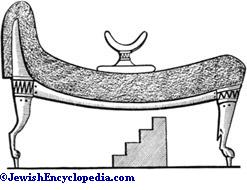
couch

To-day the beds in the East are made by laying bolsters on the low divans which run along the walls, so that a room which serves as a parlor in the daytime is easily turned into a bedroom for eight or ten persons. In ancient Israel the wealthy often had separate bedrooms (couch, II Sam. iv. 7; compare Ex. viii. 3; II Kings vi. 17; also couch, II Sam. xiii. 10, or couch, II Kings xi. 2; II Chron. xxii. 11), while the poor, especially the herdsmen, frequently slept out-of-doors, covered only with the "simlah," and with a stone under their heads (compare Ex. xxii. 26; Gen. xxviii. 11, xxxi. 40). See Bed.

Dictionary of the Bible by James Hastings (1909)

COUCH.—See House, § 8. The verb ‘to couch’ occurs in Deu 33:13 ‘the deep that coucheth beneath.’ The word means simply to lie down, but it is used almost exclusively of animals, as is the Heb. word also. The subterranean deep, says Driver, is perhaps pictured as a gigantic monster.

International Standard Bible Encyclopedia by James Orr (ed.) (1915)

kouch (substantive.). See BED.

Couch (verb): רבץ, rābhac, “to crouch,” “lurk,” as a beast in readiness to spring on its prey. “If thou doest not well, sin coucheth at the door” (Gen 4:7, the King James Version “lieth”), waiting for it to open. Cain is warned to beware of the first temptations to evil, in his case especially a sullen and jealous disposition (compare Dante, Inferno, I, 30). See ABEL; CAIN. The tribe of Judah is compared for its bravery to a recumbent lion or lioness (Gen 49:9; compare Num 24:9 f); and Issachar to “a strong ass, couching down between the sheepfolds” (Gen 49:14, the King James Version “between two burdens”; compare Jdg 5:16). “The deep that coucheth beneath” (Deu 33:13), probably the springs of water, or possibly, as Driver suggests, “the subterranean deep, pictured as a gigantic monster.” See ABYSS.

Everything we make is available for free because of a generous community of supporters.

Donate