
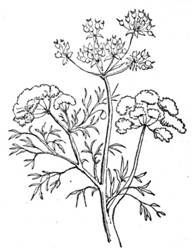
Fig. 135—Coriandrum sativum
Coriander occurs in two places in Scripture, viz. Exo 16:31, ’And it (manna) was like coriander seed, white; and the taste of it was like wafers made of honey;’ Num 11:7, ’And the manna was as coriander seed, and the color thereof as the color of bdellium.’ The coriander is known throughout Arabia, Persia, and India, in all of which it is cultivated, being universally employed as a grateful spice, and as one of the ingredients of curie-powder. It is also common in Egypt. It is now very common in the south of Europe, and also in this country, being cultivated, especially in Essex, on account of its seeds, which are required by confectioners, druggists, and distillers, in large quantities: in gardens it is reared on account of its leaves, which are used in soups and salads. The coriander is an umbelliferous plant, the Coriandrum sativum of botanists. The fruit, commonly called seeds, is globular, grayish-colored, about the size of peppercorn, having its surface marked with fine stria. Both its taste and smell are agreeable, depending on the presence of a volatile oil, which is separated by distillation.
A small round seed of an aromatic plant. The plant is a native of China, and is widely diffused in Asia and the south of Europe. Its seeds are planted in March. They are employed as a spice in the East, and are much used by druggists, confectionarists, etc. The manna which fell in the wilderness was like coriander-seed, Exo 16:31 Num 11:7 . See MANNA.\par
(
By: Morris Jastrow, Jr., John Dyneley Prince
An umbelliferous plant with white blossoms, which is peculiar to the Mediterranean district (Coriandrum sativum). It is widely cultivated in the East, and grows wild in Egypt and Palestine. It is especially abundant in the valley of the Jordan. Its fruits or seeds, which have a distinctly aromatic flavor, are used in the preparation of confectionery and also in ordinary cooking. They are employed medicinally to produce a stimulative effect and to relieve flatulence.
The only allusions to the plant in the Bible are in Ex. xvi. 31; Num. xi. 7, where the seeds are compared to Manna.
The Hebrew name "gad" was thought by Lagarde to be of Indo-European origin ("Gesammelte Abhandlungen," p. 57). It is probably not connected with any Semitic root (compare Löw, "Aramäische Pflanzennamen," No. 155). By some scholars it is identified with "goid," which the Scholiast in Dioscorides, iii. 64 states is the Punic equivalent of
Bibliography:
H. B. Tristram, Natural History of the Bible, p. 439.
Coriander. An annual herb, growing from one-half to one meter (two to three feet) tall, which produced grayish seeds used to flavor foods, for confections, and in medicine. The dried leaves of coriander were also used to flavor foods.