
There is somewhat particularly interesting in this Jewish rite. And as the appointment is from God, it demands suitable attention for the proper apprehension of it. It evidently appears, from the first moment of its institution, that the ordination was with an eye to Christ, for the covenant of redemption by Jesus had this token or seal, and it is expressly said, "that Jesus Christ was a minister of the circumcision for the truth of God, to confirm the promise made unto the fathers." (Rom. xv. 8.) And by the ceasing of this Jewish rite, and the institution of Baptism to supersede it, it should seem, that it was understood by Christ’s submitting to this act, he thereby became debtor to the whole law, and fulfilled it: and hence, all his redeemed not only are freed from it, but, in fact, they are prohibited the observance. Paul the apostle was so earnest on this point, that he declared to the Galatian church that an attention to circumcision virtually denied the covenant. "Behold, I Paul (said he) say unto you, that if ye be circumcised Christ shall profit you nothing."(Gal 5:2.) And the reason seems to have been this: The seed of Abraham, by the act of circumcision, declared that they were looking for and waiting to the coming of the promised Seed, in whom all the families of the faithful were to be blessed. To be circumcised, therefore, after Christ was come, was in effect denying that Christ Was come, and by that act saying, We are looking for his coming. Hence, all the faithful posterity of Abraham were so tenacious of observing the rite of circumcision before Christ came, andso determined not to observe it after. And also, this other cause renders circumcision improper. The person circumcised, by that act, declared himself under obligations to fulfil the whole law. And hence Christ submitted to it with this view. But his redeemed are justified in Him, and therefore, to undergo circumcision would imply a defect in this justification. "I testify (said Paul, ) again, to every man that is circumcised, that he is a debtor to do the whole law." (Gal. v. 3.) This, then, is the proper apprehension concerning therite of circumcision.
is from the Latin, circumcidere, “to cut all around,” because the Jews, in circumcising their children, cut off after this manner the skin which covers the prepuce. God enjoined Abraham to use circumcision, as a sign of his covenant. In obedience to this order, Abraham, at ninety-nine years of age, was circumcised: also his son Ishmael, and all the males of his property, Gen 17:10. God repeated the precept of circumcision to Moses: he ordered that all who were to partake of the paschal sacrifice should receive circumcision; and that this rite should be performed on children, on the eighth day after their birth.
The Jews have always been very exact in observing this ceremony, and it appears that they did not neglect it when in Egypt. But Moses, while in Midian with Jethro his father-in-law, did not circumcise his two sons born in that country; and during the journey of the Israelites in the wilderness, their children were not circumcised. Circumcision was practised among the Arabians, Saracens, and Ishmaelites. These people, as well as the Israelites, sprung from Abraham. Circumcision was introduced with the law of Moses among the Samaritans and Cutheans. The Idumeans, though descended from Abraham and Isaac, were not circumcised till subdued by John Hircanus. Those who assert that the Phenicians were circumcised, mean, probably, the Samaritans; for we know, from other authority, that the Phenicians did not observe this ceremony. As to the Egyptians, circumcision never was of general and indispensable obligation on the whole nation; certain priests only, and particular professions, were obliged to it. Circumcision is likewise the ceremony of initiation into the Mohammedan religion. There is, indeed, no law in the Koran which enjoins it, and they have the precept only in tradition. They say that Mohammed commanded it out of respect to Abraham, the head of his race. They have no fixed day for the performance of this rite, and generally wait till the child is five or six years of age.
CIRCUMCISION, Covenant of. That the covenant with Abraham, of which circumcision was made the sign and seal, Gen 17:7-14, was the general covenant of grace, and not wholly, or even chiefly, a political and national covenant, may be satisfactorily established. The first engagement in it was, that God would “greatly bless” Abraham; which promise, although it comprehended temporal blessings, referred, as we learn from St. Paul, more fully to the blessing of his justification by the imputation of his faith for righteousness, with all the spiritual advantages consequent upon the relation which was thus established between him and God, in time and eternity. The second promise in the covenant was, that he should be “the father of many nations;” which we are also taught by St. Paul to interpret more with reference to his spiritual seed, the followers of that faith whereof cometh justification, than to his natural descendants. “That the promise might be sure to all the seed, not only to that which is by the law, but to that also which is by the faith, of Abraham, who is the father of us all,”—of all believing Gentiles as well as Jews. The third stipulation in God’s covenant with the patriarch, was the gift to Abraham and to his seed of “the land of Canaan,” in which the temporal promise was manifestly but the type of the higher promise of a heavenly inheritance. Hence St. Paul says, “By faith he sojourned in the land of promise, dwelling in tabernacles with Isaac and Jacob, the heirs with him of the same promise;” but this “faith” did not respect the fulfilment of the temporal promise; for St. Paul adds, “they looked for a city which had foundations, whose builder and maker is God,” Heb 11:19. The next promise was, that God would always be “a God to Abraham and to his seed after him,” a promise which is connected with the highest spiritual blessings, such as the remission of sins, and the sanctification of our nature, as well as with a visible church state. It is even used to express the felicitous state of the church in heaven, Rev 21:3. The final engagement in the Abrahamic covenant was, that in Abraham’s “seed, all nations of the earth should be blessed;” and this blessing, we are expressly taught by St. Paul, was nothing less than the justification of all nations, that is, of all believers in all nations, by faith in Christ: “And the Scripture, foreseeing that God would justify the Heathen by faith, preached before the Gospel to Abraham, saying, In thee shall all nations be blessed. So then they who are of faith are blessed with believing Abraham;” they receive the same blessing, justification, by the same means, faith, Gal 3:8-9. This covenant with Abraham, therefore, although it respected a natural seed, Isaac, from whom a numerous progeny was to spring; and an earthly inheritance provided for this issue, the land of Canaan; and a special covenant relation with the descendants of Isaac, through the line of Jacob, to whom Jehovah was to be “a God,” visibly and specially, and they a visible and “peculiar people;” yet was, under all these temporal, earthly, and external advantages, but a higher and spiritual grace embodying itself under these circumstances, as types of a dispensation of salvation and eternal life, to all who should follow the faith of Abraham, whose justification before God was the pattern of the justification of every man, whether Jew or Gentile, in all ages. Now, of this covenant, in its spiritual as well as in its temporal provisions, circumcision was most certainly the sacrament, that is, the “sign” and the “seal;” for St. Paul thus explains the case: “And he received the SIGN of circumcision, a SEAL of the righteousness of the faith which he had yet being uncircumcised.” And as this rite was enjoined upon Abraham’s posterity, so that every “uncircumcised man-child whose flesh of his foreskin was not circumcised on the eighth day,” was to be “cut off from his people, by the special judgment of God, and that because “he had broken God’s covenant,” Gen 17:14; it therefore follows that this rite was a constant publication of God’s covenant of grace among the descendants of Abraham, and its repetition a continual confirmation of that covenant, on the part of God, to all practising it in that faith of which it was the ostensible expression.
2. As the covenant of grace made with Abraham was bound up with temporal promises and privileges, so circumcision was a sign and seal of the covenant in both its parts,—its spiritual and its temporal, its superior and inferior provisions. The spiritual promises of the covenant continued unrestricted to all the descendants of Abraham, whether by Isaac or by Ishmael; and still lower down, to the descendants of Esau as well as to those of Jacob. Circumcision was practised among them all by virtue of its divine institution at first; and was extended to their foreign servants, and to proselytes, as well as to their children; and wherever the sign of the covenant of grace was by divine appointment, there it was a seal of that covenant, to all who believingly used it; for we read of no restriction of its spiritual blessings, that is, its saving engagements, to one line of descent from Abraham only. But over the temporal branch of the covenant, and the external religious privileges arising out of it, God exercised a rightful sovereignty, and expressly restricted them first to the line of Isaac, and then to that of Jacob, with whose descendants he entered into special covenant by the ministry of Moses. The temporal blessings and external privileges comprised under general expressions in the covenant with Abraham, were explained and enlarged under that of Moses, while the spiritual blessings remained unrestricted as before. This was probably the reason why circumcision was re-enacted under the law of Moses. It was a confirmation of the temporal blessings of the Abrahamic covenant, now, by a covenant of peculiarity, made over to them, while it was still recognized as a consuetudinary rite which had descended to them from their fathers, and as the sign and seal of the covenant of grace, made with Abraham and with all his descendants without exception. This double reference of circumcision, both to the authority of Moses and to that of the patriarchs, is found in the words of our Lord, Joh 7:22: “Moses therefore gave unto you circumcision, not because it is of Moses, but of the fathers;” or, as it is better translated by Campbell, “Moses instituted circumcision among you, (not that it is from Moses, but from the patriarchs,) and ye circumcise on the Sabbath. If on the Sabbath a child receive circumcision, that the law of Moses may not be violated,” &c.
3. From these observations, the controversy in the Apostolic churches respecting circumcision will derive much elucidation. The covenant with Abraham prescribed circumcision as an act of faith in its promises, and as a pledge to perform its conditions on the part of his descendants. But the object on which this faith rested, was “the Seed of Abraham,” in whom the nations of the earth were to be blessed: which Seed, says St. Paul, “is Christ,”—Christ as promised, not yet come. When the Christ had come, so as fully to enter upon his redeeming offices, he could no longer be the object of faith, as still to come; and this leading promise of the covenant being accomplished, the sign and seal of it vanished away. Nor could circumcision be continued in this view by any, without an implied denial that Jesus was the Christ, the expected Seed of Abraham. Circumcision also as an institution of Moses, who continued it as the sign and seal of the Abrahamic covenant both in its spiritual and temporal provisions, but with respect to the latter made it also a sign and seal of the restriction of its temporal blessings and peculiar religious privileges to the descendants of Israel, was terminated by the entrance of our Lord upon his office of Mediator, in which office all nations were to be blessed in him. The Mosaic edition of the covenant not only guaranteed the land of Canaan, but the peculiarity of the Israelites, as the people and visible church of God to the exclusion of others, except by proselytism. But when our Lord commanded the Gospel to be preached to “all nations,” and opened the gates of the “common salvation” to all, whether Gentiles or Jews, circumcision, as the sign of a covenant of peculiarity and religious distinction, was also done away. It had not only no reason remaining, but the continuance of the rite involved the recognition of exclusive privileges which had been terminated by Christ. This will explain the views of the Apostle Paul on this great question. He declares that in Christ there is neither circumcision nor uncircumcision; that neither circumcision availeth any thing, nor uncircumcision, but “faith that worketh by love;” faith in the Seed of Abraham already come and already engaged in his mediatorial and redeeming work; faith, by virtue of which the Gentiles came into the church of Christ on the same terms as the Jews themselves, and were justified and saved. The doctrine of the non-necessity of circumcision, he applies to the Jews as well as to the Gentiles, although he specially resists the attempts of the Judaizers to impose this rite upon the Gentile converts; in which he was supported by the decision of the Holy Spirit when the appeal upon this question was made to the “Apostles and elders at Jerusalem,” from the church at Antioch. At the same time it is clear that he takes two different views of the practice of circumcision, as it was continued among many of the first Christians. The first is that strong one which is expressed in Gal 5:2-4, “Behold, I Paul say unto you, that if ye be circumcised, Christ shall profit you nothing; for I testify again to every man that is circumcised, that he is a debtor to do the whole law. Christ is made of no effect unto you, whosoever of you are justified by the law, ye are fallen from grace.” The second is that milder view which he himself must have had when he circumcised Timothy to render him more acceptable to the Jews; and which also appears to have led him to abstain from all allusion to this practice when writing his epistle to the believing Hebrews, although many, perhaps most of them, continue to circumcise their children, as did the Jewish Christians for a long time afterward. These different views of circumcision, held by the same person, may be explained by considering the different principles on which circumcision might be practiced after it had become an obsolete ordinance.
(1.) It might be taken in the simple view of its first institution, as the sign and seal of the Abrahamic covenant; and then it was to be condemned as involving a denial that Abraham’s Seed, the Christ, had already come, since, upon his coming, every old covenant gave place to the new covenant introduced by him.
(2.) It might be practiced and enjoined as the sign and seal of the Mosaic covenant, which was still the Abrahamic covenant with its spiritual blessings, but with restriction of its temporal promises and special ecclesiastical privileges to the line of Jacob, with a law of observances which was obligatory upon all entering that covenant by circumcision. In that case it involved, in like manner, the notion of the continuance of an old covenant, after the establishment of the new; for thus St. Paul states the case in Gal 3:19: “Wherefore then serveth the law? It was added because of transgressions until the Seed should come.” After that therefore it had no effect:—it had waxed old, and had vanished away.
(3.) Again: circumcision might imply an obligation to observe all the ceremonial usages and the moral precepts of the Mosaic law, along with a general belief in the mission of Christ, as necessary to justification before God. This appears to have been the view of those among the Galatian Christians who submitted to circumcision, and of the Jewish teachers who enjoined it upon them; for St. Paul in that epistle constantly joins circumcision with legal observances, and as involving an obligation to do “the whole law,” in order to justification.—”I testify again to every man that is circumcised, that he is a debtor to do the whole law; whosoever of you are justified by the law, ye are fallen from grace.” “Knowing that a man is not justified by the works of the law, but by the faith of our Lord Jesus Christ,” Gal 2:16. To all persons therefore practising circumcision in this view it was obvious, that “Christ was become of none effect,” the very principle of justification by faith alone in him was renounced even while his divine mission was still admitted.
(4.) But there are two grounds on which circumcision may be conceived to have been innocently, though not wisely, practiced, among the Christian Jews. The first was that of preserving an ancient national distinction on which they valued themselves; and were a converted Jew in the present day disposed to perform that rite upon his children for this purpose only, renouncing in the act all consideration of it as a sign and seal of the old covenants, or as obliging to ceremonial acts in order to justification, no one would censure him with severity. It appears clear that it was under some such view that St. Paul circumcised Timothy, whose mother was a Jewess; he did it because of “the Jews which were in those quarters,” that is, because of their national prejudices, “for they knew that his father was a Greek.” The second was a lingering notion, that, even in the Christian church, the Jews who believed would still retain some degree of eminence, some superior relation to God; a notion which, however unfounded, was not one which demanded direct rebuke, when it did not proudly refuse spiritual communion with the converted Gentiles, but was held by men who “rejoiced that God had granted to the Gentiles repentance unto life.” These considerations may account for the silence of St. Paul on the subject of circumcision in his Epistle to the Hebrews. Some of them continued to practise that rite, but they were probably believers of the class just mentioned; for had he thought that the rite was continued among them on any principle which affected the fundamental doctrines of Christianity, he would no doubt have been equally prompt and fearless in pointing out that apostasy from Christ which was implied in it, as when he wrote to the Galatians.
Not only might circumcision be practised with views so opposite that one might be wholly innocent, although an infirmity of prejudice; the other such as would involve a rejection of the doctrine of justification by faith in Christ; but some other Jewish observances also stood in the same circumstances. St. Paul in his Epistle to the Galatians, a part of his writings from which we obtain the most information on these questions, grounds his “doubts” whether the members of that church were not seeking to be “justified by the law” upon their observing “days, and months, and times, and years.” Had he done more than “doubt,” he would have expressed himself more positively. He saw their danger on this point; he saw that they were taking steps to this fatal result, by such an observance of these “days,” &c, as had a strong leaning and dangerous approach to that dependence upon them for justification, which would destroy their faith in Christ’s solely sufficient sacrifice; but his very doubting, not of the fact of their being addicted to these observances, but of the animus with which they regarded them, supposes it possible, however dangerous this Jewish conformity might be, that they might be observed for reasons which would still consist with their entire reliance upon the merits of Christ for salvation. Even he himself, strongly as he resisted the imposition of this conformity to Jewish customs upon the converts to Christianity as a matter of necessity, yet in practice must have conformed to many of them, when no sacrifice of principle was understood; for in order to gain the Jews, he became “as a Jew.” See ABRAHAM, and See BAPTISM.
The history of Jewish Circumcision lies on the surface of the Old Testament. Abraham received the rite from Jehovah, Moses established it as a national ordinance, and Joshua carried it into effect before the Israelites entered the land of Canaan. Males only were subjected to the operation, and it was to be performed on the eighth day of the child’s life: foreign slaves also were forced to submit to it, on entering an Israelites family. Those who are unacquainted with other sources of information on the subject besides the Scriptures might easily suppose that the rite was original with Abraham, characteristic of his seed, and practiced among those nations only who had learned it from them. This, however, appears not to have been the case.
First of all, the Egyptians were a circumcised people. It has been alleged by some writers that this was not true of the whole nation, but of the priests only. A great preponderance of argument, however, appears to us to prove that the rite was universal among the old Egyptians, as long as their native institutions flourished; although there is no question that, under Persian and Greek rule, it gradually fell into disuse, and was retained chiefly by the priests and by those who desired to cultivate ancient wisdom.
The Colchians, who, according to Herodotus, were a colony from Egypt, learned the practice from the Egyptians, as also did the savage Troglodytes of Africa. Herodotus, moreover, tells us that the Ethiopians were also circumcised; and he was in doubt whether they had learned the rite from the Egyptians, or the Egyptians from them. By the Ethiopians we must understand him to mean the inhabitants of Meroe or Sennaar. In the present day the Coptic Church continues to practice it; the Abyssinian Christians do the same; and that it was not introduced among the latter with a Judaical Christianity appears from their performing it upon both sexes. Oldendorp describes the rite as widely spread through Western Africa—16° on each side of the Line—even among natives that are not Muhammadan. In later times it has been ascertained that it is practiced by the Kafir nations in South Africa, whom Prichard supposes to form ’a great part of the native population of Africa to the southward of the Equator.’
How far the rite was extended through the Syro-Arabian races is uncertain, but there can be no doubt that it was widely diffused among them. The Philistines, in the days of Saul, were however uncircumcised; so also, says Herodotus, were all the Phoenicians who had intercourse with the Greeks. That the Canaanites, in the days of Jacob, were not all circumcised, is plain from the affair of Dinah and Shechem. The story of Zipporah (Exo 4:25), who did not circumcise her son until fear came over her, that Jehovah would slay her husband Moses, proves that the family of Jethro, the Midianite, had no fixed rule about it, although the Midianites are generally regarded as children of Abraham by Keturah. On the other hand, we have the distinct testimony of Josephus, that the Ishmaelite Arabs, inhabiting the district of Nabataea, were circumcised after their thirteenth year. The fact that the books of Moses, of Joshua, and of Judges, never bestow the epithet uncircumcised as a reproach on any of the seven nations of Canaan, any more than on the Moabites or Ammonites, the Amalekites, the Midianites, or other inland tribes with whom they came into conflict, taken in connection with the circumstance, that as soon as the Philistines became prominent in the narrative, after the birth of Samson, this epithet is of rather common occurrence, and that the bringing back, as a trophy, the foreskins of slain enemies, never occurs except against the Philistines (1 Samuel 18), would lead us to conclude, that while the Philistines, like the Sidonians and the other maritime Syrian nations known to the Greeks, were wholly strangers to the practice, it was common among the Canaanites and all the more inland tribes.
How far the rite of circumcision spread over the south-west of Arabia no definite record subsists. The silence of the Koran confirms the statement of Abulfedâ, that the custom is older than Mohammed, who, it would appear, in no respect regarded it as a religious rite. Nevertheless it has extended itself with the Mohammedan faith, as though it were a positive ordinance. Pocock cites a tradition, which ascribes to Mohammed the words—’Circumcision is an ordinance for men and honorable in women.’ This extension of the rite to the other sex might, in itself, satisfy us that it did not come to those nations from Abraham and Ishmael. We have already seen that Abyssinian circumcision has the same peculiarity: so that it is every way probable that Southern Arabia had the rite from the same source or influence as Ethiopia. In fact, the very closest relations are known to have subsisted between the nations on the opposite coasts of the Red Sea.
The moral meaning of the word ’uncircumcised’ was a natural result of its having been made legally essential to Hebrew faith. ’Uncircumcised in heart and ears’ was a metaphor to which a prophet would be carried, as necessarily as a Christian teacher to such phrases as ’unbaptized in soul,’ or ’washed by regeneration.’ If, however, we try to take a step farther back still, and ask why this ordinance in particular was selected, as so eminently essential to the seed of Abraham, we probably find that we have reached a point at which we must be satisfied with knowing the fact without the reason. Every external ordinance, as for instance baptism, must have more or less that is arbitrary in it. It is, however, abundantly plain that circumcision was not intended to separate the Jews from other nations generally, for it could not do so: and, least of all, from the Egyptians, as the words in Joshua (Jos 5:9) show. Rather, it was a well known and already understood symbol of purity.
A cutting around, because in this rite the foreskin was cut away. God commanded Abraham to use circumcision, as a sign of his covenant; and in obedience to this order, the patriarch, at ninety-nine years of age, was circumcised, as also his son Ishmael, and all the male of his household, Gen 17:10-12 . God repeated the precept to Moses, and ordered that all who intended to partake of the paschal sacrifice should receive circumcision; and that this rite should be performed on children on the eighth day after their birth, Exo 12:44 Lev 12:3 Joh 7:22 . The Jews have always been very exact in observing this ceremony, and it appears that they did not neglect it when in Egypt, Jos 5:1-9 .\par All the other nations sprung from Abraham besides the Hebrews, as the Ishmaelites, the Arabians, etc., also retained the practice of circumcision. At the present day it is an essential rite of the Mohammedan religion, and though not enjoined in the Koran, prevails wherever this religion is found. It is also practiced in some form among the Abyssinians, and various tribes of South Africa, as it was by the ancient Egyptians. But there is no proof that it was practiced upon infants, or became a general, national, or religious custom, before God enjoined it upon Abraham.\par The Jews esteemed uncircumcision as a very great impurity; and the greatest offence they could receive was to be called "uncircumcised." Paul frequently mentions the Gentiles under this term, not opprobriously, Ro 2.26, in opposition to the Jews, whom he names "the circumcision," etc.\par Disputes as to the observances of this rite by the converts from heathenism to Christianity occasioned much trouble in the early church, Mal 15:1-41 ; and it was long before it was well understood that "in Christ Jesus neither circumcision availeth any thing, nor uncircumcision, but a new creature," Gal 5:2,3 6:15.\par The true circumcision is that of the heart; and those are "uncircumcised in heart and ears," who will not obey the law of God nor embrace the gospel of Christ.\par
Circumcision. Circumcision was peculiarly, though not exclusively, a Jewish rite. It was enjoined upon Abraham, the father of the nation, by God, at the institution and as the token of the covenant, which assured to him and his descendants, the promise of the Messiah. Genesis 17. It was, thus, made a necessary condition of Jewish nationality.
Every male child was to be circumcised when eight days old, Lev 12:3, on pain of death. The biblical notice of the rite describes it as distinctively Jewish; so that, in the New Testament, "the circumcision," and "the uncircumcision," are frequently used as synonyms for the Jews and the Gentiles.
The rite has been found to prevail extensively in both ancient and modern times. Though Mohammed did not enjoin circumcision in the Koran, he was circumcised himself, according to the custom of his country; and circumcision is now as common among the Mohammedans as among the Jews.
The process of restoring a circumcised person to his natural condition by a surgical operation was sometimes undergone. Some of the Jews in the time of Antiochus Epiphanes, wishing to assimilate themselves to the heathen around them, "made themselves uncircumcised." Against having recourse to this practice, from an excessive anti-Judaistic tendency, St. Paul cautions the Corinthians. 1Co 7:18.
The cutting off all round of the foreskin (the projecting skin in the male member, the emblem of corruption, Deu 10:16; Jer 4:4) of males, appointed by God as token of His covenant with Abraham and his seed (Gen 17:10-14). The usage prevailed, according to Herodotus (2:104, section 36-37), among the Egyptians, Ethiopians, and Syrians. But his statement may refer only to the Egyptian priests, and those initiated in the mysteries. The Jews alone of the inhabitants of the Syrian region were circumcised. So, circumcision kept them distinct from uncircumcised Canaanite pagan around. If the rite existed before Abraham it was then first sanctioned as a token of God’s covenant with Abraham and his seed, and particular directions given by God as to the time of its being performed, the eighth day, even though it were a sabbath (Joh 7:22-23), and the persons to be circumcised, every male, every slave, and (at the Exodus it was added) every male foreigner before he could partake of the Passover (Gen 17:12-13; Exo 12:48).
So, the rainbow existed before the flood, but in Gen 9:13-17 first was made token of the covenant. The testimony of the Egyptian sculptures, mummies, and hieroglyphics, is very doubtful as to the pre-Abrahamic antiquity of circumcision. (See note Genesis 17, Speaker’s Commentary.) The Hamite races of Palestine, akin to the Egyptians, as (Jdg 14:3) the Philistines and Canaanites (the Hivites, Genesis 34), were certainly not circumcised. The Egyptian priests probably adopted the rite when Joseph was their governor and married to the daughter of the priest of On. The Israelites by the rite, which was associated with the idea of purity, were marked as a whole "kingdom of priests" (Exo 19:6; Deu 7:6-7). In Jer 9:25, "I will punish all them which are circumcised with the uncircumcised: Egypt, and Judah, and Edom," two classes seem distinguished: Israel circumcised in flesh, but uncircumcised in heart; and the Gentile nations uncircumcised both in flesh and heart.
Hyrcanus first compelled the Edomites to be circumcised (Josephus, Ant. 13:9, section 1; compare Eze 31:18). Its significance is, the cutting the outside flesh of the organ of generation denotes corruption as inherent in us from birth, and transmitted by our parents, and symbolizes our severance from nature’s defilement to a state of consecrated fellowship with God. Jehovah consecrated the nation to Himself; and whatsoever male was not circumcised on the eighth day was liable to be "cut off." Moses had neglected to circumcise his son, owing to Zipporah’s repugnance to it, as a rite not generally adopted in the East, even by the descendants of Abraham and Keturah, the Midianites. Therefore he was attacked by some sudden seizure in the resting place for the night, which he and his wife were divinely admonished arose from the neglect. She took a sharp stone or flint (compare margin Jos 5:2; Jos 5:8), the implement sanctioned by patriarchal usage as more sacred than metal (as was the Egyptian usage also in preparing mummies), and cut off her son’s foreskin, and cast it at Moses’ feet, saying, "a bloody husband art thou to me," i.e., by this blood of my child I have recovered thee as my husband, and sealed our union again (Exo 4:25).
The name was given at circumcision, as at baptism (Luk 1:59; Luk 2:21). The painfulness of Old Testament initiatory rite, as compared with the New Testament sacrament of baptism, marks strongly the contrast between the stern covenant of the law and the loving gospel. Jesus’ submission to it betokened His undertaking to fulfill the law in all its requirements, and to suffer its penalty incurred by us. "Oh wherefore bring ye here this holy Child? Such rite befits the sinful, not the clean; Why should this tender Infant undefiled Be thus espoused in blood, while we have been So gently into covenant beguiled? No keen edged knife our bleeding foreheads scored With the sharp cross of our betrothed Lord: But we belike in quiet wonder smiled. While on our brow the priest, with finger cold, Traced with the hallowed drops the saving sign; While Thou, unsparing of Thy tears, the old And sterner ritual on Thyself didst take: Meet opening for a life like Thine, Changing the blood to water for our sake." - Whytehead.
"Uncircumcised" is used of the lips (Exo 6:12; Exo 6:20), the ears (Jer 4:4; Jer 6:10), the heart (Lev 26:41; Deu 10:16; Act 7:51), in the sense closed by the foreskin of inborn fleshliness; impure, rebellious (Deu 30:6; Isa 52:1). Even the fruit of the Canaanites’ trees was called "uncircumcised," i.e. unclean (Lev 19:23). Christians "are circumcised with the circumcision made without hands in putting off the body (not merely the foreskins, as in literal circumcision) of the sins of the flesh (i.e. the whole old fleshly nature with its sins) by the circumcision of Christ" (Col 2:11; Rom 2:28-29).
The reason of the omission of circumcision in the wilderness (Jos 5:5-6) was, while suffering the penalty of their unbelief the Israelites were practically discovenanted by God, and so were excluded from the sign of the covenant. "The reproach of Egypt" was the taunt of the Egyptians that God brought them into the wilderness to slay them (Num 14:13-16; Deu 9:23-28); which reproach lay on them so long as they were in danger of being "cut off" in the wilderness as uncircumcised, but was rolled off the younger generation by their circumcision at Gilgal. Paul warned Christians who regarded circumcision as still possessing spiritual virtue, that thereby they made themselves "debtors to do the whole law," and "Christ should profit them nothing" (Gal 5:2-3; Gal 5:12). He calls its practisers "the concision," in contrast to the true circumcision (Php 3:2-3), a mere flesh cutting.
So he resisted the demand that Titus should be circumcised; for, being a Greek, Titus did not fall under the rule of expediency that Jewish born Christians should be circumcised, as Timothy was (Acts 15; Act 16:1; Act 16:3; Gal 2:3-5). Christianity did not interfere with Jewish usages, as social ordinances (no longer religiously significant) in the case of Jews, while the Jewish polity and temple stood. After their overthrow the Jewish usages necessarily ceased. To insist on them for Gentile converts would have been to make them essential to Christianity. To violate them in the case of Jews would have been inconsistent with the charity which in matters indifferent becomes all things to all men, that by all means it may win some (1Co 9:22; Romans 14). The Arabians circumcised in the 13th year, after Ishmael’s example (Gen 17:25). The Muslims and the Abyssinian Christians practice it still.
(
Further, he informs us that the Colchians were a colony from Egypt, consisting of soldiers from the army of Sesostris. With these he had conversed (2, 104), and he positively declares that they practiced circumcision. Yet if the rite had been confined to the priestly caste of Egypt, it could hardly have been found among the Colchians at all. The same remark will apply to the savage Troglodytes of Africa, every branch of whom except one (the Kolobi), as Diodorus informs us (3, 31), was circumcised, having learned the practice from the Egyptians. The Troglodytes appear to have been widely diffused through Libya, which argues a corresponding diffusion of the rite; yet, from the silence of Diodorus concerning the other savage nations whom he recounts as African Ethiopians, we may infer that it was not practiced by them. The direct testimony of Diodorus (1, 28), Philo (Opp. 2, 310), and Strabo (12, 824; comp. Agatharch. ed. Hudson, 1, 46) is to the same effect as that of Herodotus respecting Egypt; yet this can hardly be called confirmatory, since in their days the rite was no longer universal. Josephus (contra Revelation 2, 13) speaks of it as practiced by the priests only; he, however, reproaches Apion for neglecting the institutions of his country in remaining uncircumcised. Origen, in the passage above referred to, confirms the statement of Josephus. In Kenrick’s Herodotus (2, 37), the French commissioners who examined some Egyptian mummies are quoted as establishing from them the fact of Egyptian circumcision. Herodotus, moreover, tells us (2, 104) that the Ethiopians were also circumcised; and he was in doubt whether they had learned the rite from the Egyptians, or the Egyptians from them. By the Ethiopians we must understand him to mean the inhabitants of Meroe or Sennaar. In the present day the Coptic Church continues to practice it, according to C. Niebuhr (quoted by Michaelis); the Abys. sinian Christians do the same (Ludolf. Hist. Ethiop. 1, 19, and Comment. p. 268 sq.); and that it was not introduced among the latter with a Judaical Christianity appears from their performing it upon both sexes. (It is scarcely worth while to invent a new name, recision, or resection, for accuracy’s sake.)
Oldendorp describes the rite as widely spread through Western Africa — 16° on each side of the line — even among natives that are not Mohammedan. In later times it has been ascertained that it is practiced by the Kafir nations in South Africa, more properly called Kosa or Amakesa, whom Prichard supposes to form “a great part of the native population of Africa to the southward of the equator.” He remarks upon this: “It is scarcely within probability that they borrowed the custom from nations who profess Islam, or we should find among them other proofs of intercourse with people of that class. It is more probable that this practice is a relic of ancient African customs, of which the Egyptians, as it is well known, partook in the remote ages” (Prichard, Physical Hist. of Man 1:3 d ed. 2, 287). Traces of the custom have even been observed among the natives of some of the South Sea Islands (Pickering, Races of Men, p. 153, 199, 200, etc.).
How far the rite was extended through the Syro-Arabian races is uncertain (but see Strabo, 16:776; Epiphan. Hoer. 9, 30; Origen ad Genesis 1, 10). In the 9th section of the Epistle of Barnabas (which, whether genuine or not, is very old), the writer comments as follows: “But you will say the Jews were circumcised for a sign. And so are all the Syrians, and the Arabians, and the idolatrous priests; ... and even the Egyptians themselves are circumcised.” This language is vague and popular; yet it shows how notorious was the wide diffusion of the custom (see Hug, in the Freib. Zeitschrift. 3. 213). The Philistines, in the days of Saul, were, however, uncircumcised; so also, says Herodotus (2, 104), were all the Phoenicians who had intercourse with the Greeks. That the Canaanites, in the days of Jacob, were not all circumcised, is plain from the affair of Dinah and Shechem. The story of Zipporah (Exo 4:25), who did not circumcise her son until fear came over her that Jehovah would slay her husband Moses, proves that the family of Jethro, the Midianite, had no fixed rule about it, although the Midianites are generally regarded as children of Abraham by Keturah. On the other hand, we have the distinct testimony of Josephus (Ant. 1, 12, 2) that the Ishmaelite Arabs, inhabiting the district of Nabathaea, were circumcised after their 13th year: this must be connected with the tradition, which no doubt existed among them, of the age at which their forefather Ishmael underwent the rite (Gen 17:25).
St. Jerome also (quoted by Michaelis) informs us that, to his day, “usque hodie,” the tribes dwelling round Judaea and Palestine were circumcised, “especially all the Saracens who dwell in the desert.” Elsewhere he says that, “except the Egyptians, Idumaeans, Ammonites, Moabites, and Ishmaelites of the desert, of whom the greater part are circumcised, all other nations in the world are uncircumcised.” A negative argument is more or less dangerous; yet there is something striking in the fact that the books of Moses, of Joshua, and of Judges never bestow the epithet uncircumcised as a reproach on any of the seven nations of Canaan, any more than on the Moabites or Ammonites, the Amalekites, the Midianites, or other inland tribes with whom they came into conflict. On the contrary, as soon as the Philistines become prominent in the narrative, after the birth of Samson, this epithet is of rather common occurrence. The fact also of bringing back as a trophy the foreskins of slain enemies never occurs except against the Philistines (1 Samuel 18). We may perhaps infer, at least until other proof or disproof is attained, that while the Philistines, like the Sidonians and the other maritime Syrian nations known to the Greeks, were wholly strangers to the practice, yet among the Canaanites, and all the more inland tribes, it was at least so far common that no general description could be given them from the omission; It appears from Josephus (Ant. 13, 9) that when Hyrcanus subdued the Idumaeans, he forced them to be circumcised on pain of expatriation. This shows that they had at least disused the rite. But that is not wonderful, if it was only a custom, and not a national religious ordinance; for, as Michaelis observes, the disuse of it may have dated from the edict of Antiochus Epiphanes, of which it is said (1Ma 1:41-42), “The king Antiochus wrote to all his kingdom that all should be one people; and that all should keep the ordinances of his country; and all the nations acquiesced according to the word of the king.” The rather obscure notices which are found in Jeremiah and Ezekiel of the circumcision of the nations who were in immediate contact with Israel admit of a natural interpretation in conformity with what has been already adduced (Jer 9:25; Eze 31:18; also Eze 32:19, et passim). The difficulty turns on the new moral use made of the term “uncircumcised,” to mean simply impure. The passage in Jeremiah is thus translated by Ewald: “Behold, the days come that I visit all the uncircumcised circumcised ones; Egypt and Judah, Edom, and the children of Ammon and Moab; and all the dwellers in the wilderness that are shaven on the temples: for all the heathen are uncircumcised, and so is all the house of Israel uncircumcised in heart.” The shaving of the temples appears to be a religious custom of the same kind: Herodotus (3, 8) ascribes it to the Arabs generally, and Josephus rather strangely regards the epithet
Pococke quotes the ecclesiastical historian Philostorgius for the fact that the Himyarite Arabs circumcise their children on the eighth day. He adds a passage from Al Gazzali, in which the writer says that the Arabs differ from the Jews as to the time; for they postpone it until the child has teeth, which he thinks safer. Finally, he cites Ibn Athir, who, writing of the times antecedent to Mohammed, says that the Arabs were accustomed to circumcise between the tenth and fifteenth years. The origin of the custom amongst this large section of those Gentiles who follow it is to be found in the Biblical record of the circumcision of Ishmael (Gen 17:25). Josephus relates that the Arabians circumcise after the thirteenth year, because Ishmael, the founder of their nation, was circumcised at that age (Ant. 1, 12, 2; see Lane’s Mod. Eg. ch. 2). Though Mohammed did not enjoin circumcision in the Koran, he was circumcised himself, according to the custom of his country; and circumcision is now as common amongst the Mohammedans as amongst the Jews.
The statement of Philostorgius may receive light from the Arab historians, who relate (Jost, Geschichte der Israeliten, 5, 236 sq.) that about a century before the Christian aera, several Jewish sovereigns reigned in the region called Sheba by the Jews, and Yemen by the moderns, where the Himyarites (or Homeritae) dwelt. The few facts preserved show that they were not close observers of the Mosaic law, and the suspicion might arise that they were called Jews chiefly from their having received Jewish circumcision. We have, however, a collateral evidence of much importance, to prove that the influence acting on them had really come from Judaea; namely, it is well known that in Abyssinia a nation called the Falasha still exists, which has very thoroughly adopted the Jewish religion, insomuch as to have invented legends that allege their descent from the Hebrews. They possess the Old Testament in the Gheez language and character, but their own language is said to be quite alien from the Hebrew; facts which prove that they were really proselyted by the Jews at some early period. SEE ABYSSINIA.
At that same time, it is credible, the Hebrew faith met with similar success on the opposite coast of the Red Sea. Jost believes that, during the war of the Maccabees, great numbers of Jews migrated into Arabia; and it is certain that in later times they were very numerous in Yemen, and their influence great. Wherever they were settled proselytes must have been made; and great zeal was doubtless used to induce them to circumcise their children duly according to the Mosaic rite. We can then quite understand Philostorgius’s fact, if we are allowed to suppose that he spoke loosely of “the Himyarites” doing that which was done by a great many of them. An interesting story is told by Josephus-the date so late as the reign of the Emperor Claudius (Ant. 20, 2) — how Izates, the young king of Adiabene, and his mother Helena, were converted by Jewish teachers to a belief in the one true God, the God of the Hebrews: and how, when Izates was desirous of being circumcised, and his mother dreaded that it would alienate his subjects, his Jewish Instructor Ananias warmly seconded her views, with a heart like that of Paul; telling him that if he was resolved to imitate Jewish institutions, he could, without being circumcised, adore the true divinity; and that this was far more important than circumcision. At the time he satisfied the young monarch; but afterwards, another Jew, named Eleazar, came from Galitee, and inveighed so strongly on the impiety of his disobedience, that, without more delay, Izates submitted to the rite. It is evident that, in a controversy of this sort, the more narrow-minded teacher had the advantage; and, in consequence, it appears that “proselytes of righteousness” were always circumcised (Jdt 14:10, and Tacit. Hist. 5, 5). The facility with which whole nations have adopted the practice from the Mohammedans proves that it is not so serious an obstacle to the spread of a religion as some have thought it (see the Penny Cyclopaedia, s.v.).
II. Jewish Circumcision. —
1. History. — When God announced to Abraham that he would establish his covenant with him, he said to him, “This is my covenant, which ye shall keep between me and you, and thy seed after thee: Every man-child among you shall be circumcised. And ye shall circumcise the flesh of your foreskin; and it shall be a token of the covenant betwixt me and you” (Gen 17:10-11). It was also ordained that this should be extended to servants belonging to Abraham and his seed, as well as to their own childern; and that in the case of children it was to be done on the eighth day after birth. This was appointed as an ordinance of perpetual obligation in the Abrahamic family, and the neglect of it entailed the penalty of being cut off from the people (12-14). In compliance with this, Abraham, though then ninety-nine years of age, was himself circumcised and all his household, including Ishmael. On the birth of his son Isaac, the rite was attended to with regard to him (Gen 21:4); and it continued to be observed by his posterity, and distinctively to characterize them from the people amidst whom they dwelt (Gen 34:14-15). The usage thus introduced by Abraham was formally enacted as a legal institute by Moses (Lev 12:3; comp. Joh 7:23).
Slaves, whether home-born or purchased, were circumcised (Gen 17:12-13); and foreigners must have their males circumcised before they could be allowed to partake of the passover (Exo 12:48), or become Jewish citizens (Jdg 14:10. See also Est 8:17, where for Heb.
From this time forward it became the pride of the nation to observe this ordinance; on all those people who did not observe it they looked down with contempt, not to say abhorrence (Jdg 14:3; Jdg 15:18; 1Sa 14:6; 1Sa 17:26; 2Sa 1:20;’ Isa 52:1; Eze 31:18; Eph 2:11, etc.); and so much did it become a rite distinctive of them, that their oppressors sought to prevent their observing it-an attempt to which they refused to submit, though threatened with the last penalties in case of disobedience (1Ma 1:48; 1Ma 1:50; 1Ma 1:60-62). The introduction of Christianity was the signal for the abolition of this rite in the Church of God; as the old covenant had waxed feeble and was passing away, that which was the token of it also ceased to be binding; the rule was proclaimed that “in Christ Jesus neither circumcision availeth anything nor uncircumcision, but a new creature” (Gal 6:15; Col 3:11), though among the Jewish Christians were still found many who clung tenaciously to their ancient distinctive rite, and would have imposed it even on the Gentile converts to Christianity (Act 15:1; Gal 6:12, etc.). Our Lord himself was circumcised, because it became him who was of the seed of Abraham according to the flesh to fulfill all righteousness, and because he was “a minister of the circumcision for the truth of God, to confirm the promises made unto the fathers” (Rom 15:8); and Paul caused Timothy to be circumcised to avoid offense to the Jews, his mother being a Jewess; but the spirit of Christianity was averse from such institutions (Act 15:1-11; Gal 2:3, etc.) — for the outward carnal circumcision it sought to substitute that of the heart (Rom 2:28-29), “the circumcision not made with hands in putting off the sins of the flesh, even the circumcision of Christ” (Col 2:11).
Among the ancient Jews, the rule that circumcision should take place on the eighth day after birth was rigidly followed (Luk 1:59; Luk 2:21; Php 3:5), save in such very exceptional cases as those mentioned Exo 4:25; Jos 5:6. Even their reverence for the Sabbath did not prevent the Jews from observing it on that day (Joh 7:22-23); according to the Rabbins circumcision “pellit Sabbatum” (Lightfoot, Hor. Heb. in Joan 7, 22). The operation might be performed by any Israelite, but usually it was performed by the father of the child; in special cases women might perform it (Exo 4:25). The instrument used in the earlier times was a sharp stone or a knife of flint (Exo 4:25; Jos 5:2-3; comp. the
3. Figurative Use of the Term. — The moral meaning of the word “uncircumcised” was a natural result of its having been made legally essential to Hebrew faith. “Uncircumcised in heart and ears” was a metaphor to which a prophet would be carried, as necessarily as a Christian teacher to such phrases as “unbaptized in soul,” or “washed by regeneration.” It was a well-known and readily understood symbol of purity.
4. Modern Usages. — The ceremony of circumcision, as practiced by the Jews in our own times, is thus: If the eighth day happens to be on the Sabbath, the ceremony must be performed on that day, notwithstanding its sanctity. When a male child is born, the godfather is chosen from amongst his relations or near friends; and if the party is not in circumstances to bear the expenses, which are considerable (for after the ceremony is performed a breakfast is provided, even amongst the poor, in a luxurious manner), it is usual for the poor to get one amongst the richer, who accepts the office, and becomes a godfather. There are also societies formed amongst them for the purpose of defraying the expenses, and every Jew receives the benefit if his child is born in wedlock. The ceremony is performed in the following manner, in general.
The circumcisor being provided with a very sharp instrument, called the circumcising knife (see Quandt, De cultris circumcisoriis Judoeorum, Regiom. 1713), plasters, cummin-seed to dress the wound, proper bandages, etc., the child is brought to the door of the synagogue by the godmother, when the godfather receives it from her and carries it into the synagogue, where a large chair with two seats is placed; the one is for the godfather to sit upon, the other is called the seat of Elijah the prophet, who is called the angel or messenger of the covenant. As soon as the godfather enters with the child, the congregation say, “Blessed is he that cometh to be circumcised, and enter into the covenant on the eighth day.” The godfather being seated, and the child placed on a cushion in his lap, the circumciser performs the operation, and, holding the child in his arms, takes a glass of wine into his right hand, and says as follows: “Blessed be those, O Lord our God, King of the Universe, Creator of the fruit of the vine. Blessed art thou, O Lord our God! who hath sanctified his beloved from the womb, and ordained an ordinance for his kindred, and sealed his descendants with the mark of his holy covenant; therefore for the merits of this, O living God! our rock and inheritance, command the deliverance of the beloved of our kindred from the pit, for the sake of the covenant which he hath put in our flesh. Blessed art thou, O Lord, the Maker of the Covenant! Our God, and the God of our fathers! preserve this child to his father and mother, and his name shall be called in Israel, A, the son of B. Let the father rejoice in those that go forth from his loins, and let his mother be glad in the fruit of her womb; as it is written, ‘Thy father and mother shall rejoice, and they that begat thee shall be glad.”’
The father of the child says the following grace: “Blessed art thou, O Lord our God, King of the Universe! who hath sanctified us with his commandments, and commanded us to enter into the covenant of our father Abraham.” The congregation answer, “As he hath entered into the law, the canopy, and the good and virtuous deeds.” (See Buxtorf, Synagoga Judaica, ch. 2.)
III. Design of the Institution. — Herodotus long ago declared that it was adopted by the Egyptians for cleanliness (
When first appointed by God, circumcision was expressly set forth as a token of the covenant which God had made with Abraham; and the apostle tells us that Abraham received “the sign of circumcision as a seal of the righteousness of that faith which he had, being yet uncircumcised” (Rom 4:11); so that to Abraham it was not only a sign or token of God’s covenant, but also an obsignation or certificate that he was in a state of acceptance before he was circumcised. As a Mosaic institution, it was also the sign of the covenant which God made with Israel, which is hence called the “covenant of circumcision” (Act 7:8). In consequence of this, it became the medium of access to the privileges of the covenant, and entailed on all who received it an obligation to fulfill the duties which the covenant imposed (Rom 2:25; Rom 3:1; Gal 5:3). In a word, it was the token which assured to Abraham and his descendants the promise of the Messiah (Genesis 17). It was thus made a necessary condition of Jewish nationality. Circumcision served also to separate the people of the Jews from the rest of the nations, as a people set apart to God. These were its uses. As respects its meaning, that was symbolical, and the things which it symbolized were two: 1. Consecration to God; and, 2. Mental and spiritual purification (Exo 6:12; Lev 19:25; Deu 10:16; Deu 30:6; Isa 52:1; Jer 4:4; Jer 6:10; Rom 2:25-29; Col 2:11, etc. Compare Philo, De Circumcisione; Jones, Figurative Language of Scripture, Lecture 5, p. 135). “There was thus involved the concept of consecration, and along with this that of reconciliation, in circumcision; and it was thereby, as Ewald rightly remarks (Alterth. p. 95), an offering of the body to Jehovah, which, according to the true meaning of all the offerings, as fully developed and raised to their true elevation by the prophets, had to be presented to him as an offering of the soul. Only as this inner offering was perfectly presented could the obligation to be a priestly kingdom and a holy people be fulfilled” (Vaihinger in Herzog’s Real-Encykl. 2, 110). — Kitto, s.v.
On this subject in general, see Spencer, De Legibus Heb. ritualibus, 1, 5; Michaelis, Commentaries on the Laws of Moses, 3. 58-93; Witsius, De Fwdere, bk. 4:6, 8; Lokevitz, De circumcisione Judeorum (Vitemb. 1769- 80); Smeets, De circumcisione Abrahamo divinitus data (Franec. 1690); Bergson, Beschneidung vom historischen, krit. u. med. Standpunkt (Berlin, 1844); Brescher, Die Beschneidung der Israeliten von der hist., praktisch- operativen u. ritualen Seite (Vienna, 1845); Heymann, Die Beschneidung inpathol. Bedeutung (Magdeb. 1844); M. G. Salomon, Die Beschneidung, hist. u. medicinisch beleuchtet (Braunschw. 1844); S. Salomon, Phimosis nebst Beschneidung (Hamb. 1838); Schmid’s ed. of Maimonides, tract
V. Relation to Christian Baptism. —
1. The ethical and spiritual value of circumcision did not depend on its existence or use prior to its adoption by God as a symbol of true religion. The condescension of Christ consecrated and elevated old rites to new spheres, upon the principle that “what God hath cleansed, that call not thou common.” On this principle he elected the baptismal purification, and the simple elements of his Supper. When the covenant with Abraham had reached its full development, including all the seminal elements for the future growth of his Church in the world, God ratified it by the seal of circumcision. Whatever was afterwards added to the polity of the Church or nation worked no modification of the great principles involved, but was rather called into being by the exigencies of times and circumstances. This rite, as a symbol, bespoke the consummation of the Abrahamic covenant in all its power and fullness of temporal, as well as eternal and heavenly interests.
2. This ordinance included in its significance, as a fitting and most impressive emblem, deep spiritual truths. The history of circumcision, in its connection with the Abrahamic covenant and religion, clearly exhibits the nature of the things it symbolized by the direction of its figurative applications. In involving and engaging moral and mental purity, through faith and worship towards Abraham’s God, it became the token of spiritual blessings to the pious Israelite in whatever foreign regions he might dwell, notwithstanding he might never be permitted to behold Palestine or the holy city. For he alone was a Jew and a real son of Abraham, entitled to the immunities of the Covenant, whose circumcision was “of the heart; in the spirit, and not in the letter; whose praise is not of men, but of God” (Rom 2:28-29). Profligacy in the national government, though it might bring afflictions, could not nullify the spiritual law, or make void the seal upon the faithful. “All are not Israel which are of Israel” (Rom 9:6). The
3. The relation, therefore, of CIRCUMCISION to CHRISTIAN BAPTISM is manifest. Both are initiations into peculiar religious privileges and immunities, the emblems of inward cleansing, the signs and seals of consecration to and faith in the God of Abraham. Baptism follows and succeeds to the ancient rite, not because of external likeness, but on account of identity of offices and import, in sealing and imaging the same spiritual truths. For the saving economy of Jehovah has been the same from the beginning; only the instruments, furniture, and external appliances have undergone change. The Zion of the old is the Zion of the newly-arranged Church; the
4. The writers of the N.T. bear testimony to the view here presented. St. Paul uses the very impressive words “buried with him” (Christ) “in baptism” —
7. It remains to be observed, briefly, that the objection to circumcision (Acts 15; Gal 5:2) was not to the rite itself, which was a seal of the covenant of promise, not of law, and must stand till abrogated by the perfection of the seed in Christ, and a new symbol be adopted in its stead. As the objects of the covenant were to be attained not by seminal propagation, but by moral and spiritual means, among all nations, it was fitting that the seal should correspond to these in its import. The “hostility,” therefore, was not to circumcision, but to the claim of salvation through the keeping of the law which it enjoined. In this, Christ would be set aside. Circumcision, in its proper sphere, was not “worthless,” or it never had been “the seal of the righteousness of faith.” The ancient symbol was gradually to melt away in the affections of the Jew, and by a wise moderation the apostles saw it accomplished. See, on this subject, Wardlaw, Diss. on the Script. Authority of Infant Baptism, p. 29-37; Hibbard, Christian Baptism, pp. 61-63; Pond, On Baptism, pp. 82-85; Rice, On Baptism of Infants, ch. 3; Fairbairn’s Typology of Scripture, 1, 274-277; Dwight, Theology, Serm. 148; Watson, Inititutes, 2, 616-626; Wesley, Works, N. Y. ed. 6; Buchanan, On Justification, Edinb. 1867, p. 68-73.
Circumcision. A Jewish rite which Jehovah enjoined upon Abraham, the father of the Israelites, as the token of the covenant, which assured to him the promise of the Messiah. Gen 17:1-27. It was thus made a necessary condition of Jewish citizenship. Every male child was to be circumcised when eight days old. Lev 12:3, on pain of death. The biblical notice of the rite describes it as distinctively Jewish; so that in the New Testament "the circumcision" and "the uncircumcision" are frequently used as synonyms for the Jews and the Gentiles. The rite has been found to prevail extensively in both ancient and modern times. Some of the Jews in the time of Antiochus Epiphanes, wishing to assimilate themselves to the heathen around them, "made themselves uncircumcised." Against having recourse to this practice, from an excessive anü-Judaistic tendency, Paul cautioned the Corinthians. 1Co 7:18.
uy
The rite appointed by God to be a token of the covenant that He made with Abraham and his seed, and also the seal of the righteousness of his faith. Every male in Abraham’s house was to be circumcised, and afterwards every male of his seed on the eighth day after birth. It signified the separation of a people from the world to God. During the 40 years in the wilderness this rite was not performed, but on entering God’s land all were circumcised at Gilgal, when the reproach of Egypt was rolled away. Jos 5:2-9. Circumcision became a synonym for Israel, so that they could be spoken of as ’the circumcised,’ and the heathen as ’the uncircumcised.’ Jdg 14:3; Eze 31:18; Act 11:3. Contrary to the design of God, circumcision became a mere formal act, when the covenant itself was disregarded, and God then speaks of Israel as having ’uncircumcised hearts.’ Stephen charged the Jewish council with being ’uncircumcised in heart and ears.’ Lev 26:41; Act 7:51. In Rom. 4. Abraham is shown to be ’the father of circumcision,’ that is, of all that believe as the truly separated people of God.
Hence circumcision is typical of the putting off the body of the flesh by those who accept the cross as the end of all flesh, because Christ was there cut off as to the flesh: see Col 2:11: "In whom also ye are circumcised with the circumcision made without hands, in putting off the body of the [sins of the] flesh by the circumcision of Christ;" and again, "We are the circumcision which worship God by the Spirit, and rejoice in Christ Jesus, and have no confidence in the flesh." Php 3:3. "Mortify therefore your members which are upon the earth." Col 3:5.
The act of cutting off the prepuce or, in females, the inner labia, especially as a religious rite; the initiatory rite of Judaism, also practised by Moslems
Jesus Christ Being A Minister Of The Circumcision
Rom_15:8-9; Col_2:8-15.
The Covenant Of Circumcision
Gen_17:1-14.
The LORD Circumcising The Heart Of Israel
Deu_30:1-6.
What Is More Important Than Circumcision
1Co_7:19; Gal_5:6; Gal_6:15.
Who Are The Circumcision
Rom_2:28-29; Php_3:3.
Whose Circumcision Is Made Uncircumcision
Rom_2:25-27.
CIRCUMCISION (
Circumcision was very far from being confined to the Hebrews; it was practised by the ancient Arabs (Eusebius, Praep. Evangelica, vi. 11; W. R. Smith, Rel. of the Semites2 [Note: designates the particular edition of the work referred] , p. 328; Wellhausen, Reste Arab. [Note: Arabic.] Heident.2 [Note: designates the particular edition of the work referred] pp. 174–176; H. H. Ploss, Das Kind in Brauch und Sitte der Volker, i. 295–300; Bertherand, Médecine ct Hygiène des Arabcs, pp. 306–314) as well as by the Mohammedans (Nöldeke, Sketches from Eastern Hist. p. 68), by the Ethiopians (Philostorgius, Hist. Eccles. iii. 4), by the Kaffirs (J. G. Frazer, Golden Bough2 [Note: designates the particular edition of the work referred] , i. 327) and other African races (Hartmann, Die Völker Afrikas, i. 178; Ploss, op. cit. i. 295 f.), by many central Australian tribes (J. G. Frazer, Totemism, p. 47; Lagrange, Études sur les religions sémitiques, p. 239 ff.; Ploss, op. cit. ii. 250, 255, who says it is practised by the central, northern, and northwestern tribes, but not by those in the east and south-west), by the Egyptians (Ebers, aegypten und die Bucher Mose’s, i. 278; Lagrange, op. cit. p. 241 ff.), and by the Aztecs and other Central American races (Jewish Encyc. iv. 97), etc.
The great difference between the national observance of the rite by the Hebrews (however one may seek to account for the somewhat conflicting statements in Gen 7:12, Exo 4:25-26, and Jos 5:5; cf. Joh 7:22)† [Note: It is noteworthy that as a physical act circumcision is not considered in the book of Deuteronomy, though it is used in a figurative sense, 10:16, 30:16.] and that of other peoples was, firstly, that its significance was wholly religious,—the outward symbol of a covenant with God,—it was a religious act, whereas, among other nations, whatever the reason may have been for practising circumcision, it did not occupy a position like this;‡ [Note: A certain religious element, though in quite a subordinate sense, has been observed in the performance of the rite in some races, e.g. among the Polynesians (see Ploss, op. cit. i. 299 f.). In later Judaism, when sacrifices had ceased, circumcision and the keeping of the Sabbath were regarded as substitutes for sacrifices.] and secondly, that the Hebrews performed circumcision on the eighth day after birth,* [Note: This applies also to the Samaritans.] i.e. in infancy, whereas among other races it almost invariably took place at the age of puberty.† [Note: An exception to this is found among the Persians, who circumcise their children at any age from eight days to ten years, though it is unusual to do so at the earliest age (see, further, Ploss, op. cit. p. 248ff.).] It is possible that this difference between the Mosaic Code and the usage of others was due to the more humane character of the former, which enjoined the rite at a time when least painful.‡ [Note: Bertherand, Médecine des Arabes, p. 306; Driver, Genesis, p. 190.]
It was the custom among the Hebrews at all times, as it is among modern Jews,§ [Note: The so-called Reform Jews are an exception.] to give a boy|| [Note: | Girls receive their name on the day of birth.] a name at his circumcision¶ [Note: With this may be compared the custom among some primitive races of changing the name at circumcision.] (see Luk 2:21). The rite had to be performed on the eighth day after birth, even though that day happened to be a Sabbath; technically this was a breaking of the Sabbath, but the law concerning circumcision took precedence here (see Christ’s words in Joh 7:22 f.). If, however, from one cause or another, e.g. sickness, a child’s circumcision had to be postponed, the rite could under no circumstances be performed on the Sabbath.** [Note: * Cf. A. Asher, The Jewish Rite of Circumcision, p. 41 f.] In the time of Christ the ceremony was performed in the house; by the 7th cent. it had become customary to perform it in the synagogue; the modern Jews, however, have gone back to the earlier custom, and have their children circumcised at home.†† [Note: † For an account of the ceremony as performed at the present day, see Singer, Authorized Daily Prayer-Book, pp. 304–307; Asher, op. cit. p. xix f. Some interesting details will also be found in Jewish Encyc., art. ‘Circumcision.’] How fully the Law was fulfilled in the case of Christ is seen from Luk 1:59 ‘On the eighth day they came to circumcise the child [John]’ (cf. Act 7:8, Php 3:5), and Luk 2:21 ‘And when eight days were fulfilled for circumcising him, his name was called Jesus’ (cf. Gal 4:4).
Whatever may have been the original object and signification of circumcision,‡‡ [Note: ‡ See a remarkable art. by J. G. Frazer in The Independent Review, Nov. 1904.] it had lost its primary meaning long before the time of our Lord. By the time of the Babylonian exile it had become one of the distinguishing marks of Judaism; yet in spite of this, it is remarkable to find that in later days there arose a divergence of opinion among the Jews as to the need of circumcision for proselytes. Hellenistic Jews did not enforce circumcision in the case of proselytes, affirming that baptism was sufficient (see the Jewish Encyc. iv. 94, 95, where further details are given); the Palestinian Jews, on the other hand, would not admit proselytes without circumcision. The view of the latter ultimately won the day, but the episode testifies to the fact that, in the opinion of a very influential and important class of Jews, circumcision and baptism were analogous rites. Now there was one element in circumcision which may possibly have been of greater significance than is often supposed. It was an essential part of the rite that blood should be shed (cf. the ‘Mezizah’ cup, an illustration of which can be seen in the Jewish Encyc. iv. 99); but blood represented life, was even identified with life (Lev 17:11; Lev 17:14, see art. Blood); it is therefore difficult to get away from the conviction that when a child was circumcised he was consecrated to God by the fact that his life (i.e. under the symbol of blood) was offered to God. The fact of circumcision being called ‘the sign of the covenant’ (Gen 17:11
If circumcision, then, was in a certain sense a death (or at least a symbol of life laid down), there is a very striking analogy between it and baptism; cf. the words of St. Paul in Rom 6:3 ff. ‘Are ye ignorant that all we who were baptized into Christ were baptized into his death? We were buried therefore with him through baptism into death: that like as Christ was raised from the dead through the glory of the Father, so we also might walk in newness of life …’ Both circumcision and baptism were a figurative death, by means of which a new spiritual life was reached. In the later Jewish literature this view was held with regard to circumcision, as the following quotation, for example, will show: ‘According to Pirke R. El.… Pharaoh prevented the Hebrew slaves from performing the rite; but when the Passover time came and brought them deliverance, they underwent circumcision, and mingled the blood of the Paschal lamb with that of the Abrahamic covenant, wherefore (Eze 16:6) God repeats the words: In thy blood live.’‡ [Note: Jewish Encyc. iv. 93b.] The same thought is brought out in the modern ‘service at a circumcision,’ when the Mohel§ [Note: An official specially qualified to perform the rite.] says, in reference to the newly circumcised: ‘Let thy father and thy mother rejoice, and let her that bare thee be glad; and it is said, And I passed by thee, and I saw thee weltering in thy blood, and I said unto thee, “In thy blood live.” ’|| [Note: | Singer, op. cit. p. 305.]
Taking these facts together, we must regard the circumcision of Christ as of the highest significance; for it was not only a fulfilling of the Law, but inasmuch as it was symbolic of a life laid down, it must also be regarded as a ‘parable’ of the Crucifixion (cf. Milton, Poetical Works, ‘Upon the Circumcision’; Keble, Christian Year, ‘The Circumcision of Christ’).
Literature.—H. H. Ploss, Das Kind in Brauch und Sitte der Volker, i. 295–300, ii. 250 ff., Stuttgart, 1876, Geschichtliches und Ethnologisches über Kuaben-Beschneidung, Leipzig, 1885; A. Asher, The Jewish Rite of Circumcision, with the Prayers and Laws appertaining thereto (English translation ), 1873, very useful, but must be used with caution; Stade in ZATW [Note: ATW Zeitschrift für die Alttest. Wissenchaft.] , 1886, a most interesting and instructive article on the origin of the rite in the Hebrew nation; an article in ZDPV [Note: DPV Zeitschrift des Deutschen Palästina-Vereins.] xvii. 89 ff. is also useful; Harper, Priestly Element in OT2 [Note: designates the particular edition of the work referred] , Chicago, 1905, 149 f., and the lit. there; Driver, Genesis, London, 1904, pp. 189–191; Bertherand, Médecine et Hygiène des Arabes, Paris, 1855, gives many interesting details concerning the modern rite among Arabs generally, though the work deals mainly with Algeria. There is also much information to be gathered here and there in J. H. Petermann’s Reisen im Orient, 2 vols., Leipzig, 1860. The articles in the works on Hebräische Archdologie by Nowack and Benzinger, as well as that on ‘Beschneidung’ in Hamburger’s RE [Note: E Realencyklopädie.] , should be consulted; cf. also art. ‘Circumcision’ in Hasting’s Dictionary of the Bible and in the Encyc. Bibl. and the Jewish Encyclopedia.
W. O. E. Oesterley.
( ; in Biblical Hebrew,
  ="the cutting away" of the
  ="foreskin").
By: Emil G. Hirsch, Kaufmann Kohler, Joseph Jacobs, Aaron Friedenwald, Isaac Broydé
—Biblical Data:
A religious rite performed on male children of Jews on the eighth day after birth; also on their slaves, whether born in the house or not. It was enjoined upon Abraham and his descendants as "a token of the covenant" concluded with him by God for all generations, the penalty of non-observance being "karet," excision from the people (Gen. xvii. 10-14, xxi. 4; Lev. xii. 3). Aliens had to undergo circumcision before they could be allowed to partake of the covenant-feast of Passover (Ex. xii. 48), or marry into a Jewish family (Gen. xxxiv. 14-16). It was "a reproach" for the Israelite to be uncircumcised (Josh. v. 9; on "the reproach of Egypt" see below). Hence the name "'arelim" (uncircumcised) became an opprobrious term, denoting the Philistines and other non-Israelites (I Sam. xiv. 6, xxxi. 4; II Sam. i. 20; compare Judges xiv. 3; I Sam. xvii. 26), and used synonymously with "tame" (unclean) for heathen (Isa. lii. 1). The word "'arel" (uncircumcised) is also employed for "unclean" (Lev. xxvi. 41, "their uncircumcised hearts"; compare Jer. ix. 25; Ezek. xliv. 7, 9); it is even applied to the first three years' fruit of a tree, which is forbidden (Lev. xix. 23).
Original Significance.
This shows how deeply rooted in the minds of the ancient Hebrews was the idea that circumcision was an indispensable act of national consecration and purification. Nevertheless, there are several facts in the Bible which do not seem to be in full harmony with this view. According to Ex. iv. 24-26, the circumcision of the first-born son was omitted by Moses, and the Lord therefore "sought to kill him"; whereupon "Zipporah took a flint and cut off the foreskin of her son, and made it touch [A. V., "cast it at"] his [Moses'] feet," saying, "A bridegroom of blood art thou to me." Thus Moses was ransomed by the blood of his son's circumcision.
Strange as was this omission on the part of Moses, the omission of the rite on the part of the Israelites in the wilderness was no less singular. As recorded in Josh. v. 2-9, "all the people that came out" of Egypt were circumcised, but those "born in the wilderness" were not; and therefore Joshua, before the celebration of the Passover, had them circumcised with knives of flint (compare Ex. iv. 25) at Gilgal, which name is explained as "the rolling away" of "the reproach of Egypt" (see Gilgal).
Attention has also been called to the peculiar attitude of Deuteronomy and the Prophets toward circumcision. Deut. x. 16 (compare ib. xxx. 6 and Jer. iv. 4) says, "Circumcise the foreskin of your heart," thus giving the rite a spiritual meaning; circumcision as a physical act being enjoined nowhere in the whole book (see Geiger, "Urschrift," ii. 79, and Montefiore, "Hibbert Lectures," 1892, pp. 229, 337). Jer. ix. 25, 26 goes so far as to say that circumcised and uncircumcised will be punished alike by the Lord; for "all the nations are uncircumcised, and all the house of Israel are uncircumcised in heart." Obviously, the prophetic view of the sacredness of the rite differed from that of the people.
—Historical View:
Circumcision was known to be not an exclusively Jewish rite. Ishmael was circumcised when thirteen years old; that is, at the age of puberty (Gen. xvii. 25). The rite was, in fact, practised not only in ancient Arabia (Josephus, "Ant." i. 12, § 2; Origen, "Ad Genesin," i. 14; Eusebius, "Preparatio Evangelica," vi. 11; Shahrastani, transl. Haarbrücker, ii. 35, § 4; Sozomen, "Hist. Eccl." vi. 38), but also in Ethiopia (Philostorgius, "Hist. Eccl." iii. 4; Strabo, xvii. 776, 824), as well as by almost all the primitive tribes of Africa and by many of Australia (see R. Andree, "Die Beschneidung," in "Archiv für Anthropologie," 1880, xiii. 53-78; Ploss, "Geschichtliches und Ethnologisches über Knaben-Beschneidung," in "Archiv für Gesch. der Medicin," 1885, viii.; R. Hartmann, "Die Völker Afrikas," 1879, i. 178).
This accumulation of evidence points to the fact that circumcision in its primitive form was connected with marriage, whether performed with a view to the facilitation of cohabitation, as Ploss thinks, or, as is far more in accordance with the psychology of all primitive as well as of all ancient nations, to the consecration of the generative powers. At all events, the age of puberty is most frequently selected for the rite; and, after weeks of purification, accompanied by tests of courage, the boy is formally graduated into manhood and, bearing a new name, is ushered into the bridal chamber (Niebuhr, "Beschreibung von Arabien," p. 269; Andree, l.c.). For Egypt the practise is attested not alone by Herodotus (ii. 37, 104), Philo ("De Circumcisione," § 2; ed. Mangey, p. 210), and Ambrosius ("De Abrahamo," ii. 348), but also by the monuments (see Ebers, "Ægypten und die Bücher Mose's," i. 278) and the very valuable Greek text published and discussed by R. Reizenstein ("Zwei Religionsgeschichtliche Fragen," Strasburg, 1901). The rite of circumcision signified admission of the boy at the age of puberty into the rank of priesthood, as "web" (the Egyptian for "pure" or "holy"), the mother's presence being considered especially necessary. In Biblical literature the rite is incidental to the recognition of heirship, and to the adoption of a new name (Gen. xvii. 4-14). Moses' neglect to circumcise Gershom was possibly associated in some way with his (Moses') marriage to a Midianite woman. Zipporah, however, ultimately showed her allegiance to the God of the Hebrews by performing the rite herself. The fact that in Arabic "ḥatana" signifies both "to marry" (compare the Hebrew  = "bridegroom," and
  ="father-in-law") and "to circumcise" shows an original connection between the rite and the nuptial ceremony; whereas the terms "ṭuhur" and "taṭhir" (purification), applied to circumcisionin Arabia (see Wellhausen, "Skizzen und Vorarbeiten," 1887, iii. 154 et seq.), indicate the later religious view (see also Kohler, in "Z. D. M. G." xxiii. 680, and Nöldeke, ib. xl. 737).
The critical view of the Pentateuch, which ascribes Gen. xvii. to the late Priestly Code, and Josh v. 4-7 to the interpolation of the redactor (see Dillmann, commentary on the passage), sufficiently accounts for the non-circumcision of young Israelites prior to their entrance into Canaan by the following theory: The ancient Hebrews followed the more primitive custom of undergoing circumcision at the age of puberty, the circumcision of young warriors at that age signifying the consecration of their manhood to their task as men of the covenant battling against the uncircumcised inhabitants (see Reizenstein, l.c.). After the settlement of the Israelites in Palestine, the rite was transferred to the eighth day after birth. In fixing the time of the initiatory rite at an age when its severity would be least felt, the Mosaic law shows its superiority over the older custom. Explanations which find the origin of circumcision in hygienic motives, suggested first by Philo (l.c.) and Josephus ("Contra Ap." ii. 13), then by Saadia ("Emunot we-De'ot," iii. 10) and Maimonides ("Morch Nebukim," iii. 49), and often repeated in modern times, from Michaelis ("Mosaisches Recht," iv. 184-186) down to Rosenzweig ("Zur Beschneidungsfrage," 1878), who recommends its introduction into the Prussian army, have no other than a historical value.
—In Apocryphal and Rabbinical Literature:
During the Babylonian exile the Sabbath and circumcision became the characteristic symbols of Judaism. This seems to be the underlying idea of Isa. lvi. 4: "The eunuchs that keep my Sabbath" still "hold fast by my covenant," though not having "the sign of the covenant" (Gen. xvii. 11, Hebr.) upon their flesh. Contact with Grecian life, especially at the games of the arena, made this distinction obnoxious to the Hellenists, or antinationalists; and the consequence was their attempt to appear like the Greeks by epispasm ("making themselves foreskins"; I Macc. i. 15; Josephus, "Ant." xii. 5, § 1; Assumptio Mosis, viii.; I Cor. vii. 18;  , Tosef., Shab. xv. 9; Yeb. 72a, b; Yer. Peah i. 16b; Yeb. viii. 9a). All the more did the law-observing Jews defy the edict of Antiochus Epiphanes prohibiting circumcision (I Macc. i. 48, 60; ii. 46); and the Jewish women showed their loyalty to the Law, even at the risk of their lives, by themselves circumcising their sons.
In order to prevent the obliteration of the "seal of the covenant"  on the flesh, as circumcision was henceforth called, the Rabbis, probably after the war of Bar Kokba (see Yeb. l.c.; Gen. R. xlvi.), instituted the "peri'ah" (the laying bare of the glans), without which circumcision was declared to be of no value (Shab. xxx. 6).
Thenceforward circumcision was the mark of Jewish loyalty. The Book of Jubilees (xv. 26-27), written in the time of John Hyrcanus, has the following: "Whosoever is uncircumcised belongs to 'the sons of Belial,' to 'the children of doom and eternal perdition'; for all the angels of the Presence and of the Glorification have been so from the day of their creation, and God's anger will be kindled against the children of the covenant if they make the members of their body appear like those of the Gentiles, and they will be expelled and exterminated from the earth" (see Charles, "The Book of Jubilees," lv.-lx. iii. 190-192). To be born circumcised was regarded as the privilege of the saints, from Adam, "who was made in the image of God," and Moses to Zerubbabel (see Ab. R. N., ed. Schechter, p. 153; Soṭah 12a). And great importance was laid upon the shedding of a drop of blood as a sign of the covenant when a child or a proselyte born circumcised was to be initiated into Judaism (Shab. 135-137b).
Abrahamic Covenant.
Uncircumcision being a blemish, circumcision was to remove it, and to render Abraham and his descendants "perfect" (Ned. 31b; Gen. R. xlvi., after Gen. xvii. 1). "Isaac should be the offspring of the consecrated patriarch" (Gen. R. l.c.). He who destroys the covenant sign of Abraham (by epispasm), has no portion in the world to come (Ab. iii. 17; Sifre, Num. xv. 31; Sanh. 99). According to Pirḳe R. El. xxix., it was Shem who circumcised Abraham and Ishmael on the Day of Atonement; and the blood of the covenant then shed is ever before God on that day to serve as an atoning power. According to the same Midrash, Pharaoh prevented the Hebrew slaves from performing the rite, but when the Passover time came and brought them deliverance, they underwent circumcision, and mingled the blood of the paschal lamb with that of the Abrahamic covenant, wherefore (Ezek. xvi. 6) God repeats the words: "In thy blood live!"
In the wilderness, however, the Israelites omitted only the peri'ah, according to R. Ishmael; according to the other rabbis, they did not circumcise their children on account of the fatigue of the journey. According to Sifre, Beha'aloteka, 67, and Ex. R. xix., the tribe of Levi was the only one that "kept the [Abrahamic) covenant" (Deut. xxxiii. 9). They had, says R. Ishmael, piled up the foreskins of the circumcision in the wilderness, and covered them with earth. To this Balaam referred when he asked: "Who can count the dust of Jacob?" (Num. xxiii. 10); and for this reason it became customary after circumcision to cover the foreskin with earth.
Loyalty to the Abrahamic covenant was shown by the Gentiles who voluntarily espoused the Jewish faith, but not by the slaves of Abraham upon whom circumcision was enforced, the patriarch having done so only because he wished to conform to the Levitical laws of purity. Nor did Esau practise circumcision in his own household: "he despised his birthright" (Gen. xxv. 34; Tanna debe Eliyahu R. xxiv. [xxii.]). The Ephraimite kingdom also failed to observe the Abrahamic rite; wherefore Elijah swore "there shall not be dew nor rain these years, but according to my word" (I Kings xvii. 1). Elijah's lot was ever to be persecuted by Jezebel; therefore the Lord also swore an oath that no "berit milah" (rite of circumcision) should be celebrated in Israel without the presence of Elijah; hence a chair is always reserved on that occasion for Elijah, "the angel [A. V., "messenger"] of thecovenant" (Mal. iii. 1; Pirḳe R. El. xix.; see Elijah's Chair).
Saving Power of Circumcision.
Talismanic powers were ascribed to the sign of the covenant, as also to the phylacteries. According to the rabbis, David, when he saw himself at the bath stripped of the tefillin and other religious insignia, thanked God for the Abrahamic rite protecting him, and sang the Twelfth Psalm, which bears the superscription "'Al-ha Sheminit" (lit., "on the eighth," explained by the Rabbis as referring to the rite of circumcision; Yeb. 43b; compare ib. 53b.) Circumcision causes an angel to save the Israelites from the pangs of Gehenna, to which, according to Ezek. xxxii. 24, the uncircumcised ('arelim) are consigned (Tan., Lek Leka, ed. Buber, 27; Ex. R. xix.). According to Gen. R. xlviii., it is Abraham who sits at the gate of Gehenna to save the circumcised (see Abraham). "Circumcision is of such importance that heaven and earth are held only by the fulfilment of that covenant [after Jer. xxxi. 35]; and all the merits of Moses could not shield him against the danger to which he was exposed in consequence of the neglect of this command. It is a thirteenfold covenant" (Ned. 34b). But "it is also an occasion of highest joy" (Meg. 16b, with reference to Esth. viii. 16, and Ps. cxix. 162), especially "for the mother" (Giṭ. 57a, with reference to Ps. cxiii. 9), the berit milah having been made the occasion of great festivity from the days of Abraham (Shab. 130a; Pirḳe R. El. l.c.; see Banquets).
"Circumcision is one of the commandments which, having been accepted with joy, are ever obeyed with joy, and, because the people gave their lives for them, are observed with steadfast loyalty" (R. Simeon b. Eleazar, in Shab. 130a). This refers to the martyrdom which the Jewish people underwent during the Hadrianic persecution, which was especially directed against circumcision. "We ought to abstain from marrying," said R. Ishmael b. Elisha, "since the Roman [Yawan] government forbids us to celebrate the festival of the birth of a son ["yeshua' ha-ben," or "shabua' ha-ben"]; but then the world would come to a standstill" (B. B. 60b). "Why art thou, O Israel, led forth to be slain? . . . Because I have circumcised my son! . . . It is the love I show for my Father in heaven" (Mek., Yitro, Ba-Ḥodesh, vi.). "Why did God not make man as he wanted him to be?" asked Tinnius (Tyrannus) Rufus, with biting sarcasm; and Akiba replied, "In order that man should perfect himself by the fulfilment of a divine command" (Tan., Tazria', ed. Buber. 7).
Arguments for and Against.
In Gen. R. xlvi. the arguments for and against circumcision are put forth in the form of a dialogue between God and Abraham. Replying to the question why the command had not been given to Adam if it was so dear to Him, God reminds Abraham that it should be sufficient for him that he and God are in the world—a play on "ShADDAI"—and that the maintenance of the world depends upon the acceptance of the commandment. But Abraham objects that circumcision is an obstacle to the conversion of the Gentiles. This trouble, also, is overcome by the declaration of God's sufficiency to protect both Abraham and the world. In fact, circumcision had been deferred from the time of Abraham's conversion—in the forty-eighth year of his life—until his ninety-ninth year, for the express purpose of facilitating the making of proselytes.
Circumcision of Proselytes.
The problem of proselytism, indeed, had stirred Judaism to its very depths, and had almost separated Hellenistic from Palestinian Judaism. The former would admit Gentiles after having undergone the rite of baptism; that is, regeneration by living water (see Sibyllines. iv. 164 et seq.: "Wash your whole stature clean from impurity in running streams, and, with hands uplifted to heaven, ask for forgiveness for your doing; then the worship of God will heal gross impiety"). With this view, Josephus relates ("Ant." xx. 2, §§ 3, 4), a Jew named Ananias sought to make converts to Judaism. He succeeded with Queen Helena and the women of the court, and her son Izates was eager to follow her example. But Izates' mother, on hearing of his determination to submit to circumcision also, implored him not to do so, as the people might take umbrage at his act of compliance with strange and abhorrent rites, and overthrow the dynasty. His instructor, Ananias, also tried to dissuade him and to allay his scruples with arguments based on the meritoriousness of his intention, which would atone, in the sight of God, for the non-performance of the rite. But, through the influence of another Jew, Eleazar, from Galilee, the home of the Zealot party, Izates was easily induced to submit to the operation; and he informed both his mother and Ananias of what he had done. He was rewarded for his fortitude and piety; for "God . . . preserved both Izates and his sons when they had fallen into many dangers, and procured their deliverance when it seemed impossible, demonstrating thereby that the fruit of piety is not lost to those who wait for Him and who put their sole trust in Him." Compare the story related in Gen. R. xlvi.: "King Monobaz and Izates, sons of King Ptolemy [an error: read "Monobaz" for "Ptolemy"], read the Book of Genesis together. When they came to the passage xvii. 11 they wept; and each, without the other's knowledge, underwent circumcision. The next time they read the chapter together one said to the other: 'Wo unto me, my brother!' They then disclosed what they had done. Their mother, on hearing of the matter, told their father that they had needed circumcision as a precaution against phimosis, and he signified his approval. As a reward for their action they were saved by an angel from being killed in an ambush during a war in which they had become involved" (compare Grätz, "Gesch." iii. 430 et seq.).
Circumcision Necessary or Not?
The issue between the Zealot and Liberal parties regarding the circumcision of proselytes remained an open one in tannaitic times; R. Joshua asserting that the bath, or baptismal rite, rendered a person a full proselyte without circumcision, as Israel, when receiving the Law, required no initiation other than the purificative bath; while R. Eliezer makes circumcision a condition for the admission ofa proselyte, and declares the baptismal rite to be of no consequence (Yeb. 46a). A similar controversy between the Shammaites and the Hillelites is given (Shab. 137a) regarding a proselyte born circumcised: the former demanding the spilling of a drop of blood of the covenant; the latter declaring it to be unnecessary. The rigorous Shammaite view, voiced in the Book of Jubilees (l.c.), prevailed in the time of King John Hyrcanus, who forced the Abrahamic rite upon the Idumeans, and in that of King Aristobulus, who made the Itureans undergo circumcision (Josephus, "Ant." xiii. 9, § 1; 11, § 3). According to Esth. viii. 17, LXX., the Persians who, from fear of the Jews after Haman's defeat, "became Jews," were circumcised.
The rigorous view is echoed also in the Midrash: "If thy sons accept My Godhead [by undergoing circumcision] I shall be their God and bring them into the land; but if they do not observe My covenant in regard either to circumcision or to the Sabbath, they shall not enter the land of promise" (Gen. R. xlvi., with reference to Gen. xvii. 8-9). "The Sabbath-keepers who are not circumcised are intruders, and deserve punishment," ( ; Deut. R. i. and Ma'ase Torah, ed. Schönblum; see also Hippolytus," Refutatio, Omnium Hæresium," ix. 21).
It appears, however, that while the Palestinian Jews accepted the uncircumcised proselytes only as "Proselytes of the Gate"("Gore Toshab," Yeb. 47b; see Proselytes), non-Palestinian Judaism did not make such a distinction until the Roman wars, when the more rigorous view became prevalent everywhere. Thus Flavius Clemens, a nephew of the emperors Titus and Domitian, when with his wife Domitilla he embraced the Jewish faith, underwent circumcision, for which he suffered the penalty of death (see Grätz, "Gesch." iv. 403 et seq., 702).
It was chiefly this rigorous feature of Jewish proselytism which provoked the hostile measures of the emperor Hadrian. And, furthermore, it was the discussion of this same question among the Jews—whether the seal of circumcision,  (see Shab. 137b; Ex. R. xix.; Targ. Cant. iii. 8; Hermas, "Similitudines," viii. 6, ix. 16; II Clemens to the Corinthians, vii. 6, viii. 6; Grace at Meals; for heathen parallels of the expression "seal" see Anrich, "Das Antike Mysterienwesen," pp. 123-124, and Reizenstein, l.c. pp. 7-8), might not find its substitute in "the seal of baptism"—which led Paul to urge the latter in opposition to the former (Rom. ii. 25 et seq., iv. 11, and elsewhere), just as he was led to adopt the antinomistic or antinational view, which had its exponents in Alexandria (see Philo, "De Migratione Abrahami," xvi.;ed. Mangey, i. 450).
While in Biblical times the mother (perhaps generally) performed the operation, it was in later times performed by a surgeon,  or
or  , also called by the specific name "mohel" (
 ; see Josephus, "Ant." xx. 2, § 4; B. B. 21a; Shab. 130b, 133b, 135, 156a) or "gozer" (
 ). In the Codex Justinianus (i. 9, 10) physicians were prohibited from performing the operation on Roman citizens who had become converts to Judaism.
Circumcision Not a Sacrament.
Unlike Christian baptism, circumcision, however important it may be, is not a sacrament which gives the Jew his religious character as a Jew. An uncircumcised Jew is a full Jew by birth (Ḥul. 4b; 'Ab. Zarah 27a; Shulḥan 'Aruk, Yoreh De'ah, 264, 1). A non-Jewish physician may, according to R. Meïr, in the absence of a Jewish expert, perform the ceremony, as may women, slaves, and children ('Ab. Zarah 26b; Men. 42a; Maimonides, "Yad," Milah, ii. 1; Yoreh De'ah, l.c.), although the more rigorous Shammaite rule was forced by the Amoraim; compare Gen. R. l.c.
Circumcision must, whenever possible, take place on the eighth day, even when this falls upon the Sabbath (Shab. xix. 1). The Samaritans and the Karaites, however, dissent from this rule (see Karaites and Samaritans); if by reason of the child's debility or sickness the ceremony is postponed, it can not take place on the Sabbath (Shab. 137a). It is the duty of the father to have his child circumcised; and if he fails in this, the bet din of the city must see that the rite is performed (Kid. 29a).
The Ceremony.
As early as the geonic time the ceremony had been transferred from the house of the parents to the synagogue, where it took place after the service in the presence of the whole congregation. In order to give it the character of a festival certain prayers of a mournful nature, such as "Widduy" and "Taḥanun," were omitted, and occasionally appropriate hymns were recited instead. In the tenth century there appears, in addition to the mohel and the father of the child, the "ba'al berit," also called "godfather" ("sandeḳ" corresponding to the
Here follows in the liturgy a prayer, preserved from geonic times by Abraham b. Nathan, Tanyah, and Abudrahim, referring especially to the naming of the child: "Our God and God of our fathers! Preserve this child to his father and mother, and let his name be called in Israel N the son of N. Let the father rejoice in him that came forth from his loins, and let the mother be glad in the fruit of her womb; as it is written . . . [Prov. xxiii. 25]: and it is said . . . [Ezek. xvi. 6 (see above); Ps. cv. 8-10; Gen. xxi. 4; Ps. cxviii. 1]. Let the child named N wax great!" Whereupon the congregation again responds, saying: "As he hath entered into the covenant, so may he be permitted to enter the study of the Torah, the ḥuppah, and the performance of good deeds."
Reform Judaism and Circumcision.
After having for centuries been practised as a distinctively Jewish rite, circumcision appeared to many enlightened Jews of modern times to be no longer in keeping with the dictates of a religious truth intended for humanity at large; and its abolition was advocated, and made the shibboleth of the "Friends of Reform" ("Reformfreunde") in Frankfort-on-the-Main in 1843. Under the leadership of Theodor Creizenach, M. Stern of Göttingen, and others, the association published in the "Frankfurter Journal," July 15, 1843, and in "Der Israelit des Neunzehnten Jahrhunderts" of the same year articles in which, besides the abolition of circumcision and the transfer of the Jewish Sabbath to Sunday, the renunciation of historical Judaism in its entirety was declared necessary, and a sort of Jewish Church, based upon the Mosaic monotheism, was recommended. These articles called forth the protests of many rabbis, even in the Reform camp, among whom were Joseph Aub and Samuel Hirsch of Luxemburg (see S. D. Trier, "Rabbinische Gutachten über die Beschneidung," Frankfort-on-the-Main, 1844). A bitter controversy raged in the Jewish congregations and press. Samuel Holdheim took sides with the Radical Reformers; David Einhorn, with a number of other rabbis, opposed the merely negative Standpoint of the Frankfurt Reform-Verein, but emphatically indorsed the view that he who disregards the law of circumcision, whatever the motive may be, is nevertheless a Jew, circumcision having no sacramental character. Zunz and Aub, however, endeavored to attribute to circumcision a semi-sacramental character (see Ceremonies); but Geiger, who, in his private correspondence with Stern, sympathized with the Radical Reformers, objected, with others, to this arbitrary position (see Geiger, "Gesammelte Schriften," v. 174, 181). On the other hand, Samuel Hirsch, in a series of discourses on the Messianic mission of Israel (1843), preached a sermon on the symbolic value of circumcision.
In 1847 Einhorn, as chief rabbi of Mecklenburg, became involved in a controversy with Franz Delitzsch of Rostock, who denounced him for acting contrary to Jewish law in naming and consecrating an uncircumcised child in the synagogue. Einhorn, in an "opinion," published a second time in his "Sinai," 1857, pp. 736 et seq., declared, with references to ancient and modern rabbinical authorities, that a child of Jewish parents was a Jew even if uncircumcised, and retained all the privileges, as well as all the obligations, of a Jew. This view he also expressed in his catechism, his prayer-book, and his sermons, emphasizing the spiritual character of the Abrahamic covenant—"the seal of Abraham placed upon the spirit of Israel as God's covenant people."
The abolition of circumcision in the case of proselytes, on the ground of its being a measure of extreme cruelty when performed upon adults, was proposed by Isaac M. Wise at the rabbinical conference in Philadelphia in 1869, and was finally agreed to by the Reform rabbis of America at the New York conference in 1892 (see Conferences, Rabbinical; Proselytes; Reform).
Bibliography:
Hastings, Dict. Bibl. s.v.;
Cheyne and Black, Encyc. Bibl. s.v.:
Hamburger. R. B. T. s.v. Beschneidung;
Schudt, Merckwürdigkeiten der Juden, Indexes;
Gideon Brecher, Die Beschneidung der Israeliten, Vienna, 1845;
Friedreich, Ueber die Jüdische Beschneidung, Anspach, 1844;
M. G. Solomon, Die Beschneidung, Brunswick, 1844;
S. Holdheim, Ueber die Beschneidung, Schwerin, 1844;
A. J. Glasberg, Zikron Berit la-Rishonim, Berlin, 1892;
S. D. Trier, Rabbinische Gutachten über die, Beschneidung, Frankfort-on-the-Main, 1844;
Schechter, Studies in Judaism, 1896, pp. 288-299;
H. Ploss, Geschichtliches und Ethnologisches über Knaben-Beschneidung, Leipsic, 1885;
Redmondino, History of Circumcision. Philadelphia-London, 1891;
G. B. Arnold, Circumcision, in The New York Medical Journal, Feb. 13, 1886;
Kohler, The Sign of the Covenant, in The Jewish Reformer, 1886, No. 2;
S. Kohn, Die Gesch. der Beschneidung bei den Juden (Hebrew), Cracow, 1903;
S. Kutna, Studien über die Beschneidung, in Monatsschrift, 1901, pp. 353-361, 433-453;
Year Book of Central Conference American Rabbis, 1891-92.
Africa.
—In Ethnography:
Distribution: The rite of circumcision appears to be both the oldest and the most widely spread surgical operation known. According to Andree ("Die Beschneidung," in "Archiv für Anthropologie," xiii. 76), it is still practised by more than two hundred million people, which is quite a conservative estimate, since the followers of Islam alone are reckoned at two hundred and fifty million. Though not a principle or religious duty, it is spread throughout the Mohammedan world; consequently both the age at which the operation is performed and the mode of treatment vary among Turks, Persians, Algerians, and Arabs. Among theArabs circumcision seems to be a test of endurance. Philostorgius found it practised by them as early as 342 B.C. A much earlier instance, however, among Egyptian mummies, is that of Amen-en-heb, (lived between 1614 and 1555 B. C.), which H. Welcke has found to be a true case of circumcision ("Archiv für Anthr." x. 123). The practise extends over part of the Balkans, Asia Minor, Persia, part of India, and the Malay Archipelago, besides practically the whole of North Africa. Nor can this be due to Mohammedan influence, as it occurs quite as frequently among the tribes of the east and west coasts of Africa which have not been in contact with Islam. Even the Christian Abyssinians, the Bogos, and the Copts, the first of whom probably learned it from Jews, still observe the rite. Indeed, so universal is the practise in Africa that it would be simpler to give a list of the tribes that do not circumcise than to enumerate all those that do. Zobirowski attempts to prove that it is found in Africa only among those tribes which have plants of Oriental origin, like millet, rice or sorgho (boura), and appears to suggest that it has slowly spread through the dark continent from Egypt; but the absence of complete induction and of historic records renders his contention very doubtful.
The possibility of an Egyptian origin for circumcision is, however, completely disproved by the extent of the practise in Australia. The Australian evidence is of particular interest, the operation being performed there with a stone knife, as is recorded of the Israelites (Spencer and Gillen, "Tribes of Central Australia," p. 323; compare Ex. iv. 25).
The practise is almost equally wide-spread among the islanders of the Malay Archipelago.
America.
For America the evidence is somewhat scanty, and relates chiefly to the central part of the continent, though Petitot reports the practise among the Athapascans and McKenzie among the Dog River Indians. An analogous practise is reported by Squier among the inhabitants of Nicaragua, who draw blood from the organ and sow corn dipped in it. In Mexico a similar practise was found by Cortez, according to the report of Garcia de Palacio (1576); but the blood drawn was offered at the altar. Las Casas reports it among the Aztecs; and the Mayas of Yucatan still have an analogous practise. The Caribs of the Orinoco and the Tacunas of the Amazon practise the rite, as well as the Automecos, the Salivas, and the Guemos, who perform it on the eighth day, the earliest time recorded among savage tribes.
Mode of Operation:
The possibility of this wide distribution of the practise being due to a dispersion from a single center like Egypt or southern Arabia, is disproved by the great variety of methods by which the removal of the prepuce is effected, some of the practises, as in New Caledonia and the Fiji Islands, throwing light on the "peri'ah" of the Jews.
The subject can not be adequately treated without a reference to the analogous operation of clitoridectomy performed on girls of nubile age, sometimes accompanied by the so-called "infibulation" of the adjacent parts. According to Ploss (in "Zeitschrift für Ethnologie," 1871, pp. 381 et seq., summarized in his "Das Kind," 1st ed., i. 305-324), this occurs among the S. Arabs, in Egypt, in Abyssinia, among the Gallas, the Susus, the Mandingos, the Masai, and the Waknosi (all of whom likewise circumcise their boys), as well as in Peru and on the banks of the Ucayale River. The operation is in nearly every case performed simultaneously on males and females, though they are kept separate during the periods of preparation and operation. One sect of Jews, the Falashas, also circumcise both sexes (Andree, "Zur Volkskunde der Juden," p. 84); it is probable that this practise has been adopted from the surrounding Abyssinians.
The instrument with which the operation is performed is in almost every case an ordinary knife of iron or steel; but, as stated above, the Australians use stone knives, as the Jews and the Egyptians (Pliny, "Hist. Nat." xxxv. 46) did formerly, and as the North-American Indians and the Abyssinian Alnajas still do (Ludolf, "Hist. Æthiop." iii. i. 21). A case in which a stone knife was used by Jews is mentioned by Schudt as late as 1726. Mussel-shells are used in Polynesia. The Marolongs of South Africa used a "fire-stone" (meteorite), but now circumcise with an assegai.
Age.
Much variety is found in the age at which the rite is performed among different tribes. The earliest occurs among the Jews, on the eighth day after birth (Falashas even on the seventh), and among the southwestern Arabs, who perform the rite on the seventh, fourteenth, twenty-first, or twenty-eighth day. The Susus near Timbuctoo and the Guemos of South America are also said to perform the rite on the eighth day. In East Africa the Mazequas perform it between the first and the second month. The Persian Mohammedans circumcise in the third or fourth year; the Christian Copts, between the sixth and eighth. The Fijians perform the operation in the seventh year, as do also the Samoans. But, apart from these instances, all the tribes who perform this rite do so at the age of puberty, which is of course a very significant fact. The exceptional position of the Jews in this regard has to be emphasized in any discussion of the light which ethnology can throw upon the Biblical command.
Accompanying Ceremonial.
The act of circumcision is generally accompanied by some special ceremonial. In Samoa it takes place when the youth is named; but most often it forms a part of the general set of ceremonies initiating the young of both sexes into mature life. This is generally accompanied by trials of endurance for the lads or young men; and from a certain point of view circumcision may be regarded as one of these tests, as is definitely the case among the Jauf of South Arabia (Halévy). As instances may be mentioned the elaborate ceremonials of African and Australian savages; but there is nothing specifically religious in the initiation ceremonies, the elders of the tribe performing the operation and instructing the neophytes. Among the Falashas three old women perform the rite, possibly because it is practised on girls as well as boys. Occasionally, however, the operation is performed by the priest; and in the New Hebrides a distinctly mystic character is imparted to the ceremony, no woman beingallowed to be present. Similarly, Livingstone found it impossible to obtain access to the "boguera" of the Bechuanas. Among the Bourana the lads are kept apart in a special hut; and on the day of circumcision an ox is sacrificed, and all smear themselves with its blood. Among the Sulus the blood is received in a cup of ashes and buried, while with the Marolongs the removed foreskin is buried. The rite is mostly common to the whole population, but occasionally, as in Rook Island, it is performed on the rich only, while in Celebes it is only resorted to in the case of princes who have no children. In Mexico it seems to have been a prerogative of the upper classes.
There are certain indications which seem to show that primitive peoples adopt or drop the practise without much ado, possibly because it is not regarded as definitely religious. The Zulus and the Gallas have discarded the custom since Europeans have become acquainted with them, and Reinach gives reasons for believing that the Philistines, though specifically mentioned as uncircumcised (Judges xiv. 3; I Sam. xvii. 26, 36; xviii. 25; Ezek. xxxii. 30), had adopted circumcision by the time of Herodotus (ii. 104) and Aristophanes ("Birds," p. 507)—i.e., between 575 (Ezekiel) and 445 B.C. (Herodotus)—while the Idumeans, who appear to have been circumcised in the time of Jeremiah (Jer. ix. 26), had entirely discarded the practise by the time of John Hyrcanus, who forcibly reintroduced it among them ("L'Anthropologie," iv. 28-31).
Object:
The exact object for which this widespread custom is practised has been long a subject of dispute. The theories mainly held point to three originating causes: tribal, sacrificial, and utilitarian. For the tribal view there is to be said that circumcision, like other mutilations of the body intended for tribal marks, takes place at the age of puberty, when, for example, the Hereros of Africa knock out the front teeth; but as the organ is almost invariably hidden, it is difficult to see how circumcision could be regarded as a tribal mark (see Gerland in Waitz, "Anthropologie," vi. 40).
The sacrificial theory, which sees in circumcision an offering to the deity of fertility, has to draw for illustration from the practises of Yucatan and Nicaragua, where the custom itself is only in a stage of survival, if it exists at all. Others regard it as a substitute for human sacrifice (Movers and Ghillany), and place it on the same level as eunuchism (Letourneau, Elie Reclus). Hence Herbert Spencer suggests that it was a mark of subjection introduced by conquering warriors to supersede the punishment of death. The appeal made to Samson by his father (Judges xiv. 3), and that made to the Israelites and to Saul by David (I Sam. xvii. 26, 36), give a certain amount of plausibility to this theory; but the fact that the practise is either common to all the tribe or is reserved for the upper classes, as in Mexico, the Celebes, and Rook Island, tells strongly against this last form of the sacrificial theory.
Utilitarian Theories.
The suggestion of Sir Richard Burton ("Memoirs Anthrop. Soc." i. 318) that it was introduced to promote fertility seems to be contradicted by the practise and arguments of many tribes (see Riedel, in "Verhandlungen der Gesellschaft für Erdkunde zu Berlin," 1885, No. 3). The claims of cleanliness and health have been strongly urged, especially for hot countries, where phimosis is likely to be induced if the natural secretions of the parts are retained by the prepuce. Philo ("De Circumcisione," ed. Mangey, ii. 210) gives this as one of the motives for the Biblical injunction; and later writers, such as Claparède ("La Circoncision," Paris, 1861) and Rosenzweig ("Zur Beschneidungsfrage," 1878), have for this reason recommended its general adoption. But the practise is found among so many tribes who have not the most elementary notions of cleanliness, not to speak of hygiene, that this is not likely to be the prevailing motive for its adoption.
An Initiation Ceremony.
The fact that circumcision is almost invariably found practised as a rite of initiation, and frequently on both sexes, gives the clue to its general adoption, as H. Ploss contends in an essay ("Geschichtliches und Ethnologisches über Knaben-Beschneidung," in "Deutsches Archiv für Gesch. der Medicin," viii. 312-344) mainly based on Andree's materials. According to the wise custom among savages of initiating their youth into all the duties of the mature life, the elders prepare the lads for their marital life at this time; and circumcision, often of both sexes, is resorted to as part of the preparation. The only ancient legend about Zipporah circumcising Moses (as would seem to be implied by her exclamation, Ex. iv. 25, 26) confirms Ploss's view to some extent; but the exceptionally early age at which Jews perform the rite takes it entirely out of the category of initiation ceremonies among them, and proves it to be of a religious or symbolic nature, as indeed is expressly claimed for it.
Bibliography:
Index Catalogue of Surgeon-Major's Library, Washington, 1st and 2d series, s.v. Circumcision (ritual), gives a tolerably complete list of works and papers.
The above article is founded mainly on the material collected by Andree and Ploss, with the use of M. Zaborowski's La Circoncision, sa Superstition en Afrique, in L'Anthropologie, vii. 653-675;
idem, De la Circoncision des Garcons et de l'Excision des Filles Comme Pratique d'Initiation, in Bulletin Soc. Anthrop. Paris, 4th series, v. 81-104.
Special references are only introduced in correction or supplementally; for other statements authorities will be found in Andree.
J.Anatomy of the Parts. —In Medicine:
To perform the operation and to avoid any danger that may be connected with it, an acquaintance with the anatomy of the tissues involved is necessary. The organ terminates in a conical fleshy substance called the glans. The skin covering the organ is prolonged forward in a loose fold, which covers the glans and is supplied with an inner lining of the character of a mucous membrane, which, being reflected, also forms a covering of the glans proper. The prolonged portion of skin with its lining is termed the prepuce or foreskin. The prepuce has no large blood-vessels; and therefore circumcision is not attended by any dangerous hemorrhage, except when the glans is injured by unskilful handling of the knife, or in very exceptional cases where there exists an abnormal tendency to bleeding.
Circumcision varies considerably as practised by the Jews and by the Mohammedans. Among the Jews it means not only the excision of the outerpart of the prepuce, but also a slitting of its inner lining to facilitate the total uncovering of the glans. The Mohammedans pursue the simple method of cutting off the integumental portion of the foreskin, so that almost all of the inner layer remains, and the glans continues covered.
Implements and Accessories of Circumcision (18th Century). 1. Cup of benediction. 2. Shield. 3. Knife. 4. Spice-box. 5. Tape. 6. Cotton and Oil. 7. Sand. 8. Powder.(From Bodenschartz, "Kirchliche Verfassung," 1748.)
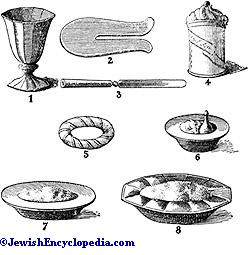
The operation up to very recent times was exclusively performed by laymen, to whom the act had been taught by others who, by experience, had acquired the necessary knowledge and skill. The tests of a good operator, or "mohel" (circumciser), were that he should perform his work quickly, safely as to its immediate effect, and successfully as to the condition which the parts would permanently assume. As a rule, the majority of these operators developed great dexterity; and accidents were remarkably rare. In case the glans was not sufficiently exposed after the healing process was completed, much anxiety was occasioned; for in some exceptional instances a second operation was resorted to.
The operation consists of three parts: "milah," "peri'ah," and "meẓiẓah."
Milah:
The child having been placed upon a pillow resting upon the lap of the godfather or "sandeḳ" (he who is honored by being assigned to hold the child), the mohel exposes the parts by removal of garments, etc., and instructs the sandeḳ how to hold the child's legs. The mohel then grasps the prepuce between the thumb and index-finger of his left hand, exerting sufficient traction to draw it from the glans, and places the shield (see Fig. 1, next column) in position just before the glans. He now takes his knife and with one sweep excises the foreskin. This completes the first act. The knife (see Fig. 3) most commonly used is doubleedged, although one like those ordinarily used by surgeons is also often employed.
Peri'ah:
After the excision has been completed, the mohel seizes the inner lining of the prepuce, which still covers the glans, with the thumb-nail and index-finger of each hand, and tears it so that he can roll it fully back over the glans and expose the latter completely. The mohel usually has his thumb-nail suitably trimmed for the purpose. In exceptional cases the inner lining of the prepuce is more or less extensively adherent to the glans, which interferes somewhat with the ready removal; but persistent effort will overcome the difficulty.
Modern Implements of Circumcision. 1. Shield 2. Mouthpiece. 3. knife. 4. Cup for Meẓiẓah.Meẓiẓah:
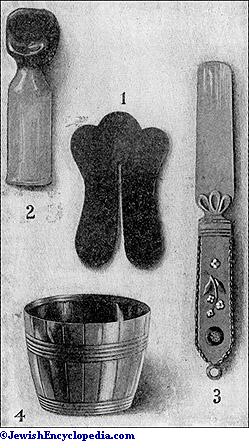
By this is meant the sucking of the blood from the wound. The mohel takes some wine in his mouth and applies his lips to the part involved in the operation, and exerts suction, after which he expels the mixture of wine and blood into a receptacle (see Fig. 4, below) provided for the purpose. This procedure is repeated several times, and completes the operation, except as to the control of the bleeding and the dressing of the wound. The remedies employed for the former purpose vary greatly among different operators and in different countries. Astringent powders enter largely into these applications. In North Germany the following mixture is extensively used: dilute sulfuric acid, one part; alcohol, three parts; honey, two parts; and vinegar, six parts. A favorite remedy with many operators is the tincture of the chlorid of iron, which is a recognized efficient styptic. These solutions areapplied by means of small circular pieces of linen with openings in the center, into which the glans is placed, and the dressing is closely applied to the parts below. This is secured in its place by a few turns of a small bandage. A diaper is now applied, and the operation is finished. The dressings are usually allowed to remain until the third day. The nurse in the mean time is instructed to apply olive-oil, plain or carbolized. When the parts are then uncovered the wound will in most cases have healed.
To guard against any mishap through suppuration or erysipelas, the genitals should be washed with soap and water, and afterward with a solution of bichlorid of mercury, 1 to 2,000. The mohel should deal similarly with his hands, and especially with his nails, using a nail-brush; and all the instruments to be used should be immersed in boiling water for about five minutes. The dressings should consist of sterile or antiseptic gauze or similar material. All the preparations relating to the dressings, the instruments, and the hands of the operator should be made before the child is brought into the room in which the operation is to be performed, in order to avoid unnecessarily prolonging the anxiety of the mother. A basin with the bichlorid of mercury solution should be at hand, into which the operator may dip his hands immediately before he begins his work.
Precautions to Be Observed.
Care must be exercised in grasping and making traction on the foreskin just before the knife is used. The outer layer is much more elastic than the inner; and if the outer and inner layers are not held firmly together at the margin, it may happen in making traction that the outer layer may become folded upon itself, with the result that the cut will remove a circular piece of skin just behind the edge of the foreskin. Of course this will require the subsequent removal of the remaining edge.
Some operators dispense with the shield, but this is not to be commended; for it will expose the child to the risk of having a piece of the glans cut off, and to dangerous bleeding in consequence.
When the operator uses his nails to tear the inner layer (peri'ah), he should be careful to have them absolutely clean. Should they not have the requisite shape or firmness, or should he prefer avoiding any risk attaching to that method, two pairs of short forceps may with advantage be substituted, and are now often used. The tear should be made carefully, so that it will not deviate greatly from the median line, and should not be carried back too far; for at the margin of the corona it might give rise to unnecessary bleeding. When the inner lining is tough, or bound down by adhesions, a probe-pointed scissors may be used for the peri'ah. Drs. Kehlberg and Löwe recommend the use of the scissors in all cases; claiming that the wound made by them is more favorable, and infection less liable. Against this, however, is the well-established principle in surgery that a lacerated wound is less apt to bleed than one made by a sharp instrument.
Danger of Meẓiẓah.
Considerable opposition has of late years been made against the meẓiẓah on the ground that it is entirely in conflict with the aseptic treatment of wounds, which should be adhered to in all instances, but more especially in consequence of a case in Cracow in which it became known that syphilis was communicated to a large number of Jewish children through an infected condition of the mohel's mouth (Glassberg, "Die Beschneidung," p. 27). The result has been that a number of mohels have discarded the meẓiẓah altogether. The majority of Jews, however, remain averse to such an innovation, the more so because it is condemned by the Orthodox rabbis. As a compromise, which has received satisfactory ecclesiastical authority, a method has been adopted which consists in the application of a glass cylinder that has a compressed mouthpiece, by means of which suction is accomplished. Before the cylinder is applied a small quantity of sterilized absorbent cotton is placed in the mouthpiece, which effectually protects both the child and the operator.
Articles Used in Circumcision. 1. Knife. 2. Platter, bearing as inscription Gen. xxi. 4. 3. Handle of platter.(In the Musée de Cluny, Paris.)
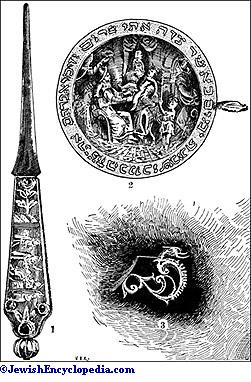
The inner layer, when it is folded back after its laceration, meets with the outer retracted layer, and the application of the dressing will satisfactorily keep the edges in fair apposition. Drs. Kehlberg and Löwe, in an article in Glassberg's work, recommend the closing of the wound by stitches after the method practised in surgery and known as the continuous suture. There are two objections to this treatment of thewound. It prolongs the operation unnecessarily, and entails the annoyance of removing the sutures when the union of the wound has taken place.
The sponge, which has almost invariably been made use of for cleansing the parts (which are more or less covered with blood), should be entirely discarded. It has been found difficult to keep sponges surgically clean; and pledgets of sterile gauze—fresh ones for every case—are to be preferred.
Treatment of Wound.
The most important consideration after the completion of the operation is to guard against hemorrhage. When the wound is limited to the prepuce itself, hemorrhage need not be dreaded; for the pressure of the simple dressings alone will be sufficient to control it effectually. Many operators apply a little tincture of iron, to which there can be no serious objection; for it is the most reliable of the remedies usually applied for the arrest of hemorrhage. The mohel should remain with the child for at least an hour to be perfectly satisfied that no hemorrhage follows, and to stop it should it occur. If the bleeding does not proceed from an artery, the tincture of iron with somewhat firmer pressure of the bandage will usually prove satisfactory. Should the bleeding come in jets, a catch-artery forceps must be applied, which acts as a clamp; and a surgeon should be sent for, as a ligature may be needed.
There is one form of bleeding which has thus far not been mentioned, and which needs consideration. It is well known that there are individuals who bleed very profusely and very persistently upon the slightest provocation. The old rabbis must have known of this condition; for they taught that, when a mother lost two children from circumcision, those that might be born afterward should not be subjected to the operation. This abnormal tendency to bleeding is of hereditary character. It is transmitted through the mother and through the daughters of such a mother. The son, who might be a bleeder himself, will not transmit it to his children. Should such a condition be met with in circumcision, the ordinary methods for the arrest of hemorrhage must not be relied upon. The actual cautery will have to be resorted to, or a short piece of a metal or hard flexible catheter must be inserted in the urethra and firm pressure applied by means of a bandage. The catheter has the advantages of not interfering with urination, and of offering a firm surface for the application of pressure. It goes without saying that mechanical provisions must be made to prevent the catheter from slipping either in or out.
As illustrating the extreme rarity of disasters as a consequence of the hemorrhagic diathesis in circumcision, Dr. A. B. Arnold writes that in an experience of more than 1,000 cases he met with one case only ("New York Medical Journal, "Feb. 19, 1886).
It happens not infrequently that the attending physician, on account of some unfavorable condition of the child, advises a postponement of the operation. The Jewish law sanctions such a proceeding until the child has fully recovered its health.
The following reasons for postponing the operation are enumerated by Drs. Kehlberg and Löwe: "pronounced feebleness of the child, febrile conditions, obstinate diarrhea, refusing to take the breast, diseased conditions of the skin, general or local convulsions or jerkings, inflammation of the eyes or eyelids, fungous excrescences in the mouth, very frequent vomiting, continued sleeplessness" (Glassberg, l.c. p. 36).
Circumcision among the Jews has been accepted and adhered to simply as a religious rite; but it is of interest to make manifest the advantages that accrue to the individual from having the prepuce removed in early life.
Medical Advantages of Circumcision.
Sometimes the physiological changes in the prepuce are interfered with and it can not be retracted at all, or only to a partial degree. These conditions are termed respectively complete and partial phimosis. Phimosis is followed by a train of disturbances more or less serious in character; one of the most frequent troubles arising from this cause being interference with the emptying of the bladder. As a result of phimosis, or even of the ordinary exudations, inflammation of the inner lining of the prepuce and the covering of the glans is extremely liable to arise. This inflammation, termed balanitis, will cause pain, especially during urination, and will have a tendency to increase the impediment to the voiding of urine.
Various authors enumerate a number of other troubles due to phimosis; viz., habitual wetting of the bed by children, masturbation, prolapse of the rectum, hernia, and hydrocele, the latter three conditions being excited by the excessive pressure exerted by the abdominal muscles in overcoming the resistance of the prepuce to the flow of urine.
Paraphimosis.
An even more severe form of inflammatory change is known under the name of paraphimosis, which at times leads to ulceration of the parts or even gangrene.
The glans in the circumcised, besides being uncovered, presents another change to which considerable importance has been attached. The covering of the glans, which before had the character of a mucous membrane, on being exposed assumes the properties of true skin, which is less vulnerable, and on theoretical grounds alone leads to the inference that it is less liable to syphilitic infection. In addition to this, however, there has been weighty authority which bases this opinion on a wide experience. That it offers some protection, there can be no doubt; but the present writer has observed too many cases of primary syphilis in the circumcised to warrant the assumption that circumcision offers any very decided immunity.
A communication was made to the convention of the American Medical Association in 1870 by Dr. Lewis A. Sayre, in which he demonstrated that partial paralysis might result from congenital phimosis and adherent prepuce, and could be removed by circumcision. In 1887 Dr. Sayre, at the Ninth International Medical Congress, gave the testimony of a large number of other observers, who corroborated his own.
Bibliography:
J. Bergson, Die Beschneidung, Berlin, 1844;
L. Terquens, La Circoncision, Paris, 1844 (German translation by Heymann, Magdeburg, 1845);
A. Asher, Jewish Rite of Circumcision, London, 1873;
M. Baum, Der Theoretisch Praktische Mohel, Frankfort-on-the-Main, 1884;
A. Glassberg, Die Beschneidung in Ihrer Geschichtlichen, Ethnographischen. Religiösen, und Medicinischen Bedeutung, Berlin, 1896;
Travers, Observations on the Local Discases Termed Malignant, in Medico-Chirurgical Transactions, xvii. 336, London, 1832.
—Among the Arabs:
It is difficult to determine whether Mohammed deemed circumcision ("khitan" or "taṭhir") to be a national custom of no religious importance, and therefore did not mention it in the Koran, or whether he judged the prescription of a rite that had been performed by the Arabs from time immemorial to be superfluous. Abulfeda counts circumcision among the rites of pagan Arabia that were sanctioned by Islam ("Historia Ante-Islamitica," ed. Fleischer, p. 24). Ibn al-Athir, in his ante-Islamic history, attributes to Mohammed the following words: "Circumcision is an ordinance for men, and honorable for women." On the other hand, the traditionalist Hurairah reported on the part of the prophet that circumcision is one of the observances of "fiṭrah" (natural impulsion), and has consequently no religious character ("Ṣaḥiḥ al-Bukhari," p. 931). Be that as it may, circumcision became in Islam a religious obligation, to which every one was required to submit.
Age.
The difference of opinion which prevails among the historians and traditionalists as to the character of the rite before Mohammed, prevails also as to the age at which circumcision had to be performed. According to Josephus, the Arabs circumcised after the age of thirteen, "because Ishmael, the founder of their nation, was circumcised at that age" (Josephus, "Ant." i. 12, § 2). Ibn al-Athir and many other Arabic authorities assign different ages. It is probable that there existed no regulation as to age; and each locality followed its own custom. Thus, in Yemen, where Jews exercised great influence, the Arabs circumcised their children on the eighth day after birth (compare Pocock, "Specimen Historiæ Arabum," pp. 319 et seq.). The Mohammedan law recommends circumcision between the ages of seven and twelve years, but it is lawful to circumcise a child seven days after its birth. The circumcision of females is also allowed, and is commonly practised in Arabia.
The operation on males is generally performed by a barber, in the following manner: The operator seizes with the forefinger and thumb of the left hand the summit of the prepuce, which he fastens with a string provided with a knot. This string is passed through a hole made in a disk of hardened leather. The operator then makes with a razor or scissors a circular section of the prepuce between the knot and the disk. The hemorrhage which follows is stopped by the application of burned rags and ashes. In India a bit of stick is used as a probe, and carried round and round between the glans and prepuce, to ascertain the exact extent of the frenum, and that no unnatural adhesions exist. No splitting ("peri'ah") is known to the Arabs, as is attested by Simon ben Ẓemaḥ Duran, who expresses himself as follows: "Mohammed sanctioned also circumcision that the Arabs performed since the time of Abraham, as is said in the Talmud: 'A circumcised Arab'; but he adopted it without peri'ah ("Ḳeshet u-Magen," 19b).
Ceremonies.
The ceremonies preceding circumcision give to this act the character of a religious initiation. After having performed the prescribed ablutions, the candidate makes his confession before the imam, and a new name is added to his former one. As among Jews, circumcision is followed among Mussulmans by feasting and rejoicing. The custom among Orthodox Jews in Russia and Poland, of inviting pious men to spend the night preceding circumcision in prayer and study in the house in which the ceremony is to take place, finds a striking parallel in that current among the Mussulmans of Egypt, where priests are hired to recite prayers in the house of the candidate the night before the ceremony. That night is called "lailah al-kabirah" (the great night), in opposition to the preceding night, "lailah al-ṣaghirah" (the small night), in which an entertainment is given to friends.
Bibliography:
Pocock, Specimen Historiœ Arabum, pp. 319 et seq.;
Millo, Histoire du Mahométisme, p. 350;
Hoffmann, Beschneidung, in Ersch and Gruber, Encyc.;
Steinschneider, Die Beschneidung der Araber und Muhammedaner, in Glassberg, Die Beschneidung;
Jolly, Etude Critique du Manuel Opératoire des Musulmans et des Israélites, Paris, 1899.
CIRCUMCISION.—This rite is not of Israelite origin; there are some good grounds for the belief that it came to the Israelites from the Egyptians. The fact of a flint being used for its performance (Jos 5:2-3) witnesses to the immense antiquity of the rite. Its original meaning and object are hidden in obscurity, though the theory that it was regarded as a necessary preliminary to marriage has much to commend it. Among the Israelites it became the sign of the Covenant People; whoever was uncircumcised could not partake of the hopes of the nation, nor could such join in the worship of Jahweh; he could not be reckoned an Israelite (Gen 17:14). Not only was every Israelite required to undergo circumcision, but even every slave acquired by the Israelites from foreign lands had likewise to be circumcised (Gen 17:12-13); according to Exo 12:48-49 even a stranger sojourning in the midst of Israel had to submit to the rite, at all events if he wished to join in the celebration of the Passover. Originally male children were not circumcised in Israel (cf. Jos 5:5-9), but boys had to undergo it on arriving at the age of puberty; but in later days the Law commanded that every male child should be circumcised on the eighth day after birth (Lev 12:3).
In the OT there are two accounts as to the occasion on which circumcision was first practised by the Israelites; according to Gen 17:10-14 the command was given to Abraham to observe the rite as a sign of the covenant between God and him, as representing the nation that was to be; while according to Exo 4:25-26 its origin is connected with Moses. It was the former that, in later days, was always looked upon as its real origin; and thus the rite acquired a purely religious character, and it has been one of the distinguishing marks of Judaism ever since the Exile. The giving of a name at circumcision (Luk 1:59; Luk 2:21) did not belong to the rite originally, but this has been the custom among Jews ever since the return from the Captivity, and probably even before.
In the early Church St. Paul had a vigorous warfare to wage against his Judaizing antagonists, and it became a vital question whether the Gentiles could be received into the Christian community without circumcision. As is well known, St. Paul gained the day, but it was this question of circumcision, which involved of course the observance of the entire Mosaic Law, that was the rock on which union between the early Christians and the Judaizing Christians split. Henceforth the Jewish and the Christian communities drifted further and further apart.
Circumcision in its symbolic meaning is found fairly frequently in the OT; an ‘uncircumcised heart’ is one from which disobedience to God has not been ‘cut off’ (see Lev 26:41, Deu 10:16; Deu 30:6); the expression ‘uncircumcised lips’ (Exo 6:12; Exo 6:30) would be equivalent to what is said of Moses, as one who ‘spake unadvisedly with his lips’ (Psa 106:33, cf. Isa 6:5); in Jer 6:10 we have the expression ‘their ear is uncircumcised’ in reference to such as will not hearken to the word of the Lord. A like figurative use is found in the NT (e.g. Col 2:11; Col 2:13).
W. O. E. Oesterley.
(Latin: circumcisio, a cutting around, specifically the removal of the foreskin from the penis) Was once widely practised, whether as a rite of religious import, for physical well-being, or as a ceremony of varying significance. It was venerated by the Jews as of sacramental meaning due to its institution by God as a sign of the covenant between Himself and Abraham and to be practised on Abraham and his nation (Genesis 17). The Child Jesus was circumcised out of reverence for the Law (Luke 2)
The Hebrew word, like the Greek (peritome), and the Latin (circumcisio), signifies a cutting and, specifically, the removal of the prepuce, or foreskin, from the penis. The number and variety of tribes and nations who practised it are surprising; a conservative estimate places the number that practise it in our day at two hundred millions. Herodotus says that the Egyptians, Colchians, and Ethiopians, from very early times, were circumcised; and he mentions other races, the Phoenicians and Syrians of Palestine (the Jews, as Josephus maintains), who say that they learned the use of circumcision from the Egyptians (Herod., II, 104; Jos., C. Ap., I, 22). Even some Christians circumcise their children, the Copts, for instance, and the Abyssinians, in Africa; and among the Filipinos, the same may be said of most of the Tagalos, who are Catholics. To these last, however, it is a mere ceremony without religious import. The Mohammedan Moros may have introduced it into the islands, where it remains, notwithstanding centuries of Christian influence against it (C. N. Barney, see bibliography). The Abyssinians are entirely under Jewish influence, though they profess Christianity: they observe the Jewish Sabbath, circumcise on the eighth day, and observe many other usages. (See Andree, cited below, p. 189.) Andree states also that the custom of circumcising is found in Sumatra (pp. 191, 192), the east coast of New Guinea (p. 197), and among the Samoans, who call Europeans "the uncircumcised". Even in America, circumcision was in use among the Aztec and Maya races (op. cit. 201, 202). The fact of its existence in Australia (Spencer and Gillen, Tribes of Central Australia, p. 218 sq.), and in a great part of the islands of Oceanica, not to speak of America, would seem to throw some doubt on the assertion of Herodotus that it had its origin in Egypt.It is not easy to assign satisfactory reasons for a usage so general. Those who think it was a tribal mark, like tattooing, or the knocking out of the front teeth, should consider that such marks are usually conspicuous. Was it connected with phallic worship, and thus regarded as an offering to the deity of fertility? or was it, as some think, a substitute for human sacrifice? From the fact that the priests in Egypt were, beyond question, circumcised (G. Rawlinson -- Ancient Egypt, vol. I, p. 452), as also from the fact that the upper classes among the Aztec and Celebes tribes made use of it, we may conclude that circumcision was not looked upon as a mark of slavery or subjection, but rather of nobility and superiority. Father Lagrange holds that it had a religious significance, and that, as it is not referred to in Chaldean monuments, it was not a protosemitic practice, but may have had its origin in Arabia (Etudes sur les religions sémitiques, 1903, pp. 239-243).Merely utilitarian motives have been assigned by many: even Philo (De Circumcisione, II, 211, ed. Mangey) gives cleanliness, freedom from disease, offspring, and purity of heart, this last the only mystical or sacramental one among the four, which Herodotus also mentions as the motive of the Egyptians, kathariotetos eineka (II, 37). Physicians prescribe circumcision in certain cases, for instance, to guard against phimosis, balanitis, and other such evils; further, Rosenzweig recommended its general adoption in the Prussian army (Zur Beschneidungsfrage, 1878). That the ceremony had some relation to initiation into manhood, at the marriageable age, seems to receive support from the custom of certain tribes of being circumcised at the age of puberty; and also from the fact that the Arabic word khatan signifies to circumcise and to be allied by marriage.It is strange that the universal practice of circumcision among those who profess Mohammedanism is neither based upon, nor sanctioned by, the Koran. Was this silence observed by the Prophet of Islam because there was no need of prescribing what already had the force of law or, perhaps, because it did not seem to him to have any religious significance? However we explain his silence, tradition, by appealing to his authority, soon gave to the practice all the weight of his sanction. The age at which the Arabs were circumcised was, according to Josephus (Ant., I, xii, 2), thirteen years, in imitation of Ismael (Gen. xvii, 25). At present the regular time for circumcising Mohammedan children is between the ages of seven and twelve years. The Bedouin tribes too, though not scrupulous Islamites, have adhered faithfully to this usage of their forefathers. A short description of the ceremony of circumcision among the nomads of the Sinaitic peninsula may be read in the "Palestine Exploration Fund, Quarterly Statement" (Jan., 1906, p. 28). The writer says that the ceremony has "nothing religious" about it: yet, as he states, the beginning of the Koran is recited on the occasion.The relation, if there be any, between Gentile and Jewish circumcision is an interesting subject. The clear statement of the Bible that circumcision was given to Abraham, as "a sign of the covenant" (Gen. xvii, 11), need not compel us to believe that hitherto it was unknown in the world. Like the law of clean and unclean, in food and daily life, it may be regarded as a practice of venerable antiquity that was adopted and adapted to express what it had not expressed before. The rainbow existed from the first days of rain and sunshine, for it is the result of both, but the Lord gave its future significance to Noe. The same is true of incense, sacrifice, and lustral water, which, though found very early among nations not in touch with revelation, are yet prescribed by Divine ordinance and used in Divine worship. If, therefore, we question the assertion of Herodotus, that circumcision was of Egyptian origin, and was adopted from the Egyptians by surrounding nations, and, among these, by the Syrians. (Jews) of Palestine, it is not because of theological scruples, but rather because of lack of argument. Whatever may be said about Herodotus as a witness in matters that fell under his personal observation, when he argues, his authority is only in proportion to the weight of his arguments, and these are, in many instances, mere conjectures. Artapanus, quoted by Eusebius (Præpar. Evan., IX, xxviii), goes so far as to say that the Egyptians adopted the practice of circumcision from Moses.The illustration of the ceremony of circumcision pictured on the ruins of Karnak, is probably later than the going down of Israel into Egypt. It is given in Andree’s work, pp. 187, 188 (see below); and also in Ebers, "Aegypten etc.", pp. 278-284 (see below), who, moreover, discusses the inferences to be drawn from the finding of a circumcised mummy. We may safely say, however, that up to our time the monuments of antiquity furnish no conclusive proof that circumcision was practised anywhere prior to the Biblical date, at which God made it "a sign of the covenant" between Himself and Abraham (Genesis 17:11). To the Jews it had a sacramental meaning, derived from its Divine institution and sanction. As Isaac, so their children were circumcised on the eighth day, according to the law: "An infant of eight days old shall be circumcised among you, every man child in your generations: he that is born in the house, as well as the bought servant shall be circumcised, and whosoever is not of your stock: And my covenant shall be in your flesh for a perpetual covenant. The male, whose flesh of his foreskin shall not be circumcised, that soul shall be destroyed out of his people: because he hath broken my covenant" (Genesis 17:12-14; 21:4). For some reason, not given in the text, Moses while in Madian neglected to circumcise his son, Eliezer, on which account God "would have killed him", i.e. not Eliezer, as some think, but Moses, as the passage indicates. Sephora, having taken a sharp stone, circumcised her son with it, and said, "a bloody spouse art thou to me"; whereupon the Lord "let him go" (Exodus 4:24-26). The Greek reading, "the blood of my son’s circumcision has ceased to flow", is obscure. Sephora very probably meant that by what she had done she had saved the life of her husband and confirmed their marriage by the shedding of blood.During the sojourn of forty years in the desert the law of circumcision was not observed, as the changes incident to nomadic life, in so large a community, made its observance almost impossible. When, however, the people came into the Land of Promise, the Lord said to Josue: "Make thee knives of stone, and circumcise the second time the children of Israel" (Joshua 5:2). The second time, i.e. renew the practice which had been omitted during the nomadic period. As Sephora used a stone knife, so on this occasion stone knives were used, which is a proof that the events narrated are of great antiquity. The words of the Lord to Josue, "This day have I taken away from you the reproach of Egypt", seem to refer not to circumcision, as some think, but to the disgrace of being slaves to the Egyptians, contrasted with the honour of entering into the true liberty of the children of God. Josephus interprets them in this sense: "Now the place where Joshua pitched his camp was called ’Gilgal’, which denotes ’liberty’, for since now they had passed over Jordan, they looked upon themselves as freed from the miseries which they had undergone from the Egyptians, and in the wilderness" (Ant., V, i, 11). Many modern scholars, however, translate Gilgal, "a rolling away", "circle" (Gesenius, s. v.), and think that the Heb. text of Josue (v, 9), "I have rolled away from you the reproach of Egypt", refers to the removal of the disgrace of uncircumcision; for at that time, they suppose, most of the Egyptians, and not a few Jews while in Egypt, were uncircumcised. The law was clear and peremptory: "The uncircumcised shall be destroyed out of his people" (Genesis 17:14); and for both Jews and strangers circumcision was a necessary preparation for eating the paschal lamb (Exodus 12:48). "i>Arel, "uncircumcised", is frequently used as a term of reproach, i.e. profane, unclean (<a href=../bible/jdg015.htm#18>Judges 15:18; <a href=../bible/1ki014.htm#6>1 Kings 14:6, <a href=../bible/1ki017.htm#36>17:36, <a href=../bible/1ki031.htm#4>31:4; <a href=../bible/isa052.htm#1>Isaiah 52:1; <a href=../bible/eze028.htm#10>Ezekiel 28:10, <a href=../bible/eze032.htm#25>32:25, 26, etc.). The school of Shammai, therefore, was conservative, insisting on the rigorous observance of the law, while that of Hillel, was more inclined to leniency, in dealing with proselytes and strangers. Josephus, in the advice of Eleazer and Ananias to Izates, King of Adiabene, gives the views of the rigorists and the laxists in reference to the necessity of circumcision (Ant., XX, ii, 4; cf. Graetz, Geschichte d. Juden, III, pp. 172 sqq.). The rigorous doctrine was adopted by John Hyrcanus, who compelled the Idumeans to be circumcised. They received, moreover, the entire Jewish Law; so that Josephus says "they were hereafter no other than Jews" (Ant., XIII, ix, 1). Therefore, the fact that <a href=07289c.htm>Herod was an Idumean helped him to the throne. The Itureans also were forced "to live according to the Jewish laws" (Jos., Ant., XIII, xi, 3).Long before this, many of the Persians were circumcised and "became Jews, for the fear of the Jews had fallen upon them" (<a href=../bible/est008.htm#17>Esther 8:17, Heb. text; Josephus, Ant., XI, 6:13). The Book of Jubilees insists upon he strict observance of the law, and protests against those that "make the members of their body appear like those of the gentiles" (xv, 26, 27). During the period of Greek rule in Palestine, when those that kept the laws of Moses were put to death by the gentile tyrants (<a href=../bible/1ma001.htm#63>1 Maccabees 1:63; <a href=../bible/2ma006.htm#10>2 Maccabees 6:10), some Jews, under Greek influence, "made themselves prepuces" and turned away from the ways and traditions of their fathers (<a href=../bible/1ma001.htm#15>1 Maccabees 1:15, 16; Joshua Ant., XII, 5:1). To this epispastic operation performed on the athletes to conceal the marks of circumcision St. Paul alludes, me epispastho (<a href=../bible/1co007.htm#18>1 Corinthians 7:18). Therefore Jewish circumcision, in later times, tears the membrane that remains after circumcision given in the ordinary way, among the Arabs for instance, and thus defeats even the surgeon’s skill.In our day many Jews are not so zealous in keeping the law as their fathers were; nor do they think it necessary to have the "sign of the covenant" in their flesh. The ceremony is considered cruel, nor has it any sacramental import in Jewish national life. The Reform movement at Frankfort-on-the-Main, 1843, considered it an unnecessary element of Judaism. This lax doctrine could find no stronger expression than in the case of Chief Rabbi Einhorn of Mecklenburg, who in 1847 defended his having named and consecrated an uncircumcised child in the synagogue, as a child, even though uncircumcised, born of Jewish parents, enjoys all the privileges and assumes all the obligations of a Jew. (See Jewish Encyl., s. vv. Circumcision, Einhorn.)Neither place nor minister is designated in the law of circumcision. The mother sometimes, oftener the father, circumcised the child. Later, one skilled in the operation, called a Mohel, usually a surgeon, performed it. In Josephus, Ant., XX, ii, 4, we read that Izates, the King of Adiabene, wishing to live as a Jew, "sent for a surgeon" and was circumcised, evidently at home, as in modern times also the ceremony may take place either at home or usually in the synagogue. The eighth day was prescribed, even should it be the Sabbath (see <a href=../bible/joh007.htm#22>John 7:22-23). A name was given, as in Luke, i, 59, ii, 21, to commemorate the change of the patriarch’s name from Abram to Abraham, when God made the covenant with him and made circumcision the sign of it (<a href=../bible/gen017.htm#5>Genesis 17:5). In the ceremony, the one that holds the child is called Sandek, from the Greek synteknos, equivalent to our godfather in baptism; and as Elias was a zealous champion of the law, for which he suffered much, there is a vacant chair for him at every circumcision.The Jews were proud of their descent from Abraham, but did not always "do the works of Abraham" (<a href=../bible/joh008.htm#39>John 8:39). They attached so much importance to the external act, that while attending to the letter they neglected the spirit of the law. Jeremias (iv, 4; ix, 25, 26) calls their attention to the necessity of circumcision of the heart, as all important. Even in Deut., x, 16, xxx, 6, this spiritual circumcision is set forth in no uncertain language. As uncircumcision means profane, unclean, imperfect, "I am of uncircumcised lips" (<a href=../bible/exo006.htm#12>Exodus 6:12), "their ears are uncircumcised" (<a href=../bible/jer006.htm#10>Jeremiah 6:10), and was applied to inanimate things also, as in Lev., xix, 23, "the fruit that cometh forth shall be unclean [Heb. uncircumcised] to you", so to circumcise the heart (<a href=../bible/rom002.htm#29>Romans 2:29) means to reform the inner man, by cutting off the vices and correcting the disorders that make him displeasing in the sight of God. To leave the synagogue was to give up that which more than anything else characterized it (see <a href=../bible/gal002.htm#7>Galatians 2:7-8). Yet St. Paul, while showing his freedom from the legalities of the Old Dispensation by not circumcising Titus (<a href=../bible/gal002.htm#3>Galatians 2:3), wished to bury the synagogue with honour by subjecting Timothy to the law of circumcision (<a href=../bible/act016.htm#3>Acts 16:3). Even though Christ Himself, as a true son of Abraham, submitted to the law, His followers were to be children of Abraham by faith, and were to "adore the Father in spirit and in truth" (<a href=../bible/joh004.htm#23>John 4:23). The Council of Jerusalem decided against the necessity of the rite, and St. Paul, in his Epistle to the Galatians, condemns the teachers that wished to make the Church of Christ only a continuation of the synagogue: "Behold, I Paul tell you, that if you be circumcised, Christ shall profit you nothing" (v, 2). Here he refers to the supposed efficacy and necessity of circumcision, rather than to the mere ceremony; for he did not consider it wrong to circumcise Timothy. It was wrong, however, for the Galatians, having been baptized, and having taken upon themselves the obligations of the law of Christ with all its privileges, to be circumcised as a necessary means of salvation, since, by going for salvation from the Church to the Synagogue, they virtually denied the sufficiency of the merits of Christ (cf. Piconio, "Trip. Exp. in Gal.," v, 2). The Apostle gives the essence of Christianity when he says: "In <a href=08374c.htm>Christ Jesus neither circumcision availeth any thing, nor uncircumcision: but faith that worketh by charity" (<a href=../bible/gal005.htm#6>Galatians 5:6). In his Epistle to the Romans, iv, he shows that Abraham was justified by faith, before circumcision was given as a sign of the covenant; so that the uncircumcision of the New Law is the continuation of the first ages of faith upon the earth. The gentile church of uncircumcision, according to <a href=06780a.htm>St. Gregory the Great, is composed of men from the time of Abel the Just to the end of ages (Hom. xix in Evan.). <a href=08580c.htm>St. Justin also says that as Henoch and the just of old received the spiritual circumcision, so do we receive it in the Sacrament of Baptism (Dial. cum Tryph., n. xliii).St. Thomas holds that circumcision was a figure of baptism: this retrenches and restrains the animal man as that removed a part of his body -- which physical act indicated the spiritual effect of the sacrament (De Sac., Summa, III, Q. lxx, a. 1). He gives three reasons why the organ of generation rather than any other was to be circumcised: <ul> <li>Abraham was to be blessed in his seed; <li>The rite was to take away original sin, which comes by generation; <li>It was to restrain concupiscence, which is found especially in the generative organs (III, Q. lxx, a. 3). </ul> According to his teaching, as baptism remits original sin and actual sins committed before its reception, so circumcision remitted both, but ex opere operantis, i.e. by the faith of the recipient, or, in the case of infants, by the faith of the parents. Infants that died before being circumcised could be saved, as were those who lived prior to the institution of circumcision, and as females were even after its institution, by some sign -- the parents’ prayer, for instance -- expressive of faith. Adults did not receive the remission of all the temporal punishment due to sin as in baptism: -- "Adulti, quando circumcidebantur, consequebantur remissionem, non solum originalis peccati, sed etiam actualium peccatorum; non tamen ita quod liberarentur ab omni reatu p næ, Sicut in baptismo, in quo confertur copiosior gratia" (III, Q. lxx, a. 4). The main points of the teaching of the <a href=14663b.htm>Angelic Doctor were commonly held in the Church, even before the days of St. Augustine, who with other Fathers maintained that circumcision was not a mere ceremony, but a sacramental rite. (Cf. De Civ. Dei, xvi, 27.)<!--CLIP--><!-- google_ad_section_end -->-----------------------------------<center><script language="javascript" src="../../newadvent.catholiccompany.com/na2.js"></script></center><font size=-2>Authorities, Patristic and Scholastic, may be found in DE AUGUSTINIS, De Re Sacram., I, par. i, art. ii, th. iii. ASHER, The Jewish Rite of Circumcision. (London, 1873); SCHECHTER, Studies in Judaism (1896), 288, 89, 343; REMONDINO, History of Circumcision (Phila. and London, 1891); ANDREE, Ethnographische Parallelen und Vergleiche (Leipzig, 1889), Beschneidung, pp. 166-213; BARNEY, Circumcision and Flagellation among the Filipinos (Carlisle, Pa., 1903); ARNOLD, Circumcision in New York Medical Jour. (Feb. 13, 1886); EBERS, Aegypten und die Bücher Moses (Leipzig, 1868); MACALESTER in HASTINGS, Dict. of the Bible, s.v.</font>JOHN J. TIERNEY <br>Transcribed by Douglas J. Potter <br>Dedicated to the Sacred Heart of Jesus Christ <p align=center><font size=-2>The Catholic Encyclopedia, Volume III<br>Copyright © 1908 by Robert Appleton Company<br>Online Edition Copyright © 2003 by K. Knight<br>Nihil Obstat, November 1, 1908. Remy Lafort, S.T.D., Censor<br>Imprimatur. +John Cardinal Farley, Archbishop of New York</font></p>
1. Circumcision in the Old Testament
In the account of the institution of the covenant between Yahweh and Abraham which Priestly Code (P) gives (Gen 17), circumcision is looked upon as the ratification of the agreement. Yahweh undertook to be the God of Abraham and of his descendants. Abraham was to be the father of a multitude of nations and the founder of a line of kings. He and his descendants were to inherit Canaan. The agreement Thus formed was permanent; Abraham’s posterity should come within the scope of it. But it was necessary to inclusion in the covenant that every male child should be circumcised on the 8th day. A foreigner who had attached himself as a slave to a Hebrew household had to undergo the rite - the punishment for its non-fulfilment being death or perhaps excommunication. According to Exo 12:48 (also P) no stranger could take part in the celebration of the Passover unless he had been circumcised. In the Book of Josh (Exo 5:2-9) we read that the Israelites were circumcised at Gilgal (“Rolling”), and Thus the “reproach of Egypt” was “rolled away.” Apparently circumcision in the case of the Hebrews was prohibited during the Egyptian period - circumcision being a distinctive mark of the ruling race. It is noticeable that flint knives were used for the purpose. This use of an obsolete instrument is one of many proofs of conservatism in religion. According to the strange and obscure account of the circumcision by Zipporah of her eldest son (Exo 4:25) the performance of the rite in the case of the son apparently possesses a vicarious value, for thereby Moses becomes a “bridegroom of blood.” The marriage bond is ratified by the rite of blood (see 4 below). But it is possible that the author’s meaning is that owing to the fact that Moses had not been circumcised (the “reproach of Egypt”) he was not fit to enter the matrimonial estate (see 3 below).
2. Theories of Origin
The different theories with regard to the origin of circumcision may be arranged under four heads: (1) Herodotus (ii.37), in dealing with circumcision among the Egyptians, suggests that it was a sanitary operation. But all suggestions of a secular, i.e. non-religious, origin to the rite, fail to do justice to the place and importance of religion in the life of primitive man.
(2) It was a tribal mark. Tattooed marks frequently answered the purpose, although they may have been originally charms. The tribal mark enabled one member of the tribe to recognize another and Thus avoid injuring or slaying a fellow-tribesman. It also enabled the tribal deity to recognize a member of the tribe which was under his special protection. A mark was placed on Cain to indicate that he was under the special protection of Yahweh (Gen 4:15). It has been suggested, in the light of Isa 44:5 the Revised Version, margin, that the employer’s mark was engraved (tattooed) on the slave’s hand. The prophet represents Jews as inscribing on their hands that they belong to Yahweh. The walls of Jerusalem are engraved on Yahweh’s palms (Isa 49:16). On the other hand “cuttings in the flesh” are prohibited in Lev 19:28 because they were common in the case of the non-Jewish religions. Such tattooed marks might be made in conspicuous places when it was necessary that they should be easily seen, but there might be reason for secrecy so that the marks might be known only to the members of the tribe in question.
(3) It was a rite which celebrated the coming of age of the person. It signified the attainment of puberty and of the right to marry and to enjoy full civic privileges.
(4) As human sacrifices began to be done away with, the sacrifice of the most easily removed portion of the anatomy provided a vicarious offering.
(5) It was a sacramental operation. “The shedding of blood” was necessary to the validity of any covenant between tribes or individuals. The rite of blood signifies the exchange of blood on the part of the contracting parties, and therefore the establishment of physical affinity between them. An alliance based on blood-relationship was inviolable. In the same way the tribal god was supposed to share in the blood of the sacrificed animal, and a sacred bond was established between him and the tribe. It is not quite obvious why circumcision should be necessary in connection with such a ceremony. But it may be pointed out that the process of generation excited the wonder and awe of primitive man. The prosperity of the tribe depended on the successful issue of the marriage bond, and a part of the body which had so much to do with the continuation and numerical strength of the tribe would naturally be fixed upon in connection with the covenant of blood. In confirmation of the last explanation it is urged that in the case of the covenant between Yahweh and Abraham circumcision was the rite that ratified the agreement. In opposition to (3) it has been urged that among the Hebrews circumcision was performed in infancy - when the child was 8 days old. But this might have been an innovation among the Hebrews, due to ignorance of the original significance of the rite. If circumcision conferred upon the person circumcised the right to the enjoyment of the blessings connected with membership in the tribe it was natural that parents should be anxious that such an initiatory act should be performed early in life. The question of adult and infant baptism is capable of similar explanation. When we examine explanations (2), (3), (4), (5), we find that they are really different forms of the same theory. There can be no doubt that circumcision was originally a religions act. Membership in the tribe, entrance upon the rights of citizenship, participation in the religious practices of the tribe - these privileges are interdependent. Anyone who had experienced the rite of blood stood within the scope of the covenant which existed between the tribe and the tribal god, and enjoyed all the privileges of tribal society. It is easily understood why the historian carefully relates the circumcision of the Israelites by Joshua on their arrival in Canaan. It was necessary, in view of the possible intermingling of the conquerors and the conquered, that the distinctive marks of the Abrahamic covenant should be preserved (Jos 5:3).
3. Spiritual Significance
In Jer 9:25 and Deu 30:6 we find the spiritual significance of circumcision. A prophet like Jeremiah was not likely to attach much importance to an external act like circumcision. He bluntly tells his countrymen that they are no better than Egyptians, Edomites, Moabites and Ammonites. They are uncircumcised in heart. Paul uses the term concision for this outward circumcision unaccompanied by any spiritual change (Php 3:2). The question of circumcision occasioned a protracted strife among the early Christians. Judaizing Christians argued for the necessity of circumcision. It was a reminiscence of the unrelenting particularism which had sprung up during the prolonged oppression of the Greek and Roman period. According to their view salvation was of the Jews and for the Jews. It was necessary to become a Jew in order to become a Christian. Paul consented to circumcision in the case of Timothy “because of the Jews” (Act 16:3). But he saw that a principle was at stake and in most of his epistles he points out the sheer futility of the contention of the Judaizers. (See commentaries on Romans and Galatians.)
4. Figurative Uses
In a few suggestive passages we find a figurative application of the term. For three years after the settlement in Canaan the “fruit of the land” was to be considered as “uncircumcised” (Lev 19:23), i.e. it was the property of the Baalim, the gods of Palestine The fruit of the fourth year belonged to Yahweh. Moses with characteristic humility describes himself as a man of “uncircumcised lips” (Exo 6:30). Jeremiah charges his contemporaries with having their ear uncircumcised (Jer 6:10) and their heart (Jer 9:26). “An uncircumcised heart is one which is, as it were, closed in, and so impervious to good influences and good impressions, just as an uncircumcised ear (Jer 6:10) is an ear which, from the same cause, hears imperfectly; and uncircumcised lips (compare Exo 6:12, Exo 6:30) are lips which open and speak with difficulty” (Driver on Deu 10:16).
The origin of circumcision and its practice by the Jews and other peoples may be studied in Hasting's Dictionary of the Bible (5 vols) and Encyclopaedia of Religion and Ethics . This article is concerned with the difficulties caused in the Apostolic Church by the desire of the Judaizing party to enforce the rite upon the Gentile Christians. The crisis thus brought about is described in Acts 15 and Gal_2:1-10.
As the work of the Church extended, the problem of the reception of Gentile converts presented itself for solution. Should such converts be compelled to be circumcised and keep the Mosaic Law or not? The answer to this question led to great difference of opinion and threatened to cause serious division in the Church. It must be remembered that the first Christians were Jews, born and brought up in the Law and taught to observe it. To them such rites as circumcision were almost second nature. To abrogate the Law of Moses was to them inconceivable. The idea of the passing away of the Law had not yet penetrated their understanding. The headquarters of those who held these opinions were at Jerusalem, where the Temple services and the whole atmosphere served to strengthen them in this belief. The very name of the party-‘They that were of the circumcision’ (Act_11:2)-shows how closely they were attached to the observance of this rite. On the other hand, we can trace the gradual growth in the Church of the opposite view: the baptism of the Ethiopian eunuch (q.v. [Note: quod vide, which see.] ) by Philip; the admission of Cornelius and his friends by St. Peter; the mission of certain evangelists to the Gentiles at Antioch; and finally the work of St. Paul and St. Barnabas, who turned to the Gentiles and freely admitted them into the fellowship of the Church.
It was obvious that the question must be settled. The Judaizing party were quite definite in their teaching. ‘Certain men which came down from Judaea taught the brethren and said, Except ye be circumcised after the manner of Moses, ye cannot be saved’ (Act_15:1). This was a position which it was impossible for St. Paul and St. Barnabas to admit. It was destructive of their work and of the catholicity of the Church. No wonder that ‘there was no small dissension and disputation.’ An appeal was made to the mother church at Jerusalem; and, among others, St. Paul and St. Barnabas went up. St. Paul’s own statement is, ‘I went up by revelation’ (Gal_2:2). He also tells us that Titus, an uncircumcised Gentile, accompanied him. They were well received by the church at Jerusalem, but certain of the Pharisees, who were believers, laid it down ‘that it was necessary to circumcise them’ (Act_15:5), and thus the issue was joined.
The question was so important that it could not be settled at once. There must be an interval for consideration. How this interval was spent we are told in Galatians 2. The Judaizing party found that an uncircumcised Gentile-Titus-had been brought into their midst, and they immediately demanded his circumcision. With this demand St. Paul was not inclined to comply. The principle for which he was contending was at stake. On the other hand, circumcision to him was nothing, and there was the question whether he should yield as a matter of charity. The course which he took has always been a matter of undecided controversy, but the opinion of the majority of authorities is that Titus was not circumcised.* [Note: For the contrary view see R. B. Rackham on Acts 15 (Oxford Com., 1901); and on the vexed chronological and other questions cf. artt. Acts of the Apostles and Galatians, Epistle to.]
After this episode St. Paul had an opportunity of discussing his gospel privately with those of repute, viz. James, Cephas, and John. They were evidently moved by the account of his work among the Gentiles, and recognized the hand of God in it, and they were influenced by the fervour and spirit of the Apostle. They gave to him and St. Barnabas ‘the right hand of fellowship.’ They recognized that their sphere was among the Gentiles, as that of the other apostles was among the Jews. The result of the conference was a compromise: Gentiles were not to be circumcised, but they were to abstain from certain practices which were offensive to their Jewish brethren.
The teaching of St. Paul on circumcision may be further illustrated from his Epistles. In Rom_2:25-29 he shows that circumcision was an outward sign of being one of the chosen people, but that it was of no value unless accompanied by obedience, of which it was the symbol. The uncircumcised keeper of the Law was better than the circumcised breaker of it. The true Jew is he who is circumcised in heart, i.e. he who keeps God’s Law and walks in His ways. In ch. 4 he discusses the case of Abraham, and asks whether the Divine blessing was conferred upon him because he was the head of the chosen race and the first person of that race who was circumcised. He shows that the promise came before circumcision, and therefore not in consequence of it. Circumcision followed as the token or sign of the promise, so that he might be the father of all believers whether they were circumcised or uncircumcised.
In the Epistle to the Philippians, St. Paul utters grave warnings against those who insist on circumcision. He speaks of the rite, when thus insisted on, not as circumcision but as ‘concision’ (êáôáôïìÞ, Php_3:2).* [Note: The paronomasia of êáôáôïìÞ and ðåñéôïìÞ used by St. Paul here is one of several instances in which he employs that figure of speech: e.g. ìçäὲí ἐñãáæïìÝíïõò ἀëëὰ ðåñéåñãáæïìÝíïõò (2Th_3:11).] The circumcision which the Judaizers wished to enforce was to Christians a mere mutilation such as was practised by the idolatrous heathen. The verb êáôáôÝìíåéí is used in the Septuagint of incisions forbidden by the Mosaic Law: e.g. êáôåôÝìíïíôï êáôὰ ôὸí ἐèéóìὸí áὐôῶí (1Ki_18:28; cf. Lev_21:5). In contrast to this, Christians have the true circumcision (Php_3:3), not of the flesh but of the heart, purified in Christ from all sin and wickedness. This contrast between circumcision of the flesh and of the spirit occurs in other passages of the Pauline Epistles, e.g. Col_2:11, Eph_2:11. No doubt the Apostle had certain OT passages in mind which use circumcision as a metaphor for purity, e.g. Lev_26:41, Deu_10:16, Eze_44:7.
Literature.-articles on ‘Circumcision’ in Hasting's Dictionary of the Bible (5 vols) , Encyclopaedia of Religion and Ethics , Dict. of Christ and the Gospels , and Jewish Encyclopedia, with Literature there cited; the relevant Commentaries, esp. Sanday-Headlam, Romans 5 (International Critical Commentary , 1902); also E. v. Dobschütz, Christian Life in the Primitive Church, Eng. translation , 1904; K. Lake, The Earlier Epistles of St. Paul, 1911; E. B. Redlich, St. Paul and his Companions, 1913; H. Weinel, St. Paul, Eng. translation , 1906; C. v. Weizsäcker, Apostolic Age, i. 2 [1897], ii. [1895].
Morley Stevenson.
(Luke 1)
- From the Latin "to cut around". Cutting the male foreskin was widely practised throughout the Middle East to mark the transition from child to man. With the Jews, it was performed when boys were only eight days old as an outward sign they belonged to God and had become members of his chosen people. Older converts were circumcised no matter what their age. The custom was introduced in Abraham’s time - Genesis 17:10 - as a sign of God’s covenant, or agreement with Abraham, that he would be the "father of many nations"
Removal of the foreskin, a commandment in Judaism performed on the 8th day of a male child’s life or upon conversion to Judaism. See Brit Milah: Circumcision.
Circumcision was a minor surgical operation carried out on baby boys to remove the foreskin from the penis. It was practised among various ancient Near Eastern peoples and had certain health benefits, but for the Israelites it had, in addition, a special religious significance.
Meaning of circumcision
The first person God commanded to be circumcised was Abraham. God had made a covenant with Abraham to be his God, to give him a multitude of descendants who would be his special people, and to give those people Canaan as their homeland. Circumcision was the sign of that covenant (Gen 17:1-11; see COVENANT).
As a permanent mark in the body, circumcision symbolized the permanency of God’s covenant with his people. Because of its significance for personal cleanliness, it symbolized also the purity that the covenant demanded of them. God required that Abraham, his household, and all his descendants throughout future generations be circumcised if they were to be his people according to the covenant (Gen 17:9-13; Act 7:8).
Abraham believed God’s promises and acted upon his commands. His circumcision sealed his faith and demonstrated his obedience (Rom 4:11). The covenant had originated in God’s grace, but the Israelites had to respond with faithful obedience if they were to enjoy the covenant’s blessing. If a man was not circumcised, he and his household were cut off from the covenant (Gen 17:14).
Circumcision was usually carried out when the child was eight days old (Gen 17:12; Lev 12:3; Luk 1:59; Luk 2:21; Php 3:5). But during Israel’s years in the wilderness between Egypt and Canaan, the people failed to circumcise their new-born children. They neglected the first requirement of the covenant. Therefore, before they could take possession of the land promised to them in the covenant, they had to circumcise all who had been born during the previous forty years (Jos 5:2-9).
Jewish misunderstandings
If circumcision was a sign of cleanness, uncircumcision was a sign of uncleanness (Exo 6:12; Lev 26:41; Isa 52:1). Israelites prided themselves that, because they were circumcised, they were God’s people. They called themselves ‘the circumcised’ (or ‘the circumcision’; Gal 2:7-8; Eph 2:11; Col 4:11), and despised the Gentiles as ‘the uncircumcised’ (1Sa 14:6; 1Sa 17:26; 1Sa 31:4; Eph 2:11).
In their self-satisfaction the Israelites forgot that circumcision was also intended to be a sign of obedience (Gen 17:10). Therefore, circumcised Israelites who were disobedient to God were no better in God’s sight than uncircumcised Gentiles. Though physically circumcised, spiritually they were uncircumcised, that is, unclean in God’s sight (Jer 9:25-26; Act 7:51; Rom 2:25; cf. Deu 10:16; Deu 30:6). In fact, the uncircumcised who obeyed God was more acceptable to God than the circumcised who disobeyed him (Rom 2:26-27).
Israelites believed also that the only people who were God’s people were those who kept the law of Moses. Since the law commanded circumcision, they believed that a person had to be circumcised to be saved (Lev 12:3; Joh 7:23; Act 15:1; Act 15:5; Act 21:21; see LAW).
But circumcision had never been a requirement for salvation. The law of Moses set out regulations for those who had already become God’s people as a result of the covenant he had made with Abraham. The law was not a means of salvation, and neither was circumcision. Abraham was saved by faith, and that occurred before the law was given and at a time when he was still uncircumcised. He received circumcision later, as an outward sign of the inward faith that he already had (Rom 4:1-2; Rom 4:10-11; Gal 3:17-18).
Abraham may be the physical father of the Israelites, but more importantly he is the spiritual father of all who are saved by faith, whether or not they are Israelites and whether or not they are circumcised (Rom 4:11-12). The true Israelites, the true people of God, are not those who have received circumcision, but those who have received inward cleansing from sin (Rom 2:28-29; Gal 6:15).
No longer necessary
Circumcision was a sign of God’s covenant with Abraham, and that covenant reached its fulfilment in Jesus Christ. Through him, the one descendant of Abraham to whom all the promises pointed, people of all nations can receive the blessings of God’s salvation (Gen 12:1-3; Luk 1:54-55; Luk 1:72-73; Rom 4:16-17; Gal 3:6-9; Gal 3:16; Gal 3:29). Now that Christ has come, the legal requirements of the former covenant no longer apply (Eph 2:15; Col 2:14-15). More than that, if people try to win God’s favour by keeping those legal requirements, they cannot be saved (Gal 5:2-4). People are saved only through faith in Christ, regardless of whether they are circumcised or uncircumcised (Rom 3:30; 1Co 7:19; Gal 5:6).
For Christian, ‘circumcision’ is spiritual, not physical. It is the cleansing from sin and uncleanness that comes through Jesus Christ (Col 2:11-12). Those so cleansed are the true people of God, the true ‘circumcision’ (Php 3:3; cf. Rom 2:28-29).
An operation (note the shedding of blood) that entered one into the covenant in O.T. times. It was instituted by God (Gen 17:10-14) and performed on the eighth day after birth (Luk 1:59). It was a sign of the covenant God made with Abraham (Gen 17:12; Rom 4:11). In the N.T. the physical operation is not practiced. Instead, a circumcision of the heart of the Christian is taught (Rom 2:29; Col 2:11-12). This is the true circumcision (Rom 2:29).