
By: Cyrus Adler, David Philipson
English Jews Settle.
Hebrew Union College, Cincinnati, O.(From a photograph.)
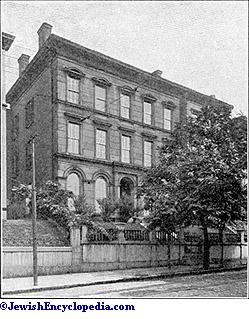
Capital of Hamilton county, Ohio, U. S. A. Its Jewish community is the oldest west of the Alleghany Mountains. In March, 1817, Joseph Jonas, a young English Jew, a native of Exeter, arrived at the metropolis of the Ohio valley. He had left his English home with the avowed intention of settling in Cincinnati. Friends in Philadelphia endeavored to induce him to relinquish his purpose of going to a spot so far removed from all association with his coreligionists, and saidto him: "In the wilds of America, and entirely among Gentiles, you will forget your religion and your God." However, the young man remained deaf to the persuasions of his friends, and persevered in his original purpose. For two years he was the only Jew in the Western town. In 1819 he was joined by three others, Lewis Cohen of London, Barnet Levi of Liverpool, and Jonas Levy of Exeter. These four with David Israel Johnson of Brookville, Ind., a frontier trading-station, conducted on the holidays in the autumn of 1819 the first Jewish service in the western portion of the United States. Similar services were held in the three succeeding falls. Newcomers continued to arrive, the early settlers being mostly Englishmen.
The first Jewish child born in Cincinnati (June 2, 1821) was Frederick A., son of the above-mentioned David Israel Johnson and his wife Eliza. This couple, also English, had removed to Cincinnati from Brookville, where they had first settled. The first couple to be joined in wedlock were Morris Symonds and Rebekah Hyams, who were married Sept. 15, 1824. The first death in the community was that of Benjamin Leib or Lape, in 1821. This man, who had not been known as a Jew, when he felt death to be approaching, asked that three of the Jewish residents of the town be called. He disclosed to them that he was a Jew. He had married a Christian wife, and had reared his children as Christians, but he begged to be buried as a Jew. There was no Jewish burial-ground in the town. The few Jews living in the city at once proceeded to acquire a small plot of ground to be used as a cemetery. Here they buried their repentant coreligionist. This plot, which was afterward enlarged, was used as the cemetery of the Jewish community till the year 1850. At present it is situated in the heart of the city, on the corner of Central avenue and Chestnut street.
There were not enough settlers to form a congregation till the year 1824, when the number of Jewish inhabitants of the town had reached about twenty. On Jan. 4 of that year a preliminary meeting was held to consider the advisability of organizing a congregation; and two weeks later, on Jan. 18, the Congregation B'ne Israel was formally organized; those in attendance were Solomon Buckingham, David I. Johnson, Joseph Jonas, Samuel Jonas, Jonas Levy, Morris Moses, Phineas Moses, Simeon Moses, Solomon Moses, and Morris Symonds. On Jan. 8, 1830, the General Assembly of Ohio granted the congregation a charter whereby it was incorporated under the laws of the state.
For twelve years the congregation worshiped in a room rented for the purpose; but during all this time the small congregation was exerting itself to secure a permanent home. Appeals were made to the Jewish congregations in various parts of the country. Philadelphia, Charleston, S. C., and New Orleans lent a helping hand. Contributions were even received from Portsmouth, England, whence a number of Cincinnatians had emigrated, and from Barbados in the West Indies. On June 11, 1835, the corner-stone of the first synagogue was laid; and on Sept. 9, 1836, the synagogue was dedicated with appropriate ceremonies. The members of the congregation had conducted the services up to this time. The first official reader was Joseph Samuels. He served a very short time, and was succeeded by Henry Harris, who was followed in 1838 by Hart Judah.
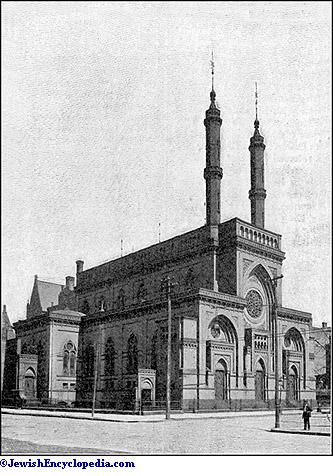
B'ne Yeshurun Temple, Cincinnati, O.(From a photograph.)
Early Religious Institutions.
The first benevolent association was organized in 1838 with Phineas Moses as president: its object was to assist needy coreligionists. The first religious school was established in 1842, Mrs. Louisa Symonds becoming its first superintendent. This school was short-lived. In 1845 a Talmud Torah school was established, which gave way the following year to the Hebrew Institute, established by James K. Gutheim. This also flourished but a short time; for with the departure of Gutheim for New Orleans the career of the institute closed.
Becomes a Jewish Center.
During the fourth decade of the century quite a number of Germans arrived in the city. These were not in sympathy with their English coreligionists, and determined to form another congregation. On Sept. 19, 1841, the B'ne Yeshurun congregation was organized by these Germans, and was incorporated under the laws of the state Feb. 28, 1842. The first reader was Simon Bamberger. In 1847 James K. Gutheim was elected lecturer and reader of the congregation. He served till 1848, and was succeeded by H. A. Henry and A. Rosenfeld. The assumption of the office of rabbi in the B'ne Yeshurun congregation by Isaac M. Wise in April, 1854, and in the B'ne Israel congregation by Max Lilienthal in June, 1855, gave the Jewish community of Cincinnati a commanding position. Owing to their efforts in the cause of Judaism, Cincinnati became a Jewish center indeed and the seat of a number of movements that were national in scope. The Union of American Hebrew Congregations, the Hebrew Union College, the Hebrew Sabbath-School Union, and the Central Conference of American Rabbis have their seat in Cincinnati.
Dr. Lilienthal died in office April 5, 1882. He was succeeded as rabbi of the Congregation B'ne Israel by Raphael Benjamin, who served till Nov., 1888, when the present incumbent, Dr. David Philipson, took charge of the congregation. Dr. Wise served as rabbi of the B'ne Yeshurun congregation till the day of his death, March 26, 1900; being succeeded by his associate, Dr. Louis Grossman. Dr. Grossman had been preceded as associate rabbi by Rabbi Charles S. Levi, who served from Sept., 1889, to Sept., 1898.
Educational Work.
The other congregations of the city are the Adath Israel, organized in 1847; the Ahabath Achim, organized in 1848; and the Sherith Israel, organized in 1855. There are also a number of small congregations. Each of these congregations conducts its own religious school, and there are also two free religious schools; one holding its sessions in the schoolrooms of the Mound street temple (B'ne Israel), and the other, conducted under the auspices of the local branch of the Council of Jewish Women, meeting at the Jewish Settlement. A large Talmud Torah school is conducted by the Talmud Torah Association on Barr street. The Hebrew Union College is located in Cincinnati. Night classes for various English and industrial branches of study are a feature of the work of the Jewish Settlement. The Jewish Kitchen Garden Association conducts a large school for girls in the building of the United Jewish Charities every Sunday morning, where instruction is given in dressmaking, millinery, housekeeping, cooking, stenography, typewriting, and allied subjects. An industrial school for girls is conducted during the summer months in the vestry-rooms of the Plum street temple (B'ne Yeshurun), and one for boys during the school year in the Ohio Mechanics Institute building. There is a training-school for nurses in connection with the Jewish Hospital.
The Jewish charities of Cincinnati are exceptionally well organized. All the relief and educational agencies joined their forces in April, 1896, and formed the United Jewish Charities. This body comprises the following federated societies: Hebrew General Relief Association, Jewish Ladies' Sewing Society, Jewish Foster Home, Jewish Kitchen Garden Association, Boys' Industrial School, Girls' Industrial School, and Society for the Relief of Jewish Sick Poor. The United Charities also grants an annual subvention to the Denver Hospital for Consumptives and to the local Jewish Settlement Association. The seat of the National Jewish Charities is also in Cincinnati, where the national organization was called into being in May, 1899. Besides the United Jewish Charities, Cincinnati supports the Jewish Hospital and the Home for the Jewish Aged and Infirm, and is one of the largest contributors to the Jewish Orphan Asylum at Cleveland.
The Jews of Cincinnati have always shown great public spirit and have filled many local positions of trust, as well as state, judicial, and governmental offices. Henry Mack, Charles Fleischmann, James Brown, and Alfred M. Cohen have been members of the Ohio senate, and Joseph Jonas, Jacob Wolf, Daniel Wolf, and Harry M. Hoffheimer have been members of the legislature. Jacob Shroder was judge of the court of common pleas for a number of years, and Frederick S. Spiegel now holds (1902) the same position. Julius Fleischmann is the present mayor of the city. Nathaniel Newburgh was appointed appraiser of merchandise by President Cleveland during his first administration, and Bernhard Bettmann has been collector of internal revenue since 1897.
The Jewish newspapers published in Cincinnati are "The American Israelite," established 1854, and "Die Deborah," established 1855; "The Sabbath Visitor," established 1874, was discontinued in 1892.
The Jews of the city were estimated in 1900 at 15,000, in a total population of 325,902.
Bibliography:
The Jews of Ohio, by J[oseph] J[onas], in Leeser's Occident. i. 547-550; ii. 29-31, 143-147, 244-247;
David Philipson, The Oldest Jewish Congregation in the West, Cincinnati, 1894;
History of the Congregation B'ne Yeshurun (by a committee of the board of trustees), Cincinnati, 1894;
David Philipson, The Jewish Pioneers of the Ohio Valley, in Publications Am. Jew. Hist. Soc. ix. 43-57;
the files of The American Israelite, 1854.
The Archdiocese of Cincinnati (Cincinnatiensis) comprises that part of the State of Ohio lying south of 40 degrees, 41 minutes, being the counties south of the northern line of Mercer, Auglaize, Hardin, all west of the eastern line of Marion, Union, and Madison counties, and all west of the Scioto River to the Ohio River, an area of 12,043 square miles. The see was erected 19 June, 1821; the archdiocese created 19 July, 1850. EARLY MISSIONARY LIFEAs early as 1749 a Jesuit, Joseph de Bonnecamp, had traversed Northern and Eastern Ohio with De Blainville, who at the time was taking possession of the Valley of the Ohio in the name of France. In 1751 another Jesuit, Armand de la Richardie, established a mission station at Sandusky. In 1795 Rev. Edmund Burke (afterwards first Bishop of Halifax) spent a short time among the Indians along the Maumee, but with little success. In 1790 a colony of French settlers located at Gallipolis on the Ohio, and Dom Peter Joseph Didier, a Benedictine monk, built a church, but growing discouraged left after a few years. The Rev. Stephen T. Badin visited Gallipolis in 1796. Bishop Flaget of Bardstown had charge at this time of Kentucky and Tennessee and the territory divided to-day into the States of Illinois, Indiana, Michigan, Wisconsin, and Ohio. In company with Father Badin he made a tour of Northern Ohio, passing through Chilicothe, Lancaster, and Somerset. The country was nothing but primeval forest. He met the first Catholics at what is to-day known as Somerset, and in response to their earnest appeal he asked the Dominicans to come to their spiritual aid. In this way Father Fenwick, in later years the first Bishop of Cincinnati, was commissioned to take charge. It was here that he met John Fink, and in the latter’s house, on the spot now occupied by the Somerset High School, the Sacrifice of the Mass was first offered for the asembled thirteen families. Some two years later Father Fenwick visited Somerset a second time, and secured from the Dittoe family a tract of three hundred acres for the Dominican Order on condition that a church and monastery be erected as early as possible. The buildings, at first small and primitive, have since been replaced by the more beautiful and commodious structure of St. Joseph’s Priory. It was early in 1811 that the first attempt was made to organize a congregation in Cincinnati. The Catholics interested in the work met on 13 December in the house of Joseph Fabler, but no definite action was taken. Bishop Flaget was passing through Cincinnati in 1814 on one of his episcopal visitations. The city, which to-day numbers within its corporate limits 400,000 people, and is one of the great centres of art, commerce, education, and religion, was at the time practically a wilderness dotted here and there with a small number of log-cabins reared by the sturdy settlers. On this occasion he met the representatives of the Catholic families of Cincinnati. Their names, recorded in the early annals of the church, were Michael Scott, Patrick Reilly, Edward Lynch, Patrick Gohegan, John McMahon, John White, P. Walsh, and Robert Ward. Mr. Scott was one of the earliest Catholic settlers in Ohio, coming from Baltimore in 1805 and eventually moving to Cincinnati. It was in his house that Bishop Flaget, on the occasion of his first visit, celebrated the first Mass in Cincinnati; on this occasion the bishop urged the erection of a church as soon as means would permit. Their faith, courage, and spirit of sacrifice can be truly appreciated when one remembers the obstacles which confronted them, and the spirit of religious bigotry with which they were obliged to contend. A city ordinance forbade the erection of a Catholic church within the city limits. An appeal for assistance to the Catholics in the East met with a ready and generous response, property was secured on the north-west corner of Vine and Liberty Streets, and with logs cut in the timberland of William Reilly, in Mayslick, Ky., rafted to Cincinnati, and carted by oxen to the site outside the corporate limits, they constructed in 1822 the first Catholic Church in Cincinnati, a plain, barn-like structure. On the recommendation of Bishop Flaget, Ohio was made a diocese 19 June, 1821, with Cincinnati as the see. BISHOPSEdward FenwickEdward Fenwick, a native of Maryland and a member of the Dominican Order, was appointed the first Bishop of Cincinnati, and made Administrator Apostolic of Michigan and the eastern part of the North-western Territory. He was consecrated by Bishop Flaget in St. Rose’s Church, Washington County, Kentucky, 13 January, 1822, and arriving in Cincinnati the same year he took up his residence at the junction of Ludlow and Lawrence Streets in a small house which served as an episcopal palace and a place of worship. His cathedral, the log-church on the outskirts of the city, was several miles distant and at times almost inaccessible. The prohibitive ordinance had in the meantime been withdrawn, and the little edifice was placed on rollers and moved by oxen through the streets of Cincinnati to the site now occupied by the College of St. Francis Xavier. Shortly before, the diocese being without priests, churches, or schools, Bishop Fenwick made a trip to Europe in quest of aid. Having received generous assistance from the nobility of France and the reigning pontiff, he purchased upon his return the ground on Sycamore Street (the present site of St. Francis Xavier’s church), and on 19 May, 1825, the corner-stone of the old St. Peter’s Cathedral was laid. The completed edifice was dedicated by Bishop Fenwick 17 December, 1826. The Athenæum, dedicated to St. Francis Xavier, was opened 11 May, 1829, with Rev. H. Montgomery as rector, four theological and six preparatory students. Among the many gifts which the bishop had received in Europe was a printing press, and from this went forth in October, 1831, the first edition of "The Catholic Telegraph", one of the oldest Catholic papers in the United States. At this time the clergy were few; the diocese extended from the Ohio River to the Lakes; the Catholics, limited in number, were scattered over the most distant points, and the bishop was compelled to visit his flock by stage, on horseback, or on foot. Cholera was raging throughout his diocese in 1832, and on 26 September of the same year he was stricken and died at Wooster. His remains were brought to Cincinnati and deposited in the old cathedral, now St. Francis Xavier’s, 11 February, 1833. In 1846 they were transferred to the new cathedral, where they now repose. When he assumed charge of the diocese, in 1822, his flock numbered fifty families, the churches did not exceed five, and his clergy were the few pioneers brought from Europe; when he died, in 1832, the Catholic population had grown to seven thousand. The churches throughout the diocese and the clergy had increased proportionately; a cathedral and seminary had been erected.(2) John Baptist PurcellJohn Baptist Purcell was consecrated second Bishop of Cincinnati, 13 October, 1833, in the Baltimore cathedral, Archbishop Whitfield being the consecrating prelate. Immediately after his consecration Bishop Purcell attended the Second Provincial Council of Baltimore, and then with borrowed funds set out for his see. Upon his arrival in Cincinnati, 14 November, 1833, he found there only one church — St. Peter’s Cathedral. Four Sisters of Charity had arrived in Cincinnati 27 October, 1829, to take charge of the first cathedral school, and with six orphans under their care started the first asylum for orphans in the diocese. The diocese was growing and clergy were needed. The seminary was removed from the city to Brown County in 1839; but in 1845 it was brought back to the city, and the seminarists continued their studies in the Jesuit college under Father Nota up to 1848, when they were transferred to the episcopal residence, under the supervision of the Rev. David Whelan. On 27 January, 1847, Michael and Patrick Considine conveyed to the bishop a tract of five acres on Price Hill for a new seminary, of which the corner-stone was laid on 19 July, 1848. The centre wing was solemnly blessed and opened 2 October, 1851, under the name of Mount St. Mary’s of the West. From this institution went forth for a half-century the clergy of the Middle West. Its history is inseparably interwoven with the history of the diocese, and its students cherished with feelings of reverence the names of its presidents, Fathers Hallinan, Quinlan, Barry, Rosecrans, Pabisch, Hecht, Byrne, Murray, and Mackey, all men of great learning and deep piety. In 1904 it was transferred to its present site: Cedar Point, Hamilton County, Ohio. The first German parish church, the Holy Trinity, was erected in 1834, and the Rev. John Martin Henni, afterwards the first Archbishop of Milwaukee, was the first pastor. In 1837 he founded the "Wahrheitsfreund", the first German Catholic paper in the United States. In 1907 it was merged with the "Ohio Waisenfreund". Bishop Purcell was always an ardent advocate of Catholic education and a pioneer in the defence of parochial schools. The progress of Catholicity was such in the thirties as to cause alarm in certain quarters. Lyman Beecher’s "Plea for the West" had gone forth, and the sentiment it moulded found expression in the Purcell-Campbell debate. The Ohio College of Teachers was in session, and the occasion was seized by the Rev. Alexander Campbell to accuse the Catholic Church of being an enemy to enlightenment. He issued a challenge for an open debate; it was accepted, though reluctantly, by Bishop Purcell. The debate commenced 13 January, 1837, in the Campbellite church, and continued for seven days. Much of the existing prejudice was removed, and the numerous conversions to Catholicity following the controversy were ample proof that the Church and its doctrines had been ably and eloquently defended by the young Bishop of Cincinnati. From this time an impetus was given to the spread of Catholicity in Cincinnati and throughout the diocese. The fertility and wealth of the Ohio Valley had become known; many immigrated from the Eastern States, and Ohio received a large proportion of the Europeans whom unsatisfactory conditions at home induced to cross the sea to seek their fortunes in the New World.Communities of sisterhoods were invited to share the burden of supplying the growing needs of religion. The Sisters of Charity arrived in Cincinnati in 1829; the Sisters of Notre-Dame in 1840; the Ursulines in 1845; the Sisters of the Good Shepherd in 1857; the Sisters of Mercy and St. Francis in 1858; the Little Sisters of the Poor in 1868; and the Religious of the Sacred Heart in 1869. To these were added religious orders of men. The Jesuits established a house in 1840; and there followed in succeeding years the Fathers of the Precious Blood (Sanguinists), the Franciscans, the Passionists, the Fathers of the Holy Cross, and the Brothers of Mary. The corner-stone of the present St. Peter’s Cathedral was laid in 1841; it was consecrated in 1845. The personality of the bishop was strong and magnetic, and attracted all classes to him. The first German orphan asylum for boys was opened in 1839, and that for girls in 1843. Eventually they were combined, and the German Orphan Asylum at Bond Hill is the successful outgrowth of both. Under the auspices of the St. Peter Benevolent Association for Orphans, formed 25 December, 1833, St. Joseph’s Orphan Asylum was opened on 24 July, 1855. It is a monument to the generosity of the people and ministers to the needs of the four hundred inmates. Sixteen churches were built in the city and the immediate neighbourhood; the parochial schools were equally numerous. The Catholic population now exceeded 50,000, and it was deemed necessary to erect a second diocese for the northern half of the state, at Cleveland, of which, on 10 October, 1847, the Rev. Amadeus Rappe was consecrated the first bishop. Not long afterwards Cincinnati was made an archiepiscopal see (19 July, 1850).In 1853 a wave of Know-Nothingism was sweeping over the country. Philadelphia and Louisville had been the scenes of riotous outbreaks. The Most Rev. Cajetan Bedini, titular Archbishop of Thebes, who had been appointed nuncio to the court of Brazil, and had been commissioned to investigate certain causes of complaint at Buffalo and Philadelphia, arrived at Cincinnati in June, 1853. Prior to his coming popular prejudice was appealed to, his character was maligned, and crimes imputed to him of which he was innocent. On his arrival in Cincinnati the smouldering spirit of Know-Nothingism was fanned into a flame. On Christmas night, 1853, while the guest of the Archbishop of Cincinnati, a mob determined upon his death marched to the cathedral, threatening to burn it. The loyalty of the people to their archbishop, who counselled prudence and forbearance, put to shame and disarmed the spirit of revolt, while the action of the mob, disgracing the hospitality of Cincinnati by insulting an unoffending visitor of one of her citizens, was abhorred by every lover of law and order. Archbishop Hughes was the champion of the Church in the East and the vigilant guardian of her interests; Archbishop Purcell was the power which moulded her destiny in the West. His tongue and pen were always active in her defence. Broadminded and devoted to truth, he was loved by all, irrespective of creed. Convinced that he was right, he never swerved from the path which duty marked out for him to follow. Able and wise and fearless as a churchman, he was none the less loyal as a citizen. When the clouds of civil war were gathering, he proclaimed himself an advocate of the Union in opposition to the sentiments of a large number of his people, hoisted the flag upon the cathedral spire, and delivered an address, classic in thought and expression, which breathed the spirit of the patriot and lover of peace. He was signally honoured by Pius IX; and on the silver jubilee of his priesthood and episcopacy, in 1851 and 1858, on his return from the Vatican Council, and on the occasion of the golden jubilee of his priesthood in 1876, the clergy and laity, non- Catholic and Catholic, vied with each other in their demonstrations of devotion to this patriarch of the West, who had laboured incessantly for half a century in the vineyard of the Lord.Father Edward Purcell, the archbishop’s brother, had conducted for years a private system of banking. Simple in its beginning and easy of control, it assumed in the course of years proportions which passed, it may be, beyond the grasp and management of an individual. The crisis and financial reverses came in 1879, it is not known how. In his eagerness to compensate the creditors, Archbishop Purcell attempted to assume the responsibility of the bankruptcy. The courts decided that the obligation was not diocesan, that Father Purcell was individually responsible, and that churches and institutions were liable for borrowed monies only. This indebtedness (of churches and institutions), amounting to some $200,000, was paid. The event hastened the death of Father Edward Purcell, and that of his brother followed on 4 July, 1883, at St. Martin’s, Brown County, Ohio, where his remains now rest. The sorrow was universal. Some, it is true, in the hour of their losses, were disposed to blame, but the majority of citizens, Catholic and Protestant, believed firmly in the honesty of purpose of the deceased archbishop and his brother, whose only faults, if such they may be called, were their forgetfulness of self and their willingness to aid their struggling people. The diocese, which in 1833 comprised the State of Ohio, had grown from infancy to full manhood–400 churches and 100 chapels raised their crosses heavenward. The Catholic population amounted to 450,000, more than 85,000 being in Cincinnati alone. He found one church in Cincinnati upon his arrival; there were now upwards of thirty. The original diocese (embracing Cincinnati, Cleveland, and Columbus) employed the services of 400 clergymen, 52 religious communities, 3 theological seminaries, 3 colleges, 25 academic institutions for girls, 22 orphan asylums, 1 protectory for boys, 6 hospitals, 40 charitable institutions, and 266 parochial schools. The Archdiocese of Cincinnati at the time of his death had 180,000 Catholics.(3) William Henry ElderWilliam Henry Elder, Bishop of Natchez, Mississippi, was transferred to the titular See of Avara and made coadjutor to the Archbishop of Cincinnati, with the right of succession, 30 January, 1880, and succeeded to the See of Cincinnati 4 July, 1883. He had been the first to extend his sympathy and to volunteer assistance to his predecessor in the hour of his affliction. He entered upon his episcopal duties during the crucial period of the financial failure. Its settlement was brought about largely through the prudence and wisdom of his administration. He received from Reuben R. Springer the generous bequest of $100,000, and in 1887 he reopened Mount St. Mary’s Seminary of the West, which had been closed for eight years. In 1890 he founded St. Gregory’s Preparatory Seminary at Cedar Point, Hamilton County, the Very Rev. J. C. Albrinck being its first rector. In 1904 it was transferred to Cincinnati and made a day college. Saintly and retiring, the archbishop exercised an influence silent but effective by the unostentatious sanctity of his life. Judicious at critical moments, he ruled wisely. A true lover of souls, he could be found in the confessional up to the close of his eighty- fifth year. He adhered closely to the laws of the Church, and exacted a similar fidelity in others. Two provincial councils were called, in 1883 and 1888. Several synods were convened and regulations framed, creating system and smoothness in the working of the archdiocese. The zeal of his predecessor characterized his efforts in behalf of Catholic education. Charitable institutions were placed upon a firm basis, and the administration of parishes made more methodical. He was loved by all during life, and was mourned by all at his death, 31 October, 1904.(4) Henry MoellerHenry Moeller, consecrated Bishop of Columbus, Ohio, 25 August, 1900, was promoted to the archiepiscopal See of Areopolis and made coadjutor to Archbishop Elder, with the right of succession, 27 April, 1903. He had been for twenty years Chancellor of the Archdiocese of Cincinnati, previous to his appointment to the See of Columbus. CAUSES OF GROWTHUp to 1829 there was practically no immigration to the West. In after years the fertility and wealth of the country lying between the Eastern mountains and the Mississippi directed thither the tide of incoming Europeans. The Irish famine of 1848, and political disturbances in Germany about the same time, sent large numbers of Irish and Germans to America. Friends had preceded them, and glowing accounts of the agricultural possibilities of Ohio attracted many to the Ohio Valley. Steamboat facilities after 1830 and railroads after 1838 contributed largely to increase the population. The Civil War did not retard materially the progress of religion. PIONEER PRIESTSThe following are worthy of mention: Revs. E. Fenwick, S. T. Badin, J. J. Young, E. Thienpont, J. B. Lamy, Joseph P. Machebeuf, Frederic Rese, J. Ferneding, J. Reed, J. H. Luers, H. D. Juncker, Martin J. Henni, H. Kundig, B. Toebbe, W. Cheymol, J. J. Mullon, Thos. Bolger, and the Jesuits Joseph de Bonnecamp and Armand de la Richardie. Eight of these priests were raised to the episcopate. Among the laymen of distinction, the Fink and Dittoe families in the early years of the Church in Ohio deserve to be remembered. In subsequent years the following merit special mention: Patrick and Michael Considine, John and Joseph Slevin, Stephen Boyle, Chas. Conahan, Joseph and Patrick Rogers, Joseph Butler, Joseph Heman, J. P. Carberry, Dr. Bonner, Col. McGroarty, James F. Meline, N. H. Hickman, Joseph Kline, B. VerKamp, F. A. Grever, Reuben R. Springer, Patrick Poland, Joseph Nurre, H. Himmelgarn, Joseph Niehaus, and Nicholas Walsh. Mrs. Sarah Peter was active in the founding of convents.-----------------------------------SHEA, Hist. Cath. Church in the United States (New York, 1889-1892); O’GORMAN, Roman Catholic Church in the United States (New York, 1895); KELLY AND KIRWIN, History of Mt. St. Mary’s Seminary of the West (Cincinnati, 1894); HOUCK, A History of Catholicity in Northern Ohio (Cleveland, 1902); The Catholic Telegraph (Cincinnati) files; REUSS, Bib. Cycl. of the Cath. Hierarchy of the U. S. (Milwaukee, 1898); Catholic Directory (1908).M.P. O’BRIEN The Catholic Encyclopedia, Volume IIICopyright © 1908 by Robert Appleton CompanyOnline Edition Copyright © 2003 by K. KnightNihil Obstat, November 1, 1908. Remy Lafort, S.T.D., CensorImprimatur. +John Cardinal Farley, Archbishop of New York