
See Chariouts
Chariot. A vehicle used either for warlike or peaceful purposes, but, most commonly, the former. The Jewish chariots were patterned after the Egyptian, and consisted of a single pair of wheels on an axle, upon which was a cart with high front and sides, but open at the back.
The earliest mention of chariots, in Scripture, is in Egypt, where Joseph, as a mark of distinction, was placed in Pharaoh’s second chariot. Gen 41:43. Later on, we find mention of Egyptian chariots for a warlike purpose. Exo 14:7.
In this point of view, chariots among some nations of antiquity, as elephants among others, may be regarded as filling the place of heavy artillery in modern times, so that the military power of a nation might be estimated by the number of its chariots. Thus, Pharaoh, in pursuing Israel, took with him 600 chariots.
The Philistines, in Saul’s time, had 30,000. 1Sa 13:5. David took from Hadadezer, king of Zobah, 1000 chariots, 2Sa 8:4, and from the Syrians, a little later, 700, 2Sa 10:18, who in order to recover their ground, collected 32,000 chariots. 1Ch 19:7.
Up to this time, the Israelites possessed few or no chariots. They were first introduced by David, 2Sa 8:4, who raised and maintained a force of 1400 chariots, 1Ki 10:25, by taxation on certain cities agreeably to eastern custom in such matters. 1Ki 9:19; 1Ki 10:25.
From this time, chariots were regarded as among the most important arms of war. 1Ki 22:34; 2Ki 9:16; 2Ki 9:21; 2Ki 13:7; 2Ki 13:14; 2Ki 18:24; 2Ki 23:30; Isa 31:1.
Most commonly two persons, and sometimes three, rode in the chariot, of whom the third was employed to carry the state umbrella. 1Ki 22:34; 2Ki 9:20; 2Ki 9:24; Act 8:38. The prophets allude frequently to chariots as typical of power. Psa 20:7; Psa 104:3; Jer 51:21; Zec 6:1.
Chariot, sometimes including the horses (2Sa 8:4; 2Sa 10:18). Mentioned first in Gen 41:43, where Joseph rides in Pharaoh’s second chariot; also Gen 46:29. In the Egyptian monuments they occur to the number of 27,000 in records of the reign of Rameses II, 1300 B.C., and even earlier in the 18th dynasty 1530 B.C., when Amosis I used them against the shepherd kings. A leading purpose of chariots was war. Pharaoh followed Israel with 600 chosen chariots (Exo 14:7). The Canaanites of the valleys armed theirs apparently with iron scythes (Jos 17:18; Jdg 1:19). Jabin had 900, which enabled him to "oppress the children of Israel mightily," because of their sins (Jdg 4:3). The Philistines in Saul’s time had 30,000 (1Sa 13:5). David took from Hadarezer of Zobah 1,000, and from the Syrians 700; these to retrieve their loss gathered 32,000 (1Ch 19:7).
God forbad their use to His people, lest they should depend on human help rather than on Him (Deu 17:16; Deu 20:1; Psa 20:7), also lest there should be a turning of the elect nation’s heart back to Egypt and its corrupt ways. Solomon from carnal state policy allied himself to Egypt, and disregarded God’s prohibition, as Samuel foretold would be the case if Israel, not content with God, should set up a human king (1Sa 8:11-12). Solomon had 1,400 chariots, and bought each out of Egypt at 600 shekels of silver, and a horse for 150; and taxed certain cities for the cost, according to eastern usage (1Ki 9:19; 1Ki 10:26; 1Ki 10:29). In Exo 14:7 translate "captains (literally, men of the king’s council of 30) over the whole of them." Not as some thought, "third men in every one of them."
For the Egyptian chariots only carried two, the driver and the warrior. The Assyrian chariots (Nah 2:3-4) depicted on the monuments often contain a third, namely, the warrior’s shieldbearer. In Exo 14:9 "horsemen" are mentioned. Hengstenberg thinks rekeb does not mean cavalry, as they are not depicted in the Egyptian monuments, but merely "riders in chariots." But Diodorus Siculus states that Rameses II had 24,000 cavalry. Egyptian art seems even in later times, when certainly cavalry were employed, to have avoided depicting horsemen. The language of Exo 15:1; Isa 31:1, can be reconciled with either view. Ancient papyri allude to mounting on horseback (Cook, in Speaker’s Commentary). The men in the chariot always stood.
The Egyptian chariot consisted of a semicircular frame of wood with straight sides, resting on the axle-tree of a pair of wheels; and on the frame a rail attached by leather thongs; one wooden upright in front; open at the back for mounting. On the right side the bowcase and the quiver and spearcase crossed diagonally. The horses wore only breastband and girths attached to the saddle, and a bearing rein fastened to a ring in front of it. In New Testament the only chariots mentioned are that of the Ethiopian eunuch of Candace (Act 8:28-29; Act 8:38), and Rev 9:9. The Persians sacrificed horses to the sun; so the Jews under the idolatrous Manasseh dedicated chariots and horses to the sun (2Ki 23:11). Josiah burned these chariots with fire, thus making the object of their superstition, fire, to consume their instruments of worship.
(properly
The only other words rendered "chariot" in the Bible are
The earliest mention of chariots in Scripture is in Egypt, where Joseph, as a mark of distinction, was placed in Pharaoh’s second chariot (Gen 41:43), and later when he went in his own chariot to meet his father on his entrance into Egypt from Canaan (Gen 46:29). In the funeral procession of Jacob chariots also formed a part, possibly by way of escort or as a guard of honor (Gen 50:9). The next mention of Egyptian chariots is for a warlike purpose (Exo 14:7). In this point of view chariots .among some nations of antiquity, as elephants among others, may le regarded as filling the place of heavy artillery in modern times, so that the military power of a nation might be estimated by the number of its chariots. Thus Pharaoh, in pursuing Israel, took with him 600 chariots. The Canaanites of the valleys of Palestine were enabled to resist the Israelites successfully in consequence of the number of their chariots of iron, i.e. perhaps armed with iron scythes (Jos 17:18; Jdg 1:19; see Schickendanz, De curribus falcatis, Zerbst. 1754). Jabin, king of Canaan, had 900 chariots (Jdg 4:3).
The Philistines in Saul’s time had 30,000, a number chich seems excessive (1Sa 13:5; but comp. the Sept. and Joseph. Ant. 6:6, 1). David took from Hadadezer, hing of Zobah, 1000 chariots (2Sa 8:4), and from the Syrians a little later 700 (2Sa 10:18), who, in order to recover their ground, collected 52,000 chariots (1Ch 19:7). Up to this time the Israelites possessed few or no chariots, partly, no doubt, in consequence of the theocratic prohibition against multiplying horses, for fear of intercourse with Egypt, and the regal despotism implied in the possession of them (Deu 17:16; 1Sa 8:11-12). — But to some extent David (2Sa 8:4), and in a much greater degree Solomon, broke through the prohibition from seeing the necessity of placing his kingdom, under its altered circumstances, on a footing of military equality or superiority toward other nations. He raised, therefore, and maintained a force of 1400 chariots (1Ki 10:25) by taxation on certain cities, agreeably to Eastern custom in such matters (1Ki 9:19; 1Ki 10:25; Xenoph. Anzab. 1:4, 9). The chariots themselves, and also the horses, were imported chiefly from Egypt, and the cost of each chariot was 600 shekels of silver, and of each horse 150 (1Ki 10:29). SEE SHEKEL.
From this time chariots were regarded as among the most important arms of war, though the supplies of them and of horses appear to have been still drawn from Egypt (1Ki 22:34; 2Ki 9:16; 2Ki 9:21; 2Ki 13:7; 2Ki 13:14; 2Ki 18:24; 2Ki 23:10; Isa 31:1). The prophets also allude frequently to chariots as typical of power (Psa 20:7; Psa 104:3; Jer 51:21 : Zec 6:1). Chariots of other nations are likewise mentioned, as of Assyria (2Ki 19:23; Eze 23:24), Syria (2 Samuel 8, and 2Ki 6:14-15), Persia (Isa 22:6); and, lastly, Antiochus Eupator is said to have had 300 chariots armed with scythes (2Ma 13:2). In the N.T. the only mention made of a chariot, except in Rev 9:9, is in the case of the Ethiopian or Abyssinian eunuch of Queen Candace, who is described as sitting in his chariot reading (Act 8:28-29; Act 8:38). SEE RIDER.
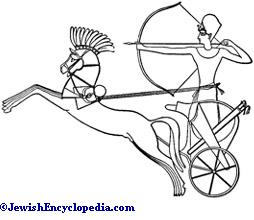
Jewish chariots were no doubt imitated from Egyptian models, if not actually imported from Egypt. These appear to have come into use not earlier than the 18th dynasty (B.C. 1530). The war-chariot, from which the chariot used in peace did not essentially differ, was extremely simple in its construction. It consisted, as appears both from Egyptian paintings and reliefs, as well as from an actual specimen preserved at Florence, of a nearly semicircular wooden frame with straightened sides, resting posteriorly on the axle-tree of a pair of wheels, and supporting a rail of wood or ivory attached to the frame by leathern thongs and one wooden upright in front. The floor of the car was made of rope net-work, intended to give a more springy footing to the occupants. The car was mounted from the back, which was open, and the sides were strengthened and ornamented with leather and metal binding.
Attached to the off or right-hand side, and crossing each other diagonally, were the bow-case, and inclining backwards, the quiver and spear-case. If two persons were in the chariot a second bow-case was added. The wheels, of which there were 2, had 6 spokes: those of peace chariots had sometimes 4, fastened to the axle by a linch-pin secured by a thong. There were no traces; but the horses, which were often of different colors, wore only a breast-band and girths, which were attached to the saddle, together with head furniture, consisting of cheek-pieces, throat-lash, head-stall, and straps across the forehead and nose. A bearing-rein was fastened to a ring or hook in front of the saddle, and the driving-reins passed through other rings on each side of both horses. From the central point of the saddle rose a short stem of metal, ending in a knob, whether for use or mere ornament is not certain. The driver stood on the off side, and in discharging his arrow hung his whip from the wrist. In some instances the king is represented alone in his chariot, with the reins fastened round his body, thus using his weapons with his hands at liberty. Most commonly two persons, and sometimes three, rode in the chariot, of whom the third was employed to carry the state umbrella (2Ki 9:20; 2Ki 9:24; 1Ki 22:34; Act 8:38). A second chariot usually accompanied the king to battle, to be used in case of necessity (2 Chronicles 35:34).
On peaceable occasions the Egyptian gentleman sometimes drove alone in his chariot, attended by servants on foot. The horses wore housings to protect them from heat and insects. For royal personages and women of rank, an umbrella was carried by a bearer or fixed upright in the chariot. Sometimes mules were driven instead of horses, and in travelling sometimes oxen; but for travelling purposes the sides of the chariot appear to have been closed. One instance occurs of a 4-wheeled car, which (like the
Among the parts of wheel-carriages mentioned in the Scriptures are:
2, the rim,
4, the hub,
The word chariots is sometimes used figuratively for hosts or armies (Psa 68:17; 2Ki 6:17); and Elijah, by his prayers and counsels, and power with God, was "the chariot of Israel, and the horsemen thereof" (2Ki 2:12; see Rosh, De curru Israelis, Bautz. 1780), inasmuch as he did more for them than all the chariots they could muster (Psa 20:7; Isa 3:1). SEE WAR.
The term "chariot" is likewise used poetically in Scripture to designate the rapid agencies of God in nature (Psa 104:3; Psa 68:17; Isa 66:15; Hab 3:8).
Except in Son 3:9, where the word is appiryon and signifies ’sedan, portable couch,’ the chariots were vehicles with two wheels, used either for travelling or for war: they are often seen portrayed on Egyptian and Assyrian monuments. Gen 41:43; Gen 50:9; 1Ki 4:26; Eze 23:24; Act 8:28; Rev 9:9. In Rev 18:13 the word is
By: Emil G. Hirsch, Wilhelm Nowack
Vehicles are designated in Hebrew chiefly by two expressions, "'agalah" and "rakab," with "merkab" and "merkabah" derived from the latter. The former denotes the wagon used for heavy loads and general work, the name being connected with the root "to roll"; while the latter is the chariot of war or of state. Wagons for carrying burdens or persons are found among the different peoples of antiquity, having displaced at an early time the sledge and the drag on rollers, drawn by men or oxen (compare the pictures in Wilkinson, "Manners and Customs of the Ancient Egyptians," iii. 324). Early Egyptian monuments show also a frame like a litter, which was fastened between asses and used to carry persons.
Egyptian Chariot.(From Champollion, "Monuments de l'Egypte.")
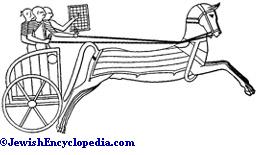
Hittite Chariot.(From Champollion, "Monuments de l'Egypte.")
Originally the wheels of the wagons were solid disks (ib. i. 369), but a more artistic type, consisting of hub, spokes, and fellies, was gradually evolved. The spokes, "ḥishshuḳim" (I Kings vii. 33), sprang from the hollow cylinder in the center of the wheel ("ofan" or "galgal"), that is, from the hub, "ḥishshurim" (I Kings vii. 33), around the stationary axletree, "yad," and connected it with the rim or the fellies, "gebim" (I Kings vii. 33; Ezek. i. 18, x. 12). In extant Assyrian illustrations the wheels generally have eight spokes, while in the Egyptian wagons four, or more frequently six, spokes are found. The body of the wagon and the pole were connected directly with the axletree. The pole had a yoke arranged for two animals only, so that each additional animal had to be harnessed separately, and not infront, but on the side of the first two animals. As horses did not come into general use among the Israelites until the time of Solomon, oxen were originally the chief draft animals (I Sam. vi. 7), while asses were generally used for the saddle. That the Israelites in very early times had wagons for carrying burdens, is evident from I Sam. vi. 7 and II Sam. vi. 3. Mention is also made of threshing-wagons (Isa. xxviii. 27). There is no definite information regarding harvesting-wagons (see Amos ii. 13). It is to be noticed that the latter are not used to-day in Palestine ("Zeit. Deutsch. Paläst. Ver." ix. 40, and the commentaries on Amos, l.c.). Persons traveled chiefly on asses, because the poor condition on the roads in Palestine made it difficult to use wagons to any extent, especially for long journeys. Nevertheless, the fact that the Egyptians evidently received the word  (Egyptian, "'agolt"), as well as
  (Egyptian, "merkobt"), from the Canaanites, shows that wagon-building was known at an early date in Canaan.
War-Chariots.
War-chariots proper were also known in Canaan at an early time, for as a result of having them the Canaanites were so superior to the Israelites that the latter could not meet them in open battle on the plain (Josh. xi. 4; Judges i. 19, iv. 3; I Sam. xiii. 5). These vehicles were indeed strange to the Israelites. Although David captured chariots and horses in his war with the Syrians, he did not use them, and even hamstrung the horses (II Sam. viii. 4). It remained for Solomon to introduce war-chariots, which were stationed partly in Jerusalem and partly in other cities (I Kings ix. 19). Beginning with his time, chariots and horsemen are often mentioned in the army of the southern as well as of the northern kingdom (I Kings xvi. 9; II Kings viii. 21, xiii. 7; Isa. ii. 7; Micah v. 9). Horses were indispensable to these chariots, and the great difficulty in procuring them (II Kings vii. 13, xviii. 23) probably often induced political leanings toward Egypt (Isa. xxx. 16, xxxi. 1, xxxvi. 9).
The war-chariots doubtless resembled the Assyrian and Egyptian two-wheeled chariots, open in the back; they were not furnished with scythes, as is often stated, for the latter were introduced by the Persians. They were made of fig-tree wood, and trimmed with bronze or iron. Like those of the Assyrians, the Hittites, and others, the chariots of the Israelites probably carried three men,  , the driver, the warrior proper, and the shield-bearer; while on those of the Egyptians there were generally but two men. According to I Kings x. 29 the price of a chariot imported from Egypt in the time of Solomon was 600 shekels, and that of a horse 150 shekels.
Sun-Chariots.
During the last decades of the southern kingdom mention is made of sun-horses and sun-chariots stationed in the outer court of the Temple, these being removed later by Josiah. They had been introduced at the time that syncretism was flourishing, and the cult of the sun-god had become dominant under Assyrian influence. As in the case of the Canaanite Baal (in reality the sun-god), the Assyro-Babylonian sun-god had been identified with Yhwh, and his symbols placed in the court of the Temple. Such syncretism was not altogether foreign to Hebrew ideas, for Yhwh is not only the God of heaven, but also He who rides in a chariot (Hab. iii. 8; Ps. lxviii. 18[17]) and on the Cherubim, and who descends in a chariot of fire to take His saints into heaven (II Kings ii. 11, vi. 17, xiii. 14). For God's chariot-throne see Merkabah.
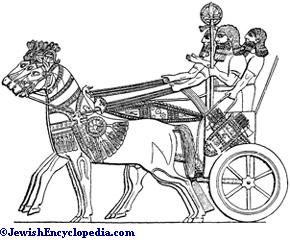
Assyrian Chariot.(From Layard's "Nineveh.")
CHARIOT.—The original home of the chariot was Western Asia, from which it passed to Egypt and other countries. In OT chariots are associated mainly with war-like operations, although they also appear not infrequently as the ‘carriages,’ so to say, of kings, princes, and high dignitaries (Gen 50:9, 2Ki 5:9, Jer 17:25; cf. Act 8:28 ff. the case of the Ethiopian eunuch) in times of peace. When royal personages drove in state, they were preceded by a body of ‘runners’ (2Sa 15:1, 1Ki 1:5).
The war chariot appears to have been introduced among the Hebrews by David (2Sa 8:4 LXX
Until the Macedonian period, when we first hear of chariots armed with scythes (2Ma 13:2), the war chariot of antiquity followed one general type, alike among the Assyrians and the Egyptians, the Hittites and the Syrians. It consisted of a light wooden body, which was always open behind. The axle, fitted with stout wheels with 6 or 8 spokes (for the Heb. terms see 1Ki 7:33), was set as far back as possible for the sake of greater steadiness, and consequently a surer aim. The pole was fixed into the axle, and after passing beneath the floor of the chariot was bent upwards and connected by a band of leather to the front of the chariot. The horses, two in number, were yoked to the pole. Traces were not used. In Assyrian representations a third horse sometimes appears, evidently as a reserve. The body of the chariot naturally received considerable decoration, for which, and for other details, reference may be made to Wilkinson’s Anc. Egyp. (1878), i. 224–241, and Rawlinson’s Five Great Monarchies (1864), ii. 1–21, where numerous illustrationss are also given. The ‘chariots of iron’ of the ancient Canaanites (Jos 17:16, Jdg 1:19; Jdg 4:3) were chariots of which the woodwork was strengthened hy metal plates.
In Egypt and Assyria the normal number of the occupants of a war chariot was two—the driver, who was often armed with a whip, and the combatant, an archer whose bow-case and quiver were usually attached to the right-hand side of the car. Egyptian representations of Hittite chariots, however, show three occupants, of whom the third carries a shield to protect his comrades. This was almost certainly the practice among the Hebrews also, since a frequently recurring military term, shâlîsh, signifies ‘the third man,’ presumably in such a chariot.
Mention may be made, finally, of the chariots set up at the entrance to the Temple at Jerusalem, which were destroyed by Josiah. They were doubtless dedicated originally to J″
A. R. S. Kennedy.
1. Chariots of Egypt
2. Chariots of the Canaanites
3. Chariots of Solomon and Later Kings
4. Chariots of the Assyrians
5. Chariots of Chaldeans, Persians, Greeks
6. In the New Testament
7. Figurative Use
Literature
1. Chariots of Egypt
It is to the chariots of ancient Egypt that reference is first made in Scripture. Joseph was honored by being made to ride in the second chariot of King Pharaoh (Gen 41:43). Joseph paid honor to his father on his arrival in Goshen by meeting him in his chariot (Gen 46:29). In the state ceremonial with which the remains of Jacob were escorted to Canaan, chariots and horsemen were conspicuous (Gen 50:9). In the narrative of the departure of the Israelites from Egypt and of Pharaoh’s futile attempts to detain them the chariots and horsemen of Pharaoh figure largely (Exo 14:17, Exo 14:18, Exo 14:23, Exo 14:15; Exo 15:4, Exo 15:19). It was with the Hyksos invasion, some centuries before the Exodus, that the horse, and subsequently the chariot, were introduced for purposes of war into Egypt; and it may have been the possession of chariots that enabled those hated shepherd warriors to overpower the native Egyptians. The Egyptian chariot was distinguished by its lightness of build. It was so reduced in weight that it was possible for a man to carry his chariot on his shoulders without fatigue. The ordinary chariot was made of wood and leather, and had only two occupants, the fighting man and his shield-bearer. The royal chariots were ornamented with gold and silver, and in the battle of Megiddo Thothmes III is represented as standing in his chariot of electrum like the god of war, brandishing his lance. In the battle the victorious Egyptians captured 2, 041 horses and 924 chariots from the Syrian allies.
2. Chariots of the Canaanites
The Canaanites had long been possessed of horses and chariots when Joshua houghed their horses and burnt their chariots with fire at the waters of Merom (Jos 11:6, Jos 11:9). The chariots of iron which the Canaanites could maneuvere in the plains and valleys proved a formidable obstacle to the Complete conquest of the land (Jdg 1:19). Jabin had 900 chariots of iron, and with them he was able to oppress the children of Israel twenty years (Jdg 4:3). The Philistines of the low country and the maritime plain, of whom we read in Judges and Samuel, were a warlike people, were disciplined and well armed and their possession of chariots gave them a great advantage over the Israelites. In the war of Michmash they put into the field the incredible number of 30,000 chariots and 6,000 horsemen, only in the end to suffer a grievous defeat (1Sa 13:5; 1Sa 14:20). In the battle of Gilboa, however, the chariots and horsemen of the Philistines bore down all opposition, and proved the destruction of Saul and his house. Of these chariots there have come down to us no detailed description and no representation. But we cannot be far wrong in turning to the chariot of the Hittites as a type of the Canaanite and Philistine chariot. It is not from the monuments of the Hittites themselves, however, but from the representations of the Kheta of the Egyptian monuments, that we know what their chariots were like. Their chariotry was their chief arm of offense. The Hittite chariot was used, too, for hunting; but a heavier car with paneled sides was employed for war. The Egyptian monuments represent three Hittites in each car, a practice which differed from that of Egypt and attracted attention. Of the three, one guided the chariot, another did the fighting with sword and lance, and the third was the shield-bearer.
3. Chariots of Solomon and Later Kings
The Israelites living in a mountainous country were tardy in adopting the chariot for purposes of war. David houghed all the chariot horses of Hadadezer, king of Zobah, and “reserved of them for a hundred chariots” (2Sa 8:4), and Adonijah prepared for himself chariots and horsemen with a view to contest the throne of his father (1Ki 1:5). But Solomon was the first in Israel to acquire chariots and horses on a national scale, and to build cities for their accommodation (1Ki 9:19). In Massoretic Text of the Old Testament we read that Solomon had agents who received droves of horses from Egypt, and it is added: “And a chariot came up and went out of Egypt for 600 shekels of silver, and a horse for 150; and so for all the kings of the Hittites, and for the kings of Syria, did they bring them out by their means” (1Ki 10:29). On the strength of a warrantable emendation of the text it is now proposed to read the preceding (1Ki 10:28): “And Solomon’s import of horses was from
4. Chariots of the Assyrians
In the later days when the Assyrians overran the lands of the West, the Israelites had to face the chariots and the hosts of Sennacherib and of the kings (2Ki 19:23). And they faced them with chariots of their own. An inscription of Shalmaneser II of Assyria tells how in the battle of Karkar (854 bc) Ahab of the land of Israel had put into the field 2,000 chariots and 10,000 soldiers. But the Assyrian chariotry was too numerous and powerful for Israel. The Assyrian chariot was larger and heavier than the Egyptian or the Hebrew: it had usually three and sometimes four occupants (Maspéro, Life in Ancient Egypt and Assyria, 322). When we read in Nahum’s prophecy of “chariots flashing with steel,” “rushing to and fro in the broad ways” (Nah 2:3, Nah 2:4), it is of the Assyrian chariots that we are to think being hastily got together for the defense of Nineveh.
5. Chariots of Chaldeans, Persians, Greeks
In early Babylonian inscriptions of the 3rd millennium before Christ there is evidence of the use of the war-chariots, and Nebuchadrezzar in his campaigns to the West had chariots as part of his victorious host (Jer 47:3). It was the Persians who first employed scythed chariots in war; and we find Antiochus Eupator in the Seleucid period equipping a Greek force against Judea which had 300 chariots armed with scythes (2 Macc 13:2).
6. In the New Testament
In the New Testament the chariot is only twice mentioned. Besides the chariot in which the Ethiopian eunuch was traveling when Philip the evangelist made up to him (Act 8:28, Act 8:29, Act 8:38), there is only the mention of the din of war-chariots to which the onrush of locusts in Apocalyptic vision is compared (Rev 9:9).
7. Figurative Use
In the figurative language of Scripture, the chariot has a place. It is a tribute to the powerful influence of Elijah and Elisha when they are separately called “the chariots of Israel and the horsemen thereof” (2Ki 2:12; 2Ki 13:14). The angelic hosts are declared to be God’s chariots, twice ten thousand, thousands upon thousands (Psa 68:17). But chariots and horses themselves are a poor substitute for the might of God (Psa 20:7). God Himself is represented as riding upon His chariots of salvation for the defense of His people (Hab 3:8). In the Book of Zec, the four chariots with their horses of various colors have an apocalyptic significance (Zec 6:1-15). In the worship of the host of heaven which prevailed in the later days of the kingdom of Judah, “the chariots of the sun” (see article) were symbols which led the people into gross idolatry and King Josiah burnt them with fire (2Ki 23:11).
Literature
Nowack, Hebrew Archaeology, I, 366 f; Garstang, Land of the Hittites, 363 f; Maspéro, Struggle of the Nations and Life in Ancient Egypt and Assyria; Rawlinson, Five Great Monarchies, II, 1-21.
.
Psa 20:7 (b) It indicates that some people trust in human expedients and schemes of their own for deliverance. We trust not in our own resources, nor wits, nor wisdom.
Psa 76:6 (b) This is a type of the power of GOD to overcome man’s resistance and rebellion.
Psa 104:3 (a) The clouds are described as the vehicles upon which the Lord is carried whithersoever He will.
Jer 4:13 (b) This is a description of the invincible power of GOD. Just as man cannot control the coming and the going of the clouds, so man cannot control GOD’s movements.
When the Israelites entered Canaan under Joshua, they were successful in conquering the hill country, but had difficulty in conquering the plains. The reason for this was that the local Canaanites were well equipped with chariots (Jos 11:4; Jos 17:16; Jdg 1:19; Jdg 4:13; 1Sa 13:5).
The use of chariots did not become common in Israel till the time of David, when Israel conquered many of the peoples of the plains and seized their chariots (2Sa 8:3-4; 2Sa 15:1). During the reign of Solomon, Israel’s chariot forces were expanded considerably, and from his time on they were an important part of Israel’s army (1Ki 4:26; 1Ki 9:22; 1Ki 10:26; 1Ki 20:21; 1Ki 22:35; 2Ki 8:21; 2Ki 9:21; 2Ki 10:2; 2Ki 13:7). The armies of other nations likewise relied heavily on chariots (1Ki 22:31; 2Ki 6:11-14; 2Ki 18:24; 2Ki 19:23; see also WAR).
A small, two-wheeled cart pulled
by horses and used in war.