
a sacred instrument made use of in the religious rites of the Hebrews. It was a vase which contained incense to be used in sacrifice. When Aaron made an atonement for himself and his house, he was to take a censer full of burning coals of fire from off the altar of the Lord, Lev 16:12. And Solomon, when he provided furniture for the temple of the Lord, made, among other things, censers of pure gold, 1Ki 7:50.
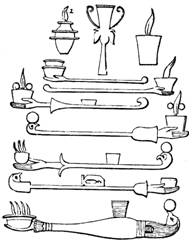
Fig. 122—Egyptian Censers
Censer, the vessel in which incense was presented in the temple (2Ch 26:19; Eze 8:11; Sir 50:9). Censers were used in the daily offering of incense, and yearly on the Day of Atonement, when the high-priest entered the Holy of Holies. On the latter occasion the priest filled the censer with live coals from the sacred fire on the altar of burnt-offering, and bore it into the sanctuary, where he threw upon the burning coals the ’sweet incense beaten small’ which he had brought in his hand (Lev 16:12-13). In this case the incense was burnt while the high-priest held the censer in his hand; but in the daily offering the censer in which the live coals were brought from the altar of burnt-offering was set down upon the altar of incense. This alone would suggest the probability of some difference of shape between the censers used on these occasions. The daily censers must have had a base or stand to admit of their being placed on the golden altar, while those employed on the Day of Atonement were probably furnished with a handle. In fact, there are different names for these vessels. We learn also that the daily censers were of brass (Num 16:39), whereas the yearly one was of gold. The form of the daily censer we have no means of determining beyond the fact that it was a pan or vase, with a stand whereon it might rest on the golden altar. The numerous figures of Egyptian censers, consisting of a small cup at the end of along shaft or handle (often in the shape of a hand), probably offer adequate illustration of those employed by the Jews on the Day of Atonement. There was, however, another kind of censer (Fig. 122, No. 1), less frequently seen on the Egyptian monuments, and likewise furnished with a handle, which will probably be regarded by many as offering a more probable resemblance.
A vessel in which fire and incense were carried, in certain parts of the Hebrew worship. Little is known of its form. The censer for the daily offering was at first made of copper, Num 16:39 . That used on the great Day of Atonement, (and perhaps others also,) was made of pure gold, 1Ki 7:50 Heb 9:4 . In the daily offering, the censer was filled with coals from the perpetual fire, and placed on the altar of incense, where the incense was thrown upon the coals, Exo 30:1,7 -10. On the day of atonement, in the Holy of Holies, the censer must have been held in the hand, and probably by a handle, Lev 16:12,13 .\par There are two Hebrew words, which are translated censer in our English Bibles. The one signifies strictly fire-pan. The other signifies incense-pan, a vessel for burning incense; but we do not know its exact shape.\par The censers of the Egyptians had long handles, like a human arm and hand, upon the palm of which the incense-cup stood. Those of the Greeks and Romans had chains, by which they were carried, like those now used in the Romish service.\par In the New Testament, where the twenty-four elders are said to have golden "vials" full of odors, Jer 5:8, the meaning is vessels of incense, censers, not vials in the present sense of the word.\par
Censer. A small portable vessel of metal fitted to receive burning coals from the altar, and on which the incense for burning was sprinkled. 2Ch 26:19; Luk 1:9. The only distinct precepts regarding the use of the censer are found in Lev 16:12, and in Num 4:14. Solomon prepared "censers of pure gold" as part of the Temple furniture. 1Ki 7:50; 2Ch 4:22. The word rendered "censer" in Heb 9:4 probably means the "Altar of Incense".
An instrument to seize or hold burning coals. Latterly the portable metal vessel for receiving from the altar burning coals, on which the priest sprinkled the incense for burning (2Ch 26:16; 2Ch 26:18-19; Luk 1:9). Korah and his company were told to take censers, with which they had furnished themselves as aspiring to share in Aaron’s priesthood. So Uzziah. So Eze 8:11. But Aaron was told to take "the censer" (Hebrew), namely, that of the sanctuary or of the high priest, and make atonement to stay the plague (Num 16:46). On the day of atonement the high priest was to carry the censer of the golden altar within the most holy place, and put the incense on the fire in the censer "before the Lord" (Lev 16:12-13).
Solomon made censers of pure gold, probably to take fire from the brazen altar, and to convey incense to the golden altar on which it was to be offered morning and evening (Exo 30:7-8; 1Ki 7:50). In Rev 8:3-4 the "angel" is not Christ, who always has His own title in Revelation, but a ministering spirit. The incense, i.e. Christ’s meritorious obedience and death, is given to the angel that he may give it to (so the Greek) the prayers of all saints, to render them a sweet smelling savor to God. "The golden altar," moreover, is Christ Himself (Heb 13:10), resting on whom alone prayer is accepted before God. How the angels’ ministry exactly is exercised we know not, but we do know they are not to be prayed to (Rev 19:10).
If we send an offering to the King, the King’s messenger is not to appropriate what is due to the King alone. In Heb 9:4 "the holiest ... had the golden censer "does not mean it was deposited there, for then the high priest would have had to go in and bring it out before burning incense in it, but that the golden censer was one of the articles belonging to the yearly service in the holiest place; it was taken into the holiest on that anniversary by the high priest. Its shape was probably that of a pan with a handle.
a vessel in which incense was presented in the Temple, being used by the Jews in the daily offering of incense, and yearly on the Day of Atonement, when the high-priest entered the Holy of Holies (2Ch 26:19; Eze 8:11; Sir 1:9). On the latter occasion the priest filled the censer with live coals from the sacred fire on the altar of burnt-offering, and bore it into the sanctuary, where he threw upon the burning coals the "sweet incense beaten small" which he had brought in his hand (Lev 16:12-13). In this case the incense was burnt while the high- priest held the censer in his hand; but in the daily offering the censer in which the live coals were brought from the altar of burnt-offering was set down upon the altar of incense. This alone would suggest the probability of some difference of shape between the censers used on these occasions. The daily censers must have had a base or stand to admit of their being placed on the golden altar, while those employed on the Day of Atonement were probably furnished with a handle. In fact, there are different names for these vessels. Those in daily use were called
The latter is also said to have had a handle (Mishna, Yoma, 4:4), which, indeed, as being held by the priest while the incense was burning, it seems to have required. It is conjectured that this distinction is alluded to in Rev 5:8; Rev 8:3, where the angel is - represented with a golden "censer" (
Censer,
Censer. There are two Hebrew words so translated, mahhtah and miktereth; the latter occurring only in the later books. 2Ch 26:19; Eze 8:11. It was a vessel or metal fire-pan to take up coals on which the incense could be placed. It was portable, and probably had a long handle. Censers are described among the furniture of the altar—the brazen altar," not the altar of incense. Num 4:14; and a special charge is given for the use of the censer on the day of atonement. Lev 16:12. Probably those of the ordinary kind were of brass or copper, comp. Exo 27:3; but the Jews suppose that the one used by the high priest was of gold; and this supposition is to a certain extent corroborated by the fact that Aaron is bidden to use some particular censer—the definite article being prefixed to the word. Lev 16:12; Num 16:46. Korah and his company had censers, Num 16:6; Num 16:17; Num 16:37-39; but they were doubtless of the common sort. Solomon made golden censers. 1Ki 7:50; 2Ch 4:22. A golden censer is mentioned in the New Testament. Heb 9:4. It is questioned, however, whether the golden altar is not rather meant. The R. V. frequently reads "fire-pans" for censers. The Greek word rendered "censer" in Rev 8:3; Rev 8:5, is derived from frankincense, implying that frankincense was burnt therein. The "vials," 5:8, have been thought to mean similar vessels.
A small vessel made of metal, to contain burning coals from the altar, on which incense was sprinkled by the priest, that a cloud of incense might arise therefrom. Lev 10:1; Lev 16:12. Solomon made some of gold. 1Ki 7:50; 2Ch 4:22; Heb 9:4; Rev 8:3; Rev 8:5. The same word is used when the company of Korah, Dathan, and Abiram were put to the test; the censers were probably hastily constructed ones, for 250 were needed. Aaron ran with a censer and incense between the living and the dead, and the plague was stayed. Num 16:6-48. The same Hebrew word is translated ’fire-pan’ in Exo 27:3; Exo 38:3; 2Ki 25:15; Jer 52:19.
By: Bernard Drachman, Emil G. Hirsch
An implement shaped like a bowl or a pan, intended for the burning of incense. In the English Bible the term is employed indiscriminately to render two Hebrew words which seem to have denoted different objects. One of these words, "miḳteret," occurs only three times (once in the variant "meḳaṭṭerot," II Chron. xxx. 14). This, according to its etymology, indicated a censer which was among the appointments of the Temple required for the performance of holy offices. The other word, "maḥtah," is mentioned in the Bible twenty-one times. In the English version it is rendered thirteen times as "censer," four times as "fire-pan," three times as "snuff-dishes," and once as "snuffer." Derived from the root "ḥatah" (to gather together coal or ashes), it was probably the name of various contrivances intended to remove the ashes or to carry live coals. Dillmann and Knobel contend that it was the saucer in which the snuffers were deposited. In Ex. xxv. 38 it stands for ladles used to remove the burnt portion of the wick (see Rashi on the passage). These may have been of small size. The larger ones in connection with the altar for burnt offerings (Ex. xxvii. 3; Num. xvii. 3 et seq.) may more properly be rendered by "fire-pans." From Mishnah Kelim ii. 3, 7 it is evident that various forms of these were known; some being open without rims, while others, designated as "complete," were provided with raised rims.
The maḥtah was, as a rule, not used to burn incense. From the documents, as now incorporated in the Pentateuch, it appears that only on the golden altar, or, as it is also called, "the inner altar," could incense be offered (Ex. xxx. 1-7; xl. 26, 27). The critical school has indeed contended that the inner or golden altar was not recognized in earlier times. But this does not weaken the evidence of the documents to the effect that in post-exilic periods censers were not proper utensils for the burning of incense. The story of Korah's adherents (Num. xvi. 17, 18), as well as Ezek. viii. 11, proves that in the opinion of the later days the use of the maḥtah for this purpose was regarded in the light of an illegal profanation.
But the maḥtah was used in conveying incense to the altar. An exception to this was in the ritual for the Day of Atonement. The high priest filled the censer with coals from the altar and, placing upon them a handful of incense, caused the smoke to cover the mercy-seat of the Ark in the Holy of Holies (Lev. xvi. 12, 13). These "pans" were of bronze, silver, and gold. Mishnah Tamid v. 5 indicates that those in the Temple were complicated in construction and of costly material (see also Yoma 43b).
Bibliography:
Keil, Handbuch der Biblischen Archäologie, translated by Christie and Cusin, Edinburgh, 1888;
Winer, B. R. Leipsic, 1833;
Cook, Exodus, note on Ex. xxvii. 3, in the Bible Commentary, Scribner's, New York, 1898;
Nowack, Biblische Archäologie;
commentaries of Knobel and Dillmann to Exodus.
CENSER.—See Firepan, Incense.
(Latin: incendere, to burn; thuribulum, incense holder; thus, incense)
A metal vessel in the shape of a vase or cup, with cover suspended by chains. It is used for burning incense at solemn offices of the Church. The cleric who carries it is called thurifer (incense-bearer).
A vessel suspended by chains, and used for burning incense at solemn Mass, Vespers, Benediction, processions, and other important offices of the Church. It is now commonly called a thurible. In its prevailing shape the censer consists of a cup, or bowl, which rests on a firm base and is provided with a hollow movable pan for holding ignited charcoal, a lid or covering, and four chains about three feet in length, three of which unite the bowl to a circular disc, while the fourth is used for raising the lid, to which one end is attached, the other passing through a hole in the disc and terminating in a small ring. To carry the censer the chains are grasped in the hand just under the disc, care being taken to keep the base elevated to a height of six or eight inches from the ground and to swing it gently to and fro in order that the current of air thus created may cause the fire to burn the fragrant gums or incense which is placed on it whenever the censer is being used. The censer played an important part in the ancient religious worship both of the Jews and Pagans. It is no wonder, then, that its employment in Christian ceremonies goes back to the very earliest times. Its primitive form, however, was quite different from what it is now, being something like a vase with a perforated cover to emit the perfumed odours. Later on chains were added for greater convenience in manipulation. These vessels in the Middle Ages were often made of gold and silver and enriched with numerous details of most elaborate ornamentation. In the archives or inventories of many Continental and English cathedrals (such as St. John Lateran, Trier, Louvain, Lincoln, and York Minster) minute descriptions are given of some ancient specimens in the possession of these churches.-----------------------------------BONA, De Rebus Liturgicis (Turin, 1747), I, xxv; DUGDALE, Monasticum Anglicanum (London, 1682), passim; PUGIN, Glossary of Ecclesiastical Ornament (London, 1868), s.v. Censer; O’LOAN, Ceremonies of Ecclesiastical Functions (Dublin, 1893), 27; LEVASSEUR, Manuel Liturgique (Paris, 1890), I, 275; VAN DER STAPPEN, De Celebratione Missæ (Mechlin, 1892), X, 92.PATRICK MORRISROE Transcribed by Thomas J. Bress The Catholic Encyclopedia, Volume IIICopyright © 1908 by Robert Appleton CompanyOnline Edition Copyright © 2003 by K. KnightNihil Obstat, November 1, 1908. Remy Lafort, S.T.D., CensorImprimatur. +John Cardinal Farley, Archbishop of New York
1. The writer of Hebrews mentions the ‘golden èõìéáôÞñéïí’ first among the pieces of furniture which belonged to the Holy of Holies (Heb_9:4). He had in view Exo_30:1-10, which is generally regarded as one of the latest strata of P. His words raise a question as to the meaning of the word èõìéáôÞñéïí, and another as to the position of the article so named, both of which questions have been the subject of much controversy. (1) Authorized Version and Revised Version , following the Vulgate-‘aureum habens thuribulum’-render èõìéáôÞñéïí by ‘censer’; but Revised Version margin and American Revised Version , like Clement Alex., Calvin, and most modern scholars, translate it as ‘altar of incense.’ Etymologically the word-a neut. adj.-may mean anything employed in the burning of incense, whether a censer in which, or an altar upon which, the act is performed. When èõìéáôÞñéïí occurs in the Septuagint -2Ch_26:19, Eze_8:11, 4Ma_7:11 -it no doubt means ‘censer,’ being a translation of îִ÷ִèֶøָú, while the altar of incense is ôὸ èõóéáóôÞñéïí èõìéÜìáôïò (or -ôùí) in Exo_30:1; Exo_30:27, Lev_4:7, 1Ch_6:49, etc. But it is also certain that èõìéáôÞñéïí became the usual Hellenistic name for the altar of incense, and Philo (Quis rer. div. haer. 46, Vit. Mos. iii. 7), Josephus (Ant. iii. vi. 8, viii. 2, 3, Bellum Judaicum (Josephus) v. v. 5), and the versions of Symmachus and Theodotion use the word with this meaning in Exo_30:1. Unless the writer of Hebrews follows the same usage, he entirely ignores the altar of incense in his description of the furniture of the tabernacle, which is scarcely credible. (2) Prima facie, the author of Hebrews has fallen into error in naming this altar among the furnishings of the most holy place. He may be supposed to have been misled (a) by the ambiguous instructions regarding it given in Exo_30:6 : ‘thou shall put it before the veil that is by the ark of the testimony, before the mercy-scat that is over the testimony’; (b) by its designation as ἅãéïí ôῶí ἁãßùí in Exo_30:10; and (c) especially by the fact that in Exo_25:23-40; Exo_26:35, only the candlestick and the table are mentioned as standing in the holy place. Such a mistake on the part of the writer, whose acquaintance with the ritual practice of Judaism was second-hand, would not prove him the Monstrum von Unwissenheit that Delitzsch suggests. Still, it is not certain that he was really wrong. He does not say that the Holy of Holies contained the èõìéáôÞñéïí (contrast ἐí ᾗ in Heb_9:3), but that it had (ἔ÷ïõóá) such an altar. Evidently he was thinking, not of the local position of the altar, but of its intimate relation to the ministry of the inner sanctuary on the Day of Atonement.
2. In Rev_8:3; Rev_8:5, ëéíâáíùôüò, which is strictly ‘frankincense,’ the gum exuding from the ëßâáíïò, is used instead of ëéâáíùôßò (or -ôñßò) for ‘censer,’ corresponding to the ðõñåῖïí (ðýñéïí) or èõßóêç (‘fire pan’) of the Septuagint . In the prophetic symbolism this censer holds (1) the lire which burns the incense that is added to the prayers of the saints, and (2) the fire, or hot ashes, of God’s vengeance, which are cast upon a hostile and impenitent world. See Incense.
Literature.-Thayer Grimm’s Gr.-Eng. Lexicon of the NT, tr. Thayer , s.v. èõìéáôÞñéïí; Schürer, History of the Jewish People (Eng. tr. of GJV).] ii. i. 295; T. Zahn, Introd. to NT, Eng. translation , 1909, ii. 363; H. B. Swete, Apocalypse of St. John2, 1907, p. 108; Expository Times i. [1889-90] 74, ii. [1890-91] 18; see also article ‘Censer’ in Hasting's Dictionary of the Bible (5 vols) and Literature there cited.
James Strahan.