
See under LIGHT.
The instrument so rendered by our translators was more properly a stand for lamps. One of beaten gold was made by Moses, Exo 25:31-32, and put into the tabernacle in the holy place, over against the table of shew bread. The basis of this candlestick was also of pure gold; it had seven branches, three on each side, and one in the middle. When Solomon had built the temple, he was not satisfied with placing one golden candlestick there, but had ten put up, of the same form and metal with that described by Moses, five on the north, and five on the south side of the holy place, 1Ki 7:49. After the Jews returned from their captivity, the golden candlestick was again placed in the temple, as it had been before in the tabernacle by Moses. The lamps were kept burning perpetually; and were supplied morning and evening with pure olive oil. Josephus says, that after the Romans had destroyed the temple, the several things which were found within it, were carried in triumph to Rome, namely, the golden table, and the golden candlestick with seven branches. These were lodged in the temple built by Vespasian, and consecrated to Peace; and at the foot of Mount Palatine, there is a triumphal arch still visible, upon which Vespasian’s triumph is represented, and the several monuments which were carried publicly in the procession are engraved, and among the rest the candlestick with the seven branches, which are still discernible upon it. In Rev 1:12; Rev 1:20, mention is made of seven golden candlesticks, which are said to be emblems of the seven Christian churches.
The candelabrum which Moses was commanded to make for the tabernacle, after the model shown him in the Mount, is chiefly known to us by the passages in Exo 25:31-40; Exo 37:17-24; on which some additional light is thrown by the Jewish writers, and by the representation of the spoils of the Temple on the arch of Titus.
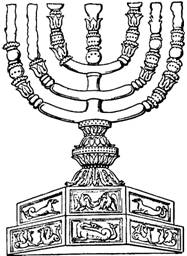
Fig. 113—Menorah as represented by Titus’ arch
The material of which it was made was fine gold, of which an entire talent was expended on the candelabrum itself and its appendages. The mode in which the metal was to be worked is described by a term which appears to mean wrought with the hammer, as opposed to cast by fusion. The structure of the candelabrum, as far as it is defined in the passages referred to, consisted of a base; of a shaft rising out of it; of six arms, which came out by threes from two opposite sides of the shaft; of seven lamps, which were supported on the summits of the central shaft and the six arms; and of three different kinds of ornaments belonging to the shaft and arms. These ornaments are called by names which mean cups, globes, and blossoms.
This candelabrum was placed in the Holy Place, on the south side (i.e. to the left of a person entering the tabernacle), opposite the table of shew-bread (Exo 26:35). Its lamps, which were supplied with pure olive oil only, were lighted every evening, and extinguished (as it seems) every morning (Exo 27:21; Exo 30:7-8; Lev 24:3; 1Sa 3:3; 2Ch 13:11). Although the tabernacle had no windows, there is no good ground for believing that the lamps burnt by day in it, whatever may have been the usage of the second temple.
In the first temple, instead of this single candelabrum, there were ten candelabra of pure gold, one half of which stood on the north and the other on the south side of the Holy Place. These were carried away to Babylon (Jer 52:19). In the temple of Zerubbabel there appears to have been only one candelabrum again (1Ma 1:21; 1Ma 4:49-50). It is probable that it also had only seven lamps. At least, that was the case in the candelabrum of the Herodian temple. This candelabrum is the one which, after the destruction of Jerusalem, was carried with other spoils to Rome; then, A.D. 455, became part of the plunder which Genseric transported to Africa; was again, about A.D. 533, recaptured from the Vandals by Belisarius, and carried to Constantinople, and was thence sent off to Jerusalem, and from that time has disappeared altogether. It is to this candelabrum that the representation on the arch of Titus at Rome was intended to apply; and there is reason to believe that, on the whole, it may be relied upon as a reasonably correct representation of the Herodian candelabrum.
In the tabernacle, the golden candlestick stood on the left hand of one entering the Holy Place, opposite the table of showbread. It consisted of a pedestal; an upright shaft; six arms, three on one side and three on the opposite side of the shaft; and seven lamps surmounting the shaft and arms. The arms were adorned with three kinds of carved ornaments, called cups, globes, and blossoms. Its lamps were supplied with pure olive oil, and lighted every evening, Exo 25:31-40 30:7,8 37:17-24 Le 24:1-3 1Sa 3:3 2Ch 13:11 . In the first temple there were ten candelabra of pure gold, half of them standing on the north, and half on the south side, within the Holy Place, 1Ki 7:49,50 2Ch 4:7 Jer 52:19 . In the second temple there was but one, resembling that of the tabernacle. This was carried to Rome, on the destruction of Jerusalem; it was lodged in Vespasian’s temple to Peace, and copied on the triumphal arch of Titus, where its mutilated image is yet to be seen. See the beautiful and significant visions of the candlestick by Zechariah and John, Zec 4:2-12 Jer 1:12,20 .\par
Lampstand:
It stood in the tabernacle "without the veil" that shut in the holiest. It illumined the table of shewbread obliquely (Josephus, Ant. 3:6, section 7). "To burn always" is explained by "from evening to morning" (Exo 27:20-21; Exo 30:8). Aaron or his successor was "always" at the appointed time to light the lamp every evening, and dress it every morning with the golden snuffers, removing the snuff in golden dishes. The artificial light had to give place each morning to the light of the sun which rendered it needless, as the light of Old Testament ordinances gives place to the Sun of righteousness (Mal 4:2). Under the New Testament of the True Light, Christ Jesus, the seven separate candlesticks represent the churches or the church in its entirety (Rev 1:12-13; Rev 1:20); no longer as the one Jewish church (represented by the one sevenfold candlestick), restricted to one outward unity and locality.
The several churches are mutually independent as to external ceremonies and government (provided all things are done to edification, and needless schisms are avoided), yet one in the unity of the Spirit and headship of Christ. The Gentile churches will not realize their unity until the Jewish church as the stem, unites all the lamps in one candlestick (Rom 11:16-24). Zechariah’s candlestick (Zechariah 4) is prophetical of that final church which shall join in one all the earth under Messiah the King, reigning in Jerusalem as the spiritual center and rallying point of all (compare Zep 3:9; Zec 14:9; Zec 14:16-17; Jer 3:17). The candlestick is not the light, but bears it for the enlightening of all (Mat 5:16). The light is the Lord’s (Php 2:15-16). The candlestick stands in the outer sanctuary, the type of the present dispensation on earth; but not in the inner holiest place, the type of the heavenly world wherein the Lord God Almighty and the Lamb are both the temple and the light (Rev 21:22-23).
In Rev 2:5 "remove thy candlestick" threatens not extinction of the candle, but removal of the seat of the light elsewhere. In Rev 11:4 "the two candlesticks" are connected with "the two witnesses," which Wordsworth identifies with the two Testaments; so they would represent the Old Testament and the New Testament churches. The olive oil represents the grace of the Holy Spirit flowing in God’s appointed channels. In Solomon’s temple there were ten golden candlesticks (1Ki 7:49; 2Ch 4:7). These were taken to Babylon (Jer 52:19). In the second temple, namely, Zerubbabel’s, a single candlestick was again placed (Zec 4:2-6; Zec 4:11), taken by Titus from the temple as restored by Herod, and carried in his triumph at Rome and deposited in the Temple of Peace. Genseric 400 years later transferred it to Carthage.
Belisarius recovered it, and carried it to Constantinople, and then deposited it in the church of Jerusalem, A.D. 533. It has never since been heard of. In Joh 8:12, "I am the light of the world," there is allusion to the two colossal golden candlesticks lighted at the feast of tabernacles (which was then being held: Joh 7:2-37) after the evening sacrifice in one of the temple courts, and casting their beams on mount Olivet and on Jerusalem. Jesus coming to the temple at daybreak (Joh 8:1-2), as they were extinguishing the artificial lights in the face of the superior light of the rising sun, virtually says, "Your typical light is passing away, I am the Sun of righteousness, the True Light." (Joh 1:9).
(
The name of the third ornament (
The Jewish authorities maintain that the height of the candelabrum was eighteen palms, or about five feet; and that the distance between the outer lamps on each side was about 3½feet (Jahn, Bibl. Arch. § 329). Bahr, however, on the ground of harmonical proportion with the altar of incense and table of shewbread, the dimensions of which are assigned, conjectures that the candelabrum was only an ell and a half high and broad. The Jewish tradition uniformly supports the opinion that the arms and shaft were of equal height, as do also Josephus and Philo (l. c.; Quis Rer. Div. Hcer. § 44), as well as the representation on the Arch of Titus. Scacchius has, however, maintained that they formed a pyramid, of which the shaft was the apex. The lamps themselves were doubtless simply set upon the summits of the shafts, and removed for the purpose of cleaning. As the description given in Exodus is not very clear, we abbreviate Lightfoot’s explanation of it. “The foot of it was gold, from which went up a shaft straight, which was the middle light. Near the foot was a golden dish wrought almondwise, and a little above that a golden knop, and above that a golden flower. Then two branches, one on each side, bowed, and coming up as high as the middle shaft. On each of them were three golden cups placed almondwise on sharp, scallop-shell fashion, above which was a golden knop, a golden flower, and the socket. Above the branches on the middle shaft was a golden boss, above which rose two shafts more; above the coming out of these was another boss, and two more shafts, and the non the shaft upward were three golden scallop-cups, a knop, and a flower, so that the heads of the branches stood an equal height” (Works, 2:397, ed. Pitman). Calmet remarks that “the number 7 might remind them of the Sabbath:” we have seen that Josephus gives it a somewhat Egyptian reference to the number of the planets, but elsewhere (War, 7:5, 5) he assigns to the 7 branches a merely general reference to the Jewish hebdomadal division of time. The whole weight of the candlestick was 100 mince (see Lamy, De Tab. Feed.). It has been calculated to have been worth $25,380, exclusive of workmanship. SEE TABERNACLE.
This candelabrum was placed in the Holy Place, on the south side (i.e. to the left of a person entering the tabernacle), opposite the table of shew- bread (Exo 26:35). Its lamps, which were supplied with wick (? of cotton) and half a log (atLou two wine-glasses) of pure olive oil only, were lighted every evening, and extinguished (as it seems) every morning (Exo 27:21; Exo 30:7-8; Lev 24:3; 1Sa 3:3; 2Ch 13:11). Although the tabernacle had no windows (Exo 30:8; Macc. 4:50), there is no good ground for believing that the lamps burnt by day in it, whatever may have been the usage of the second Temple. It has also been much disputed whether the candelabrum stood lengthwise or diagonally as regards the tabernacle; but no conclusive argument can be adduced for either view. According to Josephus, it was placed in an oblique position (
Candlestick. In the tabernacle the golden "candlestick"—or lamp-stand—stood on the left hand as one entered the Holy Place, opposite the table of shewbread. It consisted of a pedestal; an upright shaft; six arms, three on one side, and three on the opposite side of the shaft; and seven lamps surmounting the shaft and arms. The arms were adorned with three kinds of carved ornaments, called cups, globes and blossoms. Its lamps were supplied with pure olive oil, and lighted every evening. Exo 25:31-40; Exo 30:7-8; Exo 37:17-24; Lev 24:1-3; 1Sa 3:3; 2Ch 13:11. In the first temple there were ten candelabra of pure gold, half of them standing on the north, and half on the south side, Within the Holy Place. 1Ki 7:49-50; 2Ch 4:7; Jer 52:19. In the second temple there was but one, resembling that of the tabernacle. This was earned to Rome, on the destruction of Jerusalem, and copied on the triumphal arch of Titus, where its mutilated image is yet to be seen.
This, in scripture, signifies a lamp-stand, as is plainly implied in 2Ch 4:20: ’the candlesticks with their lamps,’ used in the temple. A ’candlestick’ is also mentioned in Belshazzar’s palace, near which the fingers of a man’s hand wrote upon the wall. Dan 5:5. Except in large buildings, hand lamps were all that were needed.
THE GOLDEN CANDLESTICK in the Tabernacle and Temple with its seven lamps is minutely described in Exo 25:31-40: it is also called the ’pure candlestick.’ It was situate in the holy place, and gave light over against the table of showbread. It might be thought from Exo 27:20 that the lamps were to be kept alight always, but this does not appear to be the sense of ’burn always.’ It should rather be read ’burn continuously,’ that is, every evening, for in the next verse it adds ’from evening to morning;’ and in Exo 30:8 it distinctly says "when Aaron lighteth the lamps at even. " In the morning they were allowed to go out. 1Sa 3:3: cf. also 2Ch 13:11. The candlestick was entirely of gold, signifying that which was divine in its nature, and was typical of Christ the true light, but to be reproduced in His people. Eph 5:8. The number of the lamps (seven) is also indicative of divine perfection.
The Candlestick that was in the temple in the time of the Lord was carried away at the siege of Jerusalem, and is portrayed on the triumphal ’Arch of Titus’ at Rome, but as fabulous animals are depicted on its base it is very questionable whether it is a true representation.
CANDLESTICK.—In Revised Version NT 1881, OT 1885 of the Gospels this word is without exception correctly changed into ‘stand,’
A. Norman Rowland.
A symbol of the Holy Eucharist; often depicted with a Host above it. Rubrical law prescribes that six great candlesticks be permanently stationed on the main altar, three on either side of the central crucifix. This custom dates from the 16th century, though there is evidenee of candlesticks, in use as early as the 5th century. An altar candlestick consists of five parts, the foot, stem, knob about the middle of the stem, bowl to receive the drippings of wax, and the pricket, i.e., the sharp point that terminates the stem on which the candle is fixed.
Exo 25:31 (c) This is a type of the Holy Spirit illuminating all the things of GOD.
- the pure gold represents the purity of the Spirit and of His Word.
- the seven branches or stems represent the fullness and completeness of the revelation of the Spirit.
- the bowls represent the great provision of the Spirit. - the flowers represent the beauty of the Spirit.
Some Bible expositors feel that the candlestick also represents GOD’s people, and certainly it does in the book of Revelation.
Rev 1:20 (a) Here we certainly find a type of the church as she gives light on the Scriptures and reveals CHRIST by her ministries. The Lord JESUS Himself said that the "seven candlesticks are the seven churches." These candlesticks reveal that the seven lessons given through the seven churches present full and complete light on what the Spirit says to us about GOD’s will. Each church is to present an unsullied, pure light from Heaven to a dark and sinful world.
Rev 2:5 (a) This is clearly a type of the testimony of an individual or of a church wherein the person and work of CHRIST no longer are properly presented to the public.
Rev 11:4 (a) These are two mysterious men sent from GOD with great power to make known His judgment on the earth sometime in the future days. They will give the light of GOD to the enemies of GOD. They bear GOD’s testimony in a hostile land. Some think these are Moses and Elijah. The context clearly indicates that these candlesticks are types of real men.
See LAMP.